
Geiko and Maiko: The Years of Training | Japonista
Heritage Wing · Discipline, Patience
Geiko and Maiko: The Years of Training
芸妓・舞妓
A geiko is made slowly. The path from household novice to accomplished artist is measured in years, in lessons and in the long hours of watching others work. This chapter follows the stages as the reference sources give them, and says where they differ.
Fact sheet
At a glance
- Four stages. The household novice, the observing month, the apprentice and the full artist.
- A school day. In the morning maiko take lessons in the traditional arts; at night they perform at the teahouses.
- Two roads. Those who focus on music are jikata; those who focus on dance are tachikata.
- Numbers fall. Kyoto had 548 geisha in 1965 and 202 in 2006, according to the figures in Wikipedia’s article.
Four Stages of a Career
Wikipedia’s article on the geisha gives the stages in order. The first is shikomi, which it describes as often lasting up to a year, in which the trainee lives at the okiya and learns household duties and basic skills. The second is minarai, about a month of learning by observing parties, usually at one teahouse, the minarai-jaya. The third is the maiko, the official debut being the misedashi, and the fourth is the geisha herself, who graduates through the erikae ceremony at around twenty or twenty-one.

Unknown · [Geisha Girls] · ca. 1880 · albumen silver print
Look closer: The sitters are catalogued as geisha girls; the picture is one of the Met’s nineteenth-century photographs.
The Metropolitan Museum of Art, Museum Accession, transferred from the Costume Institute Library, accession 2011.533. Public domain (Open Access).
On the length of the maiko years, the sources we consulted do not agree. The geisha article gives roughly three to five years; the article on maiko says apprenticeship ranges from a few months to a year or two. We therefore make no claim on the matter beyond the age: the maiko article says maiko are usually aged 17 to 20.
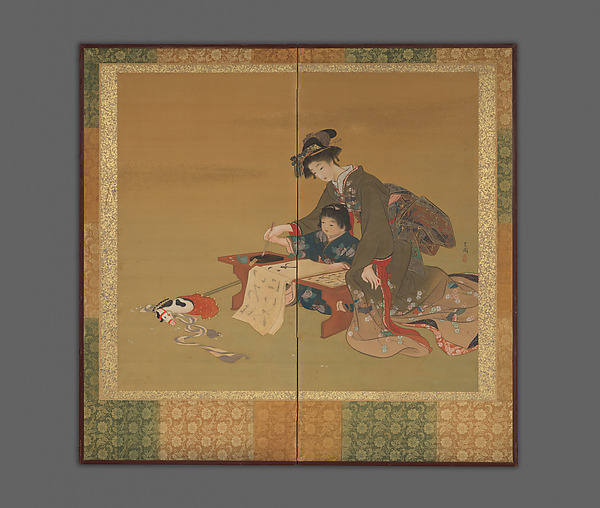
Ikeda Shōen · Calligraphy Practice (Tenarai) · 1909 · Two-panel screen; ink, color, and gold on silk
Look closer: A calligraphy lesson in painting: a woman guides a child’s hand.
The Metropolitan Museum of Art, Purchase, Sachiko and Lawrence Goodman Gift, 2023, accession 2023.1. Public domain (Open Access).
The age at which a girl begins has changed. Before the twentieth century, the geisha article says, training often began around age six. Labour laws now set 18 as the minimum age for joining an okiya, and the article adds that Kyoto houses may take recruits aged 15 to 17. We report the statement as it stands and leave the question of what any single house does to the people who work there.
Music, Dance and the Tea Room
The curriculum is broad. Wikipedia lists dance, notably the kyō-mai style of Gion Kōbu taught by the Inoue school, together with shamisen, drums, flute, singing, tea ceremony, calligraphy, poetry and literature. It adds that geisha who focus on music are jikata and those who focus on dance are tachikata. The maiko article records the daily rhythm: lessons in the traditional arts in the morning, performance at the ochaya at night.

Takechi Matsukawa · Shamisen · 1891 · Wood, catskin, rope, silk string, lacquer, red coral
Look closer: The body is covered with skin; the neck is long and slim.
The Metropolitan Museum of Art, Gift of the Estate of Mary Flagler Cary, 1969, accession 69.271.2a, b. Public domain (Open Access).
The shamisen is the emblem of the profession, and the Met has a fine collection of the instruments: a nineteenth-century example in wood, cloth and skin, one of about 1875 by Isohachi Shigemoto, and one of 1891 by Takechi Matsukawa. The museum catalogues them by materials: wood, cloth and skin, and for the 1891 example wood, skin, rope and a silk string.

Kubo Shunman · Woman Playing on the Shamisen · probably 1815 · Part of an album of woodblock prints (surimono); ink and color on paper
Look closer: Verses accompany the picture; the sheet was made for a poetry circle.
The Metropolitan Museum of Art, H. O. Havemeyer Collection, Bequest of Mrs. H. O. Havemeyer, 1929, accession JP2277. Public domain (Open Access).
Edo printmakers drew the instrument often. Kubo Shunman’s surimono, small prints that carry verses, show a woman playing the shamisen, another shows a woman beating the tsuzumi, and a third shows a koto laid beside a sho.

Kubo Shunman · Woman Playing the Tsuzumi · ca. 1800 · Woodblock print (surimono); ink and color on paper
Look closer: The tsuzumi is the shoulder drum, struck with the hand.
The Metropolitan Museum of Art, Gift of Estate of Samuel Isham, 1914, accession JP960. Public domain (Open Access).
The Okiya as a School
The okiya, in Wikipedia’s words, is a geisha lodging house. Every geisha must be registered to one, though not all live there full-time. For a trainee, the first stage described above takes place there; an engagement, the ozashiki, is a party that may last part or all of an evening.

Chōbunsai Eishi · Two Geisha · ca. 1792 · One sheet of a triptych of woodblock prints; ink and color on paper
Look closer: An Edo print of two women at ease, one with the instrument beside her.
The Metropolitan Museum of Art, The Howard Mansfield Collection, Purchase, Rogers Fund, 1936, accession JP2421. Public domain (Open Access).
The maiko article gives some of the physical detail of a maiko’s day. The hairstyles are nihongami, traditional Japanese styles that differ by rank, formality and occasion; most use the maiko’s own hair with extensions and are restyled every week. To keep the style intact she sleeps on a takamakura, a raised pillow. Her clothing, covered in the next chapter, is dressed by a specialist, an otokoshi, who the article says can dress a maiko in as little as five minutes.

Beauty Playing a Shamisen · second quarter of the 17th century · Remounted section of a screen; ink and color on paper
Look closer: The same instrument in a much older picture, in a monochrome photograph.
The Metropolitan Museum of Art, H. O. Havemeyer Collection, Bequest of Mrs. H. O. Havemeyer, 1929, accession 29.100.455. Public domain (Open Access).
The details show how much of a maiko’s day concerns the body: the hair, the pillow and the dressing are all part of the routine the article describes.
Law, Numbers and the Present
The legal frame is part of the history. Wikipedia records that an 1872 law after the Meiji Restoration liberated “prostitutes and geisha” together, which the article describes as ambiguous and controversial, though the government maintained a distinction. A law of 1956, implemented in 1958, criminalised most prostitution and, the article says, effectively outlawed mizuage, a coming-of-age custom that it describes as discouraged by many geisha groups.

Kubo Shunman · Young Woman Writing Calligraphy · 1793 (Year of the Goat) · Woodblock print (surimono); ink and color on paper
Look closer: Calligraphy is among the arts the sources list.
The Metropolitan Museum of Art, Purchase, Marjorie H. Holden Gift, 2012, accession 2012.248.3. Public domain (Open Access).
On numbers, the article’s figures are specific and dated. It reports about 80,000 geisha before the Second World War, without clearly dating the figure; in Kyoto it gives 76 maiko and 548 geisha in 1965, against 71 maiko and 202 geisha in 2006; and an estimate of 600 to 700 across the country in 1989. It gives no current national count, and we do not supply one.

Kubo Shunman · Koto (Japanese Harp) and Sho (Reed Organ) · 19th century · Woodblock print (surimono); ink and color on paper
Look closer: A koto and a sho laid as a still life; the instruments are the subject.
The Metropolitan Museum of Art, H. O. Havemeyer Collection, Bequest of Mrs. H. O. Havemeyer, 1929, accession JP2005. Public domain (Open Access).
The profession continues in smaller numbers, and the districts still give public dances; the calendar chapter in this wing sets out when.
Instruments and practice

Shigemoto, Isohachi · Shamisen (三味線) · ca. 1875 · Wood, cloth, skin
Look closer: The tuning pegs are at the top; the large body is covered with skin.
The Metropolitan Museum of Art, The Crosby Brown Collection of Musical Instruments, 1889, accession 89.4.106. Public domain (Open Access).

Chōbunsai Eishi · Shamisen, Plectrum and a Book · Woodblock print (surimono); ink and color on paper
Look closer: The plectrum, the instrument and a book: the equipment of practice.
The Metropolitan Museum of Art, H. O. Havemeyer Collection, Bequest of Mrs. H. O. Havemeyer, 1929, accession JP2186. Public domain (Open Access).
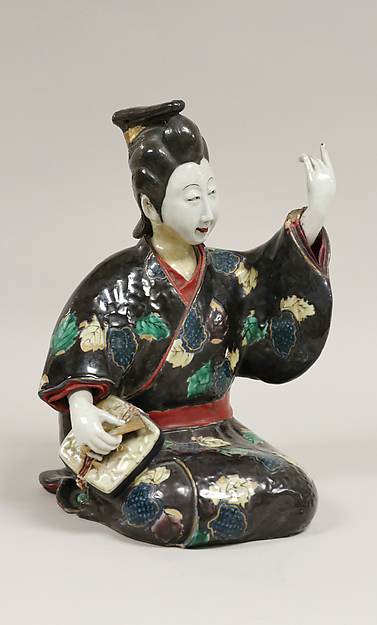
Figure of Girl playing Shamisen · 1870 · Porcelain decorated with colored enamels (Hizen ware, Kutani type)
Look closer: A porcelain figure of a girl at a shamisen, in coloured enamels.
The Metropolitan Museum of Art, Gift of Mrs. V. Everit Macy, 1923, accession 23.225.203. Public domain (Open Access).
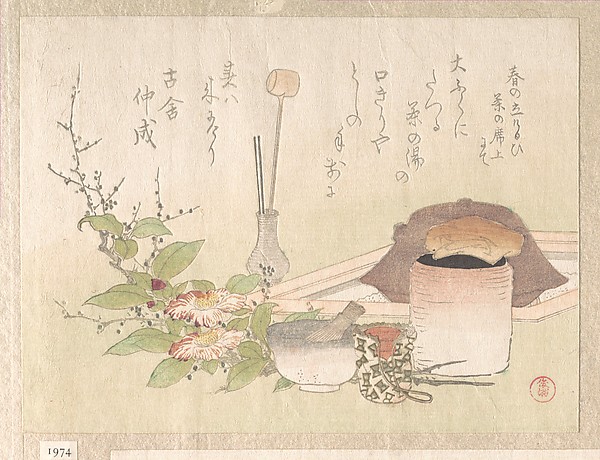
Kubo Shunman 窪俊満 · Set of Utensils for the Tea Ceremony · 1810s · Woodblock print (surimono); ink and color on paper
Look closer: The tea ceremony is on the list of arts; the Met’s print shows the utensils alone.
The Metropolitan Museum of Art, H. O. Havemeyer Collection, Bequest of Mrs. H. O. Havemeyer, 1929, accession JP1974. Public domain (Open Access).
Instruments and Printed Portraits
The house’s print and cultural-heritage shelves keep pieces from the world of the teahouse and the stage. The concierge desk can advise on dates and condition.
Answered plainly
What are the stages of geisha training?
Shikomi, minarai, maiko and geisha, according to Wikipedia. The geisha graduates through the erikae ceremony, at around twenty or twenty-one.
What is the difference between geiko and geisha?
Geiko, “woman of art”, is the regional word used in Kyoto and Kanazawa. Geisha is the general term.
What do jikata and tachikata mean?
Geisha who focus on music are jikata; those who focus on dance are tachikata.
What is the minimum age?
Labour laws set eighteen as the minimum age for joining an okiya, Wikipedia says, though Kyoto okiya may take recruits aged fifteen to seventeen.
How many geisha are there?
The sources we read give dated figures only: 202 geisha in Kyoto in 2006 and an estimate of 600 to 700 nationwide in 1989. They give no current national count.
What is a takamakura?
A raised pillow on which a maiko sleeps so that her hairstyle stays intact, according to Wikipedia’s maiko article.
Where next
Sources and image credits
- Geisha, Wikipedia
- Maiko, Wikipedia
- Metropolitan Museum of Art Open Access
- Image: [Geisha Girls], Unknown (Public domain (Met Open Access))
- Image: Calligraphy Practice (Tenarai), Ikeda Shōen (Public domain (Met Open Access))
- Image: Shamisen, Takechi Matsukawa (Public domain (Met Open Access))
- Image: Woman Playing on the Shamisen, Kubo Shunman (Public domain (Met Open Access))
- Image: Woman Playing the Tsuzumi, Kubo Shunman (Public domain (Met Open Access))
- Image: Two Geisha, Chōbunsai Eishi (Public domain (Met Open Access))
- Image: Beauty Playing a Shamisen, Unknown maker (Public domain (Met Open Access))
- Image: Young Woman Writing Calligraphy, Kubo Shunman (Public domain (Met Open Access))
- Image: Koto (Japanese Harp) and Sho (Reed Organ), Kubo Shunman (Public domain (Met Open Access))
- Image: Shamisen (三味線), Shigemoto, Isohachi (Public domain (Met Open Access))
- Image: Shamisen, Plectrum and a Book, Chōbunsai Eishi (Public domain (Met Open Access))
- Image: Figure of Girl playing Shamisen, Unknown maker (Public domain (Met Open Access))
- Image: Set of Utensils for the Tea Ceremony, Kubo Shunman 窪俊満 (Public domain (Met Open Access))
Last reviewed 28 October 2026. Pictures are public-domain or openly licensed and credited beneath each one; diagrams are drawn by Japonista.
Interested in prints, instruments or textiles from the world of the teahouse? The concierge desk replies within one to three business days.
Private concierge
Looking for something in particular?
Describe the piece or the project you have in mind. A senior advisor in Tokyo reads every case file personally and replies within two business days, with fees set out in writing before any work begins.