
Nihon Buyo: The Dance of the Stage and the Salon
Sleeves, stamps and a fan
Nihon Buyo: The Dance of the Stage and the Salon
日本舞踊
Japanese dance is not one art but a family: slow dances from Noh, quick dances from the stage, and gestures that show an Edo townsman writing a letter. The name for it is younger than most people suppose.
Fact sheet
At a glance
- A recent name. The word buyo was coined in the Meiji period; earlier, dances were named by genre.
- Open to women. Unlike Noh, kyogen, kabuki and bunraku, nihon buyo is danced by women as well as men.
- Borrowed repertoire. The great series come from Noh: Okina, Dojoji and Shakkyo.
- Sleeves and fans. Costume and hand props are part of the choreography.
What 'Japanese dance' means
First lookNihon buyo means, literally, Japanese dance. It does not mean all Japanese dance. The term was coined in the Meiji period, and the writer Tsubouchi Shoyo is believed to be the first to use it, for the dance-drama of kabuki; before that, dances were named by their kind, mai or odori, and kabuki dance had names such as shosagoto, keigoto and furigoto. In the strictest sense it refers solely to kabuki buyo. In a wider sense it takes in kamigata-mai, the dance of the Kyoto and Osaka region, and shin-buyo or sosaku-buyo, the new and creative dance that came under European and American influence in the twentieth century.
What distinguishes it from folk dance is its purpose. Nihon buyo is a refined style intended as entertainment on a public stage. Kamigata-mai, by contrast, developed in the Edo period for private parties on a surface as small as a single tatami mat, with slow, gentle movement to music for solo shamisen.

Katsukawa Shunshō 勝川春章, ca. 1777. Woodblock print (nishiki-e); ink and color on paper. The Metropolitan Museum of Art, accession JP381.
Look closer: Sleeve and fan are part of the choreography; the artist holds a single instant of a dance in motion.
Katsukawa Shunshō 勝川春章, Kabuki Actor Nakamura Tomijūrō I in a Female Dance Role, ca. 1777. The Metropolitan Museum of Art, Purchase, Joseph Pulitzer Bequest, 1918, accession JP381. Public domain (Met Open Access, CC0). Museum record
Mai, odori and furi
The connoisseur's eyeThe dance has three main elements. Mai is static and abstract, with an emphasis on ritual, and is often present in the adaptation of Noh. Odori is dynamic and rhythmic, descended from the nenbutsu odori invented by a Buddhist monk around the tenth century. Furi is theatrical, figurative body language, such as writing a letter or drinking sake, representing the actions of daily life in the Edo period.
A convenient simplification of the standard account.
Diagram by Japonista.
Two styles of role are taught: onnagata, female roles, and tachiyaku, male roles. A woman can therefore play a male role and a man a female one. In kabuki the dance of the long sleeves is the signature: sleeve movement is one of the most distinctive features, and the dancers minimise exposure of the body, placing emphasis on the costume, so that a manipulation of the sleeve can show tears being wiped. Stamping is a rhythmic device and can express anger.
| Branch | Where it lives | Character |
|---|---|---|
| Kabuki buyo | The kabuki stage and the schools founded by its choreographers | The narrow meaning of nihon buyo; important intangible cultural property since 1955 |
| Kamigata-mai (jiuta-mai) | Private rooms of Kyoto and Osaka | Small, slow and gentle, to jiuta music for a shamisen soloist |
| Shin-buyo (sosaku-buyo) | Modern stages | New dance shaped by European and American influence |
Borrowed from the Noh stage
The deep endMany dances take their shape from the other theatres. Three great series come from Noh. The Sanbaso dances come from Okina, the ritual play of prayer for harvest and prosperity. The Dojoji dances begin with Kyoganoko Musume Dojoji, adapted from the Noh play Dojoji, and give rise to a series including Ninin Dojoji and Meoto Dojoji. The Shakkyo dances come from the Noh play in which a monk sees mythical lions playing among peonies on Mount Seiryo in China; in kabuki the lion dance became the powerful Kagami Jishi and Renjishi.
Kyogen and bunraku also contribute. In the climactic scenes of dances adapted from the puppet theatre, a style called ningyo-buri has the dancer supported by puppeteers standing behind him, moving as if he were a puppet. The repertoire consists mainly of shosagoto created in the Edo period, among them Kyoganoko Musume Dojoji and Fuji Musume. About sixty per cent of plays are danced by one person, and about sixty per cent are pure dance without drama.
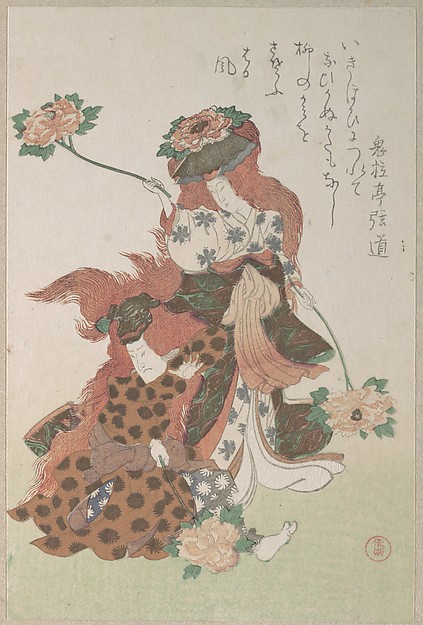
Kubo Shunman, ca. 1805–10. Privately published woodblock prints (surimono) mounted in an album; ink and color on paper. The Metropolitan Museum of Art, accession JP2291.
Look closer: Two dancers in a Shakkyo-mono piece, one of the series adapted from the Noh play of the lions and peonies.
Kubo Shunman, Two Dancers Performing a “Shakkyōmono” Kabuki Dance, from Spring Rain Surimono Album (Harusame surimono-jō), vol. 3, ca. 1805–10. The Metropolitan Museum of Art, H. O. Havemeyer Collection, Bequest of Mrs. H. O. Havemeyer, 1929, accession JP2291. Public domain (Met Open Access, CC0). Museum record
The long song beneath the dance
Nagauta, the long song, is the music played on the shamisen and used in kabuki primarily to accompany dance and to provide reflective interludes. It entered kabuki in the seventeenth century, and by the eighteenth the shamisen was established; much of the classic repertoire was composed in the nineteenth century, and many pieces are based on Noh. Its instruments are described in the chapter on shamisen, koto and shakuhachi.

Katsushika Hokusai, ca. 1796. Woodblock print; ink and color on paper. The Metropolitan Museum of Art, accession JP2570.
Look closer: Look at the angle of the arms and the fan: the print fixes one instant of a dance.
Katsushika Hokusai, The Ninth-Month Kabuki Dance "Kikujido", ca. 1796. The Metropolitan Museum of Art, The Howard Mansfield Collection, Purchase, Rogers Fund, 1936, accession JP2570. Public domain (Met Open Access, CC0). Museum record
Seeing a dance in a print gives one half of it only: the print can record the shape of a sleeve but not the stamp. The great printmakers loved the dance regardless, as the examples in the Ukiyo-e collection and the kabuki chapter show.
Answered plainly
What is the difference between nihon buyo and kabuki dance?
In the strict sense, nihon buyo refers solely to kabuki buyo, the dance of the kabuki stage. In a wider sense it includes kamigata-mai and the modern shin-buyo.
Can women perform it?
Yes. Unlike Noh, kyogen, kabuki and bunraku, which feature male performers, nihon buyo is also performed by women, and a woman may play a male role.
What are mai, odori and furi?
Mai is slow, abstract and ritual, odori is lively and rhythmic, and furi is figurative gesture representing everyday actions.
What music accompanies the dance?
Mostly shamisen music: nagauta for kabuki dance and jiuta for kamigata-mai.
Where does the repertoire come from?
Chiefly from kabuki dance plays of the Edo period, with major series adapted from Noh, kyogen and the puppet theatre.
Where next
Sources and image credits
- Nihon buyo, Wikipedia
- Nagauta, Wikipedia
- Kabuki, Wikipedia
- Noh, Wikipedia
- Metropolitan Museum of Art Open Access (images)
Image credits, in order of appearance:
- Katsukawa Shunshō 勝川春章, Kabuki Actor Nakamura Tomijūrō I in a Female Dance Role, ca. 1777. The Metropolitan Museum of Art, Purchase, Joseph Pulitzer Bequest, 1918, accession JP381. Public domain (Met Open Access, CC0). Museum record
- Kubo Shunman, Two Dancers Performing a “Shakkyōmono” Kabuki Dance, from Spring Rain Surimono Album (Harusame surimono-jō), vol. 3, ca. 1805–10. The Metropolitan Museum of Art, H. O. Havemeyer Collection, Bequest of Mrs. H. O. Havemeyer, 1929, accession JP2291. Public domain (Met Open Access, CC0). Museum record
- Katsushika Hokusai, The Ninth-Month Kabuki Dance "Kikujido", ca. 1796. The Metropolitan Museum of Art, The Howard Mansfield Collection, Purchase, Rogers Fund, 1936, accession JP2570. Public domain (Met Open Access, CC0). Museum record
Last reviewed 28 October 2026. Pictures are public-domain or openly licensed and credited beneath each one; diagrams are drawn by Japonista.
Fans, sleeves and prints of the dance are among the loveliest things the stage has left. If you are looking for one, tell us what you would like to see.
Private concierge
Looking for something in particular?
Describe the piece or the project you have in mind. A senior advisor in Tokyo reads every case file personally and replies within two business days, with fees set out in writing before any work begins.