
Geisha, Maiko and Oiran: The Costume of the Quarter
Floating world · Hanamachi and Yoshiwara
Geisha, Maiko and Oiran: The Costume of the Quarter
芸者と花魁の装い
In the licensed quarters of Edo Japan two kinds of woman dressed for an audience: the artist who danced and played, and the courtesan who paraded. Their clothes, from the trailing hikizuri to the unbelted uchikake, were a language of rank, age and season, and they can still be read.
Fact sheet
The quarter's dress in one glance
- Trailing hem. Wikipedia describes the hikizuri as a formal kimono with a trailing hem, almost always of fine silk, worn by apprentices and most geisha at engagements.
- Sleeve as rank. Wikipedia says geisha always wear short-sleeved kimono, because furisode sleeves mark apprenticeship.
- Six metres of sash. A maiko's darari obi is about 6 to 7 metres long and roughly 30 centimetres wide, and tying it needs a male dresser.
- A turning of the collar. At the graduation called erikae, around the ages of 20 to 21, a maiko becomes a geisha and her collar and sleeves change.
- Open robe, front sash. The oiran wore a heavily decorated uchikake open, over an underkimono, with an obi tied at the front.
- Twenty kilograms. Wikipedia says a formal parade outfit of an oiran could exceed 20 kilograms and often reached about 30.
Two wardrobes of the quarter
Two figures haunt the Edo pleasure districts in prints and screens: the geisha, a woman of art who danced, sang and played the shamisen, and the oiran, the high-ranking courtesan who processed in the street. They shared a neighbourhood and a taste for fine silk, but they did not share a wardrobe. The law, the market for luxury and the women themselves kept the two apart, and a careful reader can tell them from their clothes.
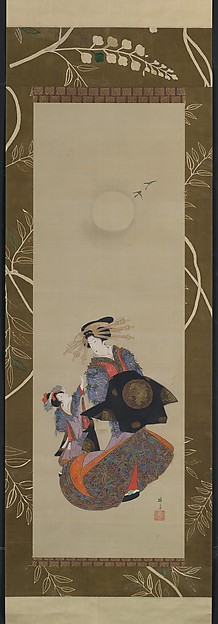
Teisai Hokuba, Beauty of the Yoshiwara with Apprentice in Moonlight, 19th century, Hanging scroll; ink, color, and gold on silk. The Metropolitan Museum of Art, Purchase, Friends of Asian Art Gifts, 2003, accession 2003.265.
Look closer: Look at the wisteria. The Met says the courtesan's lavender outer garment has three-dimensional wisteria blossoms, worn over layered robes, with an obi decorated with a gold lion and peonies.
Image: The Metropolitan Museum of Art, Open Access (CC0)
That is the subject of this chapter. It describes dress, and it takes the other matters of the licensed quarters as background. It follows Wikipedia's accounts of the geisha, the maiko and the oiran for the vocabulary, and it uses the Metropolitan Museum of Art for the garments themselves: a furisode made for a young noble lady, an uchikake of the Tokugawa family, an obi from the nineteenth century, and a long series of prints and scrolls that show the women of the quarters in their own clothes.
The garments recur in other chapters. The long-sleeved furisode and the formal tomesode are described in The Kimono Ladder: Furisode, Tomesode, Hōmongi and Komon, the sash in Obi and Its Companions: Scarf, Cord and Brooch, the hair ornaments in Kanzashi, Combs and the Dressed Head, the clogs in Geta, Zōri and Tabi: The Footwear of the Kimono, and the over-robe in its bridal form in Uchikake and Shiromuku: The Bridal Robes. The house's own account of the quarters is in Yoshiwara, Oiran and Geisha.
Walled districts and the five hanamachi
Wikipedia records that the yūkaku, the licensed pleasure districts, were built in the sixteenth century, and that prostitution was designated illegal outside them in 1617. The courtesans of the Yoshiwara in Edo, the Shimabara in Kyoto and the Shinmachi in Osaka lived and worked inside such districts.

Miyagawa Isshō, Courtesan on Parade, late 1730s–early 1740s, Hanging scroll; ink, color and gold on silk. The Metropolitan Museum of Art, Gift of Florence and Herbert Irving, 2015, accession 2015.500.9.20.
Look closer: Look at the title. The Met titles this scroll by Miyagawa Isshō a courtesan on parade, and dates it to the late 1730s or early 1740s.
Image: The Metropolitan Museum of Art, Open Access (CC0)
The geisha's districts are called hanamachi, flower towns. Kyoto's five, known together as the gokagai, are Gion Kobu, Gion Higashi, Ponto-chō, Miyagawa-chō and Kamishichiken, and Kyoto previously had six, including Shimabara. Tokyo's six are Asakusa, Akasaka, Kagurazaka, Shimbashi, Mukōjima and Yoshichō. The house does not describe the districts further, because the question here is clothes, and the clothes are the same in outline from one town to the next with the local variations noted below.
The distinction between the two kinds of woman is basic. A geisha, in Wikipedia's account, was an entertainer whose skills were music and dance; an oiran belonged to the courtesan ranks of the licensed quarter. Dress edicts, the article on the geisha says, forbade early geisha from wearing the flashy hairpins and kimono that marked the higher-ranking courtesans, and the article on the oiran says geisha were forbidden to dress elaborately like oiran. The rule is the key to this chapter: each woman's clothes were kept distinct from the other's by regulation as well as by custom.
From odoriko to the first geisha
The word geisha did not at first mean a woman. Wikipedia says geisha were male performers before the profession became mainly female, and that the first female geisha appeared in 1751. In another passage the article says the first woman to call herself geisha was a dancer from Fukagawa around 1750 named Kikuya. The two statements differ by a year and the house gives both as the article gives them. In the 1680s, the article adds, teenage dancing girls who were too young to be geisha but too old to be called odoriko began to be called geiko.

Katsukawa Shuntei, Geisha Seated, dated 1795, Hanging scroll; ink and color on silk. The Metropolitan Museum of Art, The Howard Mansfield Collection, Purchase, Rogers Fund, 1936, accession 36.100.71.
Look closer: Look at the date. The Met dates this scroll of a seated geisha to 1795.
Image: The Metropolitan Museum of Art, Open Access (CC0)
The merchant classes became the geisha's main patrons, and by the 1830s, Wikipedia says, geisha had become fashion icons. The fashion followed them into a surprising garment: the article records that women's wearing of the haori is said to have started with the Fukagawa geisha in the early 1800s. The haori, a men's jacket, is described in Haori and Hakama: The Jacket and the Divided Skirt, and the line from Fukagawa shows how a district's dress could change a nation's wardrobe.
Wikipedia also names classes of geisha in the Edo period: the kuruwa geisha of the licensed quarter, the yūjo and jorō geisha, and the machi geisha of the towns. The classes have no fixed costume in the sources the house has read, so it does not assign one. What matters for the reader is that geisha dress grew up beside a society of merchants and entertainers whose money moved fashion, and that the Met's Edo prints of the 1780s and 1790s record that world in colour.
Geiko, maiko and hangyoku
In Kyoto and western Japan the word for a geisha is geiko, which Wikipedia translates as woman of art. An apprentice is a maiko, woman of dance. In Tokyo an apprentice is often called a hangyoku, and the Wikipedia article on the maiko says that some maiko outside Kyoto, especially in Tokyo, wear furisode in place of the hikizuri. The vocabulary matters for dress because the garments differ with the title, and a reader who sees a long-sleeved kimono on a young woman in Kyoto is looking at an apprentice, not a geisha.

Furisode, 19th century, Possibly beni-dyed light red (orange) silk, figured satin weave, embroidered and couched in silvered and gilt metallic thread (wound around a white silk fiber core). Needlework in satin stitch in shades of green, dark blue, off-white, and light brown; areas of padding; yuzen dyeing, and stenciled imitation tie-dyeing throughout.. The Metropolitan Museum of Art, Robert Lehman Collection, 1975, accession 1975.1.2452.
Look closer: Look at the key-fret. The Met describes a sayagata key-fret pattern balanced by floral motifs on this furisode.
Image: The Metropolitan Museum of Art, Open Access (CC0)
The ages are part of the clothing story. Wikipedia says that before the twentieth century training began around the age of six, and that today girls usually debut as maiko around 17 or 18. The maiko stage lasts about three to five years, and the article on the maiko says maiko are usually 17 to 20 years old.
The article on the maiko adds that training covers traditional dance, shamisen, kouta songs and, in Kyoto only, the Kyoto dialect. The apprentice therefore dresses as a student of the arts, not as a finished performer, and her dress is a record of where she stands. The graduation from maiko to geisha, called erikae, is described below, and the changes it brings in sleeve, collar and sash are the clearest example of dress as status.
The trailing hem of the hikizuri
The characteristic garment is the hikizuri. Wikipedia describes it as a formal kimono with a trailing hem, almost always of fine silk, worn by apprentices and most geisha at engagements. Its collar sits further back on the neck than that of an ordinary kimono, and its sleeves are attached unevenly so the underarm stays covered. The motifs follow the placement used on the formal hōmongi and irotomesode, with designs placed asymmetrically along the hem and shoulders, and a black hikizuri resembling a kurotomesode is worn for the most formal occasions. The formal ranks are described in The Kimono Ladder: Furisode, Tomesode, Hōmongi and Komon.

Long-Sleeved Kimono (Furisode) with Hydrangeas and Cherry Blossoms, early 20th century, Resist-dyed and painted silk satin. The Metropolitan Museum of Art, Purchase, Roy R. and Marie S. Neuberger Foundation Inc. and several members of The Chairman's Council Gifts, 2000 Benefit Fund, and funds from various donors, 2001, accession 2001.428.51.
Look closer: Look at the hem and collar. The Met says the white satin is dyed beige around the hem, collar and lower sleeves, with cherry blossoms and blue hydrangeas painted on the beige ground.
Image: The Metropolitan Museum of Art, Open Access (CC0)
The article on the maiko gives the measurements: a maiko's hikizuri is typically 200 to 240 centimetres long, and the hem is lightly padded so it trails along the floor. Outside, the maiko hold the hem up by hand or tie it with a small cord. For formal occasions, the article says, the hikizuri is black, in the kurotomesode style, with five crests showing the okiya. The crest system is described in Mon: The Family Crests on Japanese Dress.
The seasons govern the cloth. Wikipedia says hikizuri are lined for most of the year and unlined in summer, that winter uses heavier fabrics such as rinzu and summer lightweight ro weave, and that slubbed silk, cotton, linen and polyester are not used. A bingata-dyed hikizuri may look like a komon but is still formal, and is made only of fine silk. The article adds that geisha almost always own their engagement kimono, whereas apprentices usually borrow from their okiya, since a new maiko's hikizuri is very expensive. The seasonal calendar for adult dress is in Seasons and Occasions: What to Wear When.
The sleeve that marks an apprentice
Sleeve length is the quickest sign of an apprentice. Wikipedia says that maiko wear furisode-style sleeves, with a tuck in each sleeve and each shoulder, and that these tucks were let out as apprentices grew. Geisha, by contrast, always wear short-sleeved kimono, because furisode sleeves mark apprenticeship. The tucked kimono of childhood is described in Shichi-Go-San and the Clothes of Childhood Rites.
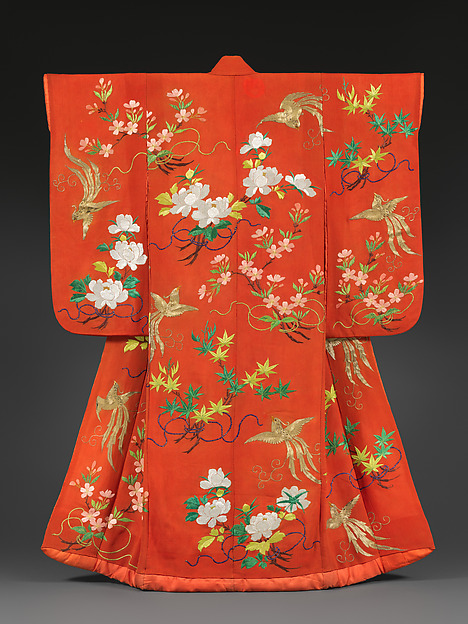
Long-Sleeved Robe (Furisode) with Phoenixes, Cherry Blossoms, Peonies, and Maple Branches, mid-19th century, Crepe silk with silk and gold-thread embroidery. The Metropolitan Museum of Art, Purchase, Anonymous Gift, 2018, accession 2018.645.
Look closer: Look at the red. The Met says the bright red crepe silk was coloured with a Western aniline dye, and that the robe was made for Princess Yuki of Kyoto.
Image: The Metropolitan Museum of Art, Open Access (CC0)
The Met's furisode show what the sleeve looked like on other bodies. Its long-sleeved robe with phoenixes, cherry blossoms, peonies and maple branches, of the mid-nineteenth century, was made for Yuki-gimi, Princess Yuki, a young noble lady of Kyoto and the daughter of the twentieth head priest of Higashi Honganji Temple. The museum notes that it is very rare for the original owner of an Edo-period garment to be recorded by name. The robe is crepe silk with silk and gold-thread embroidery, coloured with a Western aniline dye, and it measures about 172.7 by 124.5 centimetres.
A second furisode in the Lehman Collection is of the nineteenth century and is described as a figured satin weave, rinzu-ori, with a key-fret pattern called sayagata balanced by floral motifs. The museum records embroidery and couching with metallic thread, yūzen dyeing and stencilled imitation tie-dye, and gives its size as 175.5 by 117 centimetres. A third, of the early twentieth century, is explained by the museum as a long-sleeved robe worn by young, unmarried women. These are not apprentices' garments, but they show the cut, the cloth and the techniques on which the apprentice's kimono drew. The techniques are described in Yūzen: The Painted Kimono and Embroidery and Gold Leaf on Japanese Cloth.
Six metres of darari
The maiko's sash is the darari obi. Wikipedia says that in Kyoto it is roughly 6 metres long, and the article on the maiko gives the length as 6 to 7 metres and the width as roughly 30 centimetres. It is worn exclusively by maiko. Tying it requires an otokoshi, a male dresser, who can dress a maiko in as little as five minutes. The okiya's crest sits on one end of the darari, and formal occasions call for gold brocade.

Obi with Dragon and Phoenix, 19th century, Silk satin with supplementary weft patterning in silk and metallic threads. The Metropolitan Museum of Art, Gift of Phillip H. Rubin, 2006, accession 2006.572.5.
Look closer: Look at the length. The Met records this nineteenth-century obi at about 416.6 centimetres long and 69.2 centimetres wide.
Image: The Metropolitan Museum of Art, Open Access (CC0)
Outside Kyoto the rule changes. Maiko elsewhere wear the shorter, narrower fukuro obi, tied in fukura-suzume or han-dara knots, and Tokyo apprentices typically tie theirs in the fukura-suzume style. Geisha wear the nijūdaiko musubi, a taiko knot made with a fukuro obi, and geisha from Tokyo and Kanazawa also use the yanagi musubi and the tsunodashi musubi. Hakata-ori obi may be worn by geisha in summer, and by geisha from Fukuoka year-round. The weaving of Hakata is described in Regional Textiles from Kyoto to Okinawa.
The Met holds a nineteenth-century obi of silk satin with supplementary weft patterning in silk and metallic thread, which measures 164 by 27 and a quarter inches, about 416.6 by 69.2 centimetres. It shows a dragon and a phoenix. It is not a maiko's obi, but its scale is a reminder of how much cloth a sash can hold. The sash and its companions are described in Obi and Its Companions: Scarf, Cord and Brooch.
Two stripes of skin, then three
The collar tells the same story as the sleeve. Wikipedia says the maiko wears her collar far back, showing the red collar of her underkimono and two stripes of bare skin on the nape, called eri-ashi. The geisha shows three stripes, sanbon-ashi, and exclusively wears a solid white han-eri. The change between them is the ceremony of erikae, the turning of the collar, which Wikipedia places around the ages of 20 to 21.

Unknown, [Geisha Girls], ca. 1880, albumen silver print. The Metropolitan Museum of Art, Museum Accession, transferred from the Costume Institute Library, accession 2011.533.
Look closer: Look at the photograph. The Met catalogues this albumen silver print of about 1880 as two geisha girls, transferred from the Costume Institute Library.
Image: The Metropolitan Museum of Art, Open Access (CC0)
The article adds that when a maiko becomes a geisha her kimono changes from long sleeves with a typically long obi to short sleeves with a standard-length obi. The graduation therefore alters collar, sleeve and sash at once. A person who knows what to look for can read a woman's stage in the quarter from the line of her nape alone.
The underkimono, the juban, is the garment the collar belongs to, and it is largely hidden. The collar and the nape are the two places where it speaks. The same logic of layered garments with a visible edge governs the court twelve-layered robe in Court Dress: Jūnihitoe and Sokutai, where the edges of many layers were the point, and the formal kimono in The Kimono Ladder: Furisode, Tomesode, Hōmongi and Komon, where the collar is the line between wearer and viewer.
White powder and red lips
The face is part of the costume. Wikipedia says that both maiko and geisha wear white oshiroi, which was formerly made with lead. The standard look has red and black eye and eyebrow makeup, red lips and a light pink blusher, with the lips underpainted with red beni. The maiko wears heavier blush, called tonoko.

Chōkōsai Eishō, Large Head and Bust Portrait of the Oiran Hanaogi of Ogiya., probably 1798, Woodblock print; ink and color on paper. The Metropolitan Museum of Art, Rogers Fund, 1914, accession JP186.
Look closer: Look at the portrait. The Met titles this print a large head and bust portrait of the oiran Hanaogi of Ogiya, probably of 1798.
Image: The Metropolitan Museum of Art, Open Access (CC0)
The first year of apprenticeship has its own rules. First-year apprentices paint only the lower lip. Older geisha wear full white makeup mainly for stage work. The article adds that ohaguro, the blackening of the teeth, is now extremely uncommon.
The Met's prints show the face in a different register. In the large head and bust portrait of the oiran Hanaogi of Ogiya, probably of 1798, the museum's page gives only the title and the date and does not describe the face, so the house does not either. A reader who wishes to compare a painted face with a printed one can start with that portrait and with Wikipedia's account, and will notice how few of the details of the living face a woodblock print can record.
Own hair, wigs and the wooden pillow
The maiko uses her own hair, dressed in nihongami styles and decorated with kanzashi. Wikipedia says maiko have five hairstyles marking stages of training, that they spend hours each week at the hairdresser, and that they sleep on takamakura, raised pillows, to keep the style. The article on the maiko adds that the hair is restyled weekly.
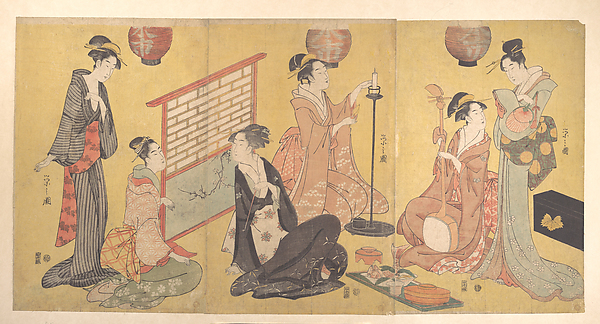
Chōbunsai Eishi, Geisha Preparing for an Entertainment, ca. 1794, Triptych of woodblock prints; ink and color on paper. The Metropolitan Museum of Art, Rogers Fund, 1914, accession JP182.
Look closer: Look at the three sheets. The Met catalogues this print by Eishi as a triptych of about 1794 showing geisha preparing for an entertainment.
Image: The Metropolitan Museum of Art, Open Access (CC0)
The geisha wears a wig. Wikipedia says the usual style is the chū taka shimada, shaped to the face by a wig stylist. After the Second World War many hairstylists stopped working, and geisha moved to human-hair wigs. The change is a clear example of how a trade's conditions alter its costume.
The ornaments are the kanzashi. Wikipedia says maiko wear many more of them than geisha, and that the materials include tortoiseshell or mock-tortoiseshell, gold, silver, jade and coral. The Wikipedia article on the oiran says that at the start of the Edo period oiran wore more than eight kanzashi, of tortoiseshell, silver, gold or gemstones. Hokuba's scroll in the Met shows tortoiseshell combs and long ornamental hairpins on a courtesan. The full vocabulary of the dressed head is in Kanzashi, Combs and the Dressed Head.
Okobo, zōri and geta
The footwear follows the same stages. Wikipedia says okobo, platform clogs, are worn by apprentices with formal kimono, at least in Kyoto, while zōri are worn by apprentices for training and everyday life, including with casual komon and yukata. Geisha wear geta or zōri with their kimono. The chapter Geta, Zōri and Tabi: The Footwear of the Kimono describes the whole family of sandals and the white split-toed tabi that accompany them.
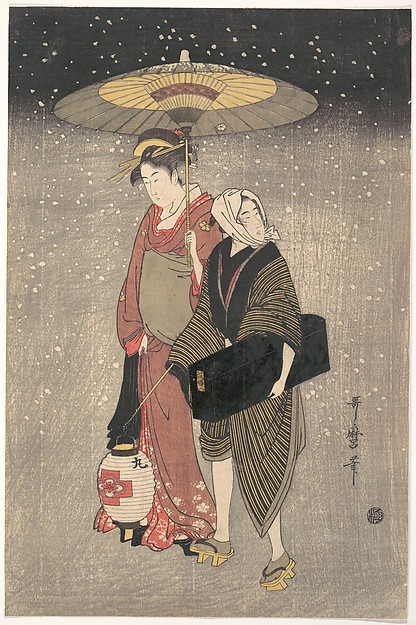
Kitagawa Utamaro, Geisha Walking through the Snow at Night, ca. 1797, Woodblock print; ink and color on paper. The Metropolitan Museum of Art, H. O. Havemeyer Collection, Bequest of Mrs. H. O. Havemeyer, 1929, accession JP1665.
Look closer: Look at the umbrella. The Met describes a geisha walking under an umbrella through a heavy snowstorm, with a male attendant carrying a lantern and a lacquered black box that holds her shamisen.
Image: The Metropolitan Museum of Art, Open Access (CC0)
The oiran's clogs were another matter. Wikipedia says the koma geta were of paulownia wood, about 20 centimetres tall with three teeth, and that they forced a slow, sliding figure-of-eight step called suri-ashi, with two attendants, the wakaimono, assisting the wearer. The Met's Hokuba scroll shows a courtesan in procession with attendants in high lacquered clogs.
The contrast between the okobo and the koma geta is the contrast between the apprentice and the courtesan. The okobo is a training shoe and a sign of youth; the koma geta is a stage in itself, a platform that changes how a woman moves and how long it takes her to cross a street. Neither is a practical shoe, and both were chosen for the picture they made, which is why the prints so often show them.
The outer robe worn open and unbelted
The oiran's outermost layer was the uchikake. Wikipedia describes it as a heavily decorated silk brocade with a heavily padded hem, with motifs including dragons, butterflies, pine, plum and bamboo in heavy gold and silver thread. It was worn with an underkimono patterned only on the lower skirt, and left unbelted. The obi was tied at the front, and in the Edo period it became wider and stiffer; the article names the manaita obi, the cutting-board obi, which had a large flat surface for big designs.
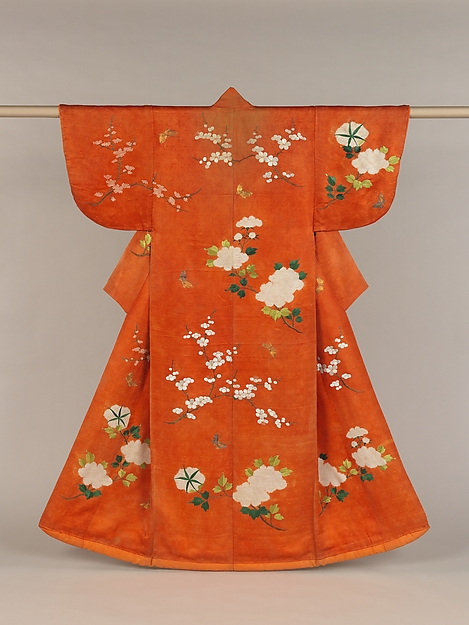
Outer Robe (Uchikake) with Peonies, Plum Blossoms, and Butterflies, late 18th–early 19th century, Silk damask embroidered with silk and metallic thread. The Metropolitan Museum of Art, Purchase, Friends of Asian Art Gifts, 2008, accession 2008.11.
Look closer: Look at the hem. The Met describes the uchikake as a lined silk robe with a padded hem, worn over another garment without a sash.
Image: The Metropolitan Museum of Art, Open Access (CC0)
The Met has several uchikake, though none is labelled as an oiran's. Its outer robe with peonies, plum blossoms and butterflies, of the late eighteenth to early nineteenth century, is explained by the museum as a lined silk robe with a padded hem, worn over another garment without a sash. The museum says its use by samurai-class women dates to the Kamakura period, that from the mid-Edo period it was often made of figured satin in white, black or red and heavily embroidered, and that it is still worn over a kimono in traditional weddings. The brides' form is described in Uchikake and Shiromuku: The Bridal Robes.
Two other Met robes show the range. An uchikake of the first half of the nineteenth century, with chrysanthemums, butterflies and sheaves of rice straw, was made for a high-ranking Tokugawa lady, with a padded hem, wild ginger Tokugawa crests, and decoration only below the waist and on the lower sleeves, which the museum says suggests a young, unmarried wearer. A second, with books and mandarin orange branches, was a formal garment for young women from wealthy merchant families. These are not courtesans' robes, but they show the garment the oiran's was a splendid version of.
Figure-of-eight steps on high clogs
The oiran's public appearance was the dōchū, the procession. Wikipedia says the formal parade outfit could exceed 20 kilograms and often reached about 30, and that the slow figure-of-eight step on three-toothed clogs was assisted by two attendants. The Met's scroll of a courtesan on parade by Miyagawa Isshō, of the late 1730s or early 1740s, and Teisai Hokuba's scroll of a beauty of the Yoshiwara with an apprentice, of the nineteenth century, show the occasion in paint.

Chōbunsai Eishi, The Yoshiwara Parade in Autumn, ca. 1793, Triptych of woodblock prints; ink and color on paper. The Metropolitan Museum of Art, Rogers Fund, 1914, accession JP183.
Look closer: Look at the three sheets. The Met catalogues this Eishi print of about 1793 as a triptych titled The Yoshiwara Parade in Autumn.
Image: The Metropolitan Museum of Art, Open Access (CC0)
Hokuba's scroll, as the museum describes it, shows an elaborately dressed courtesan walking in procession with her attendants. Her outer garment is lavender with three-dimensional wisteria blossoms, worn over layered robes; her obi is decorated with a gold lion and peonies; her hair is arranged with tortoiseshell combs and long ornamental hairpins. The setting is an evening outdoors, suggested by a pale full moon against faint ink washes and two geese flying above.
The procession survives as a festival. Wikipedia lists the oiran parades at Bunsui in Niigata in April, at Ōsu in Nagoya in early October, and at Minamishinagawa in September. These are re-enactments, and they preserve the idea that the oiran's dress was meant to be seen on the street.
Tayū, kōshi and the end of an age
The oiran were a ladder of ranks. Wikipedia says the tayū were the highest, followed by the kōshi. A tayū's fee for one evening was between one ryō and one ryō three bu. A 1688 guidebook counted 13 tayū among 329 courtesans in Shimabara, 7 among 983 in Shinmachi, and 3 among 2,790 in Osaka and Yoshiwara, according to the article, and the last tayū of Yoshiwara retired in 1761. A guidebook of 1792 listed six ranks.

Torii Kiyonaga, Two Courtesans and a Geisha, ca. 1783, Woodblock print; ink and color on paper. The Metropolitan Museum of Art, The Howard Mansfield Collection, Purchase, Rogers Fund, 1936, accession JP2599.
Look closer: Look at the three women. The Met titles this Kiyonaga print of about 1783 Two Courtesans and a Geisha.
Image: The Metropolitan Museum of Art, Open Access (CC0)
The title oiran, the article says, originated in the Yoshiwara in the 1750s. Prostitution was outlawed in 1957, the article records, and the Shimabara has the last tayū house. It says that fewer than five tayū remain.
These numbers frame the costume. The elaborate outfit belonged to a very small group at the top of a large profession, and it had disappeared from the Yoshiwara itself by the 1760s. What the later prints show is therefore partly memory, and what the festivals show is memory again. For the geisha the numbers run the other way, and the next section sets them out.
Sumptuary rules and the taste for iki
Dress was regulated. Wikipedia says dress edicts aimed at the excess of the merchant class pushed the popularity of iki, a restrained aesthetic that the oiran did not reflect, and that geisha were forbidden to dress elaborately like oiran. The article says the oiran were once trend-setting, but that the geisha usurped that reputation in the late eighteenth and nineteenth centuries.

Suzuki Harunobu, An Oiran Holding a Black Dog, ca. 1769, Woodblock print; ink and color on paper. The Metropolitan Museum of Art, Gift of Estate of Samuel Isham, 1914, accession JP878.
Look closer: Look at the format. The Met records this Harunobu print of about 1769 as 65.7 centimetres high and only 11.4 centimetres wide.
Image: The Metropolitan Museum of Art, Open Access (CC0)
The article on the geisha is less specific. It says dress edicts forbade early geisha from wearing the flashy hairpins and kimono of the higher-ranking courtesans, and that laws targeted merchant-class dress, but it gives no clear dates or details. The house therefore does not describe the edicts further. What the sources support is the direction of travel: from the gold-laden parade dress of the early oiran to the subtler silks of the geisha, and from a courtesan's fashion leadership to a geisha's.
The numbers of geisha have fallen steeply. Wikipedia says that before the war there were up to 80,000, and that in Kyoto between 1965 and 2006 maiko fell from 76 to 71 and geisha from 548 to 202. In 1989 the New York Times estimated that 600 to 700 geisha remained in Japan. The costume that remains is therefore a costume of a shrinking craft, and its details are kept up deliberately.
Eishi's triptychs and Utamaro's snowfall
The best evidence of the costume of the quarters is the pictures made of it. The Met holds two triptychs by Chōbunsai Eishi, The Yoshiwara Parade in Autumn of about 1793 and Geisha Preparing for an Entertainment of about 1794, and Torii Kiyonaga's Two Courtesans and a Geisha of about 1783. Their pages give titles, dates and credit lines but no commentary on dress, so the house describes only what each shows by name: a parade, a toilette, three women together.
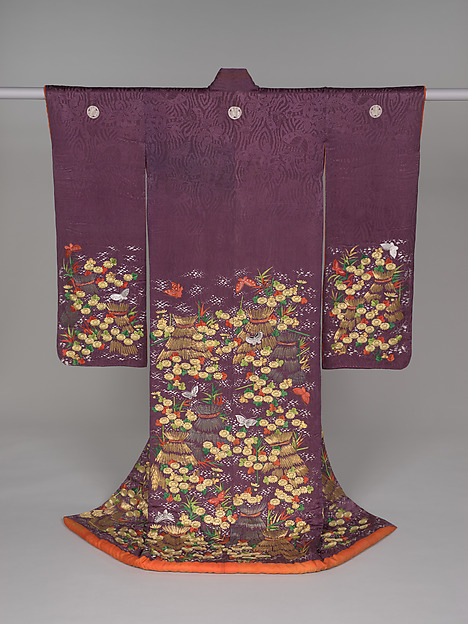
Over robe (uchikake) with chrysanthemums, butterflies, and sheaves of rice straw, first half 19th century, Figured satin-weave silk with paste-resist dyeing, silk embroidery, and couched gold thread. The Metropolitan Museum of Art, Purchase, Friends of Asian Art Gifts, 2023, accession 2023.323.
Look closer: Look at the crests. The Met says wild ginger crests on the shoulders identify the Tokugawa family.
Image: The Metropolitan Museum of Art, Open Access (CC0)
Utamaro's Geisha Walking through the Snow at Night, of about 1797, has a short museum description. It shows a geisha walking under an umbrella through a heavy snowstorm, accompanied by a male attendant with a lantern and a lacquered black box holding her shamisen. The museum calls the scene dreamlike, noting that snow falls but none has settled on the ground. The attendant and the box are details of the working life of a geisha that no kimono shows.
The portraits are one more kind. Chōkōsai Eishō's large head and bust portrait of the oiran Hanaogi of Ogiya, probably of 1798, Suzuki Harunobu's tall narrow print of an oiran holding a black dog, of about 1769, and Katsukawa Shuntei's hanging scroll of a seated geisha, dated 1795, are further portraits of the women of the quarters. The house's general account of the genre is in Ukiyo-e Art.
Ambrotypes and albumen prints of the 1880s
Photography brought the quarters into a new medium. The Met holds an ambrotype of the 1880s titled Geisha with Attendant by Yokoyama Matsusaburō, acquired in 2004, and an albumen silver print of about 1880 titled Geisha Girls, by an unknown photographer, which was transferred from the Costume Institute Library. The ambrotype is a cased portrait; the museum's page says that poetry inscriptions appear on the kiri-wood cases that house the portraits, not on the dress.

Yokoyama Matsusaburō, [Geisha with Attendant], 1880s, Ambrotype. The Metropolitan Museum of Art, Funds from various donors, 2004, accession 2004.283a, b.
Look closer: Look at the case. The Met says poetry inscriptions appear on the kiri-wood cases that house these portraits.
Image: The Metropolitan Museum of Art, Open Access (CC0)
These pictures matter for dress because they record geisha clothes worn on actual bodies, as a camera saw them. The house does not interpret the details, since the museum's pages give none, and it suggests only that a reader compare them with Wikipedia's account of the hikizuri and the nape, and with the prints that precede them by a century.
The comparison is instructive. A print stylises the figure and a photograph records it, and the difference shows how much of the ukiyo-e image of the quarters was convention.
Four tales from the quarter
Kikuya of Fukagawa. Wikipedia says the first woman to call herself a geisha was a dancer from Fukagawa around 1750 named Kikuya. The haori that women now wear is said to have started with the Fukagawa geisha in the early 1800s.
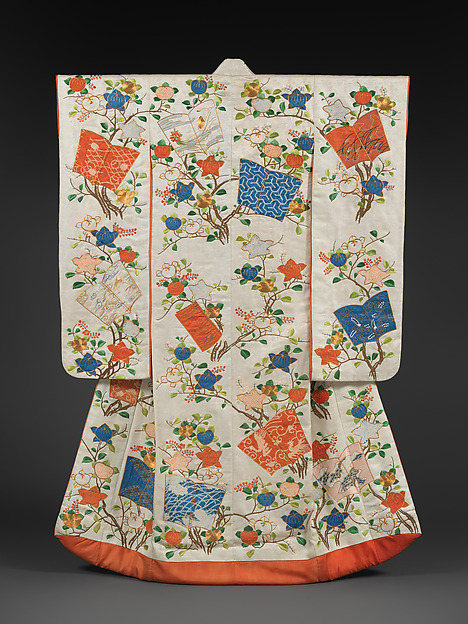
Woman's Overrobe (Uchikake) with Books and Mandarin Orange Branches, first half of the 19th century, Embroidery in silk and metallic thread; appliqué of resist-dyed (shibori) silk fabrics on silk satin damask. The Metropolitan Museum of Art, Gift of Mr. and Mrs. Earl Morse, 1972, accession 1972.18.
Look closer: Look at the motifs. The Met describes books and mandarin orange branches on this robe.
Image: The Metropolitan Museum of Art, Open Access (CC0)
Princess Yuki's red. The Met's furisode made for Princess Yuki of Kyoto is rare because an Edo garment's first owner is so seldom recorded by name. Its bright red is a Western aniline dye, which the Met records.
The wooden pillow. A maiko's hair is dressed once a week, and to keep it she sleeps with her neck on a takamakura, a raised wooden block with a small pillow.
The last tayū. The last tayū of the Yoshiwara retired in 1761, according to Wikipedia, and the outfits that prints continued to show for decades were therefore, in part, a memory of a rank that had vanished.
Small surprises from the teahouse
Short facts from the sources, each given as the source gives it.
- Geiko means woman of art, and maiko means woman of dance.
- The first female geisha appeared in 1751, according to Wikipedia's lead.
- A maiko's hikizuri is typically 200 to 240 centimetres long.
- A darari obi is 6 to 7 metres long and about 30 centimetres wide.
- A male dresser can tie a darari obi in as little as five minutes.
- Geisha show three stripes of skin at the nape, maiko two.
- Oshiroi, the white powder, was formerly made with lead.
- Geisha began wearing human-hair wigs after the Second World War.
- An oiran's koma geta stood about 20 centimetres high.
- A formal oiran parade outfit could exceed 20 kilograms.
- The last tayū of Yoshiwara retired in 1761.
- Kyoto's geisha numbered 548 in 1965 and 202 in 2006.
Words of the quarter
The terms used in this chapter, with the garment or custom each names.
| Term | Meaning | Where it appears |
|---|---|---|
| Geisha | A woman entertainer of music and dance | First look |
| Geiko | The Kyoto and western Japan word for a geisha | Terms |
| Maiko | An apprentice geiko, woman of dance | Terms |
| Hangyoku | The Tokyo term for an apprentice | Terms |
| Hanamachi | A geisha district, literally flower town | Quarters |
| Yūkaku | A licensed pleasure district | Quarters |
| Okiya | The house in which geisha and apprentices live | Kimono |
| Hikizuri | The formal kimono with a trailing hem | Kimono |
| Furisode | A long-sleeved kimono for young women | Furisode |
| Darari obi | The maiko's very long sash | Sash |
| Fukuro obi | A shorter, narrower obi worn by geisha | Sash |
| Otokoshi | The male dresser who ties a maiko's obi | Sash |
| Erikae | The turning of the collar, the graduation to geisha | Collar |
| Eri-ashi | The two stripes of bare nape a maiko shows | Collar |
| Oshiroi | White face powder | Face |
| Beni | Red pigment used under the lip colour | Face |
| Nihongami | Traditional Japanese hairstyles | Coiffure |
| Takamakura | The raised wooden pillow | Coiffure |
| Okobo | Platform clogs worn by apprentices | Feet |
| Koma geta | The oiran's three-toothed clogs | Feet |
| Uchikake | The padded-hem outer robe worn open and unbelted | Courtesan |
| Manaita obi | The cutting-board obi, wide and stiff | Courtesan |
| Dōchū | The procession of the oiran | Parade |
| Tayū | The highest rank of oiran | Rank |
| Iki | A restrained aesthetic of the Edo merchants | Edicts |
What can be seen today
A reader can see the geisha's dress in Kyoto and Tokyo, where the hanamachi continue, and the oiran's in the festivals of Bunsui, Ōsu and Shinagawa that Wikipedia names. The Met's furisode, uchikake, obi, prints and photographs can be studied through the images and labels on the museum's collection pages.
For the collector, the lesson is to separate the garment from the role. The Met's uchikake are formal robes, and its furisode are for young unmarried women; none is a geisha's or an oiran's, and the museum does not claim they are. A hikizuri, a darari obi or an oiran's robe is a specialist item whose use is a matter of the okiya's or the festival's records, and a piece offered with a story should be tested against the sources in this chapter.
The house's own pages on the quarters, Yoshiwara, Oiran and Geisha, Geiko and Maiko: The Years of Training and Oiran and Tayū: The Courtesans of the Yoshiwara, describe the lives behind the costume, and the dance that the geisha trains in is in Nihon Buyō.
Reading a quarter garment in the hand
The first question is the sleeve and the cut. A kimono with long sleeves and tucks at the sleeve and shoulder was made for a young wearer. A hikizuri has a longer body than an ordinary kimono, a trailing hem and a collar set further back.
The second is the cloth. Fine silk, lined in most of the year and unlined in summer, is the rule for the hikizuri, and slubbed silk, cotton, linen and polyester are not used. Rinzu for winter and ro for summer are the weaves to look for. The embroidery, yūzen and couching on a Met furisode or uchikake show the kind of workmanship that distinguishes a formal piece.
The third is the crest and the motif. A black hikizuri with five crests carries an okiya's mark, and a crest on a shoulder, like the wild ginger of the Tokugawa on the Met's uchikake, is a record of ownership. The condition scale and care advice in How to Read, Grade and Care for a Japanese Garment apply, and the concierge desk is glad to compare a piece with the museum records on request.
Neighbouring chapters
The quarter's dress connects to many parts of this almanac. The garments are in The Kimono Ladder: Furisode, Tomesode, Hōmongi and Komon and Uchikake and Shiromuku: The Bridal Robes, the sash in Obi and Its Companions: Scarf, Cord and Brooch, the hair in Kanzashi, Combs and the Dressed Head, the shoes in Geta, Zōri and Tabi: The Footwear of the Kimono, the stage cousins in Kabuki Costume: Hikinuki and the Onnagata Layers, and the childhood tucks in Shichi-Go-San and the Clothes of Childhood Rites. The techniques are in Yūzen: The Painted Kimono, Embroidery and Gold Leaf on Japanese Cloth and Nishijin: The Woven Brocades of Kyoto, and the vocabulary in Glossary of Japanese Dress and Textile Terms.
Among the house's other pages, The Warrior and Floating World Almanac gathers the world of the quarters with the warrior's, and the Performing Arts Almanac describes the arts the geisha practises.
A bridal robe, a furisode shirt and a nishiki back in the house
The shelf holds a bridal uchikake with phoenix embroidery, a silk remake shirt cut from a furisode, and a denim jacket backed with Kyoto nishiki-ori silk. None is a geisha's or an oiran's garment; each is described as what it is, with its age, maker and condition set out on its own page.


Kimono and textile heritage
The house's collection of kimono and textile heritage is the companion to this chapter, and the concierge desk can look for related pieces on request.
Answered plainly
What is a hikizuri?
A formal kimono with a trailing hem, almost always of fine silk, worn by apprentices and most geisha at engagements.
How long is a maiko's obi?
A darari obi is about 6 to 7 metres long and roughly 30 centimetres wide, and is tied by a male dresser.
How can you tell a maiko from a geisha?
By the sleeves, the collar and the sash: the maiko has furisode-style sleeves, a red collar and a darari obi, and the geisha has short sleeves, a white collar and a shorter obi.
What is erikae?
The turning of the collar, the graduation from maiko to geisha around the ages of 20 to 21.
Why is the face painted white?
Wikipedia says both maiko and geisha wear white oshiroi, which was formerly made with lead.
Do geisha wear wigs?
Geisha wear wigs, usually the chū taka shimada, while maiko use their own hair.
Why do maiko sleep on a wooden pillow?
To keep their hairstyle, which is restyled weekly.
What are okobo?
Platform clogs worn by apprentices with formal kimono, at least in Kyoto.
What did an oiran wear?
An uchikake with a padded hem, worn open over an underkimono, with an obi tied at the front, and three-toothed clogs of about 20 centimetres.
How heavy was an oiran's outfit?
Wikipedia says a formal parade outfit could exceed 20 kilograms and often reached about 30.
What is a tayū?
The highest rank of courtesan; the last tayū of Yoshiwara retired in 1761.
Is an oiran a geisha?
No. The oiran were courtesans of the licensed quarter, and geisha were forbidden to dress elaborately like them.
When did the first female geisha appear?
Wikipedia gives 1751 in its lead and says elsewhere that a dancer named Kikuya from Fukagawa was the first woman to call herself geisha around 1750.
Where can oiran parades be seen?
Wikipedia names Bunsui in Niigata in April, Ōsu in Nagoya in early October and Minamishinagawa in Shinagawa in September.
How many geisha are there?
Wikipedia says up to 80,000 before the war and, for Kyoto, 202 geisha and 71 maiko in 2006.
Where next
Sources and image credits
- Geisha, Wikipedia
- Maiko, Wikipedia
- Oiran, Wikipedia
- Beauty of the Yoshiwara with Apprentice in Moonlight, Metropolitan Museum of Art
- Courtesan on Parade, Metropolitan Museum of Art
- The Yoshiwara Parade in Autumn, Metropolitan Museum of Art
- Geisha Preparing for an Entertainment, Metropolitan Museum of Art
- Geisha Seated, Metropolitan Museum of Art
- Two Courtesans and a Geisha, Metropolitan Museum of Art
- Geisha Walking through the Snow at Night, Metropolitan Museum of Art
- Portrait of the Oiran Hanaogi of Ogiya, Metropolitan Museum of Art
- An Oiran Holding a Black Dog, Metropolitan Museum of Art
- Geisha with Attendant, Metropolitan Museum of Art
- Geisha Girls, Metropolitan Museum of Art
- Furisode, Lehman Collection, Metropolitan Museum of Art
- Furisode made for Princess Yuki, Metropolitan Museum of Art
- Furisode with hydrangeas and cherry blossoms, Metropolitan Museum of Art
- Uchikake with chrysanthemums, butterflies and rice straw, Metropolitan Museum of Art
- Uchikake with books and mandarin oranges, Metropolitan Museum of Art
- Uchikake with peonies, plum blossoms and butterflies, Metropolitan Museum of Art
- Obi with dragon and phoenix, Metropolitan Museum of Art
Last reviewed 28 October 2026. Pictures, where shown, are public-domain or open-access and credited beneath each one.
Looking for a furisode, an uchikake or a formal piece related to the world described here? The concierge desk replies within one to three business days.
Private concierge
Looking for something in particular?
Describe the piece or the project you have in mind. A senior advisor in Tokyo reads every case file personally and replies within two business days, with fees set out in writing before any work begins.