
Court Dress: Jūnihitoe and Sokutai
Costume · Kyoto and the palace
Court Dress: Jūnihitoe and Sokutai
宮廷装束
At the Japanese court the dress of the Heian period never quite went out of use. Two garments, the sokutai for men and the jūnihitoe for women, are still worn at the most solemn moments of the imperial house.
Fact sheet
Court dress in one glance
- Two formal garments. The sokutai is worn only by courtiers, aristocrats and the emperor; the jūnihitoe is the formal dress of noble women and ladies-in-waiting.
- Colour as rank. For men the colour of the outer robe told the rank, from purple at the first to third ranks down to light blue below the eighth.
- Colour as taste. For women the layers were named for flowers and seasons, and their harmony showed refinement.
- A glimpse of sleeves. Seated behind a blind, a lady showed only the edges of her sleeves and hems, and the layers spoke for her.
- Still in use. Both garments were worn at the enthronement of Emperor Naruhito in 2019, according to Wikipedia.
- Seen in prints. Edo artists drew the Heian court again and again, and the Met holds their sheets and a court hunting robe.
Two garments from the palace
Most Japanese dress changed with the market. Court dress changed with the calendar and the rank list, and it kept its shape. Wikipedia describes the sokutai as an outfit worn only by courtiers, aristocrats and the emperor at the imperial court, and the jūnihitoe, the twelve layers, as the formal court dress of noble women and ladies-in-waiting. Both come from the Heian period, which ran from 794 to 1185, and both are still worn by the imperial house.

Torii Kiyonaga, Kanjo: A Court Lady, ca. 1790, Woodblock print; ink and color on paper. The Metropolitan Museum of Art, The Howard Mansfield Collection, Purchase, Rogers Fund, 1936, accession JP2615.
Look closer: Look at the colours of the robe. The Met's account identifies the figure as the Heian poet Ono no Komachi in formal twelve-layer court robes, and says subtle shades of green, orange, pink and yellow would have signalled refined taste.
Image: The Metropolitan Museum of Art, Open Access (CC0)
The garments are best understood as two different answers to one question: how does a person show who they are at court? The men answered with colour fixed by office. The women answered with colour fixed by taste, a layered harmony of silks that changed with the season and which a visitor could read from a few inches of exposed edge. A reader who learns both systems can read a great deal of Japanese costume, from the Noh stage to the festival procession.

Kobayashi Kiyochika, Heian Period Courtier on a Moonlit Beach, 19th century, Triptych of woodblock prints; ink and color on paper. The Metropolitan Museum of Art, Bequest of William S. Lieberman, 2005, accession 2007.49.321a–c.
Look closer: Look at the title. The Met titles the triptych Heian Period Courtier on a Moonlit Beach.
Image: The Metropolitan Museum of Art, Open Access (CC0)
This chapter follows the dress from its Chinese beginnings in the Asuka and Nara periods, through the Heian turn toward a native style, to the parts and colours of the two formal garments, the hunting robe that became the priest's robe, the colour language called kasane no irome, and the pictures in which later centuries remembered the Heian court. It closes with the occasions on which the robes are worn today. The sister stages are described in Noh Costume: Karaori, Atsuita and Mizugoromo and Kabuki Costume: Hikinuki and the Onnagata Layers, where court figures are played in theatre versions of the same clothes.
Chinese lines in Asuka and Nara
The first court dress of Japan was borrowed. Wikipedia's account of Japanese clothing begins with the Asuka period, which opened with the introduction of Buddhism and Chinese characters, and notes strong Chinese influence. In the Tenjukoku Shūchō Mandala, dated to the reign of Empress Suiko, from 593 to 628, male and female court dress are very similar: both wore a round-necked, front-fastening hō, with women in a pleated mo and men in narrow hakama.

Male and Female Shinto Deities, 10th century, Japanese cypress with traces of color. The Metropolitan Museum of Art, Mary Griggs Burke Collection, Gift of the Mary and Jackson Burke Foundation, 2015, accession 2015.300.256a, b.
Look closer: Look at the dress carved on the figures. The Met dates this pair of Shinto deities to the tenth century, the period in which Wikipedia says the jūnihitoe first appeared.
Image: The Metropolitan Museum of Art, Open Access (CC0)
The same article records two details that matter for later centuries. The Takamatsuzuka Tomb, about 686, shows hō lapels overlapping right over left, and black lacquered kanmuri, the caps of the court, were regulated in the eleventh regnal year of Emperor Tenmu, about 684. The Yōrō clothing code of 718 required left-to-right closure, following the Chinese convention, and in 752 the consecration of the Great Buddha at Tōdai-ji in Nara drew ceremonial clothing that was preserved in the Shōsō-in.
In the Nara period, from 710 to 794, women's dress was heavily influenced by Tang China and adopted drape-necked collars, called tarikubi, while men kept the high-necked agekubi collar. The lower garments, the mo and the hakama, moved to be worn on top of the upper ones. The upper-class woman of Nara therefore wore a lap-fronted top and a pleated mo, with an overvest and stole, and the man wore narrow hakama under a hō, with the kanmuri on his head.

Kubo Shunman, Courtier Playing a Flute to Accompany a Bugaku Dance, probably 1810, Part of an album of woodblock prints (surimono); ink and color on paper. The Metropolitan Museum of Art, H. O. Havemeyer Collection, Bequest of Mrs. H. O. Havemeyer, 1929, accession JP2340.
Look closer: Look at the date. The Met dates the sheet probably to 1810.
Image: The Metropolitan Museum of Art, Open Access (CC0)
These are the ancestors of the sokutai and the jūnihitoe, and the later garments keep traces of them: the pleated, trailing mo is the pleated skirt of Nara reduced to a formal train, and the black cap is the cap that Tenmu's court regulated. Nothing in the Heian outfit appears from nowhere.
How the Heian court made its own dress
The Heian period began when Emperor Kammu moved the capital to Heian-kyō, the modern Kyoto, in 794. Wikipedia says the city was modelled on the Tang capital of Chang'an on a larger scale than Nara, and that Kyoto remained the imperial capital for the next thousand years. Imperial missions to Tang China, which began in 630, ended in 838, and Japan turned inward. The independent growth of Japanese culture that followed is called kokufū bunka, the culture of the country's own style.

Shinto Deity as a Seated Courtier, 11th–12th century, Wood; single-block (ichiboku-zukuri) construction, with traces of red and black pigment. The Metropolitan Museum of Art, Purchase, Friends of Asian Art Gifts, 2015, accession 2015.5.
Look closer: Look at the seated pose. The Met titles the sculpture a Shinto deity as a seated courtier, dated to the eleventh to twelfth century.
Image: The Metropolitan Museum of Art, Open Access (CC0)
In dress the article on Japanese clothing sums up the result in a few sentences. Clothing became increasingly stylised. The Chinese-style jacket was abandoned, while wrapped-front robes were kept. The mo skirt was reduced to a formal item, a narrow, trapezoidal pleated train. Formal hakama grew longer than the legs and trailed behind the wearer. Men's formal dress kept the agekubi collar and acquired very wide sleeves.
The court itself was a world of poetry and letters. Wikipedia on the Heian period describes it as a peak of the imperial court, especially in poetry and literature, in which handwriting was seen as a reflection of breeding, and in which court women, less trained in Chinese than men, produced much of the vernacular literature. Hiragana and katakana emerged in these years. The same article states that costume was determined by office and season, and that women's robes followed colour combinations representing flowers, plants and animals tied to a season or month.

Unidentified artist, Twelve Scenes from The Tale of Genji, mid-17th century, Album of twelve leaves; ink and color on gold-flecked paper. The Metropolitan Museum of Art, Gift of Florence and Herbert Irving, in honor of Emily K. Rafferty, 2015, accession 2015.500.9.1.
Look closer: Look at the format. The Met records an album of twelve leaves of the mid-seventeenth century by an unidentified artist.
Image: The Metropolitan Museum of Art, Open Access (CC0)
That sentence is the key to the whole chapter. For men, office; for women, season. Both systems are explained below. Behind them stood the Fujiwara, who intermarried with the imperial family so that most Heian emperors had Fujiwara mothers, and who by the year 1000, in the article's words, could enthrone and dethrone emperors at will. The court that wore these clothes was small, closed and intensely aware of itself.
The sokutai from skin to cap
Wikipedia defines the sokutai as a traditional outfit worn only by courtiers, aristocrats and the emperor at the Japanese imperial court, originating in the Heian period. It has several parts, among them the hō, the outer robe, the shaku, the ritual baton, and the kanmuri, the cap. The article lists the layers from the innermost outward, and the order is worth following slowly because it is how a courtier was dressed.

Man's Court Robe (Kariginu) with Belt and Hat, 19th century, Silk. The Metropolitan Museum of Art, Gift of Sue Cassidy Clark, in honor of Barbara Ford, 2003, accession 2003.591a–c.
Look closer: Look at the three parts. The Met lists a robe, a hat and a belt as one set, and records a paper wrapper inscribed sha go kariginu, meaning a gauze hunting robe.
Image: The Metropolitan Museum of Art, Open Access (CC0)
Against the skin is the kosode, a white garment reaching knee level. Over it go the long red ōkuchi-hakama, tied to the wearer's left, which were also worn as undergarments and sleepwear. Then comes the hitoe, an unlined upper garment, and over it the akome, several layers whose number and fabric varied with the season. Over the akome goes the ue-no-hakama, a shorter white hakama with an open fly, tied to the right. Next is the shitagasane, typically white and carrying the sokutai's characteristic tail, and over everything a sleeveless hanpi, a vest that is often embroidered.
The final layer is the hō. Wikipedia says its cut follows the Chinese yuanlingpao, the round-collared robe, but that it is tucked at the waist, so the hemline falls midway between the knees and the floor. The head carries the kanmuri, a cap of black lacquered silk with a pennon. In the hand is the shaku, a flat baton, and the emperor carries an ivory one, which Chinese emperors also carried as a symbol of imperial power. The composition changes with rank and with whether the wearer is a civil or a military official: military officers wear outer layers with split front and back panels, while civil officials wear fully sewn ones.
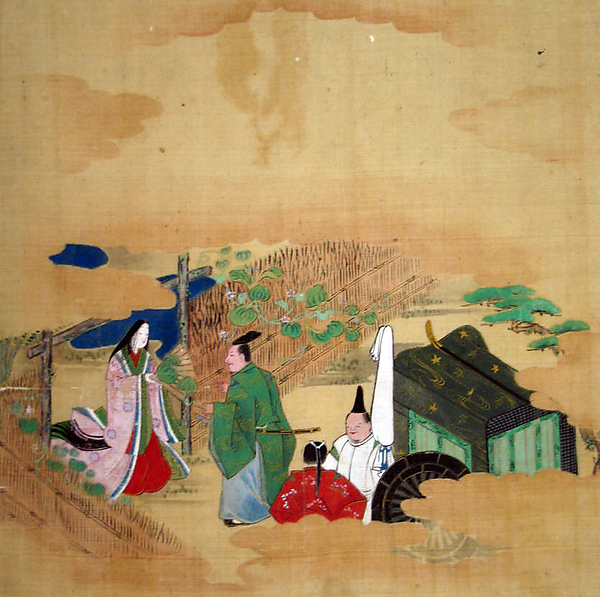
Tosa School, Scene from The Tale of Genji: Chapter 4, "Evening Face" (Yūgao), 17th century, Matted painting; ink and color on silk. The Metropolitan Museum of Art, Gift of Mrs. Morris Manges, in memory of her husband, Dr. Morris Manges, 1947, accession 47.56.
Look closer: Look at the chapter. The Met titles this matted painting on silk Evening Face, the fourth chapter.
Image: The Metropolitan Museum of Art, Open Access (CC0)
The robe of the emperor himself differs. The article describes the emperor's court dress as loose white trousers and a loose yellow outer robe decorated with patterns of the phoenix, the paulownia, bamboo and the kirin. When Emperor Akihito was enthroned in November 1990, Wikipedia records, he wore the imperial sokutai called Kōrozen no gohō, and Emperor Naruhito wore sokutai at his enthronement in 2019.
Purple to pale blue: the ladder of colour
In the sokutai the colour of the outer robe was the badge of rank. Wikipedia sets out the scale. The first to third ranks wore purple, the fourth rank maroon, the fifth crimson, the sixth dark green, the seventh light green and the eighth dark blue. Ranks below the eighth, the basic ranks, wore light blue. Persons without rank wore a muddy brown or a light yellow, and the darker, fuller yellow was reserved for the emperor.

Kubo Shunman, Court Lady on Veranda, 1796, Woodblock print (surimono); ink and color on paper. The Metropolitan Museum of Art, Purchase, Marjorie H. Holden Gift, 2012, accession 2012.248.16.
Look closer: Look at the date. The Met dates this surimono to 1796.
Image: The Metropolitan Museum of Art, Open Access (CC0)
The article adds a fact about the dye that explains why the top colours were so closely guarded. The highest-ranking shades were dyed with gromwell, a plant, and the process could take over a year. A colour that takes a year to produce is a colour that only a few can afford, and the ladder of colour was therefore also a ladder of cost. The same article records, with a note that the claim needs a citation, that the purple and maroon worn by top officials were changed to black sometime during the Heian period.
The habit of regulating court dress had its roots before the Heian court: the black lacquered caps were already regulated under Emperor Tenmu, as noted above, and the Heian court inherited the principle. For a reader of costume the lesson is a general one. Whenever a Japanese robe is described by a single colour and a rank, the colour is not decoration. It is an entry in a table.

Tosa Mitsusada, The Tale of Genji (Genji Monogatari), 17th century, Set of twenty-four album leaves; ink, color, and gold on paper. The Metropolitan Museum of Art, Gift of Mary L. Cassilly, 1894, accession 94.18.1a–xx.
Look closer: Look at the set. The Met records twenty-four album leaves by Tosa Mitsusada.
Image: The Metropolitan Museum of Art, Open Access (CC0)
The table also helps in reading pictures. A print of a courtier in a dark robe, a Noh actor in a robe of a certain colour, or a priest in white, each makes a statement that the viewer of the time could decode. The chapter on Noh Costume: Karaori, Atsuita and Mizugoromo describes how the stage turned these codes into costume types, and the chapter on Kesa, Kariginu and the Robes of Priests and Monks follows the white hunting robe into the shrine.
Red, white and ballooning legs
The legwear of the court was as particular as the robe. Wikipedia on the hakama names three kinds that belong to this world. The ōguchi-hakama, worn with sokutai, are red, with a closed crotch, and are tied at the wearer's left. The uenobakama are worn over them, white with an open fly and tied off on the right. The sashinuki, also called nu-bakama, blouse over the leg, exposing the foot, with a cord run through the hem and drawn tight. The earliest form, commonly worn in the Heian period, was cut like normal hakama; the more formal version has six panels instead of four, and court nobles wore them with leisure or semi-formal wear.

Man's Trousers (Hakama), 19th century, Silk & paper silver. The Metropolitan Museum of Art, Gift of George M. Lefferts, 1909, accession 09.188.
Look closer: Look at the material. The Met records silk with paper silver for these nineteenth-century men's trousers.
Image: The Metropolitan Museum of Art, Open Access (CC0)
The fourth kind is the long nagabakama. Wikipedia says samurai visiting the shogun or a high-ranking lord were sometimes required to wear them, that they were much longer front and back so as to form a train one or two feet long which impaired walking, and that they may have helped prevent surprise attacks. Today the article says they appear mainly in Noh and kabuki plays and in Shinto rituals. The women's version, trailing red, belongs to the jūnihitoe, and the article on that garment calls it the formal version of the hakama for noble women, a very long pleated red skirt with two split legs.

Iwasa school, The Tale of Genji, late 17th–early 18th century, Pair of six-panel screens: ink and color on paper. The Metropolitan Museum of Art, Mary and Cheney Cowles Collection, Gift of Mary and Cheney Cowles, 2023, accession 2023.583.14.1, .2.
Look closer: Look at the format. The Met records a pair of six-panel screens by the Iwasa school.
Image: The Metropolitan Museum of Art, Open Access (CC0)
The garments in this paragraph are the ancestors of a great deal that is still seen. The same hakama article reports that miko attire, with its bright red hakama, is said to stem from the Heian aristocratic women's look, that hakama were adopted as women's school wear in the Meiji and Taishō periods, and that they remain in use for graduation ceremonies. The history of the divided skirt in everyday life is told in Haori and Hakama: The Jacket and the Divided Skirt, and the ceremonial trousers of the warrior in Samurai Ceremonial Dress: Hitatare and Kamishimo.
The hunting robe that became formal
A third men's garment belongs beside the sokutai. The kariginu was, in the words of Wikipedia's article on the related priest's robe, the traditional hunting robe worn by nobles during the Heian period. The same article explains that the jōe, the pure cloth worn at Buddhist and Shinto ceremonies, is essentially a white kariginu, that it is usually white or yellow, and that it is made of linen or silk according to its type and use. Shinto priests wear it with a peaked cap, an undergarment called a hitoe, ballooning sashinuki trousers and a girdle, and may carry a ceremonial wand or a baton.
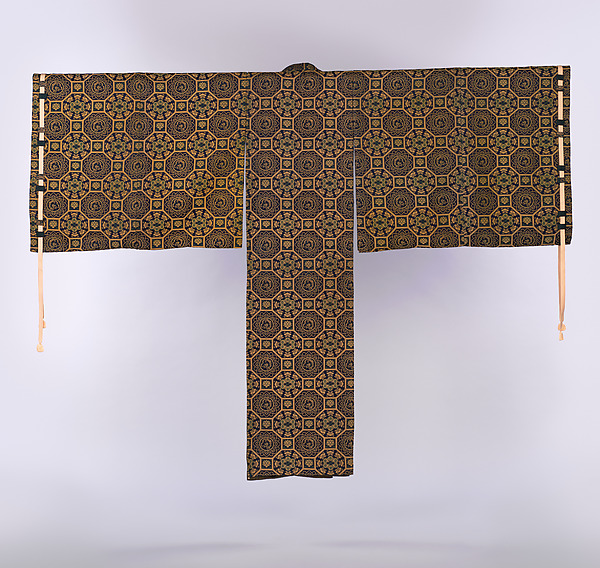
Noh Costume (Kariginu), first half 19th century, Twill-weave silk with supplementary weft patterning. The Metropolitan Museum of Art, Edward C. Moore Collection, Bequest of Edward C. Moore, 1891, accession 91.1.62.
Look closer: Look at the weave. The Met describes a twill-weave silk with supplementary weft for this Noh kariginu.
Image: The Metropolitan Museum of Art, Open Access (CC0)
The Metropolitan Museum holds a Japanese court kariginu of the nineteenth century, given by Sue Cassidy Clark in honour of Barbara Ford in 2003. It is silk, in three pieces: a robe measuring about 175 by 178 centimetres, a hat, and a belt about 175 centimetres long. The museum records that the set came with a Japanese paper wrapper inscribed sha go kariginu, meaning a gauze hunting robe, with a reference to the Lord Yoshida, an address in Kyoto and the name of a man, presumably the shop master, and a phrase indicating that all types of costume were sold at fixed prices. The museum offers no narrative label beyond that.
A second Japanese object in the Met's catalogue has the title Court Robe (Hōyeki-Hō): silk with gold, brocaded, of the Edo period, measuring about 127 by 216 centimetres, given by the Rogers Fund in 1912. The museum gives no description with it, and the house does not gloss the term further. The two objects together make one useful point. Japanese court robes survive in museum collections as three-piece sets and as large brocaded garments, and the labels that come with them are sparse.
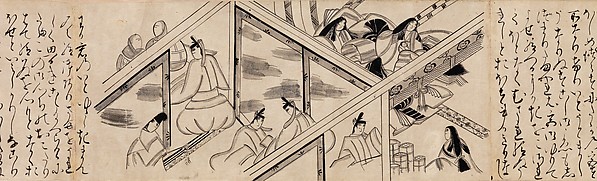
"Heartvine" ("Aoi") chapter from The Tale of Genji (Genji monogatari), 16th century, Handscroll; ink on paper. The Metropolitan Museum of Art, Mary Griggs Burke Collection, Gift of the Mary and Jackson Burke Foundation, 2015, accession 2015.300.29.
Look closer: Look at the date. The Met dates the handscroll to the sixteenth century.
Image: The Metropolitan Museum of Art, Open Access (CC0)
The Noh stage took the kariginu over as a costume. The Met's Noh costume of the first half of the nineteenth century, titled Kariginu, is a twill-weave silk with supplementary weft, and the chapter on Noh Costume: Karaori, Atsuita and Mizugoromo places the type among the costume families of the stage. The priest's use of the white form is the subject of Kesa, Kariginu and the Robes of Priests and Monks.
The twelve layers
The jūnihitoe is the better known garment, and it is not quite what its name says. Wikipedia explains that the formal name is itsutsuginu-karaginu-mo, a term used since the nineteenth century, that jūnihitoe is a common name applied retroactively, and that the number of layers varied despite the name. The garment first appeared, the article says, some time around the tenth century. Earlier styles had more layers, which could weigh up to twenty kilograms and make movement difficult.

Katsushika Hokusai, Court Lady, 18th–19th century, Ink and color on paper. The Metropolitan Museum of Art, Gift of Annette Young, in memory of her brother, Innis Young, 1956, accession 56.121.36.
Look closer: Look at the sleeves and hem. The Met records a court lady in ink and colour on paper by Hokusai, and the long sleeves and trailing hem are what mark her as a court figure.
Image: The Metropolitan Museum of Art, Open Access (CC0)
The article gives the parts in order. Undergarments are not counted as part of the jūnihitoe proper. The innermost robe is a kosode, short and red or white, and over it go the nagabakama, the long red pleated hakama. Then comes the hitoe, an unlined silk robe, usually red, white or blue-green. Over it go the itsutsuginu, the set of layered robes, usually five and sometimes six, in bright colours. Over those goes the uchiginu, a scarlet beaten silk robe worn as a stiffener and support, and then the uwagi, a patterned silk robe with woven decoration, shorter and narrower than the uchiginu, whose colour and fabric indicated the wearer's rank.
The last two parts make the garment formal. The karaginu is a waist-length jacket in the Chinese style, and the mo is an apron-like train skirt, white with dyed or embroidered decoration, worn trailing down the back and only for formal occasions. A shorter brocade robe, the kouchigi, could be worn over the uchigi or the uwagi on less formal occasions, but the karaginu and the mo are required for full formal dress. A thin, cordlike obi held the layers, nothing like the wide sash of later centuries.

Okumura Masanobu, Parody of Murasaki Shikibu at Her Desk, ca. 1710, Monochrome woodblock print (sumizuri-e); ink on paper. The Metropolitan Museum of Art, The Francis Lathrop Collection, Purchase, Frederick C. Hewitt Fund, 1911, accession JP682.
Look closer: Look at the title. The Met titles the sheet a parody of Murasaki Shikibu at her desk, about 1710.
Image: The Metropolitan Museum of Art, Open Access (CC0)
The Japanese government publication Highlighting Japan offers a complementary description. It states that the jūnihitoe originally had twelve or more layers, that five became standard around the end of the Heian period, that each layer shows only slightly at the collar, sleeve edges and hemline, and that five differently coloured robes called itsutsuginu are layered over a hitoe undergarment. The difference between the two accounts, twenty kilograms of earlier layers and five standard ones later, is itself the historical point.
Wikipedia adds a human detail: Heian ladies often slept in the innermost layers, the hakama and the kosode, as pyjamas, and could shed or keep layers depending on the season and the night's temperature. Over time the hakama and kosode became outerwear, and the kosode eventually developed into the modern kimono. The whole later history of Japanese dress in this almanac, from The Kimono Ladder: Furisode, Tomesode, Hōmongi and Komon to Obi and Its Companions: Scarf, Cord and Brooch, begins with the underwear of a Heian lady.
Long hair, powder and a drawn brow
The robe was only part of the picture. Wikipedia's article on the jūnihitoe describes the women's hair as very long, cut in a layered fashion at the sides of the face in a style called suberakashi, sometimes with a forehead ornament. The article on the Heian period adds that aristocrats powdered their faces and blackened their teeth, that women painted small red mouths, and that the eyebrows were plucked or shaved and redrawn higher on the forehead, a practice called hikimayu. Men's ideal included a faint moustache and a thin goatee.

Kubo Shunman, Court Lady by Old Plum Tree, 1796, year of the dragon, Woodblock print (surimono); ink and color on paper. The Metropolitan Museum of Art, Purchase, Marjorie H. Holden Gift, 2012, accession 2012.248.17.
Look closer: Look at the title. The Met titles the sheet Court Lady by Old Plum Tree and dates it to 1796, the year of the dragon.
Image: The Metropolitan Museum of Art, Open Access (CC0)
The blackening of the teeth, ohaguro, has its own article. Wikipedia says it is the custom of blackening the teeth with a solution of iron filings and vinegar, called kanemizu, that it first appeared among aristocrats of the Heian period, men and women alike, and that it began as a coming-of-age rite for adolescent girls and later spread to noblemen. The earliest written references come from the eleventh-century Tale of Genji. The government banned it for men in 1870, and in 1873 Empress Shōken appeared in public with white teeth, after which the custom gradually faded among married women and noblewomen.

Tsukioka Yoshitoshi, Murasaki Shikibu at Ishiyamadera Temple, based on the print “The Moon at Ishiyama,” from the series One Hundred Aspects of the Moon (Tsuki hyakushi: Ishiyama no tsuki), ca. 1892, Hanging scroll; ink and color on silk. The Metropolitan Museum of Art, Purchase, Ryo Toyonaga and Alvin E. Friedman-Kien Gift, 2019, accession 2019.41.
Look closer: Look at the setting. The Met titles the sheet Murasaki Shikibu at Ishiyamadera Temple, about 1892.
Image: The Metropolitan Museum of Art, Open Access (CC0)
Today, the article says, ohaguro survives mainly in festivals, period films, kabuki, and among apprentice geisha during their final stage of apprenticeship. The costume of the apprentice is described in Geisha, Maiko and Oiran: The Costume of the Quarter. The face and the dress of the Heian lady were designed together, and a reader who looks at a print of a court lady should read the eyebrows and the sleeves as parts of a single image.
Layers named for flowers
The colour language of the women's robes is called kasane no irome, literally the layers of colours. Wikipedia explains that each combination was named after the flora or fauna of its season, and that the colours did not exactly reproduce nature but aimed to evoke a feeling of the season. Two examples in the article make the idea concrete: a set called crimson plum of the spring, and a set called under the snow, in which green stood for leaves, pink layers lay beneath and white on top was the snow.

Kubo Shunman, Young Court Lady, 19th century, Woodblock print (surimono); ink and color on paper. The Metropolitan Museum of Art, H. O. Havemeyer Collection, Bequest of Mrs. H. O. Havemeyer, 1929, accession JP1994.
Look closer: Look at the sleeve edges. The Met records a young court lady in a nineteenth-century surimono, and the bands of colour at the sleeve are the way a painter suggests layered robes.
Image: The Metropolitan Museum of Art, Open Access (CC0)
The government publication adds that Heian nobles created the charts, covering more than a hundred possible colour patterns, and that both women and men at the imperial court used them. It describes one combination, kobai no nioi, which uses five layers: one red layer blends into four progressively lighter pink shades, a pattern suited to special occasions celebrated in early spring, produced with safflower and other natural pigments. A white outer layer over a red inner layer gives a pale red tone, like cherry blossom.
The second half of the system was timing. Wikipedia says colour schemes changed with seasons and occasions, that changing robes just before a season's turn was considered fashionable, and that using the colours appropriately and changing at the right time showed a wearer's refined taste. Only the sleeve edges, the hems and the neckline showed the layers. Sheer fabrics in summer created new colour effects.

Suzuki Harunobu, Koshikibu no Naishi (999–1025), from "Hyakunin Isshu" (One Hundred Poems by One Hundred Poets), ca. 1768, Woodblock print; ink and color on paper. The Metropolitan Museum of Art, Gift of Estate of Samuel Isham, 1914, accession JP871.
Look closer: Look at the title. The Met names the poet Koshikibu no Naishi, with the dates 999 to 1025.
Image: The Metropolitan Museum of Art, Open Access (CC0)
This is the historical source of the seasonal discipline that runs through later Japanese dress, set out in Seasons and Occasions: What to Wear When. It also explains the dyes: the red of safflower and the purples of the court were costly and slow, and the vocabulary of the dyer's craft, treated in Aizome: The Indigo Dyer’s Craft and Yūzen: The Painted Kimono, grows from the same preoccupation with a precise colour at a precise moment.
The system also explains the women's pictures that follow. A print by Torii Kiyonaga, now at the Met, shows Ono no Komachi, the Heian poet, in formal twelve-layer court robes; the museum's account says subtle shades of green, orange, pink and yellow would have signalled her refined taste, and that, because her face is drawn with the simplified features of Heian painting, she is identified mainly by the cherry blossoms on her robe. The colour, in other words, was the portrait.
What a visitor could see
The Heian lady lived largely out of sight, and her dress was designed for that. Wikipedia says women sat behind a blind, called a sudare, so that only the lower body and the sleeve edges were visible, that the layers and colours represented the woman and indicated her taste and rank, and that suitors communicated with women behind the blind, seeing only the sleeves and the layers. The article attributes the practice to the Tale of Genji, with a note that the claim needs a citation, and the house reports it with that caution.

Scenes from the Tale of Genji, 17th century, Six-panel folding screen; ink, color, and gold on paper. The Metropolitan Museum of Art, Gift of Jane Phyllis Krauss, 1986, accession 1986.154.
Look closer: Look at the format. The Met records a six-panel folding screen of the seventeenth century, with ink, colour and gold on paper.
Image: The Metropolitan Museum of Art, Open Access (CC0)
The same page describes the hiōgi, an elaborate fan of painted cypress slats tied with long silk cords, which cooled the wearer and served as a means of shielding herself from inquiring looks, since women could not speak face to face with male outsiders. The chapter on Sensu and Uchiwa: The Fan in Dress describes the fan in later dress.
The Tale of Genji is the great record of this world. Wikipedia on the book notes that women in the story are often identified by the colour of their clothing rather than by name, and gives the facts of the work: fifty-four chapters, finished in its present form by 1021, with the oldest reference to the tale in Murasaki Shikibu's diary entry of 1 November 1008, a date now kept in Japan as Classics Day. The article on Murasaki Shikibu notes that her diary covers about 1008 to 1010, that she entered Empress Shōshi's court as a lady-in-waiting about 1005 or 1006, and that emotions and seasons were expressed through layering clothing in pleasing colour combinations.
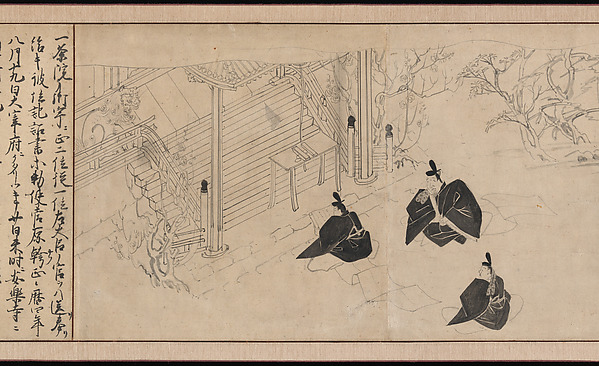
Courtiers Visit Sugawara no Michizane’s Mortuary Temple, from Illustrated Legends of the Kitano Tenjin Shrine, ca. 1300, Section of a handscroll, from a set; ink on paper. The Metropolitan Museum of Art, Mary Griggs Burke Collection, Gift of the Mary and Jackson Burke Foundation, 2015, accession 2015.300.17.
Look closer: Look at the date. The Met dates the scene to about 1300.
Image: The Metropolitan Museum of Art, Open Access (CC0)
The earliest surviving illustrated Genji is a twelfth-century picture scroll. Wikipedia dates it likely to about 1120 to 1140, records that about fifteen per cent of the original survives, comprising nineteen paintings, sixty-five text sheets and nine pages of fragments, and says the surviving parts are held at the Tokugawa Art Museum in Nagoya and the Gotoh Museum in Tokyo, both groups being National Treasures. The faces follow the technique called hikime kagibana, slit eyes and a hooked nose, with no face shown fully frontal. The article on the scroll does not discuss its costumes, and the house does not either; the point is that the faces were deliberately similar, so that the robes and the setting did the distinguishing.
Later centuries copied the Genji endlessly, and the Met holds many of these copies, from a sixteenth-century handscroll to seventeenth-century screens and albums and the Edo prints that follow.
The court as the Edo period imagined it
By the time the Edo artists drew them, the Heian robes were an antique. The pictures are therefore evidence of how the court was remembered, not of how it dressed. Kubo Shunman's surimono of 1796 in the Met show a court lady on a veranda, a court lady by an old plum tree, a seated courtier with two court ladies by plum and pine, a courtier and a lady with a young woman poling a boat, and a courtier and a young attendant gazing at a landscape. Surimono were privately published prints, and the Met's records for these sheets give the date and the maker.

Yōshū (Hashimoto) Chikanobu, “Ceremonial Attire” from the series An Array of Auspicious Customs of Eastern Japan (Azuma fūzoku, fukuzukushi: Tairei fuku), ca. 1889, Triptych of woodblock prints; ink and color on paper. The Metropolitan Museum of Art, Gift of Lincoln Kirstein, 1959, accession JP3198.
Look closer: Look at the grouped figures. The Met titles this triptych Ceremonial Attire, and dates it to about 1889.
Image: The Metropolitan Museum of Art, Open Access (CC0)
A little later come a young court lady and a courtier playing a flute to accompany a bugaku dance, both by Shunman, and a court lady praising the plum blossom by Yanagawa Shigenobu, dated 1830, and a court lady looking at a blooming cherry tree by Yashima Gakutei. Hokusai also drew a court lady, in ink and colour on paper. Kobayashi Kiyochika's triptych of a Heian courtier on a moonlit beach is of the nineteenth century, and Chikanobu's triptych of about 1889, titled Ceremonial Attire, comes from the series An Array of Auspicious Customs of Eastern Japan.
The decorative arts took the figure up as well. The Met has a box in the shape of a court lady in gold maki-e and coloured lacquer of the eighteenth century, a porcelain dish in the shape of a Japanese court woman of about 1780, and a dish with a court lady by the gate of a Shinto shrine from the 1650s and 1660s. These are small objects, and they show how widely the image of the long-sleeved, long-trained lady had spread.
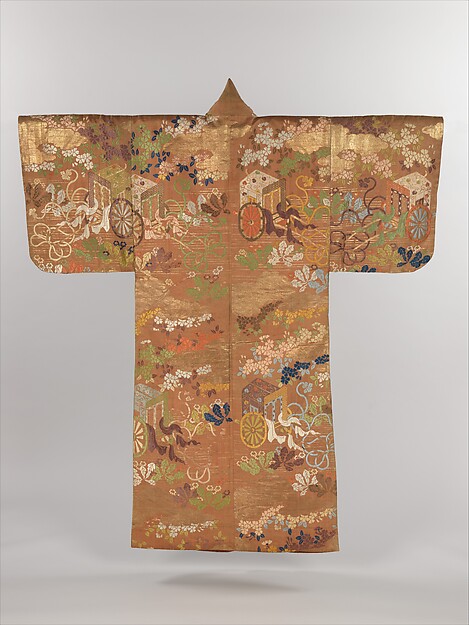
Noh Costume (Karaori) with Court Carriages, Cherry Blossoms, and Dandelions, late 18th–first half of the19th century, Twill-weave silk brocade with supplementary-weft patterning in metallic thread. The Metropolitan Museum of Art, The Howard Mansfield Collection, Gift of Howard Mansfield, 1936, accession 36.120.689.
Look closer: Look at the carriages. The Met titles this Noh costume for its court carriages, cherry blossoms and dandelions.
Image: The Metropolitan Museum of Art, Open Access (CC0)
A reader learns from this body of prints two things. The first is that the Heian court dress became a visual language, a shorthand for elegance. The second is that the later versions are simplified: the layered edges of colour and the trailing train are what the artist keeps, because they are what the viewer recognises. The accurate record is the garments themselves, and those survive mostly in the houses of the court and in the shrines.
Where the robes walk today
The Heian robes appear in public on fixed days. Wikipedia on the Aoi Matsuri, the Kamo festival, records that it is held on 15 May each year and is one of Kyoto's three main annual festivals, with the Jidai Matsuri and the Gion Festival. Its procession starts at 10:30 from the Kyoto Imperial Palace and travels to Shimogamo and Kamigamo shrines, led by the Imperial Messenger, and includes two oxcarts, four cows, thirty-six horses and about six hundred people, all wearing Heian-period noble dress. The oxcart is decorated with artificial wisteria flowers.
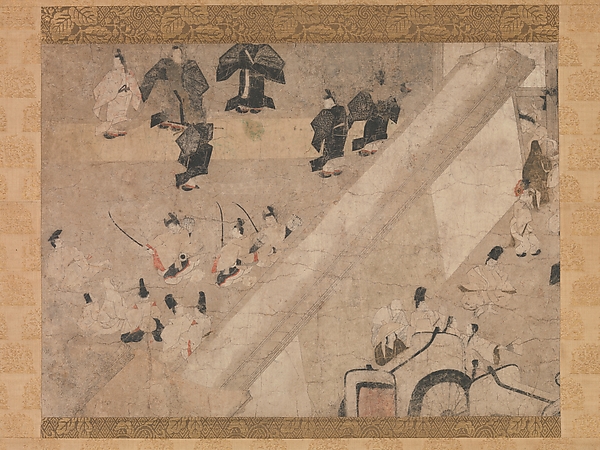
"Imperial Visit to the Great Horse Race at the Kaya-no-in Mansion" from the Tale of Flowering Fortunes, 13th–14th century, Handscroll segment mounted as a hanging scroll; ink and color on paper. The Metropolitan Museum of Art, The Harry G. C. Packard Collection of Asian Art, Gift of Harry G. C. Packard, and Purchase, Fletcher, Rogers, Harris Brisbane Dick, and Louis V. Bell Funds, Joseph Pulitzer Bequest, and The Annenberg Fund Inc. Gift, 1975, accession 1975.268.32.
Look closer: Look at the figures in court dress. The Met dates this hanging scroll, a segment from the Tale of Flowering Fortunes, to the thirteenth to fourteenth century.
Image: The Metropolitan Museum of Art, Open Access (CC0)
The central woman of the festival is the Saiō-dai. Historically an unmarried imperial woman chosen from the emperor's sisters or daughters to serve at Shimogamo, she is today an unmarried Kyoto woman, selected, the article says, for wisdom, grace and social standing, and described as holding the highest honour a woman can receive in Kyoto. She wears the twelve layers of silk robes and undergoes purification ceremonies. The article gives the history: the festival began, according to the Nihon Shoki, under Emperor Kinmei, was made an annual imperial event by Emperor Kanmu in the ninth century, peaked in the mid-Heian period, was discontinued in the Sengoku period, was revived in the Genroku era, was halted in 1869 when the capital moved to Tokyo, was revived in 1885, and resumed its full procession in 1953. The Saiō-dai tradition began in 1956.
The article on the jūnihitoe names the Saiō Matsuri, held every year in Meiwa in Mie Prefecture, as a showcase of Heian-period dress, and the article on the Heian period names the Hinamatsuri, the Doll Festival of 3 March, among the places where Heian dress persists. Wikipedia describes the Hinamatsuri dolls as wearing the traditional court dress of the Heian period and representing a Heian-period wedding, usually described as the emperor and empress. The male doll holds a ritual baton and the female a fan. The dolls represent court positions, and some Meiji-era dolls depict Emperor Meiji and Empress Shōken. The festival's name became official in 1687, according to the article.

Box in the Shape of a Court Lady, 18th century, Gold maki-e and colored lacquer on lacquered wood. The Metropolitan Museum of Art, Gift of Mrs. George A. Crocker (Elizabeth Masten), 1937, accession 38.25.156a, b.
Look closer: Look at the form. The Met describes a box in the shape of a court lady.
Image: The Metropolitan Museum of Art, Open Access (CC0)
The Kyoto celebration of 2008, the thousandth anniversary of the Genji, was marked, Wikipedia says, by modern women wearing the twelve-layered robe. The effect of all these occasions is the same: a garment that left daily life in the Heian period survives as a costume that people agree to wear, once a year, because it still means something.
Enthronements and weddings
The most solemn use of the robes is at the imperial house. Wikipedia on the jūnihitoe states that the Imperial Household still uses it at important functions, usually the coronation of an emperor and empress, while men wear sokutai. It records that Empress Masako wore it for the official ceremony of her wedding to the Crown Prince, that Empress Michiko wore it at the 1990 enthronement of Emperor Akihito in a style described as a modified Edo-period form, not the Heian style (a statement marked as needing a citation), and that at the 2019 enthronement of Emperor Naruhito the imperial women and their ladies-in-waiting wore jūnihitoe, while the emperor, Crown Prince Akishino and their gentlemen-in-waiting wore sokutai.
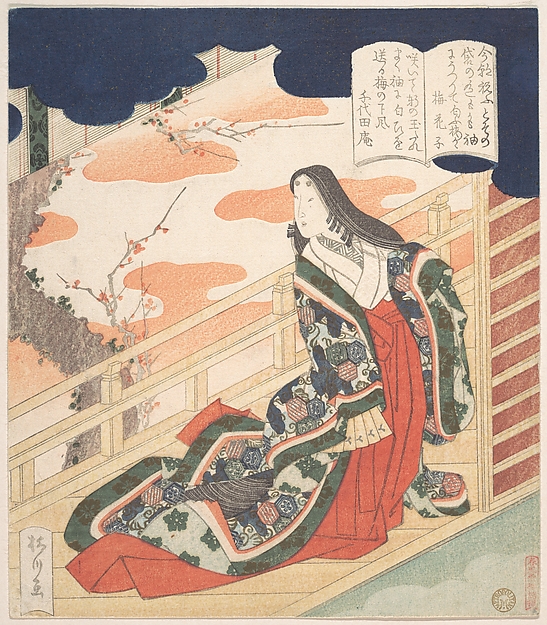
Yanagawa Shigenobu, Court Lady Praising the Plum Blossom, 1830, Woodblock print (surimono); ink and color on paper. The Metropolitan Museum of Art, Rogers Fund, 1921, accession JP1245.
Look closer: Look at the date. The Met dates the sheet to 1830.
Image: The Metropolitan Museum of Art, Open Access (CC0)
The sokutai article agrees on the men's side. It says the garment is preserved as formal wear for male members of the imperial court, including the imperial family, and for government officials such as the prime minister, that it is reserved for the most formal occasions such as weddings and enthronement ceremonies, and that women such as an empress or princess wear the jūnihitoe on such occasions.

Dish in Shape of Japanese Court Woman, ca. 1780, Porcelain decorated with colored enamels over transparent glaze (Hizen ware; Imari type). The Metropolitan Museum of Art, Gift of Mrs. V. Everit Macy, 1923, accession 23.225.151.
Look closer: Look at the shape. The Met dates the porcelain dish to about 1780.
Image: The Metropolitan Museum of Art, Open Access (CC0)
These are public events, and the garments are made by specialists. The sources read for this chapter do not describe who makes them, and the house does not guess. The reader who wishes to see a court robe in use should look for photographs of the 1990 and 2019 ceremonies, or visit a museum of costume in Kyoto; the house recommends consulting the Imperial Household Agency's own information for the details of any ceremony.
Four tales from the layered court
The pyjamas that became the kimono. The innermost layers of the Heian lady, the hakama and the kosode, were worn as sleepwear, according to Wikipedia. Over centuries the undergarment moved outward, and the kosode became the ancestor of the modern kimono. The most famous garment in the world began as what a lady wore to bed.

Yashima Gakutei, Court Lady Looking at a Blooming Cherry-Tree, 19th century, Woodblock print (surimono); ink and color on paper. The Metropolitan Museum of Art, H. O. Havemeyer Collection, Bequest of Mrs. H. O. Havemeyer, 1929, accession JP2061.
Look closer: Look at the title. The Met titles the sheet Court Lady Looking at a Blooming Cherry-Tree.
Image: The Metropolitan Museum of Art, Open Access (CC0)
The dye that took a year. The purples of the highest ranks were dyed with gromwell, a process that could take over a year. A courtier in the highest purple was wearing a year's labour, and the colour told every other courtier how much it had cost.
The empress with white teeth. In 1873, Wikipedia records, Empress Shōken appeared in public with white teeth. The Heian custom of blackened teeth, which the government had banned for men three years earlier, began to fade among married women and noblewomen from that moment.

Court Robe (Hōyeki-Hō), Silk; gold / Brocaded. The Metropolitan Museum of Art, Rogers Fund, 1912, accession 12.134.14.
Look closer: Look at the scale. The Met records a brocaded silk robe of the Edo period measuring about 127 by 216 centimetres.
Image: The Metropolitan Museum of Art, Open Access (CC0)
The twenty-kilogram robe. Earlier styles of the jūnihitoe had more layers, which could weigh up to twenty kilograms and make movement difficult. The standard five-layer form of the end of the Heian period is, in this light, a practical reform made by the wearers.
Small surprises from the palace
Short facts from the sources, each given as the source gives it.
- The formal name of the jūnihitoe, itsutsuginu-karaginu-mo, has been used only since the nineteenth century.
- The emperor carries an ivory shaku, as Chinese emperors did.
- The highest ranks wore purple dyed with gromwell, a process that could take over a year.
- The ōkuchi-hakama of the sokutai are tied on the left, and the white uenobakama on the right.
- A Heian lady could keep or shed layers according to the night's temperature.
- The hiōgi fan is made of painted cypress slats tied with long silk cords.
- Heian nobles produced colour charts covering more than a hundred patterns.
- The Aoi Matsuri procession of 15 May has about six hundred participants, thirty-six horses and two oxcarts.
- The Saiō-dai tradition of the festival began in 1956.
- The Hinamatsuri dolls wear Heian court dress and represent a wedding.
- The Genji picture scroll survives at about fifteen per cent of its original size.
- The Met's court kariginu came with a paper wrapper inscribed sha go kariginu, a gauze hunting robe.
Words from the palace
The terms used in this chapter, with the garment or custom each names.
| Term | Meaning | Where it appears |
|---|---|---|
| Sokutai | Formal court dress of men | Men |
| Jūnihitoe | Formal court dress of women, formally itsutsuginu-karaginu-mo | Women |
| Hō | Outer robe of the sokutai, from the Chinese round-collared robe | Men |
| Kanmuri | The black lacquered silk cap with a pennon | Men |
| Shaku | Flat ritual baton, ivory for the emperor | Men |
| Ōkuchi-hakama | Long red hakama, tied on the left | Trousers |
| Uenobakama | White hakama with an open fly, tied on the right | Trousers |
| Sashinuki | Hakama blousing over the leg with a hem cord | Trousers |
| Nagabakama | Long hakama with a trailing train | Trousers |
| Kariginu | The Heian hunting robe | The field |
| Jōe | The white kariginu worn by priests | The field |
| Itsutsuginu | The five coloured layered robes | Women |
| Uchiginu | Scarlet beaten silk stiffener | Women |
| Uwagi | Patterned silk over-robe indicating rank | Women |
| Karaginu | Waist-length Chinese-style jacket | Women |
| Mo | Trailing apron-like train skirt | Women |
| Kouchigi | Shorter brocade robe for less formal occasions | Women |
| Kasane no irome | Named layered colour combinations | Colour |
| Suberakashi | The long layered women's hair | Appearance |
| Hikimayu | Eyebrows redrawn high on the forehead | Appearance |
| Ohaguro | Blackened teeth | Appearance |
| Sudare | The blind behind which a lady sat | Behind the blind |
| Hiōgi | Fan of painted cypress slats | Behind the blind |
| Saiō-dai | The woman of the Aoi Matsuri who wears the twelve layers | Processions |
Court dress in the present
Court dress is no longer worn daily, and the sources are consistent on that. Wikipedia says the jūnihitoe can now mostly be seen in museums, films, costume demonstrations, tourist sites and some festivals, and that the sokutai is no longer everyday clothing. What has survived is a repertoire of occasions: the enthronement, the wedding, the Kamo procession, the Saiō Matsuri in Mie and the doll display of March.

Kubo Shunman, Seated Courtier with Two Court Ladies by Plum and Pine, 1796, Woodblock print (surimono); ink and color on paper. The Metropolitan Museum of Art, Purchase, Marjorie H. Holden Gift, 2012, accession 2012.248.15.
Look closer: Look at the grouping. The Met titles the sheet Seated Courtier with Two Court Ladies by Plum and Pine.
Image: The Metropolitan Museum of Art, Open Access (CC0)
The dress also lives in the vocabulary of other garments. The red of the miko hakama, the hunting robe worn by the shrine priest, the pleated train of the Noh stage and the trailing hakama of the kabuki dance each descend from the court. The lines can be traced through Kesa, Kariginu and the Robes of Priests and Monks for the shrine, Noh Costume: Karaori, Atsuita and Mizugoromo for the stage and Shichi-Go-San and the Clothes of Childhood Rites for the clothes of the child's rites.
For a reader wishing to see the robes, the best course is a procession or a museum. The house's pages on Japanese art and performance, including the house article on Noh and The Performing Arts Almanac, describe the stages on which court costume is still seen.
What to ask of a court textile
Court dress is rare on the market, and descriptions are often loose. The first caution comes from the Met's own catalogue. When the department of Asian art lists a robe as a court robe, the object is very often Chinese, as the many Chinese court robes in the catalogue show; the Japanese court pieces, such as the nineteenth-century kariginu with its belt and hat, are labelled as Japanese. A reader should therefore ask for the country, the date range and the type of the piece before the description.

Kubo Shunman, Courtier and Lady with a Young Woman Poling a Boat, 1796, Woodblock print (surimono); ink and color on paper. The Metropolitan Museum of Art, Purchase, Marjorie H. Holden Gift, 2012, accession 2012.248.14.
Look closer: Look at the boat. The Met titles the sheet Courtier and Lady with a Young Woman Poling a Boat.
Image: The Metropolitan Museum of Art, Open Access (CC0)
The second question is function. A robe sold as court dress may be a Noh costume, a priest's robe, a doll's robe or a theatrical piece, and each of these has its own chapter in this almanac. The kariginu of the stage is described in Noh Costume: Karaori, Atsuita and Mizugoromo, the shrine and temple robes in Kesa, Kariginu and the Robes of Priests and Monks, and the colours and fibres in Silk, Hemp, Cotton and Ramie: The Fibres of Japanese Dress and How to Read, Grade and Care for a Japanese Garment. The house does not describe any piece as court-worn without records that support it.
The third question is condition. Silk robes of the court were made of fine, often sheer fabric, and the condition scale and care advice in How to Read, Grade and Care for a Japanese Garment apply. A reader considering a piece should ask for fibre, weave, decoration, date range and condition, and treat any claim of an imperial or aristocratic owner as one to be checked. The concierge desk can compare a piece with a museum record on request.
The house shelf carries Noh masks and Noh costume pieces, the stage descendants of court dress, which are described as what they are on their own pages.
Neighbouring chapters
Court dress touches most of the costume chapters. The stage versions are in Noh Costume: Karaori, Atsuita and Mizugoromo and Kabuki Costume: Hikinuki and the Onnagata Layers, the hunting robe in Kesa, Kariginu and the Robes of Priests and Monks, the dress of the warrior who displaced the court in Samurai Ceremonial Dress: Hitatare and Kamishimo, and the dress of the quarter in Geisha, Maiko and Oiran: The Costume of the Quarter. The vocabulary is gathered in Glossary of Japanese Dress and Textile Terms.

Kubo Shunman, Courtier and Young Attendant Gazing at a Landscape, 1796, Woodblock print (surimono); ink and color on paper, textured ground. The Metropolitan Museum of Art, Purchase, Marjorie H. Holden Gift, 2012, accession 2012.248.22.
Look closer: Look at the pair. The Met titles the sheet Courtier and Young Attendant Gazing at a Landscape.
Image: The Metropolitan Museum of Art, Open Access (CC0)
Among the house's other pages, The Warrior and Floating World Almanac describes the world that followed the court, Ukiyo-e Art the prints in which the court was remembered, and Gagaku and Bugaku: The Court Music and Dance the music and dance that the court kept alive.
Stage and silk in the house
The shelf holds Noh masks and a brocade textile, the descendants and companions of court dress. Each is described as what it is, with its age, maker and condition set out on its own page.


Noh masks and the stage
The house's collection of Noh masks and related pieces is the stage companion to this chapter, and the concierge desk can look for related pieces on request.
Answered plainly
What is the sokutai?
The formal court dress of men, worn only by courtiers, aristocrats and the emperor, originating in the Heian period.
What is the jūnihitoe?
The formal court dress of noble women and ladies-in-waiting, formally called itsutsuginu-karaginu-mo.
Does the jūnihitoe really have twelve layers?
No. The number varied despite the name; five coloured robes became standard around the end of the Heian period.
How heavy was the jūnihitoe?
Earlier styles with more layers could weigh up to 20 kg, according to Wikipedia.
What did colours mean in the sokutai?
Rank: purple for the first to third ranks, maroon for the fourth, crimson for the fifth, dark and light green for the sixth and seventh, blues for the eighth and below.
What is kasane no irome?
Named combinations of layered colours, based on the plants and animals of a season, used by women and men at the Heian court.
When was the Heian period?
From 794 to 1185, with the capital at Heian-kyō, modern Kyoto.
What is a kariginu?
The traditional hunting robe of Heian nobles; the white priest's jōe is essentially a white kariginu.
What is the mo?
A trailing apron-like train skirt, white with dyed or embroidered decoration, worn only for formal occasions.
Why did Heian ladies sit behind a blind?
They could not speak face to face with male outsiders, and only their sleeve edges and hems showed, so the layers spoke for them.
What is ohaguro?
The custom of blackening the teeth with iron filings and vinegar, begun among Heian aristocrats.
Is court dress still worn?
Yes. It was worn at the enthronement of Emperor Naruhito in 2019, and appears at Kyoto festivals such as the Aoi Matsuri.
What is the Saiō-dai?
The woman at the Aoi Matsuri who wears the twelve layers of silk robes; today an unmarried Kyoto woman, a role begun in 1956.
What do the Hinamatsuri dolls wear?
The court dress of the Heian period, representing a wedding; the male doll holds a baton and the female a fan.
What did the emperor wear?
A loose yellow outer robe with patterns of the phoenix, paulownia, bamboo and kirin, and an ivory shaku.
Is every Met court robe Japanese?
No. Many court robes in the Met's Asian art catalogue are Chinese; check the country field.
Where next
Sources and image credits
- Jūnihitoe, Wikipedia
- Sokutai, Wikipedia
- Jōe (kariginu), Wikipedia
- Hakama, Wikipedia
- Heian period, Wikipedia
- Japanese clothing, Wikipedia
- Murasaki Shikibu, Wikipedia
- The Tale of Genji, Wikipedia
- Genji Monogatari Emaki, Wikipedia
- Ohaguro, Wikipedia
- Aoi Matsuri, Wikipedia
- Hinamatsuri, Wikipedia
- Highlighting Japan, October 2020, Government of Japan
- Kanjo: A Court Lady, Metropolitan Museum of Art
- Man's Court Robe (Kariginu) with Belt and Hat, Metropolitan Museum of Art
- Court Robe (Hōyeki-Hō), Metropolitan Museum of Art
- Noh Costume (Kariginu), Metropolitan Museum of Art
- Object record: Heian Period Courtier on a Moonlit Beach, The Metropolitan Museum of Art
- Object record: Male and Female Shinto Deities, The Metropolitan Museum of Art
- Object record: Courtier Playing a Flute to Accompany a Bugaku Dance, The Metropolitan Museum of Art
- Object record: Shinto Deity as a Seated Courtier, The Metropolitan Museum of Art
- Object record: Twelve Scenes from The Tale of Genji, The Metropolitan Museum of Art
- Object record: Scene from The Tale of Genji: Chapter 4, "Evening Face" (Yūgao), The Metropolitan Museum of Art
- Object record: Court Lady on Veranda, The Metropolitan Museum of Art
- Object record: The Tale of Genji (Genji Monogatari), The Metropolitan Museum of Art
- Object record: Man's Trousers (Hakama), The Metropolitan Museum of Art
- Object record: The Tale of Genji, The Metropolitan Museum of Art
- Object record: "Heartvine" ("Aoi") chapter from The Tale of Genji (Genji monogatari), The Metropolitan Museum of Art
- Object record: Court Lady, The Metropolitan Museum of Art
- Object record: Parody of Murasaki Shikibu at Her Desk, The Metropolitan Museum of Art
- Object record: Court Lady by Old Plum Tree, The Metropolitan Museum of Art
- Object record: Murasaki Shikibu at Ishiyamadera Temple, based on the print “The Moon at Ishiyama,” from the series One Hundred Aspects of the Moon (Tsuki hyakushi: Ishiyama no tsuki), The Metropolitan Museum of Art
- Object record: Young Court Lady, The Metropolitan Museum of Art
- Object record: Koshikibu no Naishi (999–1025), from "Hyakunin Isshu" (One Hundred Poems by One Hundred Poets), The Metropolitan Museum of Art
- Object record: Scenes from the Tale of Genji, The Metropolitan Museum of Art
- Object record: Courtiers Visit Sugawara no Michizane’s Mortuary Temple, from Illustrated Legends of the Kitano Tenjin Shrine, The Metropolitan Museum of Art
- Object record: “Ceremonial Attire” from the series An Array of Auspicious Customs of Eastern Japan (Azuma fūzoku, fukuzukushi: Tairei fuku), The Metropolitan Museum of Art
- Object record: Noh Costume (Karaori) with Court Carriages, Cherry Blossoms, and Dandelions, The Metropolitan Museum of Art
- Object record: "Imperial Visit to the Great Horse Race at the Kaya-no-in Mansion" from the Tale of Flowering Fortunes, The Metropolitan Museum of Art
- Object record: Box in the Shape of a Court Lady, The Metropolitan Museum of Art
- Object record: Court Lady Praising the Plum Blossom, The Metropolitan Museum of Art
- Object record: Dish in Shape of Japanese Court Woman, The Metropolitan Museum of Art
- Object record: Court Lady Looking at a Blooming Cherry-Tree, The Metropolitan Museum of Art
- Object record: Seated Courtier with Two Court Ladies by Plum and Pine, The Metropolitan Museum of Art
- Object record: Courtier and Lady with a Young Woman Poling a Boat, The Metropolitan Museum of Art
- Object record: Courtier and Young Attendant Gazing at a Landscape, The Metropolitan Museum of Art
Last reviewed 28 October 2026. Pictures, where shown, are public-domain or open-access and credited beneath each one.
Looking for a Noh costume, a stage-related textile or a kimono related to the world described here? The concierge desk replies within one to three business days.
Private concierge
Looking for something in particular?
Describe the piece or the project you have in mind. A senior advisor in Tokyo reads every case file personally and replies within two business days, with fees set out in writing before any work begins.