
The Kimono Ladder: Furisode, Tomesode, Hōmongi and Komon
Garments · Formality, rung by rung
The Kimono Ladder: Furisode, Tomesode, Hōmongi and Komon
着物
A kimono looks like a single garment, yet it is a language. The length of a sleeve, the number of crests and the place where a pattern crosses a seam tell a Japanese reader who is wearing it and for what occasion.
Fact sheet
The ladder in one glance
- Furisode. The highest formality for unmarried women, with long swinging sleeves.
- Tomesode. Hem-only designs for married women, black with crests or coloured.
- Hōmongi and tsukesage. Visiting wear and its quieter cousin, ranked by whether the pattern flows across the seams.
- Iromuji and komon. The plain tea-room silk and the small-patterned everyday kimono.
- Yukata and mofuku. The unlined summer cotton at one end, the black mourning silk at the other.
Why one garment holds so many ranks
Stand a furisode beside a komon and the difference is not subtle. The first sweeps almost to the floor at the sleeve; the second is a quiet repeat of tiny forms, made to be worn to market. Between them lie a dozen named steps of formality, and every one of them is cut from the same rectangle of cloth.

Long-Sleeved Kimono (Furisode) with Hydrangeas and Cherry Blossoms, early 20th century, Resist-dyed and painted silk satin. The Metropolitan Museum of Art, Purchase, Roy R. and Marie S. Neuberger Foundation Inc. and several members of The Chairman's Council Gifts, 2000 Benefit Fund, and funds from various donors, 2001, accession 2001.428.51.
Look closer: Follow the pattern across the hem and up the sleeve. A furisode is designed as one continuous picture, so the artist can use the whole height of the garment.
Image: The Metropolitan Museum of Art, Open Access (CC0)
That rectangle is the key to the whole garment. Wikipedia’s account describes a kimono traditionally cut from a single bolt, a tanmono, about 11.5 metres long and 36 centimetres wide for a woman, and slightly longer and wider for a man. The Google Arts and Culture history of the kimono gives a similar bolt, commonly 0.38 by 13 metres, divided into eight parts: two sleeves, front and back body, and the collar and overlap panels. Either way the principle is the same. The panels are straight, the selvedges stay in the seam allowances, and the garment can be unpicked and resewn, which is why a fine kimono can pass through several generations of a family and several changes of figure.

Furisode, 19th century, Possibly beni-dyed light red (orange) silk, figured satin weave, embroidered and couched in silvered and gilt metallic thread (wound around a white silk fiber core). Needlework in satin stitch in shades of green, dark blue, off-white, and light brown; areas of padding; yuzen dyeing, and stenciled imitation tie-dyeing throughout.. The Metropolitan Museum of Art, Robert Lehman Collection, 1975, accession 1975.1.2452.
Look closer: Beni is the safflower red. Look at how the colour reads warmer than the later chemical reds.
Image: The Metropolitan Museum of Art, Open Access (CC0)
The name has a history too. Until the Edo period, garments of this kind were collectively called kosode, ‘small sleeve’. The kosode began as an undergarment; from the later Heian period it became outerwear, and by the Muromachi period (1336 to 1573) it was held closed by an obi instead of a hakama. In the Edo period, the Tokyo Metropolitan Library notes, city people of every age, sex, trade and class wore the kosode as outerwear, and it kept the same basic form throughout. Sources differ on exactly when the word ‘kimono’ took over; the Arts and Culture history links the change to the Meiji era, when social classes were levelled.
Eight panels and a handful of named parts
A short vocabulary opens every conversation about the garment. The sode is the sleeve and the tamoto the hanging pocket of the sleeve; the eri is the collar and the okumi the front overlap panel; the hakkake is the lining at the hem and lower body. The crest positions, kamon, are placed according to formality. Each of these terms appears in the older glossary of kimono terms, and the fuller Glossary of Japanese Dress and Textile Terms extends the list to dress, dyeing and weaving.
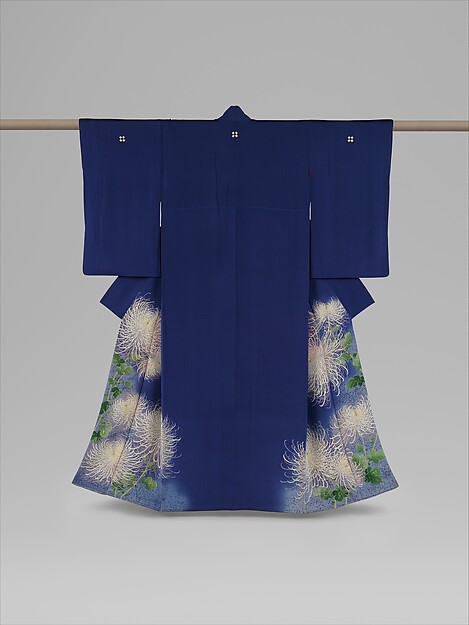
Kimono Ensemble with Chrysanthemums, Silk, metallic thread. The Metropolitan Museum of Art, Gift of Atsuko Irie, in honor of Suga Irie, 1998, accession 1998.487.2a, b.
Look closer: Look for the way the chrysanthemum is drawn flat and bold. It is a crest flower, and the design is as much a mark of rank as of beauty.
Image: The Metropolitan Museum of Art, Open Access (CC0)
A kimono is also worn in layers, and the layers do much of the work of fit. Beneath the outer garment lies the under-kimono, the nagajuban, which is sometimes boldly patterned, and the folds at the hip are managed by ties worn beneath the obi. Wikipedia notes that a woman’s kimono is ideally about the wearer’s full height from shoulder to hem, leaving the excess to be folded into a hip fold, the ohashori, typically 18 to 25 centimetres deep. This is why one garment can be worn by a wide range of figures. The house’s Kimono Textile Heritage guide sets out the collecting standards in more detail.
Men’s kimono follow the same logic with narrower means. The sleeves are attached nearly all the way down the body and are shorter than a woman’s; the garment is cut to the length of the body and tied with a narrow belt, with no hip overfold. Colour is subdued and fabric matte, and the richness is often hidden in a lining, as the chapter on Haori and Hakama: The Jacket and the Divided Skirt explains.
Reading the ladder, one step at a time
Women’s kimono are ranked by four visible signals: sleeve length, the number of family crests (mon), where the pattern sits, and the fabric. The crests are treated at length in Mon: The Family Crests on Japanese Dress; here it is enough to say that one crest is the lightest formal mark, three is more serious, and five is the most formal that a kimono can carry.

Child's Kimono with Pine, Bamboo, Plum Blossoms, and Fans, late 19th–early 20th century, Ikat-patterned plain-weave bast fiber (asa). The Metropolitan Museum of Art, Gift of Andreas Leisinger, in memory of Jean Mailey, 1996, accession 1996.84.
Look closer: Pine, bamboo and plum form the ‘three friends of winter’, a set you will meet again in the motif dictionary.
Image: The Metropolitan Museum of Art, Open Access (CC0)
The furisode is the highest formal wear for an unmarried woman. Wikipedia gives three classes by sleeve: the ko-furisode at 76 to 86 centimetres, the chū-furisode at 86 to 115, and the ō-furisode at 114 to 125, the last often with a padded, trailing hem. The tomesode, by contrast, has the standard hip-length sleeve of about 49 centimetres and is for married women. The black kurotomesode carries its design only on the hem and usually three to five crests; the coloured irotomesode with five crests equals it in formality.
Below these sit the garments that most people actually met. The hōmongi, or ‘visiting wear’, is always silk, and its design flows across the seams as one picture; the tsukesage is one step lower, with motifs placed so that they usually do not cross the seams, and one to three crests. The iromuji is a solid colour, undecorated, and mainly worn to the tea ceremony; you can read more of that world in the Tea Ceremony Almanac. The komon carries a small repeat and usually no crests, and was the most common everyday womenswear before the war.
The ends of the scale are the yukata, an unlined cotton kimono for summer and festivals (see Yukata: The Summer Cotton Robe), and the mofuku, plain black silk with five crests, worn with white undergarments and white tabi for mourning. Men’s kimono are quieter. They are dark, matte and sleeved almost to the hem, and the highest formal wear for a man is a black habutae kimono with five crests, worn with a haori and striped hakama, the subject of Haori and Hakama: The Jacket and the Divided Skirt.
| Type | Worn by | Pattern and crests | Occasion |
|---|---|---|---|
| Furisode | Unmarried women | Long sleeves; pictorial; crests optional | Coming-of-age, weddings, the most formal events |
| Kurotomesode | Married women | Black; hem-only pattern; commonly 3 to 5 crests | Weddings of family and friends |
| Irotomesode | Married, sometimes unmarried | Coloured; hem-only; five crests match black | Formal occasions |
| Hōmongi | Married or unmarried | Silk; pattern flows across seams | Visits, receptions, wedding guest |
| Tsukesage | Women | Pattern placed, mostly not crossing seams; 1 to 3 crests | Parties, less ceremonial events |
| Iromuji | Women | Solid colour; one crest possible | Tea ceremony |
| Komon | Women | Small all-over repeat; usually no crests | Everyday, informal |
| Yukata | Men and women | Unlined cotton or linen | Summer festivals, bathhouses, inns |
| Mofuku | Mourners | Plain black silk; five crests | Funerals |
Sleeves, ranked in centimetres
The chart below turns the furisode classes into a picture. Even the shortest furisode sleeve is more than half as long again as the tomesode’s, and the grandest is two and a half times the length. The name furisode means ‘swinging sleeve’, and the garment is the formal dress of the unmarried.
Diagram by Japonista, from sleeve lengths given in the Wikipedia kimono article; the tomesode is shown for comparison.
Look closer: Compare the bars with the furisode above and note how much of the garment’s picture the sleeve carries.
Diagram by Japonista
Season, lining and what has changed
Season governs the lining. Lined kimono, awase, are worn for most of the year; unlined hitoe are worn in summer, and the strict guides give June to October. The summer robe in the Metropolitan Museum’s collection with cranes and pines, paste-resist dyed on plain-weave silk and dated to about the 1870s and 1880s, shows how much art could be put into a garment that was made to be worn in heat. For the full calendar see Seasons and Occasions: What to Wear When.
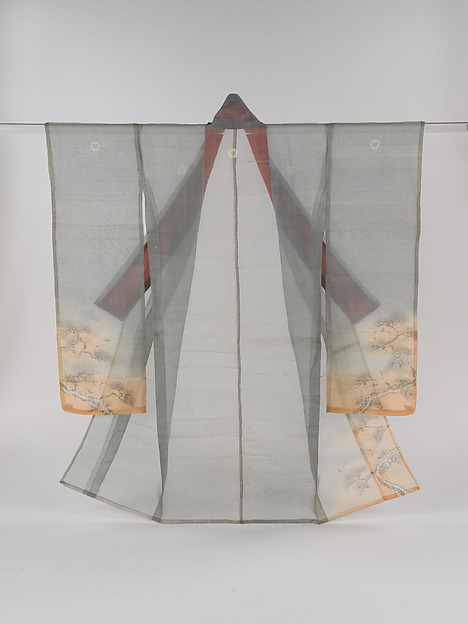
Summer robe (hito-e) with cranes and pines, ca. 1870–80s, Plain-weave silk with paste-resist dyeing. The Metropolitan Museum of Art, Purchase, Friends of Asian Art Gifts, 2023, accession 2023.325a, b.
Look closer: Cranes and pines are among the most auspicious pairings in Japanese design. Count how often the same two motifs recur across the robe.
Image: The Metropolitan Museum of Art, Open Access (CC0)
The system as we know it is younger than it looks. Wikipedia places the modern formalisation of dress codes in the Taishō period (1912 to 1926), with the standards of dressing, kitsuke, codified after the Second World War. Sales of formal kimono made up most of the market by the 1970s, and the industry peaked in 1975 at 2.8 trillion yen before the economic collapse of the 1990s ended many costly practices. Today most people in Japan wear Western clothing daily, and the kimono belongs mainly to formal events and summer festivals, although men began wearing it again outside their own weddings around 2010.
For the collector this history matters. A hand-sewn kimono of the right silk from before the war, still unfaded, is a different object from a machine-sewn polyester one made for hire. How to Read, Grade and Care for a Japanese Garment explains how to tell them apart, and Regional Textiles from Kyoto to Okinawa shows where the great fabrics came from.
From wrapped robe to kosode
The earliest written description of Japanese dress is Chinese. Google Arts and Culture, in its story on the making and wearing of the kimono, points to the third-century Gishi-wajin-den, the Records of Wei, which describes men in a single cloth worn over one shoulder and women in a sleeveless garment. It treats the women's garment, the kantoi, as the prototype of the kimono, and says it slowly became the kosode, a robe with small armholes. The same story says garments with collars and sleeves, in the Chinese manner, appeared in the late sixth century. Wikipedia dates the arrival of Chinese-style dress earlier, to the Kofun period, and adds that the Yōrō code of 718 fixed the rule that the left side closes over the right.

Kimono, 20th century, Silk. The Metropolitan Museum of Art, Gift of Mr. Alan L. Wolfe, 1961, accession C.I.61.15.3.
Look closer: Run your eye down the seam lines of the body panels: they are straight, which is what makes a kimono easy to unpick and resew.
Image: The Metropolitan Museum of Art, Open Access (CC0)
The Heian period supplies the great ceremonial layers. Wikipedia explains that once the embassies to Tang China ended, a national taste took shape in which the twelve-layered jūnihitoe and the men's sokutai developed, and the trailing skirt, the mo, narrowed into a pleated train. Google Arts and Culture adds that the kosode was then the innermost layer for the aristocracy, while commoners wore a tight-sleeved version, the tsutsusode. Both layers and their codes are the subject of Court Dress: Jūnihitoe and Sokutai.
The great change came when the underwear moved out. Wikipedia says that edicts reducing the number of layers made the kosode, originally an undergarment, into outerwear by the Muromachi period, held at the waist by a narrow belt that was the ancestor of the obi. In the Kamakura period, as Google Arts and Culture puts it, the rising samurai wore the kosode as everyday clothing, and women wore it under the uchikake, an unbelted full-length outer robe; that robe survives in Uchikake and Shiromuku: The Bridal Robes. By the Momoyama period the shape and the design of the kosode were complete, the story says, and the costumes of Noh theatre, treated in Noh Costume: Karaori, Atsuita and Mizugoromo, are its example.
The sources disagree on the edges of these periods. Wikipedia gives the end of the Heian period as 1185 in one place and 1193 in another, and the end of the Edo period as 1867 or 1868. The reader who needs a date for a particular robe should treat these as ranges, and look to the museum label for the object itself.
Pattern books, merchants and the plain exterior
The Edo period is where the kosode became a canvas. The Tokyo Metropolitan Library's account of Edo fashion says that many city residents wore the kosode as outerwear whatever their age, sex, occupation or class, and that its basic manner of wearing hardly changed, while colours and designs differed with the period and the social group. It adds that the fabric design changed dramatically in the middle of the period, after yūzen dyeing was developed in Kyoto and accepted across the country, allowing many more colours on the cloth; its method is the subject of Yūzen: The Painted Kimono.
Long-Sleeved Kimono (Furisode) with Hydrangeas and Cherry Blossoms, early 20th century, Resist-dyed and painted silk satin. The Metropolitan Museum of Art, Purchase, Roy R. and Marie S. Neuberger Foundation Inc. and several members of The Chairman's Council Gifts, 2000 Benefit Fund, and funds from various donors, 2001, accession 2001.428.51.
Look closer: Hydrangea and cherry blossom belong to different seasons. Count how the designer lets them share one hem.
Image: The Metropolitan Museum of Art, Open Access (CC0)
Google Arts and Culture dates the designs more closely. Patterns of the Kanbun era, 1661 to 1673, ran in a diagonal, semicircular composition from the right shoulder to the left hem and were often finished in shibori or embroidery; patterns of the Genroku era, 1688 to 1704, were less prominent at first but grew larger and bolder as yūzen rose in popularity. Wikipedia places the merchant patronage behind this, the culture of the Genroku years fuelled by the townsmen, chōnin, and says that damask, rinzu, replaced plain-weave silk for the resist-dyed tsujigahana style.
The designs travelled by book. The British Library's account of Japanese textile design books says that pattern books, hinagata-bon, were first published in the 1660s as practical manuals for designers and kimono merchants and as catalogues for rich customers. The first title it names is Shinsen o-hiinagata, by Asai Ryōi, of 1666, printed from woodblocks in black and white with notes on the colour and fabric intended, and a 1667 edition added pages in single colours: blue, green or red. The books show the kosode in a T-shape, with the back and sleeves as the field of design, and drew their subjects from nature, folklore, history, the zodiac, auspicious symbols and written characters.
The same article carries the story down to the shop counter. A Kyoto book of 1902, Kuretake, was produced by Ichida Yaichirō, owner of the Ichida Shoten kimono store, to attract clients, and held 120 designs and 47 textile samples so that customers could choose their colours and fabrics. By the late nineteenth century the publishers Unsōdō and Unkindō were working with artists such as Kamisaka Sekka to issue luxurious design albums, some for artisans and some as art objects in their own right.
Wikipedia explains the other half of the Edo story, the law. Sumptuary rules barred commoners from purple and red, from gold embroidery and from intricate shibori, and the response was iki, a restrained taste for hidden luxury in which the richness moved to the lining and the hem. The Tokyo library's account does not discuss these laws, so the point rests on Wikipedia alone. Wikipedia also records the shogunate's ban on silk for commoners in 1785, in the Tenmei famine, which pushed townspeople towards cotton and hemp, and describes the trade in three layers: craftspeople who made the bolts and accessories, wholesalers, tonya, and retailers.
Uniforms, an earthquake and the peak of 1975
The Meiji Restoration changed the name and the habit. Google Arts and Culture says the four social classes were made equal in 1868 and that the kosode was renamed the kimono. Wikipedia sets out the stages of the change of dress: red and purple became available once the class system was abolished in 1869, and synthetic dyes such as mauvine arrived; in 1871 an edict of the emperor moved the police and postal workers into Western dress, railway workers followed in 1872, and an edict of Empress Haruko in 1877 extended the change to women. It adds that the first mass-produced Western-style clothing is said to be the 2,000 uniforms made in 1864 by a Tokyo merchant, Morita Jihee.
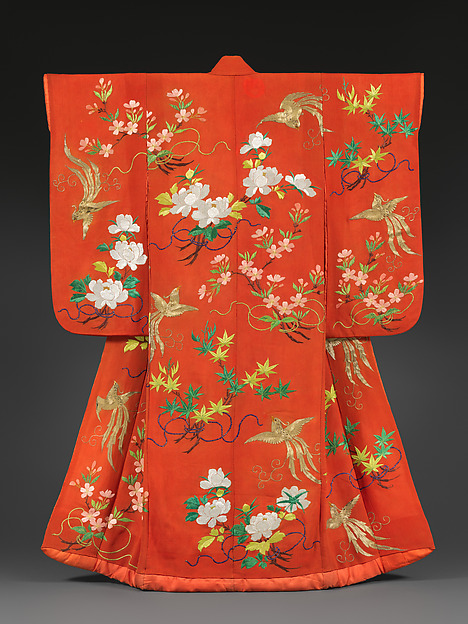
Long-Sleeved Robe (Furisode) with Phoenixes, Cherry Blossoms, Peonies, and Maple Branches, mid-19th century, Crepe silk with silk and gold-thread embroidery. The Metropolitan Museum of Art, Purchase, Anonymous Gift, 2018, accession 2018.645.
Look closer: Follow the gold thread. Embroidery over dyed crepe was a rich ground for the bridal and the festive.
Image: The Metropolitan Museum of Art, Open Access (CC0)
The Taishō period (1912 to 1926) brought Western dress into the army and the boys' schools, and the sailor-style uniform replaced the kimono in girls' schools between 1920 and 1930, according to Wikipedia. It names two shocks that remade the kimono trade. After the Great Kantō Earthquake of 1923, cheap, ready-to-wear meisen silk, woven from waste silk, became popular, and by 1930 its designs drew on Art Deco. The Taishō years also saw the invention or fixing of several formal types, among them the hōmongi and the divisions of the tomesode, and the bridal trousseau spread to the middle class.
War and its aftermath followed. Wikipedia says factories were closed in the Shōwa war years, trousers called monpe made from old kimono were encouraged, rayon became common, and cloth rationing lasted until 1951. After the war the rules of formality, the so-called TPO of time, place and occasion, hardened, and commercial schools of dressing, kitsuke, taught women how to wear a garment that had stopped being everyday dress. The same article says that trousseaus could reach ten million yen and were displayed publicly, and that by the 1970s formal kimono made up most sales; the industry peaked in 1975 at 2.8 trillion yen.
Since then the decline has been steep. Wikipedia says the collapse of the bubble economy bankrupted much of the industry, that second-hand kimono selling for about 500 yen opened a market of its own in the 1990s and early 2000s, and that yukata became fashionable with the young in the early 2000s, a story told in Yukata: The Summer Cotton Robe. It reports that around 2010 men began to wear kimono outside their own weddings, and that in 2023 new kimono ranged from about 1,000 yen to 150,000 yen, with second-hand pieces starting at 100 yen.
One cloth, eight pieces, no waste
A kimono is cut from a single bolt, the tanmono, and the sources agree on the principle while differing on the numbers. Wikipedia gives a woman's bolt as about 11.5 metres by 36 centimetres and a man's as about 12.5 metres by 42 centimetres. Google Arts and Culture gives a commonly cited size of 0.38 by 13 metres. The difference is plausible for different periods and weavers, and a reader measuring a particular roll should trust the roll. Both sources agree that the bolt makes the whole garment, and Google Arts and Culture says it is divided into eight parts, among them two sleeves, the front body and the back body, sewn mainly with straight stitches.

Unlined Summer Kimono (Hito-e) with Carp, Water Lilies, and Morning Glories, ca. 1876, Resist-dyed, painted, and embroidered silk gauze with plain-weave patterning. The Metropolitan Museum of Art, Gift of Naoki Nomura, 2006, accession 2006.73.2.
Look closer: Notice the gauze. The open weave is what makes an unlined summer robe breathe.
Image: The Metropolitan Museum of Art, Open Access (CC0)
Wikipedia names the pieces. There are the right and left front panels, maemigoro, and the right and left back panels, ushiromigoro, the half-width front strip, okumi, the sleeves and the collar, with lining pieces in the upper body and the skirt. It gives the stitches by hand as three to four millimetres long, tightening at the collar, and says the seams keep the selvedges, so that they are wide and never trimmed. That is why a kimono can be taken apart, washed as flat cloth and sewn again, in the traditional method called arai-hari, and why sleeves and back panels can be reversed or turned.
The excess length is the secret of the fit. Wikipedia says an adult woman's hip fold, ohashori, takes up seven to ten inches of the length, a coarse adjustment held by a stitched tuck under the sash, and that children's kimono carry tucks at the shoulder and the hip to be let out as the child grows; apprentice geisha in Kyoto still wear them. The woman's collar, the layers beneath it and the sash above are the subject of Obi and Its Companions: Scarf, Cord and Brooch.
Lining is a matter of season. Wikipedia says that lined kimono, awase, are worn from October to May and unlined ones, hitoe, from June to October, although tea-ceremony guides are stricter, and that the changing of clothes is called koromogae. Within the summer months, it adds, gauze-weave ro is worn only in July and August. The calendar is treated at length in Seasons and Occasions: What to Wear When.
Four tales told by the cloth
The merchant who made the uniforms. Wikipedia reports that in 1864, at the time of the Kinmon incident, the merchant Morita Jihee of Kodenmachō produced 2,000 Western-style uniforms, which the article describes as reportedly the first mass-produced Western clothing in Japan. It is a small story with a large consequence: within a decade the state itself had put its police, postal workers and railway staff into Western dress, and the garment that had been worn by every class began its long slide into occasion wear.

Kimono with Pines, Bamboo, and Plum, second quarter 20th century, Figured satin silk (rinzu) with hand-painted details and silk embroidery. The Metropolitan Museum of Art, Gift of Sue Cassidy Clark, in memory of Terry Satsuki Milhaupt, 2013, accession 2013.510.4.
Look closer: The woven ground is a damask of its own. The painted pines sit on top of it.
Image: The Metropolitan Museum of Art, Open Access (CC0)
The quake that made silk cheap. After the Great Kantō Earthquake of 1923, Wikipedia says, cheap ready-to-wear meisen kimono woven from waste silk became popular. The cloth had been a sort of leftover; it became a fashion, and by 1930 its patterns followed Art Deco. A great many of the bright, bold kimono that collectors now seek out as Taishō and early Shōwa pieces come from this moment, which is one reason the date matters when a kimono is dated.
Hidden luxury. The same article says the sumptuary laws of the Edo period, which forbade commoners purple, red and gold embroidery, led to iki, the restrained taste in which wealth was hidden. The designs the law would not allow moved to the underkimono collar and the inside of the hem. The story is often retold as a paradox: a law meant to keep people plain taught them to put the splendour where only the wearer, and the person close enough to see, would know.
The catalogue with samples. The British Library's account of the 1902 pattern book Kuretake holds a quiet commercial tale. Its publisher, the owner of a Kyoto kimono store, did not print a book of art; he printed a book of choices, with 120 designs and 47 pasted textile samples, so that a customer could hold the cloth in the hand before choosing. It is a reminder that the system of formal kimono was always as much a shop as a tradition.
Small surprises from the sources
Short facts, each as the cited source gives it.
- Kimono combines kiru, to wear, and mono, thing: a thing to wear. Japanese has no plural suffix, so the word serves for one or many, as Wikipedia notes.
- Left over right has been the rule since the Yōrō code of 718; only the dead are dressed right over left.
- A woman's kimono is cut from a bolt about 11.5 metres long, and nothing is thrown away, because the selvedges stay in the seams.
- Wikipedia says a good second-hand woman's obi can cost over 300 US dollars, while a second-hand kimono can start at about 100 yen.
- Sumo wrestlers must wear kimono in public, and some choose bright colours such as fuchsia, according to Wikipedia.
- A black kurotomesode is not permitted at the royal court, Wikipedia says, because black signals mourning there; the coloured irotomesode with five crests is worn instead.
- The three layers of an o-tsui set are white, red and black; the false layers called hiyoku appear in the Kabuki dance Fuji Musume.
- The unlined yukata began as a bathrobe-like garment worn at inns, and the inn's name appeared in the design.
- In Kyoto the first pattern book, Shinsen o-hiinagata, appeared in 1666, and a colour edition followed the next year.
- The 2023 price range Wikipedia gives for a new kimono runs from 1,000 yen to 150,000 yen, a spread of a hundred and fifty times.
- The V&A's exhibition Kimono: Kyoto to Catwalk showed about 300 items over four years, ending at V&A Dundee in 2024.
- The industry's peak came in 1975, at 2.8 trillion yen, and fell steeply afterwards.
Words of the wardrobe
A short list of the terms used in this chapter.
| Term | Meaning | Where it appears |
|---|---|---|
| Tanmono | The single bolt of cloth from which a garment is cut | Construction |
| Kosode | ‘Small sleeve’; the forerunner of the kimono, once an undergarment | History |
| Uchikake | An unbelted, full-length outer robe | Kamakura onwards; bridal |
| Tsutsusode | The tight-sleeved kosode of commoners in the Heian period | History |
| Hinagata-bon | Woodblock pattern books for kosode designs | Edo; 1666 onwards |
| Iki | A restrained taste in which luxury is hidden | Edo |
| Tonya | Wholesalers in the cloth trade | Edo |
| Meisen | Cheap ready-to-wear silk woven from waste silk | After 1923 |
| Monpe | Trousers made from old kimono in wartime | Shōwa |
| Kitsuke | The art of dressing, codified after the war | Twentieth century |
| Ohashori | The fold at the hip that takes up the excess length | Construction |
| Arai-hari | Washing by unpicking the kimono and sewing it again by hand | Care |
| Awase / hitoe | Lined and unlined kimono | Seasons |
| Koromogae | The seasonal changing of clothes | Seasons |
The kimono today
Wikipedia gives a plain picture of the present. Most Japanese now wear Western clothes every day; the kimono is seen at weddings, funerals, graduations and, as the yukata, at summer festivals. It adds that Western dress became acceptable even at weddings and funerals after the 1990s, that Shinto shrines keep and rent the white bridal robe, and that the kimono has returned as a fashion, so that a kimono-inspired trouser suit appeared in the V&A's exhibition Kimono: Kyoto to Catwalk.

Unlined Summer Kimono (Hito-e) with Crickets, Grasshoppers, Cricket Cages, and Pampas Grass, early 20th century, Gauze-weave silk with paste-resist dyeing, hand-painted details, and gold thread. The Metropolitan Museum of Art, Gift of Abby Aldrich Rockefeller, 1937, accession 37.92.13.
Look closer: Autumn insects on a summer robe. The wearer was already looking ahead.
Image: The Metropolitan Museum of Art, Open Access (CC0)
The Tokyo Metropolitan Library and Google Arts and Culture both stress how little the garment itself has changed. Google Arts and Culture says that after the abolition of the classes the men turned to Western clothing and that the kimono has changed little since. The change has been in who wears it and when. A reader who sees a kimono worn today should expect it to be a statement of occasion: a furisode at the January coming-of-age ceremony, which Google Arts and Culture names as the usual moment, a tomesode at a wedding, a komon in the town on a free afternoon.
Where the garment can be studied
The Costume Museum of Kyoto, on the fifth floor of the Izutsu Building in Shimogyō-ku near Nishi Hongan-ji, concentrates on the dress of the Heian court. Japan Experience describes a quarter-scale model of an imperial palace populated by dolls in miniature reproductions of period costume, with scenes from The Tale of Genji and the twelve-layered jūnihitoe on show. The page gives hours of 9:00 to 17:00 and says the museum is closed on Sundays and public holidays and sometimes between exhibitions; the reader should check before going.
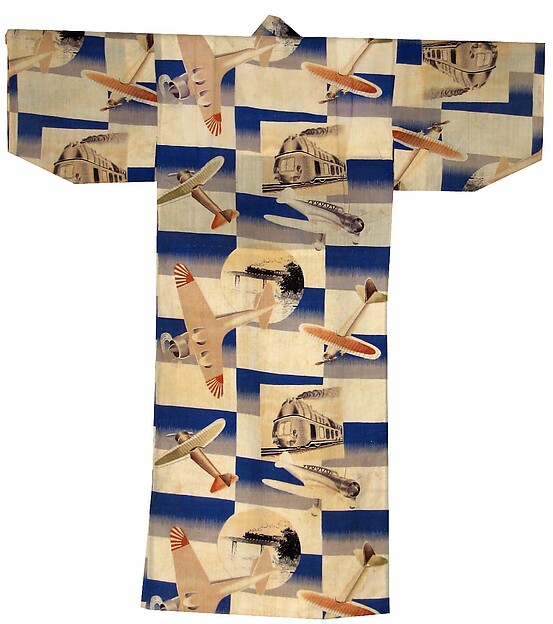
Boy’s Kimono with Streamline Train, ca. mid-1930s, Plain-weave wool muslin with printing. The Metropolitan Museum of Art, Purchase, Friends of Asian Art Gifts, 2014, accession 2014.236.
Look closer: The age of the machine reached the child’s kimono. Compare the printed train with the hand-painted flowers elsewhere in the chapter.
Image: The Metropolitan Museum of Art, Open Access (CC0)
The Metropolitan Museum of Art holds a large body of Japanese dress, and the objects in this chapter are drawn from it and credited in their captions. For the history of how designs travelled, the British Library's digitised collection of Japanese textile design books is the place to begin; the page records that the digitisation was supported by a grant from the Great Britain Sasakawa Foundation.
Reading a kimono in the hand
Four checks come straight from the sources. First, the cut: a kimono with wide seams that keep the selvedge is built to be taken apart, and Wikipedia treats hand stitches of three to four millimetres, tightening at the collar, as the sign of careful tailoring. Second, the crests: five is the most formal, three is middle and one the least, and whether they are in white outline, hinata, or in shadow, kage, matters too. Third, the pattern: motifs that cross the seams mark a hōmongi, while a design only below the waist marks a tomesode. Fourth, the cloth: gofuku is the word for silk, and cotton and hemp are futomono.

Woman's Summer Kimono with Design of Small Crosses, 19th century, Ikat-patterned plain-weave ramie. The Metropolitan Museum of Art, Gift of John B. Elliott through the Mercer Trust, 1999, accession 1999.247.10.
Look closer: A plain ground of small crosses. The fibre is ramie, a cool summer cloth.
Image: The Metropolitan Museum of Art, Open Access (CC0)
The date of a piece is often the hardest question, and the sources suggest three guides: the Edo patterns in the pattern books, the meisen silk of the 1920s, and the synthetic dyes from the 1860s onward. How to grade and care for a garment is the subject of How to Read, Grade and Care for a Japanese Garment, and the regional looms are in Regional Textiles from Kyoto to Okinawa.
Neighbouring chapters
The kimono touches nearly every other chapter of this almanac. The sash and its companions are in Obi and Its Companions: Scarf, Cord and Brooch, the jacket and divided skirt worn over it in Haori and Hakama: The Jacket and the Divided Skirt, and the painted and bound cloths in Yūzen: The Painted Kimono and Shibori: The Art of the Bound Cloth. For motifs, see A Motif Dictionary: Crane, Pine, Wave and Chrysanthemum, and for crests Mon: The Family Crests on Japanese Dress.
Kimono silk in the house
The shelf holds true kimono textiles and pieces made from them. Where a garment has been remade into a jacket or shirt, the page says so plainly; the cloth, and the dyeing or weaving in it, is the subject.


Kimono and textile heritage
The full shelf of kimono, uchikake, boro and textile pieces is gathered in one collection, and the concierge desk can look for a particular type or period on request.
Answered plainly
What is the difference between a kimono and a yukata?
A yukata is an unlined cotton or linen summer kimono worn at festivals, bathhouses and traditional inns. A kimono proper is usually silk and ranked by formality.
Why do furisode have such long sleeves?
The long sleeve marks an unmarried woman and gives the garment its name, ‘swinging sleeve’. Wikipedia lists three classes: ko-furisode at 76 to 86 centimetres, chū-furisode at 86 to 115, and ō-furisode at 114 to 125.
How many crests does a formal kimono carry?
One is the lightest mark, three is more serious and five is the most formal. A black kurotomesode usually has three to five, and mourning dress has five.
Which side of a kimono goes over the other?
The left side goes over the right. Only the dead are dressed with the right over the left.
Can a kimono be altered?
Yes. Because the panels are straight and the selvedges kept in the seams, a kimono can be unpicked, washed flat and resewn.
What was the kosode?
The kosode, ‘small sleeve’, was the forerunner of the kimono. It began as an undergarment and became outerwear, and in the Edo period was worn by people of every class.
When did the kosode become the outer garment?
Wikipedia says edicts reducing the number of layers made the kosode, originally underwear, into outerwear by the Muromachi period, held by a narrow belt that became the obi.
What were hinagata-bon?
Woodblock pattern books for kosode designs, first published in the 1660s. The British Library names Shinsen o-hiinagata, by Asai Ryōi, of 1666 as the first.
How big is the bolt of cloth for a kimono?
Wikipedia gives about 11.5 metres by 36 centimetres for a woman's bolt; Google Arts and Culture gives 0.38 by 13 metres. Both say the single bolt makes the whole garment.
Why did the kimono decline after 1868?
Wikipedia traces it to Western uniforms for police, postal and railway workers in the 1870s, to schools and the army in the Taishō years, and to wartime rationing and the postwar bubble.
What is meisen?
Cheap ready-to-wear silk woven from waste silk that became popular after the 1923 Great Kantō Earthquake, with designs that followed Art Deco by 1930.
What is iki?
A restrained taste, born under the Edo sumptuary laws, in which luxury is hidden in linings and hems.
Where can the dress of the Heian court be seen?
The Costume Museum of Kyoto in Shimogyō-ku shows quarter-scale scenes of the court in miniature reproductions of period costume.
Are lined and unlined kimono worn at different times?
Yes. Wikipedia says lined kimono are worn from October to May and unlined from June to October, with stricter dates in tea-ceremony guides.
Where next
Sources and image credits
- Kimono, Wikipedia
- Edo-period fashion, Tokyo Metropolitan Library
- History of the Kimono, Google Arts and Culture
- Exquisite patterns: Japanese textile design books, British Library
- The Costume Museum of Kyoto, Japan Experience
- Object record: Long-Sleeved Kimono (Furisode) with Hydrangeas and Cherry Blossoms, The Metropolitan Museum of Art
- Object record: Furisode, The Metropolitan Museum of Art
- Object record: Kimono Ensemble with Chrysanthemums, The Metropolitan Museum of Art
- Object record: Child's Kimono with Pine, Bamboo, Plum Blossoms, and Fans, The Metropolitan Museum of Art
- Object record: Summer robe (hito-e) with cranes and pines, The Metropolitan Museum of Art
- Object record: Kimono, The Metropolitan Museum of Art
- Object record: Long-Sleeved Robe (Furisode) with Phoenixes, Cherry Blossoms, Peonies, and Maple Branches, The Metropolitan Museum of Art
- Object record: Unlined Summer Kimono (Hito-e) with Carp, Water Lilies, and Morning Glories, The Metropolitan Museum of Art
- Object record: Kimono with Pines, Bamboo, and Plum, The Metropolitan Museum of Art
- Object record: Unlined Summer Kimono (Hito-e) with Crickets, Grasshoppers, Cricket Cages, and Pampas Grass, The Metropolitan Museum of Art
- Object record: Boy’s Kimono with Streamline Train, The Metropolitan Museum of Art
- Object record: Woman's Summer Kimono with Design of Small Crosses, The Metropolitan Museum of Art
Last reviewed 28 October 2026. Pictures, where shown, are public-domain or open-access and credited beneath each one.
Looking for a garment, textile or accessory you have seen described here? The concierge desk replies within one to three business days.
Private concierge
Looking for something in particular?
Describe the piece or the project you have in mind. A senior advisor in Tokyo reads every case file personally and replies within two business days, with fees set out in writing before any work begins.