
Regional Textiles from Kyoto to Okinawa
Reading · A map of cloth
Regional Textiles from Kyoto to Okinawa
産地
Japan did not make one cloth but dozens, each tied to a river basin, a port or an island. To read a garment well is to know where its thread was born.
Fact sheet
The map in one glance
- Nishijin. Kyoto silk, named after a camp of the Onin War, 1467 to 1477.
- Echigo jofu. Fine ramie linen from Niigata; Ojiya chijimi evolved from it.
- Three kasuri. Kurume, Iyo and Bingo; dark blue with white splash patterns.
- Yuki tsumugi. Silk of the Kinu River basin; UNESCO-listed in 2010.
- Oshima tsumugi. Silk from the Amami region; over thirty steps over six months to a year.
- Hakata-ori. Fukuoka's stiff obi weave, traced to 1235.
- Bingata. Stencil-dyed cloth of the Ryukyu Islands.
Hemp and ramie in the snow country
The oldest of the regional stories belongs to the north. Fun-Japan's survey of Japanese weaving names Ojiya chijimi, a hemp-based textile woven in and around Ojiya City, Niigata Prefecture, and says it evolved from Echigo jofu, which it describes as crafted for over a thousand years. Ojiya chijimi and Echigo jofu are National Important Intangible Cultural Properties and were added to the UNESCO Intangible Cultural Heritage list in 2009. The Kyoto museum guide to textile arts places Echigo among Japan's three great jofu, the fine hemp or ramie linens, with Miyako-jofu from Okinawa and Oumi-jofu from Shiga.
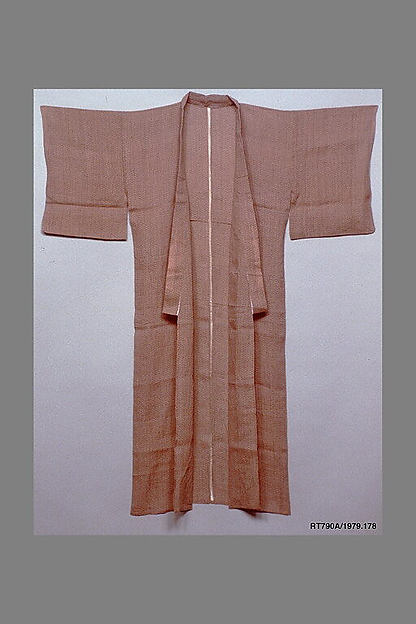
Summer Kimono, early 20th century, Ramie plain-weave crepe with geometric warp and weft kasuri (ikat) patterning. The Metropolitan Museum of Art, Seymour Fund, 1966, accession 1979.178.
Look closer: Look at the pattern. The Met says the dark blue geometry was made with warp and weft kasuri and that the cloth may be Echigo chijimi.
Image: The Metropolitan Museum of Art, Open Access (CC0)
The Metropolitan Museum's early-twentieth-century summer kimono shows the cloth in use. Its label explains that Echigo, in present-day Niigata Prefecture, has long produced fine ramie cloth, which the upper classes used for summer clothing in the Edo period; this kimono may be made of Echigo chijimi, a ramie crepe with a tightly twisted weft. Its dark blue geometric pattern was made with warp and weft kasuri dyeing, and the garment once had long hanging sleeves, which made it a furisode, a style suited to young women. It measures 158.8 by 125.7 centimetres and is ramie plain-weave crepe.
The three jofu are one thread among many. The same Kyoto guide records that Japan's three famed ancient textiles are kudzu cloth from Shizuoka, shina cloth from Yamagata and bashōfu, and that rural households spun, dyed and wove family clothing during winter; in the Edo period, when silk became more common, they took their yarn to town dyers. The fibres behind these stories are described in Silk, Hemp, Cotton and Ramie: The Fibres of Japanese Dress.
A camp, a war and a loom
The capital's cloth takes its name from a battle. The Kyoto museum guide explains that Nishijin, literally the western camp, comes from the position of the warlord Yamana Sōzen during the Ōnin War, from 1467 to 1477; after the war weavers returned to the area and revived Kyoto-style weaving. It names the Otoneri-za, weavers linked to the Hata clan, who made silks under the shogun family's control. Fun-Japan adds that twelve of its weaving techniques are designated Traditional Craft Products.
The district is exact. The guide places Nishijin in Kamigyō-ku and Kita-ku, bounded by Kitaōji-dōri, Imadegawa-dōri, Senbon-dōri and Horikawa-dōri. Weavers use hand looms and a fingernail technique called tsumekaki-hontsuzure-ori to draw the weft in for patterns, and the guide notes that before the Jacquard looms reached Japan in the nineteenth century, the draw loom called the sorahikibata was used. Nishijin is known for kimono obi and for donchō, stage drop curtains, and its textiles appear on high-school baseball pennants and Gion festival float tapestries. The full craft is the subject of Nishijin: The Woven Brocades of Kyoto.
Kyoto is also a painting city. The paste-resist work of yūzen and the dyed work of shibori belong to the same streets, and the Met's kosode with bamboo and plum, discussed in A Motif Dictionary: Crane, Pine, Wave and Chrysanthemum, shows that the technique reached Kanazawa as Kaga yūzen. Those crafts are described in Yūzen: The Painted Kimono and Shibori: The Art of the Bound Cloth.
Fukuoka tells a different story. Wikipedia traces Hakata-ori to 1235, when the merchant Mitsuda Yazaemon travelled to Song China with the monk Shōichi Kokushi and, on returning in 1241, began a textile business using the technique that became hakata-ori. About two hundred and fifty years later his descendant Mitsuda Hikosaburō studied in Ming China and combined Ming and earlier Song techniques, giving fusenmon and ryūjō, a taffeta-like fabric with a raised stripe. In the Edo period the Fukuoka lord Kuroda Nagamasa presented it to the Tokugawa shogunate, from which the term kenjō-gara is said to derive, and in 1815 a kabuki actor wore a hakata-ori obi onstage, which helped its popularity.
The weave is practical. Hakata-ori was first used for obi, mainly for men wearing kimono or yukata; its stiff, sturdy weave keeps obi knots from slipping, so samurai wore it to hold their swords, and women's obi were developed in the Meiji period. A thin warp and a thicker weft are woven tightly, giving a stiff, ribbed texture, and the patterns are formed by the warp yarn. The kenjō pattern uses only five colours, each given a meaning from Sui dynasty symbolism: purple for elegance and virtue, red for happiness and prosperity, yellow for sincerity and trust, blue for honour and peace, and navy for wisdom and solidity. The obi itself is described in Obi and Its Companions: Scarf, Cord and Brooch.
Dark blue with white splashes
Southwest of Kyoto the loom turns to indigo. The Kyoto guide explains that kasuri uses resist tying so that dye forms splash patterns, and that the three famed kasuri textiles are Kurume-kasuri from Fukuoka, Iyo-kasuri from Ehime and Bingo-kasuri from Hiroshima, all kongasuri, dark blue with white splash patterns. Fun-Japan describes Kurume kasuri as cotton fabric traditionally woven in and around Kurume City, a National Important Intangible Cultural Property with about thirty production steps taking several months.
Wikipedia's article on Kurume kasuri adds that it was developed in the late Edo period by Inoue Den, who was twelve years old at the time, and that unlike kasuri techniques that came from the south via the Ryukyu Islands it is believed to have been developed independently. The Kurume domain encouraged its production as a local industry; it is primarily dyed with indigo, with patterns created from pre-dyed threads alternating between indigo and white. It was designated an Important Intangible Cultural Property in 1956, and the article says annual production once peaked at two to three million bolts and fell significantly after the Second World War as Western-style clothing rose in popularity. The article itself notes that it needs further citations. The method is described in Kasuri: Ikat Woven from Dyed Thread.
Silk has its own map. Fun-Japan describes Yūki-tsumugi as silk made with tsumugi threads from the Kinu River basin, spanning Ibaraki and Tochigi, with over forty mostly manual steps and registered as a UNESCO Intangible Cultural Heritage in 2010. It describes Honba Ōshima-tsumugi from the Amami region of southern Kagoshima as one hundred per cent silk made with raw silk rather than uneven tsumugi threads, with more than thirty steps over six months to a year, and says the fabric can last 150 to 200 years. Those figures are the page's own claims and are given here as such.
The geography of the loom is therefore simple to state. The north weaves bast fibres, the capital weaves brocade, the southwest dyes thread blue before weaving, the east and the far south spin and dye silk thread by hand, and the islands, as the last section shows, paint cloth with stencils and pigments. A reader who can place a cloth can often date it, and the grading of what is found is the work of How to Read, Grade and Care for a Japanese Garment.
The Met holds a garment that crosses the map. Its early-twentieth-century short kimono in silk kasuri and damask shows how a technique born in one region was adopted in another, a theme that runs through Sashiko and Boro: The Mended Cloth, Aizome: The Indigo Dyer’s Craft and Tsutsugaki and Katazome: Paste and Stencil.
| Cloth | Place | Note from the sources |
|---|---|---|
| Nishijin-ori | Kyoto | Named after the Ōnin War camp; twelve techniques designated |
| Echigo jofu / Ojiya chijimi | Niigata | Ramie and hemp; UNESCO-listed in 2009 |
| Kurume kasuri | Fukuoka | Cotton, indigo; about thirty steps |
| Yūki-tsumugi | Ibaraki and Tochigi | Over forty steps; UNESCO-listed in 2010 |
| Honba Ōshima-tsumugi | Amami, Kagoshima | Raw silk; thirty steps over six months to a year |
| Hakata-ori | Fukuoka | Obi weave traced to 1235 |
| Bingata | Okinawa | Stencil-dyed; dated to the 14th century |
Pigments of the southern islands
The south is the great exception. Wikipedia's article on bingata describes a stencil resist dyeing technique from Okinawa Prefecture, known for busy, repeating nature motifs in bright colours, and dates it to the fourteenth century, when foreign goods and techniques reached the islands; it is believed to blend Indian, Chinese and Javanese dyeing methods. In the fifteenth and sixteenth centuries the kingdom's trade network with Korea, Japan, China and Southeast Asia helped it build a distinct style, and the oldest known piece, found on Kumejima, dates to the late fifteenth century. After Japan's invasion of 1609 the people of the islands were required to produce textiles as tribute, including the banana-fibre cloths called jōfu and kafu, and imported pigments were no longer available, so indigo became the main dye for ordinary consumers.
The article also records the hierarchy of colour: only the royal family wore yellow, nobility wore pale blue, and commoners could wear certain colours on special occasions. Pigments were originally imported from Fujian, and white came from ground chalk or powdered shells; other colours used cochineal, vermilion, arsenic and sulphur, and some patterns used up to eighteen colour applications. Only three families were granted permission to produce bingata, each keeping its own designs, and the stencils were made by bonding mulberry paper with persimmon tannin. Painting one kimono takes three people three days, plus about a month to finish. The Battle of Okinawa destroyed many shops, and Eiki Shiroma, a former artist, recovered original stencils that had been taken to mainland Japan and restarted the craft.
The Met's bingata robe of the nineteenth century, in resist-dyed and painted silk crepe from Okinawa, is described in its label as involving resist paste applied through one or more stencils, with dyes and pigments brushed onto pattern areas; designs are typically covered with protective paste before the background is dyed, and the paste is then washed off, revealing the bright colours typical of bingata. A second Met robe, also of the nineteenth century, combines pine branches and plum blossoms over a colourful ground of broken-diamond shapes, a traditional Japanese motif named for its resemblance to pine bark. The pine appears in two forms: a cloud-like section of a large limb and a circular view of a branch tip with needles radiating outward. The cloth of the stencil is described further in Tsutsugaki and Katazome: Paste and Stencil.
The islands also made fibre cloth. The Kyoto guide records that Okinawa's bashōfu is abaca cloth made from itobashō, and that Ogimimura Kijoka abaca cloth is an important intangible cultural asset. The map ends where the islands meet the northern frontier of Japanese dress: the robes of the Ainu in Hokkaido, treated with respect in Ainu Attus and the Dress of the North and South.
The shelf strip below shows pieces from the house that belong to this geography, each described as what it is, and the chapter on Glossary of Japanese Dress and Textile Terms gathers the place names in one list. The concierge desk can look for a cloth by region on request.
Mud, cocoon and the weaver's waist
Two silks stand apart from the brocades of the capital because they begin with thread rather than pattern. Wikipedia describes Yūki-tsumugi as a silk cloth made mainly in Yūki, Ibaraki Prefecture, designated an Important Intangible Cultural Property of Japan in 1956 and inscribed on UNESCO's Representative List of the Intangible Cultural Heritage of Humanity in 2010. Silk floss is extracted from silkworm cocoons and spun by hand into yarn; patterns are added by kasuri dyeing before weaving, and thousands of resists are tied by hand before the yarn is dyed to the intended design. Weaving is done on a jibata loom, on which a strap around the weaver's waist adjusts the tension of the vertical threads. The article gives the time required as up to fifteen days for enough plain fabric for an adult garment and up to forty-five days for patterned fabric.
The article records two origin accounts. One traces the cloth to a craft house called Nagahatabeno Ashiginu under the legendary Emperor Sujin, whose founder, Ooyanomikoto, is said to have developed the method of silk production that spread to the Yūki district and beyond. Another dates its development to the Muromachi period, when a feudal lord of a farmer family in Hitachi Province is said to have sent tsumugi fabric each year to a governor named Kamakura Kanryō as a gift. The name yūki-tsumugi was adopted in 1602, weavers were invited from Ueda Castle, and the cloth, at first plain, was given as a gift to the shōgun. In 1873 it was exhibited at the Vienna World's Fair, which the article says made it known worldwide.
Ōshima-tsumugi comes from another corner of the map. Wikipedia describes a hand-woven, plain-weave silk from the Amami Islands, mainly Amami Ōshima in the northern Ryukyus, dyed with mud and mostly used for kimono that are often simply called Ōshima. It reports a history of about thirteen hundred years, with mud dyeing documented in a book held in the Shōsōin, and says the cloth is supple, lightweight and wrinkle-resistant, with up to three generations wearing the same kimono. In the latter half of the Edo period it became a specialty of the island, and islanders paid fabric to the Satsuma domain in place of tax, as they did with sugarcane; the obligation ended in 1879 when Amami Ōshima became part of Japan.
The process has more than thirty steps. In the first, sixteen to twenty threads about sixteen metres long are stretched between two posts and coated with a seaweed-based paste, igisu, and must dry perfectly round for sharp kasuri. White silk threads are then bound tightly with cotton threads so that only the exposed silk takes colour. Dyeing has two main processes, a bark dye from the techigi tree and mud: chips of techigi are boiled into a thick red liquid, the threads are dyed pink and then repeatedly dyed in mud, moving from light grey to reddish brown and finally to a warm black. Wikipedia explains that tannin from the techigi reacts with iron in the mud to produce the black, and that cycad leaves are added if the mud lacks iron. Weaving can take three months to a year per bolt of about twelve metres, and weavers usually work at home and manage only a few centimetres a day.
Wikipedia names the traditional patterns: Tatsugō-gara, after the village of Tatsugō, a major weaving region, which often features a snake-skin motif and zig-zag cycad leaves; and Akina-bara, after Akina village. The kasuri weave called hitomoto forms small windmill-like dots where a warp and two wefts meet. The Honba Amami-Ōshima Tsumugi Textile Cooperative Association certifies qualifying kimono with a mark at the foot of the fabric roll, and certified bolts are high in value.
Four tales from the looms
The girl who unpicked the cloth. The most affectionate story belongs to Kurume. Fukuoka Now says that around 1800 a twelve-year-old named Inoue Den developed a method of dyeing the thread before weaving it, a technique still used for Kurume kasuri and other cotton textiles of the Chikugo region. The Japan Experience account, drawing on a book of the Kurume Kasuri Preservation Society, gives her dates as 1788 to 1869 and says that at about twelve she became fascinated by an old garment with a faded indigo pattern, unpicked the textile to work out how it was woven, and set about reproducing it. After several years she succeeded, and taught the method for the rest of her life. Fukuoka Now adds that she began studying cotton weaving at seven and by forty had over a thousand students, about four hundred of whom reportedly opened their own studios.
The merchant who went to Song China. Hakata-ori begins, in Wikipedia's account, with a voyage. In 1235 the merchant Mitsuda Yazaemon travelled to Song China with the monk Shōichi Kokushi to study trades, including textile techniques, returning in 1241 to begin a textile business. Two and a half centuries later his descendant went to Ming China and combined the later techniques with the earlier ones. The cloth entered the great houses of the Edo period when the Fukuoka lord Kuroda Nagamasa presented it to the shogunate, and an actor's turn on stage in 1815, wearing a hakata-ori obi, widened its fame.
Cloth as tax. The Amami story is one of obligation. Wikipedia says that islanders paid fabric to the Satsuma domain in place of tax, as they did with sugarcane, and that the obligation ended only in 1879. The bingata story is similar in outline: after Japan's invasion of 1609, according to Wikipedia, Ryukyuans were required to produce textiles as tribute, including the banana-fibre cloths called jōfu and kafu. In both cases a luxury that later generations treasure began as a duty that families met with their own hands.
The woman who revived the banana cloth. Motoji's article on bashōfu says the cloth was woven in many parts of Okinawa before the war and that production stopped afterwards; Taira Toshiko revived it. It records that in 1974 the Kijoka Bashōfu Preservation Society, represented by Taira, was recognised as the holding group, and that in 2000 she was individually recognised as a holder of the Important Intangible Cultural Asset and became a Living National Treasure. The Visit Okinawa site adds that she had trained during the war at the Ohara spinning mill in Kurashiki, and that her successor Taira Mieko calls farming the hardest and most important job.
Small surprises on the loom
Short facts from the sources, each given as the source gives it.
- Nishijin means the western camp: the name comes from the army position of Yamana Sōzen in the Ōnin War, 1467 to 1477.
- Wikipedia says Nishijin-ori covers many weaving methods, among them tsumugi, kasuri, velvet, damask and brocade, so the name refers to a place and not to one technique.
- A hakata-ori obi is so stiff that its weave keeps the knot from slipping, which is why Wikipedia says samurai wore it to hold their swords.
- Kurume kasuri is a double ikat, a technique the Japan Experience article says is practised in only three countries: India, Indonesia and Japan.
- Some Kurume designs are dyed up to forty times, moving from a blue-green to a deep, nearly black blue.
- On a hand-woven kasuri, slight misalignment between sections shows that it was made by hand.
- The mud dye of Ōshima-tsumugi turns black because tannin from the techigi bark reacts with iron in the mud.
- A bashōfu kimono bolt needs fibre from roughly two hundred banana plants, and the plant takes about three years to mature.
- In the Ryukyu Kingdom, according to Wikipedia, only the royal family wore yellow bingata.
- A bingata kimono takes three people three days to paint, plus about a month to finish.
- Yūki-tsumugi has a school club: Yūki Daiichi High School keeps a yūki-tsumugi club.
- The Vienna World's Fair of 1873 is credited by Wikipedia with making Yūki-tsumugi known worldwide.
Terms of the loom and the vat
A short list of the words used in this chapter.
| Term | Meaning | Where it appears |
|---|---|---|
| Ori | Weaving, or a woven cloth | Nishijin-ori, Hakata-ori |
| Tsumugi | Silk spun from short or damaged fibres, and the cloths woven from it | Yūki and Ōshima |
| Kasuri | Ikat; thread resist-dyed before weaving so that a splash pattern forms | Kurume, Iyo, Bingo |
| Kongasuri | Dark blue kasuri with white splash patterns | The three famed kasuri |
| Jōfu | Fine hemp or ramie linen | Echigo, Miyako, Oumi |
| Chijimi | A crepe cloth with a tightly twisted weft | Ojiya chijimi, Echigo chijimi |
| Bashōfu | Cloth woven from the fibre of the banana plant | Okinawa, Kijoka |
| Bingata | Stencil resist-dyed cloth of the Ryukyu Islands | Okinawa |
| Jibata | A loom on which a waist strap adjusts the tension | Yūki-tsumugi |
| Sorahikibata | The draw loom used before the Jacquard | Nishijin |
| Tsumekaki | The fingernail technique used to draw the weft in | Nishijin |
| Kenjō-gara | The patterned stripe of the Hakata obi | Hakata-ori |
| Igisu | A seaweed-based paste used to coat threads | Ōshima-tsumugi |
| Techigi | The tree whose bark dye reacts with the mud | Ōshima-tsumugi |
Where the looms stand today
The sources give a picture of crafts that are honoured and fragile at once. Wikipedia says production of Nishijin-ori continues, with Tatsumura Textile a major manufacturing centre known for luxurious obi, some of them intricately woven, even three-dimensional, and costing up to a million yen. It says that approximately a hundred and thirty craftsmen currently practise Yūki-tsumugi in Yūki and Oyama. For Ōshima-tsumugi it reports that the cheapest bolt costs about three hundred thousand yen and the finest several million, that colours and patterns are diversifying, with coloured and white Ōshima and small items such as coasters, neckties and purses, and that fewer craftspeople remain on the island, so that the textile is described as facing extinction.
Kurume kasuri is described by Japan Experience as recognised as an Important Intangible Cultural Property, with a Technical Preservation Guild founded in 1976 that had thirty-one registered members, and with members producing fifty guild-certified products in 2012; that article was written after a visit in May 2013. Fukuoka Now reported in 2018, the hundred-and-fiftieth year since Inoue Den's death, that seven studios produced the cloth and that the Chikugo Village Kasuri Open House takes place twice a year and opens the studios to the public. The reader should check current dates directly with the organisers, as the pages are not new.
In Okinawa, Visit Okinawa's page, last updated in December 2021, says that bashōfu is still made in Kijoka, a coastal village in Ogimi, that apprentices are taught at the Bashōfu Kaikan, where visitors can watch the production process and buy small items, and that the production involves over twenty steps with no chemicals used at any stage. The address it gives is 454 Kijoka, Ogimi-son, Kunigami. Bingata is represented there by an exhibit of a kimono cloth by Tamanaha Yūshō, successor of the Living National Treasure Tamanaha Yūkō.
Reading a roll of cloth
A reader who holds a length of regional cloth should look for four things. First, the mark: the Ōshima cooperative certifies qualifying kimono with a mark at the foot of the fabric roll, and Wikipedia says the two unions use different seals, a globe for the Amami union and two flags for the Kagoshima union. Second, the hand: on Kurume kasuri, slight misalignment between sections is the sign of hand weaving. Third, the fibre: Echigo and Miyako cloth is ramie or hemp, bashōfu is banana, and Hakata-ori is typically silk, though cheaper versions may use cotton or synthetic fibres. Fourth, the ground: indigo for the southwest kasuri, mud-black for Ōshima, bright stencilled colour for bingata.
None of these checks replaces examination in person, and a piece described as regional should be described by its maker, age and condition rather than by place alone. The grading of such pieces is the subject of How to Read, Grade and Care for a Japanese Garment, and the place names are gathered again in Glossary of Japanese Dress and Textile Terms.
Neighbouring chapters
The weaving and dyeing techniques named here have chapters of their own. Brocade is the subject of Nishijin: The Woven Brocades of Kyoto, resist-woven thread of Kasuri: Ikat Woven from Dyed Thread, mud and bark and indigo of Aizome: The Indigo Dyer’s Craft, and the banana fibre of Silk, Hemp, Cotton and Ramie: The Fibres of Japanese Dress. The stencilled work of the south shares its tools with Tsutsugaki and Katazome: Paste and Stencil, and the cloth of the northern islanders, the Ainu, is treated with the respect it deserves in Ainu Attus and the Dress of the North and South.
For the museum view, the Metropolitan Museum's Asian art department holds bingata robes and panels, an Echigo ramie kimono and many of the pieces illustrated in this almanac, each credited beside its picture. The house's own shelf appears below, and the concierge desk can look for a cloth from a particular place on request.
Cloth by place at the Met

Robe, 19th century, Resist-dyed and painted (bingata) silk crepe. The Metropolitan Museum of Art, Purchase, Seymour Fund, Gift of Mr. and Mrs. Harold Bach, by exchange, 1983, accession 1983.417a, b.
Look closer: Look at the colour. The Met says the paste protects the design while the background is dyed, then is washed out to reveal bingata's bright colours.
Image: The Metropolitan Museum of Art, Open Access (CC0)

Robe, 19th century, Resist-dyed and painted (bingata) silk crepe. The Metropolitan Museum of Art, Purchase, Roy R. and Marie S. Neuberger Foundation Inc. and several members of The Chairman's Council Gifts, 2000 Benefit Fund, and funds from various donors, 2001, accession 2001.428.56.
Look closer: Look at the ground. The Met describes broken-diamond shapes named for their resemblance to pine bark.
Image: The Metropolitan Museum of Art, Open Access (CC0)

Teruyo Shinohara, Bingata Panel with Tree Peonies, 20th century, Cotton tabby. The Metropolitan Museum of Art, Gift of Teruyo Shinohara, 1989, accession 1989.268.2.
Look closer: Look at the maker. The Met credits Teruyo Shinohara and her pupils, and records cotton tabby from the Ryukyu Islands.
Image: The Metropolitan Museum of Art, Open Access (CC0)
Summer Kimono, early 20th century, Ramie plain-weave crepe with geometric warp and weft kasuri (ikat) patterning. The Metropolitan Museum of Art, Seymour Fund, 1966, accession 1979.178.
Look closer: Look at the weave. The Met says Echigo has long produced fine ramie cloth, used by the upper classes for summer in the Edo period.
Image: The Metropolitan Museum of Art, Open Access (CC0)
Cloth by place in the house
The shelf holds a denim jacket backed with Kyoto nishiki-ori, an antique indigo hemp-and-kasuri jacket, an indigo patchwork piece and a bridal robe. Each is described as what it is, with its age and condition set out on its own page.


Kimono and textile heritage
Cloth from every region is gathered in one collection, and the concierge desk can look for a particular region's weave or dye on request.
Answered plainly
Why is Nishijin called Nishijin?
The name, meaning western camp, comes from the position of the warlord Yamana Sōzen during the Ōnin War, 1467 to 1477.
What are the three famed kasuri?
Kurume-kasuri from Fukuoka, Iyo-kasuri from Ehime and Bingo-kasuri from Hiroshima, all dark blue with white splash patterns.
What is Echigo jofu?
A fine ramie or hemp linen from Niigata, listed with Ojiya chijimi by UNESCO in 2009.
What is bingata?
A stencil resist-dyed cloth of Okinawa, dated by Wikipedia to the fourteenth century.
How old is Hakata-ori?
Wikipedia traces it to 1235, when the merchant Mitsuda Yazaemon went to Song China.
Who wore yellow in the Ryukyu Kingdom?
Only the royal family, according to Wikipedia's account of bingata.
What is the most expensive kimono silk in Japan?
Wikipedia says Ōshima-tsumugi is among the most expensive silk fabrics in Japan, with the cheapest bolt about 300,000 yen and the finest several million.
Why is Ōshima-tsumugi black?
Tannin from the techigi bark dye reacts with iron in the mud, turning the silk a deep black.
How long does it take to weave Ōshima-tsumugi?
Weaving can take three months to a year per bolt of about twelve metres, according to Wikipedia.
Is Kurume kasuri a double ikat?
Yes. Both warp and weft threads are tie-dyed before weaving, according to the Japan Experience article.
Who was Inoue Den?
A woman of Kurume, 1788 to 1869, who at about twelve unpicked an old indigo garment, worked out how it was woven and taught the method for the rest of her life.
What is Nishijin famous for?
Silk brocade for obi and kimono, woven in the Nishijin district of Kyoto, whose name comes from the Ōnin War camp of Yamana Sōzen.
What is Yūki-tsumugi?
A hand-spun, kasuri-patterned silk made mainly in Yūki, Ibaraki, inscribed by UNESCO in 2010.
Where can I see bashōfu being made?
In Kijoka, Ogimi Village, Okinawa, where the Bashōfu Kaikan shows the production process, according to Visit Okinawa.
What is Hakata-ori used for?
Mainly obi, especially for men, and also bags, neckties and scarves; its stiff weave keeps the knot from slipping.
Where next
Sources and image credits
- What is Japanese Ori-mono (Textile)?, Fun-Japan
- Textile arts, Kyoto City Museums
- Bingata, Wikipedia
- Hakata-ori, Wikipedia
- Kurume Kasuri, Wikipedia
- Summer Kimono, Metropolitan Museum of Art, 1979.178
- Robe (bingata), Metropolitan Museum of Art, 1983.417a, b
- Robe (bingata), Metropolitan Museum of Art, 2001.428.56
- Bingata Panel with Tree Peonies, Metropolitan Museum of Art
- Nishijin-ori, Wikipedia
- Yūki-tsumugi, Wikipedia
- Ōshima-tsumugi, Wikipedia
- Kurume Kasuri, Japan Experience
- Kurume kasuri history, Fukuoka Now
- Bashōfu, Motoji
- Power of textiles: art of Okinawa, Visit Okinawa Japan
Last reviewed 28 October 2026. Pictures, where shown, are public-domain or open-access and credited beneath each one.
Looking for a cloth from a particular region, such as Kyoto brocade, Kurume indigo or Okinawan bingata? The concierge desk replies within one to three business days.
Private concierge
Looking for something in particular?
Describe the piece or the project you have in mind. A senior advisor in Tokyo reads every case file personally and replies within two business days, with fees set out in writing before any work begins.