
Tsutsugaki and Katazome: Paste and Stencil
Techniques · Resist on cotton
Tsutsugaki and Katazome: Paste and Stencil
筒描・型染
Two ways of keeping the dye out. One draws a picture in rice with a tube, like icing a cake; the other pushes the same rice through a cut sheet of paper, over and over, along a length of cloth.
Fact sheet
The two resists in one glance
- Tsutsugaki. Paste is drawn through a tube, similar to a piping bag.
- Katazome. Paste is applied through a reused stencil to make a repeating pattern.
- Dyeing. The cloth is dyed, usually in indigo, and the paste is washed off.
- Ise katagami. Stencils of three washi sheets pasted with persimmon tannin.
- Bingata. The stencilled, painted textiles of the Ryukyu Islands.
Drawing with rice
Wikipedia defines tsutsugaki as a Japanese resist-dyeing technique in which rice-paste designs are drawn on cloth, the cloth is dyed, and the paste is washed off. The paste is made from sweet rice, which is high in starch and therefore sticky, and it is applied through a tube, tsutsu, similar to a piping bag. The cloth is usually cotton and the dye usually indigo, so that the design appears white on blue. The motifs the entry lists are mythical creatures such as cranes and tortoises, family crests, names written in kanji, and flowers and trees, and it notes that banners for shops and other purposes are sometimes made this way.
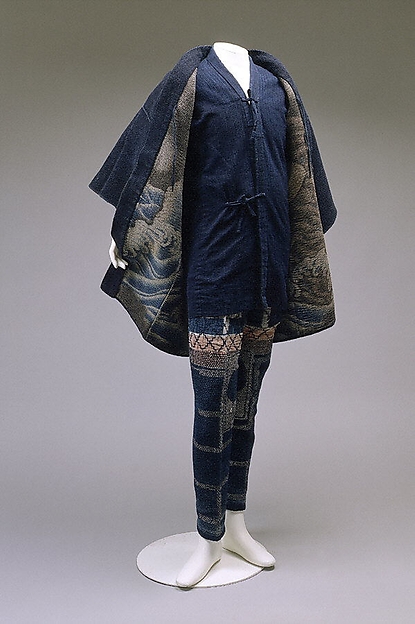
Fireman’s Jacket (Hikeshi-Banten) with Susanoo-no-mikoto Deity Scene, mid-19th century, Quilted cotton with tube-drawn paste-resist dyeing (tsutsugaki) with hand-painted details. The Metropolitan Museum of Art, Purchase, Irene Lewisohn and Alice L. Crowley Bequests, 1983, accession 1983.158a–c.
Look closer: Look at the line. The Met records tube-drawn paste-resist dyeing, tsutsugaki, with hand-painted details on quilted cotton.
Image: The Metropolitan Museum of Art, Open Access (CC0)
The Metropolitan Museum describes the process in the label of a shop curtain. The design on a noren of the nineteenth century, covered with a boldly flowering cherry tree, was drawn with a technique called tsutsugaki, literally ‘tube drawing’. In this paste-resist dyeing process, the museum explains, the design is drawn with an applicator consisting of a paper cone with a metal tip that trails rice paste onto the cloth. Then the cloth is dyed, usually with indigo. The areas covered with paste resist the dye and remain white, while the background, through repeated dipping and oxidation, attains a dark blue.
The same hand-drawn line appears on the fire brigade’s coats. The Met’s hikeshi-banten of the middle of the nineteenth century is quilted cotton with tsutsugaki and hand-painted details, and its scene of the deity Susanoo is drawn in the same medium as a shop’s name. The technique served the commercial and the heroic alike, and it is worth remembering that the line of a tsutsugaki drawing is the line of a single hand.
The cut sheet and the repeat
Katazome is the same resist applied differently. Wikipedia defines it as a Japanese method of dyeing fabric using a resist paste applied through a stencil, typically a rice flour mixture applied with a brush or palette knife. Stencils are reused to make a repeating pattern, and dye is applied by hand-painting, immersion or both. The entry explains that katazome was invented as a cheaper, faster alternative to highly patterned woven brocade, and later became a respected fibre art. Thin fabrics show the design on the reverse, whereas thicker or tighter weaves usually have a solid underside, typically indigo blue on cotton. Futon covers made of several panels can show a seamless pattern if the stencils are placed and joined correctly.

Stencil for Textile with Pattern of Bush Clover and Meandering Stream, 19th century, Paper reinforced with silk. The Metropolitan Museum of Art, Gift of Mrs. Horace Havemeyer, 1942, accession 42.91.225.
Look closer: Look at the two elements. The Met explains that the autumn landscape is made from bush clover and a meandering stream, and that its direction is deliberately ambiguous.
Image: The Metropolitan Museum of Art, Open Access (CC0)
The Met’s stencil with a pattern of bush clover and a meandering stream, of the nineteenth century, makes the process visible. The label says a length of white cloth was stretched out and paste applied through the stencil, which was then moved to the next area and the next until the entire length was covered; the cloth was then dyed, usually with indigo, and the areas covered with paste resisted the dye. A poetic autumn landscape is represented by only two elements, the museum says. And although the pattern is pictorial, its direction is ambiguous, a hard-to-achieve effect that is a tribute to the designer’s skill, because it allows the textile to be right-side up whether used as the front or the back of traditional Japanese garments, which have no shoulder seam.
The stencils themselves are a craft. Wikipedia’s entry on Ise katagami says that three sheets of washi are pasted together with kakishibu, the tannin-rich juice of the persimmon, to make a strong, flexible brown paper. The pattern is cut with tools collectively called dōgu-bori, using four techniques: pulling the knife towards the artist for long straight cuts, carving figurative designs, cutting circular holes, and using shaped punches. Production is now centred on Suzuka in Mie Prefecture, and historically towns of Ise Province were centres of the craft. For kimono printing, the stencils are mounted on fine silk net, which replaced human hair because it warps less and can be finer.
The entry also records that stencil use is evident in Nara period objects in the Shōsōin, and that the craft was designated an Important Intangible Cultural Property in 1993, the Association for the Preservation of Ise-Katagami having been founded in 1992 and the Ise-Katagami Stencil Museum in Suzuka opened in 1997. It names six holders of the title of Living National Treasure, from Nakajima Hidekichi, 1883 to 1968, to Jōnoguchi Mie, 1917 to 2003. And it notes that the Museum of Applied Arts in Vienna has more than eight thousand examples, a sign of how far the stencils travelled as design.
White on blue, and the reverse
A reader looking at a resist-dyed cloth should ask three questions. Is the line hand-drawn or repeated? A hand-drawn line varies in width and character, as the line of a tsutsugaki drawing does; a stencilled line repeats exactly, and the repeat can be counted. Is the reverse as clear as the face? Wikipedia notes that thin fabrics show the design on the reverse, while tighter weaves usually have a solid underside. And what is the ground? The cloth is usually cotton and the dye usually indigo, which is why so many surviving examples are white on blue.
The Met’s other stencils show the vocabulary. A stencil with bats on a lattice, of the nineteenth century, carries a lesson in cultural translation: the label says the auspiciousness of bats in China is based on wordplay in the Chinese language, which did not carry over to Japan, but that bats still appear in some Japanese contexts, such as the informal crest of the Ichikawa Danjūrō line of kabuki actors. The bold design, two bats moving freely in front of a rigid lattice, makes their movements look more eccentric. A third stencil, with a continuous fret pattern called sayagata, was made in the nineteenth century, and the label says the pattern originated in China and became very common in Japanese dress in the Edo period; many silk kosode of the seventeenth to nineteenth centuries were made of dyed, embroidered rinzu, a lightweight figured satin usually patterned with tiny flowers on a sayagata ground, and cargo lists of the early Edo period reveal that large amounts of rinzu were imported from China.
The Ryukyu Islands developed their own stencilled textile, bingata. The Met holds a twentieth-century bingata panel with tree peonies, made by Teruyo Shinohara and her pupils, in cotton tabby, 47 by 38.1 centimetres. It is a reminder that stencil resist reached Okinawa in a colourful form as well as the blue-and-white of the mainland, and that the techniques of this chapter are practised today by named makers.
The futon cover is the great domestic surface of both techniques. The Met’s nineteenth-century futon cover with a turtle, crane, pine, plum and bamboo is cotton, 156.2 by 124.1 centimetres, and gathers a set of long-life and congratulatory motifs on a single bedding cloth. The chapter on A Motif Dictionary: Crane, Pine, Wave and Chrysanthemum explains each of those emblems.
| Technique | How the resist is laid | Note from the sources |
|---|---|---|
| Tsutsugaki | Drawn freehand through a tube | Paste from sweet rice; usually indigo on cotton |
| Katazome | Pushed through a stencil | A repeating pattern from a reused stencil |
| Ise katagami | The stencil itself | Three washi sheets pasted with persimmon tannin |
| Bingata | Stencilled and painted | The Ryukyu Islands |
From brocade to bedding
The most revealing sentence in the sources is the one on origin: katazome was invented as a cheaper, faster alternative to highly patterned woven brocade. The woven pattern of Nishijin: The Woven Brocades of Kyoto could be afforded by few, and the stencil let a household have a repeating design on cotton. The resist-dyed cloth of the Edo period, in this sense, is the democratic cousin of the brocade.
The techniques are bound up with the indigo vat described in Aizome: The Indigo Dyer’s Craft, with the stitched cloth of Sashiko and Boro: The Mended Cloth and with the fire brigade's coat in Happi, Hanten and the Fire Brigade Coat. They meet the painted work of Yūzen: The Painted Kimono when a resist line is filled with colour. For the reader building a collection, the sequence of tsutsugaki, katazome, shibori and yūzen is a natural progression from the plain to the pictorial.
Within the house, the shelf strip below shows resist-dyed garments of the kind this chapter describes, including a fire-brigade coat and a festival coat made from a banner. The concierge desk can look for a particular motif, ground or technique on request.
Resist-dyed work in the Met

Stencil with Bats on a Lattice, 19th century, Paper. The Metropolitan Museum of Art, Purchase, Mrs. Helen M. Meserve Gift, 1981, accession 1981.10.28.
Look closer: Look at the contrast. The Met describes two bats moving freely in front of a rigid lattice, which makes their movements look more eccentric.
Image: The Metropolitan Museum of Art, Open Access (CC0)

Stencil with Continuous Fret Pattern (sayagata), 19th century, Paper. The Metropolitan Museum of Art, Fletcher Fund, 1937, accession 37.14.45.
Look closer: Look at the fret. The Met says the pattern originated in China and became very common in Japanese dress during the Edo period.
Image: The Metropolitan Museum of Art, Open Access (CC0)

Futon Cover with Turtle, Crane, Pine, Plum, and Bamboo, 19th century, Cotton. The Metropolitan Museum of Art, Gift of Sue Cassidy Clark, in honor of Dr. Barbara Brennan Ford, 2004, accession 2004.559.1.
Look closer: Look at the emblems. The Met records a cotton bedding cover of 156.2 by 124.1 centimetres with a gathering of long-life motifs.
Image: The Metropolitan Museum of Art, Open Access (CC0)

Teruyo Shinohara, Bingata Panel with Tree Peonies, 20th century, Cotton tabby. The Metropolitan Museum of Art, Gift of Teruyo Shinohara, 1989, accession 1989.268.2.
Look closer: Look at the colour. The Met credits Teruyo Shinohara and her pupils, and records cotton tabby from the Ryukyu Islands.
Image: The Metropolitan Museum of Art, Open Access (CC0)
Resist-dyed cloth in the house
The shelf holds fire-brigade and festival coats of the kind this chapter describes, and an antique boro hanten. Each is described as what it is, with its age and condition set out plainly on its own page.


Kimono and textile heritage
Antique cloth of every kind is gathered in one collection, and the concierge desk can look for a particular fibre, dye or region on request.
Answered plainly
What is tsutsugaki?
Resist dyeing in which rice paste is drawn through a tube, similar to a piping bag, before the cloth is dyed.
What is katazome?
Resist dyeing in which paste is applied through a stencil, so a pattern can repeat along a length of cloth.
What is the paste made of?
Sweet rice, which is high in starch and sticky.
What are Ise katagami?
Stencils made from three sheets of washi pasted with persimmon tannin, cut with specialist tools.
Why is so much of it white on blue?
The cloth is usually cotton and the dye usually indigo.
What is bingata?
The stencilled and painted textile of the Ryukyu Islands.
Where next
Sources and image credits
- Tsutsugaki, Wikipedia
- Katazome, Wikipedia
- Ise-katagami, Wikipedia
- Noren with Design of Flowering Cherry Tree, Metropolitan Museum of Art
- Stencil for Textile with Pattern of Bush Clover and Meandering Stream, Metropolitan Museum of Art, 42.91.225
- Stencil with Bats on a Lattice, Metropolitan Museum of Art, 1981.10.28
- Stencil with Continuous Fret Pattern (sayagata), Metropolitan Museum of Art, 37.14.45
- Fireman’s Jacket (Hikeshi-Banten), Metropolitan Museum of Art, 1983.158a–c
- Futon Cover with Turtle, Crane, Pine, Plum, and Bamboo, Metropolitan Museum of Art, 2004.559.1
- Bingata Panel with Tree Peonies, Metropolitan Museum of Art, 1989.268.2
Last reviewed 28 October 2026. Pictures, where shown, are public-domain or open-access and credited beneath each one.
Looking for a resist-dyed coat, a length of old cloth or a piece with a particular motif you have seen described here? The concierge desk replies within one to three business days.
Private concierge
Looking for something in particular?
Describe the piece or the project you have in mind. A senior advisor in Tokyo reads every case file personally and replies within two business days, with fees set out in writing before any work begins.