
Sashiko and Boro: The Mended Cloth
Techniques · Needle and thrift
Sashiko and Boro: The Mended Cloth
刺し子・襤褸
Where cotton was scarce, a household stitched its cloth into something warmer and stronger. White thread on indigo, laid in rows of running stitch, became a language of pattern as well as a repair.
Fact sheet
The stitched cloth in one glance
- Sashiko. Running stitch used to strengthen, warm and decorate cloth.
- Moyōzashi. Patterns built from long lines of running stitch.
- Hitomezashi. Patterns built from single stitches aligned on a grid.
- Boro. Textiles mended or patched together, from boroboro, ‘tattered’.
- Kogin-zashi. Rows of diamond shapes, developed in Aomori Prefecture.
Little stabs, long use
Wikipedia defines sashiko, written with characters meaning ‘little stabs’, as traditional Japanese stitching used to reinforce and decorate cloth. The entry gives its first appearance as the Edo period, 1603 to 1867, and says that by the Meiji period, 1868 to 1912, it had become winter work in the farming communities of the north. The purpose was practical. Sashiko strengthened homespun clothing, joined worn cloth into new garments, and added warmth by layering thin fabrics. The same entry notes that the coats of firefighters, hikeshi banten, were quilted so that the cloth was thick and absorbent and could be soaked in water.

Sashiko Jacket, second half of the 19th century, Indigo-dyed plain-weave cotton, quilted and embroidered with white cotton thread. The Metropolitan Museum of Art, Seymour Fund, 1967, accession 67.172.1.
Look closer: Look for the interlocking circles. The Met names the shippō-tsunagi pattern in three variations, with a band of waves at the hem.
Image: The Metropolitan Museum of Art, Open Access (CC0)
The Metropolitan Museum puts the idea in a sentence on the label of its sashiko jacket: sashiko is a quilting technique that uses a running stitch to reinforce and prolong the life of a textile, or to join together recycled pieces of cloth into a new garment. The museum adds that Japanese farmers used the technique to create warmer and more durable fabrics, and that decorative sashiko stitching developed from this practical function. The jacket, of the second half of the nineteenth century, is indigo-dyed plain-weave cotton, quilted and embroidered with white cotton thread, and measures 129.9 by 125.7 centimetres.
The Met’s description of the design is a lesson in how to read the stitching. The robe’s embroidered design is dominated by three variations on the pattern of interlocking circles called shippō-tsunagi, the museum says, and the bottom band bears a design of waves. In other words, the rows of stitches are not a fill but a drawing, and the pattern can be named.
Thread, indigo and patience
The entry on sashiko explains why the colours are what they are. Traditionally, white cotton thread was stitched on indigo-dyed blue cloth, because both were cheap and plentiful. Some decorative pieces used red thread. Most sashiko uses a plain running stitch. The entry distinguishes two ways of building a pattern: moyōzashi, which builds patterns from long lines of running stitches, and hitomezashi, which forms them from single stitches aligned on a grid.
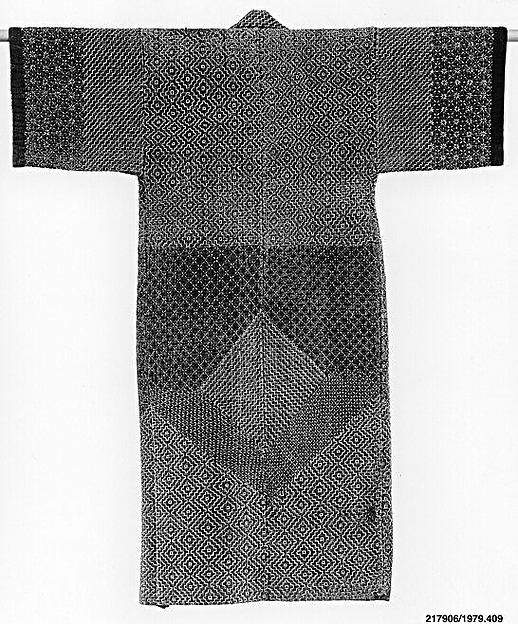
Sashiko Kimono, mid-19th century, Indigo-dyed plain-weave cotton, quilted and embroidered with white cotton thread. The Metropolitan Museum of Art, Purchase, Mrs. Jackson Burke Gift, 1979, accession 1979.409.
Look closer: Look at the ground. The Met records indigo-dyed plain-weave cotton, quilted and embroidered with white cotton thread.
Image: The Metropolitan Museum of Art, Open Access (CC0)
The entry adds a note on tools. Traditional work used specialist needles and thread, whereas modern work may use modern embroidery threads and needles, so a reader meeting a recent piece should not assume the old materials. A garment’s thread, its ground and the evenness of its stitches are the first things to examine, and the Met’s own labels, which name the cloth and the thread, are a good model for describing them.
The pattern names are a small vocabulary of Japanese design. The entry lists waves, mountains, bamboo, arrow feathers, shippō-tsunagi, pampas grass and interlocking geometric shapes, and names kagome, the woven bamboo; uroko, the fish scale; shippō, the seven treasures; amime, the fishing net; and hishi-moyō, the diamond. It records that kogin-zashi, with diamond shapes in horizontal rows, was developed in Aomori Prefecture, that many patterns derive from Chinese designs while others were developed in Japan, and that Katsushika Hokusai’s New Forms for Design of 1824 inspired many of them.
The Met’s sashiko kimono, of the mid-nineteenth century, is of the same material as the jacket: indigo-dyed plain-weave cotton, quilted and embroidered with white cotton thread. It is catalogued under the Meiji period in the museum’s records, though the date given for the object is the middle of the century, a reminder that the dates on such garments are approximate. The Met also holds a farmer’s jacket of the nineteenth century in linen and cotton with embroidery, 121.9 centimetres square, which shows that the technique was applied to bast fibre as well as cotton.
The textile of necessity
The word boro comes from boroboro, a term for something tattered or repaired, and Wikipedia’s entry defines boro as Japanese textiles that have been mended or patched together. The cloth was usually cotton, linen or hemp, mostly hand-woven by peasant farmers. The entry explains that cotton was less available than other fibres, so layering became necessary for lower-class clothing, and that indigo was the commonest dye because it was cheap and easy to grow and was said to repel moths. It also records saki-ori, cloth woven from old kimono cut into strips about a centimetre wide, and says that one obi needed roughly three kimono.
The history is bound up with class. In the Edo period, the entry says, fine silk and cotton were limited to the upper classes, and working people made their own cloth, which led to kasuri. The pieces in the exhibition Boro: The Fabric of Life were made by peasants between 1850 and 1950. With the Meiji period came rising living standards, and most boro were discarded; many working-class people saw them as a reminder of poverty, and in the early twentieth century cheaper ready-to-wear clothing made them mostly unnecessary. Only later did boro come to represent wabi-sabi, with the signs of wear seen as beautiful.
The collection that changed that view was made by a single man. The entry names Chūzaburō Tanaka, a folklorist who personally collected over twenty thousand boro pieces, of which 786 are designated Important Tangible Cultural Properties, and records that the Amuse Museum in Asakusa, Tokyo, exhibited 1,500 of them. A piece on the market should be judged for what it is: a working garment with a history of use and repair.
The Met’s work jacket for sledge pulling, the sorihiki sodenashi, is the clearest instance in the museum of thrift as design. The label says the vest was made for pulling sledges on the Shōnai plain, where farmers hauled fertiliser to the rice fields, and that farmers’ wives reinforced the part that touched the sledge band with sashiko embroidery. The stitching is known as kaki no hana, ‘persimmon flower’, from its resemblance to the arrangement of the blossom’s petals and sepals. The museum remarks that the thrift of the Shōnai farmwives is apparent in a jacket assembled from many different fabrics, and suggests that the striped cloth on the shoulders and neckband, which includes silk stripes, may have come from more formal garments. It measures 85.7 centimetres including the collar.
| Term | Meaning | Note from the sources |
|---|---|---|
| Sashiko | Running-stitch reinforcement and decoration | Edo period onward; winter work in the north |
| Moyōzashi | Patterns from long lines of running stitch | A way of building pattern |
| Hitomezashi | Patterns from single stitches on a grid | A way of building pattern |
| Kogin-zashi | Rows of diamond shapes | Developed in Aomori Prefecture |
| Boro | Mended or patched textiles | From boroboro, ‘tattered’ |
| Saki-ori | Cloth woven from strips of old kimono | Strips about one centimetre wide |
The quilted coat of the fire brigade
The Met’s hikeshi-banten of the middle of the nineteenth century, dated to the Edo or Meiji period, is of quilted cotton with tube-drawn paste-resist dyeing, tsutsugaki, and hand-painted details. The label observes that decoration was important to firefighters’ garments, which were far from purely utilitarian uniforms. Commoners wore reversible coats made of thick, quilted cotton, with a plain indigo-dyed exterior and an elaborately decorated interior. The inside of this coat depicts a climactic scene from a legend recorded in the Kojiki, in which Susanoo-no-mikoto saves the eighth and last daughter of an elderly couple from a monstrous serpent.
The set is complete in the museum’s record: trousers and an inner jacket belong to it, and the label says gloves, socks and headgear of the same material would also have been part of the ensemble. It adds that firefighters had high status in Edo, where wooden buildings and crowded housing made fires common. The coat shows what the quilted cotton of sashiko could become when a dyer and a painter were added to the work of a needle. Its fuller story belongs to Happi, Hanten and the Fire Brigade Coat, and its dyeing to Tsutsugaki and Katazome: Paste and Stencil.
Two small facts from the Met’s labels are worth carrying away. The first is the size of the sledge-pulling vest, 85.7 centimetres including the collar. The second is the dating: the museum gives the jacket as late nineteenth to early twentieth century, and the hikeshi-banten as mid-nineteenth century, so the stitched and quilted garments of this chapter span the end of the Edo period and the Meiji period that followed.
For the reader who wants to place sashiko among the other techniques of the wardrobe, the next chapters are Aizome: The Indigo Dyer’s Craft, on the dye that gave the cloth its ground, and Noragi and the Clothes of Work, on the farm garment in which the stitching was worn. Kasuri: Ikat Woven from Dyed Thread follows the woven pattern that working households also made for themselves.
Within the house, the shelf strip below shows antique boro and sashiko pieces and a fire-brigade coat, each in its own condition. The concierge desk can look for a particular type of stitched garment on request.
Stitched work in the Met

Sleeveless Work Jacket for Sledge Pulling (Sorihiki Sodenashi), late 19th–early 20th century, Plain-weave fabrics of cotton and of cotton and silk, some reinforced with embroidery. The Metropolitan Museum of Art, Seymour Fund, 1978, accession 1978.66.
Look closer: Look at the shoulders. The Met says the striped patches may have come from more formal garments, and that the stitching is called persimmon flower.
Image: The Metropolitan Museum of Art, Open Access (CC0)
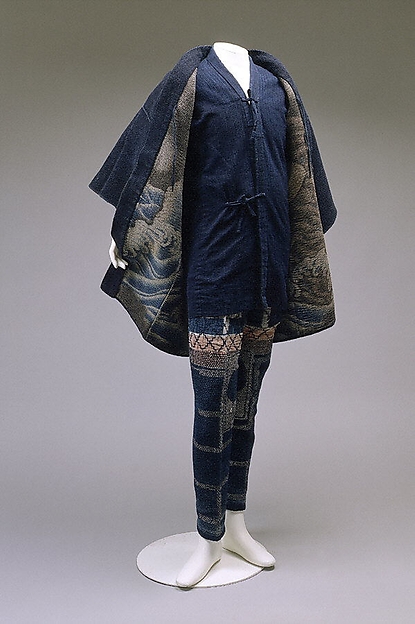
Fireman’s Jacket (Hikeshi-Banten) with Susanoo-no-mikoto Deity Scene, mid-19th century, Quilted cotton with tube-drawn paste-resist dyeing (tsutsugaki) with hand-painted details. The Metropolitan Museum of Art, Purchase, Irene Lewisohn and Alice L. Crowley Bequests, 1983, accession 1983.158a–c.
Look closer: Look at the interior. The Met records an indigo exterior and a decorated inside showing Susanoo saving a daughter from the serpent.
Image: The Metropolitan Museum of Art, Open Access (CC0)

Farmer's Jacket, 19th century, Linen;cotton / Embroidery. The Metropolitan Museum of Art, Seymour Fund, 1980, accession 1980.493.2.
Look closer: Look at the ground. The Met records linen and cotton with embroidery, and a size of 121.9 centimetres square.
Image: The Metropolitan Museum of Art, Open Access (CC0)
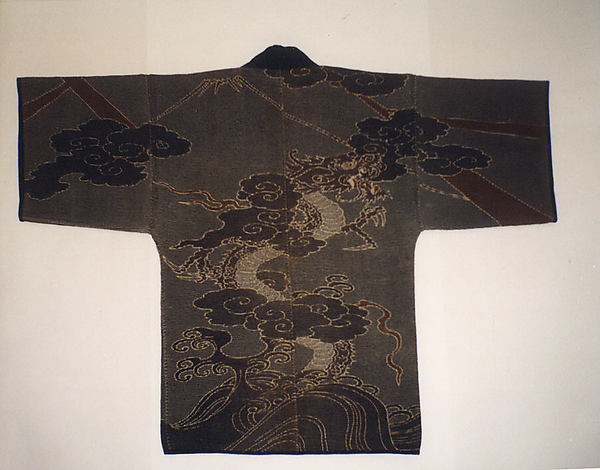
Jacket with Dragon and Mount Fuji, 19th century, Cotton. The Metropolitan Museum of Art, Gift of John B. Elliott through the Mercer Trust, 1999, accession 1999.247.2.
Look closer: Look at the subject. The Met titles the jacket for a dragon and Mount Fuji and records cotton as the material.
Image: The Metropolitan Museum of Art, Open Access (CC0)
Stitched cloth in the house
The shelf holds antique boro and sashiko pieces, a fire-brigade coat and a contemporary indigo patchwork. Each is described as what it is, with its age and condition set out plainly on its own page.


Kimono and textile heritage
Antique cloth of every kind is gathered in one collection, and the concierge desk can look for a particular fibre, dye or region on request.
Answered plainly
What does sashiko mean?
‘Little stabs’: a running stitch used to reinforce, warm and decorate cloth.
Why white thread on blue?
White cotton thread and indigo cloth were both cheap and plentiful.
What is boro?
Textiles that have been mended or patched together, from boroboro, ‘tattered’.
What is hitomezashi?
A pattern formed from single stitches aligned on a grid.
Who collected boro?
The folklorist Chūzaburō Tanaka collected over 20,000 pieces.
Why were firefighters’ coats quilted?
Quilting made the cloth thick and absorbent, so it could be soaked in water.
Where next
In the Lexicon: sashiko, boro.
Sources and image credits
- Sashiko, Wikipedia
- Boro (textile), Wikipedia
- Sashiko Jacket, Metropolitan Museum of Art, 67.172.1
- Sashiko Kimono, Metropolitan Museum of Art, 1979.409
- Sleeveless Work Jacket for Sledge Pulling, Metropolitan Museum of Art, 1978.66
- Fireman’s Jacket (Hikeshi-Banten), Metropolitan Museum of Art, 1983.158a–c
- Farmer’s Jacket, Metropolitan Museum of Art, 1980.493.2
- Object record: Jacket with Dragon and Mount Fuji, The Metropolitan Museum of Art
Last reviewed 28 October 2026. Pictures, where shown, are public-domain or open-access and credited beneath each one.
Looking for a stitched jacket, a length of indigo or a piece of patched cloth you have seen described here? The concierge desk replies within one to three business days.
Private concierge
Looking for something in particular?
Describe the piece or the project you have in mind. A senior advisor in Tokyo reads every case file personally and replies within two business days, with fees set out in writing before any work begins.