
Kasuri: Ikat Woven from Dyed Thread
Techniques · Pattern before the loom
Kasuri: Ikat Woven from Dyed Thread
絣
The design is fixed before a single row is woven. Bundles of yarn are bound, dipped and untied, and the picture only appears when the cloth comes off the loom, with the soft, brushed edge that is the mark of the technique.
Fact sheet
The pattern before the loom in one glance
- Tying. Sections of yarn are tightly wrapped so that they will not take the dye.
- Dyeing. The bundles are dipped, and the wrapped areas stay pale.
- Weaving. The pale and dark yarns interlace so that the pattern appears.
- Tate and yoko. The pattern may lie in the warp, the weft or both.
- Meisen. A stiff silk, often but not always made with kasuri.
A design planned in the yarn
Wikipedia defines kasuri as the Japanese term for fabric woven from fibres dyed to form patterns or images, usually referring to cloth made in Japan, and describes it as a form of ikat dyeing that traditionally gives a blurred or brushed look. The method is stated plainly. Warp or weft threads, or both, are resist-dyed before weaving, with sections tightly wrapped to block the dye; when the cloth is woven, the undyed areas interlace to form the pattern. The pattern may lie in the warp, as in tate gasuri, in the weft, as in yoko gasuri, or in both, as in tate-yoko gasuri, a double ikat.
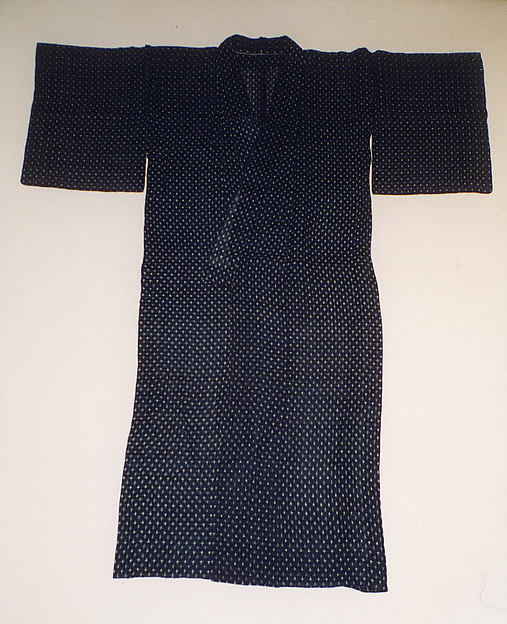
Woman's Summer Kimono with Design of Small Crosses, 19th century, Ikat-patterned plain-weave ramie. The Metropolitan Museum of Art, Gift of John B. Elliott through the Mercer Trust, 1999, accession 1999.247.10.
Look closer: Look at the edges of the crosses. The Met explains that the tied areas resist the dye and the pattern emerges as the cloth is woven.
Image: The Metropolitan Museum of Art, Open Access (CC0)
The Metropolitan Museum puts the same idea in the label of a nineteenth-century woman’s summer kimono. Ikat, it says, is a term that generally corresponds to kasuri in Japanese; it is a resist-patterning technique that requires careful planning. Traditionally, threads of the warp or weft or both are tied in certain areas and then dyed before weaving, and the tied areas resist the dye, remaining white, while the desired pattern emerges as the cloth is woven. The kimono, which has a design of small crosses, is ikat-patterned plain-weave ramie, 154.3 centimetres high including the neckband and 128.3 centimetres wide.
A reader should hold on to the difference between technique and cloth. Wikipedia notes that kasuri is a dyeing technique, whereas meisen is a stiff silk woven from noil-spun thread, and that meisen is often, but not always, dyed using kasuri, which is the source of the confusion between them. The word on a label may therefore name a method, a fabric or both.
From the islands to the farmhouse
The entry on kasuri traces the path of the technique. Ikat was practised in the Ryukyu Kingdom, which is the modern Okinawa, in the twelfth or thirteenth century, and kasuri textiles were exported in the fourteenth century. After the invasion of the Ryukyu Islands in 1609 the technique entered southern Japan, and by 1750 it had reached the Nara area of Honshu. Increased cotton production, the entry says, let farmers weave and dye cloth for home use and for sale. Some sources credit Den Inoue, 1788 to 1869, with inventing kasuri as a young girl.

Girl's Summer Kimono with Design of Sea Bream and Bamboo, 19th century, Ikat-patterned plain-weave ramie. The Metropolitan Museum of Art, Seymour Fund, 1966, accession 66.239.2.
Look closer: Look at the bream. The Met explains that tai is linked to medetai, a word for joyous occasions, and that the lightweight ramie suits summer.
Image: The Metropolitan Museum of Art, Open Access (CC0)
By 1850, according to the same entry, kasuri was produced in Kurume in Kyushu, Iyo in Shikoku, and the Bingo and San-in regions of Honshu. Some rural villages became manufacturing centres, with families weaving the cloth while the dyeing was often done in community dyeworks. Production grew until the 1930s, and by the late twentieth century few could afford the time for hand dyeing and weaving, though artisans still make prized textiles.
The Met’s girl’s summer kimono of the nineteenth century, dated to the Edo period, is a good instance of the technique in domestic use. The label says the long-hanging sleeves make it appropriate for a girl and the lightweight ramie makes it suitable for summer, and that the cloth is decorated in kasuri with an auspicious pattern of sea bream and bamboo. Sea bream, tai in Japanese, is associated with the last syllable of medetai, a word used to describe joyous occasions. The kimono measures 99.1 by 94 centimetres.
The Met’s child’s kimono of the late nineteenth or early twentieth century shows the other side of domestic planning. It is ikat-patterned plain-weave bast fibre, asa, with a design of pine, bamboo, plum blossoms and fans, and the label observes that the waist and shoulder have tucks that can be let out as a child grows; the kimono could be enlarged nearly fifteen inches in length and over four inches in width and so accommodated several years of growth. Pine, bamboo and plum blossoms often occur together as a trio of congratulatory motifs, the museum says, and the fan is also auspicious because its shape, widening at one end, signifies increase or growth.
Reading the blur
The first thing to look for is the soft edge. Because the pattern is tied into the yarn before weaving, the dye never meets the pale ground in a hard line, and the resulting blur is the visual signature of the technique. A crisply outlined design in a similar blue and white may have been drawn or stencilled instead, and the chapters on Tsutsugaki and Katazome: Paste and Stencil and Yūzen: The Painted Kimono describe those methods.
The second thing is the fibre. The Met’s pieces illustrate the range: ramie in the woman’s and girl’s summer kimono, plain-weave asa, which is a bast fibre, in the child’s kimono and in a nineteenth-century piece of cloth for a kimono with round fans, bamboo and interrupted stripes, which measures 66 by 27.9 centimetres and is patterned in both warp and weft kasuri. A twentieth-century length with a pattern of roundels, in weft-ikat plain-weave ramie, measures 116.8 by 50.8 centimetres. Wikipedia lists regional types on the same logic: Ōshima-tsumugi, a mud-dyed silk with a deep black colour; the picture kasuri of Kurume, e-gasuri; the hemp kasuri of Nara; the ramie kasuri of Miyakojima in Okinawa; and the silk kasuri of Isesaki and Amami Ōshima.
The third thing is the method of tying. The entry names four. In tegukuri the yarn bundles are tied by hand; in itajime the yarn is clamped between engraved boards as a resist; in orijime a thick warp creates a fine dotted pattern; and in bokashi twisted or plaited yarn forms its own resist. The patterns of this chapter’s cloths, from small crosses to roundels, are the products of such decisions, made before the first pass of the shuttle.
Two further records show how widely the look was recognised. The Met holds a ceramic sake cup of the second half of the eighteenth century whose title describes a pattern resembling ikat-dyed fabric, so that the blurred edge of kasuri had by then become a decorative idea in its own right, one that could be borrowed by a potter. And the museum’s round-fan cloth was shown in the exhibition Seasonal Pleasures in Japanese Art in 1995 and 1996, a reminder that a humble length of country cloth can carry a seasonal and auspicious meaning as readily as a courtly robe.
A last note concerns the fan. The Met’s round-fan cloth is a reminder, following Sensu and Uchiwa: The Fan in Dress, that an auspicious motif can be woven rather than drawn.
| Term | Meaning | Note from the sources |
|---|---|---|
| Tate gasuri | Pattern in the warp | Warp threads resist-dyed |
| Yoko gasuri | Pattern in the weft | Weft threads resist-dyed |
| Tate-yoko gasuri | Pattern in both | A double ikat |
| Tegukuri | Yarn bundles hand-tied | A way of making the resist |
| Itajime | Yarn clamped between engraved boards | A way of making the resist |
| E-gasuri | Picture kasuri | Kurume |
Cotton, community and the home loom
Kasuri belongs to the history of cotton. The entry says that increased cotton production let farmers weave and dye cloth for home use and sale, and the sashiko and aizome chapters tell the same story from the side of the needle and the vat. Indigo, as Aizome: The Indigo Dyer’s Craft explains, was one of the few substances that could dye cotton; the dark blue ground of many kasuri cloths, with its pale pattern, belongs to the same economy.
Kasuri also sits in a longer line of textile technique. The Silk, Hemp, Cotton and Ramie: The Fibres of Japanese Dress chapter describes the bast fibres and silk on which the Met’s examples were made, and the Regional Textiles from Kyoto to Okinawa chapter takes the geography further, from Okinawa northwards. For the farm garment, the reader should turn to Noragi and the Clothes of Work.
The reader who wishes to handle the subject practically should remember three sentences from the sources. Kasuri is resist-dyed before weaving. Its pattern may lie in the warp, the weft or both. And it is a method, which may or may not have been used to make the fabric named on a label. With these three, most descriptions of kasuri textiles can be tested against the cloth itself.
Within the house, the shelf strip below shows antique boro garments that combine indigo cotton, hemp and kasuri in a single jacket, together with contemporary pieces made from old indigo cloth. The concierge desk can look for a particular fibre, region or pattern on request, and will describe each as what it is.
Pattern before the loom in the Met
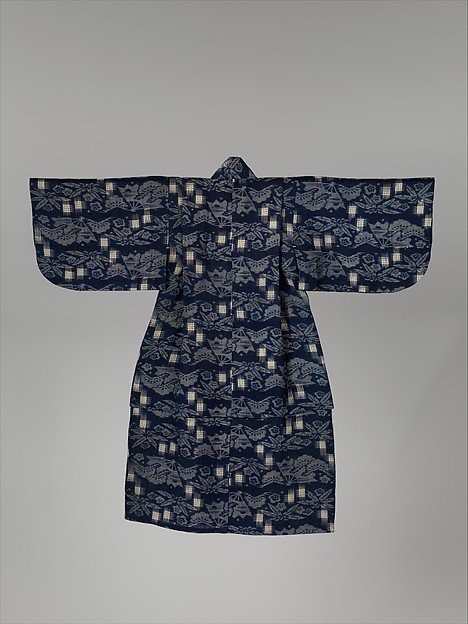
Child's Kimono with Pine, Bamboo, Plum Blossoms, and Fans, late 19th–early 20th century, Ikat-patterned plain-weave bast fiber (asa). The Metropolitan Museum of Art, Gift of Andreas Leisinger, in memory of Jean Mailey, 1996, accession 1996.84.
Look closer: Look at the tucks. The Met explains that the waist and shoulder could be let out, so that the kimono could grow with the child.
Image: The Metropolitan Museum of Art, Open Access (CC0)
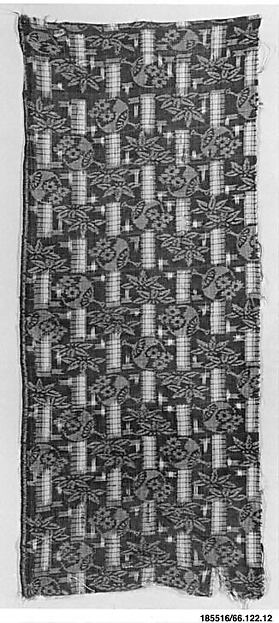
Piece of Cloth for Kimono with Pattern of Round Fans (Uchiwa), Bamboo, and Interrupted Stripes, 19th century, Plain-weave asa with warp and weft kasuri (ikat ) patterning. The Metropolitan Museum of Art, Seymour Fund, 1966, accession 66.122.12.
Look closer: Look at the fans. The Met records warp and weft kasuri on plain-weave asa, in a length of 66 by 27.9 centimetres.
Image: The Metropolitan Museum of Art, Open Access (CC0)
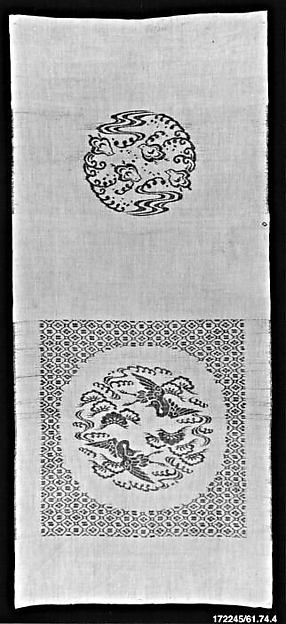
Length with Pattern of Roundels, first half of the 20th century, Weft ikat-patterned (kasuri) plain-weave ramie. The Metropolitan Museum of Art, Gift of Mr. and Mrs. Cartter Patten, in memory of Mrs. Sarah Key Patten, 1961, accession 61.74.4.
Look closer: Look at the roundels. The Met records weft ikat on plain-weave ramie, in a length of 116.8 by 50.8 centimetres.
Image: The Metropolitan Museum of Art, Open Access (CC0)
Girl's Summer Kimono with Design of Sea Bream and Bamboo, 19th century, Ikat-patterned plain-weave ramie. The Metropolitan Museum of Art, Seymour Fund, 1966, accession 66.239.2.
Look closer: Look at the sleeves. The Met says the long-hanging sleeves make the robe appropriate for a girl.
Image: The Metropolitan Museum of Art, Open Access (CC0)
Indigo cloth in the house
The shelf holds antique indigo garments, among them a boro jacket that combines cotton, hemp and kasuri, and a contemporary patchwork. Each is described as what it is, with its age and condition set out plainly on its own page.


Kimono and textile heritage
Antique cloth of every kind is gathered in one collection, and the concierge desk can look for a particular fibre, dye or region on request.
Answered plainly
What is kasuri?
Cloth woven from yarn that has been resist-dyed in patterns before weaving; a form of ikat.
Why is the edge blurred?
The pattern is tied into the yarn before weaving, so the dye does not meet the pale ground in a hard line.
What is the difference between kasuri and meisen?
Kasuri is a dyeing technique; meisen is a stiff silk, often but not always made with kasuri.
Where did the technique come from?
Ikat was practised in the Ryukyu Kingdom by the twelfth or thirteenth century and entered southern Japan after 1609.
What is double ikat?
Tate-yoko gasuri, in which both warp and weft carry the pattern.
Where was it made?
By 1850 in Kurume, Iyo, and the Bingo and San-in regions.
Where next
Sources and image credits
- Kasuri, Wikipedia
- Woman’s Summer Kimono with Design of Small Crosses, Metropolitan Museum of Art, 1999.247.10
- Girl’s Summer Kimono with Design of Sea Bream and Bamboo, Metropolitan Museum of Art, 66.239.2
- Child’s Kimono with Pine, Bamboo, Plum Blossoms, and Fans, Metropolitan Museum of Art, 1996.84
- Piece of Cloth for Kimono with Pattern of Round Fans, Metropolitan Museum of Art, 66.122.12
- Length with Pattern of Roundels, Metropolitan Museum of Art, 61.74.4
Last reviewed 28 October 2026. Pictures, where shown, are public-domain or open-access and credited beneath each one.
Looking for a length of old kasuri, a summer robe or a farmhouse jacket you have seen described here? The concierge desk replies within one to three business days.
Private concierge
Looking for something in particular?
Describe the piece or the project you have in mind. A senior advisor in Tokyo reads every case file personally and replies within two business days, with fees set out in writing before any work begins.