
How to Read, Grade and Care for a Japanese Garment
Reading · The keeper's art
How to Read, Grade and Care for a Japanese Garment
手入れ
A kimono is made of straight lengths, folded flat and aired on a pole. Its care is a body of habits older than any shop, and a good keeper knows them before buying.
Fact sheet
The keeper's rules in one glance
- Read the cut. A traditional bolt is about 11.5 metres by 36 centimetres for women, and the seams are not trimmed.
- Air it. Hang it overnight on an erisao, and air it seasonally as well, according to Wikipedia.
- Fold it. Fold along the seams into a compact rectangle; creases are part of the method.
- Wrap it. Washi paper breathes; plastic bags trap moisture and are to be avoided.
- Keep it dark. Stable 18 to 21 degrees and 45 to 55 per cent humidity, in darkness, says one dealer's guide.
- Ask a conservator. Do not wash antique textiles at home; stains and tears belong to a professional.
Straight seams and long memories
The first thing to know about a Japanese garment is that it is flat. Wikipedia describes the traditional tanmono bolt as about 11.5 metres long and 36 centimetres wide for women, and about 12.5 metres long and 42 centimetres wide for men, with one bolt making one kimono and the linings cut from bolts of the same width. Because the woven selvedges do not fray, the seam allowances are not trimmed, which is why a kimono can be re-sewn to different measurements and why its seams are so generous. The article adds that a hand-sewn kimono is closed with a single running stitch of about three to four millimetres, shorter near the collar, and that the seams are pressed with a small lip, the kise, of roughly two millimetres, which hides the stitches.

Kimono Rack (Ikō) with Scrolling Foliage and Tokugawa Family Crest, 18th century, Lacquered wood with gold hiramaki-e on nashiji (“pear-skin” ground); gilt bronze fittings. The Metropolitan Museum of Art, Mary Griggs Burke Collection, Gift of the Mary and Jackson Burke Foundation, 2015, accession 2015.300.287a–g.
Look closer: Look at the crest and the scrolling foliage. The Met says lacquer clothing stands were a standard part of wealthy women's bridal trousseaux, and that this rack could have belonged to a Tokugawa princess.
Image: The Metropolitan Museum of Art, Open Access (CC0)
This construction governs every habit of care. A garment made of straight panels can be unpicked back into bolt lengths, washed, stretched and sewn again, and the same article says that a kimono was often taken entirely apart for washing. It also means that a creased kimono is not a damaged one: the folds follow the seams, and the cloth is meant to be folded along them. Those facts are the common ground of the museum conservators, the dealers and the dressers whose advice is gathered in this chapter.
New custom kimono, according to the same source, usually arrive with long, loose basting stitches, the shitsuke ito, around the outer edges, which keep the layers aligned and prevent bunching, folding and wrinkling; they are sometimes replaced for storage. A garment that still carries them has probably never been worn, and a reader looking at one should say so only after examining the stitches and the cloth together.
A garment also has a front. Wikipedia records that the wearer's left side wraps over the right, unless the wearer is deceased, and that the eighth-century Yōrō code of 718 required this left-over-right overlap, following Chinese fashion. The rule governs how a kimono is folded as well as how it is worn, as the stories below show.
- Bolt for a woman: about 11.5 m long and 36 cm wide.
- Bolt for a man: about 12.5 m long and 42 cm wide.
- Stitch: a single running stitch of about 3 to 4 mm.
From the unpicked robe to the wrapped one
Care in Japan began with water. Wikipedia explains that the traditional method had two steps: washing each separated piece, called toki arai, and then stretching each washed and starched piece on a board to dry, called arai hari. Because stitches had to be removed, a traditional kimono needed hand-sewing afterwards, which the article calls expensive and difficult and cites, with a request for a reference, as one cause of the garment's declining popularity. Modern fabrics and cleaning methods have removed the need for unpicking, though traditional washing is still practised, especially for high-end garments.

Kimono rack, 19th century, Lacquered wood. The Metropolitan Museum of Art, Gift of Shoji Yamanaka, in memory of Alan Priest, 1984, accession 1984.497a–h.
Look closer: Look at the frame. The Met records a nineteenth-century kimono rack in lacquered wood, the same form as the eighteenth-century stand.
Image: The Metropolitan Museum of Art, Open Access (CC0)
The article's account of dry cleaning is plain. Many owners dry clean, which is usually cheaper than unpicking, though it may be impossible for some fabrics or dyes. The same section says that a kimono should be aired at least seasonally and before and after each wearing, and that kimono are often stored in acid-free paper envelopes called tatōshi, with specific folding methods to prevent creasing.
The furniture of care is old. The Metropolitan Museum's lacquer kimono rack of the eighteenth century, carrying the Tokugawa family crest, is accompanied by a note that lacquer clothing stands were a standard part of wealthy women's bridal trousseaux by the thirteenth to fifteenth centuries, and that this rack could have been part of the trousseau of a Tokugawa princess. The same collection holds nineteenth- and twentieth-century racks in lacquered wood, which shows how long the form lasted.
The paper is also old, and also a matter of record. A set of tatōshi in the Baltimore Museum of Art, dated 2010 and made of washi, woven tape and ink, is described there as protective wrappers in which kimono and obi are commonly enclosed in storage in Japan. The museum notes that washi is a sturdy paper made from the fibres of the paper mulberry tree. Care, in short, is a chain of objects: the pole, the rack, the paper and the chest, each with its own history.
The modern turn is described in the next sections. In the twentieth century the museum conservators of the West met the Japanese method head on, as the story of the Los Angeles County Museum of Art below shows, and the older view that a crease is a wound was replaced, for kimono, by the view that a crease is a sign of proper folding. The chapter on The Kimono Ladder: Furisode, Tomesode, Hōmongi and Komon describes the garments themselves; this one describes how they are kept.
Seven letters for the state of cloth
Condition is read before anything else. The house uses the Japanese scale, in which the written description of a piece is the starting point and not the grade: the curator looks at every photograph, lowers the grade when the pictures show more than the description admits, and raises it only on clear photographic evidence. The scale is short and is set out in the table below. Every defect the pictures show is named plainly on the page of the piece, and the condition photographs are kept in the gallery and never buried at the end.

Kimono rack, 20th century, Lacquer on wood. The Metropolitan Museum of Art, Museum Accession, accession X.634a–g.
Look closer: Look at the date. The Met's third rack is of the twentieth century, which shows how long the form lasted.
Image: The Metropolitan Museum of Art, Open Access (CC0)
A garment graded S is described as unused, SA as near new, A as good, AB as showing light signs of use, B as showing visible signs of use and C as marked wear; N stands for new. Pieces remade from old kimono are always graded as used, never unused. These labels are the house's own convention, adapted from the Japanese description of condition, and they are not a museum standard. A conservator, who asks different questions, will care less about the letter than about the state of the fibre, the dye and the seams.
A reader should look at four things on any piece. The first is the fibre: silk that has become brittle will tear along folds, and the Kimono Gallery's guide says that relative humidity below 35 per cent makes fibres brittle, especially silk, while humidity above 65 per cent promotes mould and mildew and attracts pests. The second is the dye: water, detergents and dry-cleaning chemicals can cause bleeding dyes and shrinkage, so a garment that has been cleaned at home deserves a closer look. The third is the stitching, where the shitsuke ito and the line of the kise show whether the garment has been altered. The fourth is the smell: the Baltimore wrapper warns against perfume, and a garment that has been stored with naphthalene will carry it.
Grading is not valuation. A faded cotton hanten can be a better document of its time than a flawless silk, and a repaired boro jacket can be more interesting than a pristine one, a point developed in Sashiko and Boro: The Mended Cloth. The letter tells a reader what condition to expect, not whether the object is worth owning.
| Grade | House label | Japanese description it answers |
|---|---|---|
| N | New | Shinpin, new |
| S | Unused | Mishiyō, unused |
| SA | Near new | Mishiyō ni chikai, close to unused |
| A | Good | No conspicuous damage or dirt |
| AB | Light signs of use | Between good and visible signs of use |
| B | Visible signs of use | Some damage or dirt |
| C | Marked wear | Damage or dirt, or poor overall condition |
Overnight on the pole
The first act of care is to let the garment breathe. In his series on dressing in the kimono, the illustrator Kazuo Hozumi writes in Openers magazine, in an English article published in May 2015, that after wearing the kimono should be hung on an erisao, a kimono-specific hanger, overnight so that moisture dries out. A regular hanger does not fit because its shoulders slope; the erisao should match the full shoulder width of the kimono, and some extend or fold in half for travel. He hangs the under-kimono, the kimono and the jacket together in layers, and puts the accessories away while the garments air.

Whose Sleeves? (Tagasode), (right screen) late 16th–early 17th century; (left screen) early to mid-17th century, Pair of six-panel folding screens; ink, color, and gold on gilt paper. The Metropolitan Museum of Art, H. O. Havemeyer Collection, Bequest of Mrs. H. O. Havemeyer, 1929, accession 29.100.493, .494.
Look closer: Look at what is missing. The Met says such screens omit human figures and show only the robes, accessories and furniture of the owners.
Image: The Metropolitan Museum of Art, Open Access (CC0)
Airing is older than the pole. The translator's note on the Baltimore wrappers explains that the final phrase of the printed text tells the owner to air the kimono, with the term mushiboshi, a traditional airing that prevents mould and insects. Wikipedia's recommendation of airing at least seasonally and before and after each wearing says the same thing in modern terms.
A garment aired overnight is also inspected. Hozumi's argument is that a keeper should tidy the garment personally and not rely on others, because this builds attachment to the kimono and allows regular checks for stains or damage. A museum would call this condition monitoring; a household calls it looking after what one owns.
Airing has limits. The Kimono Gallery's guide says to store textiles in complete darkness, because ultraviolet light from sunlight and fluorescent bulbs fades dye and weakens fibre, and to limit any display to short periods in dim light behind ultraviolet-filtering glass or acrylic, rotating pieces. The pole in a dim room is therefore the right place; a bright window is not. A reader who displays a garment on a stand should read the section on display in the guide, which says that garments should sit on properly padded mannequins or hangers to spread their weight evenly.
Creases that are meant
Folding is where Western and Japanese practice differ most, and the clearest account is a museum's own. The Los Angeles County Museum of Art, on its Unframed blog, describes how its textile conservators first tried a Western method: lining the folds of each kimono with long cotton pads and folding the fabric as few times as possible, since Western conservation usually tries to remove sharp creases to prevent wear along folds. The method took up significant time and space, and when the kimono came out of storage they were rumpled and wrinkled.

Tagasode (“Whose Sleeves?”), first half of 17th century, Pair of six-panel folding screens; ink, color, gold, silver, and gold leaf on paper. The Metropolitan Museum of Art, H. O. Havemeyer Collection, Gift of Mrs. Dunbar W. Bostwick, John C. Wilmerding, J. Watson Webb Jr., Harry H. Webb, and Samuel B. Webb, 1962, accession 62.36.2, .3.
Look closer: Look at the materials. The Met records ink, colour, gold, silver and gold leaf on paper.
Image: The Metropolitan Museum of Art, Open Access (CC0)
After years of Western-style storage, Catherine McLean, head of conservation in the museum's textiles department, the conservation team and Sharon Takeda, senior curator and head of costume and textiles, chose to fold the kimono in the Japanese style, in which a crease is a sign of proper folding. Rika Hiro of the conservation centre taught an informal class on folding the collection in the traditional way. The result, the museum says, avoided unwanted wrinkles and made the garments compact and transportable: all thirty-five kimono in the exhibition Kimono for a Modern Age fitted into three flat boxes.
The Kimono Gallery's guide describes the same method in the language of a dealer: fold along existing seams and creases to form a compact rectangle that limits stress and allows some airflow, which it calls the tatami-gata fold. For very fragile or heavily embellished pieces, or for long-term storage, it recommends rolling the textile around an acid-free tube padded with acid-free tissue to avoid sharp creases. Where the Los Angeles team and the dealer agree is that the folds follow the garment's own seams.
Hozumi's article puts the practical side: fold on a tatami mat, or clear a space on a bed and spread a large decorative tatami mat, the hana-goza, over it, and wrap each folded item in a tatō. The article illustrates the folding of the kimono, the jacket and the under-kimono but gives no written steps, which is itself a reminder that the craft is learned by watching a hand. The reader who wants step-by-step instructions should ask a teacher or a conservator and not rely on a page.
The sleeves carry a meaning. The Los Angeles article records that Japanese folding specifies which sleeve overlaps the other: left over right indicates that the owner is alive, and right over left indicates that the owner has died. It is the same rule that governs how the garment is worn.
Paper, paulownia and the dark
Once folded, a garment is wrapped. A personal men's kimono site, crediting John Marshall of John's Attic, advises wrapping kimono in large sheets of washi, the tatōshi, which ventilates and absorbs and releases excess moisture, helping prevent mould; other papers may lack ventilation and contain acid and are unsuitable. It warns that silk should never be stored in plastic bags, which can trap moisture and cause spotting, and suggests acid-free archival tissue where tatōshi are hard to find. The Kimono Gallery agrees on materials: use only acid-free, lignin-free archival materials, wrap textiles in unbleached cotton or muslin, avoid plastic, and use unbuffered acid-free tissue for silk because buffering agents may react with it over long periods, while buffered tissue may be used for cotton or linen.

Whose Sleeves? (Tagasode), 17th century, Six-panel folding screen; ink, color, and gold on paper. The Metropolitan Museum of Art, Gift of Mrs. P. H. B. Frelinghuysen, 1962, accession 62.98.4.
Look closer: Look at the single screen. The Met records one six-panel screen in ink, colour and gold on paper.
Image: The Metropolitan Museum of Art, Open Access (CC0)
The printed note on the Baltimore wrappers is a small catechism. The translation records that it covers moth repellents, gold and silver foil, and the need to avoid perfume, plastic bags, high-temperature ironing and sulphur, and that perspiration and humidity can change colours. The wrapper's own words say that the kimono cannot be used with perfume or plastic bags.
The chest is the next layer. Hozumi's article says that paulownia chests have long been considered the best for kimono storage, and the men's kimono site calls tansu chests the ideal option, naming wide dresser drawers, camphor or cedar chests, map drawers and bamboo baskets as alternatives while noting that some believe paulownia controls humidity better than paper. The Metropolitan Museum's collection even holds a storage case of 1422, a piece of Negoro ware made of wood with layers of black and red lacquer and gilt-bronze fittings, an early witness to the Japanese habit of keeping valuables in lacquered cases.
The room matters as much as the box. The Kimono Gallery recommends a stable temperature of 18 to 21 degrees Celsius and relative humidity of 45 to 55 per cent, advises avoiding attics, basements and exterior walls where temperature and humidity swing, and recommends hygrometers and thermometers to monitor conditions. It also asks for protection from dust, soot and pollutants such as sulphur dioxide and nitrogen oxides, with some ventilation to prevent stagnant air.
Handling is the last part of storage. The guide asks for clean, dry hands without lotions, oils or jewellery that could snag the fabric, for the textile's full weight to be supported and not pulled from one point, and for handling to be kept to a minimum. These are the rules of any museum store, and they are the same rules a household can follow.
Camphor, incense and vigilance
Insects are the quiet enemy of silk and wool. The men's kimono site lists the repellents in use: mothballs work but are poisonous and leave a lingering odour; camphor cubes, shōnō, are inexpensive, have a moderately pleasant smell and fade once the garment is aired; Bochu-Koh Kyoto incense is more expensive and pleasantly scented but should be used with tatōshi and never touch silk directly. Any repellent should be wrapped in breathable paper so that it does not touch the cloth, since contact can cause discoloration, and repellents should be replaced once a year or as the package directs.

Stacked Food Box (Jūbako) with “Whose Sleeves?” (Tagasode) Design, 18th century, Lacquered wood with gold and silver hiramaki-e, gold- and silver-foil application, and mother-of-pearl inlay on gold nashiji (“pear-skin”) ground. The Metropolitan Museum of Art, Mary Griggs Burke Collection, Gift of the Mary and Jackson Burke Foundation, 2015, accession 2015.300.288a–e.
Look closer: Look at the lacquer. The Met records gold and silver hiramaki-e, foil and mother-of-pearl on a gold nashiji ground, with the tagasode theme.
Image: The Metropolitan Museum of Art, Open Access (CC0)
The Kimono Gallery takes a more cautious line. It warns that cedar oils can stain textiles and that mothballs containing naphthalene or paradichlorobenzene are toxic, have a persistent odour and can damage fabric with prolonged contact; it names dried lavender sachets as an alternative of limited effect and controlled freezing of small, unsoiled items, done carefully to avoid condensation damage. Its conclusion is that vigilance and a clean, stable environment are the most effective controls.
Hozumi, by contrast, writes frankly that he likes the scent of naphthalene-based repellents, which he adds as soon as he stores a garment, while conceding that some dislike it, and suggests hanging the kimono on the pole on the morning of wearing so that the scent fades. The two views are not reconciled in the sources and are given here as they stand. A keeper in a museum would choose the dealer's cautious line, and a keeper of a daily wardrobe may follow Hozumi's; the house recommends that anyone with a valuable or fragile piece ask a conservator.
Inspection is the quiet part of pest control. The Kimono Gallery asks for regular checks for frass, casings, insects or holes, for storage areas to be kept clean and vacuumed, and for no food or plants to be kept near textiles. A garment that has been aired and wrapped but never examined has not been looked after.
Wash, stretch or leave alone
The temptation with an old garment is to clean it. The Kimono Gallery's answer is flat: do not wash antique textiles at home, because water, detergents and dry-cleaning chemicals can cause irreversible damage, including bleeding dyes and shrinkage. For surface dust, gently brush with a soft, natural-bristle hake brush; for ingrained dirt, a museum vacuum on low suction with a protective mesh screen over the textile, used with extreme care. Any significant cleaning or stain removal should go to a professional textile conservator, as should stains, tears, active mould or insect infestation.

Storage Case (Karabitsu), 1422, Wood with layers of black and red lacquer (Negoro ware); gilt-bronze fittings. The Metropolitan Museum of Art, Gift of Florence and Herbert Irving, 2015, accession 2015.500.2.9a, b.
Look closer: Look at the layers. The Met records wood with layers of black and red lacquer and gilt-bronze fittings, dated 1422.
Image: The Metropolitan Museum of Art, Open Access (CC0)
The traditional professional method is the one Wikipedia describes: unpick, wash each piece, stretch it on a board and sew it again. It remains in use for high-end garments, and it is best understood as a craft with its own specialists. The Icon conservation society's online talk of October 2023, by Mie Ishii of Saga University, covered traditional kimono maintenance, storage and display tips, Japan's cultural preservation policy for kimono conservation, and scientific studies including analysis of natural dyes and colour fading caused by museum lighting, which indicates how much of the field is still being studied.
A garment that is worn also needs lighter attention. Wikipedia notes that the under-kimono, the nagajuban, is worn under every type of kimono except the yukata, and that its collar cover, the han'eri, is replaceable. The layers next to the skin are therefore the ones that take sweat and are laundered, which spares the outer garment. The point is developed in Yukata: The Summer Cotton Robe, where cotton garments that are washed regularly are discussed.
For routine questions the house keeps an older guide to care, Care of Kimono and Textiles, which this chapter extends and does not replace.
Four tales of keeping
The museum that unlearned its folding. The Los Angeles story is the best known. A department of conservators, trained to remove creases, found that their padded, barely folded kimono emerged rumpled; they learned the Japanese fold from a colleague, and thirty-five kimono shrank into three boxes. The anecdote shows that the Japanese method was not a quaint habit but an engineered answer to the problem of keeping long, flat garments.

Obi with “Whose Sleeves?” (Tagasode) Pattern, first half of 19th century, Twill-weave silk with supplementary weft patterning and metallic thread. The Metropolitan Museum of Art, Gift of Ellen Barker, 1934, accession 34.37.1.
Look closer: Look at the weave. The Met records twill-weave silk with supplementary weft patterning and metallic thread, the theme of the screens carried on to a sash.
Image: The Metropolitan Museum of Art, Open Access (CC0)
The note in the wrapper. A Baltimore collector bought a set of tatōshi in Tokyo and gave them to the museum in 2014; the museum exhibited them in Kimono and Obi: Romantic Echoes from Japan's Golden Age from 10 July 2016 to 15 January 2017. On the inner flap a printed note, translated by Yuta Hayashi, gives the owner a short list of cautions on moth repellents, foil, perfume, plastic, ironing and sulphur. The label also records that one wrapper carries the collector's first name in black ink. The wrapper is the rare object that tells its keeper how to keep it.
The princess's rack. The Metropolitan Museum's eighteenth-century rack, finished in gold hiramaki-e on a ground called nashiji, or pear-skin, with gilt-bronze fittings, stands 164.1 centimetres high and 187 centimetres wide. The museum's note says it could have been part of the trousseau of a Tokugawa princess. The point of the story is the scale: the rack is a piece of furniture made to hold a robe open like a screen, and an object of that quality assumes a household that cared for its clothes.
Whose sleeves? A genre of Japanese screen painting shows no people at all. The Metropolitan Museum's pair of six-panel screens of the late sixteenth to seventeenth century is titled Whose Sleeves?, Tagasode, and the museum says the suggestive title points to its provocative nature, because such screens omit human figures and represent only the robes, personal accessories and furniture of the owners. The garments of a household, hung on a rack, were thought beautiful enough to stand for the people who wore them.
Small surprises about keeping
Short facts from the sources, each given as the source gives it.
- Left over right is for the living, and right over left for the dead, a rule that Wikipedia traces to the Yōrō code of 718 and that the Los Angeles conservators apply to the folded sleeves.
- A traditional women's bolt is about 11.5 metres long and 36 centimetres wide, and one bolt makes one kimono.
- The seam allowances are not trimmed because the woven selvedges do not fray, so a kimono can be re-sewn to different measurements.
- Hand-sewn kimono use a running stitch of about 3 to 4 millimetres, with shorter stitches near the collar.
- The kise, the small lip that hides the stitches, is roughly 2 millimetres.
- Thirty-five kimono fitted into three flat boxes at Los Angeles once folded the Japanese way.
- An erisao has to match the full shoulder width of the kimono, because a regular hanger has sloping shoulders.
- The Baltimore wrapper warns against perfume, plastic bags, high-temperature ironing and sulphur.
- The Met's storage case of 1422 is Negoro ware, lacquered in black and red over wood.
- Humidity above 65 per cent promotes mould; below 35 per cent it makes silk brittle, says the Kimono Gallery.
- Cedar oils can stain textiles, says the Kimono Gallery, which is why cedar chests are not the safe choice they appear.
- The Icon society's online talk on Japanese textile conservation in October 2023 cost twenty-five pounds and lasted seventy minutes.
Terms of the keeper
The words used in this chapter, in the order a keeper meets them.
| Term | Meaning | Where it appears |
|---|---|---|
| Tanmono | The standard bolt of kimono cloth | Construction |
| Shitsuke ito | Long basting stitches on a new kimono | Construction |
| Kise | The small lip that hides the stitches | Seams |
| Toki arai | Washing each separated piece | Traditional washing |
| Arai hari | Stretching washed cloth on a board to dry | Traditional washing |
| Erisao | A kimono hanger, or pole | Airing |
| Mushiboshi | The traditional airing against mould and insects | Airing |
| Tatōshi | The washi paper wrapper for kimono and obi | Storage |
| Washi | Paper made from the fibres of the paper mulberry | Storage |
| Tansu | A chest of drawers for clothes | Storage |
| Hana-goza | A decorative tatami mat used as a folding surface | Folding |
| Ikō | A lacquer stand for hanging a kimono | The Met's rack |
| Hake | A soft brush for surface dust | Cleaning |
| Nagajuban | The under-kimono | Laundering |
| Han'eri | The replaceable collar cover on the under-kimono | Laundering |
| Tagasode | A screen genre showing only robes and furnishings | Stories |
The keeper's practice today
The practice is alive and still being studied. The Kimono Gallery's care page, which carries a 2026 copyright notice, applies museum standards to private collections: stable temperature and humidity, darkness, acid-free wrappers, regular inspection, and conservators for anything serious. The Icon talk of 2023 shows that Japanese universities teach textile conservation as a discipline, and that the study of fading under museum lighting and the testing of conservation materials such as synthetic adhesives are active areas of research.
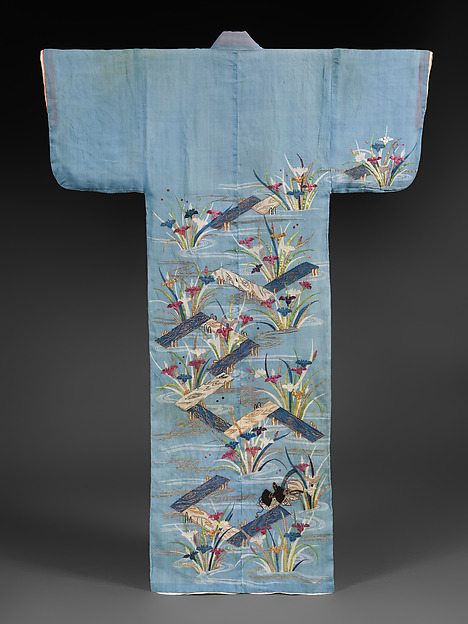
Summer Robe (Katabira) with Irises at Yatsuhashi, mid-19th century, Plain-weave ramie with paste-resist dyeing, stencil-dyed dots (suri-bitta), hand-painted details, silk embroidery, and couched gold thread. The Metropolitan Museum of Art, Gift of John C. Weber, 2019, accession 2019.16.2.
Look closer: Look at the ground. The Met records plain-weave ramie with paste-resist dyeing, stencilled dots, hand painting, silk embroidery and couched gold thread.
Image: The Metropolitan Museum of Art, Open Access (CC0)
The Los Angeles team's decision to use Japanese folding for a Western museum collection is a modern one, and the museum continues to describe the result with pride. The Openers article of 2015 shows that the pole and the paper are in daily use among men who wear kimono, and that they are as much part of the garment's life as the cloth. Wikipedia reports that post-war standards of dressing demand no creases or unevenness, and that commercial dressing schools were set up after the war, so that the care of a garment now begins before it is worn.
A reader should not expect a single authority. The sources give different views on repellents, on the merits of paulownia and paper, and on whether a garment should be aired in a room or in a dark cupboard. The house gives each view as it found it and suggests that a valuable piece be shown to a conservator before anything is done to it.
Reading a garment in the hand
A reader holding a garment can follow a short sequence. Open it on a clean surface and look first at the seams: generous, untrimmed allowances and a fine running stitch point to hand sewing, and a line of long basting stitches points to a garment never worn. Smell it: perfume, which the Baltimore note warns against, and naphthalene are both detectable. Look along the folds for tears and for the sheen of silk that has begun to break. Hold the lining to the light for stains and spots, and examine the collar and the underarms, where the body leaves its marks.
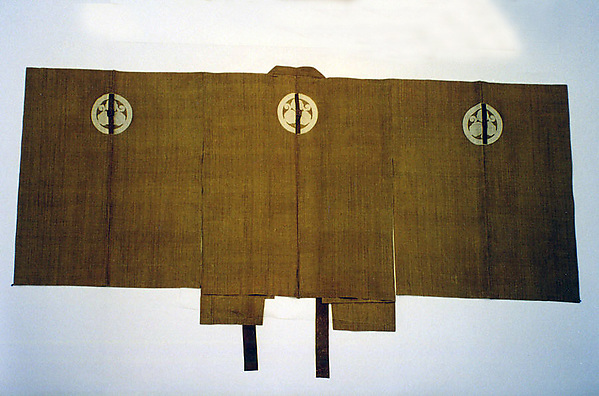
Jacket (suo) and trousers (nagabakama), 19th century, Resist-dyed hemp and ramie. The Metropolitan Museum of Art, Gift of John B. Elliott through the Mercer Trust, 1999, accession 1999.247.3a, b.
Look closer: Look at the cloth. The Met records resist-dyed hemp and ramie, bast fibres that age differently from silk.
Image: The Metropolitan Museum of Art, Open Access (CC0)
Then read the cloth against its history. A summer robe in ramie, such as the Met's katabira with irises at Yatsuhashi, is paste-resist dyed, stencilled and embroidered on a plain-weave ramie ground, and demands different handling from a silk brocade. A hemp and ramie jacket and trousers of the nineteenth century, recorded by the Met as resist-dyed, belong to the clothes of work and ceremony described in Noragi and the Clothes of Work and Haori and Hakama: The Jacket and the Divided Skirt. A reader who can name the fibre can predict how it will age, a point that the chapter on Silk, Hemp, Cotton and Ramie: The Fibres of Japanese Dress develops.
Finally, ask what the garment is for. The chapters on Regional Textiles from Kyoto to Okinawa and Seasons and Occasions: What to Wear When help the reader to place it by origin and by season, and the glossary in Glossary of Japanese Dress and Textile Terms lists the terms used on labels. The concierge desk can examine a piece for a client on request and report on its fibre, its seams and its condition before any decision is made.
Neighbouring chapters
Care belongs to every garment. The kimono itself is described in The Kimono Ladder: Furisode, Tomesode, Hōmongi and Komon, the obi in Obi and Its Companions: Scarf, Cord and Brooch, the hakama and jacket in Haori and Hakama: The Jacket and the Divided Skirt, and the cotton summer robe in Yukata: The Summer Cotton Robe. The techniques whose products need care are described in Yūzen: The Painted Kimono, Shibori: The Art of the Bound Cloth, Nishijin: The Woven Brocades of Kyoto and Embroidery and Gold Leaf on Japanese Cloth. The patching and mending traditions that extend a garment's life are in Sashiko and Boro: The Mended Cloth.

Hand-towel Rack (Tenugui kake) with Chrysanthemums and Meandering Stream, 18th century, Gold and silver maki-e on lacquered wood. The Metropolitan Museum of Art, Purchase, Friends of Asian Art Gifts, 2005, accession 2005.121a, b.
Look closer: Look at the small rack. The Met records gold and silver maki-e on lacquered wood, the same craft as the larger stands.
Image: The Metropolitan Museum of Art, Open Access (CC0)
The house's older guide, Care of Kimono and Textiles, and the heritage collection, Kimono and Textile Heritage, are the places to continue. The concierge desk replies to questions about a particular piece.
Pieces and their condition
The shelf holds a patterned haori, an antique boro jacket, a denim jacket backed with kimono silk and a bridal robe. Each page sets out the age, the fibre and the condition of the piece, with every defect named.


Kimono and textile heritage
The collection gathers garments and textiles with their condition set out in full, and the concierge desk can advise on the care of a particular piece.
Answered plainly
How do you store a kimono?
Fold it along its seams, wrap it in washi paper or acid-free tissue, avoid plastic bags and keep it dark and dry. Paulownia chests have long been considered the best, according to an Openers article.
What is a tatōshi?
An acid-free paper envelope, traditionally washi, in which kimono and obi are stored, according to Wikipedia and the Baltimore Museum of Art.
How often should a kimono be aired?
Wikipedia says at least seasonally and before and after each wearing; Hozumi hangs his garments overnight on an erisao after wearing.
Should a kimono be folded or hung?
Folded along its seams for storage, and hung on an erisao pole for airing. A regular hanger does not fit because its shoulders slope.
Which side goes over which?
The left side wraps over the right unless the wearer is deceased, a rule Wikipedia traces to the Yōrō code of 718.
Can you wash a vintage kimono at home?
The Kimono Gallery says not to wash antique textiles at home, because water, detergents and dry-cleaning chemicals can cause irreversible damage.
What temperature and humidity suit silk?
The Kimono Gallery recommends 18 to 21 degrees Celsius and 45 to 55 per cent relative humidity, in darkness.
Are mothballs safe for kimono?
The sources disagree: one dealer's guide calls naphthalene and paradichlorobenzene mothballs toxic and damaging in prolonged contact, while a kimono-dressing writer likes the scent of naphthalene; wrap any repellent in breathable paper.
Why is a kimono folded in a rectangle?
Folding along the seams in a compact rectangle limits stress, allows some airflow and, as the Los Angeles museum found, avoids unwanted wrinkles.
What does the condition grade S mean?
On the house's Japanese scale, S means unused, SA near new, A good, AB light signs of use, B visible signs of use and C marked wear.
How long is a kimono bolt?
About 11.5 metres by 36 centimetres for women and 12.5 metres by 42 centimetres for men, according to Wikipedia.
Why is paulownia used for chests?
Openers calls paulownia chests long considered the best for kimono, and a kimono site says some believe it controls humidity better than paper.
Can creases be ironed out of a kimono?
The Baltimore wrapper warns against high-temperature ironing; the Los Angeles conservators found that Japanese-style creases are a sign of proper folding.
Who should clean a valuable kimono?
A professional textile conservator, says the Kimono Gallery, for stains, tears, mould or thorough cleaning.
Where next
Sources and image credits
- Kimono, Wikipedia
- Part 9: Folding Your Kimono, Openers (Kazuo Hozumi, 2015)
- Care and storage, The Kimono Gallery (Yorke Antique Textiles)
- Traditional Japanese folding at LACMA, Unframed
- Paper Wrappers (tatoshi) for Kimono and Accessories, Baltimore Museum of Art
- How to care for your kimono: Folding and Storage, Old Japan men's kimono pages
- Conservation and Care of Japanese Textiles, Icon (2023)
- Kimono Rack (Iko) with Tokugawa Family Crest, Metropolitan Museum of Art
- Whose Sleeves? (Tagasode), Metropolitan Museum of Art
- Object record: Kimono rack, The Metropolitan Museum of Art
- Object record: Kimono rack, The Metropolitan Museum of Art
- Object record: Tagasode (“Whose Sleeves?”), The Metropolitan Museum of Art
- Object record: Whose Sleeves? (Tagasode), The Metropolitan Museum of Art
- Object record: Stacked Food Box (Jūbako) with “Whose Sleeves?” (Tagasode) Design, The Metropolitan Museum of Art
- Object record: Storage Case (Karabitsu), The Metropolitan Museum of Art
- Object record: Obi with “Whose Sleeves?” (Tagasode) Pattern, The Metropolitan Museum of Art
- Object record: Summer Robe (Katabira) with Irises at Yatsuhashi, The Metropolitan Museum of Art
- Object record: Jacket (suo) and trousers (nagabakama), The Metropolitan Museum of Art
- Object record: Hand-towel Rack (Tenugui kake) with Chrysanthemums and Meandering Stream, The Metropolitan Museum of Art
Last reviewed 28 October 2026. Pictures, where shown, are public-domain or open-access and credited beneath each one.
Holding a garment and unsure how to keep it? The concierge desk replies within one to three business days and can examine a piece for fibre, seams and condition.
Private concierge
Looking for something in particular?
Describe the piece or the project you have in mind. A senior advisor in Tokyo reads every case file personally and replies within two business days, with fees set out in writing before any work begins.