
Yukata: The Summer Cotton Robe
Garments · Bathing cloth
Yukata: The Summer Cotton Robe
浴衣
The yukata began as a bathing cloth and became the most widely worn kimono of the Japanese summer. Its indigo-and-white tradition rests on a stencil technique that dyed both sides of the cloth.
Fact sheet
The robe in one glance
- Cloth. Unlined cotton, light enough for a summer night.
- Dye. Indigo and white, once dyed on both sides through stencils.
- Sleeve. Longer on a woman than on a man, by the measure below.
- Obi. A soft or stiff single-layer sash, narrower than formal kimono wear.
- Shoes. Wooden geta, worn bare-footed and loud on the street.
A bathing cloth for the street
Wikipedia defines the yukata as an unlined cotton or linen summer kimono worn in casual settings, such as summer festivals and trips to the nearby bathhouse. The Japanese word, 浴衣, is translated literally as ‘bathing cloth’, and the entry says that yukata were originally worn as bathrobes. It adds that the garment resembles the nemaki, the unisex short-sleeved robe that guests wear at traditional inns, and that wearing a yukata as a bathrobe all year round is uncommon today and mostly confined to hot-spring resort towns such as Atami, Kinosaki and Kusatsu, where an inn often supplies one to each guest.

Kitagawa Utamaro, Two Young Women Wrapped in Yukata After a Bath, ca. 1796, Woodblock print; ink and color on paper. The Metropolitan Museum of Art, Rogers Fund, 1914, accession JP142.
Look closer: Look at the title and the date together. The Met records the subject as two young women wrapped in yukata after a bath, which is the garment’s first role.
Image: The Metropolitan Museum of Art, Open Access (CC0)
The Metropolitan Museum holds an early picture of the garment in its role as a bathrobe. Kitagawa Utamaro’s woodblock print Two Young Women Wrapped in Yukata After a Bath, dated to about 1796, takes the garment as its subject, and the Met’s record, which gives only the title and the facts of the print, is enough to date the idea to the Edo period. The print is a reminder that the yukata’s social life began indoors, at the bath, and moved outdoors afterwards.
Its present standing as a street garment is much more recent. The Wikipedia entry records that its popularity rose in the late 1990s, when a wide variety of colours and designs became available, and that modern yukata are often multicoloured and made to be machine-washed. The older standard was austere. Traditionally, the entry says, yukata were mostly indigo-dyed cotton, in indigo and white.
The dye that went through the cloth
What gave the yukata its old character was the way it was dyed. According to Wikipedia, the traditional method used stencils on both sides of the cloth, a technique called nagaita-chūgata, so that the design appeared on the front and the back. The entry calls the method expensive, and says that in the late Edo period a cheaper technique, chūsen, was developed to replicate the double-sided effect. The Tokyo form, Tokyo honzome chūsen, was designated a national traditional craft on 26 October, which the official Kōgeihin site dates to 2020; the Wikipedia entry gives 2023, and the official date is used here.
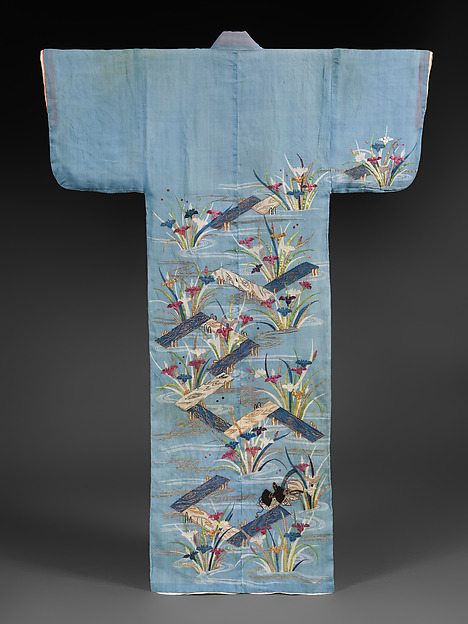
Summer Robe (Katabira) with Irises at Yatsuhashi, mid-19th century, Plain-weave ramie with paste-resist dyeing, stencil-dyed dots (suri-bitta), hand-painted details, silk embroidery, and couched gold thread. The Metropolitan Museum of Art, Gift of John C. Weber, 2019, accession 2019.16.2.
Look closer: Find the irises. The Met names the scene as Yatsuhashi and the cloth as ramie, a bast fibre. The yukata is the cotton relative of garments like this.
Image: The Metropolitan Museum of Art, Open Access (CC0)
The point of the technique is that the design is present on both faces of the cloth, which is why the method was costly and why its cheaper successor was worth inventing. The wider craft of resist dyeing is described in Tsutsugaki and Katazome: Paste and Stencil.
The same entry gives two further pointers to the garment’s place in popular culture. It lists a woodblock print of 1887 by Tsukioka Yoshitoshi, Endō Shimpei, among its illustrations, and notes that the Los Angeles County Museum of Art holds a nineteenth-century yukata printed with scenes from Jippensha Ikku’s comic travel novel Hizakurige. Both suggest that by the nineteenth century the yukata carried pictures and jokes as well as indigo geometry, and that it was a garment on which an owner could show a taste for popular fiction. Both men and women wear it, the entry adds, and both carry the kinchaku for small personal items, which today usually means a telephone.
Summer clothing in the Edo period was not limited to cotton. The Met’s collection includes summer robes of ramie and gauze silk, among them a mid-nineteenth-century katabira of plain-weave ramie, resist-dyed and stencilled with irises at Yatsuhashi. Such robes belonged to a more formal summer wardrobe. The yukata was the plainer, cheaper and more easily washed relative, and its growth in popularity tracks the spread of cotton as a common cloth, whose history is told in Silk, Hemp, Cotton and Ramie: The Fibres of Japanese Dress.
Proportion, pattern and wear
A yukata is cut like any kimono, with straight seams and wide sleeves, and the Wikipedia entry gives the proportions that distinguish the sexes. A man’s sleeve extends about 10 centimetres from the armpit seam, and a woman’s about 20 centimetres. As with all kimono, the left side is wrapped over the right. These are useful measures to hold in mind when reading a description.

Kitagawa Utamaro, Bathtime (Gyōzui), ca. 1801, Woodblock print; ink and color on paper. The Metropolitan Museum of Art, H. O. Havemeyer Collection, Bequest of Mrs. H. O. Havemeyer, 1929, accession JP1661.
Look closer: Compare the date with the first print. The two Utamaro scenes are only a few years apart and both put the bath at the centre.
Image: The Metropolitan Museum of Art, Open Access (CC0)
The standard ensemble, according to the entry, is the yukata, an obi, and geta worn without socks, with a folding or fixed fan and a kinchaku, the drawstring bag, as optional accessories. The obi is lighter than the formal kind. The entry on obi lists the hanhaba, about 15 centimetres wide and 300 to 400 centimetres long, as informal, easy to tie and often worn with yukata. It also describes a stiff one-layer obi, the hitoe, of which the Hakata weave is the example. The full range is set out in Obi and Its Companions: Scarf, Cord and Brooch, and the footwear in Geta, Zōri and Tabi: The Footwear of the Kimono.
On pattern, indigo and white remain the classical pair, though the Wikipedia entry notes that traditional yukata were mostly indigo-dyed cotton. A reader should treat the more elaborate multicolour designs as modern unless there is evidence otherwise. For a sense of how the motifs read, the dictionary in A Motif Dictionary: Crane, Pine, Wave and Chrysanthemum describes the plants, waves and animals that appear across summer cloth, and Seasons and Occasions: What to Wear When sets out the order in which they are worn.
The Met’s collection supplies the comparison with the bathing scene. A second Utamaro print, Bathtime of about 1801, again takes the bath as its subject. The two prints, a few years apart, suggest how settled the pairing of bath and light cotton robe had become by the end of the eighteenth century, which is as much as the museum’s records allow us to say.
| Point | What the sources say | Why it matters |
|---|---|---|
| Name | ‘Bathing cloth’; originally a bathrobe | Explains the unlined cotton and loose cut |
| Dye | Nagaita-chūgata stencilling on both sides; chūsen as the cheaper late-Edo method | Compare front and back |
| Sleeve | About 10 cm for men, 20 cm for women, from the armpit seam | A proportion to hold in mind |
| Obi | Hanhaba, 15 cm wide, 300–400 cm long, informal | The usual companion; the formal fukuro obi is about 30 cm wide |
| Feet | Geta without socks | Tabi are for more formal dress |
| Revival | Late 1990s: more colours and designs | Most bright modern patterns are recent |
Cotton, summer and the bath
To read the yukata properly one needs the social context of the bath. Hot-spring towns, as the entry notes, still supply a robe to each guest, and the garment’s association with relaxation and the end of the day gives it a tone that the formal kimono does not have. A yukata worn to a festival is not a costume of tradition so much as a small declaration of leisure. The way it is worn, with the obi at the waist and the feet in geta, is deliberately casual.

Unlined Summer Kimono (Hito-e) with Crickets, Grasshoppers, Cricket Cages, and Pampas Grass, early 20th century, Gauze-weave silk with paste-resist dyeing, hand-painted details, and gold thread. The Metropolitan Museum of Art, Gift of Abby Aldrich Rockefeller, 1937, accession 37.92.13.
Look closer: Notice the word unlined in the title. The Met uses it for summer garments of gauze silk, as the yukata is unlined in cotton.
Image: The Metropolitan Museum of Art, Open Access (CC0)
That casualness affects collecting. A good old yukata cloth, dyed with real stencils, is valued for its dye and its handling, not for its rarity or its embroidery. Condition matters in the ordinary ways: the cotton should be sound, the indigo should have aged evenly, and any stains should be considered against the price. The reasoning applied to Noragi and the Clothes of Work applies here too, in that indigo cotton should be judged for the cloth itself. The grading approach is set out in How to Read, Grade and Care for a Japanese Garment.
The garment also travels. Its cut and its loose sleeve connect it to the happi of the festival, whose story is told in Happi, Hanten and the Fire Brigade Coat, and the house’s Amekaji Almanac traces how the casual Japanese cotton robe fed a wider idea of leisure dress. Within the house’s own collection, the Kimono and Textile Heritage shelf holds cotton and indigo pieces beside the silks.
A final note on language. The word yukata is often used loosely in English for any lightweight robe. The sources used here treat it as a specific garment, an unlined cotton or linen summer kimono, with its own cut, dye and companions. It is worth keeping that definition when reading catalogue descriptions, because a robe of silk gauze with a lining is a different thing, and the Met’s summer robes of ramie and gauze show how wide the family of summer dress is.
Nobles, hemp and the word for a bathing cloth
The word is older than the cotton robe it now names. The National Diet Library’s image bank, in a short history of the garment, traces yukata to yukatabira, a simple covering that nobles of the Heian period wore when bathing in hot springs. It suggests the purpose was both to avoid exposing the naked body and to absorb sweat after the bath, and it says that early yukata were of hemp, unlined, and worn directly on the skin. A Japan Times column on the language of the summer robe gives the same picture in outline: in the Heian period, nobles wore a light kimono when taking steam baths.

Isoda Koryūsai, Girl Drying Herself after Her Bath, Woodblock print; ink and color on paper. The Metropolitan Museum of Art, H. O. Havemeyer Collection, Bequest of Mrs. H. O. Havemeyer, 1929, accession JP1708.
Look closer: Look at the long, narrow format. The Met records only the artist, the medium and the size, about 66 by 12 centimetres, and places the print in the Edo period.
Image: The Metropolitan Museum of Art, Open Access (CC0)
The Tokyo Metropolitan Government’s page on the craft sets the garment in a timeline. It says that the term appears in the Engishiki in the late eighth century, and that the encyclopaedia Wakan Sansai Zue, of 1713, discusses the yukata and mentions unlined robes worn during and after bathing. It adds that some temples were building bathhouses around that time, and that strict rules against showing skin led bathers to wear simple coverings called yukatabira or meii, which were mostly white raw silk at first, with patterned cloth coming later. The same page lists other names for such bathing wear, yugu, minugui, yumaki and koshimaki.
Two changes turned the bathing cover into a summer robe. The first was cloth. The Library’s account says that cotton became popular around the Genroku period, which ran from 1688 to 1704, and began to replace hemp. The second was habit. Both accounts say that as public bathhouses spread, the garment shifted from something worn in the bath to something worn after it, so that it became loungewear and then clothing for the street. The Tokyo page places the shift in the middle of the Edo period, and the Japan Times column puts the spread of casual wear in public in the late Edo period together with the popularity of the sentō. The Library adds a detail that fits the hot-spring trade: at spa inns, it says, guests brought their own yukata.
The sources are less certain about the early centuries than about the later ones, and the reader should be too. Some popular accounts of the yukata assign precise dates and dyes to the Heian and Muromachi periods without citing any authority, and those claims are left out here. What the cited sources establish is a short chain: a bathing cover of hemp or silk, a word recorded in the eighth century, a cotton robe from the late seventeenth century, and a street garment from the later Edo period. The cloth the later robe was cut from is described in Silk, Hemp, Cotton and Ramie: The Fibres of Japanese Dress.
Fireflies, fireworks and a robe for the actor’s favourite pattern
The National Diet Library’s account makes the robe’s social life concrete. It says that yukata became common for evening strolls, firefly hunting and watching fireworks, that they were not worn outdoors in the daytime, but were worn outdoors on summer nights and shown in nishiki-e prints. It also records older uses that have disappeared. Until the middle of the Edo period, it says, men and women wore yukata over their clothes as rain or snow gear or as travel clothing, groups on pilgrimages such as the Ise pilgrimage wore matching yukata, and people wore yukata over their kimono as work clothes for the year-end sweeping of soot. The cotton robe was, in other words, a working garment before it was a festival one.

Towel with the Family Crest of Ichikawa Danjūrō, early 20th century, Cotton with rust brown ground. The Metropolitan Museum of Art, Gift of Sidney Cardozo, 1962, accession 62.159.2.
Look closer: Find the crest, three nested squares cut in half. The Met reads the towel as a probable keepsake for enthusiastic patrons and fans of the actor.
Image: The Metropolitan Museum of Art, Open Access (CC0)
The same account describes the pattern books of the middle Edo period. It says that hinagatabon books of yukata designs were produced so that customers could order the pattern they liked. That is the first appearance in these sources of the idea that a yukata could be a matter of personal choice, and it explains why the surviving designs are so varied.
The theatre supplied the fashion. According to the Library, kabuki actors wore yukata dyed with their favourite patterns, or patterns named after themselves, in the dressing room and on stage, and the custom continues in kabuki, rakugo and sumo. The actors’ patterns, called yakusha-zome and yakusha-gara, became popular with the general public. The Tokyo page adds a theatrical example: in the kabuki play Sukeroku, one of the eighteen plays of the Ichikawa Danjūrō line, the character Kampera Mombei appears in a yukata of white Moka cotton dyed with indigo, Moka being a town in Tochigi Prefecture. The Met keeps a small memento of the same world, an early twentieth-century cotton towel with the crest of Ichikawa Danjūrō, three nested squares boldly cropped in half. The museum thinks it was probably a keepsake for the actor’s devoted fans. Theatre costume is the subject of Kabuki Costume: Hikinuki and the Onnagata Layers.
The fashion trade followed. The Chikusen shop, which describes itself as founded in 1842 by a man named Sentarō, says on the Tokyo government’s craft site that his stencil-dyed designs made the yukata a fashionable casual garment in Edo. The shop adds that before this boom the yukata had been a plain bathrobe, that kabuki actors favoured it, and that the people of Edo took it up. It also explains the rules of the age: commoners were limited in the materials, colours and patterns they could wear, and Edo komon, tiny, fine patterns that look plain from a distance, allowed them to show taste within the rules. The shop’s own claims are the shop’s, but the pattern of the argument, that restriction pushed fashion towards subtlety, is one that recurs through Japanese dress.
The long board, the indigo vat and the towel that taught the method
The first of the two dyeing methods named in the opening of this chapter is easier to understand once it is described step by step. The Chikusen shop says that nagaita-chūgata is an Edo-period method that uses indigo only: paste is applied to both sides of fabric fixed to a long board, and the fabric is then dipped in an indigo vat, so that the pattern on the front and the back align precisely. It adds that this requires experience and skill. The Tokyo government’s page describes the stencil itself: handmade Japanese paper treated with persimmon juice and backed with further paper, with the designs cut from similar backing paper, and applied to the fabric by hand. The Met keeps paper stencils in its collection, among them an Edo-period example cut with a hemp-leaf pattern, which the museum describes as a naturalistic design, noting that hemp was widely grown and woven across Japan.

Stencil with Hemp-Leaf Pattern, early 19th century, Paper. The Metropolitan Museum of Art, Fletcher Fund, 1937, accession 37.14.41.
Look closer: Hold the design in mind. The Met describes it as a naturalistic hemp-leaf pattern cut in paper, the kind of tool that carried a design onto cloth.
Image: The Metropolitan Museum of Art, Open Access (CC0)
The cheaper method, chūsen, has a different ancestry, and the official craft site traces it to the towel. It says the technique grew out of a pour-dyeing method devised by Edo-period dyers for tenugui, the hand towel, and that a dyer in Fukagawa developed the pouring of indigo over a stencil to solve the problem of towels with large white grounds, which were hard to dye in the old way. Its initial stages, it says, were established by the middle of the nineteenth century, and in the early and middle nineteenth century towel dyers gathered in Kanda, where a culture of custom-dyed towels grew up as gifts for the entertainment world and for hobbyists. The tenugui itself, according to Wikipedia, is a thin plain-woven cotton cloth of about 35 by 90 centimetres, with finished long edges and raw short ends, which had taken the form it has today by the Edo period.
From the towel the method moved to the robe. The site says that modern chūsen was developed in Osaka in the Meiji period and then spread to Tokyo, that it was applied to yukata fabric first in Osaka, and that Tokyo began chūsen dyeing of yukata by the end of the Meiji period. It adds that Tokyo yukata had been dyed by the double-sided nagaita-chūgata method since the Edo period, and that Tokyo’s chūsen has been called honzome, genuine dyeing, since the early Shōwa period. The Chikusen shop gives the practical difference: chūsen uses several colours and gradation, where the older method uses indigo alone.
The official record of the designation is worth stating exactly. The craft site says that Tokyo honzome chūsen was designated a national traditional craft on 26 October 2020, with its main production in the Tokyo wards of Adachi, Katsushika and Edogawa and also in Utsunomiya in Tochigi and Takasaki in Gunma. An earlier designation by the city is recorded on the Tokyo government’s craft page, which says that the Tokyo hand-dyed yukata and tenugui were designated on 27 December 1983. That page also records the present economics of the trade: print dyeing is now the mainstream method for yukata, and the hand-dyed cloth is a specialist product.
Paste, a watering can and a vacuum table
The pour is a spectacle of a modest sort, and the sources describe it in some detail. The craft site lists the steps of Tokyo chūsen. A pattern-bearing frame is placed and the fabric folded, generally one to four rolls at a time. The stencil is lowered onto the cloth and resist paste is spread with a spatula, the fabric is folded at the edge of the paste, and the step is repeated until paste covers both sides evenly. Dye is then poured over the folded layers with a narrow-spouted kettle, the cloth is turned inside out and dyed from the back, and the fabric is washed with water and dried in the sun. The tools of the pour are the yakan, a kettle or can with a long spout, and, for the finer lines, a paste tube and a poking stick that guides dye into small areas.

Ryūryūkyo Shinsai, Umbrellas and Geta (Japanese Wooden Sandals), probably 1816, Part of an album of woodblock prints (surimono); ink and color on paper. The Metropolitan Museum of Art, H. O. Havemeyer Collection, Bequest of Mrs. H. O. Havemeyer, 1929, accession JP2315.
Look closer: Find the geta. The Met’s title names them as the footwear, here drawn in a small private print rather than in a fashion plate.
Image: The Metropolitan Museum of Art, Open Access (CC0)
The Tokyo government’s page adds that the colours centre on indigo and deep blue, that the process produces a worn texture that imitates years of use, and that pouring several colours at once creates gradations, but demands high skill. The site lists the techniques by which one length can take more than one colour: differential dyeing, in which several colours are dyed at once; blurring or gradation dyeing; and a layered method named after Hosokawa.
A Hamamatsu workshop described by the kimono dealer Yamato gives the industrial view. It says that stencils are fixed to wooden frames, that the starch paste is made from clay, glutinous rice, seaweed and rice bran, and that sawdust is sprinkled on to stop the paste running. The cloth can weigh up to two kilograms at this stage. Barriers are built around the patterns to stop the dye overflowing, and artisans pour from a long-spouted kettle onto a table with vacuum suction that pulls the dye through from below. Gradations come from pouring two dyes at once, and the reverse side is dyed too. Rinsing uses five to seven tonnes of water a day, and the fabric, about twelve metres long, is dried on racks seven metres high, usually within a day.
The same page gives the history of the town. It says that the method was known by other names in other places, sosogizome in Hamamatsu and tsugizome in Osaka, and that around 1935 the term chūsen became the standard name across the country. Yukata artisans from Tokyo, it says, moved to Hamamatsu after the Great Kantō Earthquake of 1923, and the city became a yukata production centre, helped by the water of the Tenryū River, dry winds for drying fabric, advanced machinery and its position between Tokyo and Osaka.
A Tokyo workshop shows the craft at a smaller scale. A feature on the Tokyo government’s updates site describes the Marukyu company, founded in 1899 as a wholesaler of chūsen-dyed goods, where one batch can dye dozens of pieces at once. It records that early business records were largely destroyed by fires, including the Great Kantō Earthquake of 1923, and that the fifth-generation masters Misako Saito and Takashi Yamauchi pieced the history together from surviving notes, dyeing samples from the 1940s and 1950s, and a design book found in an antique bookshop. Each stage, the feature says, is handled by a specialist, among them the person who spools the cloth, the itaba specialist who applies the paste, and the dyer, and the results show the colour bleeding, offsetting and blurring typical of hand-dyeing. The workshop launched a brand named TEWSEN in 2022 and showed collaborative work with the designer Noritaka Tatehana in March 2023. The craft is alive, and it is a craft of several hands.
Gauze, ramie and the robes that were never cotton
The yukata was the plainest of the summer robes, and the Met’s collection shows what stood above it. An unlined silk robe, hito-e, of the late eighteenth or early nineteenth century is decorated with cormorants among reeds, drying nets, and a boat with a fisherman in a straw raincoat and hat. The museum says it was worn from May, as the weather grew warm and humid, and that the scene alludes to the Noh play The Cormorant Fisher. Wild ginger leaves on the shoulders as crests suggest, in the museum’s words, that the owner was a princess of the Tokugawa family. The dots on the robe were made by stencil dyeing and not by the labour-intensive tie-dye technique, which was banned at the time as a sign of excessive luxury. A rule of the age, and a way round it, are written into the cloth.
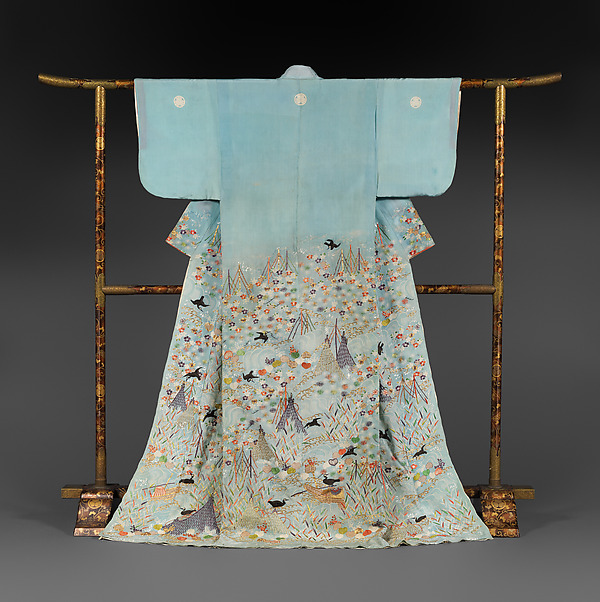
Summer Robe (Hito-e) with Cormorant-Fishing Scene, late 18th–early 19th century, Thin crepe silk (chijimi) with paste-resist dyeing, stencil-dyed dots (suri-bitta), hand-painted details, silk embroidery, and couched gold thread. The Metropolitan Museum of Art, Gift of John C. Weber, 2019, accession 2019.16.1.
Look closer: Find the fisherman in his straw raincoat. The Met reads the scene as an allusion to the Noh play The Cormorant Fisher and the crests as those of a Tokugawa princess.
Image: The Metropolitan Museum of Art, Open Access (CC0)
A second hito-e, made around 1870 to 1880, is a thin, fine silk with cranes and pines painted against sunrise-like colours that shade from orange-beige to gray. The museum notes that because the left panel overlaps the right, much of the pattern is hidden until the wearer moves, and that the robe came with a white undergarment that protected the silk. A third, of the early twentieth century and woven as gauze, carries insect cages holding crickets, grasshoppers and bell-ring bugs among pampas grass. The Met says that the motif suggests early autumn evenings but is often used on summer kimono, that it was already popular in the early Edo period, and that it appears in the 1667 pattern book On-hiinagata. The robe was recorded on view in Gallery 227 of the museum’s Fifth Avenue building.
Ramie, the bast fibre, supplies the other side of the family. The Met’s ikat-patterned summer kimono for a girl, of the nineteenth century, has long hanging sleeves and a design of sea bream and bamboo, and the museum explains that the sea bream, tai, is linked to medetai, a word for joyous occasions. A woman’s summer kimono in ikat-patterned ramie, with a design of small crosses, is described by the museum only through the technique: threads of the warp, the weft or both are tied and dyed before weaving, and the tied areas stay undyed. The method is the subject of Kasuri: Ikat Woven from Dyed Thread. The resulting cloths are lighter and more formal than cotton, and show how large a range of summer dress lay between the bath robe and the court.
A mother, a bucket and a model of the modern girl
The print makers loved the subject, and the Met’s holdings show the range. Utamaro’s Bathtime (Gyōzui) of about 1801 shows, in the museum’s words, a heavyset mother bathing her son, who holds a toy bucket and pushes at her arm. The composition is cropped at the bucket, the woman’s leg and the child’s kimono to heighten its energy, and the museum notes that prints like this inspired Mary Cassatt’s first series of prints. The earlier Two Young Women Wrapped in Yukata After a Bath, of about 1796, is recorded with only the facts of the print, 38 by 25 centimetres, from the Rogers Fund of 1914.

Girl's Summer Kimono with Design of Sea Bream and Bamboo, 19th century, Ikat-patterned plain-weave ramie. The Metropolitan Museum of Art, Seymour Fund, 1966, accession 66.239.2.
Look closer: Look at the long sleeves. The Met says they suit a girl and that the sea bream, tai, links to medetai, a word for joyous occasions.
Image: The Metropolitan Museum of Art, Open Access (CC0)
The garment also carried pictures itself. The Los Angeles County Museum of Art holds a woman’s summer kimono, a yukata, of the early nineteenth century, in plain-weave cotton and stencil-paste-resist dyed, with a white ground covered with scenes in blue and black from the 1802 novel Hizakurige, ‘Shank’s Mare’, by Jippensha Ikku. The museum describes trees, bridges, boats and buildings among figures in traditional dress, and says that one image caption suggests the piece may be a kimono lining. It is a rare case of a cotton robe turned into an illustrated page. The National Diet Library’s account adds that actors’ patterns were popular with the public, and the two together suggest that a printed cotton in Edo could be a joke, a book, or a fan’s tribute.
The modern girl appears in a print of 1929 by Itō Shinsui, First Wearing of a Yukata, from the series First Selection of Modern Beauties, which the Los Angeles County Museum of Art holds. The museum’s record gives no description of the garment in the print, only the title, the date and the size, 41 by 26 centimetres. The title is enough to make the point. By the 1920s the yukata was already a thing one wore for the first time, a rite of summer, and an occasion for a picture.
Four tales of the bathing cloth
Mombei in indigo. In the kabuki play Sukeroku the character Kampera Mombei walks on in a yukata of white Moka cotton dyed with indigo, according to the Tokyo craft page. It is a small piece of stage business, and an important one, because it shows the bathing cloth on an Edo stage as an item of swagger. The robe that began as underwear had become costume.

Woman's Summer Kimono with Design of Small Crosses, 19th century, Ikat-patterned plain-weave ramie. The Metropolitan Museum of Art, Gift of John B. Elliott through the Mercer Trust, 1999, accession 1999.247.10.
Look closer: Follow the tiny crosses. The Met explains the ikat technique: warp or weft threads tied and dyed before weaving.
Image: The Metropolitan Museum of Art, Open Access (CC0)
The towel dyer of Fukagawa. According to the craft site, a dyer in Fukagawa found that indigo poured over a stencil could dye towels with wide white grounds, and that discovery, made for a towel, became the method for a robe. The great technique of the summer yukata began as a way to solve a problem of white space.
The records that burned. The Marukyu company lost its early records in fires, among them the earthquake of 1923. Its fifth-generation masters pieced the history together from notes, samples of the 1940s and 1950s, and a design book that they found in an antique bookshop. A craft that lost its papers was rebuilt from objects.
The mother and the bucket. Utamaro’s bath scene is not about the yukata at all. It is about a boy with a toy bucket pushing at his mother’s arm. Yet the Met’s note, that Mary Cassatt’s first series of prints was inspired by prints like it, carries the bathing world of Edo across an ocean and a century.
Small surprises from the sources
Short facts, each given as the cited source gives it.
- Yukata means ‘bathing cloth’, and the word appears in the Engishiki of the late eighth century, according to the Tokyo craft page.
- Early yukata were unlined hemp worn directly on the skin, according to the National Diet Library.
- Cotton began to replace hemp around the Genroku period, 1688 to 1704.
- Until the middle of the Edo period yukata were also worn over clothes as rain or snow gear.
- Pilgrim groups on the Ise pilgrimage wore matching yukata.
- Kabuki actors wore yukata dyed with patterns named after themselves.
- A men’s yukata sleeve extends about 10 centimetres from the armpit seam; a woman’s about 20.
- Chusen means pouring dye, and the yakan is the long-spouted can it is poured from.
- The starch paste for chusen is made from clay, glutinous rice, seaweed and rice bran.
- Rinsing a day’s chusen cloth in one Hamamatsu workshop uses five to seven tonnes of water.
- Tokyo yukata artisans moved to Hamamatsu after the earthquake of 1923.
- A tenugui is about 35 by 90 centimetres, with raw short ends.
Words of the bathing cloth
The terms used in this chapter, in the sense the sources give them.
| Term | Meaning | Where it appears |
|---|---|---|
| Yukata | Bathing cloth; the unlined cotton summer robe | Throughout |
| Yukatabira | A bathing garment of nobles; early hemp or silk | Before cotton |
| Nemaki | Unisex short-sleeved robe worn by guests at inns | First look |
| Hinagatabon | Pattern books of the middle Edo period | Summer nights |
| Yakusha-zome | Dyeing with an actor’s favourite or own pattern | Summer nights |
| Nagaita-chugata | Stencil dyeing with paste on both sides of cloth, in indigo | Both faces |
| Chusen | Pour dyeing; several colours and gradation | The kettle |
| Honzome | Genuine dyeing; the Tokyo name for chusen since early Showa | Both faces |
| Yakan | A long-spouted dye can | The kettle |
| Tenugui | A thin cotton hand towel, about 35 by 90 cm | Both faces |
| Edo komon | Tiny, fine patterns that look plain from a distance | Summer nights |
| Hito-e | An unlined summer robe, often of silk | The other summer |
| Uchiwa | A fixed round fan | In the prints |
| Kinchaku | A drawstring bag | First look |
Where to see the dye and the cloth
The Metropolitan Museum of Art holds the Utamaro prints, the Koryūsai print, the summer robes, the paper stencils and the Danjūrō towel described here, and its records say that the cricket-cage robe was on view at the Fifth Avenue building while the others were not. The Los Angeles County Museum of Art holds the Hizakurige yukata and the Itō Shinsui print, and records the yukata as not on view.
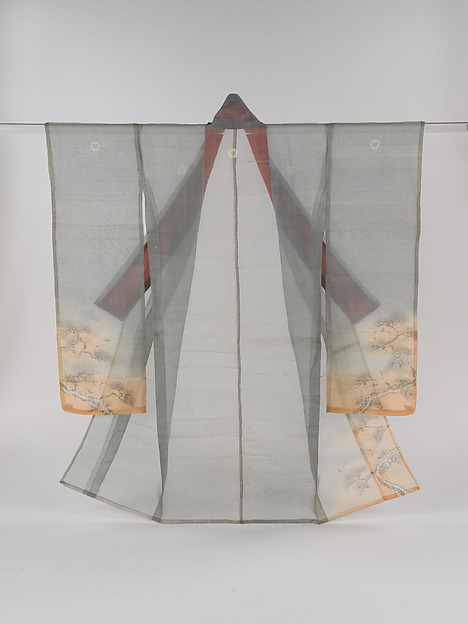
Summer robe (hito-e) with cranes and pines, ca. 1870–80s, Plain-weave silk with paste-resist dyeing. The Metropolitan Museum of Art, Purchase, Friends of Asian Art Gifts, 2023, accession 2023.325a, b.
Look closer: Find the cranes in their sunrise colours. The Met notes that the left panel hides much of the pattern until the wearer moves.
Image: The Metropolitan Museum of Art, Open Access (CC0)
The craft itself is carried on in Tokyo’s Adachi, Katsushika and Edogawa wards, in Utsunomiya and Takasaki, and in Hamamatsu, according to the official craft site and the Yamato feature. The hot-spring towns of Atami, Kinosaki and Kusatsu, named by Wikipedia, are the places where an inn still supplies a yukata to each guest. A visitor should check the current arrangements of any workshop or museum before travelling.
Reading a yukata cloth in the hand
Five checks are worth the time. First, turn the cloth over. Double-sided stencil dyeing should show the design on both faces with the patterns aligned, and a print that is paler on the back is a printed cloth, which the Tokyo craft page says is now the mainstream method. Second, look at the edges of the colours. Hand pouring leaves bleeding, offsetting and blurring where one dye meets another, and the Marukyu feature names these as the marks of hand-dyeing. Third, look at the gradation. A smooth, mechanical fade is a different thing from the shading made by pouring two dyes at once.
Fourth, the date. Traditional yukata were mostly indigo and white, and Wikipedia records that the wide range of colours and designs became available in the late 1990s, so a bright multicolour pattern is far more likely to be modern than antique. Fifth, the cut: the sleeve should match the measure given in the sources, and the length of cloth should be that of a plain unlined cotton robe, not a lined one. Cotton that has been laundered for decades will have lost its starch and gained its softness, and that is a quality to value. The grading approach is set out in How to Read, Grade and Care for a Japanese Garment, and the way the robe is worn with the obi and geta in Obi and Its Companions: Scarf, Cord and Brooch and Geta, Zōri and Tabi: The Footwear of the Kimono.
Cotton and indigo in the house
The shelf holds coats and jackets in indigo cotton and a contemporary piece made from vintage kimono silk. Each is described as what it is, with its age and condition set out plainly on its own page.


Kimono and textile heritage
Antique cotton, hemp and silk are gathered in one collection, and the concierge desk can look for a particular dye or region on request.
Answered plainly
What is a yukata?
An unlined cotton or linen summer kimono, worn at summer festivals and the bathhouse. Its name means ‘bathing cloth’.
How is it different from a kimono?
It is unlined, usually of cotton, worn bare-footed in geta with a light obi, and is casual dress. A kimono is generally lined or of silk and worn with tabi.
What was the old way of dyeing it?
Stencilled on both sides of the cloth, a technique called nagaita-chūgata, which was expensive. Chūsen was developed in the late Edo period to copy the double-sided effect.
Which side wraps over?
The left side is wrapped over the right, as with all kimono.
What do you wear with it?
An obi, geta without socks, and optionally a fan and a drawstring bag.
Is it still a bathrobe?
In hot-spring towns, yes: inns often supply one to each guest. Elsewhere it is mainly summer dress.
Where does the word yukata come from?
The National Diet Library traces it to yukatabira, a simple covering that Heian nobles wore when bathing in hot springs. The Tokyo craft page says the term appears in the Engishiki in the late eighth century.
When did cotton replace hemp?
Cotton became popular around the Genroku period, 1688 to 1704, and began to replace hemp, according to the National Diet Library.
Why do kabuki actors matter to the yukata?
Actors wore yukata dyed with their favourite or their own patterns, and those actors’ patterns, yakusha-zome, became popular with the public.
What is chusen?
A pour-dyeing method in which dye is poured from a long-spouted can over a stencil and paste. It grew out of towel dyeing in Edo and became the standard method for yukata in the Meiji and later periods.
What is the difference between nagaita-chugata and chusen?
Nagaita-chugata is the Edo-period indigo-only method with paste applied to both sides of the cloth on a long board; chusen uses several colours and gradation.
When was Tokyo honzome chusen designated?
The official Kogeihin site gives 26 October 2020 as the date of its national designation; the Wikipedia entry gives 2023.
Was the yukata worn in the daytime?
According to the National Diet Library it was not worn outdoors by day but was worn outdoors on summer nights, for strolls, firefly hunting and fireworks.
Did people wear yukata as rain gear?
Yes. Until the middle of the Edo period men and women wore them over their clothes against rain or snow, and for travel.
Where next
Sources and image credits
- Yukata, Wikipedia
- Obi (sash), Wikipedia
- Two Young Women Wrapped in Yukata After a Bath, Metropolitan Museum of Art
- Umbrellas and Geta, Metropolitan Museum of Art
- Yukata: Edo Chic, National Diet Library
- Tokyo Hanzome Yukata and Tenugui, Traditional Crafts of Tokyo
- Tokyo Honzome Chusen, Kogeihin
- Edo-style chic, propagated through traditional stencil-dyeing (Chikusen), Tokyo Kirari
- Continually discovering tradition and new value (Marukyu Shoten), Tokyo Updates
- What is chusen? Hamamatsu, Kimono Yamato
- Summer yukata, The Japan Times
- Tenugui, Wikipedia
- Girl Drying Herself after Her Bath, Isoda Koryusai, Metropolitan Museum of Art
- Bathtime (Gyozui), Kitagawa Utamaro, Metropolitan Museum of Art
- Summer Robe (Hito-e) with Cormorant-Fishing Scene, Metropolitan Museum of Art
- Summer robe (hito-e) with cranes and pines, Metropolitan Museum of Art
- Unlined Summer Kimono (Hito-e) with Crickets, Metropolitan Museum of Art
- Girl's Summer Kimono with Sea Bream and Bamboo, Metropolitan Museum of Art
- Woman's Summer Kimono with Small Crosses, Metropolitan Museum of Art
- Towel with the Family Crest of Ichikawa Danjuro, Metropolitan Museum of Art
- Stencil with Hemp-Leaf Pattern, Metropolitan Museum of Art
- Woman's Summer Kimono (Yukata) with Illustrations from Hizakurige, Los Angeles County Museum of Art
- First Wearing of a Yukata, Ito Shinsui, Los Angeles County Museum of Art
- Object record: Summer Robe (Katabira) with Irises at Yatsuhashi, The Metropolitan Museum of Art
Last reviewed 28 October 2026. Pictures, where shown, are public-domain or open-access and credited beneath each one.
Looking for a summer robe, a length of indigo cotton or a piece of festival dress you have seen described here? The concierge desk replies within one to three business days.
Private concierge
Looking for something in particular?
Describe the piece or the project you have in mind. A senior advisor in Tokyo reads every case file personally and replies within two business days, with fees set out in writing before any work begins.