
Shibori: The Art of the Bound Cloth
Techniques · Knot and fold
Shibori: The Art of the Bound Cloth
絞り
A cloth is twisted, pinched, stitched or clamped before it meets the dye, and the design is whatever the dye could not reach.
Fact sheet
The six best-known methods
- Kanoko. Sections are bound with thread; what Westerners usually call tie-dye.
- Miura. A looped binding held by tension rather than knots.
- Kumo. Fine, even pleating and close binding make a spider-like pattern.
- Nui. Running stitches are drawn tight.
- Arashi. The cloth is bound diagonally on a pole; the name means storm.
- Itajime. The cloth is clamped between boards.
To wring and to squeeze
Wikipedia explains that the word shibori comes from the verb shiboru, meaning to wring, squeeze or press. The family of techniques it names is large, and the entry groups it into three categories: kōkechi, tied or bound resists; rōkechi, wax resists; and kyōkechi, cloth folded and clamped between carved blocks. What unites them is that pressure, not paste or paint, keeps the dye out.
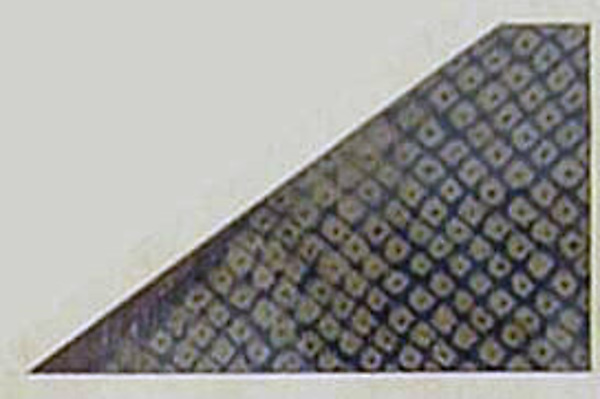
Textile with Spotted Dyeing (kanoko shibori), Resist-dyed plain-weave bast-fiber (asa) crepe. The Metropolitan Museum of Art, Gift of Sue Cassidy Clark, in honor of Dr. Barbara Brennan Ford, 2008, accession 2008.335.10.
Look closer: Look at the spots. The Met titles this scrap kanoko shibori, a resist-dyed plain-weave bast-fibre crepe.
Image: The Metropolitan Museum of Art, Open Access (CC0)
The oldest documentary reference the entry gives is not Japanese. A Chinese text of 238 CE, the Treatise on the Wa People, records Queen Himiko giving the emperor of Cao Wei over two hundred yards of ‘spotted cloth’, possibly a wax-resist technique. The earliest surviving shibori-dyed cloth dates to the middle of the eighth century; it was donated to Tōdai-ji in Nara in 756 with goods from Emperor Shōmu, and some of it may be Chinese in origin. The entry adds that resist-dyeing in China has surviving examples dating to 418 CE, so the Japanese practice sits in a wide Asian history.
The Met preserves a tiny Edo-period witness. The textile with spotted dyeing, kanoko shibori, is resist-dyed plain-weave bast-fibre crepe, 6.5 by 10.5 centimetres at its greatest, given by Sue Cassidy Clark in honour of Dr Barbara Brennan Ford in 2008. A scrap of this kind lets the viewer see the small, regular spots that the larger robes repeat across a whole garment.
Six ways to hold back dye
Wikipedia describes the best-known methods. Kanoko shibori binds sections with thread and is, the entry says, what Westerners usually call tie-dye. Miura shibori uses a looped binding held by tension rather than knots, so that it is easy to bind and unbind. Kumo shibori is fine, even pleating followed by close binding, producing a spider-like design. Nui shibori is stitched: running stitches are pulled tight, offering more control but taking more time. Arashi shibori is pole-wrapping, in which cloth is bound diagonally on a pole to produce diagonal patterns, arashi meaning storm. Itajime is shaped resist, with cloth clamped between boards.

Robe (Kosode) with Pines and Interlocking Squares, second half of the 18th century, Figured silk satin with tie-dying (shibori). The Metropolitan Museum of Art, Purchase, Mr. and Mrs. Jerome Straka Gift and Rogers Fund, 1975, accession 1975.37.
Look closer: Look at the dots. The Met says the common kanoko version leaves small undyed squares, each with a tiny dot at the centre.
Image: The Metropolitan Museum of Art, Open Access (CC0)
The Met’s robe with pines and interlocking squares, of the second half of the eighteenth century, shows kanoko on a grand scale. It is figured silk satin with tie-dyeing, 180.3 by 127 centimetres. The label explains that the blue robe has a pattern of overlapping squares and pine branches, and that kanoko is a resist-dyeing method in which the cloth is twisted, compressed and bound before dyeing; the design appears when the binding is removed and the cloth is flattened. The most common version, kanoko, meaning fawn, uses hand-tied pinches to leave small undyed squares, each with a tiny dot at the centre.
The label adds the point that makes the technique a measure of wealth. Because it was slow and costly, robes covered entirely in kanoko were prized, and they were part of the trousseaux of eldest daughters from wealthy Kyoto merchant families. The museum calls them the ultimate luxury. A reader who has met the idea of the painted cloth in the chapter on Yūzen: The Painted Kimono will recognise the contrast: yūzen puts a picture onto a ground, whereas a full kanoko ground is itself the picture, made of tied points repeated across the whole garment.
A robe for the wedding chest
The Met’s uchikake with fans and flowers shows tie-dye working with other techniques. It dates from the second half of the eighteenth to the first half of the nineteenth century, in figured satin-weave silk with tie-dyeing, silk embroidery and couched gold thread, 167.6 by 121.9 centimetres. The label explains that high-ranking samurai women wore uchikake for formal occasions in the Edo period; these padded, cotton-lined outer garments were worn over kosode in autumn and spring. This example, often associated with young women, has a red ground with peonies, chrysanthemums and wisteria, along with Chinese fans and butterflies that suggest beauty, longevity and seasonal renewal. The decoration combines shiroage, kanoko tie-dye, hand painting, and silk and metallic-thread embroidery, and the ground fabric is woven with chrysanthemums, orchids and a key-fret pattern.
That summary is a lesson in how the finest garments were made. The weaver, the tier, the painter and the embroiderer each contributed a layer, and shibori was one of those layers rather than the whole. The chapter on Uchikake and Shiromuku: The Bridal Robes describes the uchikake in its bridal form, and the chapter on Embroidery and Gold Leaf on Japanese Cloth treats the needle and the gold thread.
Two further uchikake in the Met show the same layering. The outer robe with mandarin oranges and folded-paper butterflies, of the late eighteenth to early nineteenth century, is tie-dyed satin damask with silk embroidery and couched gold thread, 176.5 by 123.2 centimetres. The label explains that the uchikake was worn without a sash over a kosode at formal occasions, that it originated in the Kamakura period as a robe for high-ranking samurai women and later became formal winter attire, and that in traditional weddings it is worn over a wedding kimono, with padding in the hem for a smooth train. The paired male and female folded-paper butterflies represent the couple, and because the Japanese word for butterfly, chō, sounds like the word for long, the motif also suggests a long, happy marriage. The evergreen mandarin orange tree, tachibana, is done in tie-dye on black satin damask.
The second, of the late eighteenth century, is a red robe in figured satin-weave silk with tie-dyeing, silk embroidery and couched gold thread, 168.9 by 128.3 centimetres, acquired by the museum in 2024. Its main motif is the stylised wheels of an imperial ox-drawn carriage, which relate to The Tale of Genji and are sometimes called Genji-guruma; narcissus, wild ginger, wisteria and chrysanthemums are embroidered in gold, greens and purple. The label notes that the flowers are auspicious and that the bright red suggests it was made for a young woman to wear on a festive occasion.
The town that gave shibori its popular face is Narumi, on the Tōkaidō road. Hiroshige’s print of about 1834, Narumi, Famous Arimatsu Shibori, in the Met’s Rogers Fund collection, is 24.1 by 35.6 centimetres, and its Japanese inscription names the Tōkaidō station of Narumi and its famous product, Arimatsu shibori. The title alone is evidence that tie-dyed cloth was known as the specialty of a named place on the road, and the museum holds other prints of the same station that carry the same wording in their titles.
| Method | Gesture | Typical result |
|---|---|---|
| Kanoko | Bind sections with thread | Small undyed squares with a dot at the centre |
| Miura | Looped binding held by tension | Easy to bind and unbind |
| Kumo | Pleat finely, bind closely | A spider-like design |
| Nui | Running stitches pulled tight | More control, more time |
| Arashi | Bind diagonally on a pole | Diagonal patterns; arashi means storm |
| Itajime | Clamp between boards | Shaped, geometric resist |
Safflower, boards and a lost dyeworks
Wikipedia gives one of its fullest accounts to a lost variety, beni itajime, in which safflower red dyes pictorial fabrics clamped between boards. It names Kyoto and Takasaki in Gunma Prefecture as production centres, Takasaki being known for fine, lightweight silk. The last of the beni itajime dyeworks, Yoshimura in Takasaki, closed in 1932.
A modern revival followed. In 2010 Yoshiko Iwamoto Wada and Masanao Arai researched the technique with help from the Yoshimura archive and the Takasaki Beni no Kai group, and found that the boards were lacquered except on the sides and centre, soaked for two weeks before use, and that the fabric was folded eight times. Modern artists, the entry says, often use acrylic or plexiglass shapes held with C-clamps. The account is a reminder that a technique can be lost within a single lifetime and recovered from an archive, and that the surviving cloth is therefore evidence as well as ornament.
In the shop, the useful questions are the plain ones. Are the spots regular and tiny, or large and loose? Is the shape the result of stitching, pleating, or boards? Does the ground carry a second technique? The chapter on How to Read, Grade and Care for a Japanese Garment explains how such cloth should be kept, since a tied ground is a different surface from flat dyed silk, and the chapter on The Kimono Ladder: Furisode, Tomesode, Hōmongi and Komon places a tie-dyed ground on the ladder of formality.
The shelf strip below shows remade pieces with shibori bands and antique cloth of related kinds. Each is described as what it is, and the concierge desk can look for a particular method or ground on request.
Tied and clamped cloth at the Met
Textile with Spotted Dyeing (kanoko shibori), Resist-dyed plain-weave bast-fiber (asa) crepe. The Metropolitan Museum of Art, Gift of Sue Cassidy Clark, in honor of Dr. Barbara Brennan Ford, 2008, accession 2008.335.10.
Look closer: Look at the scale. The Met records a fragment of 6.5 by 10.5 centimetres at its greatest.
Image: The Metropolitan Museum of Art, Open Access (CC0)
Robe (Kosode) with Pines and Interlocking Squares, second half of the 18th century, Figured silk satin with tie-dying (shibori). The Metropolitan Museum of Art, Purchase, Mr. and Mrs. Jerome Straka Gift and Rogers Fund, 1975, accession 1975.37.
Look closer: Look at the ground. The Met says robes covered entirely in kanoko were prized and were part of the trousseaux of eldest daughters of wealthy Kyoto merchant families.
Image: The Metropolitan Museum of Art, Open Access (CC0)
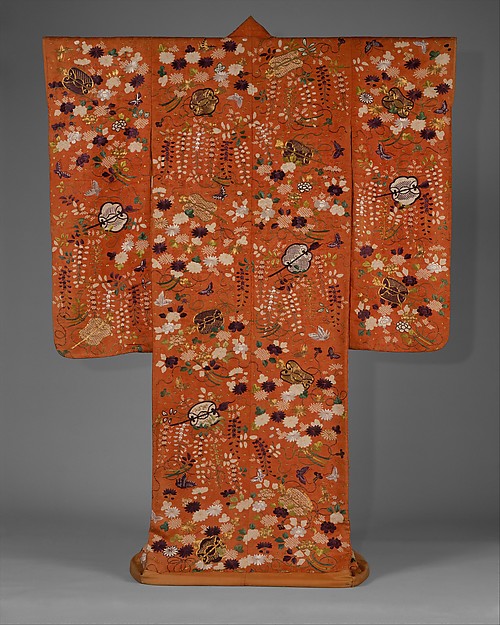
Over Robe (Uchikake) with Fans and Flowers, second half 18th–first half 19th century, Figured satin-weave silk with tie-dyeing, silk embroidery, and couched gold thread. The Metropolitan Museum of Art, Purchase, Seymour Fund, Mrs. Donald Oenslager Gift and Gifts in memory of Gertrude Carp, 1988, accession 1988.165.
Look closer: Look at the layers. The Met lists shiroage, kanoko tie-dye, hand painting and silk and metallic-thread embroidery.
Image: The Metropolitan Museum of Art, Open Access (CC0)
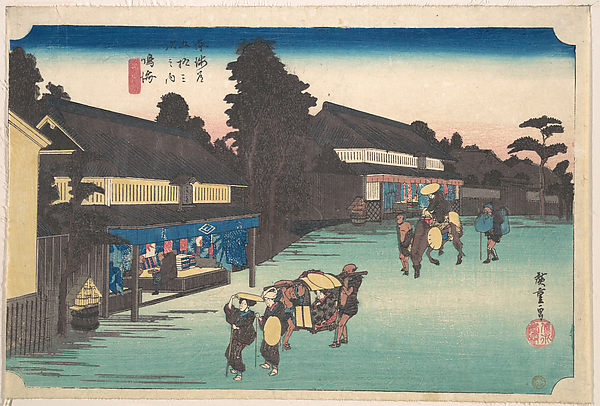
Utagawa Hiroshige, Narumi, Meibutsu Arimatsu Shibori, ca. 1834, Woodblock print; ink and color on paper. The Metropolitan Museum of Art, Rogers Fund, 1918, accession JP511.
Look closer: Look at the title. The Met records Hiroshige’s Tōkaidō print of Narumi, with an inscription naming Arimatsu shibori as the famous product.
Image: The Metropolitan Museum of Art, Open Access (CC0)
Tied cloth in the house
The shelf holds a remade furisode with shibori bands, a remade peony jacket, a brocade piece and a bridal uchikake. Each is described as what it is, with its age and condition set out plainly on its own page.


Textile heritage
Antique cloth of every kind is gathered in one collection, and the concierge desk can look for a particular method, ground or region on request.
Answered plainly
What does shibori mean?
It comes from the verb shiboru, to wring, squeeze or press.
What is kanoko?
A tie-dye in which sections are bound with thread; the common version leaves small undyed squares, each with a dot at the centre.
How old is the oldest surviving shibori?
Wikipedia dates it to the mid-8th century, given to Tōdai-ji in 756.
What is arashi?
Pole-wrapping, in which cloth is bound diagonally on a pole; arashi means storm.
Why was a full kanoko robe prized?
The Met says the technique was slow and costly, and such robes belonged to the trousseaux of wealthy Kyoto merchant families.
What was beni itajime?
A lost safflower-red technique using cloth clamped between boards; the last dyeworks closed in 1932.
Where next
Sources and image credits
- Shibori, Wikipedia
- Textile with Spotted Dyeing (kanoko shibori), Metropolitan Museum of Art, 2008.335.10
- Robe (Kosode) with Pines and Interlocking Squares, Metropolitan Museum of Art, 1975.37
- Over Robe (Uchikake) with Fans and Flowers, Metropolitan Museum of Art, 1988.165
- Outer Robe (Uchikake) with Mandarin Oranges and Folded-Paper Butterflies, Metropolitan Museum of Art, 1976.108
- Over Robe (Uchikake) with Genji Wheels, Narcissus Bouquets, Wild Ginger Leaves, Wisteria, and Chrysanthemums, Metropolitan Museum of Art, 2024.104
- Narumi, Meibutsu Arimatsu Shibori, Utagawa Hiroshige, Metropolitan Museum of Art, JP511
Last reviewed 28 October 2026. Pictures, where shown, are public-domain or open-access and credited beneath each one.
Looking for a tie-dyed furisode, a length of old kanoko or a piece with a particular ground you have seen described here? The concierge desk replies within one to three business days.
Private concierge
Looking for something in particular?
Describe the piece or the project you have in mind. A senior advisor in Tokyo reads every case file personally and replies within two business days, with fees set out in writing before any work begins.