
Kesa, Kariginu and the Robes of Priests and Monks
Costume · Temple and shrine
Kesa, Kariginu and the Robes of Priests and Monks
袄裟と神職装束
A Buddhist monk wears a patchwork of small rectangles that recalls the Buddha's patched cloth. A Shinto priest wears the clothes the emperor's court once wore. The two wardrobes stand beside one another in Japan, and each tells its history in cloth.
Fact sheet
Priestly dress in one glance
- Patchwork on purpose. The kesa descends from Indian monks' robes sewn from discarded cloth, and the Met says small rectangles recall the Buddha's patched garment.
- Passed from master to disciple. In Zen the gift of a master's kesa represents the transmission of the teaching, according to the Met's labels.
- Made from gifts. Many kesa were cut from donated clothes, among them Noh costumes and Chinese court robes.
- Court dress at the shrine. Wikipedia says the jōe, eboshi and kariginu have no special religious significance and were official garments of the Imperial court.
- Regulated by licence. From the mid-sixteenth century Yoshida licences decided what ritual garb a Shinto priest could wear, until 1868.
- Mountain ascetics. Yamabushi carry a conch, a staff and a backpack, and wear a small hat-like tokin.
Two wardrobes at one gate
Japan keeps two great ritual wardrobes side by side. At a Buddhist temple the clergy wear the kesa, a rectangle of stitched panels that traces its design back to the robes of the earliest Indian monks. At a Shinto shrine the priests wear the clothes of the Heian court, in the shapes that the emperor's household once used. The two traditions share a culture, a calendar and often a town, and they have clothed their officiants in entirely different ways.
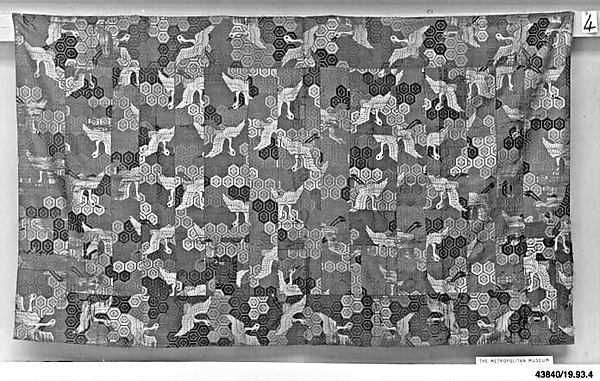
Seven-Panel Buddhist Monk’s Vestment (Shichijō kesa) with Crane Patterns on Hexagonal Diaper Pattern (Mokkō) Background, early 17th century, Twill-weave silk with supplementary weft patterning (karaori). The Metropolitan Museum of Art, Purchase, Joseph Pulitzer Bequest, 1919, accession 19.93.4.
Look closer: Look at the crane. The Met titles this seven-panel kesa for cranes on a hexagonal ground, and dates it to the early seventeenth century.
Image: The Metropolitan Museum of Art, Open Access (CC0)
The difference is a useful way to read each of them. The Buddhist vestment has a story of poverty and gift: a robe made from scraps, then from donated cloth, then from cut-up silk and brocade that gave the old idea new splendour. The Shinto garment has a story of office: clothes that once belonged to a court and then passed to the shrine, with their colours and their licences governed for centuries by family and rank. The Metropolitan Museum has gathered more than twenty kesa, several portraits of Zen masters and one court robe of the nineteenth century, and these objects allow both stories to be told from the cloth.

Buddhist Vestment (Kesa) with Clematis Flowers, Leaves, and Vines, 17th century, Body of the kesa: brocaded silk twill (karaori); Squares: silk and metallic-thread lampas. The Metropolitan Museum of Art, Purchase, Joseph Pulitzer Bequest, 1919, accession 19.93.7.
Look closer: Look at the weft. The Met says the karaori uses nine colours of floating weft.
Image: The Metropolitan Museum of Art, Open Access (CC0)
This chapter takes the temple first, from the Indian beginnings of the kasaya through the Japanese kesa, its patchwork construction, its meaning in Zen, its raw material in donated silk, and the portraits that show abbots wearing it. It then crosses to the shrine, to the jōe, the kariginu and the eboshi, to the licences and ranks that governed them, to the shrine maiden's red and white, and to the mountain ascetics who wear a third kind of dress altogether. The court clothes that the shrine inherited are described in Court Dress: Jūnihitoe and Sokutai, the stage robes that supplied the temple's silk in Noh Costume: Karaori, Atsuita and Mizugoromo, and the warrior's use of the same hunting robe in Samurai Ceremonial Dress: Hitatare and Kamishimo.
Patched cloth from India to Kyoto
The kesa begins in India. Wikipedia, in its article on the kasaya, states that kāṣāya robes are said to have originated in ancient India as the robes of monks who followed Gautama Buddha. They were made from discarded fabric stitched into three rectangular pieces, the antarvāsa, the uttarāsaṅga and the saṃghāṭī, which together formed the triple robe, the ticīvara. The Theravāda Vinaya describes the triple robe in detail. The article is clear that the patchwork is a method of construction from scraps, and it does not read a symbolism into it.
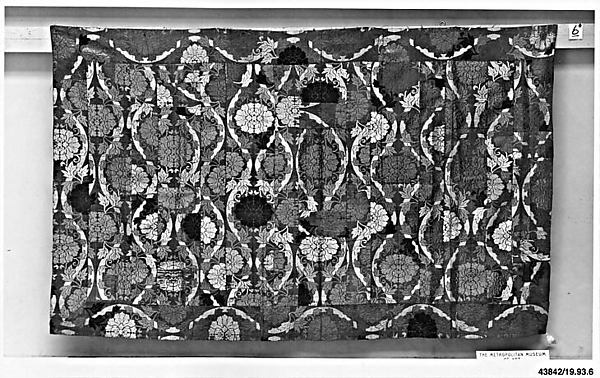
Seven-Panel Buddhist Monk’s Vestment (Shichijō kesa) with Peony Patterns in Undulating Columns, ca. early 18th century, Twill-weave silk with supplementary weft patterning. The Metropolitan Museum of Art, Purchase, Joseph Pulitzer Bequest, 1919, accession 19.93.6.
Look closer: Look at the columns. The Met titles this kesa for peonies in undulating columns, and notes it was cut from a Noh costume.
Image: The Metropolitan Museum of Art, Open Access (CC0)
Colour followed the sects. The article records that in India robes ranged from red and ochre to blue and black. An Shigao, a Parthian monk who worked in China between 148 and 170, translated a text that describes the robe colours of five Indian sects, and a later text gives a similar passage with two of the colours reversed. In Tibetan Buddhism, which follows the Mūlasarvāstivāda Vinaya, red is regarded as characteristic of that school. In China the early robes were mostly red, and under the Tang dynasty monastics typically wore grayish-black robes, which earned them the nickname Ziyi, those of the black robes.
The word travelled with the cloth. The article explains that the Chinese term jiasha was borrowed from kāṣāya, and that the Japanese term kesa comes from the Chinese transliteration. In Japan the kesa is a rectangle worn over the left shoulder, made of patchwork called kassetsue in five, seven, nine or more panels. It is worn over the jikitotsu, a Chinese-style long robe with a belt or sash at the waist, and the article adds that Zen monks wear two kimono covered by the jikitotsu, with the kesa on top. The page also offers a portrait of Wuzhun Shifan wearing a jiasha, dated 1238, in the Song dynasty, and a Japanese portrait of Kyūzan Sōei of the seventeenth century.

Buddhist Priest's Vestment (Kesa) with Phoenix, 19th century, Silk and metallic thread tapestry. The Metropolitan Museum of Art, Purchase, Joseph Pulitzer Bequest, 1919, accession 19.93.119.
Look closer: Look at the phoenix. The Met says this kesa was woven in a single piece and its columns are suggested by a stitched cord.
Image: The Metropolitan Museum of Art, Open Access (CC0)
Here the Japanese kimono family meets the Buddhist one. The article names the kimono as the layer beneath, and the chapter The Kimono Ladder: Furisode, Tomesode, Hōmongi and Komon describes the lay garment on which the later layers rest.
Seven columns and four guardians
The Met's labels explain the anatomy of the kesa in unusual detail. One label says the central panel is made of five, seven or nine patchwork strips, which recall the Buddha's teaching on poverty, that the corner patches represent the four directional guardian deities and that the two larger side patches represent temple guardian deities. The label belongs to a seven-panel kesa made from a Chinese robe of the eighteenth century, and it states that the robe's construction and symbolism have changed over time.

Buddhist Vestment (Kesa) with Figural Squares, 18th century, Body of the kesa: silk lampas; Squares: silk twill with supplementary weft patterning in metallic thread. The Metropolitan Museum of Art, Purchase, Joseph Pulitzer Bequest, 1919, accession 19.93.112.
Look closer: Look at the corners. The Met says the squares on this kesa depict the Four Guardians and the two Benevolent Kings.
Image: The Metropolitan Museum of Art, Open Access (CC0)
A second label, for a kesa with figural squares of the eighteenth century, reads the vestment as a diagram. The museum says the principal Buddhist vestment, called kashaya in Sanskrit and kesa in Japanese, has many meanings: it marks clergy apart from laypeople, it is made according to the rules of a school, it is the result of donated cloth, and it can be read as a diagram of the Buddhist world, a mandala. Japanese Esoteric Buddhist kesa usually have seven vertical columns, with squares at the corners tied to the Guardians of the Four Directions. The central column is made first and often stands for the central buddha of the mandala. The flanking squares may represent the bodhisattvas Manjushri and Samantabhadra, or the two Benevolent Kings. The museum adds that this example depicts the Four Guardians and the two Benevolent Kings.
The Lehman Collection at the Met adds a count. Its kesa of the late nineteenth to early twentieth century has an allover pattern of chrysanthemums and curling leaf devices, six lighter silk patches showing cloud bands and parts of dragons, and fourteen narrow strips, called jo, of dark blue silk, with six light red or orange patches at the corners. The museum notes that such corner patches generally mark where the wearer's hands and feet would be if the kesa were laid out as a figure, a reading that the museum states with the word generally.

Buddhist Priest's Robe (Kesa) with Pattern of Swallows among Willow Branches, 18th century, Brocaded twill with supplementary weft patterning; silk and metallic thread. The Metropolitan Museum of Art, Purchase, Joseph Pulitzer Bequest, 1919, accession 19.93.9.
Look closer: Look at the border. The Met says the pieced border suggests the cloth was not woven for use as a vestment.
Image: The Metropolitan Museum of Art, Open Access (CC0)
Not every kesa is patched. The Met's phoenix kesa of the nineteenth century was woven in a single piece as a tapestry-like textile, and its columns are only suggested by a cord stitched onto the surface. The museum says that kesa are usually assembled from many small pieces sewn in column formations, and that this example was woven as one. It is a useful reminder that the patchwork was both a rule and a look, and that the look could be woven when the rule was no longer sewn.
A master's cloth passes to the disciple
The vestment is more than clothing. The Met's labels for several kesa say that a master giving a kesa to a disciple represents the transmission of the dharma, the teaching, and that this is especially important in Zen Buddhism, in which only a master who has already experienced enlightenment can recognise a disciple who is on the way to it or has reached it. The labels add that kesa are treasured because of their association with the monks who wore or owned them, and that they indicate the wearer's rank in the religious hierarchy.
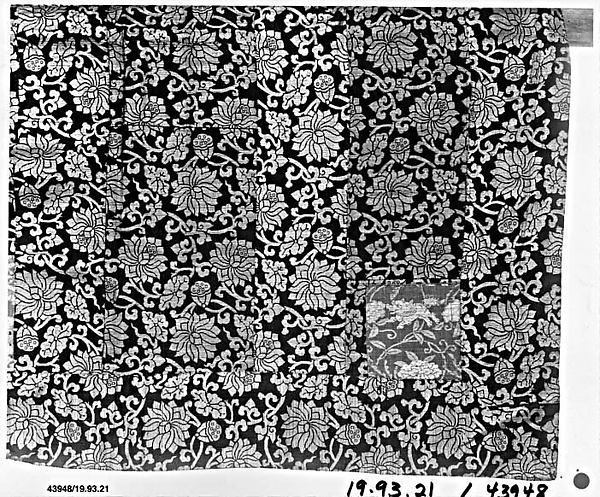
Seven-Panel Buddhist Monk’s Vestment (Shichijō kesa) with Lotus Arabesque, dated 1796, Twill-weave silk with gold supplementary weft patterning (kinran). The Metropolitan Museum of Art, Purchase, Joseph Pulitzer Bequest, 1919, accession 19.93.21.
Look closer: Look at the date. The Met reads the inscription as Kansei 8, which is 1796, and a gift to the temple on Mount Hashimoto.
Image: The Metropolitan Museum of Art, Open Access (CC0)
One of the Met's kesa carries a date and an inscription. The seven-panel kesa with lotus arabesque and gold supplementary weft was dated 1796 by Louise Cort's 1986 translation of its inscription, which reads Kansei 8, and the inscription also reads Hashimotoyama jōmotsu, meaning a possession of the temple on Mount Hashimoto. The rest of the inscription gives an official position, the name of a priest, Son'ō, and the word kifu, meaning a gift. A second translation on the museum's page gives the month as July, and the museum's page lists the object's period as Muromachi even though the inscription gives 1796. The house records the discrepancy as the museum gives it and takes the date from the inscription.
Such details show what a kesa was: an object with a provenance. A vestment with an inscription is the record of a gift from one person to a temple, and from one generation to the next. The same museum labels call the cloth treasured for its association with its wearers, and that association is what separates a kesa from a piece of silk of the same pattern.

Buddhist Priest's Robe (Kesa) with Pattern of Lotus Petals on Water, 18th century, Brocaded plain weave; silk and metallic thread. The Metropolitan Museum of Art, Gift of E. G. Kennedy, 1932, accession 32.65.24.
Look closer: Look at the lotus. The Met titles this kesa for a pattern of lotus petals.
Image: The Metropolitan Museum of Art, Open Access (CC0)
The theme returns in the Zen portraits described below, which show the abbot in the formal robes of his office, and in the chapter on How to Read, Grade and Care for a Japanese Garment, which explains why a vestment with a known history is handled differently from an unmarked one.
Noh costumes cut into vestments
The raw material of a kesa was often gift cloth. A Met label states that Buddhist vestments were typically sewn from donated cloth or from garments that were cut up and reassembled as patchwork, that such gifts are regarded as adorning the Buddha's realm, and that they earn the donor karmic merit. Another label on a related kesa says that what is worthless in the secular world becomes sacred in the Buddhist one.

Buddhist Vestment (Kesa) Made from a Noh Costume (Karaori) with Autumn Grasses and Butterflies, 18th–19th century, Twill-weave silk brocaded with silk and metallic thread. The Metropolitan Museum of Art, Purchase, Joseph Pulitzer Bequest, 1919, accession 19.93.10.
Look closer: Look at the butterflies. The Met says this kesa was likely made from an eighteenth-century karaori, once worn by an actor playing a young woman.
Image: The Metropolitan Museum of Art, Open Access (CC0)
The cloth that came to temples was often the best. The Met's kesa with clematis flowers, leaves and vines of the seventeenth century uses karaori, a textile in which the design is woven with long floating silk wefts in many colours, nine in this example, and the museum notes that the same cloth was used for the Noh costume also called karaori, which is usually worn as an outer robe by an actor playing a female role. A kesa of the eighteenth to nineteenth century, with autumn grasses and butterflies, was likely made from an eighteenth-century karaori, and the museum says the kesa was used by an elderly monk. The plants on it belong to the standard set of seven autumn flowers and grasses of Japanese art and poetry, which the label names as bush clover, Chinese bellflower, miscanthus grass, purple trousers flower, large pink, pampas grass and valerian.
The swallows kesa shows the process from the other side. The museum describes a seven-section kesa with swallows among willow branches on a reverse-swastika fret ground, a symbol of infinity in Buddhist thought, with corner and central patches of pine boughs on a gold ground. It notes that the border is pieced together rather than continuous, which suggests the textile was not woven for use as a vestment, and that temples often received treasured textiles and clothing and repurposed them as vestments and altar cloths.

Buddhist Priest's Robe (Kesa), 19th century, Silk and metallic thread. The Metropolitan Museum of Art, Gift of Phillip H. Rubin, 2006, accession 2006.572.6.
Look closer: Look at the thread. The Met records silk and metallic thread for this nineteenth-century kesa.
Image: The Metropolitan Museum of Art, Open Access (CC0)
The Noh stage and the temple therefore shared a supply of silk. The costumes of the stage are described in Noh Costume: Karaori, Atsuita and Mizugoromo, and a reader who knows a brocade from the Noh wardrobe may meet the same weave on a monk's shoulder.
Dragon robes made suitable for monks
Some of the grandest kesa began as Chinese court robes. The Met's seven-panel kesa of the eighteenth century, made from a Chinese robe, is decorated with dragons. The museum explains that dragon robes were rare and highly valued in eighteenth-century Japan and that several kesa made from cut-up Chinese robes survive. The dragons on this one originally had five claws, the imperial form; the fifth claw of each is hidden beneath an embroidered cloud pattern, so they appear four-clawed, the form called mang, which the museum says made the design suitable for lower-ranking wearers.
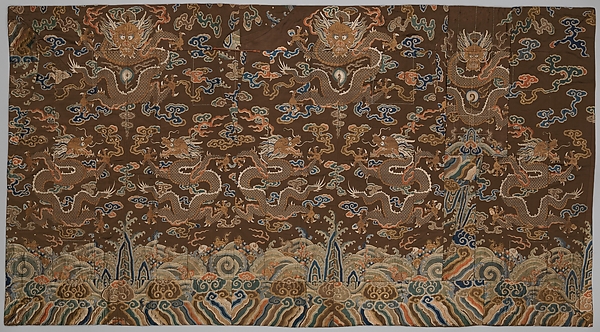
Seven-Panel Buddhist Monk’s Vestment (Shichijō kesa) Made from a Chinese Robe, 18th century, Silk satin brocaded with silk and metallic thread; silk embroidery. The Metropolitan Museum of Art, Purchase, Joseph Pulitzer Bequest, 1919, accession 19.93.50.
Look closer: Look at the clouds. The Met says an embroidered cloud pattern hides the fifth claw of each dragon, turning an imperial design into a lower-ranking one.
Image: The Metropolitan Museum of Art, Open Access (CC0)
The detail is a good example of how rank travelled in cloth. The dragon on the court robe signalled the emperor's household; the same dragon with a hidden claw signalled a lesser station. The kesa therefore carries two ranks, the original wearer's and the new one's, in a single motif.
The Met also owns a theatrical robe for a Buddhist priest of the eighteenth century in silk brocade patchwork, whose lining carries a stamp reading Used in the Grand Theatre, which the museum takes to show that an actor in the imperial theatre in the Forbidden City wore it, not an actual priest. The object is Chinese. The house mentions it for a reason: a patchwork robe with a hook at the front, labelled a kasaya, can be a stage costume, and a reader who meets one should ask where it was worn.

Buddhist Vestment (Kesa), 18th century, Silk, metallic thread. The Metropolitan Museum of Art, Anonymous Gift, 1949, accession 49.32.111.
Look closer: Look at the date. The Met dates this kesa to the eighteenth century.
Image: The Metropolitan Museum of Art, Open Access (CC0)
The imports remind a reader how interconnected the Asian textile world was. The silk brocades and velvets that came in through Nagasaki also appear in the warlord's surcoat described in Jinbaori: The Warlord’s Surcoat, where the Met records a body of Chinese silk velvet made for the European market, a lining of Chinese damask and lapels of Japanese lampas.
Abbots seated in carved lacquer chairs
The best evidence of how a kesa was worn is the portrait of a man wearing one. The Met owns several Zen portraits, and its labels explain the genre. A chinsō, the label for the portrait of Keinan Eibun says, is a realistic portrait reserved for senior Zen monks and abbots, and its sitters are usually shown in a carved lacquer chair, wearing formal robes including the ornate kesa, the master's vestment, with the facial features rendered in careful detail. Such portraits were treasured as records of the teacher-disciple bond central to Zen and may have been used in Buddhist ceremonies.
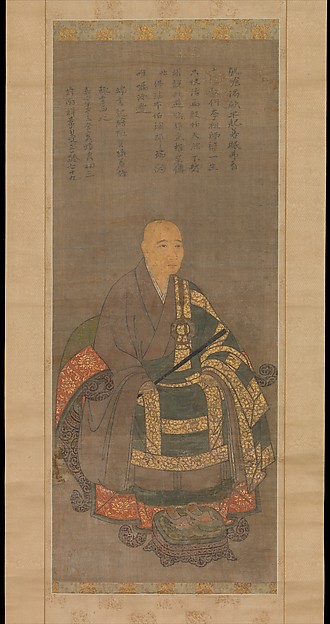
Portrait of Keinan Eibun, 1449, Hanging scroll; ink, color, and gold on silk. The Metropolitan Museum of Art, Gift of Florence and Herbert Irving, 2015, accession 2015.500.9.10.
Look closer: Look at the chair. The Met says the portrait of Keinan Eibun shows him in a carved lacquer chair, wearing formal robes including the ornate kesa.
Image: The Metropolitan Museum of Art, Open Access (CC0)
Keinan Eibun lived from 1365 to 1454 and was once abbot of Nanzenji in Kyoto, and the portrait of 1449 shows him at the age of seventy-nine. The portrait of Kyūzan Sōei, of the seventeenth century, shows a master who lived from 1605 to 1656 and became the 194th abbot of Daitokuji, a Zen temple in northern Kyoto. The inscription above the seated figure was written by his own master, Tenyū Shōkō, who lived from 1586 to 1666 and was the 169th abbot of Daitokuji. The museum says masters sometimes gave such portraits to disciples as proof that they had attained enlightenment, or displayed them at rituals such as memorial services, and that they document a disciple's place in the lineage of Zen teaching.
A third portrait shows the Ōbaku monk Jifei Ruyi, painted by Kita Genki in 1666. The museum says the painter was from Nagasaki, that the subject, who lived from 1616 to 1671, inscribed the portrait himself while living at Fukujuji, a temple supported by the daimyo of Kokura, and that Nagasaki was one of the few places under the tightly controlled Tokugawa government in which Chinese culture and learning could be openly studied. The labels for the Kyūzan Sōei and Jifei Ruyi portraits do not describe the robes, so the house leaves their garments to the reader's own eye.

Buddhist Vestment (Kesa), 18th century, Lampas, silk; squares:silk satin, brocaded, silk and gilt paper-wrapped thread. The Metropolitan Museum of Art, Purchase, Joseph Pulitzer Bequest, 1919, accession 19.93.111.
Look closer: Look at the squares. The Met records lampas with brocaded satin squares.
Image: The Metropolitan Museum of Art, Open Access (CC0)
The sculpture of a Zen master in the Met, of lacquer on wood with inlaid crystal, of the fifteenth century, makes the same point in three dimensions. The label says the face is realistic and the body, with its heavy robes spilling over the chair, more stylised, that such portraits were often kept in the living quarters of Zen temples as a reminder of a deceased founder, and that because Zen emphasises passing on understanding without relying on sutras, they held greater importance than icons of Buddhist deities. The key phrase of the label is from heart to heart.
Left shoulder first, then both
The way a kesa is worn is part of what it means. The Met's labels say the kesa is draped over the left shoulder, and one adds that it is worn diagonally. Wikipedia on the kasaya says the kesa sits over the jikitotsu, and that historically the kesa covered both shoulders, tsuken, while now the right shoulder is typically left exposed, hendan-uken, a practice the article links to reverence for the Buddha. The article marks both claims as needing a citation, so the house offers them as the article does.

Portrait of a Zen Master, 15th century, Lacquer on wood with inlaid crystal. The Metropolitan Museum of Art, Purchase, John D. Rockefeller 3rd Gift, 1963, accession 63.65.
Look closer: Look at the robes. The Met says the heavy robes spill over the chair in this fifteenth-century figure of a Zen master.
Image: The Metropolitan Museum of Art, Open Access (CC0)
The Met's label for the phoenix kesa gives the same fact in plainer words: it is the outer robe Japanese Buddhist priests wear draped over the left shoulder. That repetition across the labels shows how settled the placement is. The panels, the columns and the corner patches are designed to be read on a body or laid flat, and a kesa in a museum case is almost always laid flat, which is why the guardians in the corners are easy to see and the drape is not.
The jikitotsu under the kesa is a plain long robe, and the lay garments under that are the same kosode-based layers described in the chapter on The Kimono Ladder: Furisode, Tomesode, Hōmongi and Komon. A reader who wishes to place a kesa in the wardrobe should therefore think of three layers: the lay kimono, the long robe and the vestment. The Met's labels do not discuss the layers, and the house takes them from Wikipedia on the kasaya, which says Zen monks wear two kimono, covered by the jikitotsu, with the kesa on top.
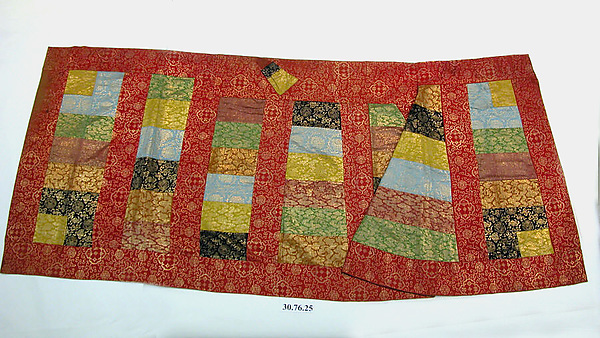
Theatrical robe for a Buddhist priest, 18th century, Silk brocade patchwork. The Metropolitan Museum of Art, Rogers Fund, 1930, accession 30.76.25.
Look closer: Look at the lining. The Met says a stamp in the lining shows an actor in the imperial theatre wore it, not a priest.
Image: The Metropolitan Museum of Art, Open Access (CC0)
Colour belongs here too. The Met's kesa range from gold brocades to dark tapestry weaves, and the labels do not give a colour code for rank. The house therefore does not claim one, and reminds the reader that in India and China the colours were linked to sects and to the Tang fashion for grey, as the article records.
The court's clothes in the priest's hands
A Shinto priest's dress tells the opposite story. Wikipedia's article on Shinto priests says the jōe, the eboshi and the kariginu do not have any special religious significance: they are official garments that the Imperial court formerly used, which the article says reveals the close link between kami worship and the Emperor. The priests also use a baton called the shaku and a wand called the ōnusa, which is decorated with white paper streamers called shide.

Man's Court Robe (Kariginu) with Belt and Hat, 19th century, Silk. The Metropolitan Museum of Art, Gift of Sue Cassidy Clark, in honor of Barbara Ford, 2003, accession 2003.591a–c.
Look closer: Look at the three pieces. The Met records the robe, the hat and the belt, which came in a Kyoto shop's paper wrapper.
Image: The Metropolitan Museum of Art, Open Access (CC0)
The hunting robe, the kariginu, is therefore at once a court garment, a samurai's full dress and a shrine priest's vestment. The chapter Court Dress: Jūnihitoe and Sokutai describes its Heian origin, and the chapter Samurai Ceremonial Dress: Hitatare and Kamishimo explains that the Edo shogunate used a thin summer-gauze kariginu as full dress for daimyo and high-ranking samurai of the fourth court rank. The shrine has kept for ritual what the court gave up as daily wear.
The Met holds a nineteenth-century garment of the same kind. It is a man's court robe, a kariginu, with belt and hat, of the nineteenth century, in silk, and the three pieces came in a Japanese paper wrapper that describes the item as a gauze hunting robe and names a Kyoto shop, with the notice that all kinds of costume are available and that prices are not negotiable. The robe measures about 175 by 178 centimetres, the hat about 29 by 37 centimetres and the belt about 8 by 175 centimetres. The museum does not say who wore it, and the house does not guess; but the shop's wrapper shows that by the nineteenth century these clothes were a trade in Kyoto.

Portrait of Kyūzan Sōei, 17th century, Hanging scroll; ink and color on silk. The Metropolitan Museum of Art, Rogers Fund, 1913, accession 13.95.2.
Look closer: Look at the inscription. The Met says Kyūzan Sōei's own master wrote the inscription above the seated figure.
Image: The Metropolitan Museum of Art, Open Access (CC0)
The Met also holds a Noh costume in the kariginu form, of the first half of the nineteenth century, and the chapter Noh Costume: Karaori, Atsuita and Mizugoromo follows it onto the stage. A reader looking at a kariginu in a museum should ask first whether it is a court, shrine, samurai or stage garment, because the cut is the same and the use differs.
Yoshida, Shirakawa and the grant of dress
Dress at the shrine was a matter of permission. Wikipedia's article on Shinto priests records that in the mid-sixteenth century licences from the Yoshida family determined what ritual garb a priest could wear, and that in 1665 the Shrine Article gave the Yoshida family control over the assignment of court rank and the types of ritual garb priests wore. In the eighteenth century the Shirakawa family opposed the Yoshida and recruited regional priests.
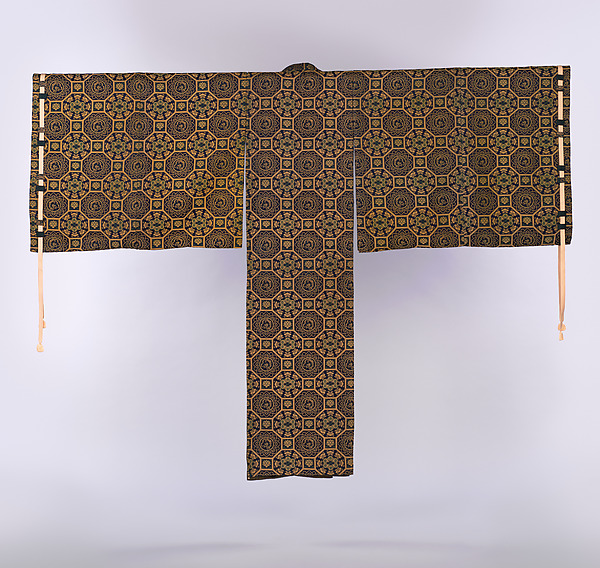
Noh Costume (Kariginu), first half 19th century, Twill-weave silk with supplementary weft patterning. The Metropolitan Museum of Art, Edward C. Moore Collection, Bequest of Edward C. Moore, 1891, accession 91.1.62.
Look closer: Look at the weave. The Met records twill-weave silk with supplementary weft patterning for this Noh kariginu of the first half of the nineteenth century.
Image: The Metropolitan Museum of Art, Open Access (CC0)
The system ended with the Meiji Restoration. In 1868, the article says, the Yoshida and Shirakawa licences were invalidated, and priests had to be recertified through a national examination. In 1871 hereditary priest positions were outlawed. In March 1887 the term shinkan was replaced by shinshoku for most priests. In 1902 a new rank system was introduced at imperial and national shrines.
Rank and position were separate. The article describes five levels of rank, kaii, called jōkai, meikai, seikai, gonsekai and chokkai, whose names derive from the four virtues of purity, light, correctness and forthrightness, and a hierarchy of positions, shokkai, running from head priest, gūji, through assistant head priest, gongūji, and assistant priest, negi, to junior priest, gonnegi. The article states that hierarchy matters more than rank for status. The rank of gonsekai was added in 1961 when the system was reformed. The article does not link particular vestments to particular ranks, and neither does the house.
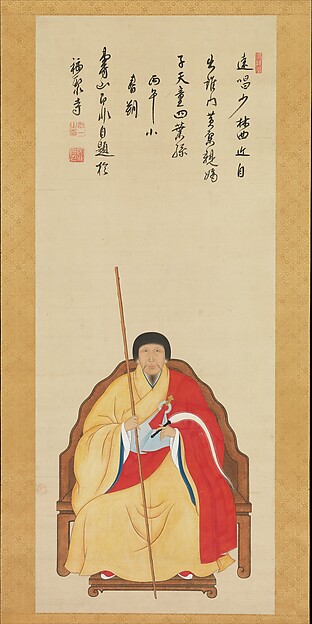
Kita Genki, Portrait of the Ōbaku Zen Monk Jifei Ruyi (Sokuhi Nyoitsu), 1666, Hanging scroll; ink and color on silk. The Metropolitan Museum of Art, The Harry G. C. Packard Collection of Asian Art, Gift of Harry G. C. Packard, and Purchase, Fletcher, Rogers, Harris Brisbane Dick, and Louis V. Bell Funds, Joseph Pulitzer Bequest, and The Annenberg Fund Inc. Gift, 1975, accession 1975.268.78.
Look closer: Look at the date. The Met dates this portrait by Kita Genki to 1666 and says it was inscribed by the sitter himself.
Image: The Metropolitan Museum of Art, Open Access (CC0)
What the history gives a reader is the right question. A shrine garment of the Edo period was dressed within a system of licences, so its style and quality were partly a matter of what the priest was permitted. A garment of the twentieth century was dressed within the modern Association of Shinto Shrines, which the article says was established in 1946.
Women and the shrine priesthood
The modern priesthood has changed. Wikipedia on Shinto priests records that in 1946 women were allowed to become priests at any rank except head priest, and that in 1948 they were allowed to become head priests. A government survey of 2024 found about 65,000 priests in Shinto-related religions, and the Association of Shinto Shrines reported about 21,000 registered priests. Women make up nearly 3,800 priests in the Association's shrines, close to twenty per cent of the priesthood.
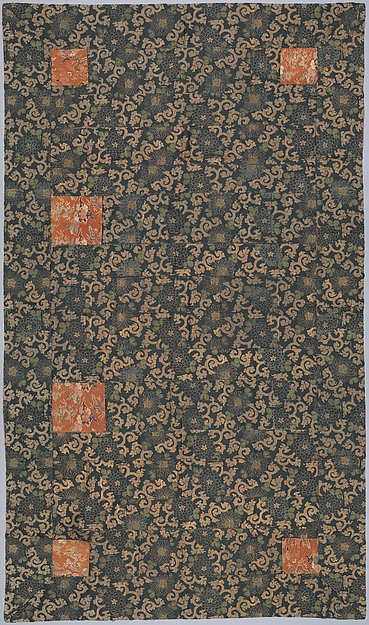
Japanese, Kesa (Buddhist priest's robe), late 19th to early 20th century, Silk, gold leaf on lacquered paper strip, and gold leaf on lacquered paper-strip-wrapped cotton, warp-float-faced 4/1 satin weave with weft-float-faced 1/2 "z" twill interlacings of secondary binding warps and supplementary patterning wefts.. The Metropolitan Museum of Art, Robert Lehman Collection, 1975, accession 1975.1.1934.
Look closer: Look at the patches. The Met describes cloud bands and parts of dragons on six lighter silk patches, and fourteen narrow strips of dark blue silk.
Image: The Metropolitan Museum of Art, Open Access (CC0)
The dress has kept pace with the change. The shapes are the court's, and the wearer may be a man or a woman. The article does not describe the vestments by rank, and the house does not add detail it has not read.
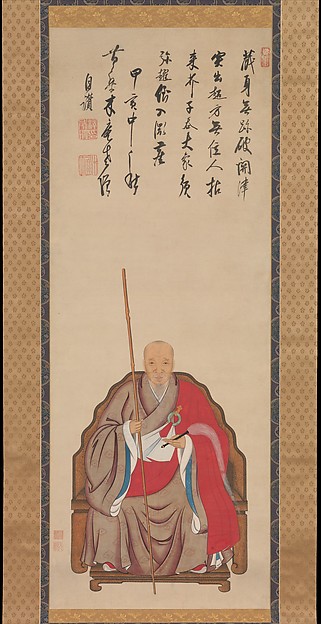
Kita Genki, Portrait of the Ōbaku Zen Monk Mu’an Xingtao (Mokuan Shōtō), dated 1674, Hanging scroll; ink and color on silk. The Metropolitan Museum of Art, Gift of Florence and Herbert Irving, 2015, accession 2015.500.9.7.
Look closer: Look at the date. The Met dates this portrait of an Ōbaku monk to 1674.
Image: The Metropolitan Museum of Art, Open Access (CC0)
For the Buddhist side, the corresponding modern fact is the persistence of the school's own patterns. The Met's kesa of the nineteenth and twentieth centuries, with chrysanthemums, clouds and dragons, show a design vocabulary that did not change when the shogunate fell.
White kosode, red hakama and the chihaya
The shrine's maidens are dressed differently again. Wikipedia on the miko gives their dress as a white kosode, the predecessor of the kimono, with red hakama called hi-bakama, which are divided pleated trousers. During kagura dances a garment called the chihaya is worn over the kosode. The article says the miko wear white or red hair ribbons, and that white is said to symbolise purity in Shinto, a claim the article marks as needing a citation. It does not mention hair ornaments such as kanzashi.

Shinto Deity as a Seated Courtier, 11th–12th century, Wood; single-block (ichiboku-zukuri) construction, with traces of red and black pigment. The Metropolitan Museum of Art, Purchase, Friends of Asian Art Gifts, 2015, accession 2015.5.
Look closer: Look at the dress. The Met titles this wooden figure a Shinto deity as a seated courtier, of the eleventh to twelfth century.
Image: The Metropolitan Museum of Art, Open Access (CC0)
The history behind the dress is turbulent. The article traces miko traditions to prehistoric Japan, and records the earliest record resembling the term, a reference to Himiko, though it is unknown whether she was a miko. Official edicts of 780 and 807 were issued against ecstatic practice outside shrine authority. In the Kamakura period, from 1185 to 1333, shrines that supported miko fell into bankruptcy, which pushed many of them into mendicancy. In the Edo period, from 1603 to 1868, the organisation and practices of female shamans changed significantly. After 1867 official views of miko became increasingly negative, and an edict of 1873 forbade miko spiritual practices. In the twentieth century the kagura dance was transformed into a popular ceremonial dance called miko-mai or miko-kagura.
The article adds that initiation into some traditions involved a training of three to seven years, and that the initiation ceremony involved the trainee wearing a white shroud, which symbolised the end of her previous life; after initiation the girl was allowed to wear a coloured wedding dress. The details differ by tradition, and the article is the only source the house has read.

Kumano Mandala, early 14th century, Hanging scroll; ink, color, and gold on silk. The Metropolitan Museum of Art, Purchase, Gift of Dr. Mortimer D. Sackler, Theresa Sackler and Family, 2006, accession 2006.521.
Look closer: Look at the date. The Met dates the Kumano Mandala to the early fourteenth century.
Image: The Metropolitan Museum of Art, Open Access (CC0)
The article presents the white kosode and red hakama as the miko's dress, and the wider history it records shows how many different roles women held in and around the shrines.
Conch, staff and backpack
A third kind of religious dress belongs to the mountains. Wikipedia on the yamabushi, the mountain ascetics, lists their equipment: the tokin, a small hat-like adornment worn at the front of the head; the oi, a backpack; the shakujō, a metal rod held in the hands; the horagai, a conch shell blown like a horn and said to bind evil spirits; the yuigesa, a harness or sash decorated with pom-poms; and the kyahan, leg wraps worn with straw sandals. The article traces the origins of the yamabushi to the solitary yamabito and some hijiri of the eighth and ninth centuries, and says they are generally part of Shugendō, a syncretic religion that includes Tantric Buddhism and Shinto.

Zaō Gongen, 11th century, Gilt bronze with incised decoration. The Metropolitan Museum of Art, The Harry G. C. Packard Collection of Asian Art, Gift of Harry G. C. Packard, and Purchase, Fletcher, Rogers, Harris Brisbane Dick, and Louis V. Bell Funds, Joseph Pulitzer Bequest, and The Annenberg Fund Inc. Gift, 1975, accession 1975.268.155.
Look closer: Look at the date. The Met dates this sculpture titled Zaō Gongen to the eleventh century.
Image: The Metropolitan Museum of Art, Open Access (CC0)
The name of one item shows how the traditions mix. The yuigesa carries the word kesa in its name, and it is the yamabushi's version of the vestment: a harness, with pom-poms, worn by a man who belongs to neither the temple nor the shrine alone. The article does not describe it further, and the house does not either.
The Met holds an eleventh-century sculpture titled Zaō Gongen and an early fourteenth-century Kumano Mandala, both of which belong to the mountain religion's neighbourhood of images, though the house takes only their titles and dates from the museum. The Wikipedia article lists the horagai and the tokin among the yamabushi's equipment.
The point for this chapter is that Japan has at least three clerical wardrobes: the Buddhist patchwork, the Shinto court dress and the mountain ascetic's kit. A person who wishes to identify a piece of religious clothing should ask which of the three it belongs to.
Four tales from the vestry
The hidden claw. A dragon robe made for the Chinese court had five claws on each dragon. When it was cut up and made into a Japanese kesa, an embroidered cloud was placed over the fifth claw of each, so the dragons appeared four-clawed and the design suited lower-ranking wearers. The Met's label tells the story, and the claw is still there beneath the cloud.
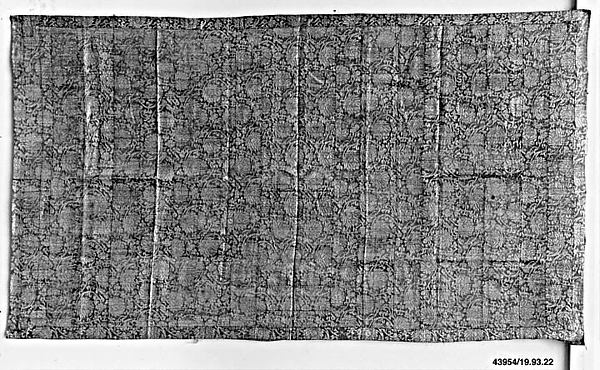
Nine-Panel Buddhist Monk’s Vestment (Kujō kesa) with Lotus Arabesque, late 17th–mid 18th century, Silk satin with gold supplementary weft patterning (kinran). The Metropolitan Museum of Art, Purchase, Joseph Pulitzer Bequest, 1919, accession 19.93.22.
Look closer: Look at the count. The Met titles this one a nine-panel kujō kesa, in silk satin with gold supplementary weft.
Image: The Metropolitan Museum of Art, Open Access (CC0)
The actress's robe on a monk's shoulder. The Met's kesa with autumn grasses and butterflies was likely made from an eighteenth-century karaori, the costume worn by a male actor playing a young woman in a Noh play, and was used by an elderly monk. A robe for a stage maiden became a vestment for an old man.
The inscribed gift. The Met's kesa dated 1796 carries an inscription naming Mount Hashimoto, a priest called Son'ō and the word for a gift. Two translations differ on the month. The vestment records, in one line, who gave it and where it went.
The stage priest. A robe in the Met's collection that is labelled a kasaya and was made for a Buddhist priest turns out, from its stamp, to have been worn by an actor in the imperial theatre in the Forbidden City. It reminds a reader that a monk's vestment is the easiest religious costume to put on a stage.
Small surprises from the temple
Short facts from the sources, each given as the source gives it.
- Kesa is the Japanese form of the Chinese transliteration of the Sanskrit kāṣāya.
- The original Indian triple robe was stitched from discarded cloth into three rectangles.
- Under the Tang dynasty, Chinese monastics typically wore grayish-black and were nicknamed those of the black robes.
- A Met kesa dated 1796 was a gift to the temple on Mount Hashimoto.
- Karaori, the cloth of Noh costumes, was often recut into kesa.
- The Met's seven autumn plants include bush clover, miscanthus grass and pampas grass.
- The reverse-swastika fret on one kesa is a symbol of infinity in Buddhist thought.
- Four-clawed dragons on a kesa began as five-clawed imperial dragons.
- Keinan Eibun's portrait shows him at the age of seventy-nine.
- The jōe, eboshi and kariginu have no special religious significance, according to Wikipedia.
- In 1871 hereditary priest positions were outlawed.
- Nearly 3,800 priests in the Association of Shinto Shrines are women, close to twenty per cent.
Words from the temple and the shrine
The terms used in this chapter, with the garment or custom each names.
| Term | Meaning | Where it appears |
|---|---|---|
| Kesa | The patchwork Buddhist vestment worn over the left shoulder | Origins |
| Kāṣāya | The Sanskrit name of the monk's robe | Origins |
| Ticīvara | The triple robe of early Buddhism | Origins |
| Kassetsue | The patchwork of the Japanese kesa | Origins |
| Jikitotsu | The long robe worn under the kesa | Origins |
| Shichijō kesa | A seven-panel kesa | Panels |
| Kujō kesa | A nine-panel kesa | Panels |
| Karaori | Brocaded silk with long floating wefts, used for Noh costumes and kesa | Donations |
| Chinsō | A realistic portrait of a Zen abbot | Portraits |
| Jōe | A formal court robe also worn by Shinto priests | Shrine |
| Kariginu | The hunting robe of the court, worn by priests and samurai | Shrine |
| Eboshi | The court cap worn by priests | Shrine |
| Shaku | The baton carried by priests | Shrine |
| Ōnusa | A wand with white paper streamers | Shrine |
| Shide | White paper streamers | Shrine |
| Kaii | The five ranks of a Shinto priest | Licence |
| Shokkai | The hierarchy of positions in a shrine | Licence |
| Miko | A shrine maiden | Maidens |
| Hi-bakama | Red hakama of the miko | Maidens |
| Chihaya | A garment worn over the kosode during kagura | Maidens |
| Yamabushi | Mountain ascetics of Shugendō | Mountains |
| Horagai | The conch shell blown by yamabushi | Mountains |
What can be seen today
A reader can study all of this through the museum records. The Met's online pages for the kesa read for this chapter list them as not on view, and the images and labels on those pages are the practical way to examine them. Wikipedia's articles on the kasaya, the Shinto priest, the miko and the yamabushi supply the wider outline.
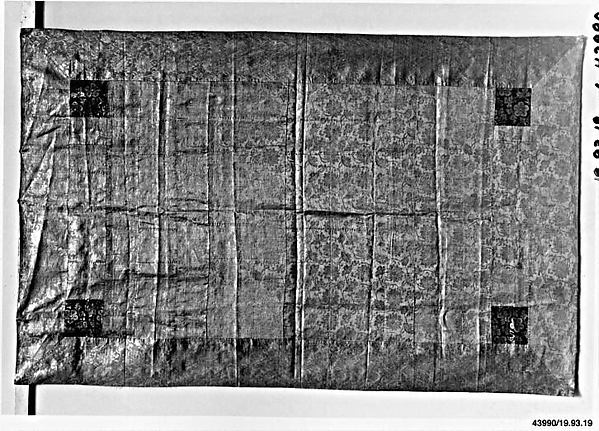
Seven-Panel Buddhist Monk’s Vestment (Shichijō kesa) with Lotus Arabesque, early 17th century, Twill-weave silk with gold supplementary weft patterning (kinran). The Metropolitan Museum of Art, Purchase, Joseph Pulitzer Bequest, 1919, accession 19.93.19.
Look closer: Look at the date. The Met dates this seven-panel kesa to the early seventeenth century.
Image: The Metropolitan Museum of Art, Open Access (CC0)
The Wikipedia articles describe the shrine priest's dress as the court's, the miko's costume as white and red, and the yamabushi's equipment as conch, staff, backpack and tokin. Each is part of a living tradition, and the house describes the clothes without presuming to describe the faith.
For the collector, the lesson is that religious clothing is a family of objects with different histories, and that the Met's own kesa include several whose cloth had a first life elsewhere. The house's own pages on the shrine and household religion, Shinto, Kami, Shrines and the Household, and on the stage, Noh Costume: Karaori, Atsuita and Mizugoromo, describe the neighbouring worlds.
Reading a vestment in the hand
The first question is the origin of the cloth. A kesa may have been woven as a vestment, recut from a Noh costume, cut from a Chinese robe or made from a mixture, and the Met's labels show each case. The pieced border of the swallows kesa, which the museum says suggests the cloth was not woven for the purpose, is a good model of the kind of observation a reader can make.
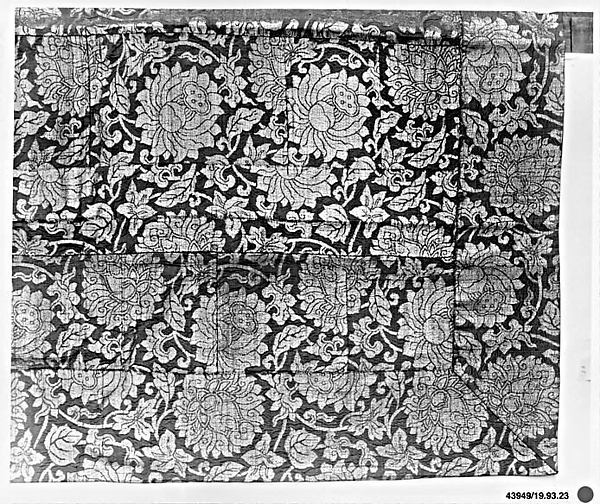
Seven-Panel Buddhist Monk’s Vestment (Shichijō kesa) with Peony Arabesque, 18th century, Twill-weave silk with gold supplementary weft patterning (kinran). The Metropolitan Museum of Art, Purchase, Joseph Pulitzer Bequest, 1919, accession 19.93.23.
Look closer: Look at the pattern. The Met titles this seven-panel kesa for its peony patterns.
Image: The Metropolitan Museum of Art, Open Access (CC0)
The second is the construction. A seven-column or nine-column kesa with corner squares follows a pattern; a single-piece tapestry with a stitched cord does not. The house records both without ranking them, because a woven kesa is also a document of the history of the form.
The third is the temple. A vestment with an inscription, a temple name or a known gift is more informative than an unmarked piece. The condition scale and care advice in How to Read, Grade and Care for a Japanese Garment apply, and silk with gold thread is best stored flat or rolled on a wide tube, never folded along old creases.
The fourth is the category. A priest's robe from a theatre, a court robe sold in a Kyoto costume shop or a modern ceremonial copy is a different object from a temple's vestment, even when the cut is the same. The concierge desk is glad to compare a piece with the museum records on request.
Neighbouring chapters
The temple and the shrine connect to many parts of this almanac. The court garments that the shrine inherited are in Court Dress: Jūnihitoe and Sokutai, the hunting robe as samurai dress in Samurai Ceremonial Dress: Hitatare and Kamishimo, the stage costumes whose silk became vestments in Noh Costume: Karaori, Atsuita and Mizugoromo, and the fibres and weaves in Silk, Hemp, Cotton and Ramie: The Fibres of Japanese Dress and Nishijin: The Woven Brocades of Kyoto. The vocabulary is gathered in Glossary of Japanese Dress and Textile Terms.

Buddhist Vestment (Kesa) with Pattern of Flowing Water, Chrysanthemums, Fishing Nets, and Waterwheels, 18th century, Twill-weave silk brocaded with silk (karaori). The Metropolitan Museum of Art, Purchase, Joseph Pulitzer Bequest, 1919, accession 19.93.11.
Look closer: Look at the pattern. The Met titles this karaori kesa for flowing water and chrysanthemums.
Image: The Metropolitan Museum of Art, Open Access (CC0)
Among the house's other pages, Shinto, Kami, Shrines and the Household describes the religion the shrine priest serves, and the house's collection of kimono and textile heritage holds related textiles.
Patchwork and silk in the house
The shelf holds an indigo patchwork jacket, a Kyoto nishiki-ori silk back and an indigo patchwork bomber. None is a vestment; each is described as what it is, with its age, maker and condition set out on its own page.


Kimono and textile heritage
The house's collection of kimono and textile heritage is the companion to this chapter, and the concierge desk can look for related pieces on request.
Answered plainly
What is a kesa?
The patchwork vestment of a Japanese Buddhist monk, a rectangle of stitched panels worn over the left shoulder; the word comes from the Chinese transliteration of the Sanskrit kāṣāya.
Why is a kesa made of patches?
Wikipedia says the original robes were stitched from discarded cloth; the Met says small rectangles recall the Buddha's patched garment.
How many panels does a kesa have?
Wikipedia says five, seven, nine or more; the Met's kesa include seven-panel and nine-panel examples.
What do the corner patches mean?
One Met label says the corner patches represent the four directional guardian deities; another says the corner squares of Esoteric kesa are tied to the Guardians of the Four Directions.
Why were Noh costumes made into kesa?
Vestments were often sewn from donated cloth, and the Met notes that karaori cloth from Noh costumes was cut up and reused, which earned the donor merit.
What does passing a kesa signify?
In Zen, the Met says, a master's gift of a kesa to a disciple represents the transmission of the teaching.
Which hand side is the kesa worn on?
Draped over the left shoulder, according to the Met's labels.
What is a chinsō?
A realistic portrait of a senior Zen monk or abbot, usually seated in a carved lacquer chair and wearing formal robes including the kesa.
What do Shinto priests wear?
The jōe, eboshi and kariginu, which Wikipedia says have no special religious significance and are official garments formerly used by the Imperial court.
What is the shaku?
A baton carried by Shinto priests.
What is the ōnusa?
A wand decorated with white paper streamers called shide, used by priests.
What did the Yoshida licences do?
From the mid-sixteenth century they determined what ritual garb a Shinto priest could wear; they were invalidated in 1868.
What do miko wear?
A white kosode with red hakama, and during kagura dances a chihaya over the kosode.
Can women be Shinto priests?
Yes. Women were allowed to become priests in 1946 and head priests in 1948; nearly 3,800 priests in the Association's shrines are women.
What do yamabushi carry?
A conch shell called a horagai, a metal staff called a shakujō and a backpack called an oi, and they wear a small tokin.
Is a theatrical Buddhist robe a real vestment?
No. The Met's theatrical robe for a Buddhist priest has a stamp showing it was worn by an actor in the imperial theatre in the Forbidden City.
Where next
Sources and image credits
- Kasaya, Wikipedia
- Shinto priest, Wikipedia
- Kannushi, Wikipedia
- Miko, Wikipedia
- Yamabushi, Wikipedia
- Seven-panel kesa with cranes, Metropolitan Museum of Art
- Seven-panel kesa with peonies, Metropolitan Museum of Art
- Kesa from a Noh costume, Metropolitan Museum of Art
- Nine-panel kesa, Metropolitan Museum of Art
- Seven-panel kesa dated 1796, Metropolitan Museum of Art
- Kesa made from a Chinese robe, Metropolitan Museum of Art
- Kesa with clematis, Metropolitan Museum of Art
- Kesa with figural squares, Metropolitan Museum of Art
- Kesa with phoenix, Metropolitan Museum of Art
- Kesa with swallows and willow, Metropolitan Museum of Art
- Kesa, Lehman Collection, Metropolitan Museum of Art
- Theatrical robe for a Buddhist priest, Metropolitan Museum of Art
- Portrait of Keinan Eibun, Metropolitan Museum of Art
- Portrait of Kyuzan Soei, Metropolitan Museum of Art
- Portrait of Jifei Ruyi, Metropolitan Museum of Art
- Portrait of a Zen Master, Metropolitan Museum of Art
- Man's court robe (kariginu), Metropolitan Museum of Art
- Object record: Buddhist Priest's Robe (Kesa) with Pattern of Lotus Petals on Water, The Metropolitan Museum of Art
- Object record: Buddhist Priest's Robe (Kesa), The Metropolitan Museum of Art
- Object record: Buddhist Vestment (Kesa), The Metropolitan Museum of Art
- Object record: Buddhist Vestment (Kesa), The Metropolitan Museum of Art
- Object record: Noh Costume (Kariginu), The Metropolitan Museum of Art
- Object record: Portrait of the Ōbaku Zen Monk Mu’an Xingtao (Mokuan Shōtō), The Metropolitan Museum of Art
- Object record: Shinto Deity as a Seated Courtier, The Metropolitan Museum of Art
- Object record: Kumano Mandala, The Metropolitan Museum of Art
- Object record: Zaō Gongen, The Metropolitan Museum of Art
- Object record: Seven-Panel Buddhist Monk’s Vestment (Shichijō kesa) with Lotus Arabesque, The Metropolitan Museum of Art
- Object record: Seven-Panel Buddhist Monk’s Vestment (Shichijō kesa) with Peony Arabesque, The Metropolitan Museum of Art
- Object record: Buddhist Vestment (Kesa) with Pattern of Flowing Water, Chrysanthemums, Fishing Nets, and Waterwheels, The Metropolitan Museum of Art
Last reviewed 28 October 2026. Pictures, where shown, are public-domain or open-access and credited beneath each one.
Looking for a kesa, a temple textile or a ceremonial piece related to the world described here? The concierge desk replies within one to three business days.
Private concierge
Looking for something in particular?
Describe the piece or the project you have in mind. A senior advisor in Tokyo reads every case file personally and replies within two business days, with fees set out in writing before any work begins.