
Kabuki Makeup, Kumadori and the Onnagata
Painted faces
Kabuki Makeup, Kumadori and the Onnagata
隈取 女形
Two ways of making a face for the stage: a white ground lined in red, blue or brown to show a hero or a monster, and the training that turns a man into a woman so persuasive that a whole tradition rests on him.
Fact sheet
At a glance
- Face as signal. The colour tells the audience a character's nature before he speaks.
- A mask of lines. Kumadori exaggerates the lines of the face to make animal or supernatural masks.
- Onnagata. Male actors who play female roles; the practice began in 1629.
- A specialism. Onnagata are trained separately and are not stand-ins for actresses.
A face you can read from the back row
First lookKumadori is the stage make-up of kabuki, worn mostly in plays of the aragoto style, the bold, exaggerated manner associated with the Ichikawa family. It consists of brightly coloured stripes or patterns over a white foundation of rice powder. The lines enhance and exaggerate the face to make a mask of dramatic animal or supernatural expression, and each colour and pattern tells the audience something about the character.
After the standard description of kumadori colours.
Diagram by Japonista.
Only a few colours are used: red, blue, brown and black. Black simply exaggerates features such as the brows and the line of the mouth. The other colours are a code. The word also names a painting technique that uses two brushes at once, one for colour and one to blend or shade.
Colours, patterns and a famous hero
The connoisseur's eyeRed indicates a powerful hero, often one of virtue and courage. The most famous red kumadori belongs to the hero of Shibaraku, Kamakura Gongoro, and has come to stand, in the West, for kabuki itself. Blue is for a villain, human or not, and for negative feelings such as fear and jealousy; ghosts, trapped by such attachments, often wear it, as do fox spirits such as Genkuro in Yoshitsune Senbon Zakura. Brown marks monsters and non-human spirits such as oni, as in the ground spider fought by Minamoto no Raiko in Tsuchigumo Soshi.
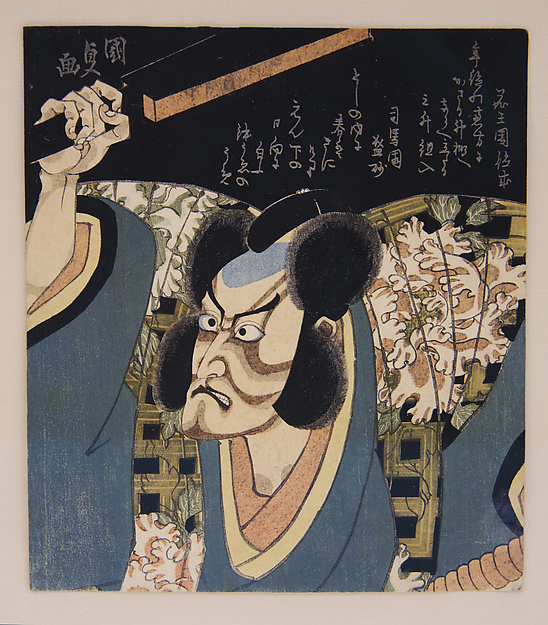
Utagawa Kunisada, 1829. Woodblock print (surimono); ink and color on paper; shikishiban. The Metropolitan Museum of Art, accession 2013.1126.1.
Look closer: Follow the red-brown lines from the brows across the cheeks: this is painted symmetry, a mask made of line.
Utagawa Kunisada, Ichikawa Danjūrō VII as Arajishi Otokonosuke, 1829. The Metropolitan Museum of Art, Gift of Dorothy Tapper Goldman, 2013, accession 2013.1126.1. Public domain (Met Open Access, CC0). Museum record
| Pattern | Japanese | Colour | Meaning |
|---|---|---|---|
| Nihon-guma | 二本隈 two lines | Red | Two lines rising to the hairline; quiet strength in a hero |
| Suji-guma | 筋隈 | Red | The best-known pattern: power and righteous anger, as in Shibaraku |
| Mukimi-guma | むきみ隈 | Red | A stylish pattern for young, handsome, virtuous heroes, such as Sukeroku |
| Zare-guma | ざれ隈 playful | Red | Comic villains, drawn to look like an animal such as a monkey or a crab |
| Kuge-guma | 公家 | Blue | A villainous court aristocrat plotting against those in power |
Though only four colours are used, there are over fifty patterns, worn symmetrically. Some have come to represent a type of character whatever the play. The patterns below are the ones most often named.
The man who plays the woman
The deep endOnnagata, literally female role, or oyama, are male actors who play female roles in kabuki. The practice began in 1629 after women were banned from the stage, and its history is tangled with the early reforms. In the early seventeenth century many theatres had all-female casts. Wakashu kabuki, adolescent-boy kabuki, came about 1612. After 1629 all-male casts became the norm; in 1642 female roles were themselves forbidden, a ban lifted in 1644, and the ban on adolescent roles in 1652, on condition that every actor adopt the adult male hairstyle with a shaved crown. Onnagata and wakashu soon began wearing a small purple headscarf, the murasaki boshi, to cover the shaved portion, which became an emblem of their roles.
The role was shaped as an expression of femininity that was meant to align with the femininity of real women in Edo society. The techniques are demanding and take years of training: graceful movement while wearing geta, a distinctive posture with slightly slouched shoulders and bent knees, a high falsetto voice throughout, and make-up quite different from that of male roles. Every kabuki actor is expected to have facility with these techniques.

Tōshūsai Sharaku, 1794–95. Woodblock print; ink and color on paper. The Metropolitan Museum of Art, accession JP3121.
Look closer: Look at the crests on the sleeves and the long row of hairpins: a courtesan's full dress, worn by a man.
Tōshūsai Sharaku, Actor Segawa Tomisaburo II as the Courtesan Toyama and Actor Ichikawa Kurizo as Higashiyama Yoshiwakamaru, 1794–95. The Metropolitan Museum of Art, Harris Brisbane Dick Fund and Rogers Fund, 1949, accession JP3121. Public domain (Met Open Access, CC0). Museum record
The ban on women lapsed in the Meiji era, but the onnagata remained a separate art with its own training, distinct from actual women in society. When film arrived, onnagata, called oyama, continued to play women until the early 1920s; in 1922 they protested at Nikkatsu against being replaced by actresses in realist films. Among the best-known onnagata of recent times are Bando Tamasaburo V, Nakamura Jakuemon IV and Kataoka Nizaemon XII.
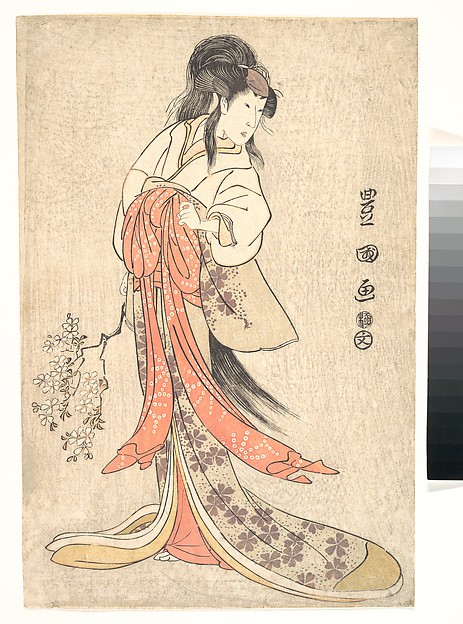
Utagawa Toyokuni I, 1798 (Kansei 9). Woodblock print; ink and color on paper. The Metropolitan Museum of Art, accession JP1529.
Look closer: Loosened hair streams down the back and a cloth is tied at the head; the print's title tells us this is a mad role, played by a man.
Utagawa Toyokuni I, Kabuki Actor Segawa Kikunojō III in a Mad Female Role, 1798 (Kansei 9). The Metropolitan Museum of Art, Fletcher Fund, 1929, accession JP1529. Public domain (Met Open Access, CC0). Museum record
Seeing both in woodblock
The theatre's printmakers were its first critics and its best publicists. Look at how they draw the two. A face with lines across the brows and cheeks is a kumadori role; an actor in a woman's kimono with a headscarf is an onnagata. Prints of the great stars were collected the way posters of musicians are now, and the tradition of the actor print is set out in Ukiyo-e and in the chapter on printing technique.

Katsushika Hokusai, 1796 (Kansei, 6th year). Woodblock print; ink and color on paper. The Metropolitan Museum of Art, accession JP2904.
Look closer: An early actor print by Katsushika Hokusai, dated 1796: the future master of landscape began by drawing the stage.
Katsushika Hokusai, The Actor Nakamura Noshio II, in Female Role, Holding a Shakuhachi (Bamboo Flute), 1796 (Kansei, 6th year). The Metropolitan Museum of Art, Henry L. Phillips Collection, Bequest of Henry L. Phillips, 1939, accession JP2904. Public domain (Met Open Access, CC0). Museum record
For the history of the theatre itself, with its great houses, its stage machinery and the Ichikawa line, see Kabuki: the Theatre of the Unusual. The dance which is the other great art of the onnagata is discussed in Nihon buyo.
Answered plainly
What do the colours of kumadori mean?
Red indicates a powerful hero of virtue and courage, blue a villain or a ghost, and brown a monster or non-human spirit. Black only sharpens features.
Is kumadori worn in every kabuki play?
No. It is worn mostly in plays in the aragoto style, and not by every performer in them.
Why do men play women in kabuki?
Women were banned from the stage in 1629. The male tradition of onnagata developed afterwards into a distinct art with its own training.
Do women perform kabuki today?
A few local troupes use women, and the all-female Ichikawa Shojo Kabuki Gekidan debuted in 1953, but the majority of troupes remain all-male.
What is an oshiguma?
An impression of an actor's face paint, taken on a piece of cloth.
Where next
Sources and image credits
- Kumadori, Wikipedia
- Onnagata, Wikipedia
- Kabuki, Wikipedia
- Ichikawa Danjuro, Wikipedia
- Metropolitan Museum of Art Open Access (images)
Image credits, in order of appearance:
- Utagawa Kunisada, Ichikawa Danjūrō VII as Arajishi Otokonosuke, 1829. The Metropolitan Museum of Art, Gift of Dorothy Tapper Goldman, 2013, accession 2013.1126.1. Public domain (Met Open Access, CC0). Museum record
- Tōshūsai Sharaku, Actor Segawa Tomisaburo II as the Courtesan Toyama and Actor Ichikawa Kurizo as Higashiyama Yoshiwakamaru, 1794–95. The Metropolitan Museum of Art, Harris Brisbane Dick Fund and Rogers Fund, 1949, accession JP3121. Public domain (Met Open Access, CC0). Museum record
- Utagawa Toyokuni I, Kabuki Actor Segawa Kikunojō III in a Mad Female Role, 1798 (Kansei 9). The Metropolitan Museum of Art, Fletcher Fund, 1929, accession JP1529. Public domain (Met Open Access, CC0). Museum record
- Katsushika Hokusai, The Actor Nakamura Noshio II, in Female Role, Holding a Shakuhachi (Bamboo Flute), 1796 (Kansei, 6th year). The Metropolitan Museum of Art, Henry L. Phillips Collection, Bequest of Henry L. Phillips, 1939, accession JP2904. Public domain (Met Open Access, CC0). Museum record
Last reviewed 28 October 2026. Pictures are public-domain or openly licensed and credited beneath each one; diagrams are drawn by Japonista.
Actor prints and stage objects with a kabuki subject are scarce, and we are glad to search for a particular actor or role.
Private concierge
Looking for something in particular?
Describe the piece or the project you have in mind. A senior advisor in Tokyo reads every case file personally and replies within two business days, with fees set out in writing before any work begins.