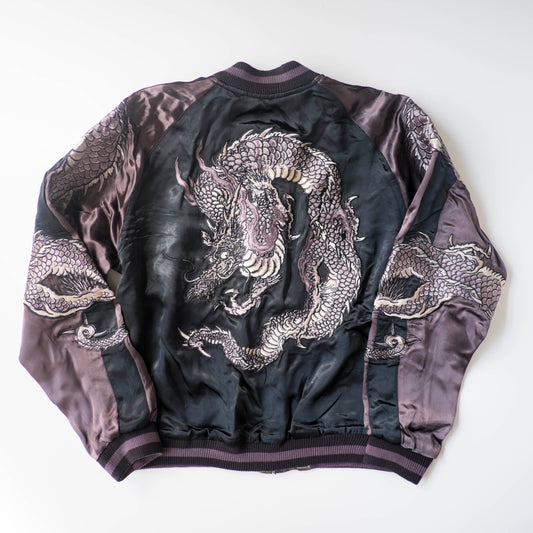
RITUAL & REBELLION — EMBROIDERED AUTHORITY, TATTOO ICONOGRAPHY, AND POSTWAR YOUTH THEATER
A curatorial dossier on Japan’s outlaw aesthetics as textile history: from Edo-era shadow economies to postwar youth refusal, and from manifesto coats to modern Amekaji refinement.
There are garments that clothe the body, and there are garments that declare allegiance. Yakuza and Bosozoku clothing belongs to the second category: textiles as social signal, ritual object, and moving banner. To reduce these forms to “streetwear” is to miss their deeper function. They are, at their most legible, stitched documents of postwar identity formation in Japan.
The genealogy begins before motorcycles. The Yakuza’s distant ancestors are found in Edo-period shadow economies: tekiya (itinerant merchants) and bakuto (gambling networks) operating at the margins of formal authority. These groups developed parallel systems of hierarchy, oath, and ritual. Power needed to be recognized quickly, and recognition often relied on codes of appearance. Even when exterior dress remained conservative, the body itself became archive.
Irezumi, the full-body tattoo tradition, is central to this archive. In premodern contexts, tattooing could signify punishment; in Yakuza mythology it becomes inversion: stigma transmuted into dignity. Dragons, peonies, koi, deities and guardians appear not as decoration but as a narrative system of protection, endurance, and fate. The suit, in this schema, is deliberate restraint: a controlled surface concealing mythic density beneath.
Bosozoku arrives later, and loudly. In the 1970s and 1980s, as Japan accelerated toward corporate futurity, youth motorcycle groups emerged as a refusal of the salaryman horizon. Their aesthetics were not random: they were engineered for visibility. At highway speed, the back of a coat becomes a billboard. In this logic, the garment is designed to be read in motion.
Tokkofuku uniforms, borrowing their silhouette and aura from wartime “special attack” references, become the definitive canvas. Elongated coats and jumpsuits carry dense embroidery across the back panel: rising sun energy, dragons, koi ascending against waves, cherry blossoms as mono no aware, lightning and fatalistic slogans. The stitch density is often sculptural. Weight is part of meaning: the physical heaviness of thread mirrors the ideological heaviness of declaration.
Symbols must be read with discipline. Cherry blossoms evoke impermanence rather than mere sweetness; koi signify transformation through adversity; dragons are guardianship and authority; the manji is a historic Buddhist symbol of continuity, often misunderstood when detached from context. Bosozoku typography, layout, and patch placement also operate as hierarchy. Scale can imply rank. Placement can imply territory. These are garments as structured systems.
By the 1990s, visibility contracts. Policing reforms and generational change reduce the public presence of Bosozoku. Yet aesthetics rarely disappear; they migrate. Embroidered back panels, manifesto typography, and mythic iconography enter the retail world, where craft replaces allegiance. The result is a critical shift: subculture intensity reframed as textile virtuosity.
This is where Amekaji becomes a key bridge. Japanese Americana originally centered on workwear, Ivy silhouettes, and reproduction discipline. When Bosozoku embroidery enters this ecosystem, it produces a distinctly Japanese hybrid: American heritage construction fused with Edo myth, postwar souvenir embroidery lineage, and biker-scale iconography. The garment becomes neither “American” nor “gang” but reinterpretation — a nationalized remix of imported forms and indigenous symbol systems.
For collectors, the field stratifies into three tiers. First: culturally sensitive original garments, rare and sociologically significant. Second: 1990s revival-era heavy embroidery pieces, increasingly valued as nostalgia cycles mature. Third: modern Amekaji reinterpretations with superior fabric, disciplined stitchwork, and wearable refinement. Condition is assessed through density, thread integrity, era-consistent formatting, fabric weight, and construction cues. These pieces are not merely bold; they are legible cultural artifacts.
Within the Japonista framework, this collection is curated as textile anthropology: ritual and rebellion, hierarchy and theater, stitched into durable cloth. For adjacent study and deeper scholarship, the wired essays below form the interpretive scaffold of the category.
Internal Linking Architecture
Planned editorial nodes that expand this collection into a full research corridor.
- Irezumi as Cultural Text: Myth, Stigma, and the Sacred Body
- From Tekiya to Syndicate: Early Yakuza Structure and Visible Hierarchy
- Mono no Aware in Textiles: Cherry Blossoms, Mortality, and Style
- Sukajan Lineage: Occupation-Era Souvenir Embroidery to Global Icon
- Japanese Rockabilly & the American Imaginary
- Amekaji as Reinvention: Why Japan Rebuilt American Heritage
- From Highway to Runway: The Statement Back Panel in Modern Luxury
- Heavy Stitch Economics: Labor, Density, and Collectible Value
- Reading Garments as Codes: Typography, Rank, and Territory
- Authentication Notes: Original Bosozoku Garments vs Revival Pieces
- 1990s Embroidery Boom: Switch Planning, Tedman, and the Era of Aggression
- Why Collect Japanese Subculture Garments Now
Collection Wiring
Adjacent collections curated to reinforce this category.
Frequently Asked Questions
Are Bosozoku garments inherently political?
Historically, they functioned more as territorial and hierarchical signaling than partisan messaging. Motifs such as rising sun energy imagery have multiple cultural readings; within Bosozoku formatting, they often served as force, origin, and visibility symbols.
How does Bosozoku clothing differ structurally from sukajan?
Sukajan are typically satin bomber silhouettes balancing motif embroidery with souvenir-jacket tradition. Bosozoku uniform language prioritizes elongated silhouettes and manifesto-scale back panels, where typography is often as important as imagery.
Why is embroidery density so extreme?
Density amplifies presence and durability. Visually it creates sculptural relief; practically it survives abrasion and wear; psychologically it signals permanence and seriousness.
How did Amekaji absorb the aesthetic without inheriting criminal connotation?
Through technical reframing. Craft markers such as selvedge denim, chain-stitch finishing, disciplined motif placement, and reproduction-grade construction shift the narrative from allegiance to artisanship.
Are original garments considered cultural artifacts?
Yes. Early pieces document postwar youth identity and semiotic hierarchy. Many are scarce due to enforcement crackdowns and generational disposal, making surviving examples valuable as sociological textiles.
What should collectors look for when assessing authenticity or period relevance?
Evaluate stitch density and thread integrity, era-consistent layout conventions, fabric composition and aging, construction details, and the coherence of typography placement. Contextual consistency is often as important as material condition.