Rare Vintage, Antiques and Art Collector / Curator / Personal Shopper From Japan
Rare CROWS x WORST Regulus Bōya Harumichi Reversible Sukajan Jacket | Japan Tokyo Dragon Black Satin Manga Bomber
Rare CROWS x WORST Regulus Bōya Harumichi Reversible Sukajan Jacket | Japan Tokyo Dragon Black Satin Manga Bomber
Couldn't load pickup availability
Discontinued Japanese Delinquent Manga Streetwear with Full Dragon Embroidery, JAPAN TOKYO Lettering and Contrasting Ivory Reverse
A formidable piece of Japanese manga fashion, sukajan tradition and full-volume Amekaji streetwear.
This reversible CROWS x WORST × Regulus souvenir jacket recreates the iconic JAPAN TOKYO dragon sukajan associated with Bōya Harumichi, the central protagonist of Hiroshi Takahashi’s landmark delinquent manga CROWS. The principal black satin face is covered with silver, ivory, champagne-gold and midnight-blue dragon embroidery, transforming the entire garment into a moving field of scales, claws, flames and snarling mythological faces.
Across the back, a monumental dragon coils beneath the sweeping word “Japan,” while block-letter “TOKYO” embroidery anchors the lower composition. Matching dragons descend both sleeves, and two confronting dragon heads occupy the chest like heraldic guardians.
Turn the jacket inside out and its character changes dramatically. The reverse presents an ivory satin body with black raglan sleeves, striped athletic ribbing and a large brush-style kanji emblem embroidered across the chest. Where the black face is densely pictorial and theatrical, the ivory face is stripped back, graphic and almost calligraphic.
It is simultaneously manga memorabilia, Japanese street-fashion history, embroidered textile art and an exceptionally commanding black-and-white statement jacket. 🐉🖤
Opening Impression
This jacket does not merely place a dragon on the back.
It surrounds the wearer with dragons.
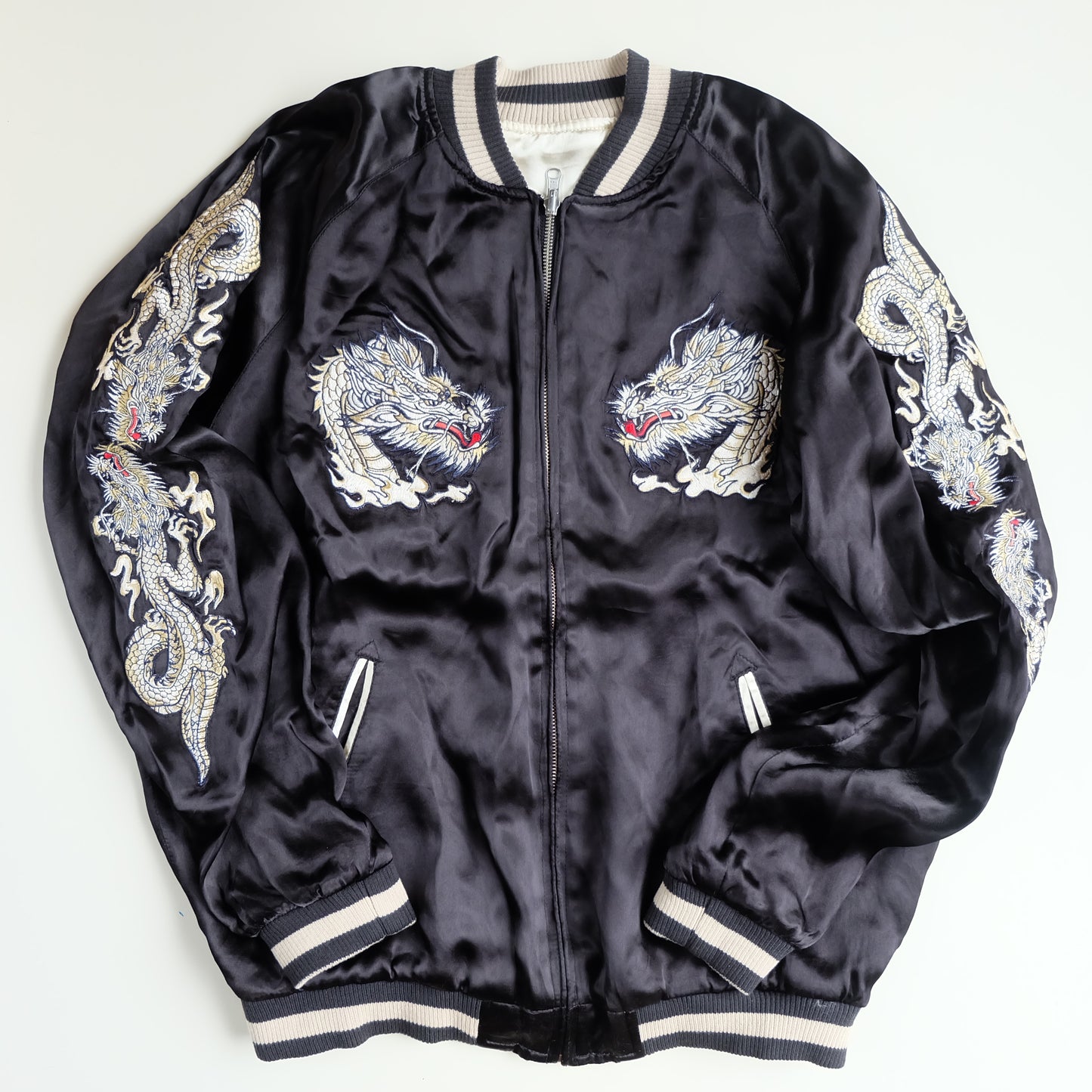
The main black face presents a complete visual system built around repetition, symmetry and motion. A large central dragon dominates the back, smaller dragons coil down each sleeve, and twin dragon heads rise from the chest. The composition creates the sensation that the garment itself is inhabited by a mythological force rather than simply decorated with one.
The restricted palette is particularly effective.
Instead of relying on bright primary colors, the embroidery is executed predominantly in ivory, silver, pale gold, muted champagne, charcoal and dark blue. Small flashes of red appear inside the dragons’ mouths, sharpening their expressions without disturbing the monochrome architecture.
The result is severe, luxurious and immediately recognizable.
This is not a generic souvenir jacket. It belongs to the visual universe of CROWS and WORST, where clothing communicates confidence, independence, defiance and personal mythology before a character speaks a single word.
Identification
Brand / Collaboration: CROWS x WORST × Regulus
Associated Character Model: Bōya Harumichi / 坊屋春道
Garment Type: Reversible sukajan / Japanese souvenir bomber jacket
Design Family: JAPAN TOKYO Dragon
Estimated Wearable Size Range: Approximately L–XL
Primary Face: Black satin-finish body with extensive dragon embroidery
Reverse Face: Ivory body with black sleeves and brush-style kanji embroidery
Primary Motifs: Japanese dragons, flames, clouds, JAPAN and TOKYO lettering
Construction: Fully reversible bomber-style jacket
Sleeves: Raglan construction
Closure: Reversible metal front zipper
Trim: Black-and-ivory striped rib-knit collar, cuffs and waistband
Pockets: Angled welt pockets integrated into both wearable faces
Color Palette: Black, ivory, silver, champagne gold, muted blue and red accents
Style Associations: Sukajan, Amekaji, Japanese streetwear, manga fashion, yankii style, rock fashion and collector outerwear
Gender Presentation: Unisex
Country of Cultural Origin: Japan
Condition: Pre-owned with visible age-related wear and notable discoloration on the ivory face
Regulus officially identifies the JAPAN TOKYO dragon design as a recreation of the sukajan repeatedly worn by Bōya Harumichi in CROWS, noting its appearance throughout the manga, on volume covers and in illustration material.
Visual Presence
The jacket’s visual power comes from the disciplined way its embroidery occupies nearly every major surface.
The back carries the principal narrative.
The chest establishes symmetry.
The sleeves extend the imagery into movement.
The lettering gives the garment an unmistakable geographical and cultural identity.
When worn, the dragons no longer appear as separate decorative patches. The body and sleeves move independently, causing their forms to coil, fold and reappear with every gesture. This makes the jacket particularly effective in motion, whether worn for street photography, live performance, editorial styling, motorcycle culture, music events or Japanese fashion display.
The broad black satin field also gives the embroidery room to breathe. Although the garment is heavily decorated, it does not feel visually chaotic. The limited palette keeps the composition controlled and allows the scale work, facial contours and flame shapes to remain legible.
From a distance, it reads as a powerful black-and-white dragon bomber.
At closer range, it becomes a dense study in Japanese embroidered linework.
The Monumental Back Dragon
The largest dragon coils across the center of the back beneath the embroidered word “Japan.”
Its body is built from individually articulated scales, each outlined in dark thread and filled with pale ivory, silver and muted champagne tones. The dragon curves inward rather than stretching horizontally, creating a compact circular form that concentrates the design’s energy near the center of the jacket.
The face is especially expressive.
Long whiskers extend from the muzzle.
The eyebrows and mane flare backward.
The nostrils and open jaws create an aggressive forward thrust.
Small red details inside the mouth provide the only strong chromatic interruption within the otherwise monochromatic design.
The dragon’s claws reach outward from the body while stylized flames and cloud-like forms gather around its feet and tail. These surrounding shapes prevent the creature from appearing suspended in empty space. Instead, it seems to emerge from a turbulent atmosphere of smoke, fire and supernatural energy.
Above the dragon, the flowing embroidered script “Japan” gives the composition a souvenir-jacket lineage.
Below it, the heavier block lettering “TOKYO” creates visual weight and anchors the image.
The contrast between cursive and block typography mirrors the contrast within the dragon itself: elegant linework paired with physical force.
Twin Dragon Chest Embroidery
The front face is comparatively restrained, but it is far from plain.
Two dragon heads are positioned symmetrically across the chest. Each emerges from pale flame and cloud forms, facing inward toward the zipper.
This symmetrical placement creates an almost heraldic effect.
When the jacket is closed, the dragons appear to confront one another across the center line. When the zipper is open, the composition separates and becomes more dynamic, revealing the contrasting ivory reverse beneath.
The dragon heads repeat the facial vocabulary of the larger back motif:
- layered brows
- extended whiskers
- sharp teeth
- red mouths
- curling horns
- windblown manes
- scale-covered necks
- pale smoke or flame borders
Their placement draws attention upward toward the face of the wearer while preserving a clear, uncluttered area across the lower torso.
This balance makes the jacket easier to wear than many maximalist sukajan. The back and sleeves carry the loudest visual impact, while the front maintains a strong but controlled presence.
Full-Length Sleeve Dragons
The sleeves are among the most distinctive parts of the design.
Multiple dragons coil vertically along both arms, transforming the raglan sleeves into narrow embroidered panels. The serpentine bodies follow the natural length of the arm, while smaller heads, claws and flame forms appear at intervals from shoulder to cuff.
Because the sleeves bend and rotate during wear, the dragons seem to move around the arms.
This is especially effective with the black satin ground. Highlights shift across the fabric while the dense embroidery remains visually stable, creating a contrast between liquid textile movement and sharply defined threadwork.
The repeated sleeve dragons also prevent the jacket from becoming back-heavy.
Many souvenir jackets concentrate nearly all ornament on the rear panel, leaving the arms comparatively empty. Here, the motif continues around the wearer, creating visual impact from the side, front and back.
The sleeve embroidery is also an important collector detail because it requires considerably more production work than a jacket decorated only with chest and back motifs.
Dragon Symbolism
The Japanese dragon, or ryū, occupies a different visual and symbolic territory from the winged fire-breathing dragons commonly found in European imagery.
Japanese dragons are generally serpentine, fluid and closely connected with water, weather, clouds, rainfall and supernatural authority. Their bodies move through the air as though swimming through an invisible current.
This jacket emphasizes that fluid character.
The dragons twist rather than stand.
Their bodies loop inward.
Their whiskers travel through the surrounding space.
Flames and clouds echo the curves of their scales.
The result suggests controlled power rather than brute weight.
Within Japanese decorative culture, the dragon may evoke authority, transformation, protection, resilience, ambition and mastery over unstable forces. In the context of CROWS, the motif also becomes an emblem of individual presence. It communicates that the wearer does not disappear into the crowd.
The large dragon is not merely ornamental.
It functions like an embroidered declaration.
JAPAN and TOKYO Lettering
The lettering is integral to the jacket’s identity.
The script word “Japan” stretches across the upper back in a pale champagne and silver tone, while “TOKYO” appears below the dragon in large capital letters.
This arrangement draws directly from the visual language of souvenir and tour jackets, garments historically designed to carry place names, destinations, military tours, maps and regional symbols.
Here, however, the lettering is filtered through contemporary manga streetwear.
It no longer functions only as a record of travel. It becomes a statement of cultural origin and urban mythology.
“Japan” establishes the national frame.
“Tokyo” supplies the metropolitan edge.
The dragon connects both words to the world of Japanese iconography.
Within the CROWS universe, that combination feels entirely appropriate. It merges traditional imagery with the hard, independent silhouette of delinquent street fashion.
The Ivory and Black Reverse
The reverse face creates a sharp transformation.
Instead of the densely embroidered black field, the jacket turns into an ivory-and-black bomber with a much cleaner visual structure.
The body is rendered in pale ivory satin, while the sleeves and side panels shift into deep black. Dark piping and matching striped ribbing emphasize the athletic construction.
A bold black brush-style kanji emblem appears on the chest.
Its sweeping lines provide the reverse with a calligraphic, almost graffiti-like quality. Rather than competing with another full pictorial scene, this face relies on proportion, contrast and emptiness.
The ivory field acts as negative space.
The black sleeves frame the torso.
The kanji becomes the focal point.
The result is significantly more understated than the dragon face, yet it remains unmistakably Japanese.
This reversal gives the garment two useful styling modes:
Dragon Face
Dramatic, mythological, manga-associated, highly embroidered and immediately recognizable.
Ivory Face
Graphic, monochrome, athletic, minimalist and easier to coordinate with restrained outfits.
The reverse also demonstrates why a genuine reversible sukajan offers more than a decorative lining. Both faces are constructed to be worn outward, with finished surfaces, coordinated trim, pockets and a reversible zipper.
Black, Ivory and Champagne Color Architecture
The jacket’s palette is unusually disciplined.
Black
The black satin body gives the primary face a nocturnal, severe and luxurious character. It absorbs light in flat areas and releases subtle highlights wherever the fabric folds.
Ivory
Ivory thread defines the dragon scales, whiskers, teeth and flames. On the reverse, ivory becomes the primary garment color and creates the strongest possible contrast with the black sleeves.
Champagne Gold
Muted metallic-looking gold softens the monochrome palette and adds depth to the dragon bodies and lettering without becoming overly bright.
Silver
Silver and pale grey threads sharpen the scales and facial contours, giving the embroidery a cool, almost armored quality.
Midnight Blue
Dark blue outlines and shadows provide separation between individual embroidered elements.
Red
Red is used sparingly inside the dragons’ mouths and around selected facial details. Because it appears in small quantities, it has greater impact.
Together, these colors produce a jacket that feels more sophisticated than a conventional multicolored dragon sukajan. Its drama comes from contrast and scale rather than from a rainbow palette.
Embroidery and Surface Work
The primary face is extensively machine embroidered.
Visible embroidery techniques include:
- dense satin stitching
- layered scale construction
- fine contour stitching
- directional facial embroidery
- filled typographic embroidery
- outlined flames and clouds
- contrasting thread borders
- repeated sleeve motifs
- broad, high-density back embroidery
The large dragon is built through multiple thread directions. Scales are stitched in repeating units, while the mane, eyebrows and whiskers use longer lines to produce movement.
The sleeve dragons are smaller but retain considerable anatomical detail. Their bodies, limbs and facial features remain clearly distinguishable despite being adapted to narrower surfaces.
The lettering is also densely filled. The raised thread gives “Japan” and “TOKYO” a tactile presence that differs from flat printing.
Natural gathering, rippling and slight puckering may be visible around heavily embroidered areas. This is characteristic of dense embroidery applied to lightweight satin-finish fabric and contributes to the garment’s dimensional appearance.
Construction
Reversible Format
The jacket is constructed to be worn on either face.
The metal zipper uses a reversible configuration, and the pocket openings are finished for use from both sides.
Raglan Sleeves
Raglan construction creates the rounded shoulder profile associated with traditional souvenir jackets and allows the sleeve dragons to extend smoothly from the upper arm toward the cuffs.
Rib-Knit Trim
The collar, cuffs and waistband use black-and-ivory striped ribbing.
This athletic trim connects the garment to bomber, stadium and varsity-jacket design while visually coordinating both reversible faces.
Welt Pockets
Angled pockets are integrated into the lower front panels.
Their openings are edged with contrasting fabric, allowing them to remain visible without interrupting the larger embroidered composition.
Satin-Finish Textile
The fabric has a smooth, lustrous surface that shifts between matte black and reflective charcoal depending on the direction of light.
The exact fiber composition is not confirmed from the available photographs. Comparable official Regulus JAPAN TOKYO revival jackets are produced in rayon satin, but this particular earlier or alternate version is described according to its visible satin-finish character rather than assigning an unverified fiber content. The documented revival uses 100% rayon satin.
CROWS, WORST and the Bōya Harumichi Connection
CROWS and its successor WORST occupy a distinctive place within Japanese delinquent manga culture.
Their visual world is populated by rival schools, fiercely independent fighters, motorcycle crews, personal codes of loyalty and characters whose clothing becomes an extension of their identity.
Bōya Harumichi is particularly associated with sukajan.
Unlike a uniform that erases individuality, his embroidered jackets amplify it. They combine traditional Japanese imagery with the swagger of streetwear, rock culture and postwar youth fashion.
The JAPAN TOKYO dragon composition became one of the most recognizable jacket designs connected with the character. Regulus describes the model as a reproduction of the dragon jacket Harumichi repeatedly wears in the original manga, including appearances in the story, illustration books and cover artwork.
This gives the garment a dual collector identity.
It appeals to sukajan enthusiasts as embroidered Japanese outerwear.
It also appeals to CROWS and WORST collectors as wearable character-associated memorabilia.
Japanese Delinquent and Yankii Fashion Context
The sukajan has long carried associations with rebellious Japanese youth style.
Its shiny textile, rounded bomber silhouette and oversized embroidery make it inherently conspicuous. It was never designed to disappear quietly into conservative clothing.
In postwar Japan, the souvenir jacket moved from a garment created for visiting servicemen into local youth culture. It became associated with working-class street style, rockabilly, motorcycle culture and forms of delinquent fashion that rejected restrained middle-class dressing.
The CROWS universe draws naturally from that history.
Its characters wear clothing that expresses pride, rivalry, independence and refusal to conform. The sukajan’s mixture of beauty and confrontation makes it an ideal garment for that world.
This Regulus piece carries that energy without becoming costume-like.
It remains a functional jacket, but its scale of embroidery ensures that it always reads as a statement.
Amekaji and East-West Design Fusion
Amekaji, derived from “American casual,” describes Japan’s distinctive reinterpretation of American workwear, military clothing, collegiate style, denim, motorcycle apparel and postwar casual fashion.
The sukajan stands near the center of that cultural exchange.
Its silhouette recalls American bomber and varsity jackets.
Its embroidery draws from Japanese dragons, tigers, eagles, Mount Fuji, cherry blossoms and calligraphy.
Its history reflects contact between Japanese textile craft and Western military souvenir culture.
Its later adoption by Japanese youth transformed it again.
This jacket continues that cycle.
The bomber construction comes from Western athletic and military clothing.
The dragon imagery is unmistakably Japanese.
The words JAPAN and TOKYO frame the garment as an export of place and identity.
The CROWS connection adds manga and modern street culture.
The result is not purely traditional and not purely Western. It belongs to the productive collision where Japanese designers repeatedly turn imported forms into something more theatrical, precise and culturally specific.
Design Character
This jacket stands apart through the completeness of its dragon program.
It offers:
- one monumental embroidered back dragon
- two confronting chest dragons
- multiple full-length sleeve dragons
- JAPAN script embroidery
- TOKYO block lettering
- a reversible ivory-and-black face
- bold kanji calligraphy
- coordinated striped ribbing
- a black, ivory, silver and champagne palette
- direct association with Bōya Harumichi
- official CROWS x WORST × Regulus identity
- a larger L–XL wearable range
Many dragon sukajan rely on a single back motif.
This piece creates a complete environment.
The motif surrounds the torso, travels down both arms and returns across the chest. The wearer is framed by dragons from every viewing angle.
Period Assessment
The exact production year is not visible in the supplied photographs.
The garment appears consistent with an earlier or discontinued Regulus production of the Bōya Harumichi JAPAN TOKYO dragon design, rather than the later documented revival whose opposite face features a large Suzuran crow composition.
The current Regulus archive identifies its revival version under model RGJ-2101 and documents a different reversible pairing. The alternate ivory-and-black reverse seen here suggests an earlier, separate or less commonly encountered production configuration. This is an evidence-based attribution rather than a claim of a specific release year.
It should therefore be described as an older collectible Japanese manga streetwear jacket whose exact year remains unconfirmed.
No claim is made that it is an original postwar souvenir jacket.
Its value lies in its Regulus collaboration, discontinued configuration, recognizable manga-associated design, extensive embroidery and wearable larger size.
Condition
This is a pre-owned older garment offered in its present condition.
The black dragon face retains strong visual impact. The embroidery remains highly legible, with the principal back dragon, sleeve dragons, chest motifs and JAPAN TOKYO lettering clearly defined.
Visible condition characteristics include:
- general creasing and folding throughout the satin-finish textile
- natural puckering around densely embroidered areas
- minor thread irregularities and signs of previous wear
- light surface variation across the black satin
- wear and slight distortion to the rib-knit trim
- visible age-related tonal variation
- discoloration and staining on the ivory reverse
- grey, beige and brown-toned marks across portions of the ivory body and sleeves
- localized darkening around selected seams and high-contact areas
- possible storage-related marks and textile oxidation
The ivory face displays considerably more visible wear than the black face. This should be considered part of the garment’s condition and character rather than overlooked.
The black embroidered side remains the strongest presentation face and is likely to be the preferred outward configuration for display or regular wear.
The reverse may still be worn for a distressed, aged or deliberately weathered look, but buyers seeking a pristine ivory face should carefully review all photographs before purchasing.
The zipper, pockets, embroidery panels and rib-knit components appear present in the supplied images.
No claim of mint, unworn or factory-perfect condition is made.
Older satin garments may reveal marks differently under natural light, indoor lighting and photography. Slight pulls, loose fibers, embroidery irregularities or additional small signs of use may be present.
Approximate Size and Fit
Estimated wearable size range: L–XL
The jacket presents a roomy Japanese bomber silhouette with raglan sleeves and a relatively broad body.
Because Japanese sizing may fit differently from contemporary Western sizing, the estimated L–XL range should be treated as a general guide rather than a guaranteed equivalent.
Detailed flat garment measurements will be added when available.
Recommended measurements include:
- overall back length
- flat chest width
- sleeve length from collar
- sleeve length from underarm
- hem width
- cuff opening
For the most reliable fit assessment, compare the forthcoming flat measurements with a bomber or jacket that already fits comfortably.
The raglan shoulder construction gives the upper body some flexibility, but chest width, arm length and preferred layering will determine the final fit.
For a slimmer wearer, the jacket may create an intentionally oversized Japanese streetwear silhouette.
For a broader wearer, it may sit closer to the body while retaining the traditional rounded sukajan profile.
Styling
Monochrome Streetwear
Wear the dragon face over a plain black T-shirt with black denim, wide trousers or military cargos.
The ivory embroidery supplies enough contrast without requiring additional color.
Japanese Amekaji
Combine it with raw denim, cuffed jeans, engineer boots, vintage sneakers or a loopwheel sweatshirt.
Manga and Anime Streetwear
Allow the jacket to function as the central statement over minimal layers.
The Bōya Harumichi association is strong enough that additional character graphics are unnecessary.
Rock and Punk Styling
Pair it with distressed denim, leather trousers, silver jewelry, boots and a narrow monochrome base.
Ivory Reverse
The reverse face works with black trousers, cream denim, minimal sneakers and restrained knitwear.
Its black-and-ivory palette creates a cleaner and more graphic alternative to the elaborate dragon face.
Editorial Display
The jacket photographs especially well from the rear, where the complete dragon and JAPAN TOKYO lettering can be seen together.
Display Potential
When not being worn, this jacket deserves to be displayed with the black face outward.
The back functions almost like an embroidered manga cover.
The dragon creates the central illustration.
“Japan” forms the title line.
“TOKYO” acts as a visual footer.
The sleeve dragons frame the body when the arms are arranged beside it.
It would make an excellent display piece for:
- CROWS and WORST collections
- Hiroshi Takahashi manga memorabilia
- Japanese delinquent fashion archives
- sukajan collections
- Amekaji wardrobes
- Japanese streetwear interiors
- tattoo studios
- music rooms
- motorcycle garages
- alternative fashion boutiques
- manga-themed spaces
- editorial wardrobe departments
- Japanese textile-art displays
Unlike a paper collectible, the jacket preserves the ability to be worn, photographed and styled.
Collecting Significance
The strongest reason to acquire this piece is the convergence of several collecting categories.
It is simultaneously:
- an embroidered sukajan
- a Regulus collaboration
- a CROWS x WORST garment
- a Bōya Harumichi-associated design
- a discontinued or alternate reversible configuration
- a Japanese dragon jacket
- manga-linked wearable art
- large-size Japanese streetwear
- a black-and-white statement bomber
- a piece of Amekaji and yankii fashion culture
Official Regulus revival examples remain available in Japan at approximately ¥35,200 when stocked, but the presently offered garment differs in its ivory-and-black reverse and appears to represent an earlier or alternate version.
That distinction matters.
Collectors are not merely purchasing the currently reproduced design. They are acquiring a less commonly encountered configuration with its own age, wear pattern and material history.
Why This Piece Stands Apart
The jacket succeeds because it is uncompromising without becoming visually careless.
Its embroidery is dense, but its palette is controlled.
Its dragons are aggressive, but the ivory and champagne thread gives them elegance.
Its manga connection is unmistakable, but the jacket remains wearable beyond fandom.
Its reverse is minimal, allowing a complete change of mood.
Its visible wear gives it credibility as an older streetwear piece rather than a newly manufactured costume.
The black face has the atmosphere of a nocturnal Tokyo emblem.
The ivory face feels like a brushstroke across a vintage athletic jacket.
One side announces itself.
The other leaves space.
Together, they create an unusually versatile piece of Japanese collector fashion.
Purchase, Shipping and Vintage Garment Policy
This is an older pre-owned garment offered in its present condition.
Please review all photographs and written condition details carefully before purchasing. The ivory reverse displays visible staining, discoloration and signs of age, while the black embroidered face presents more strongly.
Older garments may show creasing, storage marks, fading, surface variation, loose fibers, embroidery irregularity, ribbing wear, small pulls, stitching variation or other evidence of previous ownership.
The item will be packed carefully and shipped worldwide from Japan by tracked EMS or another suitable tracked international service.
Preparation, shipping and handling normally takes 5–10 business days or earlier.
Delivery time begins after dispatch and may vary according to destination, customs procedures, postal conditions and seasonal volume.
All sales are considered final. Returns, exchanges and claims based on expected age-related wear, fit preference, visible condition, minor textile irregularity or differences in color perception cannot be accepted.
Please ask any important questions before purchasing.
Respectful offers from serious collectors may be considered.
Searching for This Design in Another Size?
Should this CROWS x WORST × Regulus JAPAN TOKYO dragon design appeal to you but the available fit is not ideal, please feel welcome to contact us with your preferred tagged size and approximate flat garment measurements.
Availability cannot be guaranteed, particularly for discontinued and collectible Japanese sukajan. However, through our sourcing network in Japan, we may be able to locate the same model in another size, an alternate colorway, a later revival edition or a closely related Bōya Harumichi jacket with comparable dragon embroidery.
We are always pleased to investigate suitable alternatives and assist collectors in finding a version that more closely matches their preferred fit and design.
#CrowsWorst #CrowsXWorst #RegulusJapan #BoyaHarumichi #HarumichiBouya #JapanTokyo #DragonSukajan #ReversibleSukajan #JapaneseSukajan #JapaneseStreetwear #MangaFashion #AnimeStreetwear #YankiiFashion #Amekaji #SouvenirJacket #EmbroideredBomber #JapaneseDragon #BlackSukajan #TokyoStreetwear #CollectorJacket #WearableArt #JapaneseFashion #DelinquentManga #HiroshiTakahashi #RareSukajan #DragonJacket #SatinBomber #JapaneseBomber #RockFashion #JapanVintage
crows worst jacket, regulus sukajan, harumichi jacket, dragon sukajan, reversible jacket, japanese bomber, anime streetwear, manga jacket, yankii fashion, black satin jacket, embroidered dragon, japan tokyo jacket, rare sukajan
Material Tags
satin-finish textile, multicolor embroidery thread, rib-knit trim, reversible metal zipper, woven pocketing, embroidered lettering, reversible construction