Rare Vintage, Antiques and Art Collector / Curator / Personal Shopper From Japan
Rare Vintage Tedman Ted Company BRM Bakuretsu Ranman Musume Reversible Sukajan M-L Mikoshi Festival Vehicle of God Japanese Satin Bomber Jacket
Rare Vintage Tedman Ted Company BRM Bakuretsu Ranman Musume Reversible Sukajan M-L Mikoshi Festival Vehicle of God Japanese Satin Bomber Jacket
Couldn't load pickup availability
Have a reasonable price in mind? Submit your best offer and our concierge will review it personally.
Efu Shokai “Matsuri / Mikoshi” Souvenir Jacket with Shrine Procession Embroidery, Japanese Tradition Graphics and Two Complete Wearable Faces
A spectacular reversible sukajan by Bakuretsu Ranman Musume, also known as B-R-M or BRM, transforming one jacket into two dramatically different expressions of Japanese festival culture.
The first face is rendered in sleek black satin with sweeping white embroidered currents, a monumental orange-and-silver 祭, matsuri or festival, emblem, and the words “JAPANESE TRADITION.” The design carries the Bakuretsu Ranman Musume identity, B-R-M lettering, Efu Shokai corporate embroidery and the brand’s “Works from 1997” statement.
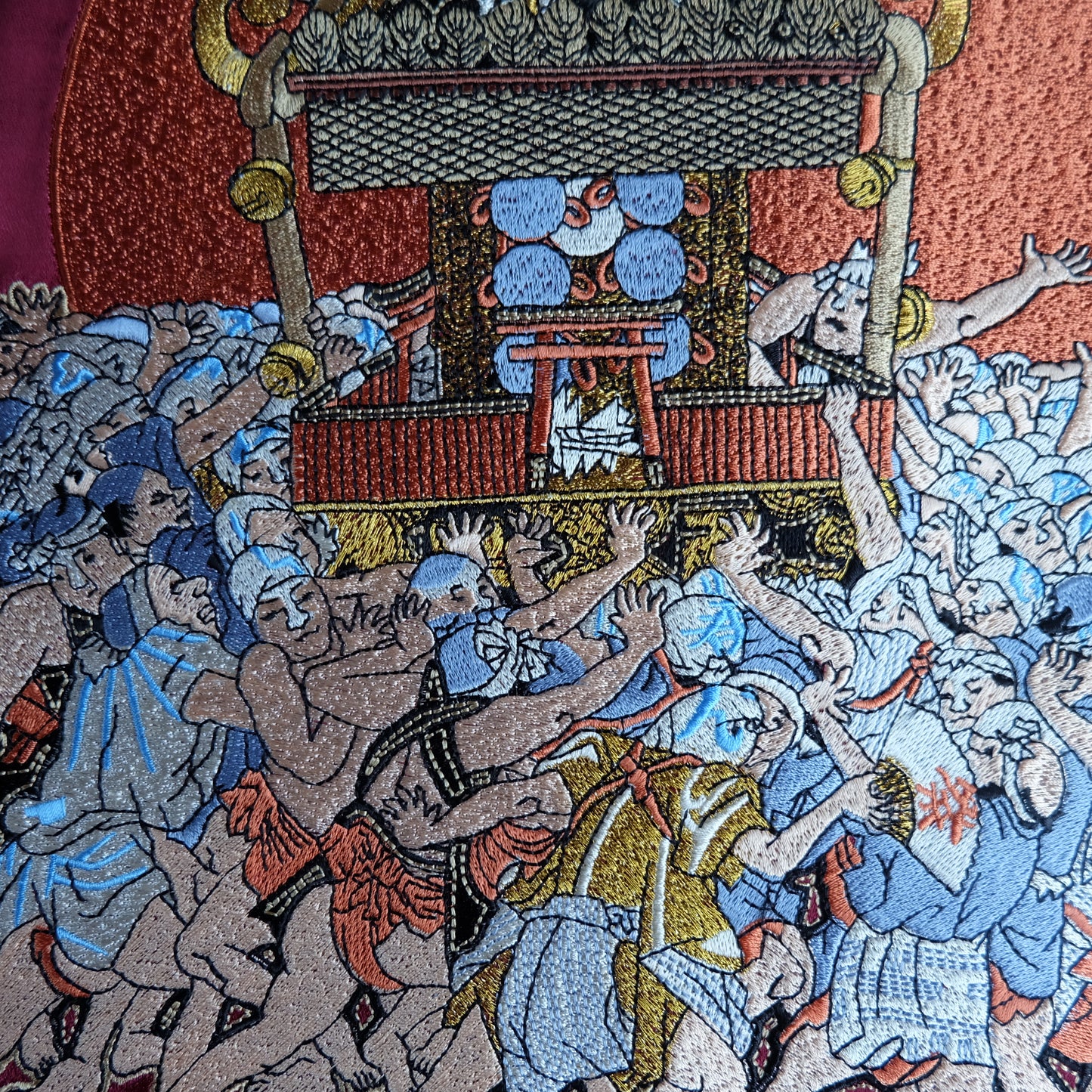
Turn the jacket inside out and the restrained monochrome face gives way to an extraordinary burgundy-and-ivory festival mural. The reverse depicts a densely packed crowd carrying an ornate mikoshi, or portable Shinto shrine, beneath the embroidered declaration “Vehicle of God.”
Every surface participates in the story. The sleeves, chest, back, ribbing and color blocking work together to create a garment that feels less like ordinary outerwear and more like a moving festival procession preserved in thread.
This exact design is identifiable through Japanese resale records as a Bakuretsu Ranman Musume Matsuri / Mikoshi reversible sukajan, combining the black Japanese Tradition face with the burgundy Vehicle of God festival scene.
Two Jackets, Two Visual Languages
Black Japanese Tradition Face
The black side offers the more restrained of the two presentations, although it remains unmistakably graphic.
Across the back, large ivory embroidery spells:
JAPANESE TRADITION
At the center sits a large circular orange field embroidered with a stylized white 祭 character, meaning festival or matsuri. The emblem is surrounded by pale silver and ivory detailing, decorative currents and smaller English inscriptions concerning quality, clothing design and the Efu Shokai company.
The lower back is embroidered with:
efu shokai corporation
along with the company’s Tokyo address and a small square Bakuretsu Ranman Musume seal.
This combination of English typography, Japanese calligraphy, Tokyo corporate identity and sweeping traditional pattern work is pure Japanese Amekaji: Western bomber-jacket structure recast through Japanese cultural graphics and highly decorative embroidery.
Black-Side Sleeve Work
One sleeve is covered in a continuous stream of ivory embroidery resembling stylized currents, droplets, waves and abstract festival ornament.
The design travels almost the full length of the arm rather than remaining confined to a small shoulder emblem. This gives the jacket a sense of motion even when laid flat.
The opposite sleeve carries a large orange festival roundel embroidered with the 祭 character, accompanied by:
Bakuretsu-Ranman-Musume
Works from 1997
The chest continues the graphic balance with:
- B-R-M lettering
- A smaller festival emblem
- Fine Quality wording
- Japanese Tradition text
- Additional current and wave motifs
- Welt-style hand pockets
- Black rib-knit collar, cuffs and waistband
The black face is visually strong without being excessively colorful, making it easier to coordinate with denim, military trousers, black jeans or contemporary streetwear.
Burgundy “Vehicle of God” Face
The reverse is the jacket’s great theatrical reveal.
A deep wine-red or burgundy satin body is framed by ivory sleeves, matching burgundy shoulder panels, gold piping and striped cream, brown and black rib-knit trim.
Across the upper back, large ivory embroidery reads:
Vehicle of God
Below it, an ornate mikoshi rises above a tightly packed crowd of festival participants.
The embroidery depicts dozens of moving bodies compressed into a single energetic procession. Arms rise into the air, feet overlap, garments twist and carriers appear to push collectively beneath the weight of the shrine.
The red-orange circular field behind the mikoshi functions like a rising sun, festival lantern or sacred halo, visually separating the shrine from the moving crowd.
At the lower edge appears:
BAKURETSU RANMAN MUSUME
The scene has remarkable density. From a distance it reads as a dramatic mass of motion. Seen closely, individual heads, limbs, garments, ropes, shrine fittings and decorative architectural details emerge from the embroidery.
The Mikoshi as “Vehicle of God”
A mikoshi is a sacred portable shrine carried through streets during Japanese festivals. It serves as a temporary vehicle for the local kami or Shinto deity, allowing the divine presence to leave the home shrine and travel through the surrounding community.
Official Japanese cultural and tourism sources describe mikoshi as portable shrines into which deities are symbolically placed before being carried through neighborhoods, often with vigorous movement, chanting and collective participation.
The phrase “Vehicle of God” is therefore not merely decorative English. It is a direct poetic interpretation of the mikoshi’s ritual purpose.
The embroidery captures the communal intensity of matsuri culture:
- Collective physical effort
- Local identity
- Rhythm and chanting
- Sacred procession
- Celebration and devotion
- Neighborhood solidarity
- Movement between shrine and community
- The meeting of ritual and spectacle
Rather than portraying the shrine in isolation, the design emphasizes the crowd carrying it. The people become an essential part of the sacred mechanism.
Matsuri Energy in Wearable Form
Japanese matsuri are not quiet museum traditions. They are filled with drums, shouted calls, lanterns, happi coats, packed streets, food stalls, music, sweat, ritual and controlled chaos.
That energy is the heart of this jacket.
The burgundy side captures the communal force of a shrine procession, while the black side distills the idea into symbols, lettering and the single monumental character 祭.
One face is narrative.
The other is emblematic.
Together they create a garment that can be read as both documentary festival art and graphic Japanese streetwear.
Identification
Brand: Bakuretsu Ranman Musume
Common Brand Abbreviation: B-R-M / BRM
Japanese Brand Name: 爆烈爛漫娘
Company: Efu Shokai Corporation
Garment Type: Reversible sukajan / Japanese souvenir jacket
Design Theme: Matsuri festival and mikoshi procession
Primary Back Text: Vehicle of God
Alternate Back Text: Japanese Tradition
Main Motifs: Mikoshi, festival crowd, 祭 character, rising-sun disc, waves and currents
Primary Colors: Black, burgundy, ivory, orange and silver
Construction: Fully reversible satin-finish bomber jacket
Suggested Fit: Approximately unisex M-L
Origin of Brand: Japan
Condition: Pre-owned collectible condition
Efu Shokai operates the official Bakuretsu Ranman Musume label alongside its other Japanese Amekaji and tattoo-inspired clothing lines.
The Bakuretsu Ranman Musume Identity
Bakuretsu Ranman Musume occupies a distinctive place within Japanese wa-gara and Amekaji fashion.
The label’s jackets frequently combine:
- Japanese legends
- Samurai and warrior imagery
- Folklore
- Festival scenes
- Tattoo aesthetics
- Buddhist or Shinto references
- Dramatic English phrases
- Dense multicolored embroidery
- Reversible souvenir-jacket construction
The garments are designed not simply as replicas of postwar souvenir jackets, but as modern illustrated canvases carrying Japanese cultural subject matter.
This example is particularly representative because it avoids the more familiar tiger, dragon and eagle formula. Instead, it celebrates an actual communal festival ritual.
That makes it visually distinctive even within the broader sukajan category.
Design Character
Monumental Festival Emblem
The enormous 祭 character on the black back is one of the strongest graphic elements.
Its pale embroidery sits against an orange circular ground, creating the visual impact of a crest, festival seal or oversized mon.
The rounded field also echoes the red-orange disc behind the mikoshi on the reverse, creating a hidden visual relationship between both sides.
Dynamic Crowd Embroidery
The procession side succeeds because it does not simplify the crowd into a few figures.
The embroidery intentionally creates density. Bodies overlap, limbs rise and the mikoshi appears to surge forward over the carriers.
The result is almost cinematic, capturing a single frozen moment from a noisy street celebration.
Controlled Color Architecture
The palette is carefully divided between the two faces.
Black side:
- Black satin ground
- Ivory and silver embroidery
- Orange-red festival emblems
- Monochrome graphic styling
Festival side:
- Deep burgundy satin
- Ivory sleeves
- Gold piping
- Pale blue, brown, ochre, white and black figures
- Orange-red celestial disc
- Cream and brown striped ribbing
This contrast allows the wearer to choose between a subdued graphic side and a richly narrative side.
Materials and Construction
The garment appears to feature:
- Smooth satin-finish woven fabric
- Fully reversible construction
- Dense machine embroidery
- Contrasting raglan sleeves
- Embroidered sleeve panels
- Rib-knit collar
- Rib-knit cuffs
- Rib-knit waistband
- Reversible metal zipper
- Hand pockets accessible on both faces
- Decorative piping
- Multi-panel shoulder construction
- Finished interior seams suitable for reversible wear
The exact fiber composition is not visible in the supplied photographs. Comparable Bakuretsu Ranman Musume sukajan are often produced in rayon, acetate or blended satin fabrics, but the material of this individual garment should be confirmed from its care label before stating a precise percentage.
Embroidery Technique and Surface Detail
The jacket combines several embroidery approaches.
Filled Satin Stitch
The large festival characters, lettering and circular emblems use dense filled stitching, giving the motifs a raised, almost appliquéd presence.
Fine Figurative Stitching
The mikoshi procession requires much smaller thread changes to define:
- Faces
- Hands
- Legs
- Festival clothing
- Shrine fittings
- Decorative roof elements
- Ropes and supports
- Layered groups of carriers
Linear Embroidery
The black-side currents use long, sweeping lines rather than fully filled forms. This creates a lighter rhythm and prevents the monochrome side from feeling too visually heavy.
Metallic-Looking Accents
Silver-grey and pale ivory thread catch the light differently from the black satin ground, producing a metallic effect without overwhelming the composition.
Lettering
The jacket includes multiple embroidered lettering styles:
- Large curved capitals
- Brush-style Japanese character
- Script typography
- Corporate identification
- Abbreviated B-R-M branding
- Small descriptive text
This mixture of languages and typefaces is characteristic of Japanese graphic fashion from the peak wa-gara and Amekaji eras.
Reversible Construction
A true reversible sukajan must function convincingly on both sides.
This jacket succeeds because neither face feels like a mere lining.
Both sides include:
- Complete front presentation
- Designed back artwork
- Finished sleeve treatment
- Functional hand pockets
- Coordinated ribbing
- Deliberate color blocking
- Concealed or reversible zipper finishing
The black side has the appearance of a sleek graphic bomber.
The burgundy side has the visual presence of a full ceremonial mural.
This two-jacket construction greatly expands its styling range and collector appeal.
Period Assessment
The jacket appears consistent with an archival Bakuretsu Ranman Musume production from the broader 2000s to early-2010s Japanese wa-gara streetwear period.
The embroidered phrase “Works from 1997” refers to the brand’s history and should not automatically be interpreted as the exact manufacturing year of this individual garment.
Period characteristics include:
- Heavy all-over embroidery
- Highly polished reversible satin
- Oversized English wording
- Japanese cultural narrative imagery
- Numbered Japanese sizing traditions
- Dense sleeve decoration
- Contrasting retro rib-knit trim
- Strong Y2K and post-Y2K Amekaji styling
An exact production date is not visible in the photographs and should therefore be described as attributed to the brand’s archival era rather than assigned a specific year.
Condition
The jacket presents in very good pre-owned collectible condition overall.
Visible characteristics include:
- Strong remaining satin sheen
- Bright burgundy and black color
- Clearly defined embroidery
- Strong orange, ivory and silver thread color
- Well-preserved festival scene
- Complete-looking zipper
- Intact-looking rib-knit collar, cuffs and waistband
- Natural surface creasing from folding and storage
- Light signs of previous handling
- Minor waviness around heavily embroidered areas
- No major tear visible in the supplied photographs
- No obvious large stain visible
- No immediately apparent catastrophic thread loss
The smooth satin surfaces naturally reveal wrinkles, light reflections and subtle tonal changes depending on angle.
Dense embroidery may also create gentle puckering or tension around stitched areas. This is typical of elaborately embroidered sukajan and forms part of their construction character.
Please review all photographs carefully, as they form an essential part of the condition description.
Size and Fit
Suggested Fit Range: Approximately unisex M-L
Japanese sukajan sizing can fit shorter and more compactly than modern Western outerwear, especially through the body length and ribbed hem.
The raglan construction may provide flexibility across the shoulders, but the most reliable fit should always be determined from flat garment measurements rather than the M-L estimate alone.
Recommended comparison points include:
- Underarm-to-underarm chest width
- Back length from collar seam to hem
- Raglan sleeve length from collar to cuff
- Hem width
- Upper-arm width
- Cuff opening
The closest documented exact-design resale example was offered with a chest width of approximately 57 cm and a sleeve measurement of approximately 87 cm, but those measurements belong to another individual jacket and should not be applied automatically to this garment.
Styling Possibilities
Classic Amekaji
Wear the black face with:
- Faded selvedge denim
- Plain white or black T-shirt
- Engineer boots
- Service boots
- Canvas sneakers
- Military-inspired trousers
The monochrome embroidery works particularly well with indigo denim and simple heritage basics.
Festival Side as the Main Statement
Allow the burgundy mikoshi face to dominate by pairing it with:
- Black jeans
- Charcoal trousers
- Plain cream knitwear
- Dark boots
- Minimal accessories
The festival mural already contains enough movement and color to function as the centerpiece of an outfit.
Contemporary Streetwear
Combine the jacket with:
- Wide-leg trousers
- Oversized T-shirt
- Cargo pants
- Japanese denim
- Layered hoodie
- Chunky sneakers
The compact bomber silhouette contrasts well with broader modern proportions.
Rock and Tattoo Styling
Although the subject is festival tradition rather than tattoo flash, the dense sleeve work and graphic black side coordinate naturally with:
- Black denim
- Silver jewelry
- Leather boots
- Printed band shirts
- Biker-inspired accessories
Display as Wearable Art
The mikoshi side can be displayed on a broad hanger with the sleeves relaxed outward, allowing the full crowd scene and burgundy color architecture to remain visible.
The black face also works well as wall-mounted textile art because of its centered 祭 emblem and symmetrical back composition.
Cultural and Collector Significance
This jacket brings together several important elements of Japanese fashion history.
Sukajan Heritage
The souvenir jacket began as a postwar meeting point between Japanese embroidery traditions and American military clothing. Later Japanese labels transformed the category into an independent streetwear art form.
Amekaji Interpretation
Amekaji, or Japanese American casual style, did not simply imitate American garments. Japanese designers refined, exaggerated and reinterpreted workwear, military clothing, denim and souvenir jackets through local craftsmanship and cultural imagery.
Wa-Gara Revival
During the late 1990s, 2000s and early 2010s, Japanese brands increasingly placed traditional motifs, legends, festivals, warriors and tattoo imagery onto modern casual garments.
This jacket belongs to that highly expressive tradition.
Uncommon Festival Subject
Tigers, dragons, eagles and koi are widely represented in sukajan.
A mikoshi procession involving dozens of individual participants is considerably less common.
The subject gives this piece a documentary and community-centered quality absent from more conventional animal designs.
Why This Piece Stands Apart
An Identifiable BRM Festival Model
The Matsuri / Mikoshi design is documented in Japanese resale references and international listings, confirming it as a recognizable Bakuretsu Ranman Musume reversible model rather than an anonymous souvenir jacket.
Complete Narrative Embroidery
The burgundy back presents not merely a shrine, but an entire crowd in motion.
Two Distinct Wearable Identities
The contrast between the black Japanese Tradition face and the burgundy Vehicle of God face is unusually dramatic.
Strong Cultural Meaning
The mikoshi is central to community shrine festivals and symbolizes the movement of the kami through the neighborhood.
Archival Japanese Streetwear Appeal
BRM garments are increasingly appreciated by collectors of discontinued Japanese Amekaji, tattoo fashion and embroidered souvenir jackets.
Visually Accessible Fit
The approximate M-L range is useful for a broad segment of international collectors, provided the flat measurements suit the intended wearer.
Suitable For
- Sukajan collectors
- Japanese streetwear enthusiasts
- Amekaji wardrobes
- Matsuri and festival-art collectors
- Wearable-art buyers
- Tattoo-fashion enthusiasts
- Y2K Japanese fashion collections
- Reversible bomber collectors
- Japanese cultural displays
- Photographic styling
- Stage and performance wardrobes
- Heritage streetwear archives
- Efu Shokai and BRM collectors
- Statement outerwear wardrobes
Purchase, Shipping and Pre-Owned Garment Policy
This is a pre-owned collectible garment offered in its present condition. Please review all photographs and written details carefully before purchasing.
Pre-owned garments may display minor wear, storage marks, loose threads, embroidery irregularity, fading, surface variation, creasing, ribbing wear or other evidence of age and previous ownership. These characteristics form part of the garment’s individual history and should be expected when acquiring archival Japanese fashion.
The item will be packed carefully and shipped worldwide from Japan by tracked EMS or another suitable tracked international service.
Shipping and handling period: approximately 5-10 business days or earlier.
Delivery time begins after dispatch and may vary depending on destination, customs processing, postal conditions and seasonal shipping volume.
All sales are considered final. Returns, exchanges and claims based on expected pre-owned wear, personal fit preference or differences in color perception cannot be accepted. Please ask any important questions before purchasing.
Some prices may be flexible. Respectful offers from serious collectors are always welcome.
Searching for This Design in Another Size?
Should you be searching for this particular Bakuretsu Ranman Musume model, the same Matsuri and Mikoshi embroidery, or a closely related BRM design in another size, please contact us with your preferred tagged size and ideal flat garment measurements.
Discontinued Japanese sukajan were often produced in limited quantities and can become increasingly difficult to locate once the original production has sold through. Although an exact match cannot be guaranteed, we may be able to locate another example, an alternate size or a closely comparable design through our sourcing network in Japan.
We are always pleased to investigate suitable options and help collectors find the version that most closely matches their preferred fit, proportions and design.
#BakuretsuRanmanMusume #BRM #MikoshiJacket #MatsuriJacket #VehicleOfGod #JapaneseSukajan #ReversibleSukajan #JapaneseBomber #SouvenirJacket #JapaneseFestival #Amekaji #JapaneseStreetwear #EfuShokai #EmbroideredJacket #SatinBomber #WearableArt #FestivalArt #MikoshiFestival #WagaraFashion #JapaneseFashion #Y2KJapaneseFashion #ArchivalStreetwear #JapaneseTradition #MatsuriStyle #TokyoStreetwear #EmbroideredBomber #RareSukajan #JapanCollector #ReversibleBomber #JapaneseHeritage
brm sukajan, bakuretsu jacket, mikoshi jacket, festival jacket, vehicle of god, reversible sukajan, japanese bomber, satin bomber, matsuri jacket, amekaji fashion, souvenir jacket, japanese streetwear, embroidered jacket
Material Tags
satin-finish fabric, embroidery thread, rib-knit trim, metal zipper, woven textile, reversible construction, decorative piping, machine embroidery, rayon-style satin, acetate-style satin