Rare Vintage, Antiques and Art Collector / Curator / Personal Shopper From Japan
Vintage Karl Helmut Reversible Sukajan Jacket L Black Velvet Eagle Tiger Japan Map Pink House Amekaji Souvenir Bomber
Vintage Karl Helmut Reversible Sukajan Jacket L Black Velvet Eagle Tiger Japan Map Pink House Amekaji Souvenir Bomber
Couldn't load pickup availability
Have a reasonable price in mind? Submit your best offer and our concierge will review it personally.
Rare Pink House–Era Karl Helmut Embroidered Velvet and Quilted Satin Jacket with Golden Eagles, Falling Feathers, Japan Map and Tiger
A remarkable vintage Karl Helmut sukajan that transforms from nocturnal black velvet embroidered with a flock of golden eagles into a quilted satin souvenir jacket charting Japan through city names, a gold-outlined map and a prowling tiger.
This is not a conventional reversible bomber with one dominant exterior and a plain lining. Both faces are fully composed garments, each with its own textile, embroidery system, color palette and visual identity.
One side is dark, luxurious and airborne: black velvet illuminated by golden birds and drifting feathers.
The reverse is graphic, geographic and unmistakably Japanese: black quilted satin framed by antique-gold sleeves, embroidered with a map of the Japanese archipelago, dozens of destination names, the Karl Helmut signature and a striped tiger standing in grass.
Designed by Karl Helmut, the menswear-oriented label within the official Pink House brand family, this jacket brings together Japanese amekaji, souvenir-jacket tradition, maximalist designer fashion and the playful narrative sensibility for which Karl Helmut pieces are collected. Karl Helmut continues to be presented through the official Pink House store alongside Pink House and Ingeborg.
Visual Presence
This jacket feels like a wearable travel diary written in velvet, satin and embroidery thread.
The black velvet face is nearly monochromatic at first glance, but the closer one looks, the more movement appears. Eagles descend across the sleeves and body, wings spread at different angles, while golden feathers tumble between them like fragments caught in a midnight current.
The quilted reverse changes the entire mood. Antique-gold sleeves frame a black satin field filled with Japanese city names, an embroidered national map, bright red location markers and a traditional tiger.
The contrast creates two distinct styling personalities:
Black velvet side: luxurious, gothic, rock-oriented and quietly dramatic.
Japan-map side: classic amekaji, travel-inspired, graphic and unmistakably rooted in Japanese souvenir fashion.
Identification
Brand: Karl Helmut
Brand Family: Pink House
Garment Type: Reversible sukajan / Japanese souvenir jacket / embroidered bomber
Manufacturer Size: L
Estimated Era: Vintage, likely 1990s
Primary Style: Japanese amekaji / designer souvenir jacket
Construction: Fully reversible
Side A: Black velvet or velveteen-style pile textile
Side B: Black and antique-gold quilted satin-finish textile
Main Motifs: Eagles, falling feathers, tiger, Japan map, Japanese city names
Closure: Reversible front zipper
Sleeves: Raglan-inspired bomber construction
Pockets: Angled welt pockets on both wearable faces
Trim: Rib-knit collar, cuffs and waistband
Color Palette: Black, gold, champagne, yellow, red, green and white
Gender Presentation: Unisex
Size: L, likely closer to a Western medium or trim large depending on build
The jacket’s combination of velvet, quilted satin, geographic embroidery and humorous illustrated animal motifs places it squarely within Karl Helmut’s distinctive interpretation of Japanese Americana.
Side A: Golden Eagles and Falling Feathers
Black Velvet Ground
The velvet face uses a deep black pile fabric that absorbs light rather than reflecting it.
This produces a rich, shadowed surface where the embroidery appears to hover above the garment. Depending on the viewing angle, the velvet may shift between jet black, charcoal and soft graphite.
Natural changes in the direction of the pile create tonal movement across the body and sleeves. This is part of the visual character of velvet and becomes more pronounced as the fabric bends, folds or catches side lighting.
The rib-knit collar, cuffs and waistband remain predominantly black, keeping the focus on the gold embroidery.
Multi-Eagle Back Composition
The back is covered with multiple embroidered birds in flight.
A large central eagle crosses the middle of the jacket with its wings extended, tail feathers spread and talons lowered. Additional birds descend from the shoulders and circle around the lower back.
The arrangement is intentionally asymmetrical. Rather than forming a static heraldic crest, the eagles appear to move through open space.
Their different sizes suggest depth:
- larger birds appear closer to the wearer
- smaller birds appear farther away
- partially visible birds continue onto the sleeves
- scattered feathers create the impression of wind and motion
The result feels almost cinematic, a flock passing across a black night sky.
Golden Thread Architecture
The eagles are constructed in overlapping shades of:
- warm gold
- pale champagne
- cream
- honey yellow
- bronze brown
- muted tan
- small red accents
The embroidery follows the anatomy of each bird.
Long directional stitches define the flight feathers. Shorter dense stitches form the body and neck. Darker outlines separate the wings, claws, tail and head.
The central bird is especially expressive, with individually articulated feathers radiating from the wings and tail.
Falling Feathers
Golden feathers descend across the sleeves and back between the eagles.
Several are tied with small red cords, introducing a curious decorative detail that makes the design feel more imaginative than naturalistic.
The feathers give the composition rhythm. They fill the negative space without overwhelming it and lead the eye from the shoulders toward the hem.
On the sleeves, the birds and feathers continue almost from shoulder to cuff, making the jacket visually active from every angle.
Karl Helmut Signature
The Karl Helmut name is embroidered across the upper back in a loose handwritten script.
White thread creates a sharp contrast against the black velvet while connecting the scattered birds into a recognizable designer composition.
A smaller Karl Helmut signature also appears near one of the chest eagles.
Rather than functioning only as branding, the script becomes part of the illustration, almost like an artist’s signature across a textile painting.
Velvet-Side Front
The front is comparatively restrained.
Two gold eagles descend toward the chest, one on each side of the zipper. Their mirrored positioning creates balance while leaving the center and lower body relatively open.
The sleeves carry the denser narrative, with additional birds, falling feathers and red ties continuing around the arms.
Black welt pockets blend discreetly into the velvet body.
This quieter front allows the jacket to be worn without immediately revealing the full drama of the back.
Side B: Japan Map and Tiger
Quilted Black and Antique-Gold Satin
Reversing the jacket reveals a completely different textile structure.
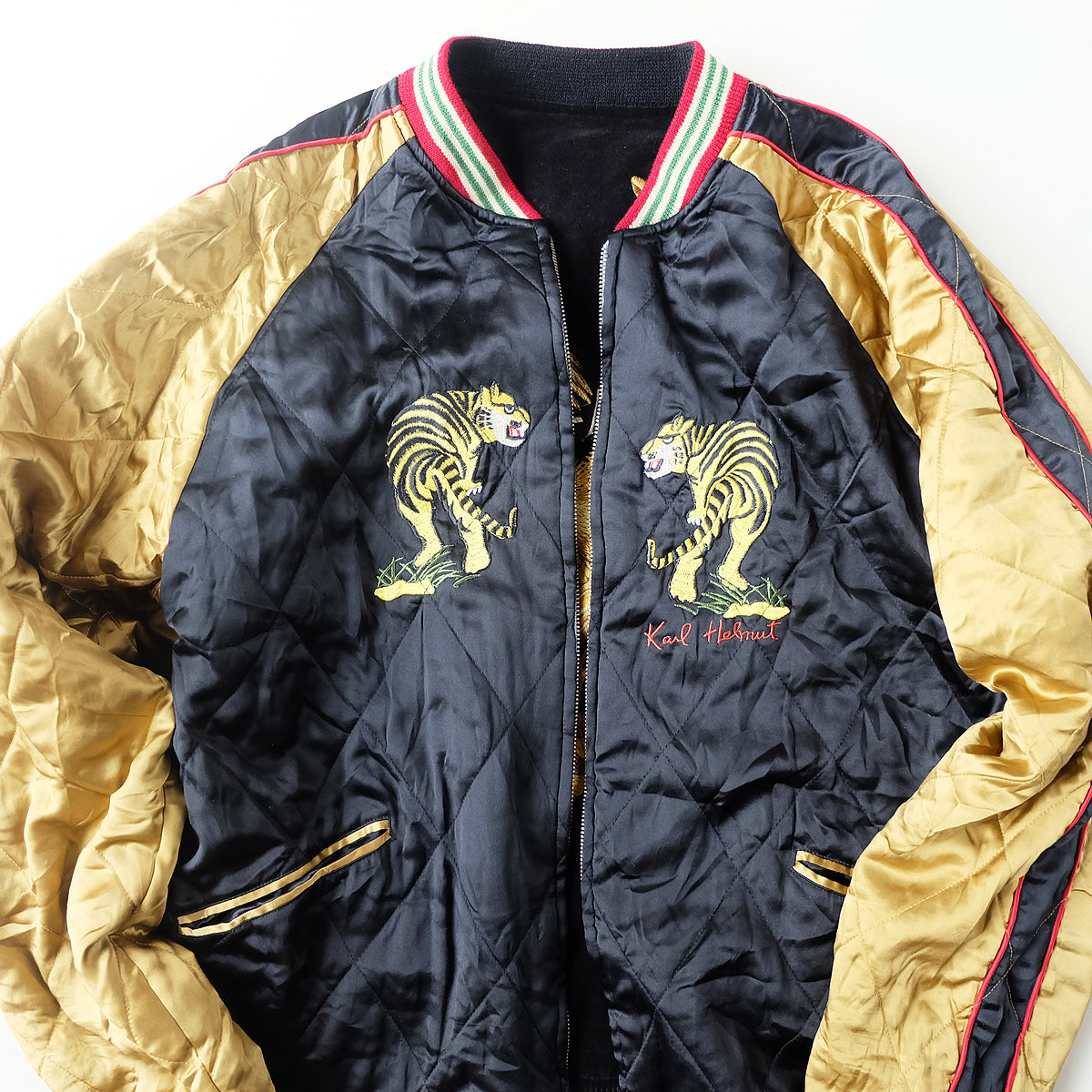
The black body is diamond quilted, giving the satin surface geometric depth and a lightly padded appearance. The sleeves change to antique gold, with black racing stripes edged in narrow red piping.
The contrast between the black center and gold sleeves recalls vintage athletic jackets, racing apparel and postwar souvenir bombers.
The ribbing becomes brighter and more playful on this face, combining red, white and green stripes.
These colors give the jacket a celebratory, travel-souvenir character.
Twin Tiger Chest Embroidery
The front features two yellow-and-black tigers, positioned on either side of the zipper.
Each tiger stands on a patch of embroidered green grass with its body turned slightly inward.
The animals are deliberately stylized rather than anatomically realistic. Their curved backs, exaggerated striping and expressive faces echo the naïve charm found in early souvenir-jacket embroidery.
One chest also carries the red Karl Helmut signature beneath the tiger.
The symmetry of the two animals creates a heraldic effect while retaining the playful personality associated with the brand.
Embroidered Japan Map
The reverse back is organized around an outlined map of Japan.
The archipelago is rendered in gold thread, with numerous red embroidered dots marking locations throughout the country.
Rather than presenting a precise cartographic document, the map operates as a visual symbol of national travel, memory and discovery.
It recalls the map-backed jackets purchased or commissioned as personal records of service, movement and experience in Japan.
Traditional souvenir jackets originated in the early postwar period when American servicemen stationed in the Pacific had jackets embroidered with base names, unit references and Asian motifs as personal mementos. The garments were later commercialized and sold through military retail networks.
Karl Helmut reinterprets that historic language through a designer-fashion lens.
Japanese City and Place Names
The black quilted ground is densely embroidered with place names from across Japan.
Visible names include locations such as:
Asahikawa, Kushiro, Sapporo, Chitose, Hirosaki, Aomori, Obihiro, Hakodate, Morioka, Ishinomaki, Sendai, Iwaki, Utsunomiya, Ashikaga, Takasaki, Maebashi, Mito, Chiba, Tokyo, Yokohama, Ebina, Kofu, Shizuoka, Hamamatsu, Okazaki, Nagoya, Takaoka, Toyama, Kanazawa, Gifu, Yokkaichi, Tsu, Osaka, Kyoto, Kobe, Otsu, Nishinomiya, Hirakata, Wakayama, Matsue, Okayama, Hiroshima, Himeji, Takamatsu, Matsuyama, Kurume, Hakata, Kokura, Oita, Nobeoka, Miyazaki, Nagasaki, Sasebo and Okinawa.
The names form a typographic landscape around the map.
They transform the jacket into something between a vintage travel poster, railway itinerary, tour souvenir and embroidered atlas.
For international collectors, this is one of the jacket’s most distinctive features. It does not simply display “Japan” as an abstract idea. It names the country through dozens of specific destinations.
Tiger and Grass Motif
A large tiger occupies the lower-right portion of the map face.
Its yellow body and black stripes stand out strongly against the quilted black satin. The tiger appears alert and slightly hunched, with one paw raised and its tail curving behind it.
The expression is stern but stylized, balancing danger with the idiosyncratic charm of vintage Japanese embroidery.
Green grass anchors the animal at the bottom of the composition, while a large green handwritten Japan inscription sweeps across the lower center.
Symbolism and Cultural Meaning
The Eagle
The eagle commonly represents freedom, power, height, vigilance and expansive movement.
Within this jacket, the bird also functions as a symbol of travel. The flock circles through open space while feathers descend across the sleeves, suggesting movement between places rather than a single static emblem.
The motif also connects the jacket to American military, collegiate and sportswear imagery, an important part of amekaji’s visual vocabulary.
The Tiger
The tiger is one of the most recognizable motifs in Japanese souvenir-jacket design.
It signifies strength, courage, protection and restless energy.
Vintage sukajan tigers often possess exaggerated eyes, curved backs and highly graphic stripes. Their appeal lies partly in their expressive imperfection. They are not zoological studies. They are icons designed to communicate force instantly through thread.
Karl Helmut preserves that tradition while making the animals feel unmistakably playful and brand-specific.
The Japan Map
Map designs are central to the historical language of souvenir jackets.
They transform a garment into a record of place, travel and personal history. City names, route markers and geographic outlines allowed the wearer to carry a visual memory of Japan.
Here, the map is expanded into a dense national itinerary. The embroidered place names create an almost obsessive catalogue of destinations, perfectly suited to Karl Helmut’s love of decorative storytelling.
Karl Helmut and Japanese Amekaji
Karl Helmut belongs to the broader Pink House fashion universe, but its menswear has developed a distinctive identity of its own.
The label frequently combines traditional menswear references with expressive embroidery, illustrated characters, sportswear construction, logos, maps, animals and nostalgic Americana.
This approach fits naturally within amekaji, the Japanese reinterpretation of American casual clothing.
Amekaji does not merely reproduce American garments. It filters them through Japanese craftsmanship, collecting culture and attention to detail.
A bomber jacket may acquire denser embroidery. A varsity silhouette may become a narrative canvas. A military-derived souvenir jacket may be reimagined through designer graphics, unexpected colors and humor.
This piece embodies that process beautifully.
Its historical vocabulary comes from souvenir jackets and American athletic wear, but its final character is unmistakably Japanese.
Construction and Materials
Fully Reversible Design
Both faces are completed as independent exteriors.
The jacket includes:
- reversible zipper construction
- functional welt pockets on both faces
- completed front and back embroidery on both sides
- coordinated rib-knit finishes
- velvet or velveteen-style pile fabric
- quilted satin-finish reverse
- contrasting raglan-style sleeves
- embroidered branding
- lightly padded structure
The absence of a conventional exposed lining means there is no visually inferior “inside.”
The wearer receives two complete jackets in a single garment.
Textile Contrast
The velvet side is matte, dark and tactile.
The satin side is brighter, smoother and more reflective.
This contrast changes how the embroidery behaves:
On velvet, the gold thread appears luminous and dimensional against the light-absorbing pile.
On satin, the black quilting and metallic sleeves create a sharper, sportier effect.
The embroidery is substantial enough to influence the surrounding drape, producing natural rippling and slight puckering around densely stitched areas.
Fiber composition: Not confirmed from the available photographs. Material descriptions are based on visible textile characteristics.
Period Assessment
The jacket appears consistent with Karl Helmut’s vintage late-20th-century output, most plausibly the 1990s.
Its oversized embroidery, reversible novelty construction, quilted satin, black velvet, colorful striped ribbing and maximalist Japan-themed graphics all align with Japanese designer sportswear from that period.
No exact production year or model number is visible in the supplied photographs, so the date is best expressed as likely 1990s rather than assigned to a specific year.
An exact matching example has circulated in the Japanese vintage market identified as Karl Helmut, size L, reversible velvet and quilted satin, with eagle, feather, tiger and Japan-map embroidery.
Condition
Good vintage condition with visible age-related character.
The jacket shows the natural signs expected from a wearable vintage embroidered garment, including:
- gentle surface wear
- minor fading and tonal variation
- compression and directional changes in the velvet pile
- light lint or fibers visible against the black surface
- creasing and wrinkling to the quilted satin
- slight puckering around dense embroidery
- mild wear to rib-knit areas
- possible small marks, scuffs or isolated thread movement
- age-related variation in the gold and black textiles
The matching Japanese vintage record describes the piece as used, with some wear, fading, minor marks and age-related imperfections.
The main embroideries remain strong and visually complete in the supplied photographs. The central eagle, sleeve birds, scattered feathers, city names, Japan map and tiger retain excellent graphic presence.
No large tear or major section of missing embroidery is apparent in the available images.
Please examine every photograph carefully, as the photographs form an important part of the condition description.
Size and Approximate Measurements
Manufacturer Size: L
Approximate Flat Measurements:
Shoulder width: 40 cm / 15.7 in
Chest width, pit to pit: 56 cm / 22 in
Length, excluding collar: 64 cm / 25.2 in
Sleeve length: 68 cm / 26.8 in
These measurements correspond with the documented matching example of this Karl Helmut design.
Japanese vintage sizing can fit smaller or shorter than modern Western sizing.
This jacket may suit approximately a Western medium or trim large, depending on the wearer’s build, preferred silhouette and layering.
Please compare the measurements with a similar jacket that fits comfortably rather than relying only on the letter size.
Styling
The black velvet face works beautifully with:
black denim, leather boots, dark tailored trousers, monochrome layers, punk-inspired accessories, rockabilly styling and Japanese designer clothing.
The quilted Japan-map face pairs naturally with:
selvedge denim, chinos, engineer boots, vintage sneakers, work shirts, varsity pieces and classic amekaji wardrobes.
Worn open, the two faces become visible simultaneously. The black velvet exterior frames glimpses of the quilted map, while the satin exterior reveals flashes of golden eagle embroidery within.
The reversible construction allows the wearer to shift from quiet luxury to full souvenir-jacket spectacle in a single movement.
Display and Collector Appeal
Displayed from the velvet side, the jacket resembles a nocturnal embroidered tapestry.
Displayed from the map side, it becomes an illustrated travel archive.
It would make a powerful addition to:
a Karl Helmut collection, Pink House archive, Japanese amekaji wardrobe, vintage sukajan collection, embroidered textile display, Japanese streetwear boutique, music room, tattoo studio, travel-themed interior or designer-fashion archive.
Its collector strengths include:
rare Karl Helmut branding, complete reversible construction, black velvet body, quilted satin reverse, extensive sleeve embroidery, multiple golden eagles, falling-feather motif, Japan map, numerous embroidered city names, tiger imagery, size L and strong crossover appeal between sukajan, amekaji and Japanese designer fashion.
Comparable Karl Helmut reversible souvenir jackets are offered internationally around the $200 level even when their embroidery is considerably less extensive, while this exact eagle, map and tiger design has appeared domestically in Japan at a much lower local-market price. The international recommendation below positions the jacket as a curated collector piece rather than a rapid domestic resale item.
Purchase, Shipping and Vintage Garment Policy
This is an authentic pre-owned vintage garment offered in its present condition.
The photographs show the exact jacket that will be received. Please review all images and consider the visible wear, fading, fabric variation, velvet pile movement, satin creasing and embroidery texture before purchasing.
Vintage garments are not factory-new. Minor marks, storage creases, isolated loose threads, rib wear, fabric shading and other age-related characteristics are part of the garment’s history.
Velvet and satin can appear lighter or darker according to photography, lighting, viewing angle and screen settings.
The jacket will be carefully folded, protected and prepared for international transit.
Worldwide shipping is available from Japan through Japan Post EMS or another appropriate tracked international service.
Preparation, shipping and handling normally takes 5–10 business days or earlier.
Tracking information will be supplied after dispatch. Delivery time begins after shipment and may vary because of customs inspection, postal conditions, local carrier operations and seasonal volume.
International buyers are responsible for customs duties, import taxes or handling charges imposed by the destination country.
All sales are considered final, subject to applicable Etsy rules and consumer law. Returns, exchanges or claims based on fit preference, visible vintage wear, normal textile variation, satin creasing, velvet pile movement or details already shown in the photographs cannot be accepted.
Some prices may be flexible, while others remain firm. Respectful offers from serious collectors are always welcome and will be considered thoughtfully.
If you are searching for this design or model in another size, please feel free to message us. Although availability cannot be guaranteed, we may be able to locate the same or a closely matching piece in a different size through our sourcing network.
#KarlHelmut #PinkHouse #VintageKarlHelmut #VintageSukajan #JapaneseSukajan #ReversibleSukajan #JapanMapJacket #EagleJacket #TigerJacket #VelvetBomber #EmbroideredJacket #JapaneseSouvenirJacket #Amekaji #JapaneseAmericana #JapaneseStreetwear #VintageJapaneseFashion #DesignerVintage #BlackVelvetJacket #QuiltedBomber #JapanTravelJacket #WearableArt #VintageBomber #JapanFashion #EmbroideredBomber #SizeLarge #UnisexVintage #CollectorJacket #GoldenEagle #TigerEmbroidery #RareJapaneseJacket
Material Tags
velvet pile textile, velveteen fabric, satin finish textile, quilted fabric, embroidery thread, rib knit trim, metal zipper, padded interlining, woven pocket trim