Rare Vintage, Antiques and Art Collector / Curator / Personal Shopper From Japan
Vintage Japanese Reversible Sukajan Jacket Emerald Green Black Dragon Skeleton Dokuro Embroidered Satin Souvenir Bomber
Vintage Japanese Reversible Sukajan Jacket Emerald Green Black Dragon Skeleton Dokuro Embroidered Satin Souvenir Bomber
Couldn't load pickup availability
Double-Faced Japanese Wearable Art with Monumental Ryū Dragon and Anatomical Skeleton Embroidery
A visually formidable reversible Japanese sukajan built around one of the most dramatic symbolic pairings in Japanese streetwear: the celestial dragon and the human skeleton.
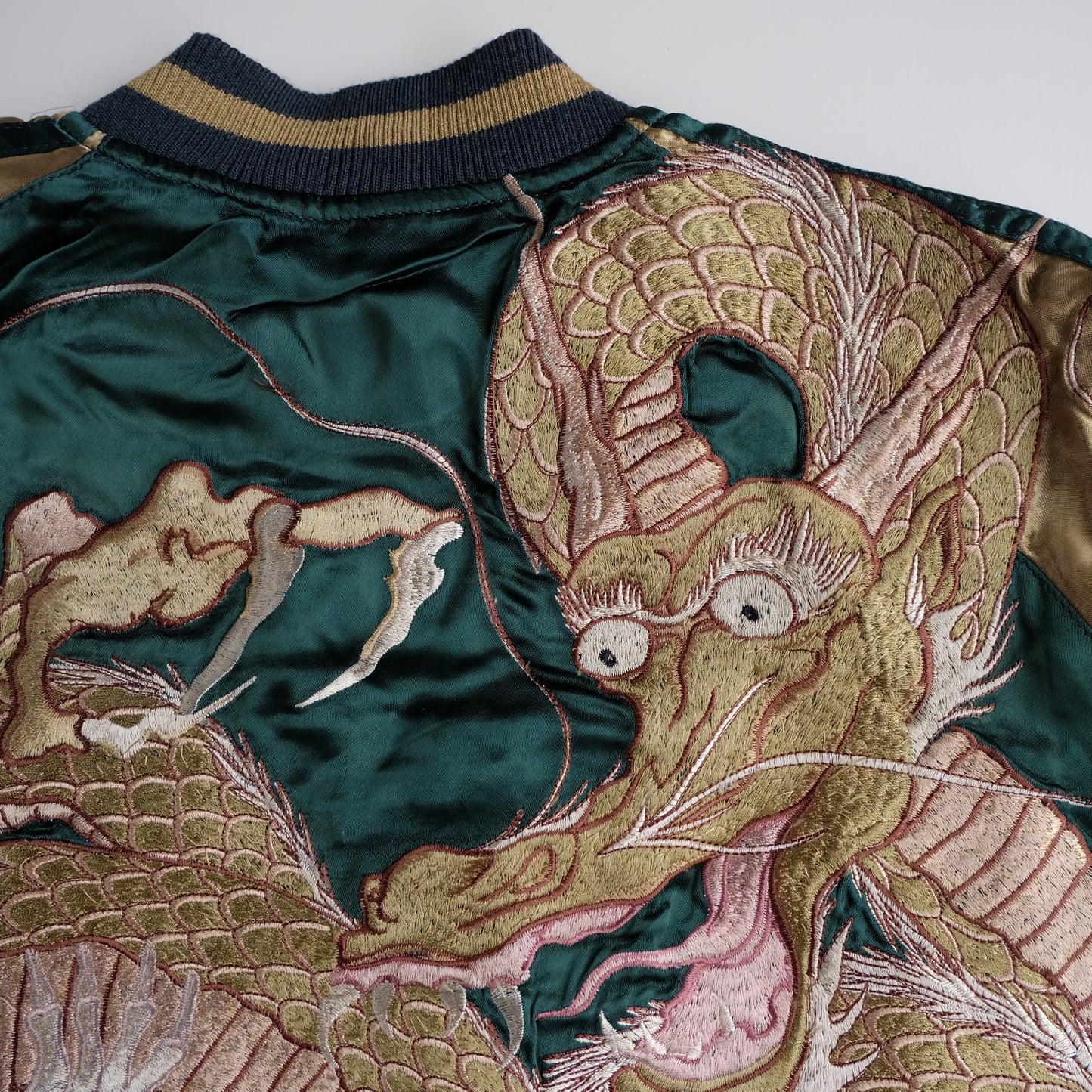
On one face, deep emerald-green satin meets antique-gold sleeves and muted gold ribbing. A vast dragon coils around an ivory embroidered skeleton, filling almost the entire back with scales, claws, whiskers, ribs and bones. Turn the jacket inside out and the same extraordinary composition re-emerges in a darker register: black satin, silver-grey sleeves and pale lavender-grey embroidery transform the scene into a spectral monochrome vision.
This is not a conventional reversible jacket with one decorated face and one simplified alternative. Both sides are complete, expressive and independently wearable.
The emerald-and-gold face feels imperial, mythological and richly aged.
The black-and-silver face feels nocturnal, ghostly and severe.
Together, they create a striking meditation on strength, mortality, transformation and the fleeting nature of physical life. 🐉💀
Identification
Garment Type: Reversible sukajan / Japanese souvenir bomber jacket
Style Category: Vintage Japanese streetwear / Amekaji / embroidered wearable art
Gender Presentation: Unisex
Primary Face: Emerald-green satin body with antique-gold sleeves
Reverse Face: Black satin body with silver-grey sleeves
Principal Motifs: Japanese dragon, full human skeleton, dragon heads, scales, claws and sweeping whiskers
Japanese Motif Terms: Ryū / tatsu dragon and dokuro skeletal imagery
Color Palette: Emerald green, antique gold, ivory, dusty pink, bronze, black, silver-grey and muted lavender
Construction: Fully reversible double-faced souvenir-jacket construction
Sleeves: Raglan sleeves
Closure: Reversible metal front zipper
Trim: Striped rib-knit collar, cuffs and waistband
Pockets: Angled welt pockets on both wearable faces
Brand / Maker: Not visibly identified in the available photographs
Likely Production Era: Appears consistent with an older late-20th- to early-21st-century Japanese sukajan
Condition: Pre-owned vintage condition with visible age-related wear, satin creasing, tonal variation and patina
Detailed flat measurements and tagged-size information will be added when available. Buyers requiring measurements sooner are warmly invited to contact us.
Opening Impression
This jacket does not whisper.
It arrives like a piece of embroidered folklore.
The back composition is enormous, almost architectural in scale. A long serpentine dragon encircles a fully articulated skeleton, its body winding around the rib cage, spine, pelvis and limbs. The dragon’s head looms above the figure with exaggerated eyes, flowing whiskers and an open mouth, while the skeleton appears to crouch or fold inward within the creature’s coils.
The embroidery nearly eliminates the distinction between garment and artwork.
From a distance, the jacket reads as a bold graphic object.
At close range, the individual scales, vertebrae, ribs, claws, teeth, thread directions and tonal transitions become visible.
The design possesses the raw visual energy associated with Japanese tattoo culture, punk fashion, underground rock styling and the darker current of Japanese folk and supernatural imagery.
The Emerald-Green and Antique-Gold Face
The first face combines a deep jewel-toned green body with warm antique-gold sleeves.
The palette immediately separates this jacket from more familiar black, navy and red sukajan colorways. Emerald green creates a luxurious, almost ceremonial atmosphere, while the muted gold sleeves echo the color of aged metal, temple ornament and antique textile thread.
The back is dominated by an olive-gold dragon wrapped around an ivory skeletal figure.
The dragon is built from:
- individually embroidered scales
- pale pink and bronze contour stitching
- sharply articulated claws
- long curling whiskers
- raised horns
- layered mane details
- ribbed belly plates
- an open jaw with visible teeth
- a sweeping body that forms an enclosing circular rhythm
The skeleton is executed in ivory, bone-white, cream and pale grey threads. Dark eye sockets, nasal cavity and mouth openings create a graphic contrast against the lighter skull.
The figure includes a clearly embroidered:
- skull
- jaw
- cervical spine
- vertebral column
- rib cage
- shoulder blades
- pelvis
- upper arms
- forearms
- hands
- fingers
- femur and lower skeletal elements
This unusual anatomical treatment gives the jacket a level of visual complexity rarely encountered in ordinary souvenir-jacket designs.
Green-Side Front Composition
The green front is asymmetrical and theatrical.
A large dragon head occupies the upper chest on one side, with its horn extending upward toward the collar. The face is rendered in olive, tan, dusty pink and ivory, with a wide eye, flared nostril, whiskers and visible fangs.
Opposite the dragon, the lower front contains a skeletal figure emerging from the side of the torso. Its skull and raised hand create the impression of the figure appearing from beyond the edge of the jacket.
This asymmetry gives the front a more unpredictable character than standard mirrored chest embroidery.
The dragon looks across the zipper.
The skeleton rises below it.
When the jacket is worn open, portions of the reverse embroidery become visible within the center, creating an additional layered effect.
The Black and Silver-Grey Face
The reverse face transforms the same subject into something colder and more spectral.
The body becomes deep black.
The sleeves shift to pale silver-grey.
The ribbing becomes black and ivory.
The dragon and skeleton are rendered primarily in dusty lavender, silver-grey, pale violet, ivory and muted taupe.
The brighter green-side drama becomes a monochromatic apparition.
Because the black ground absorbs much of the surrounding light, the pale embroidered bones appear to emerge from darkness. The dragon’s body becomes less earthly and more ghostlike, while its enormous eyes and winding whiskers become especially prominent.
The black face has a quieter color palette but an even stronger emotional intensity.
It feels closer to ink drawing, ghost-story illustration, underground tattoo flash and monochrome textile art.
Black-Side Front Composition
The front of the black face features two opposing dragon heads placed across the chest.
Their long horns, open mouths and pale whiskers create a symmetrical gateway around the zipper. The ivory and lavender embroidery contrasts strongly against the black satin without requiring bright color.
Silver-grey raglan sleeves frame the body and connect visually with the skeletal palette on the back.
The angled welt pockets are finished with pale trim, while striped black-and-ivory ribbing completes the traditional bomber silhouette.
This face is easier to coordinate with monochrome clothing while still remaining visually commanding.
Dragon and Skeleton Composition
The central image can be read in several ways.
The dragon appears to protect, restrain, confront or envelop the skeleton.
The skeleton may represent mortality, the physical body after life, the stripping away of status or the equality of all people before death.
The dragon may represent power, transformation, spiritual energy, authority over natural forces and survival beyond physical limitation.
Together, they form a dramatic tension:
- body and spirit
- mortality and endurance
- fear and mastery
- destruction and protection
- impermanence and continuing energy
- earthly limitation and supernatural force
The design does not provide a single fixed interpretation. Its power comes from that ambiguity.
The dragon may be an adversary.
It may be a guardian.
It may be death itself.
It may be the force through which the mortal body transforms.
Japanese Dragon Symbolism
The Japanese dragon, commonly described as ryū or tatsu, is traditionally associated with water, clouds, storms, rivers, rain, oceans and supernatural authority.
Unlike many European dragons, the Japanese dragon is typically serpentine rather than winged. Its elongated body moves through air and water like a current.
Common symbolic associations include:
- transformation
- protection
- wisdom
- resilience
- elemental power
- control over unstable forces
- spiritual authority
- courage under pressure
- movement between earthly and supernatural realms
The dragon on this jacket does not stand beside the skeleton as a decorative companion. It surrounds the figure completely.
Its scaled body forms an embroidered boundary around the human bones, making the dragon both environment and active presence.
Dokuro and Skeletal Imagery
The skull and skeleton, or dokuro imagery, appear throughout Japanese art, folklore, tattoo culture and alternative fashion.
The skeleton can function as a reminder that wealth, appearance, social position and physical strength are temporary.
It may also represent:
- impermanence
- fearlessness in the face of death
- release from worldly attachment
- rebellion against polite convention
- equality beneath outward identity
- survival after catastrophe
- transformation through destruction
- the hidden structure beneath the surface
In Japanese streetwear, skeleton imagery often carries both philosophical and confrontational energy. It can be darkly humorous, rebellious, theatrical or meditative.
This jacket amplifies that symbolism by rendering nearly the entire skeleton rather than using only a skull emblem.
A Japanese Memento Mori
The composition functions as a wearable memento mori: a reminder of mortality expressed through lavish craftsmanship rather than solemn minimalism.
The skeleton is anatomically recognizable but stylized enough to remain part of the surrounding mythological scene.
The dragon’s coils move around the figure like time, fate, karma or natural force.
The result is neither purely religious nor purely macabre.
It belongs to the visual territory where folklore, tattoo art, streetwear and philosophical symbolism overlap.
The jacket can therefore appeal equally to collectors of:
- dragon imagery
- skull and skeleton art
- Japanese tattoo aesthetics
- supernatural folklore
- punk and rock fashion
- embroidered streetwear
- memento mori objects
- reversible sukajan
Embroidery Density
The back embroidery is exceptionally extensive.
The design covers nearly the entire central body panel, leaving only narrow areas of satin visible around the edges.
Visible embroidery techniques include:
- dense satin stitching
- layered scale construction
- directional bone stitching
- contour outlining
- filled anatomical forms
- fine whisker embroidery
- long linear horn stitching
- curved belly-plate embroidery
- shaded thread transitions
- contrasting facial details
- dimensional raised threadwork
The dragon’s body requires hundreds of individually defined scale shapes.
The skeleton requires separate treatment for each bone group.
The two subjects overlap without losing their visual identity, demonstrating careful control of outline, spacing and thread color.
Reversible Embroidery Character
One of the most remarkable aspects of the jacket is the way the same major composition changes character on each face.
Emerald-Green Face
The dragon appears warm, golden and physical.
The skeleton is bright ivory.
The contrast suggests antique illustration, temple ornament, faded brocade and mythic grandeur.
Black Face
The dragon becomes pale violet and silver-grey.
The skeleton becomes more ghostly and tonal.
The composition feels colder, nocturnal and closer to monochrome ink art.
The garment therefore does not merely offer two colors.
It offers two emotional interpretations of the same subject.
Color Architecture
Emerald Green
The green body creates depth and jewel-like richness. It also provides a natural contrast with the warm dragon scales and ivory skeleton.
Antique Gold
The sleeves and embroidered scale tones introduce age, warmth and a sense of ceremonial luxury.
Black
The reverse face creates a stark, graphic background that intensifies the pale skeletal details.
Silver and Lavender
Muted grey-violet thread softens the imagery without reducing its macabre power.
Ribbing
The striped ribbing alternates dark charcoal or black with beige, antique gold or ivory depending on the face. This helps distinguish each side while maintaining a coherent reversible construction.
Construction
Fully Reversible Design
The jacket is finished for wear on both sides and incorporates a reversible front zipper.
Both faces include functional front pockets and complete decorative treatments.
Raglan Sleeves
The raglan construction produces the rounded shoulder line associated with classic sukajan and souvenir jackets.
It also allows the sleeve colors to frame the central back embroidery without interrupting the main composition.
Satin-Finish Textile
The jacket is constructed from a smooth, light-reflective satin-finish textile.
The precise fiber composition is not confirmed, so the material is described according to its visible characteristics rather than assigning an unverified rayon, acetate or polyester content.
Rib-Knit Trim
The collar, cuffs and waistband are finished with striped rib knit, maintaining the traditional compact bomber silhouette.
Welt Pockets
Angled welt pockets are incorporated into both wearable faces and finished with contrasting trims.
Visual Presence
This jacket has extraordinary back-facing impact.
The dragon and skeleton form a nearly circular composition, with the creature’s body wrapping around the lower and outer sections while the head descends from the upper corner.
The skeleton occupies the center and foreground.
The dragon moves behind, around and above it.
This creates genuine depth rather than a flat arrangement of separate motifs.
The eyes travel first to the skull.
Then to the ribs.
Then upward to the dragon’s face.
Finally, the viewer follows the scaled body around the composition and back toward the skeleton.
It is an image designed to hold attention.
Sukajan History and Cultural Context
The sukajan developed from postwar Japanese souvenir jackets made for foreign servicemen stationed in Japan.
American military and athletic jacket silhouettes were combined with Japanese embroidery traditions, producing garments decorated with dragons, tigers, eagles, maps, cherry blossoms, Mount Fuji, military insignia and place names.
Over time, the sukajan became part of Japanese youth fashion, motorcycle style, rockabilly culture, underground streetwear, Amekaji collecting and global fashion.
Its importance lies partly in its hybrid nature.
The silhouette reflects American military and sportswear.
The embroidery reflects Japanese visual culture.
The garment became a cultural exchange object that Japan later reclaimed, refined and transformed into a highly respected streetwear tradition.
This dragon-and-skeleton example belongs to the darker and more theatrical branch of that history.
Amekaji and Japanese Streetwear
Amekaji, meaning “American casual,” refers to Japan’s reinterpretation of American workwear, denim, military clothing, sportswear and mid-century youth fashion.
Japanese designers often approach these forms with unusual attention to:
- material
- construction
- historical silhouette
- embroidery
- symbolic detail
- fading and patina
- small-production craftsmanship
The sukajan occupies a special position in Amekaji because it was already a Japanese-American hybrid from its beginning.
This jacket expands that hybrid tradition through an especially complex motif drawn from Japanese mythological and macabre visual language.
Period Assessment
The exact maker and production date are not confirmed from the available photographs.
The jacket appears consistent with an older Japanese sukajan produced during the late 20th century or early 21st century, likely within the broad vintage revival era when reversible souvenir jackets were reinterpreted for Japanese streetwear, rock and alternative fashion audiences.
The assessment is based on:
- reversible satin construction
- large-scale machine embroidery
- muted vintage color palette
- striped rib-knit trim
- traditional raglan silhouette
- extensive two-sided decoration
- naturally developed textile patina
- older zipper and finishing character
It is not represented as an original 1940s or 1950s occupation-era souvenir jacket.
Its appeal lies in its dramatic design, heavy embroidery, reversible construction and authentic age-related character.
Condition
This is an older pre-owned garment offered in its present vintage condition.
The embroidery retains strong visual definition, and the main dragon and skeleton compositions remain clearly readable on both sides.
Visible condition characteristics include:
- overall satin creasing
- natural puckering around dense embroidery
- age-related tonal variation
- areas of fading and muted color
- visible patina on lighter sleeve sections
- discoloration and shading on portions of the silver-grey and antique-gold fabric
- wear and tonal variation around the rib-knit collar, cuffs and waistband
- possible minor pulls or thread irregularities
- storage-related wrinkles
- surface variation consistent with previous wear
- uneven sheen under changing light
The lighter sleeves naturally reveal age and handling more readily than the darker body panels.
The emerald-green side retains a rich visual presence, while the black side offers a more subdued and atmospheric finish.
No claim of mint, deadstock or unworn condition is made.
Please review all photographs carefully, particularly the sleeves, ribbing, zipper area and larger embroidered sections.
Size and Measurements
Tagged-size information and detailed flat measurements will be added shortly.
The essential measurements will include:
- back length
- chest width measured pit to pit
- sleeve length measured from collar seam
- sleeve length measured from underarm
- hem width
- cuff opening
Japanese vintage sizing may differ from contemporary Western sizing.
Please compare the forthcoming measurements with a similar jacket that already fits comfortably rather than relying exclusively on a tagged size.
Buyers requiring measurements before the listing is updated are encouraged to message us for priority assistance.
Styling
Emerald-Green Face
Pair the green-and-gold face with:
- black denim
- faded indigo jeans
- wide military trousers
- brown or black boots
- heavy silver jewelry
- vintage graphic shirts
- plain black layers
- distressed workwear
- dark leather accessories
The jewel-toned body works especially well with black, charcoal, brown, cream and muted olive.
Black Face
The black-and-silver face pairs naturally with:
- monochrome outfits
- black trousers
- faded grey denim
- engineer boots
- high-top sneakers
- minimal silver jewelry
- punk or rock styling
- layered hoodies
- distressed leather
The black face is more restrained in color but no less visually powerful.
Editorial Use
The jacket would be particularly striking in:
- tattoo photography
- alternative fashion editorials
- rock and metal styling
- Japanese streetwear shoots
- dark romantic fashion
- gothic-inspired wardrobes
- gender-fluid styling
- collector portraiture
Display Potential
When not worn, this jacket can be displayed as textile art.
The back composition is large enough to read clearly from across a room and rewards close inspection.
The emerald face works beautifully in interiors with wood, brass, dark green or antique decorative elements.
The black face works well in monochrome, industrial, punk, tattoo-studio or gallery-style interiors.
It would suit:
- sukajan collections
- Japanese streetwear archives
- tattoo studios
- music rooms
- rock boutiques
- photography studios
- alternative fashion displays
- collector wardrobes
- manga and subculture interiors
- gallery-style wall presentation
Because both sides are fully developed, the jacket can be periodically reversed to change the atmosphere of the display.
Collecting Appeal
This piece crosses several important collecting categories:
- reversible Japanese sukajan
- dragon embroidery
- skeleton and skull fashion
- dokuro imagery
- Japanese tattoo aesthetic
- Amekaji streetwear
- satin souvenir jackets
- punk and rock clothing
- wearable textile art
- supernatural Japanese motifs
- vintage embroidered bombers
- unisex Japanese fashion
The enormous dragon-and-skeleton composition is the defining feature.
It does not depend on a visible designer logo for impact.
Its desirability comes from the design itself, the embroidery density, the unusual color system and the fact that both faces are visually complete.
Why This Piece Stands Apart
Most sukajan are organized around familiar animals, maps, military emblems or landscape scenes.
This jacket enters more unusual territory.
It places the human skeleton directly inside the coils of a dragon.
It presents the same mythological confrontation twice, once in emerald and antique gold, once in black and ghostly lavender.
It offers two colorways without abandoning its central identity.
It is dramatic without relying on bright primary colors.
It is macabre without becoming costume-like.
It is philosophical without losing the swagger of streetwear.
The result is a reversible garment with the presence of a tattoo mural, the density of a textile artwork and the cultural vocabulary of Japanese souvenir-jacket tradition.
Purchase, Shipping and Vintage Garment Policy
This is an older pre-owned garment offered in its present condition.
Please review all photographs and written condition details carefully before purchasing. Visible creasing, fading, discoloration, textile variation, embroidery puckering and age-related patina form part of the garment’s current character.
Older clothing may show storage marks, surface irregularities, small pulls, loose fibers, thread variation, ribbing wear and other evidence of previous ownership.
The item will be carefully packed and shipped worldwide from Japan by tracked EMS or another suitable tracked international service.
Preparation, shipping and handling normally takes 5–10 business days or earlier.
Delivery time begins after dispatch and may vary according to destination, customs processing, local postal conditions and seasonal volume.
All sales are considered final. Returns, exchanges and claims based on fit preference, visible vintage wear, expected age-related condition, minor textile irregularity or differences in screen color cannot be accepted.
Please ask any important questions before purchasing.
Respectful offers from serious collectors may be considered.
Searching for This Design in Another Size?
Should this dragon-and-skeleton sukajan speak to you but the available fit not be suitable, please feel welcome to contact us with your preferred tagged size and approximate flat garment measurements.
Availability cannot be guaranteed, particularly for discontinued and older Japanese souvenir jackets. However, through our sourcing network in Japan, we may be able to locate the same model, a related colorway or another reversible sukajan featuring comparable dragon, skull, skeleton or darker Japanese embroidery.
We are always pleased to investigate suitable alternatives and help collectors locate a piece that more closely matches their preferred fit, color palette and design.
#JapaneseSukajan #VintageSukajan #ReversibleSukajan #DragonSukajan #SkeletonJacket #Dokuro #JapaneseDragon #DragonJacket #SkullJacket #SouvenirJacket #JapaneseBomber #EmbroideredJacket #Amekaji #JapaneseStreetwear #WearableArt #MementoMori #TattooFashion #JapaneseTattoo #RockFashion #PunkFashion #GothicStreetwear #SatinBomber #VintageJapanese #Ryujacket #SkullFashion #AlternativeFashion #CollectorJacket #JapaneseTextile #UnisexJacket #EmbroideredBomber
dragon sukajan, skeleton jacket, reversible sukajan, japanese bomber, vintage sukajan, dokuro jacket, skull embroidery, dragon jacket, souvenir jacket, amekaji jacket, japanese streetwear, satin bomber, wearable art
Material Tags
satin-finish textile, dense embroidery thread, rib-knit trim, reversible metal zipper, woven pocketing, embroidered appliqué, reversible construction, satin bomber fabric