Rare Vintage, Antiques and Art Collector / Curator / Personal Shopper From Japan
Rare Satori GSJR-005 Hannya Skull Oiran Reversible Sukajan Jacket Sakura Japanese Embroidered Satin Bomber
Rare Satori GSJR-005 Hannya Skull Oiran Reversible Sukajan Jacket Sakura Japanese Embroidered Satin Bomber
Couldn't load pickup availability
Have a reasonable price in mind? Submit your best offer and our concierge will review it personally.
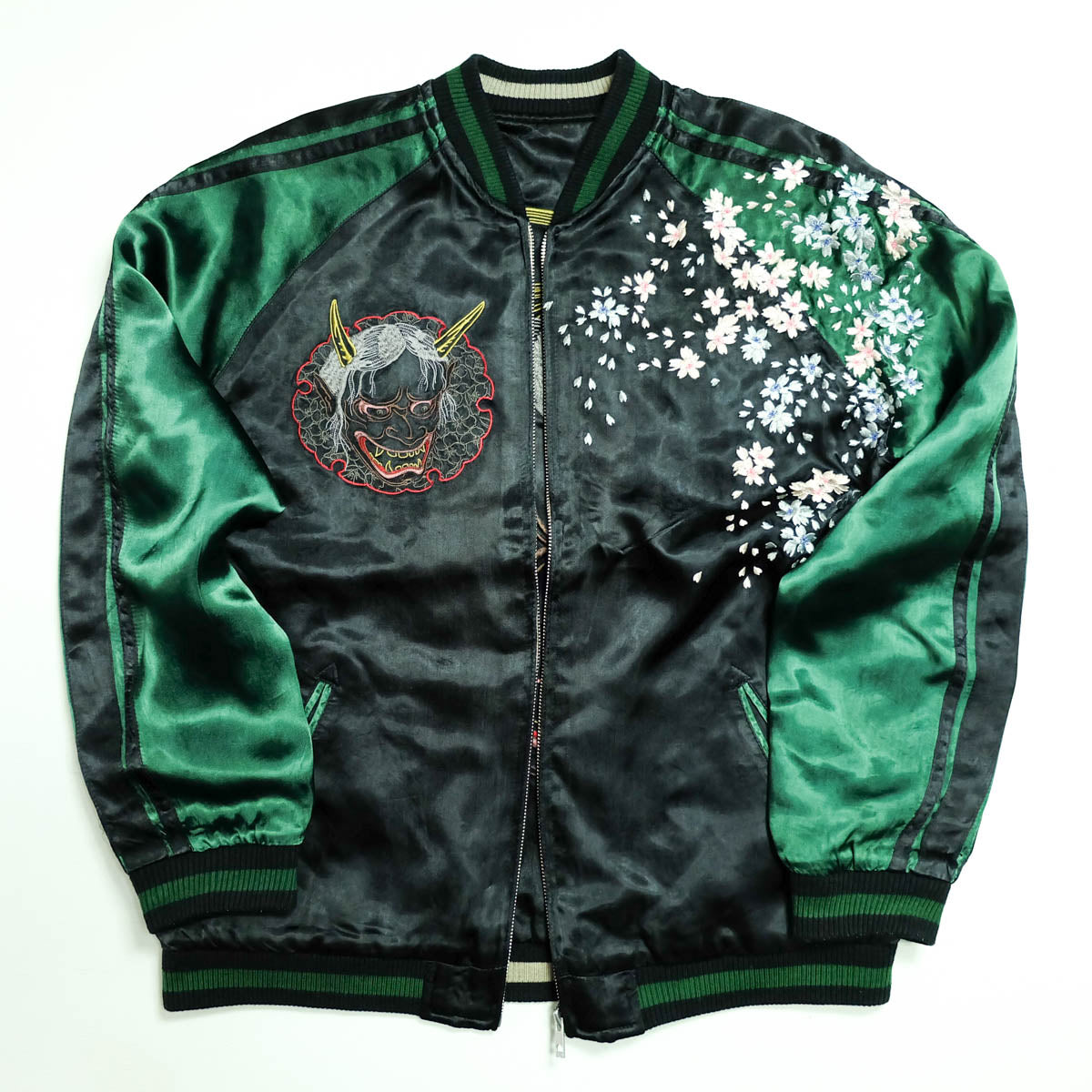
Black and Emerald-Green Wagara Souvenir Jacket with Skeletal Oiran, Hannya Masks, Cherry Blossoms, Peonies and Flowing Water Embroidery
A spectacular reversible Satori sukajan, uniting the haunted elegance of a skull-faced oiran with one of the most psychologically charged images in Japanese theatrical art: the horned Hannya mask.
One face presents a dramatic black and emerald-green composition. A skeletal oiran appears in an elaborately patterned purple kimono beneath flowering sakura, with a Hannya mask watching from above. White, blush-pink and pale-blue blossoms scatter across the dark satin, while turbulent waves, gold current lines and large floral outlines transform the entire back into a densely embroidered nocturnal tableau.
Reversed, the jacket becomes an equally commanding black and antique-ivory sukajan dominated by an enormous Hannya mask. Long golden horns, silver-white hair, red-outlined cherry blossoms and streams of gold embroidery create an image that feels suspended between Noh theatre, tattoo art and supernatural folklore.
This is not a jacket with a decorative front and a secondary lining. It is a genuine two-sided work of wearable art, with each face carrying its own complete visual language.
Opening Story
Beauty, mortality and transformation meet across the two faces of this extraordinary jacket.
On the emerald side, the oiran retains all the ceremonial splendor of her role. Her richly decorated kimono remains vivid with peonies, repeating faces, patterned panels and layered robes, yet her living face has vanished. She has become a skull, a memento mori wrapped in the luxurious costume of the pleasure quarters.
Above her, the Hannya mask appears within a dark floral medallion. It does not merely decorate the scene. It acts almost like the emotional shadow of the figure below, suggesting jealousy, anguish, attachment and rage transformed into something supernatural.
The reverse strips away the elaborate human costume and gives that concealed emotion monumental form. The Hannya now occupies nearly the entire back, surrounded by falling blossoms and streaming gold lines.
The result is a jacket that unfolds as a visual narrative. One face shows worldly beauty haunted by impermanence. The other reveals the force hidden beneath it.
Identification
Brand
Satori / さとり
Satori is a Japanese wagara fashion label associated with Script Hanatabi Gakudan and Switch Planning, known for highly detailed souvenir jackets built around traditional Japanese imagery, supernatural figures, tattoo-style compositions and elaborate machine embroidery. Comparable Satori product documentation identifies the label within the Script and Switch Planning family of Japanese casualwear brands.
Official Design Name
花魁髑髏刺繍リバーシブルスカジャン
Oiran Dokuro Embroidered Reversible Sukajan
The maker’s archived Japanese description identifies GSJR-005 specifically as a reversible skull-oiran and Hannya jacket in black and green, with flowing-water and cherry-blossom embroidery on the Hannya face.
Garment Type
Reversible Japanese sukajan
Yokosuka-style souvenir jacket
Wagara embroidered satin bomber
Japanese streetwear jacket
Tattoo-art inspired outerwear
Lightweight reversible rayon jacket
Unisex collectible fashion
Principal Colorway
Oiran Face: smoky black body, emerald-green sleeves, green and black ribbing, purple, red, white, gray, pale blue, pink and gold embroidery.
Hannya Face: smoky black body, antique ivory or champagne sleeves, black and ivory ribbing, silver, gold, red, pink and charcoal embroidery.
Design Character
The rarity of this design lies not only in the density of its embroidery, but in the relationship between its two sides.
The skull oiran face is ornate, narrative and almost cinematic. It contains architecture of a different kind, built from layered robes, waves, flowers, scattered petals and curving gold lines.
The Hannya face is comparatively graphic. The enormous mask occupies the center like an emblem, surrounded by outlined sakura and river-like streams that curve around its horns and jaw.
One side rewards close observation. The other commands attention from across a room.
The colors also produce two different personalities. Emerald green gives the oiran scene a jewel-toned, nocturnal quality, while the ivory sleeves of the reverse create the more traditional contrast associated with classic black-and-white souvenir jackets.
Skull Oiran and Emerald-Green Face
The Skeletal Oiran
The principal figure is not simply a generic geisha.
The maker identifies her as an oiran, a high-ranking courtesan associated with the licensed pleasure quarters of Edo-period Japan. Oiran were distinguished by highly elaborate clothing, formal hairstyles, ceremonial processions and demanding artistic accomplishments.
Here, the figure is rendered as a skeleton or skull-faced woman while retaining the visual grandeur of her role.
Her purple kimono is densely embroidered with large peony-like blossoms, patterned borders, wave forms and repeating expressive faces. Layers of red, coral, gray, white and gold thread create the effect of brocade translated into embroidery.
The skeletal face introduces a stark memento mori element. Physical beauty, social prestige and luxurious clothing remain, but the individual has passed beyond them. The image does not simply celebrate glamour. It questions its permanence.
Hannya Watching from Above
A horned Hannya mask appears in the upper-left portion of the back.
Long golden horns rise from silver-white hair, while red, gold and muted pink thread define the eyes, mouth and teeth. The mask is framed inside a dark floral cloud outlined in red, giving it the appearance of a vision, memory or supernatural presence.
The maker’s Japanese description connects the skull-faced oiran with the emotional transformation embodied by Hannya. It describes the design as expressing the jealousy or resentment of the oiran through the skull and mask imagery.
Sakura Canopy
White, pale-blue and blush-pink cherry blossoms spread across the upper-right back and shoulder.
Some flowers are fully formed, while others dissolve into individual petals scattered across the black satin. This gradual dispersal gives the scene movement, as though the blossoms are being carried through the composition by wind.
Sakura brings beauty and seasonal delicacy into an otherwise dark supernatural scene. The blossoms are radiant precisely because they are temporary, echoing the skeletal figure’s meditation on mortality.
Flowing Water
Stylized waves rise behind the oiran on the right, rendered in white and gray thread against black satin.
Gold embroidered currents travel horizontally across the composition, curling behind the mask, figure and flowers. These flowing lines prevent the artwork from feeling static and visually connect the separate motifs.
Water may be read as movement, emotional turbulence, purification or the unstoppable passage of time. In this composition, it seems to carry the oiran, blossoms and supernatural apparition within the same dreamlike current.
Peonies and Floral Outlines
Large chrysanthemum or peony-like flowers appear in gold outline across the lower-left background.
Their open linework contrasts with the densely filled kimono and sakura embroidery. This balance between filled and outlined stitching allows the design to remain complex without becoming visually congested.
Peonies traditionally suggest splendor, beauty and abundance, making them an especially appropriate companion to the elaborately dressed oiran.
Front Embroidery
The front continues the narrative rather than merely repeating isolated symbols.
A smaller Hannya mask appears on one chest, enclosed within the same red-edged floral medallion seen on the back.
Across the opposite shoulder and chest, pale sakura blossoms cascade diagonally downward. The flowers cross from the emerald sleeve into the black body, creating a deliberately asymmetrical composition.
The contrast is compelling. One chest carries supernatural intensity, while the other carries fragile seasonal beauty.
Giant Hannya and Antique-Ivory Face
Monumental Hannya Mask
The reverse is dominated by an enormous Hannya mask embroidered across most of the back.
Its face is rendered primarily in charcoal, black, bronze, pale pink and red thread. Gold stitching defines the long horns and teeth, while silver-white embroidery forms the hair gathered above the forehead.
The eyes are especially powerful. Their circular pupils and downward-set brows produce an expression that can appear furious, tormented or mournful depending upon the viewing angle.
Hannya is often loosely described outside Japan as an oni or demon mask. More precisely, it belongs to the tradition of Japanese Noh theatre and represents a woman transformed by consuming jealousy, resentment, suffering and grief. The mask’s emotional ambiguity is fundamental to its power. It is frightening, yet it also preserves traces of the human sorrow that produced the transformation. The model’s surviving product descriptions likewise identify the Hannya theme as a woman transformed through jealousy and resentment.
Golden Horns and Streaming Lines
The horns are executed in bright gold and yellow thread, making them the strongest points of contrast against the dark body.
Long parallel gold lines curve around the mask like flowing water, wind, smoke or strands of supernatural energy. Their sweeping movement enlarges the visual field and makes the design appear broader than the mask alone.
The gold streams also connect this reverse directly with the flowing lines surrounding the oiran on the opposite face.
Red and Charcoal Sakura
Outlined cherry blossoms surround the mask in two contrasting treatments.
Some are embroidered in vivid red, while others nearly disappear into the smoky black background in charcoal-gray thread. The darker blossoms reveal themselves gradually as the satin catches light.
This near-monochrome technique is particularly effective. It creates depth without competing with the central face, while the red blossoms echo the mask’s lips, eye contours and medallion border.
Reverse Front Composition
A smaller Hannya medallion occupies one chest.
The opposite chest carries a scattered arrangement of red and charcoal cherry-blossom outlines extending toward the shoulder. This mirrors the asymmetrical structure of the green side, but uses line embroidery rather than filled blossoms.
The ivory sleeves are bordered by double black racing stripes, introducing a vintage athletic and varsity-jacket influence. The stripes also sharpen the silhouette and visually frame the dark body.
Hannya, Oiran and the Jacket’s Narrative
This model is unusually sophisticated because its symbolism functions across both faces.
The skull oiran represents beauty after the body has disappeared. Her clothing remains elaborate, but the person within it has become a reminder of mortality.
The Hannya represents emotion transformed into visible form. Jealousy, grief and attachment become horns, staring eyes and an open mouth.
Sakura blossoms link these ideas together. They bloom brilliantly, scatter and vanish.
Water provides the final connecting element. It moves around every figure, carrying beauty, suffering and memory forward.
The jacket can therefore be read as a meditation on impermanence, but it never becomes solemn or static. Its colors, reflective rayon and dense embroidery make the imagery vivid, theatrical and intensely wearable.
Materials and Construction
Archival product documentation for GSJR-005 identifies both sides as 100% rayon satin.
Construction Details
Fully reversible design
Rayon satin on both wearable faces
Dense multicolor machine embroidery
Raglan sleeve construction
Two complete front-and-back embroidery programs
Reversible metal zipper closure
Angled welt pockets on both faces
Striped rib-knit collar
Striped rib-knit cuffs
Striped rib-knit waistband
Decorative sleeve stripes
Lightweight, fluid bomber silhouette
No visible quilting
Rayon satin gives the jacket its characteristic liquid shine and graceful drape. Unlike a stiff polyester costume jacket, rayon responds dramatically to movement and light, causing different areas of the embroidery and fabric to appear brighter as the garment shifts.
The material is also delicate by nature. Friction, prolonged sunlight, rough surfaces and improper storage should be avoided.
Distinctive Satin Finish
The black panels display a smoky, clouded surface appearance rather than a flat, uniform black.
This mottling contributes to the jacket’s vintage-inspired atmosphere and prevents the densely embroidered scenes from appearing overly polished or new. It also creates subtle depth around the charcoal blossoms and dark outlines.
The emerald sleeves similarly shift between forest green and jewel-toned highlights depending upon the angle of the fabric.
On the reverse, the ivory sleeves carry a softly aged champagne cast that complements the gold horns and flowing embroidery.
Period Assessment
The exact production year of this individual jacket has not been confirmed.
GSJR-005 belongs to Satori’s established modern wagara sukajan line and appears in archived Japanese retail documentation as a numbered commercial design. It should therefore be described as a modern Japanese-market collectible or archive-style sukajan, rather than represented as a postwar military souvenir jacket.
The model is currently difficult to locate through regular retail channels. An archived Japanese retailer lists the GSJR-005 at ¥46,200 and marks it unavailable, while another surviving reference also documents the model, material, black-and-green colorway and full size range.
Its appeal comes from Satori’s interpretation of classic sukajan construction through highly elaborate contemporary Japanese tattoo, Noh and pleasure-quarter imagery.
Condition
This is a pre-owned collectible garment with visible surface character appropriate to delicate rayon satin.
Based upon the supplied photographs, condition characteristics include:
Natural wrinkling and rippling throughout the satin
Clouded or mottled tonal variation across the black panels
Softened coloration on the antique-ivory sleeves
Light surface marks or variations that may become more visible under directional lighting
Possible minor embroidery-thread movement consistent with wear and storage
Gentle relaxation of the rib-knit trim
Natural variation in shine caused by the rayon weave
The principal embroidery remains vivid, dense and visually impressive. The oiran, Hannya masks, sakura, peonies, waves and gold current lines retain strong definition.
No large holes, severe tears or obvious major structural failure can be seen in the supplied full-garment photographs. Smaller marks, thread pulls, stains or signs of previous use may be present and should be evaluated through all available images.
The smoky black finish and tonal variation are integral to the jacket’s current visual identity. Buyers seeking a perfectly flat, uniformly colored or factory-new satin surface should carefully consider its pre-owned character before purchasing.
Please review every photograph closely, as the images form an essential part of the description.
Size and Measurements
The tagged size is not visible in the supplied photographs.
Please contact us for the current flat-lay measurements and fit guidance before purchase.
For a reversible raglan-sleeve sukajan, the most useful measurements are:
Chest width from armpit to armpit
Back length from the base of the collar
Hem width across the ribbed waistband
Sleeve length from the center back collar to the cuff
Satori’s archived sizing for GSJR-005 follows Japanese-market proportions. Manufacturer references list progressively compact lengths relative to chest width, so the jacket may fit shorter and smaller than a similarly tagged contemporary Western bomber. Actual garment measurements should always take priority over the tag.
Styling Possibilities
Emerald Oiran Face
The black-and-green face pairs naturally with:
Black denim
Faded selvedge jeans
Leather trousers
Engineer or combat boots
Dark Japanese streetwear
Visual Kei-inspired outfits
Tattoo-art fashion
Avant-garde monochrome layering
Rock and punk styling
Minimal black basics
The emerald sleeves create a jewel-like flash of color without overpowering the dense back embroidery.
Antique-Ivory Hannya Face
The black-and-ivory reverse works especially well with:
Raw indigo denim
Black or charcoal jeans
Military chinos
Plain white T-shirts
Brown or black leather boots
Vintage athletic trousers
Classic Amekaji styling
Rockabilly wardrobes
Contemporary oversized streetwear
The ivory sleeves give this side a more traditional souvenir-jacket silhouette, while the enormous mask ensures that it remains anything but conventional.
Display and Collecting Appeal
This jacket has the visual density to function as Japanese textile art even when it is not being worn.
The oiran side can be displayed as a narrative composition, with the skeletal figure surrounded by waves, flowers and the watching Hannya.
The reverse becomes a monumental mask study, closer to a tattoo back piece translated into thread.
It would sit naturally within collections focused on:
Satori sukajan
Script and Switch Planning apparel
Japanese wagara fashion
Hannya and Noh imagery
Oiran iconography
Japanese tattoo-inspired clothing
Vintage-style streetwear
Yokosuka jackets
Visual Kei fashion
Skull and memento mori art
Reversible embroidered jackets
Japanese textile and wearable art
Because each face is visually complete, the jacket offers two separate display possibilities rather than a single preferred exterior.
Why This Model Stands Apart
Many sukajan rely upon familiar combinations of tiger, dragon, eagle and Japan-map embroidery.
GSJR-005 takes a more psychologically charged direction.
Its central subjects are a skeletal oiran and the Hannya mask, linked through an implied story of beauty, jealousy, emotional transformation and death.
Its embroidery also displays unusual technical variety:
Filled and outlined cherry blossoms
Fine-line facial work
Dense kimono patterning
Metallic-looking gold currents
Layered wave embroidery
Large-scale mask portraiture
Asymmetrical chest compositions
Two strongly contrasting sleeve colorways
Subtle charcoal-on-black stitching
The exact design is documented as a Satori GSJR-005 and is currently unavailable through the surviving Japanese retail sources located during research. Original Japanese retail references place it around ¥46,200, while comparable contemporary Satori sukajan are currently offered internationally in roughly the US $400 to $520 range depending upon model and availability.
For collectors outside Japan, the combination of a verified model number, hard-to-find artwork, full rayon construction and two heavily embroidered faces supports positioning it above more ordinary unbranded souvenir jackets.
Purchase, Shipping and Vintage Policy
This is a genuine pre-owned collectible garment and is offered in its present as-is condition.
Signs of previous wear, storage, satin creasing, tonal variation, minor surface marks, embroidery-thread movement and natural aging are inherent characteristics of pre-owned embroidered clothing.
Please examine all photographs and written details carefully before purchasing. Colors may appear slightly different depending upon lighting, screen settings and the reflective direction of the satin.
Due to the vintage or collectible nature of this item and the complexities of international shipping, returns, exchanges and claims based upon fit, previously described condition, expected surface variation or minor color differences cannot be accepted.
Reasonable and respectful offers may be considered.
The jacket will be carefully folded, protected and packed for international transit. Worldwide shipping is normally provided through Japan Post EMS or another suitable tracked international service where required.
Preparation, shipping and handling normally takes 5–10 business days or earlier. Tracking information will be supplied after dispatch.
Any customs duties, import taxes, local handling fees or destination-country charges remain the responsibility of the buyer.
If you are looking for this design or model in another size, please feel free to message us. Although availability cannot be guaranteed, we may be able to locate the same or a closely matching piece in a different size through our sourcing network.
#Satori #GSJR005 #SatoriSukajan #HannyaJacket #HannyaMask #SkullOiran #OiranJacket #JapaneseSukajan #ReversibleSukajan #JapaneseStreetwear #WagaraFashion #SakuraEmbroidery #CherryBlossomJacket #RayonSatin #SouvenirJacket #YokosukaJacket #JapaneseBomber #WearableArt #TattooArtJacket #JapaneseFolklore #NohMask #SkullJacket #EmeraldGreenJacket #VisualKeiFashion #Amekaji #JapaneseVintageStyle #EmbroideredJacket #CollectorJacket #JapaneseFashion #MementoMori
satori sukajan, gsjr 005 jacket, hannya jacket, skull oiran, reversible bomber, japanese jacket, sakura embroidery, green sukajan, wagara jacket, rayon satin coat, oni mask jacket, japanese streetwear, yokosuka jacket
Material Tags
100% rayon satin, embroidery thread, rib-knit trim, metal zipper, woven pocketing, reversible construction