Rare Vintage, Antiques and Art Collector / Curator / Personal Shopper From Japan
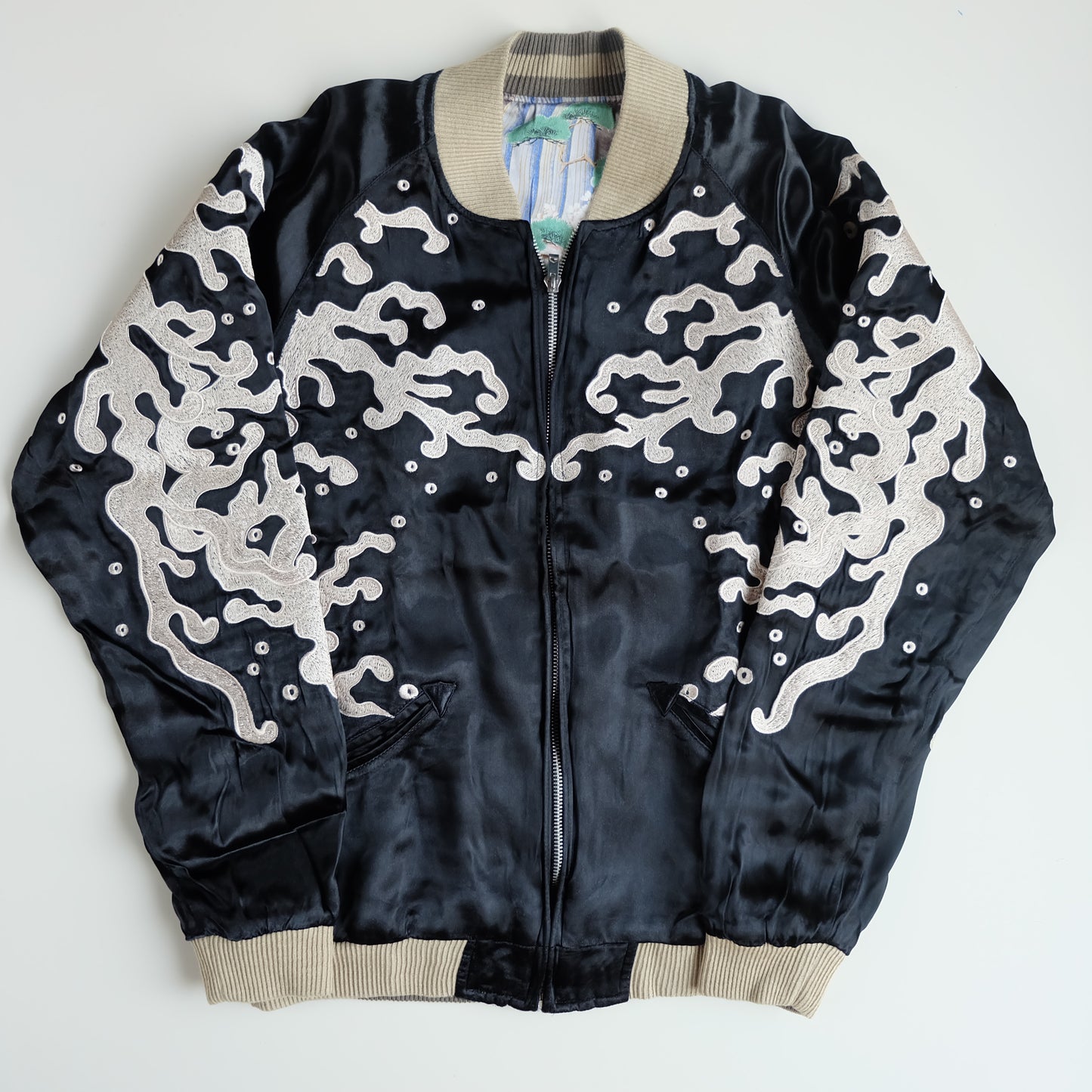
Vintage Japanese Reversible Sukajan Jacket Size S Black Dragon Cloud Koi Sakura Pine Embroidered Satin Souvenir Bomber
Vintage Japanese Reversible Sukajan Jacket Size S Black Dragon Cloud Koi Sakura Pine Embroidered Satin Souvenir Bomber
Couldn't load pickup availability
Two-Sided Japanese Wearable Art with Storm Dragon Embroidery and a Koi, Waterfall, Pine and Cherry Blossom Landscape
A richly conceived reversible Japanese sukajan that tells two connected stories through embroidery, color and symbolism.
The dramatic black face surrounds a silver-grey ryū dragon with enormous fields of ivory storm clouds, red flame accents and circular droplets that spread across the back, chest and sleeves. Turn the jacket inside out and the atmosphere changes completely: smoky lavender-grey panels, aged ivory sleeves and a serene Japanese landscape filled with crimson koi, sculptural pine trees, pale cherry blossoms, flowing waterfalls and stylized waves.
The contrast is striking.
One face presents the dragon after transformation, emerging through clouds with claws extended and flames crossing its scaled body.
The other presents koi ascending through rushing water beneath pine and blossom, recalling the enduring East Asian legend of the carp that conquers the waterfall and becomes a dragon.
Whether this narrative pairing was deliberately intended or simply created through the designer’s motif selection, the two sides form a remarkably coherent visual cycle: perseverance, ascent, transformation and awakened power.
A beautiful collector garment for admirers of Japanese embroidery, vintage Amekaji, sukajan history, tattoo iconography and wearable textile art. 🐉🌊🌸
Identification
Garment Type: Reversible sukajan / Japanese souvenir bomber jacket
Manufacturer’s Size: S
Estimated Contemporary Fit: Generally suitable for an adult XS–S depending on body shape and preferred fit
Gender Presentation: Unisex
Primary Face: Black satin-finish body with silver dragon, cloud and flame embroidery
Reverse Face: Smoky lavender-grey and ivory body with koi, pine, cherry blossom, waterfall and wave imagery
Principal Motifs: Ryū dragon, kumo clouds, flames, koi carp, matsu pine, sakura blossoms, waterfall and waves
Color Palette: Black, ivory, silver-grey, charcoal, red, smoky lavender, turquoise-green, pale blue and orange
Construction: Fully reversible souvenir-jacket construction
Sleeves: Raglan sleeves
Closure: Reversible metal front zipper
Trim: Rib-knit collar, cuffs and waistband
Pockets: Angled welt pockets on both wearable faces
Brand / Maker: Not visibly identified in the available photographs
Likely Era: Appears consistent with late-20th- to early-21st-century Japanese production
Condition: Pre-owned vintage condition with visible age-related patina, creasing and discoloration, especially on the lighter side
Detailed flat garment measurements will be added when available. Buyers requiring measurements before the listing is updated are warmly invited to contact us.
Opening Impression
This is a sukajan built around transformation.
The black face is immediate, nocturnal and powerful. An immense dragon occupies the center of the back while embroidered clouds surge outward across both sleeves. The cloud fields are so extensive that they do not merely frame the creature. They become the environment through which it moves.
The reverse is quieter but more narrative.
Red koi appear throughout a landscape of waterfalls, layered waves, blossoming trees and evergreen pine. The front introduces the scene with a small pine tree on one chest and a solitary red koi on the other. The back expands those elements into a complete panoramic composition.
The jacket therefore offers more than a conventional bright side and plain side.
Both faces are fully developed.
Both have their own visual language.
Both reward close inspection.
The Black Dragon Face
The principal face is constructed from lustrous black satin-finish fabric with pale beige ribbing and a restrained embroidery palette.
At the center of the back, a Japanese dragon moves horizontally through a storm of clouds. The body is rendered primarily in charcoal, steel grey, silver and ivory, allowing the scale pattern to remain distinct without becoming overly colorful.
The dragon’s face has a sharp, almost tattoo-like intensity:
- layered horns
- flame-shaped eyebrows
- long whiskers
- open jaws
- pronounced fangs
- curling mane
- scaled torso
- extended claws
- articulated legs
- sweeping tail
Red flame-like accents travel across the dragon’s back and body, creating the strongest color contrast on the black face. These crimson forms draw the eye through the center of the composition and make the otherwise monochromatic creature appear electrically alive.
The surrounding cloud system is embroidered in thick ivory and pale silver thread. Large cloud forms rise around the dragon and continue across the raglan sleeves, while smaller circular droplets or atmospheric orbs fill the negative space.
The result has the feeling of a mythological creature materializing inside a storm.
Full-Surface Cloud Embroidery
One of the jacket’s most distinctive features is the amount of space devoted to clouds.
The front is not decorated with conventional isolated chest badges. Instead, cloud shapes spread across both sides of the torso and continue down the sleeves.
This creates a visual structure that becomes complete only when the jacket is worn.
When the arms are relaxed, the sleeve clouds join the chest composition.
When the arms move, the clouds separate, fold and re-form.
From the front, the wearer appears surrounded by a supernatural atmosphere before the central dragon on the back is even revealed.
The rounded cloud forms also soften the dragon’s sharper anatomy. Their broad curves contrast with the creature’s claws, scales, teeth and flame accents, producing a composition that is simultaneously aggressive and balanced.
The Back Dragon
The dragon occupies the central back panel without being confined inside a circular medallion or decorative frame.
Its body stretches horizontally, giving it the appearance of moving directly across the garment.
The head turns toward the viewer with its mouth open, while one foreleg reaches downward through the surrounding cloud. The rear legs and tail extend toward the opposite side, creating a strong left-to-right rhythm.
The embroidery uses several distinct thread directions.
The scales are individually articulated.
The beard and mane are created through longer, more directional stitches.
The claws are outlined sharply.
Fine white lines emphasize the facial structure.
Red flame embroidery crosses behind and through the body, adding depth to the monochrome animal.
Rather than presenting the dragon as a distant symbol, the design places it close to the surface. It feels immediate, active and slightly confrontational.
Japanese Dragon Symbolism
The Japanese dragon, or ryū, is one of the most enduring motifs in East Asian visual culture.
Unlike the heavy, winged dragons often seen in European mythology, Japanese dragons are typically serpentine and closely associated with:
- clouds
- rain
- rivers
- oceans
- waterfalls
- storms
- agricultural prosperity
- supernatural authority
- protection
- transformation
- mastery over unstable forces
The embroidered creature on this jacket belongs firmly to that water-and-weather tradition.
It does not stand on the earth.
It moves through clouds.
Its body bends like a current.
Its flames and whiskers behave like streams of wind.
This fluidity is central to the dragon’s visual power.
The design can be read as an emblem of determination, awakened strength and the ability to command turbulent circumstances without being consumed by them.
The Reverse Landscape
The reverse transforms the jacket from a dark mythological bomber into a soft Japanese landscape composition.
The body uses a smoky lavender-grey satin finish, while the sleeves shift to aged ivory. Thin orange piping follows the shoulder and sleeve seams, creating a subtle architectural border.
The front is comparatively restrained.
A stylized pine tree appears on one chest panel.
A red koi appears on the opposite panel.
These two small motifs serve as an introduction to the much larger landscape on the back.
The reverse back contains:
- multiple crimson koi
- layered blue waterfalls
- curling wave crests
- turquoise-green pine trees
- pale pink and white cherry blossoms
- grey atmospheric space
- fine gold and blue linear details
- rising and descending water movement
The scene feels less like standard sukajan embroidery and more like a textile panel drawn from a decorative kimono, obi or traditional Japanese screen.
Its colors are muted enough to feel aged and atmospheric rather than excessively bright.
Koi and the Dragon-Gate Narrative
The pairing of dragon and koi gives this reversible jacket unusual symbolic depth.
In East Asian tradition, the carp is admired for its ability to swim against strong currents. A famous legend tells of a carp ascending the dangerous rapids and waterfall at the Dragon Gate. After overcoming the ascent, the carp transforms into a dragon.
The image became a powerful symbol of:
- endurance
- courage
- ambition
- advancement
- personal transformation
- success earned through struggle
- persistence despite resistance
The reverse face shows koi moving through vertical water, waves and landscape.
The black face reveals the dragon.
The two sides can therefore be interpreted as different stages in the same mythic journey.
The koi represents potential under pressure.
The waterfall represents adversity.
The dragon represents transformation achieved.
This narrative relationship gives the garment a coherence that is rarely found in reversible jackets assembled merely through contrasting decorative themes.
The Red Koi
The koi are rendered in deep red, rust, orange and subtle gold tones.
Their placement throughout the waterfall scene creates continuous movement.
One fish rises near the upper portion of the composition.
Another curves downward through the center.
A third appears partially from the lower side.
Smaller koi motifs appear on the chest.
Rather than arranging the fish in a static pond, the artist places them inside a vertical and turbulent landscape. They appear to climb, turn and resist the water.
Red koi may traditionally be associated with strength, vitality, affection, courage and determined forward movement. Within this jacket’s larger symbolic structure, they become visual carriers of persistence.
Their warm color also provides a strong counterpoint to the cool lavender, teal and pale blue background.
Pine Trees
The Japanese pine, or matsu, appears throughout the reverse landscape.
Its branches are shaped into layered, cloud-like canopies in pale turquoise and green. The trees grow from rocky or obscured ground and appear to cling to the edges of the waterfall.
Pine is traditionally associated with:
- longevity
- endurance
- constancy
- dignity
- winter survival
- resilience under difficult conditions
The tree retains its needles when many other plants lose their leaves, making it a natural symbol of strength through adversity.
Placed beside the ascending koi, the pine reinforces the jacket’s wider theme of persistence.
Cherry Blossoms
Pale cherry blossoms fill the reverse back around the waterfall and pine trees.
Their soft pink and white forms lighten the composition and contrast with the evergreen pine.
Sakura are often associated with:
- spring
- renewal
- beauty
- transience
- the passage of time
- the fragile brilliance of life
- the importance of the present moment
The combination of pine and cherry blossom creates a meaningful tension.
Pine represents endurance.
Sakura represents impermanence.
One remains.
The other blooms and falls.
Together, they evoke both the strength required to continue and the awareness that each season must eventually pass.
Waterfall and Waves
The waterfall is represented through long vertical blue bands, layered curves and pale foam.
At the base, the falling water becomes stylized waves.
The design does not attempt strict realism. Instead, it draws on the vocabulary of Japanese decorative art, where water is simplified into repeated lines, crests and rhythmic arcs.
Water plays several roles within the composition.
It creates movement.
It connects the koi.
It divides the pine and blossom.
It provides the challenge through which transformation becomes possible.
The reverse therefore has a much more narrative quality than a conventional scenic sukajan. The water is not background decoration. It is the central force through which every other motif moves.
Color Architecture
Black Face
The main face relies on black, ivory, silver and charcoal.
This monochrome system makes the dragon feel severe and graphic. The limited red accents become far more powerful because they are not competing with other bright colors.
Reverse Face
The landscape side uses smoky lavender-grey, aged ivory, pale blue, turquoise, red, pink and touches of orange.
The colors are softer and more atmospheric.
The black face feels nocturnal.
The reverse feels like morning mist around a mountain waterfall.
Ribbing and Piping
The rib-knit collar, cuffs and waistband use beige, taupe and dark brown-grey striping. Thin orange piping on the landscape face adds a warm outline around the shoulders and sleeves.
The ribbing shows visible age and tonal variation, which complements the muted vintage palette.
Embroidery and Textile Work
The dragon face demonstrates extensive machine embroidery across the back, front and sleeves.
Visible techniques include:
- dense satin stitching
- fine contour stitching
- layered scale construction
- directional mane embroidery
- filled cloud forms
- outlined flame embroidery
- small circular accent embroidery
- contrasting border stitches
- multi-panel motif continuation
The reverse combines embroidered details with a broader scenic textile treatment. The pine foliage, koi and selected decorative elements have dimensional threadwork, while portions of the landscape appear integrated into or printed upon the satin panel.
This mixture creates a layered surface.
Some areas are raised and tactile.
Others remain smoother and more pictorial.
The reverse therefore has the atmosphere of a decorative textile artwork rather than a simple embroidered bomber.
Construction
Fully Reversible Design
The jacket is finished for wear on both faces.
A reversible metal zipper runs through the center, and angled welt pockets are incorporated into each side.
Raglan Sleeves
Raglan construction gives the shoulders a rounded profile and allows the embroidered cloud fields to travel continuously from the torso onto the sleeves.
Rib-Knit Trim
The collar, cuffs and waistband are finished with striped rib knit.
The trim creates the compact bomber silhouette associated with classic souvenir jackets and helps both faces maintain the same overall structure.
Satin-Finish Fabric
The outer textile has a smooth, reflective surface that changes appearance according to light and movement.
The exact fiber composition is not confirmed, so the garment is described by its visible satin-finish character rather than assigning an unverified rayon, acetate or polyester content.
Welt Pockets
Both faces include angled lower-front pockets.
The pocket openings are trimmed with contrasting fabric, allowing them to remain visible without overwhelming the larger motif system.
Sukajan History and Cultural Context
The sukajan emerged from the postwar meeting of Japanese embroidery traditions and American military souvenir culture.
Early jackets were created in Japan for foreign servicemen who wanted portable mementos of their time in the country. Familiar bomber and athletic-jacket silhouettes were decorated with embroidered dragons, tigers, eagles, maps, cherry blossoms, Mount Fuji and place names.
The garment later moved beyond the souvenir market.
Japanese youth adopted it.
Rockabilly and motorcycle communities embraced it.
Amekaji collectors elevated it.
Streetwear designers reinterpreted it.
Manga, music and alternative fashion gave it new cultural meanings.
The sukajan became one of the clearest examples of fashion traveling between cultures and returning in a transformed form.
Its silhouette carries American military and collegiate influence.
Its embroidery carries Japanese mythology and decorative art.
Its contemporary identity belongs to global streetwear.
This jacket continues that history through a particularly thoughtful reversible pairing.
Amekaji Character
Amekaji, meaning “American casual,” describes Japan’s careful reinterpretation of American workwear, military clothing, denim, sportswear and postwar youth fashion.
Japanese makers often treat these borrowed forms not as disposable trends but as subjects for deep study and refinement.
The souvenir jacket became especially important because it already embodied exchange.
It was Western in silhouette.
Japanese in decoration.
Military in origin.
Streetwear in later use.
This piece reflects that layered history.
Its bomber structure comes from imported military and athletic forms.
Its dragon, koi, pine, sakura and waterfall imagery comes from Japanese symbolic culture.
Its reversible construction turns the garment into a complete wearable artwork.
Design Character
What distinguishes this jacket is the relationship between its two sides.
Many reversible sukajan pair unrelated images simply to offer variety.
This piece feels far more unified.
The black side presents the dragon.
The reverse presents the koi.
The dragon exists in clouds.
The koi exists in water.
The dragon represents achieved transformation.
The koi represents the struggle that precedes it.
Pine contributes endurance.
Sakura contributes awareness of time.
The waterfall creates the obstacle.
The waves create motion.
This gives the jacket a mythological beginning and conclusion.
It can be worn as either chapter.
Period Assessment
The exact production date and maker are not confirmed from the available photographs.
The garment appears consistent with a Japanese sukajan produced during the late 20th century or early 21st century, likely within the broad 1990s to early-2000s revival period.
This assessment is based on:
- the satin-finish reversible construction
- the density and style of machine embroidery
- the muted rib-knit trim
- the full cloud treatment
- the contrasting scenic reverse
- the zipper construction
- the overall Japanese streetwear silhouette
It is not presented as an original 1940s or 1950s occupation-era souvenir jacket.
Its appeal lies instead in its older Japanese production, sophisticated motif pairing, extensive surface decoration and naturally developed patina.
Condition
This is an older pre-owned garment offered in its present vintage condition.
The black dragon face retains strong visual impact. The dragon, clouds, flame accents and circular details remain clearly legible, and the overall embroidery composition appears substantially intact.
Visible condition characteristics include:
- general creasing and folding throughout both faces
- surface rippling around embroidered areas
- natural puckering caused by dense embroidery on lightweight satin
- age-related tonal variation
- visible discoloration on the pale sleeves
- grey, beige and brownish marks on portions of the ivory fabric
- discoloration and darkening around the rib-knit trim
- visible patina around cuffs, waistband and collar
- mottled shading across the reverse body
- possible storage-related marks
- minor thread irregularities
- normal evidence of previous wear
The lighter reverse displays the most visible age.
The ivory sleeves show uneven coloration and areas of darkening. Some buyers may appreciate this as authentic vintage character, while those seeking a pristine pale satin face should carefully review the photographs.
The black dragon side presents more strongly and will likely be the preferred outward face for regular wear or display.
No claim of mint, deadstock or unworn condition is made.
Vintage satin may reveal additional small marks, pulls, loose fibers or surface irregularities under changing light.
Size and Fit
Manufacturer’s Size: S
Japanese sizing often runs smaller than contemporary Western sizing.
This jacket will generally be most suitable for an adult XS–S, depending on shoulder width, chest measurement, arm length and desired layering.
The raglan sleeves provide some flexibility through the shoulders, but the body and hem will still determine the overall fit.
For a petite wearer, it may create a classic fitted sukajan silhouette.
For a very slim wearer, it may allow light layering.
For a youth or teenager, it may provide a more relaxed bomber fit depending on measurements.
Measurements
Detailed flat measurements will be added shortly.
The most useful measurements will include:
- back length
- chest width measured pit to pit
- sleeve length measured from collar seam
- sleeve length measured from underarm
- hem width
- cuff opening
Please compare the forthcoming measurements with a jacket that already fits well rather than relying solely on the tagged size.
Styling
Black Dragon Face
Pair the black side with:
- black denim
- raw indigo jeans
- wide military trousers
- distressed denim
- engineer boots
- black sneakers
- plain monochrome T-shirts
- lightweight hoodies
- silver accessories
The cloud embroidery already creates considerable visual movement, so simple base layers allow the jacket to remain the focus.
Landscape Face
The reverse works beautifully with:
- cream trousers
- faded blue denim
- muted olive garments
- ivory knitwear
- Japanese work pants
- minimalist sneakers
- soft natural colors
The smoky lavender-grey body and ivory sleeves create a lighter, more contemplative appearance.
Editorial Styling
The jacket is especially effective photographed from the back.
The black side produces a dramatic dragon portrait.
The reverse produces a complete Japanese landscape.
Its smaller size also makes it suitable for cropped, fitted or gender-fluid editorial styling.
Display Potential
This piece has strong display value even when it is not being worn.
The black face can be shown with the sleeves arranged outward so that the surrounding cloud system becomes visible around the central dragon.
The reverse can be displayed like a hanging textile panel, with the koi, waterfall, pine and cherry blossom composition fully visible.
It would be especially suitable for:
- sukajan collections
- Japanese textile displays
- tattoo studios
- Amekaji interiors
- rock and punk wardrobes
- manga-inspired rooms
- Japanese streetwear boutiques
- photography studios
- music rooms
- alternative fashion archives
- collector dressing rooms
- gallery-style wall presentation
Because both sides are visually complete, the garment can be periodically reversed to change the display.
Collecting Appeal
This jacket belongs to several collecting categories at once:
- vintage Japanese streetwear
- reversible sukajan
- dragon embroidery
- koi symbolism
- Japanese landscape textiles
- Amekaji fashion
- tattoo-inspired clothing
- wearable art
- Japanese bomber jackets
- souvenir-jacket history
- unisex alternative fashion
- smaller-size collector garments
The combination of full cloud embroidery and a scenic koi reverse is particularly distinctive.
It does not rely on branding alone.
Its value comes from the design itself.
Why This Piece Stands Apart
The jacket offers a rare balance of force and serenity.
The black side is storm, flame and dragon.
The reverse is water, blossom and pine.
The black side uses large graphic embroidery.
The reverse uses a more painterly landscape.
The black side feels immediate and confrontational.
The reverse feels reflective and atmospheric.
Together, they create one of the most symbolically coherent reversible sukajan designs: the koi’s ascent on one face and the dragon’s awakening on the other.
It is not simply two jackets in one.
It is two stages of the same story.
Purchase, Shipping and Vintage Garment Policy
This is an older pre-owned garment offered in its present condition.
Please review all photographs and written condition details carefully before purchasing. Visible age-related discoloration, creasing, textile variation and patina are part of the garment’s current condition.
Older clothing may show fading, storage marks, surface irregularities, small pulls, loose threads, embroidery variation, ribbing wear and other evidence of previous ownership.
The item will be packed carefully and shipped worldwide from Japan by tracked EMS or another suitable tracked international service.
Preparation, shipping and handling normally takes 5–10 business days or earlier.
Delivery time begins after dispatch and may vary according to destination, customs processing, local postal conditions and seasonal volume.
All sales are considered final. Returns, exchanges and claims based on fit preference, visible vintage wear, expected age-related condition, minor textile irregularity or differences in screen color cannot be accepted.
Please ask any important questions before purchasing.
Respectful offers from serious collectors may be considered.
Searching for This Design in Another Size?
Should this dragon-and-koi sukajan appeal to you but the available Size S is not suitable, please feel welcome to contact us with your preferred tagged size and approximate flat garment measurements.
Availability cannot be guaranteed, particularly for discontinued and older Japanese souvenir jackets. However, through our sourcing network in Japan, we may be able to locate the same model, a closely related colorway, or another reversible sukajan with comparable dragon, koi, cloud or Japanese landscape embroidery.
We are always pleased to investigate suitable alternatives and assist collectors in finding a piece that more closely matches their preferred fit and design.
#JapaneseSukajan #VintageSukajan #ReversibleSukajan #DragonSukajan #KoiSukajan #JapaneseDragon #KoiFishJacket #SouvenirJacket #JapaneseBomber #EmbroideredJacket #Amekaji #JapaneseStreetwear #WearableArt #DragonJacket #KoiCarp #SakuraJacket #CherryBlossom #JapanesePine #WaterfallArt #CloudEmbroidery #Ryujacket #VintageJapanese #TattooFashion #RockFashion #UnisexJacket #SatinBomber #JapanFashion #CollectorJacket #JapaneseTextile #SizeSmall
dragon sukajan, koi sukajan, reversible jacket, japanese bomber, vintage sukajan, embroidered dragon, koi fish jacket, souvenir jacket, japanese streetwear, amekaji jacket, sakura jacket, satin bomber, size small jacket
Material Tags
satin-finish textile, multicolor embroidery thread, rib-knit trim, reversible metal zipper, woven pocketing, embroidered appliqué, printed scenic textile, reversible construction