
Glossary of Japanese Dress and Textile Terms
Vocabulary · Readings
Glossary of Japanese Dress and Textile Terms
和服と織物の用語集
More than three hundred words for the garments, parts, cloths and customs of Japanese dress, set out by subject with a plain meaning for each and a link to the chapter where it is explained. The definitions follow the sources read for this almanac.
Fact sheet
How to use this chapter
- Grouped by subject. Terms sit in groups, from kimono types to knots, so that related words are read together.
- A chapter for each term. The last column names the chapter that treats the word at length.
- Sources read. Meanings come from the chapters of this almanac and from Wikipedia's articles on Japanese clothing, the kimono and the obi.
- Where sources differ. Where a meaning is given differently by two sources, the entry says so or leaves it out.
- Spelling. Long vowels are shown with macrons, and the Hepburn system is used throughout.
- Older glossary. The house's earlier kimono glossary and its colour glossary remain available for readers who want them.
Why a glossary of dress
A reader of Japanese dress meets a thicket of words. The kimono has a collar, a hem guard and a sleeve pouch, each with its own name; the sash has a dozen forms and a dozen knots; the cloths are named for where they were woven or how they were dyed. This chapter gathers those words in one place, grouped by subject, so that a term met in any other chapter can be looked up here and traced back to the chapter that explains it.
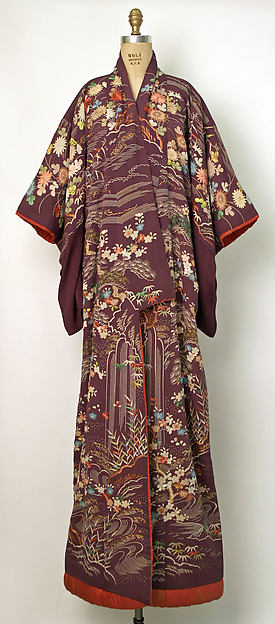
Kimono, 19th century, silk. The Metropolitan Museum of Art, Gift of Estate of Mrs. Thomas Lamont, 1953, accession C.I.53.22.10.
Look closer: Look at the whole garment. The Met catalogues this as a kimono of the nineteenth century in silk; every word in the next sections names a part of a garment like this one, or something worn with it.
Image: The Metropolitan Museum of Art, Open Access (CC0)
The entries are drawn from two kinds of source. The first is the chapters of this almanac, each of which carries its own glossary built from the sources read for it: the Metropolitan Museum of Art's catalogue and labels, and Wikipedia's articles. The second is Wikipedia's articles on Japanese clothing, the kimono and the obi, read for this chapter. Where a meaning could not be confirmed in a source, the term is left out and not guessed at.
The glossary is a map, and the chapters are the country. For the garments themselves see The Kimono Ladder: Furisode, Tomesode, Hōmongi and Komon, for the sash Obi and Its Companions: Scarf, Cord and Brooch, and for the cloths Silk, Hemp, Cotton and Ramie: The Fibres of Japanese Dress. The house's earlier kimono glossary, the glossary of kimono terms, and its glossary of traditional Japanese colours remain available beside this one.
The kimono and its ranks
The first group names the garments themselves. Wikipedia's article on the kimono explains that the word means a thing to wear, and describes a wrapped-front robe with a rectangular body and square sleeves. The kimono grew from the kosode, a small-sleeved garment that began as underwear and became outerwear. The article on Japanese clothing adds that the garment is wrapped left over right and worn with an obi.

Furisode, 19th century, Possibly beni-dyed light red (orange) silk, figured satin weave, embroidered and couched in silvered and gilt metallic thread (wound around a white silk fiber core). Needlework in satin stitch in shades of green, dark blue, off-white, and light brown; areas of padding; yuzen dyeing, and stenciled imitation tie-dyeing throughout.. The Metropolitan Museum of Art, Robert Lehman Collection, 1975, accession 1975.1.2452.
Look closer: Look at the sleeves. The Met catalogues this as a furisode of the nineteenth century, the long-sleeved garment of a young woman.
Image: The Metropolitan Museum of Art, Open Access (CC0)
The ranks of women's kimono are sorted by how far the design runs across the cloth. The most formal have the design only along the hem, as in the tomesode; the semi-formal hōmongi has motifs that run across the seams; the tsukesage is a step lower, with motifs that usually stop at the seams; and the komon carries a small pattern all over. The furisode, with its long swinging sleeves, is the formal garment of a young, usually unmarried, woman. The ladder is set out in The Kimono Ladder: Furisode, Tomesode, Hōmongi and Komon.

Over-Robe (Uchikake), second half 19th century, Silk, metallic thread. The Metropolitan Museum of Art, Gift of Elizabeth Gordon, 1967, accession 67.177.2.
Look closer: Look at the weight of the cloth. The Met catalogues this over-robe in silk and metallic thread, the kind of garment the entry for the uchikake describes.
Image: The Metropolitan Museum of Art, Open Access (CC0)
Some words name the garment by its use. The uchikake is an unbelted over-robe worn by brides or on stage, the shiromuku is the pure-white robe of the Shinto wedding, and the susohiki, also called the hikizuri, is built to trail on the floor for geisha, maiko and performers. The table lists the types, with the chapter that treats each.
| Term | Meaning | Chapter |
|---|---|---|
| Wafuku | Japan's traditional clothing, as distinct from yōfuku, Western-style dress | Kimono ladder |
| Kimono | The national garment, a wrapped-front robe with a rectangular body and square sleeves; the word means a thing to wear | Kimono ladder |
| Kosode | A small-sleeved garment that began as underwear, became outerwear and led to the kimono | Kimono ladder |
| Furisode | The most formal kimono of a young, usually unmarried, woman, with long swinging sleeves | Kimono ladder |
| Kurotomesode | The most formal kimono of a married woman, black with a design only along the hem | Kimono ladder |
| Irotomesode | A formal kimono with a hem design on a coloured ground, a little less formal than the black one | Kimono ladder |
| Tomesode | The family of kimono with a pattern only from the waist down | Kimono ladder |
| Hōmongi | A semi-formal silk kimono whose motifs run across the seams | Kimono ladder |
| Tsukesage | A lower-ranking formal kimono whose motifs usually stop at the seams | Kimono ladder |
| Iromuji | A plain, single-colour kimono, mainly worn for tea | Kimono ladder |
| Komon | An informal kimono with a small repeating pattern all over | Kimono ladder |
| Edo komon | A komon with a tiny repeat that looks nearly solid from a distance | Kimono ladder |
| Tsumugi | A casual silk kimono, traditionally plain-woven from silk noil | Regional textiles |
| Mofuku | Mourning dress, typically plain black silk | Kimono ladder |
| Yukata | A lightweight, usually cotton, unlined summer kimono | Yukata |
| Uchikake | A heavily decorated, unbelted over-robe worn by brides or on stage | Bridal robes |
| Shiromuku | The pure-white wedding kimono of the Shinto ceremony | Bridal robes |
| Susohiki, hikizuri | A kimono made to trail on the floor, worn by geisha, maiko and performers | Geisha and oiran |
| Iro-montsuki | A men's formal kimono with crests on a coloured ground | Mon |
| Kuro-montsuki | The most formal men's kimono, black with crests | Mon |
| Kataginu | A garment with body panels but no sleeves | Samurai dress |
| Kataire | A child's kimono with finer cloth at the front panel and upper back | Shichi-go-san |
| Boroboro | A patchwork kimono made of scraps | Sashiko and boro |
| Hitoe | Unlined; also a single layer of the court's many-layered robe | Court dress |
| Awase | Fully lined, worn in the cooler months | Seasons |
| Dō-bitoe | Partly lined | Seasons |
| Monpe | Trousers made from old kimono, encouraged in wartime | Noragi |
| Hō | A loose, mandarin-collared coat worn by upper-class men of early court dress | Court dress |
| Jūnihitoe | The formal court garment of many layers worn over a kosode and hakama | Court dress |
| Ryūsō | The traditional clothing of the Ryukyuan people | Ainu and Ryukyu |
What is worn beneath
A kimono is never worn alone. Wikipedia's article names the juban, an under-kimono with a removable collar; the nagajuban, its long form; and the hadajuban, a washable layer worn closest to the skin. The collar cover on the juban is the han'eri. Ties called koshihimo hold the layers in place, and a belt called the datejime smooths them over the ties.
Some layers were not layers at all. The hiyoku is a false second layer sewn into a kimono to look like layering, and Wikipedia says the dōnuki is a patchwork undergarment made from scraps of worn kimono. Before the Second World War the nakagi was a layered kimono worn beneath the outer one, and the o-tsui was a matching set in graduated colours.
| Term | Meaning | Chapter |
|---|---|---|
| Juban | An under-kimono worn beneath the outer kimono, with a removable collar | Care |
| Nagajuban | The long under-kimono layer, tied on with a koshihimo | Care |
| Hadajuban, hadagi | A washable undergarment worn closest to the skin | Care |
| Hiyoku | A false second layer sewn into a kimono to look like layering | Kimono ladder |
| Han'eri | A removable collar cover on the juban | Care |
| Dōnuki | A patchwork undergarment made from scraps of worn kimono | Sashiko and boro |
| Nakagi | A layered kimono worn beneath the outer one before the Second World War | Kimono ladder |
| O-tsui | A matching set of formal layered kimono in graduated ground colours | Kimono ladder |
| Koshihimo | Ties that fasten the kimono layers in place beneath the obi | Obi |
| Himo | Flat ties that keep a modern kimono closed, since modern obi are stiffer | Obi |
| Datejime | A belt that smooths the kimono over the koshihimo | Obi |
| Suteteko | Loose, thin cotton men's underpants, like long johns | Noragi |
| Hitoe | A single layer of the court robe | Court dress |
The parts of a kimono
Wikipedia's article on the kimono lists the parts of the garment, and the list shows how a kimono is built from straight panels. The tanmono is the long, narrow bolt from which it is cut. The body, the migoro, is made of front panels, the maemigoro, and back panels, the ushiromigoro; the okumi is the half-width panel that overlaps at the front. The collar is the eri, and the sleeve, the sode, has an armhole, a wrist opening and a pouch.
Linings have names too. The dōura is the upper lining, the hakkake the lower, and the fuki the hem guard. The ohashori is the fold at the hip that takes up the extra length, and the kise is the slight lip pressed over a seam. The care of these parts is the subject of How to Read, Grade and Care for a Japanese Garment.
| Term | Meaning | Chapter |
|---|---|---|
| Tanmono | The long, narrow bolt of cloth from which a kimono is traditionally cut | Care |
| Migoro | The main body of the garment, front and back | Care |
| Maemigoro | The front body panels, not counting the okumi | Care |
| Ushiromigoro | The back body panels | Care |
| Okumi | The half-width overlapping front panel that makes the garment easier to close | Care |
| Eri | The collar | Care |
| Uraeri | The inner collar lining | Care |
| Tomoeri | The collar cover sewn over the uraeri | Care |
| Sode | The whole sleeve | Kimono ladder |
| Sodeguchi | The wrist opening of the sleeve | Kimono ladder |
| Sodetsuke | The armhole | Kimono ladder |
| Furi | The part of the sleeve that hangs below the armhole | Kimono ladder |
| Tamoto | The sleeve pouch | Kimono ladder |
| Miyatsukuchi | The opening beneath the sleeve of a woman's kimono | Kimono ladder |
| Dōura | The upper lining | Care |
| Hakkake | The lower lining | Care |
| Fuki | The hem guard | Care |
| Ohashori | The hip fold that takes up extra length beneath the obi | Kimono ladder |
| Kise | The slight lip pressed over a seam | Care |
The obi and its forms
The obi is the broad sash worn over the kimono, and Wikipedia's article on it describes a long list of forms, ranked from the most formal to the most informal. The maru obi, now worn mostly by brides and maiko, is the most formal; the fukuro obi, about thirty centimetres wide, is formal in daily use; and the nagoya obi, with one end folded and sewn, is the commonest today. Below them come the half-width hoso obi and hanhaba obi, and the very informal heko obi of soft cloth.

Woman's Obi, 19th century, Silk;gold / Compound. The Metropolitan Museum of Art, Gift of Courtland Palmer, 1950, accession 50.79.3.
Look closer: Look at the surface. The Met catalogues this as a woman's obi of the nineteenth century in silk and gold thread.
Image: The Metropolitan Museum of Art, Open Access (CC0)
The article also names obi by their use. The darari obi is the long sash of a maiko, the manaita obi a flat padded sash once worn by courtesans, the odori obi a dance sash with large simple motifs in metallic thread, and the sakiori obi a rag weave of recycled cloth. The men's sashes are the narrow kaku obi and the sanjaku obi. Around the obi sit the obiage, the obijime, the obidome, the obi-ita and the obimakura. The sash is the subject of Obi and Its Companions: Scarf, Cord and Brooch.

Obi with Stylized Waves, early 20th century, Silk and metallic thread. The Metropolitan Museum of Art, Gift of Sue Cassidy Clark, in honor of Dr. Barbara Brennan Ford, 2005, accession 2005.171.
Look closer: Look at the pattern. The Met titles this obi with stylised waves, in silk and metallic thread, of the early twentieth century.
Image: The Metropolitan Museum of Art, Open Access (CC0)
| Term | Meaning | Chapter |
|---|---|---|
| Obi | The broad sash worn over the kimono | Obi |
| Maru obi | The most formal women's obi, now worn only by some brides and maiko | Obi |
| Darari obi | A very long maru obi worn by maiko, with the house crest at the end | Geisha and oiran |
| Fukuro obi | A formal women's obi, about thirty centimetres wide | Obi |
| Nagoya obi | The most widely worn obi today, with one end folded and sewn to make it easier to put on | Obi |
| Fukuro nagoya obi, hassun nagoya obi | A nagoya obi sewn in two where the drum knot begins, for the two-layer knot | Obi |
| Kyōbukuro obi | A capital fukuro obi, devised in Nishijin in the 1970s, between nagoya and fukuro in formality | Nishijin |
| Hoso obi | An informal, thin, half-width sash | Obi |
| Kobukuro obi | An unlined hoso obi | Obi |
| Hanhaba obi | A thin, informal half-width obi worn with the yukata | Yukata |
| Hara-awase obi, chūya obi | A day-and-night obi with differently coloured sides | Obi |
| Heko obi | A very informal obi of soft, thin, often shibori-dyed cloth, used by children and men | Shibori |
| Hitoe obi | A one-layer obi stiff enough to need no lining | Obi |
| Hakata obi | An obi made of hakata-ori, a stiff, tightly woven cloth of Fukuoka | Regional textiles |
| Manaita obi | A flat, padded, front-tied obi once worn by courtesans and now by reenactors and kabuki actors | Kabuki costume |
| Odori obi | An obi for dance, with large simple motifs in metallic thread | Kabuki costume |
| Sakiori obi | A rag-weave obi of recycled cloth strips, valued as rural craft | Sashiko and boro |
| Tenga obi | A fancy obi like the hanhaba but more formal, with celebratory motifs | Obi |
| Tsuke obi | A ready-tied obi with a separate knot piece fastened by ribbons | Obi |
| Kaku obi | The stiff, narrow men's obi, about ten centimetres wide | Obi |
| Sanjaku obi | A men's obi named for its length of about three old Japanese feet | Obi |
| Shigoki obi | A cloth ribbon once used to tie up excess length, now decorative | Obi |
| Obiage | A scarf-like cloth worn above the obi, often shibori-dyed, which decorates and holds the knot | Obi |
| Obijime | A decorative braided cord, about 150 centimetres long, tied around the obi | Obi |
| Obidome | A small brooch fastened to the obijime at the front | Obi |
| Obi-ita | A stiffener inserted at the front of the obi | Obi |
| Obimakura | A small pillow that supports and shapes the knot | Obi |
The musubi, or knots
The word for a knot of the obi is musubi, and Wikipedia's article on the sash lists many, mostly named for what they resemble. The taiko musubi, named for a drum, is the commonest women's knot. The darari musubi, with long hanging tails, is worn only by maiko, dancers and kabuki actors. Others are the morning glory, the iris, the rose, the butterfly, the puffed sparrow, the standing arrow and the eagle plant.
The article adds a remark about one of them. The puffed-sparrow knot is worn with the furisode and, it says, traditionally signalled that a woman was available for marriage. Men's knots are plainer: the clam's mouth is common among men and sometimes worn by women, and the square koma musubi serves for the haori cord, the obijime and the children's sanjaku obi.
| Term | Meaning | Chapter |
|---|---|---|
| Musubi | The general word for a knot tied with the obi | Obi |
| Taiko musubi | The commonest women's knot today, a box with a short tail, named for a drum | Obi |
| Nijūdaiko musubi | A two-layer drum knot, tied with a formal fukuro obi | Obi |
| Darari musubi | A knot with long hanging tails, worn only by maiko, dancers and kabuki actors | Geisha and oiran |
| Handara musubi | A half-length darari knot, worn by apprentice geisha in some regions | Geisha and oiran |
| Kai-no-kuchi musubi | A subdued clam's-mouth knot, commonly worn by men and sometimes by women | Obi |
| Koma musubi | A square knot used for the haori cord, the obijime and the children's sanjaku obi | Haori and hakama |
| Asagao musubi | A morning-glory knot worn with the yukata, needing a very long obi | Yukata |
| Ayame musubi | An iris knot for informal occasions and parties of young women | Obi |
| Bara musubi | A contemporary rose knot for young women at the lower end of the formal | Obi |
| Chōchō musubi | A butterfly knot, a version of the bunko knot tied with the hanhaba obi | Obi |
| Fukura-suzume musubi | A puffed-sparrow knot worn with the furisode | Obi |
| Tateya musubi | A standing-arrow knot like a large bow, suited to the furisode | Obi |
| Washikusa musubi | An eagle-plant knot, a bow shape | Obi |
Coats, skirts and trousers
Over the kimono come the garments of the second layer. The haori is the jacket, and the hakama a divided, pleated skirt that Wikipedia calls trouser-like. Older forms of the same family belong to the court: the mo and the hirami were pleated skirts of the Heian and Asuka periods, and the sashinuki and the naga-bakama were trousers. The hō was a loose coat with a mandarin collar, and the kanmuri a stiffened black hat of the courtier.
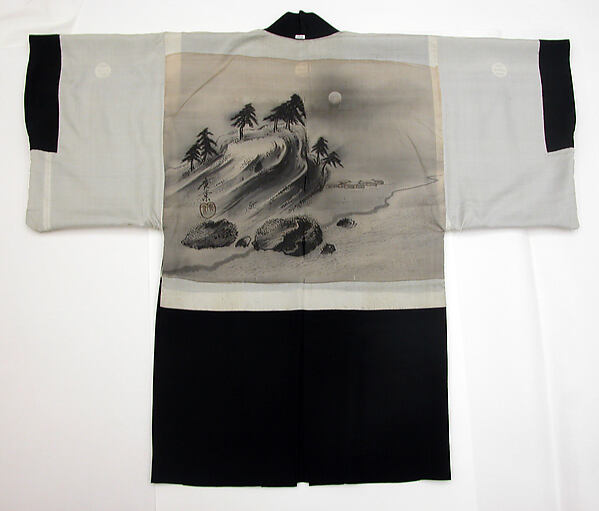
Man's Jacket (Haori), 19th century, White silk tabby lining / Silk tabby,painted. The Metropolitan Museum of Art, Purchase, Seymour Fund, and Mrs. Peter Oliver Gift, 1978, accession 1978.286.
Look closer: Look at the cut. The Met catalogues this as a man's haori of the nineteenth century, in painted silk tabby with a white silk lining.
Image: The Metropolitan Museum of Art, Open Access (CC0)
The table also lists the wrapping cloth, the furoshiki, and the paper envelope, the tatōshi, in which kimono are stored. Both are objects of the cupboard, and appear in the chapters on bags and on care.

Man's Trousers (Hakama), 19th century, Silk & paper silver. The Metropolitan Museum of Art, Gift of George M. Lefferts, 1909, accession 09.188.
Look closer: Look at the pleats. The Met catalogues these as a man's hakama of the nineteenth century, in silk and silvered paper.
Image: The Metropolitan Museum of Art, Open Access (CC0)
| Term | Meaning | Chapter |
|---|---|---|
| Haori | A traditional jacket worn over the kimono | Haori and hakama |
| Hakama | Trouser-like garment, a long, wide, pleated skirt worn as formal wear | Haori and hakama |
| Mo | A wrapped, pleated skirt of the Heian court, later reduced to a trailing train | Court dress |
| Ran | An above-knee skirt of Asuka-period court dress | Court dress |
| Hirami | A heavily pleated contrasting skirt worn below the ran in the Asuka period | Court dress |
| Sashinuki | Men's court trousers with a drawstring at the ankle | Court dress |
| Naga-bakama | Long, trailing hakama with waist ties | Court dress |
| Kanmuri | A stiffened, open-weave black hat worn by male courtiers | Court dress |
| Furoshiki | A wrapping cloth | Sagemono |
| Tatōshi | Acid-free paper envelopes used to store kimono | Care |
What hangs from the sash
Garments without pockets needed other places to carry things, and the answer was to hang them from the obi. Wikipedia describes the inrō as a small stackable case, hung from the men's obi in the Edo period, and the netsuke as the toggle that fastened it. Sagemono is the general word for such hanging bags and boxes, which held tobacco, pipes, ink and the like.

Shibata Zeshin, Case (Inrō) with Fox Wedding Procession, 19th century, Colored lacquer and gold maki-e on wood Netsuke: ivory in form of fox reclining on large leaf; Ojima: gold bead; connecting cord, dark green silk Inro with netsuke and ojime. The Metropolitan Museum of Art, Rogers Fund, 1957, accession 57.53.
Look closer: Look at the lacquer. The Met catalogues this inrō with a fox wedding procession, in coloured lacquer and gold maki-e on wood.
Image: The Metropolitan Museum of Art, Open Access (CC0)
The Met holds many such objects, and some of its netsuke are carved as Noh masks. The whole family is treated in Netsuke, Inrō and Sagemono: The Hanging Objects.

Netsuke of Noh Mask, 19th century, Wood with metal eyes and teeth. The Metropolitan Museum of Art, Gift of Mrs. Russell Sage, 1910, accession 10.211.2457.
Look closer: Look at the face. The Met catalogues this netsuke as a Noh mask in wood with metal eyes and teeth.
Image: The Metropolitan Museum of Art, Open Access (CC0)
| Term | Meaning | Chapter |
|---|---|---|
| Sagemono | A general term for hanging bags and boxes for tobacco, pipes, ink and the like | Sagemono |
| Inrō | A small stackable, box-shaped case hung from the men's obi in the Edo period | Sagemono |
| Netsuke | The toggle that fastened an inrō to the obi | Sagemono |
Socks, sandals and clogs
The feet have their own vocabulary. Tabi are white cotton split-toe socks; zōri are sandals with a sturdy base; geta are wooden-soled sandals, made for snow or dirt; and the hanao is the strap, which may be embroidered or woven with gold or silver. Wikipedia says the okobo, also called pokkuri, is worn by girls at Shichi-go-san and by young women on Coming of Age Day.

Ryūryūkyo Shinsai, Umbrellas and Geta (Japanese Wooden Sandals), probably 1816, Part of an album of woodblock prints (surimono); ink and color on paper. The Metropolitan Museum of Art, H. O. Havemeyer Collection, Bequest of Mrs. H. O. Havemeyer, 1929, accession JP2315.
Look closer: Look at the clogs. The Met catalogues this print of umbrellas and geta, probably of 1816, as part of an album of surimono.
Image: The Metropolitan Museum of Art, Open Access (CC0)
The Met's print of umbrellas and geta, below, belongs to a surimono album and shows the sandal as an object of pleasure as well as use. The shoes are treated at length in Geta, Zōri and Tabi: The Footwear of the Kimono.
| Term | Meaning | Chapter |
|---|---|---|
| Tabi | White cotton split-toe socks worn with the kimono | Footwear |
| Zōri | A flip-flop-like sandal with a sturdier base, sometimes with a gentle heel | Footwear |
| Hanao | The decorated strap of a zōri, sometimes embroidered or woven with gold or silver | Footwear |
| Geta | Wooden-soled sandals made for snow or dirt | Footwear |
| Okobo, pokkuri | Footwear worn by girls at Shichi-go-san and by young women on Coming of Age Day | Shichi-go-san |
Fabrics and dyes
The cloths of the kimono have their own names. Gofuku is the word for silk kimono cloth and for the kimono in general, and futomono, thick materials, the word for cotton and hemp. Rinzu is a damask, chirimen a crepe, and ro a summer weave with leno stripes. Meisen, Wikipedia says, was an affordable ready-to-wear silk woven from waste or raw silk thread, popular after the earthquake of 1923, and momi a red lining dyed with safflower.

Textile with Spotted Dyeing (kanoko shibori), Resist-dyed plain-weave bast-fiber (asa) crepe. The Metropolitan Museum of Art, Gift of Sue Cassidy Clark, in honor of Dr. Barbara Brennan Ford, 2008, accession 2008.335.10.
Look closer: Look at the spots. The Met catalogues this textile with spotted dyeing, kanoko shibori, in resist-dyed bast-fibre crepe.
Image: The Metropolitan Museum of Art, Open Access (CC0)
Two dyeing words are famous. Shibori is tie-dyeing, and kasuri an ikat in which the threads are dyed before weaving. The Met holds a textile with spotted dyeing, called kanoko shibori, and a cloth with a pattern of round fans in warp and weft kasuri, both shown here. The cloths are treated in Silk, Hemp, Cotton and Ramie: The Fibres of Japanese Dress, Shibori: The Art of the Bound Cloth and Kasuri: Ikat Woven from Dyed Thread.

Piece of Cloth for Kimono with Pattern of Round Fans (Uchiwa), Bamboo, and Interrupted Stripes, 19th century, Plain-weave asa with warp and weft kasuri (ikat ) patterning. The Metropolitan Museum of Art, Seymour Fund, 1966, accession 66.122.12.
Look closer: Look at the pattern. The Met catalogues this piece of cloth for a kimono as a plain-weave asa with warp and weft kasuri, nineteenth century.
Image: The Metropolitan Museum of Art, Open Access (CC0)
| Term | Meaning | Chapter |
|---|---|---|
| Gofuku | The term for silk kimono cloth and for the kimono in general | Fibres |
| Futomono | The term for cotton and hemp cloths, meaning thick materials | Fibres |
| Rinzu | A damask cloth favoured for kimono | Nishijin |
| Chirimen | Silk crepe used for kimono | Fibres |
| Ro | A plain-weave cloth with leno stripes, worn in midsummer | Seasons |
| Meisen | Affordable ready-to-wear silk woven from waste or raw silk thread, popular after the 1923 earthquake | Fibres |
| Momi | A silk lining cloth dyed with safflower, red | Fibres |
| Shibori | Tie-dyeing, a resist technique | Shibori |
| Kasuri | Ikat; threads are dyed before weaving | Kasuri |
| Sashiko | Decorative stitching that also holds cloth together | Sashiko and boro |
Crests, seasons and manners
Some terms name ideas and not objects. The mon, or kamon, is the family crest, and Wikipedia says its number and style affect formality: the hinata kamon, filled with white, is the most formal, and the faint outline of the kage kamon the least. Koromogae is the seasonal changing of clothes, and kitsuke is the manner of dressing in a kimono.
The article also lists iki, an aesthetic that prizes subtle, understated display of wealth, and names the chōnin, the merchant classes of the Edo period, who favoured it. The crest is the subject of Mon: The Family Crests on Japanese Dress, the seasons of Seasons and Occasions: What to Wear When.
| Term | Meaning | Chapter |
|---|---|---|
| Mon, kamon | Family crests, whose number and style indicate formality | Mon |
| Hinata kamon | The most formal crest style, filled in with white | Mon |
| Kage kamon | The least formal crest style, a faint outline | Mon |
| Ryōzuma | Mirrored placement of a motif along the back seam, typical of older kimono | Kimono ladder |
| Koromogae | The seasonal changing of clothes | Seasons |
| Kitsuke | The way a kimono is put on, literally dressing | Care |
| Iki | A design aesthetic that prizes subtle, understated display of wealth | Motifs |
| Chōnin | The merchant classes of the Edo period | Kimono ladder |
| Gofukuya | A traditional kimono shop | Kimono ladder |
| Sanchi | Kimono-producing regions | Regional textiles |
Words of the court and the warrior
The terms below come from the chapters on court dress and on samurai dress. They include the layered robes and black cap of the imperial court, and the sleeveless jacket, the surcoat worn over armour and the formal dress of the warrior class. Terms already given in earlier tables are not repeated.
Read them with Court Dress: Jūnihitoe and Sokutai and Samurai Ceremonial Dress: Hitatare and Kamishimo, where each is set in its place.
| Term | Meaning | Chapter |
|---|---|---|
| Sokutai | Formal court dress of men | Court dress |
| Jūnihitoe | Formal court dress of women, formally itsutsuginu-karaginu-mo | Court dress |
| Hō | Outer robe of the sokutai, from the Chinese round-collared robe | Court dress |
| Kanmuri | The black lacquered silk cap with a pennon | Court dress |
| Shaku | Flat ritual baton, ivory for the emperor | Court dress |
| Ōkuchi-hakama | Long red hakama, tied on the left | Court dress |
| Uenobakama | White hakama with an open fly, tied on the right | Court dress |
| Sashinuki | Hakama blousing over the leg with a hem cord | Court dress |
| Nagabakama | Long hakama with a trailing train | Court dress |
| Kariginu | The Heian hunting robe | Court dress |
| Jōe | The white kariginu worn by priests | Court dress |
| Itsutsuginu | The five coloured layered robes | Court dress |
| Uchiginu | Scarlet beaten silk stiffener | Court dress |
| Uwagi | Patterned silk over-robe indicating rank | Court dress |
| Karaginu | Waist-length Chinese-style jacket | Court dress |
| Mo | Trailing apron-like train skirt | Court dress |
| Kouchigi | Shorter brocade robe for less formal occasions | Court dress |
| Kasane no irome | Named layered colour combinations | Court dress |
| Suberakashi | The long layered women's hair | Court dress |
| Hikimayu | Eyebrows redrawn high on the forehead | Court dress |
| Ohaguro | Blackened teeth | Court dress |
| Sudare | The blind behind which a lady sat | Court dress |
| Hiōgi | Fan of painted cypress slats | Court dress |
| Saiō-dai | The woman of the Aoi Matsuri who wears the twelve layers | Court dress |
| Hitatare | The long-sleeved jacket and hakama that became standard samurai dress | Samurai dress |
| Eboshi | The court cap worn with hitatare and suō | Samurai dress |
| Daimon | A hitatare with a large crest in five places | Samurai dress |
| Suō | A hitatare simplified; the shogunate's formal dress with the eboshi | Samurai dress |
| Kataginu | The sleeveless jacket with winged shoulders | Samurai dress |
| Kamishimo | Kataginu and hakama together | Samurai dress |
| Han-kamishimo | Kamishimo with normal-length hakama | Samurai dress |
| Naga-kamishimo | Kamishimo with long hakama | Samurai dress |
| Hakama | Pleated divided or undivided skirt-trousers | Samurai dress |
| Koshi-ita | The rigid board at the back of the hakama | Samurai dress |
| Sendaihira | The most formal striped silk for men's hakama | Samurai dress |
| Naga-hitatare | Ceremonial dress of the shogun and highest daimyo in the castle | Samurai dress |
| Gosanke | The three great Tokugawa houses | Samurai dress |
| Sankin-kōtai | Alternate attendance of daimyo in Edo | Samurai dress |
| Honmaru | The main compound of Edo Castle | Samurai dress |
| Jinbaori | Sleeveless surcoat over armour | Samurai dress |
| Kōken | Stage attendants in the Noh | Samurai dress |
| Goshodoki | Palace-court style kimono with landscapes | Samurai dress |
| Tsuma moyō | Decoration from the waist down | Samurai dress |
Words of the temple and the shrine
The vestments of Buddhist priests and Shinto officiants have a vocabulary of their own, drawn here from the chapter on priests' robes. It includes the patchwork robe, the stole and the garments of the shrine.
Read them with Kesa, Kariginu and the Robes of Priests and Monks.
| Term | Meaning | Chapter |
|---|---|---|
| Kesa | The patchwork Buddhist vestment worn over the left shoulder | Priests |
| Kāṣāya | The Sanskrit name of the monk's robe | Priests |
| Ticīvara | The triple robe of early Buddhism | Priests |
| Kassetsue | The patchwork of the Japanese kesa | Priests |
| Jikitotsu | The long robe worn under the kesa | Priests |
| Shichijō kesa | A seven-panel kesa | Priests |
| Kujō kesa | A nine-panel kesa | Priests |
| Karaori | Brocaded silk with long floating wefts, used for Noh costumes and kesa | Priests |
| Chinsō | A realistic portrait of a Zen abbot | Priests |
| Ōnusa | A wand with white paper streamers | Priests |
| Shide | White paper streamers | Priests |
| Kaii | The five ranks of a Shinto priest | Priests |
| Shokkai | The hierarchy of positions in a shrine | Priests |
| Miko | A shrine maiden | Priests |
| Hi-bakama | Red hakama of the miko | Priests |
| Chihaya | A garment worn over the kosode during kagura | Priests |
| Yamabushi | Mountain ascetics of Shugendō | Priests |
| Horagai | The conch shell blown by yamabushi | Priests |
Words of the stage and the teahouse
The terms of Noh and kabuki costume, of the geisha and the maiko, and of the child's festival of Shichi-go-san are gathered here. They come from the chapters on those subjects, each of which was built from Met catalogue entries and from Wikipedia.

Trousers ("hakama") associated with Kyogen, late 19th century, Hemp. The Metropolitan Museum of Art, Purchase, Proceeds from Sale: Japanese Art, 1991, accession 1991.135.
Look closer: Look at the hemp. The Met catalogues these as hakama associated with Kyogen, of the late nineteenth century, in hemp.
Image: The Metropolitan Museum of Art, Open Access (CC0)
Read them with Noh Costume: Karaori, Atsuita and Mizugoromo, Kabuki Costume: Hikinuki and the Onnagata Layers, Geisha, Maiko and Oiran: The Costume of the Quarter and Shichi-Go-San and the Clothes of Childhood Rites.
| Term | Meaning | Chapter |
|---|---|---|
| Shōzoku | Costume | Noh costume |
| Shite | The lead actor | Noh costume |
| Atsuita | Twill-brocade robe for male leads | Noh costume |
| Nuihaku | Embroidery and metal leaf on satin, worn beneath | Noh costume |
| Surihaku | Metal leaf pressed on stencilled paste | Noh costume |
| Chōken | Gauze robe with gold supplementary wefts | Noh costume |
| Happi | Noh warrior's outer jacket | Noh costume |
| Mizugoromo | Distressed three-quarter-length overgarment | Noh costume |
| Kazura-obi | The wig band | Noh costume |
| Iroiri | Costume with red, for young women | Noh costume |
| Ironashi | Costume without red, for older women | Noh costume |
| Kinagashi | Style with the upper part folded to show the under-kimono | Noh costume |
| Koshimaki | Waist wrap; the robe folded down at the waist | Noh costume |
| Koshi-ake | A blank waist left unembroidered | Noh costume |
| Monzukushi | A pattern of many crests | Noh costume |
| Ishō | Costume | Kabuki costume |
| Kabukimono | The flamboyant street gangs whose name gave kabuki its own | Kabuki costume |
| Onnagata | A male actor in a female role | Kabuki costume |
| Wakashū | Roles for adolescent men | Kabuki costume |
| Murasaki bōshi | The small purple scarf over a shaved head | Kabuki costume |
| Katsura | The wig, on a hand-beaten copper base | Kabuki costume |
| Oshiroi | The white rice-powder foundation | Kabuki costume |
| Kumadori | Exaggerated face lines in colour | Kabuki costume |
| Aragoto | The rough, bold style founded by Danjūrō I | Kabuki costume |
| Mie | A held pose of the actor | Kabuki costume |
| Sanshō | The three-square crest of the Naritaya | Kabuki costume |
| Hikinuki | A stagehand pulls the outer robe away on stage | Kabuki costume |
| Bukkaeri | A related reveal of a costume beneath | Kabuki costume |
| Hayagawari | A rapid change of costume with assistants | Kabuki costume |
| Kuroko | Stagehands in black, treated as invisible | Kabuki costume |
| Hengemono | A change piece, as in Musume Dōjōji | Kabuki costume |
| Uchikake | An outer robe worn open over the layers | Kabuki costume |
| Yakusha-e | An actor print | Kabuki costume |
| Geisha | A woman entertainer of music and dance | Geisha and oiran |
| Geiko | The Kyoto and western Japan word for a geisha | Geisha and oiran |
| Maiko | An apprentice geiko, woman of dance | Geisha and oiran |
| Hangyoku | The Tokyo term for an apprentice | Geisha and oiran |
| Hanamachi | A geisha district, literally flower town | Geisha and oiran |
| Yūkaku | A licensed pleasure district | Geisha and oiran |
| Okiya | The house in which geisha and apprentices live | Geisha and oiran |
| Hikizuri | The formal kimono with a trailing hem | Geisha and oiran |
| Furisode | A long-sleeved kimono for young women | Geisha and oiran |
| Darari obi | The maiko's very long sash | Geisha and oiran |
| Fukuro obi | A shorter, narrower obi worn by geisha | Geisha and oiran |
| Otokoshi | The male dresser who ties a maiko's obi | Geisha and oiran |
| Erikae | The turning of the collar, the graduation to geisha | Geisha and oiran |
| Eri-ashi | The two stripes of bare nape a maiko shows | Geisha and oiran |
| Beni | Red pigment used under the lip colour | Geisha and oiran |
| Nihongami | Traditional Japanese hairstyles | Geisha and oiran |
| Takamakura | The raised wooden pillow | Geisha and oiran |
| Okobo | Platform clogs worn by apprentices | Geisha and oiran |
| Koma geta | The oiran's three-toothed clogs | Geisha and oiran |
| Manaita obi | The cutting-board obi, wide and stiff | Geisha and oiran |
| Dōchū | The procession of the oiran | Geisha and oiran |
| Tayū | The highest rank of oiran | Geisha and oiran |
| Iki | A restrained aesthetic of the Edo merchants | Geisha and oiran |
| Shichi-Go-San | The festival of seven, five and three, held on 15 November | Shichi-go-san |
| Kazoedoshi | The traditional way of counting age, adding a year each New Year's Day | Shichi-go-san |
| Kamioki | Hair-leaving, the rite for three-year-olds | Shichi-go-san |
| Hifu | A padded vest worn by three-year-old girls over the kimono | Shichi-go-san |
| Hakamagi-no-gi | The rite of the first hakama for five-year-old boys | Shichi-go-san |
| Hera | The spoon-shaped piece that holds the hakama in place | Shichi-go-san |
| Obitoki-no-gi | The rite of the first obi for seven-year-old girls | Shichi-go-san |
| Kata-nuiage | Shoulder tucks that were let out as a child grew | Shichi-go-san |
| Koshi-nuiage | The hip overfold in a child's kimono | Shichi-go-san |
| Asa | Bast fibre cloth, the Met's term for the child's kimono | Shichi-go-san |
| Tai | Sea bream, whose name echoes medetai, meaning joyous | Shichi-go-san |
| Miya mairi | The first presentation of a baby at a shrine | Shichi-go-san |
| Tamagushi | A sacred branch offered by the priest and family | Shichi-go-san |
| Tango no sekku | The festival on the fifth day of the fifth lunar month, called Boys' Day | Shichi-go-san |
| Chitose-ame | Thousand-year candy given to children on the day | Shichi-go-san |
| Sujime-gaki | White-line drawing, the technique of Jakuchū's turtles | Shichi-go-san |
Words of the north and the south
The Ainu and Ryukyuan vocabulary, and the terms of regional cloths from Kyoto to Okinawa, are set out here, together with the terms of the chapter on care and storage.
Read them with Ainu Attus and the Dress of the North and South, Regional Textiles from Kyoto to Okinawa and How to Read, Grade and Care for a Japanese Garment.
| Term | Meaning | Chapter |
|---|---|---|
| Ainu | A human being; the indigenous people of Hokkaido, Sakhalin and the Kurils | Ainu and Ryukyu |
| Kamuy | Divine beings, in Ainu belief | Ainu and Ryukyu |
| Ainu Mosir | The land of the Ainu | Ainu and Ryukyu |
| Attus, attush | A robe of woven bark fibre | Ainu and Ryukyu |
| Kiri-fuse | Japanese term for appliqué, used in the Met catalogue | Ainu and Ryukyu |
| Atsushi | The Met's term for indigo-dyed tabby appliqué | Ainu and Ryukyu |
| Tepa | A loincloth | Ainu and Ryukyu |
| Tekunpe | Gloves or mittens | Ainu and Ryukyu |
| Konci | A hood | Ainu and Ryukyu |
| Hos | Leggings | Ainu and Ryukyu |
| Raun kut, upsoro kut | A sacred girdle worn by women | Ainu and Ryukyu |
| Matanpushi | A woman's embroidered headband | Ainu and Ryukyu |
| Sapanpe | A man's ceremonial crown | Ainu and Ryukyu |
| Hetmuye | A Sakhalin woman's ritual headdress | Ainu and Ryukyu |
| Tamasay | A beaded necklace | Ainu and Ryukyu |
| Ninkari | Earrings | Ainu and Ryukyu |
| Ezo nishiki | The Japanese name for Chinese silk that reached the Ainu | Ainu and Ryukyu |
| Matsumae | The clan with exclusive trading rights with the Ainu | Ainu and Ryukyu |
| Bingata | Stencil-resist dyeing of the Ryukyu Islands | Ainu and Ryukyu |
| Bashofu | Banana-fibre cloth of the Ryukyu Islands | Ainu and Ryukyu |
| Matsukawabishi | A pattern named for pine bark, in broken diamonds | Ainu and Ryukyu |
| Ori | Weaving, or a woven cloth | Regional textiles |
| Tsumugi | Silk spun from short or damaged fibres, and the cloths woven from it | Regional textiles |
| Kasuri | Ikat; thread resist-dyed before weaving so that a splash pattern forms | Regional textiles |
| Kongasuri | Dark blue kasuri with white splash patterns | Regional textiles |
| Jōfu | Fine hemp or ramie linen | Regional textiles |
| Chijimi | A crepe cloth with a tightly twisted weft | Regional textiles |
| Bashōfu | Cloth woven from the fibre of the banana plant | Regional textiles |
| Jibata | A loom on which a waist strap adjusts the tension | Regional textiles |
| Sorahikibata | The draw loom used before the Jacquard | Regional textiles |
| Tsumekaki | The fingernail technique used to draw the weft in | Regional textiles |
| Kenjō-gara | The patterned stripe of the Hakata obi | Regional textiles |
| Igisu | A seaweed-based paste used to coat threads | Regional textiles |
| Techigi | The tree whose bark dye reacts with the mud | Regional textiles |
| Tanmono | The standard bolt of kimono cloth | Care |
| Shitsuke ito | Long basting stitches on a new kimono | Care |
| Kise | The small lip that hides the stitches | Care |
| Toki arai | Washing each separated piece | Care |
| Arai hari | Stretching washed cloth on a board to dry | Care |
| Erisao | A kimono hanger, or pole | Care |
| Mushiboshi | The traditional airing against mould and insects | Care |
| Tatōshi | The washi paper wrapper for kimono and obi | Care |
| Washi | Paper made from the fibres of the paper mulberry | Care |
| Tansu | A chest of drawers for clothes | Care |
| Hana-goza | A decorative tatami mat used as a folding surface | Care |
| Ikō | A lacquer stand for hanging a kimono | Care |
| Hake | A soft brush for surface dust | Care |
| Nagajuban | The under-kimono | Care |
| Han'eri | The replaceable collar cover on the under-kimono | Care |
| Tagasode | A screen genre showing only robes and furnishings | Care |
Four tales of words
A thing to wear. The word kimono, Wikipedia explains, means a thing to wear, a plain name for the garment that has come to stand for the whole country.
The false layer. The hiyoku looks like a second garment but is sewn into the first, a reminder that appearance was part of the design of dress.
A knot that spoke. The puffed-sparrow knot of the furisode, Wikipedia says, traditionally signalled that a woman was available for marriage, so that a garment carried a message without a word.
The stiff and the soft. Wikipedia observes that modern obi are stiffer than old ones, which is why flat ties such as the himo are used to keep the kimono closed beneath them.
Small surprises from the word list
Short facts from the sources, each given as the source gives it.
- A kimono is worn wrapped left over right, according to Wikipedia.
- The darari obi of a maiko can bear the crest of her house at its end.
- The kobukuro obi is the unlined form of the half-width hoso obi.
- The kyōbukuro obi was devised in Nishijin, Kyoto, in the 1970s.
- The taiko musubi is named for a drum.
- Okobo, or pokkuri, are worn at Shichi-go-san and on Coming of Age Day.
- Meisen silk became popular after the earthquake of 1923.
- The momi lining is dyed with safflower.
- The tanmono, the bolt of cloth for a kimono, is long and narrow.
- The shigoki obi once tied up excess length and is now decorative.
- The men's sanjaku obi is named for its length of about three old Japanese feet.
- Sagemono is the general word for bags and boxes that hang from the sash.
Using the glossary now
A glossary is most useful in front of an object. A reader holding a garment, a catalogue entry or a shop label can look up the words here, find the chapter that explains them and compare them with the object. The condition scale in How to Read, Grade and Care for a Japanese Garment uses many of the same words.
Words also change. Wikipedia notes that some forms have fallen out of use: the maru obi is now worn mostly by brides and maiko, and the nakagi is known from before the war. The glossary records both, and a living vocabulary will go on growing.
Reading a label with these words
A museum label or a dealer's note is usually a string of these terms, and they can be decoded in order: the type of garment, the cloth, the technique, the motif and the date. A furisode in silk crepe with yūzen and embroidery is a young woman's long-sleeved robe, in a crepe cloth, painted with paste resist and stitched.
Where the words and the object disagree, trust the object. The house's concierge desk is glad to help decode a label on request.
Neighbouring chapters
The garments are in The Kimono Ladder: Furisode, Tomesode, Hōmongi and Komon, Uchikake and Shiromuku: The Bridal Robes, Haori and Hakama: The Jacket and the Divided Skirt, Happi, Hanten and the Fire Brigade Coat, Jinbaori: The Warlord’s Surcoat, Noragi and the Clothes of Work and Yukata: The Summer Cotton Robe. The accessories are in Obi and Its Companions: Scarf, Cord and Brooch, Kanzashi, Combs and the Dressed Head, Geta, Zōri and Tabi: The Footwear of the Kimono, Netsuke, Inrō and Sagemono: The Hanging Objects and Sensu and Uchiwa: The Fan in Dress. The techniques are in Yūzen: The Painted Kimono, Shibori: The Art of the Bound Cloth, Kasuri: Ikat Woven from Dyed Thread, Tsutsugaki and Katazome: Paste and Stencil, Nishijin: The Woven Brocades of Kyoto, Sashiko and Boro: The Mended Cloth, Aizome: The Indigo Dyer’s Craft, Embroidery and Gold Leaf on Japanese Cloth and Silk, Hemp, Cotton and Ramie: The Fibres of Japanese Dress. The reading chapters are A Motif Dictionary: Crane, Pine, Wave and Chrysanthemum, Mon: The Family Crests on Japanese Dress, Seasons and Occasions: What to Wear When, Regional Textiles from Kyoto to Okinawa and How to Read, Grade and Care for a Japanese Garment.
The costume chapters are Noh Costume: Karaori, Atsuita and Mizugoromo, Kabuki Costume: Hikinuki and the Onnagata Layers, Court Dress: Jūnihitoe and Sokutai, Samurai Ceremonial Dress: Hitatare and Kamishimo, Kesa, Kariginu and the Robes of Priests and Monks, Shichi-Go-San and the Clothes of Childhood Rites, Geisha, Maiko and Oiran: The Costume of the Quarter and Ainu Attus and the Dress of the North and South. Among the house's other pages, the Fashionista Bible follows the wider story of Japanese dress.
Garments named in this glossary
The shelf holds an over-robe, a jacket and a brocade, each described on its own page with its age, maker and condition.


Kimono and textile heritage
The house's collection of kimono and textile heritage is the companion to this glossary, and the concierge desk can look for related pieces on request.
Answered plainly
What does kimono mean?
A thing to wear. Wikipedia describes it as Japan's traditional national garment, a wrapped-front robe with a rectangular body and square sleeves.
What is an obi?
The broad sash worn over the kimono, made in many forms from the formal maru obi to the informal hanhaba obi.
What is the difference between a furisode and a tomesode?
The furisode has long swinging sleeves and is worn by young, usually unmarried, women; the tomesode has a design only from the waist to the hem.
What is a hōmongi?
A semi-formal silk kimono whose motifs run across the seams.
What is a juban?
An under-kimono worn beneath the outer kimono, with a removable collar called a han'eri.
What is a haori?
A traditional jacket worn over the kimono.
What is a hakama?
A wide, pleated, trouser-like skirt worn as formal wear.
What are tabi?
White cotton split-toe socks worn with the kimono.
What is the difference between zōri and geta?
Zōri are flat sandals with a sturdier base; geta are wooden-soled sandals made for snow or dirt.
What is a netsuke?
The toggle that fastened an inrō, a small stackable case, to the men's obi.
What is a mon?
A family crest, whose number and style indicate formality.
What is kasuri?
An ikat in which threads are dyed before they are woven.
What is shibori?
Tie-dyeing, a resist technique.
What is koromogae?
The seasonal changing of clothes.
What is a tanmono?
The long, narrow bolt of cloth from which a kimono is traditionally cut.
Where next
Sources and image credits
- Japanese clothing, Wikipedia
- Kimono, Wikipedia
- Obi (sash), Wikipedia
- Object record: Kimono, The Metropolitan Museum of Art
- Object record: Furisode, The Metropolitan Museum of Art
- Object record: Over-Robe (Uchikake), The Metropolitan Museum of Art
- Object record: Woman's Obi, The Metropolitan Museum of Art
- Object record: Obi with Stylized Waves, The Metropolitan Museum of Art
- Object record: Man's Jacket (Haori), The Metropolitan Museum of Art
- Object record: Man's Trousers (Hakama), The Metropolitan Museum of Art
- Object record: Case (Inrō) with Fox Wedding Procession, The Metropolitan Museum of Art
- Object record: Netsuke of Noh Mask, The Metropolitan Museum of Art
- Object record: Umbrellas and Geta (Japanese Wooden Sandals), The Metropolitan Museum of Art
- Object record: Textile with Spotted Dyeing (kanoko shibori), The Metropolitan Museum of Art
- Object record: Piece of Cloth for Kimono with Pattern of Round Fans (Uchiwa), Bamboo, and Interrupted Stripes, The Metropolitan Museum of Art
- Object record: Trousers ("hakama") associated with Kyogen, The Metropolitan Museum of Art
Last reviewed 28 October 2026. Pictures, where shown, are public-domain or open-access and credited beneath each one.
Looking for a garment you have met in a glossary? The concierge desk replies within one to three business days.
Private concierge
Looking for something in particular?
Describe the piece or the project you have in mind. A senior advisor in Tokyo reads every case file personally and replies within two business days, with fees set out in writing before any work begins.