
Embroidery and Gold Leaf on Japanese Cloth
Techniques · Needle and foil
Embroidery and Gold Leaf on Japanese Cloth
刺繍・摩箔
Silk thread laid on silk, and a skin of metal pressed into paste: the two ways a plain ground was made to shine.
Fact sheet
The two crafts in one glance
- Nui. Free-style embroidery in silk and metal threads on delicate silk.
- Surihaku. Metal leaf applied to the ground material.
- Nuihaku. Fine embroidery on a metal-leaf ground, worn at the waist in Noh.
- Judging. Technique, design, colour and the choice among 43 traditional methods.
- Finishing. Wheat starch is applied to the front and steamed to give strength and shine.
Sewing before the Meiji era
The Textile Research Centre in Leiden explains that Japanese embroidery, nihon shishu, uses silk and metal threads on delicate silk fabrics, and that it is generally done irrespective of the ground material, which it calls free-style embroidery. Before the Meiji era, of 1868 to 1912, it was known as nui, which means sewing; after European techniques were introduced it became known as nihon shishu. It was originally used mainly for garments worn at religious ceremonies and became over the centuries a widely accepted art form that is still popular among many Japanese people.

Robe (Kosode) with Shells and Sea Grasses, early 17th century, Embroidery and gold leaf on plain-weave silk patterned with warp floats. The Metropolitan Museum of Art, Gift of Mr. and Mrs. Paul T. Nomura, in memory of Mr. and Mrs. S. Morris Nomura, 1992, accession 1992.253.
Look closer: Look at the sandbanks. The Met says the ground was resist-dyed to suggest irregular sandbanks and the marine motifs embroidered on top.
Image: The Metropolitan Museum of Art, Open Access (CC0)
The page names Kyoto as one of the main centres of embroidery production, Kyo-nui being the general term for Kyoto embroidery. Embroidery is used on kimono and many other garments and textiles, including fukusa, or coverings, wall hangings and bedspreads. The process begins with a drawing made on the fabric; thread colours are chosen according to the pattern, the season the garment is meant for, and the wearer’s age and gender. The embroidery is done on a frame, excess threads on the reverse are cut off, and the front is covered with wheat starch and smoothed with steam to make the threads stronger and shiny.
The same source says that embroidery is assessed on four elements: the technique, the designs, the colours, and the selection of one or more of the forty-three traditional embroidery methods. The page does not list the methods, and this chapter does not guess at them; it is enough to say that a craft judged on the choice among forty-three has a vocabulary far beyond what a casual viewer can name.
A shore on a sleeve
The Met’s kosode with shells and sea grasses, of the early seventeenth century, is among the earliest surviving garments of its kind. It is embroidery and gold leaf on plain-weave silk patterned with warp floats, 153.7 by 124.5 centimetres, given by Mr and Mrs Paul T. Nomura in memory of Mr and Mrs S. Morris Nomura in 1992. The description says that the robe is among the earliest surviving kosode, a garment with small sleeve openings, and that its embroidered design draws on Japan’s coastline, with beaches strewn with shells and sea grass. The foundation fabric, a key-fret pattern with floral motifs, was likely imported from China undecorated; it was then resist-dyed to suggest irregular sandbanks, and the marine motifs were embroidered on top, with alternating bands of light blue carrying gold-leaf accents.
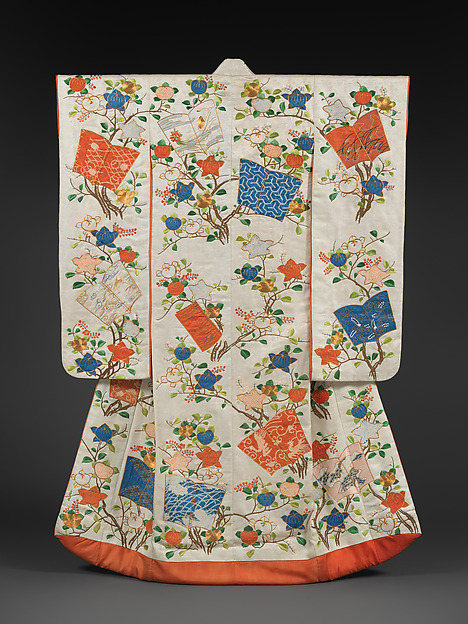
Woman's Overrobe (Uchikake) with Books and Mandarin Orange Branches, first half of the 19th century, Embroidery in silk and metallic thread; appliqué of resist-dyed (shibori) silk fabrics on silk satin damask. The Metropolitan Museum of Art, Gift of Mr. and Mrs. Earl Morse, 1972, accession 1972.18.
Look closer: Look at the books. The Met says they reflect the growth of publishing and literacy in the Edo period.
Image: The Metropolitan Museum of Art, Open Access (CC0)
A second Met piece, from a seventeenth-century kosode, is silk and metallic thread embroidery on silk satin, in two fragments. The description says that it is a fragment from a full-length robe decorated with yukiwa, snow roundels, a stylised pattern that emerged in the Edo period; the roundels contain small embroidered flowers, including chrysanthemums, some of which seem to have roots. It adds that other pieces from the same robe are held by the Nomura Collection of the National Museum of Japanese History in Sakura, Japan, a reminder that garments were cut up and their parts preserved separately.
The uchikake with books and mandarin orange branches, of the first half of the nineteenth century, adds a third pattern. It is embroidery in silk and metallic thread with appliqué of resist-dyed shibori silk fabrics on silk satin damask, about 177.8 centimetres long. The books have different decorative covers among mandarin orange branches bearing fruit and flowers; the museum says they reflect the growth of publishing and literacy in the Edo period, and that their poetic and congratulatory motifs recall Heian-period aristocratic culture and auspicious celebratory patterns. It points to dewy autumn grasses on a red book on the back of the right sleeve and cranes in flight on a white book on the back of the left, and notes that in the late Edo period wealthy merchant families had robes like this made as formal wear for their daughters’ weddings and other special occasions.
Foil pressed into paste
The Leiden centre’s short entry on surihaku says that it is a Japanese embroidery technique that uses metal leaf applied to the ground material, and that it was becoming popular in the Momoyama period, of 1568 to 1600. The Met’s Noh costume, surihaku, with water, water plants and leaves, of the nineteenth century, is gold leaf on plain-weave silk, 165.1 by 134.6 centimetres, from the Rogers Fund of 1958. The label explains that Noh robes patterned with metallic leaf are called surihaku, a term that also refers to the textiles themselves. The textile was decorated by applying paste through stencils, pressing gold leaf onto the wet paste, and brushing away the excess once the paste dried; the artful arrangement of the stencils creates a fluid, rhythmic design rather than a static, repeating pattern.
The label adds that the flowing water beneath the plants is often called kanze mizu, ‘Kanze water’, a pattern associated with the Kanze troupe of Noh actors, and that the motif later became the signature of the kabuki actor Sawamura Sōjūrō III, who appears wearing it in a Utagawa Toyokuni woodblock print. It is an example of a textile pattern that crosses from one theatre to another.
Nuihaku, the combination, is described in the Met’s label for a Noh costume with phoenixes and peonies, of the second half of the eighteenth century. Nuihaku are Noh costumes with fine embroidery on a metal-leaf ground, worn at the waist beneath lavish outer robes and used mainly in plays with young female leads; in the Momoyama and early Edo periods they were the most splendid part of the costume and were sometimes worn as outer robes themselves. The phoenix flying through peonies symbolises prosperity, fidelity and good deeds, and the peonies, the king of flowers, represent good fortune and honour. The design is based on a work by Maruyama Ōkyo, 1733 to 1795, a Kyoto painter who combined Western naturalism with East Asian painting traditions. The costume is plain-weave silk with gold leaf and silk-thread embroidery, 157.5 by 132.1 centimetres, from the Joseph Pulitzer Bequest of 1932.
| Term | Meaning | Note from the sources |
|---|---|---|
| Nui | Sewing; the older name for embroidery | Used before the Meiji era |
| Nihon shishu | Japanese embroidery | Silk and metal threads on silk, free-style |
| Surihaku | Metal leaf pressed into stencilled paste | Popular in the Momoyama period |
| Nuihaku | Embroidery on a metal-leaf ground | Worn at the waist in Noh; used for young female roles |
| Kyo-nui | Kyoto embroidery | Kyoto is a main centre |
| Fukusa | Covering cloth | Embroidery is used on these as well as on garments |
Pieces kept and re-sewn
A final Met object shows how valued the needle’s work was. The Noh robe, nuihaku, with a design of butterflies and miscanthus grass in mist, is gold and silver leaf on silk satin damask, with the butterflies in silk embroidery on plain-weave silk, 168.3 by 136.2 centimetres, a gift of Alice Boney in 1966. The label explains that the butterfly has long been a theme in China, appearing in the philosophical Zhuangzi, that the motif flourished in the Tang dynasty, and that Tang examples survive in Japan’s Shōshōin repository; its popularity in Japanese literature and art then lasted for centuries. The embroidered butterflies, the second paragraph says, date to the seventeenth century on the evidence of their style, technique and colouring, and were likely valued highly, since they were preserved and sewn onto a nineteenth-century robe.
That last sentence is the lesson of the chapter. The needle’s work could outlive the ground on which it was sewn, and was therefore cut out and applied to a new robe. A viewer who sees an older motif on a later ground should not assume an error; it may be exactly this kind of preservation. The chapter on How to Read, Grade and Care for a Japanese Garment explains how such repairs and transfers are graded, and the chapter on Sashiko and Boro: The Mended Cloth describes a very different tradition of mending.
The chapter on Noh Costume: Karaori, Atsuita and Mizugoromo places nuihaku and surihaku in the theatre’s wardrobe, and the chapter on Nishijin: The Woven Brocades of Kyoto shows the woven brocade that sits beside them. For the reader building a collection, the sequence of Yūzen: The Painted Kimono and this chapter is natural: the dyed ground is finished by the needle and the leaf.
Within the house, the shelf strip below shows an embroidered bridal uchikake and remade pieces with embroidered and woven motifs. Each is described as what it is, and the concierge desk can look for a particular finish on request.
Needle and leaf at the Met
Robe (Kosode) with Shells and Sea Grasses, early 17th century, Embroidery and gold leaf on plain-weave silk patterned with warp floats. The Metropolitan Museum of Art, Gift of Mr. and Mrs. Paul T. Nomura, in memory of Mr. and Mrs. S. Morris Nomura, 1992, accession 1992.253.
Look closer: Look at the shore. The Met reads the design as Japan’s coastline, with beaches strewn with shells and sea grass.
Image: The Metropolitan Museum of Art, Open Access (CC0)

Piece from a Kosode with Pattern of Scattered Snow Roundels (Yukiwa) Filled with Small Flowers, 17th century, Silk and metallic thread embroidery on silk satin. The Metropolitan Museum of Art, Purchase, Roy R. and Marie S. Neuberger Foundation Inc. and several members of The Chairman's Council Gifts, 2000 Benefit Fund, and funds from various donors, 2001, accession 2001.428.4a, b.
Look closer: Look at the roundels. The Met identifies yukiwa, snow roundels, containing small embroidered flowers including chrysanthemums.
Image: The Metropolitan Museum of Art, Open Access (CC0)

Noh Costume (Surihaku) with Water, Water Plants, and Leaves, 19th century, Gold leaf on plain-weave silk. The Metropolitan Museum of Art, Rogers Fund, 1958, accession 58.97.1.
Look closer: Look at the water. The Met names the flowing pattern kanze mizu, associated with the Kanze troupe.
Image: The Metropolitan Museum of Art, Open Access (CC0)
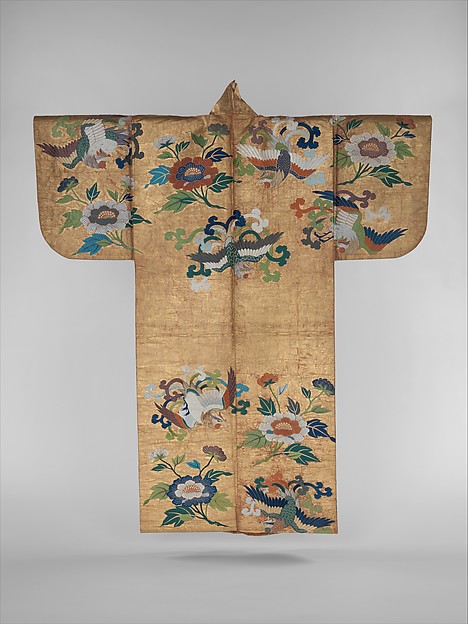
Noh Costume (Nuihaku) with Phoenixes and Peonies, second half 18th century, Plain-waive silk with gold leaf and silk-thread embroidery. The Metropolitan Museum of Art, Purchase, Joseph Pulitzer Bequest, 1932, accession 32.30.3.
Look closer: Look at the phoenix. The Met says the design is based on a work by Maruyama Ōkyo.
Image: The Metropolitan Museum of Art, Open Access (CC0)
Embroidered and woven pieces in the house
The shelf holds an embroidered bridal uchikake, a remade jacket with crane and fan motifs, a brocade piece and a remade furisode. Each is described as what it is, with its age and condition set out plainly on its own page.


Textile heritage
Antique cloth of every kind is gathered in one collection, and the concierge desk can look for a particular finish, subject or region on request.
Answered plainly
What was embroidery called before the Meiji era?
Nui, meaning sewing; nihon shishu came into use after European techniques arrived.
What is surihaku?
A technique in which metal leaf is applied to the ground; the Met describes stencilled paste, pressed leaf and brushing away the excess.
What is nuihaku?
Fine embroidery on a metal-leaf ground, worn at the waist in Noh plays with young female leads.
Where is Japanese embroidery centred?
Kyoto is a main centre; Kyo-nui is the general term.
How is embroidery judged?
On technique, design, colour and the choice among 43 traditional methods.
Why might an old motif sit on a later robe?
Valued embroidery was preserved and sewn onto new grounds, as the Met describes for a Noh robe.
Where next
Sources and image credits
- Japanese Embroidery, Textile Research Centre, Leiden
- Surihaku, Textile Research Centre, Leiden
- Robe (Kosode) with Shells and Sea Grasses, Metropolitan Museum of Art, 1992.253
- Piece from a Kosode with Pattern of Scattered Snow Roundels (Yukiwa) Filled with Small Flowers, Metropolitan Museum of Art, 2001.428.4a, b
- Woman’s Overrobe (Uchikake) with Books and Mandarin Orange Branches, Metropolitan Museum of Art, 1972.18
- Noh Costume (Surihaku) with Water, Water Plants, and Leaves, Metropolitan Museum of Art, 58.97.1
- Noh Costume (Nuihaku) with Phoenixes and Peonies, Metropolitan Museum of Art, 32.30.3
- Noh Robe (Nuihaku) with Design of Butterflies and Miscanthus Grass in Mist, Metropolitan Museum of Art, 66.20
Last reviewed 28 October 2026. Pictures, where shown, are public-domain or open-access and credited beneath each one.
Looking for an embroidered robe, a fragment of old metal-leaf silk or a piece with a particular motif you have seen described here? The concierge desk replies within one to three business days.
Private concierge
Looking for something in particular?
Describe the piece or the project you have in mind. A senior advisor in Tokyo reads every case file personally and replies within two business days, with fees set out in writing before any work begins.