Rare Vintage, Antiques and Art Collector / Curator / Personal Shopper From Japan
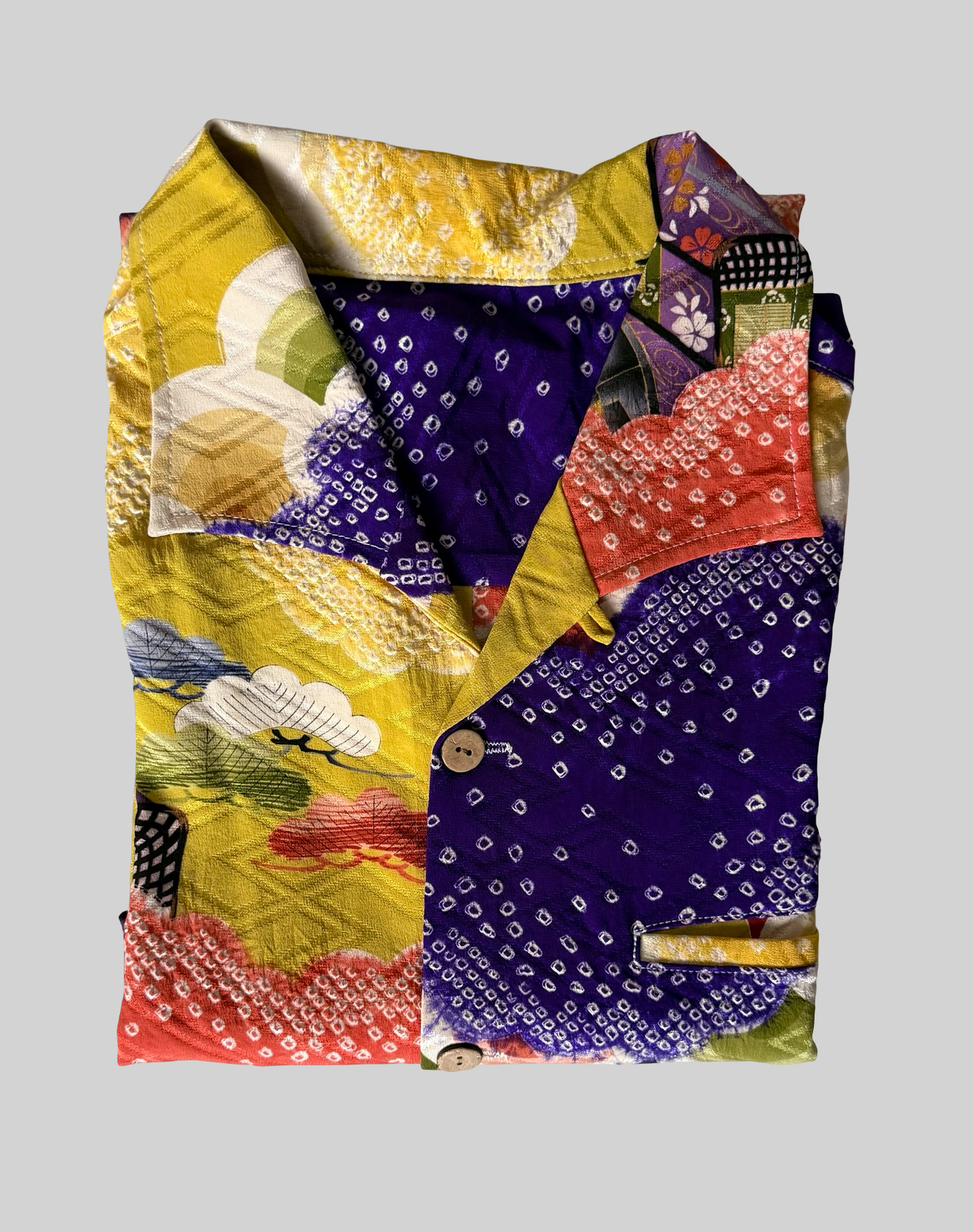
Kimono Remake Silk Aloha Shirt Gosho Guruma Imperial Carriage Shibori Cloud Pattern Handmade Japanese Vintage Textile L
Kimono Remake Silk Aloha Shirt Gosho Guruma Imperial Carriage Shibori Cloud Pattern Handmade Japanese Vintage Textile L
Couldn't load pickup availability
Have a reasonable price in mind? Submit your best offer and our concierge will review it personally.
KIMONO REMAKE SILK ALOHA SHIRT
GOSHO-GURUMA AND SHIBORI CLOUD PATTERN
HAND-CONSTRUCTED FROM VINTAGE FURISODE TEXTILE
A striking example of contemporary textile reinterpretation, the present aloha shirt is constructed from a vintage silk furisode, featuring the auspicious gosho-guruma (imperial carriage) motif set within a dynamic cloud-banding (kumotori) composition.
The surface is further enriched through extensive shibori resist-dye work, producing dense constellations of micro-patterning across the fabric. The transformation into a Western-style shirt with an Italian collar introduces a deliberate structural shift, recontextualizing the original ceremonial textile into a modern wearable form.
Collector’s example combining high-grade silk origin, complex motif layering, and thoughtful reconstruction; representative of the most refined tier within kimono remake practice.
THIS IS NOT A SHIRT — IT IS A DISPLACED TEXTILE SYSTEM
Before it was worn, before it was cut, before it was reassembled into something casual and open-collared—
this was a ceremonial surface.
A furisode textile carries with it a very specific role: it is not neutral cloth. It is encoded with intention, status, and seasonal meaning. Every motif is placed with awareness of movement, drape, and visibility.
When that textile is cut, something irreversible happens.
The garment loses its original form.
But it gains something else:
👉 mobility across time
GOSHO-GURUMA — SYMBOL OF MOTION WITHIN STILLNESS
The imperial carriage motif is rarely static in meaning.
It represents:
- courtly movement
- aristocratic presence
- seasonal procession
Yet here, the carriage floats—not on ground, but within clouds.
This matters.
Because it removes the object from physical space and places it into symbolic space. The carriage is no longer traveling through the world. It is traveling through memory and atmosphere.
CLOUD-BANDING AS STRUCTURAL FIELD
The kumotori (cloud-banding) pattern does not function as decoration.
It is a spatial system.
Instead of creating depth, it creates segmentation:
- blocks of yellow (radiant ground)
- red clusters (dense shibori fields)
- indigo-violet zones (visual anchors)
Each field interrupts the next, producing rhythm rather than continuity.
The eye does not glide across this shirt.
It jumps.
SHIBORI — MICROSCOPIC CONSTELLATION
Within the larger color fields, the shibori technique introduces micro-patterning—thousands of tiny resist-dyed points forming dense constellations.
These are not printed.
They are:
- tied
- resisted
- dyed
- released
Each dot is the result of physical tension applied to cloth.
👉 This is labor encoded into surface.
When viewed from a distance, it reads as texture.
Up close, it becomes evidence of process.
THE CUT — WHERE TRADITION IS BROKEN (AND REASSEMBLED)
The transformation from kimono to aloha shirt is not translation. It is disruption.
A kimono is constructed to:
- wrap
- fold
- align along a vertical axis
This shirt does the opposite:
- it opens
- it centers
- it flattens
Patterns that were once meant to flow diagonally across a moving body are now locked into a frontal grid.
And yet—
the original rhythm remains visible.
You can still feel where the textile wanted to move.
ITALIAN COLLAR — THE SECOND CULTURAL SHIFT
The Italian collar introduces a second layer of displacement.
Now the garment sits between:
- Japanese ceremonial textile
- Western casual tailoring
- Tropical aloha shirt language
This is not fusion.
It is coexistence without resolution.
The silk still speaks of formality.
The silhouette insists on ease.
COLOR AS EMOTIONAL TEMPERATURE
This piece does not behave like typical kimono tones.
It is louder.
- yellow radiates outward (solar field)
- red clusters intensify (heat zones)
- indigo grounds the composition (cool counterweight)
This is not harmony.
It is controlled imbalance.
And that imbalance creates presence.
WHY THIS IS RARE (BEYOND “HANDMADE”)
There are thousands of kimono remake shirts.
Very few operate at this level.
Because rarity here depends on three conditions:
- Textile quality (furisode-grade silk)
- Motif complexity (gosho-guruma + shibori layering)
- Cut intelligence (pattern continuity across Western form)
Most fail at one.
This achieves all three.
IX. WHAT YOU ARE ACTUALLY ACQUIRING
Not:
- a shirt
- a summer garment
- a casual piece
But:
👉 a fragment of formal Japanese textile culture
👉 reconfigured into wearable contemporary form
👉 without fully surrendering its original identity
CONCLUSION
This object exists in tension.
It is formal, but worn casually.
It is historical, but reassembled.
It is structured, but visually chaotic.
And in that tension, it becomes something rare:
👉 not reproduction
👉 not costume
👉 but continuation through transformation


Kimono Remake, Aloha Shirts & Upcycled Garments
Reconstructed Textile, Cultural Translation & Wearable Archive
Authenticity & Stewardship
Evaluated under the Japonista Upcycled Textile Authentication Framework™:
• Source textile verification and material origin assessment
• Reconstruction technique and garment transformation review
• Structural integrity and wearability evaluation
• Stitching, reinforcement, and finishing analysis
• Condition transparency including textile age and variation
Guaranteed 100% Authentic.
All works are curated and backed by the Japonista Lifetime Authenticity Warranty™, with emphasis on transparency of source material and reconstruction method.
A Note on Transformation, Translation & Cultural Continuity
Upcycled garments represent the translation of traditional textiles into contemporary form. Kimono fabrics become aloha shirts, jackets, or hybrid garments—shifting from ceremonial or historical context into everyday wear.
At Japonista, these works are treated as acts of cultural reinterpretation rather than replication. Textile variation, pattern placement, and asymmetry reflect the constraints and creativity of working with existing material.
Visible inconsistencies are understood as part of the transformation process, preserving the narrative of the original garment within its new form.
Inquiries, Availability, and Private Consideration
Many upcycled garments are one-of-one due to the uniqueness of source textiles. Certain pieces are held firmly based on material rarity or design execution.
All inquiries are handled discreetly, and we welcome discussion regarding source textile, reconstruction process, or long-term wearability.
Concierge Support & Collector Guidance
Japonista Concierge™ provides guidance on textile care, washing considerations, storage, and preservation of mixed-age fabrics.
Whether intended for wear or collection, we guide each acquisition with clarity regarding material behavior and structural integrity.
For rare or highly detailed pieces, private consideration arrangements may be available.
Before Proceeding
We encourage collectors to review our shop policies outlining textile care, condition transparency, and handling considerations specific to upcycled and reconstructed garments.
A Closing Note
These garments carry two lives—their original form and their transformed identity. They stand as wearable records of continuity, adaptation, and creative reinterpretation.
We are honored to steward them between generations of material and design.
If you have questions or wish to explore related works, please feel free to contact Japonista Concierge™ at any time.