
Nishijin: The Woven Brocades of Kyoto
Techniques · Loom and thread
Nishijin: The Woven Brocades of Kyoto
西陣織
The word names a place before it names a weave: the silk of the western camp, made where the weavers settled after a war had emptied the city.
Fact sheet
The story in one glance
- 794. Heian-kyō becomes the capital; weaving grows to supply the court.
- 1467 to 1477. The Ōnin War reduces demand and empties much of the city.
- 1480s. Residents return and settle to the west; the district is named Nishijin.
- 1837. Production halts for want of materials after crop failures.
- 1872. Weavers return from Europe and adapt the Jacquard loom.
A place, not a pattern
Wikipedia begins with a correction of the common assumption. Nishijin-ori is silk textile produced in the Nishijin district of Kamigō-ku in Kyoto, and the name denotes the place of origin, not a single technique or pattern. The weaving techniques the entry names include tsumugi, kasuri, velvet, damask and brocade. A reader who expects one cloth will therefore meet several, with the district as the thread that joins them.
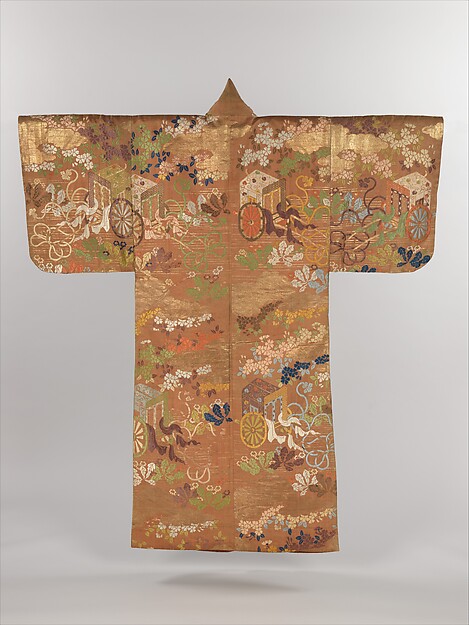
Noh Costume (Karaori) with Court Carriages, Cherry Blossoms, and Dandelions, late 18th–first half of the19th century, Twill-weave silk brocade with supplementary-weft patterning in metallic thread. The Metropolitan Museum of Art, The Howard Mansfield Collection, Gift of Howard Mansfield, 1936, accession 36.120.689.
Look closer: Look at the carriages. The Met records unusually large motifs of courtly ox carriages (gosho-guruma) with dandelions and cherry blossoms.
Image: The Metropolitan Museum of Art, Open Access (CC0)
The entry places the origin in Heian-kyō, modern Kyoto, over twelve hundred years ago. In 794 Heian-kyō became the capital, and production grew to supply the Imperial Court and aristocracy. The Ōnin War, of 1467 to 1477, reduced demand: most of Kyoto was demolished and residents fled to nearby towns. After the war ended in the 1480s, residents returned and settled on the western side of the city, and the area was named Nishijin, meaning ‘western position’.
After the war the weaving thrived again, supplying the Imperial Court and samurai lords. The entry says gold brocades and damask silks were introduced, said to originate in Ming China, and that weaving continued to thrive in the Edo period. It is worth pausing on what these sentences claim. They describe a trade that depended on a clientele, first the court and then the warrior class, and that moved with their fortunes.
Famine, the capital and the loom
The entry then turns to a run of disruptions. In 1837, it says, production halted because of material shortages from crop failures. In 1869 the capital moved to Tokyo, which was thought to mark the end of production, a statement the entry marks as needing a citation. In 1872 production revived after some weavers travelled to Europe, where they learned European methods; they adapted the Jacquard loom and the flying shuttle. By 1898 the Nishijin textile trade was well developed and used the shared technology.

Obi with Dragon and Phoenix, 19th century, Silk satin with supplementary weft patterning in silk and metallic threads. The Metropolitan Museum of Art, Gift of Phillip H. Rubin, 2006, accession 2006.572.5.
Look closer: Look at the ground. The Met describes a dragon and a phoenix against a background crowded with peonies and chrysanthemums.
Image: The Metropolitan Museum of Art, Open Access (CC0)
That sequence is a useful guide to what a collector may find. A cloth woven before the 1870s will have been woven by the older methods; a cloth woven after them may use the Jacquard mechanism that made complex patterns repeatable. The two are not better or worse, but they are different, and the difference is part of how a dealer or museum dates a piece.
The Met’s Noh costume, a karaori, with court carriages, cherry blossoms and dandelions, is a fine example of the older weaving. It is twill-weave silk brocade with supplementary-weft patterning in metallic thread, 172.7 by 146.1 centimetres, of the late eighteenth to the first half of the nineteenth century, in the Howard Mansfield Collection. The description notes unusually large motifs of courtly ox carriages, gosho-guruma, with dandelions and cherry blossoms, and opaque gold clouds like those in Genji paintings partly covering the motifs. It links the design to the Battle of the Carriages in chapter nine of The Tale of Genji, ‘Aoi’, in which Lady Rokujō, feeling neglected by Genji, goes to watch his Kamo Festival procession, where Lady Aoi’s grooms force her carriage aside; the carriages on the costume are decorated with aoi leaves, which were sacred to the Kamo Shrine, and the episode also appears in Zeami’s Noh play Lady Aoi.
The chapter on Noh Costume: Karaori, Atsuita and Mizugoromo describes the theatrical use of this kind of weave, and the chapter on A Motif Dictionary: Crane, Pine, Wave and Chrysanthemum the emblems that weavers set into their cloth.
The sash as a canvas
Wikipedia says the silk is commonly used for high-quality obi and kimono, and that other products include scarves, belts, shawls and wall decorations. It adds that Nishijin-ori is worn at ceremonies such as weddings, including the bride’s kimono, and that the traditional designs include nature scenes, birds and flowers. It names Tatsumura Textile, founded by Heizo Tatsumura I in the nineteenth century, as a manufacturing centre in Nishijin known for luxurious obi that can cost up to one million yen, and records that Tatsumura trained painters, including the late Inshō Dōmoto.
Three Met obi show what a sash can carry. The obi with thistle, of the second half of the nineteenth century, in the Meiji period, is brocaded silk with metallic thread, 410.2 by 31.8 centimetres, given by Jean Mailey in 1981. The obi with a pattern of checks and floral roundels, of the nineteenth century, is silk and metallic thread, twill with supplementary weft patterning and brocading, 410 by 32.2 centimetres, from the same gift. The third, the obi with dragon and phoenix, of the nineteenth century, is silk satin with supplementary weft patterning in silk and metallic threads, 416.6 by 69.2 centimetres. The museum’s label says that a dragon and a phoenix, fantastic creatures of Chinese origin, are shown in a Japanese obi against a background crowded with peonies and chrysanthemums, and that the dragon is seen in its usual Qing dynasty Chinese milieu, which includes stylised motifs of a mountain, waves and a flaming jewel.
The length of each sash, about four metres, is a reminder that the weaver works on a long, narrow field. The chapter on Obi and Its Companions: Scarf, Cord and Brooch explains how that field is tied, and the chapter on The Kimono Ladder: Furisode, Tomesode, Hōmongi and Komon how the sash completes the garment.
A reader looking at a woven silk should ask three questions. Is the pattern woven in, or printed on the surface? Is there metallic thread, which a weaver can lay as supplementary weft or as brocading? And does the cloth show the repeats of a mechanical loom, or the irregularities of a hand? The answers are a way of placing a cloth before and after the changes of 1872.
| Date | Event | Source note |
|---|---|---|
| 794 | Heian-kyō becomes the capital | Production grows to supply the court and aristocracy |
| 1467 to 1477 | Ōnin War | Demand falls and most of Kyoto is demolished |
| 1480s | Residents return and settle in the west | The district is named Nishijin, ‘western position’ |
| 1837 | Production halts | Material shortages from crop failures |
| 1872 | Weavers return from Europe | They adapt the Jacquard loom and the flying shuttle |
| 1898 | The trade is well developed | It uses the shared technology |
From court silk to the shop shelf
The material in this chapter ties several others together. The weaver’s metallic thread is the cousin of the gold applied to a dyed ground in Embroidery and Gold Leaf on Japanese Cloth. The silk itself is the subject of Silk, Hemp, Cotton and Ramie: The Fibres of Japanese Dress. The woven obi are worn with the garments in The Kimono Ladder: Furisode, Tomesode, Hōmongi and Komon and Uchikake and Shiromuku: The Bridal Robes. And the district’s history is bound up with the regional traditions surveyed in Regional Textiles from Kyoto to Okinawa.
The chronology also shows how much of the trade rested on a few kinds of patron. The court and aristocracy of 794, the samurai lords of the years after the Ōnin War, and the families who bought a bride’s kimono or a ceremonial sash in the later period are all clients named or implied in the entry, and each demanded something different: ceremonial dignity, display, and a lasting heirloom. The surviving objects in the Met reflect that range, from a theatrical robe made for a stage to sashes made to be tied and worn. A reader who keeps the patron in mind will usually read the cloth more accurately than one who looks only at the pattern.
For the buyer, the practical lesson is that ‘Nishijin’ on a label is a statement about origin, not about weave or quality. The entry’s own list of techniques, from tsumugi to brocade, shows how varied the cloth can be, and the Met’s examples, a Noh robe and three sashes, show the range of uses. The chapter on How to Read, Grade and Care for a Japanese Garment explains how such silk is graded and kept.
Within the house, the shelf strip below shows a brocade piece set into a denim jacket, a bridal uchikake, a remade jacket in brocade and a warlord’s surcoat. Each is described as what it is, and the concierge desk can look for a particular weave on request.
Woven silk at the Met
Noh Costume (Karaori) with Court Carriages, Cherry Blossoms, and Dandelions, late 18th–first half of the19th century, Twill-weave silk brocade with supplementary-weft patterning in metallic thread. The Metropolitan Museum of Art, The Howard Mansfield Collection, Gift of Howard Mansfield, 1936, accession 36.120.689.
Look closer: Look at the clouds. The Met notes opaque gold clouds, like those in Genji paintings, partly covering the motifs.
Image: The Metropolitan Museum of Art, Open Access (CC0)
Obi with Dragon and Phoenix, 19th century, Silk satin with supplementary weft patterning in silk and metallic threads. The Metropolitan Museum of Art, Gift of Phillip H. Rubin, 2006, accession 2006.572.5.
Look closer: Look at the dragon. The Met places it in its usual Qing dynasty Chinese milieu of mountain, waves and flaming jewel.
Image: The Metropolitan Museum of Art, Open Access (CC0)

Obi with Thistle, second half of the 19th century, Brocaded silk with metallic thread. The Metropolitan Museum of Art, Gift of Jean Mailey, 1981, accession 1981.229.1.
Look closer: Look at the length. The Met records 410.2 by 31.8 centimetres of brocaded silk with metallic thread.
Image: The Metropolitan Museum of Art, Open Access (CC0)

Obi with Pattern of Checks and Floral Roundels, 19th century, Silk, metallic thread; twill with supplementary weft patterning and brocading. The Metropolitan Museum of Art, Gift of Jean Mailey, 1981, accession 1981.229.2.
Look closer: Look at the construction. The Met records twill with supplementary weft patterning and brocading.
Image: The Metropolitan Museum of Art, Open Access (CC0)
Woven silk in the house
The shelf holds a brocade piece set into a denim jacket, a remade jacket in obi brocade, a bridal uchikake and a warlord’s surcoat. Each is described as what it is, with its age and condition set out plainly on its own page.


Textile heritage
Antique cloth of every kind is gathered in one collection, and the concierge desk can look for a particular weave, fibre or region on request.
Answered plainly
What is Nishijin-ori?
Silk textile produced in the Nishijin district of Kyoto; the name denotes the place, not a single technique.
Why is it called Nishijin?
After the Ōnin War residents returned and settled on the western side of the city, and the area was named for the ‘western position’.
When did the Jacquard loom arrive?
Wikipedia dates the revival to 1872, when weavers returned from Europe and adapted the Jacquard loom and the flying shuttle.
What is made from it?
High-quality obi and kimono, scarves, belts, shawls and wall decorations.
What is a karaori?
A Noh costume woven in brocaded twill silk; the Met holds several, including one with court carriages.
Is Nishijin a quality grade?
No. It names the place of origin, not the weave or the quality.
Where next
Sources and image credits
- Nishijin-ori, Wikipedia
- Noh Costume (Karaori) with Court Carriages, Cherry Blossoms, and Dandelions, Metropolitan Museum of Art, 36.120.689
- Obi with Dragon and Phoenix, Metropolitan Museum of Art, 2006.572.5
- Obi with Thistle, Metropolitan Museum of Art, 1981.229.1
- Obi with Pattern of Checks and Floral Roundels, Metropolitan Museum of Art, 1981.229.2
Last reviewed 28 October 2026. Pictures, where shown, are public-domain or open-access and credited beneath each one.
Looking for a woven obi, a length of old brocade or a piece with a particular pattern you have seen described here? The concierge desk replies within one to three business days.
Private concierge
Looking for something in particular?
Describe the piece or the project you have in mind. A senior advisor in Tokyo reads every case file personally and replies within two business days, with fees set out in writing before any work begins.