
Ainu Attus and the Dress of the North and South
Northern peoples · Island kingdoms
Ainu Attus and the Dress of the North and South
アイヌの衣と琉球の紅型
At the northern and southern edges of the archipelago, two textile cultures grew apart from the kimono. The Ainu made robes of elm bark and cotton, edged with bold appliqué and fine embroidery; the Ryukyu Islands dyed silk in stencilled colour. This chapter reads both from the objects and from careful sources.
Fact sheet
The two edges in one glance
- Bark cloth. Wikipedia describes attus as a strong garment made from Ainu bark cloth, common from the seventeenth century.
- Who did what. The Met label says men collected the bark, while women designed, wove, sewed and decorated the clothing for their families.
- A protective border. The Met's label for one robe says the blue appliqué guards the neck, sleeves and edges, and was meant to keep evil spirits out.
- Kimono echoes. A Met label notes that uniformly wide sleeves on one robe suggest the influence of the Japanese kimono.
- Imported silk. Wikipedia records that Chinese silk reached the Ainu through trade, and that the Japanese called the resulting textiles Ezo nishiki.
- Colour by rank. In the Ryukyu Kingdom, Wikipedia says only the royal family wore yellow, and nobility wore pale blue.
Beyond the kimono's reach
Most of this almanac follows the kimono and its relatives, the garments of the court, the city, the theatre and the field. This chapter turns to two peoples whose clothes grew from other roots. In the north, on Hokkaido, Sakhalin and the Kuril Islands, the Ainu made robes of tree bark and, later, of cotton. In the south, in the islands of the Ryukyu Kingdom, makers painted silk and cotton with stencils and pigments. Both cultures traded with the main islands, borrowed from them and kept their own ways.
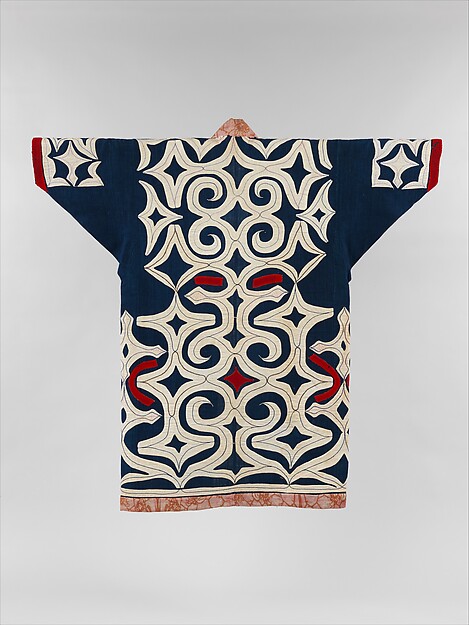
Ainu robe, Cotton and wool with applique (kiri-fuse). The Metropolitan Museum of Art, Seymour Fund, 1967, accession 67.172.2.
Look closer: Look at the border. The Met's label says the blue geometric appliqué protects the areas around the neck, sleeves and edges.
Image: The Metropolitan Museum of Art, Open Access (CC0)
The chapter relies on two kinds of evidence. The first is the Metropolitan Museum of Art, whose collection includes six Ainu robes and several pieces of Ryukyuan bingata, with labels that explain materials and methods. The second is Wikipedia's articles on Ainu clothing, the Ainu people and bingata, which supply history and vocabulary. Where the sources differ or say nothing, the text says so, and it does not fill the gaps. Dress is also a living inheritance for the people who made it, so the wording here is kept plain and respectful.
The kimono and its cut are described in The Kimono Ladder: Furisode, Tomesode, Hōmongi and Komon, the plant fibres in Silk, Hemp, Cotton and Ramie: The Fibres of Japanese Dress, and the regional weaving of the main islands, including a first account of bingata, in Regional Textiles from Kyoto to Okinawa. Decoration by stitch is treated in Embroidery and Gold Leaf on Japanese Cloth, and the indigo that colours many of the objects here is in Aizome: The Indigo Dyer’s Craft.
Words for a people and a place
Wikipedia's article on the Ainu explains that the word Ainu means a human being in the Ainu language, as opposed to kamuy, which are divine beings. The people also call themselves Utari, comrades or people, and the homeland is Ainu Mosir, the land of the Ainu. Sakhalin Ainu used the name Enchiw. The article notes that Emishi, a historical Japanese term, is considered derogatory in modern usage, so this chapter does not use it.

Ainu costume, 19th century, Elm-bark fiber with appliqué of indigo-dyed tabby (atsushi). The Metropolitan Museum of Art, Purchase, Bequest of Edward G. Kennedy and The Lesley and Emma Sheafer Collection, Bequest of Emma A. Sheafer, by exchange, 1984, accession 1984.103.
Look closer: Look at the length. The Met records this robe at about 135.9 centimetres from neck to hem and 130.8 centimetres from sleeve end to sleeve end.
Image: The Metropolitan Museum of Art, Open Access (CC0)
The Met label for one robe describes the Ainu as the indigenous people of Hokkaido, the nearby islands, the Kuriles and Sakhalin. Another label says the Ainu of northern Japan were culturally distinct from the Japanese in language, religion and artistic traditions. Both statements matter for dress: a robe is the work of a particular community, with its own patterns, uses and meanings, and not simply a variant of a Japanese garment.
The vocabulary of the clothes is Ainu. The robe is called attus or attush, which Wikipedia also spells attusi. Other words used in this chapter, such as matanpushi for a woman's embroidered headband and sapanpe for a man's ceremonial crown, are likewise given as the sources give them. A reader who meets an invented or loosely translated term should treat it with caution, and the glossary at the end of this chapter lists the words the sources support.
A cloth from the inner bark of the elm
The characteristic Ainu cloth is made from bark. The Met label for one robe says attush was made from the inner bark of the elm, or from linden or nettle, and that men collected the bark, while women designed, wove, sewed and decorated the costumes for their families. Wikipedia says attus is a strong garment made from Ainu bark cloth, and that it became common from the seventeenth century. Wikipedia's article on the Ainu people also describes the traditional dress as a short robe of woven bark fibres with straight sleeves, wrapped around the body and tied with a band at the waist, and does not name the tree.

Ainu Robe, 19th century, Elm-bark fiber with appliqué of indigo-dyed tabby (atsushi). The Metropolitan Museum of Art, Gift of Mrs. Risa Sussman, 1980, accession 1980.29.
Look closer: Look at the cloth. The Met records the material of this robe as elm-bark fibre with appliqué of indigo-dyed tabby, called atsushi.
Image: The Metropolitan Museum of Art, Open Access (CC0)
The Met label for a second robe describes the weaving of such robes by women in winter from softened elm bark fibres. The two labels agree on the main point, which is that the cloth was a household craft divided by sex, with the gathering of the raw material in men's hands and the making, from design to finishing, in women's. Neither label gives the stages by which bark became thread, and the house, which writes only what its sources say, does not describe them.
Wikipedia adds a wider list of Ainu materials. Jackets of grass skin, such as tetarabe and utarbe, were made from nettle or hemp fibre. Haori-like jackets were made from the fur of earless seals, or from the skin of salmon or itou, the Sakhalin taimen. The Met's elm-bark robes are therefore one part of a larger repertoire in which each animal and plant gave its own cloth. The wider world of plant fibres in Japan is described in Silk, Hemp, Cotton and Ramie: The Fibres of Japanese Dress.
A straight robe with tubular sleeves
Wikipedia's article on Ainu clothing says the clothing resembles the kimono in tailoring but has tubular sleeves, no gussets and a single layer. Both sexes wore a T-shirt-like undergarment reaching the knees under the jacket, and men wore a loincloth, tepa, before the jacket. Depending on the weather, people added gloves or mittens, tekunpe, a hood, konci, or leggings, hos. Women also wore a sacred girdle on the lower abdomen, called raun kut or upsoro kut, which the article says traces the woman's matrilineal line.
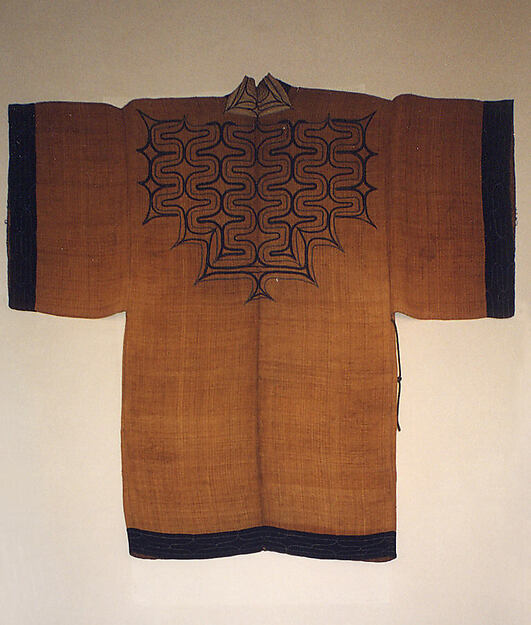
Robe, 19th century, appliquéd and embroidered elm fiber. The Metropolitan Museum of Art, Gift of John B. Elliott through the Mercer Trust, 1999, accession 1999.247.1.
Look closer: Look at the sleeves. The Met label says the uniformly wide sleeves of this robe suggest a likely influence from the Japanese kimono.
Image: The Metropolitan Museum of Art, Open Access (CC0)
The Met's robes show the cut as made. The robe of the Seymour Fund, of the Meiji period, measures about 122.6 by 128.3 centimetres, a nearly square spread of cloth. The elm-fibre robe acquired in 1984 is 135.9 centimetres from neck to hem and 130.8 centimetres across the sleeves. A narrower elm-bark robe given in 1980 measures 121.9 by 63.5 centimetres, and two robes given in 1999 are about 120 centimetres high and 127 to 130 centimetres wide. The robes are broad and nearly square in their spread, with the sleeves cut straight from the body.
The Met label for one of the 1999 robes remarks that its uniformly wide sleeves suggest a likely influence from the Japanese kimono. That is a careful statement, and the house repeats it as one. The cut of a straight-seamed robe, wrapped across the body and tied at the waist, is shared with the kimono, and the label sees a borrowing in the sleeves. The kimono's own construction is described in The Kimono Ladder: Furisode, Tomesode, Hōmongi and Komon, and the unlined peasant coat in Noragi and the Clothes of Work shows another straight-seamed garment of the countryside.
Bands of cloth, blue and white
The Met describes the decoration of Ainu robes as appliqué, embroidery or both. Two robes are catalogued as elm-bark fibre with appliqué of indigo-dyed tabby, called atsushi, and a third, in cotton and wool, is catalogued with the Japanese term kiri-fuse for the appliqué. The label for that robe says the blue geometric appliqué protects the areas around the neck, sleeves and edges, which reinforces areas prone to wear, and was also meant to keep evil spirits from entering the wearer.

Robe, 19th century, Cotton. The Metropolitan Museum of Art, Gift of John B. Elliott through the Mercer Trust, 1999, accession 1999.247.13.
Look closer: Look at the contrast. The Met label describes fine curvilinear embroidery set against wide applied bands, most of them white.
Image: The Metropolitan Museum of Art, Open Access (CC0)
That label joins two reasons in one sentence. The bands strengthen the parts of a garment that suffer most, and they guard the openings of the body, where the label says harm could enter. A border that is both useful and protective is a familiar idea elsewhere in this almanac, in the reinforcing stitchery of Sashiko and Boro: The Mended Cloth and in the crests and charms of Mon: The Family Crests on Japanese Dress, and the Ainu robe is a clear example.
A second label, for a cotton robe of the nineteenth century, describes the contrast between curvilinear embroidery, a comparatively fine tracery, and the wide applied bands. It says most of the applied textiles are white, though bright red and printed cotton also appear. The result is a bold layout of broad bands set against a delicate line, and it is one of the features that makes an Ainu robe easy to recognise at a distance.
Patterns learned young
The same label gives one of the few glimpses of how the patterns were passed on. It says Ainu girls learned embroidery designs at a young age, possibly by drawing patterns in the sand, as shown in an 1799 Japanese book illustration by Murakami Shimanojo. The house reports it as the label does, as a possibility supported by one illustration, and not as a general rule.

Robe (Ainu), 19th century, Cotton / Embroidery. The Metropolitan Museum of Art, Purchase, Seymour Fund and Gift of Mrs. Russell Sage, by exchange, 1979, accession 1979.281.
Look closer: Look at the line. The Met catalogues this robe as cotton with embroidery, about 152.4 by 127 centimetres.
Image: The Metropolitan Museum of Art, Open Access (CC0)
Wikipedia says the traditional patterns that decorated clothing and tools possibly date to the thirteenth century, and that a spiral pattern entered through exchange with the Nivkh, a neighbouring people. It also notes that engraved marks called aishiroshi on arrowheads functioned like household crests. The article does not name individual patterns of embroidery, and the house does not either. What the sources support is the idea that pattern was a shared language, with some designs travelling across borders and others belonging to a household.
Wikipedia also mentions the matanpushi, an embroidered headband worn by women, and says that embroidery appears in engagement gifts, when women gave embroidered clothing. It adds that modern craftswomen weave and embroider garments that sell for very high prices. For the stitches of Japan's main islands, see Embroidery and Gold Leaf on Japanese Cloth; the Ainu tradition is its own.
Silk, cotton and the road from the south
The Ainu were never isolated. Wikipedia's article on the Ainu people says they engaged in transit trade between Honshu and north-east Asia. Dried salmon was a staple food and a major trade item with the Japanese, and the Ainu hunted sea eagles for their tail feathers and sea otters for their pelts, which they sold to Japanese buyers. Ainu lacquerware was almost entirely imported from southern Honshu.
Cloth travelled too. Wikipedia's article on Ainu clothing records that Japanese traders brought cotton, and that kosode and jinbaori became ceremonial clothing. Chinese silk reached the Ainu through trade, and the Japanese called the resulting textiles Ezo nishiki, Ezo silk. It adds that attus fabric was also sent out of Hokkaido and made into clothing elsewhere. The battle coat of the samurai is described in Jinbaori: The Warlord’s Surcoat, and the robe cut from imported cotton is the Ainu answer to it.
The Matsumae clan, to which the Tokugawa shogunate granted exclusive rights to trade with the Ainu, appears in both articles. Wikipedia says the clan traded iron and lacquerware through the Ainu for silk, glass beads and Qing dynasty uniforms, and that it later leased trading rights to Japanese merchants. The article on the Ainu people says Matsumae nominally governed Sakhalin but extorted the Ainu for Chinese silk, which it sold in Honshu as its own product, leaving the Ainu in debt. Wikipedia's article on Ainu clothing adds that under Matsumae rule the Ainu were forbidden from adopting Japanese dress. The cloth in a museum case thus carries a history of unequal trade.
Seal fur, salmon skin and winter wear
Not all Ainu clothing was cloth. Wikipedia says winter wear included animal skins and deerskin leggings, and that on Sakhalin people made boots from the skin of dogs or salmon. Its article on Ainu clothing lists haori-like jackets made from earless seal fur, or from the skin of salmon or itou. These garments are not among the Met's holdings, so this chapter describes them only as Wikipedia does.
The list is a reminder of the environment. The Ainu lived by rivers rich in salmon and on coasts frequented by seals and sea otters, and the same animals fed them and clothed them. In the sources the house has read, the making of fish-skin garments is stated but not explained, so the chapter does not describe the process.
A reader who knows the heavy hemp and cotton clothes of the Japanese countryside will see a difference in kind. The country garments described in Noragi and the Clothes of Work and Happi, Hanten and the Fire Brigade Coat are cloth, dyed and stitched; the Ainu repertoire also included the skins themselves, worn as the animal provided them.
Crowns, headbands and beads
Wikipedia lists the accessories of Ainu dress. Men wore a sapanpe, a crown, for important ceremonies and carried an emush, a ceremonial sword. Women wore a matanpushi, an embroidered headband, and Sakhalin Ainu women wore a cloth headdress called hetmuye, wrapped in a ring, during rituals. Earrings, ninkari, traditionally made from grapevine, were considered gender-neutral; metal ball earrings are also recorded. Women wore a bead necklace, tamasay, and the article lists a choker, rekutunpe, and a ring or bracelet, tekunkane, mostly of metalwork.
The article on Ainu clothing also records that hoe-shaped metal objects were the most prized items, valued for their spiritual power and never given away, and that when owners died, they were hidden. It states that the Tokyo National Museum preserves four of seven such objects found in Kakuda Village in 1916. The same article says a related belt, upshoro kut, is in the collection of the British Museum.
The house keeps to what the sources state. Maidari, aprons, are described as now part of women's formal clothing. The Met's robes, by contrast, show the main garment and none of the ornaments, and a reader should remember that in life the robe was worn with them.
Markings, a ban and a revival of memory
Dress in the broad sense includes the skin, and the sources treat the tattooing of Ainu women with care. Wikipedia says women received mouth tattoos beginning around age seven or eight, with soot rubbed into small cuts, applied in stages, and that hands and forearms were tattooed later. Women stopped being tattooed after marriage. Men's tattoos varied by region, on the shoulders or hands, and hand tattoos were believed to improve archery.
The Meiji government banned tattooing in 1871, and an 1876 law added punishment. Wikipedia says many women resisted because they feared divine anger and the inability to marry. After 1869, Meiji policies included hair-cutting and other so-called civilising measures. The article adds that today some women paint their mouths black for events.
The point for a reader of textiles is that the robe belonged to a whole system of appearance, which included the body, the hair, the ornaments and the cloth, and that the state set out to dismantle it. The loss of the tattoo is a reminder that what survives in museums is only a part of what was worn.
From a nineteenth-century act to a 2019 recognition
Wikipedia's article on the Ainu people sets out the legal frame. The Hokkaido Former Aborigines Protection Act of 1899 labelled the Ainu former aborigines and aimed to integrate them fully into Japanese society while erasing Ainu culture and identity. It led to the government's taking of Ainu land, granted automatic Japanese citizenship, which effectively denied indigenous status, and contributed to legal restrictions on traditional practices, including hunting, gathering and speaking the Ainu language.
The article records the change of direction. In 2008 the Diet passed a non-binding resolution, and eleven years later, in 2019, it passed an act recognising the Ainu as an indigenous people of Japan. The article on Ainu clothing adds that a 1997 law promoted Ainu culture, that Ainu traditional dance was registered by UNESCO in 2009, and that groups hold an annual cultural festival.
For this chapter the relevance is direct. The Met label for the Seymour Fund robe says that after 1868 the Ainu were pushed toward agriculture and commercial fishing, which is the same history from the museum's side. A robe of the Meiji period was made in the years when the cultural system around it was being broken, and its survival is not an accident of fashion.
How many, then and now
Wikipedia gives figures that frame the human context. The Ainu numbered about 80,000 in the eighteenth century, and by 1868 there were about 15,000 in Hokkaido, 2,000 on Sakhalin and around 100 in the Kurils. A 2023 official survey in Hokkaido recorded 11,450 responses, and the Russian census of 2021 recorded about 300 in Russia. Unofficial 2002 estimates put the population in Japan at 200,000 or higher, because many people of Ainu descent do not know their ancestry.
The figures differ in kind and cannot be compared directly: the first are historical estimates, the second a survey of those who responded, the last an informal estimate. The house gives them as the article gives them and draws no total.
The Met label for the Seymour Fund robe observes that intermarriage has reduced the unmixed population. That statement belongs to the label's own time, and the house notes it only as the museum's wording. A reader should rely on the Ainu's own and recent official accounts for the present community, which this chapter does not attempt to supply.
Bingata: the stencilled colour of the Ryukyu Kingdom
At the other end of the archipelago, in the islands of the Ryukyu Kingdom, makers dyed cloth in colour. Wikipedia describes bingata as a stencil resist dyeing technique from Okinawa that produces busy patterns of nature motifs, such as fish, flowers and fauna, in bright colours, worn at traditional festivals and arts performances. It dates the technique to the Ryukyu Kingdom period, in the fourteenth century, and says it is believed to combine Indian, Chinese and Javanese dyeing methods, possibly introduced through trade. The oldest known piece, found on Kumejima, dates to the late fifteenth century.

Robe, 19th century, Resist-dyed and painted (bingata) silk crepe. The Metropolitan Museum of Art, Purchase, Roy R. and Marie S. Neuberger Foundation Inc. and several members of The Chairman's Council Gifts, 2000 Benefit Fund, and funds from various donors, 2001, accession 2001.428.56.
Look closer: Look at the ground. The Met's label says pine boughs and plum blossoms are set on colourful broken-diamond shapes, against a matsukawabishi pattern named for pine bark.
Image: The Metropolitan Museum of Art, Open Access (CC0)
The Met label for a nineteenth-century robe in resist-dyed and painted silk crepe explains the method: resist paste is applied through one or more stencils, dyes and pigments are painted onto the pattern areas by hand, the coloured designs are covered with protective paste, and the background is then dyed. Washing off the paste reveals the bright colours and bold designs typical of bingata. A second robe, with pine boughs and plum blossoms set on colourful broken-diamond shapes against a matsukawabishi ground, is explained in the same terms. The house's account of Japan's regional cloths, including bingata, is in Regional Textiles from Kyoto to Okinawa.
Wikipedia adds the hierarchy of colour. Only the royal family wore yellow, nobility wore pale blue, and commoners wore simple indigo or black patterns, with certain colours allowed on special occasions. Only three families were licensed to produce bingata, with 45 dyers in total, most of them at Shuri. The article describes ten steps, from stencil cutting to final washing, and says a single kimono took three people three days to paint, plus about a month to finish. The paste-resist cousin of this technique on the main islands is described in Tsutsugaki and Katazome: Paste and Stencil.
Peonies, phoenixes and a family workshop
The Met also holds bingata panels. One, with phoenixes and flowers, is of the eighteenth century and is catalogued as cotton, 37.5 by 45.1 centimetres, a gift of Mrs Teruyoe Shinohara in 1989. Four others, with tree peonies, peonies and peacocks, and chrysanthemums with snow circles, are of the twentieth century, and the Met credits one of the peony panels to Teruyo Shinohara and her pupils, a gift of 1989. The museum's pages give no label text for these panels, so the house describes only their titles, dates and materials.

Teruyo Shinohara, Bingata Panel with Tree Peonies, 20th century, Cotton tabby. The Metropolitan Museum of Art, Gift of Teruyo Shinohara, 1989, accession 1989.268.2.
Look closer: Look at the credit. The Met credits the panel to Teruyo Shinohara and her pupils, a gift of Teruyo Shinohara, 1989.
Image: The Metropolitan Museum of Art, Open Access (CC0)

Bingata Panel with Hō-ō Birds and Flowers, 18th century, Cotton. The Metropolitan Museum of Art, Mrs. Teruyoe Shinohara Gift, 1989, accession 1989.207.
Look closer: Look at the date. The Met dates this bingata panel to the eighteenth century.
Image: The Metropolitan Museum of Art, Open Access (CC0)
Wikipedia's account of the twentieth-century story is brief. The Battle of Okinawa destroyed many workshops and halted production, and after the war Eiki Shiroma, a former artist, recovered original stencils from mainland Japan and revived the craft. During the United States occupation, demand grew from American customers. His son Eijun Shiroma is the fifteenth generation of his family to practise the craft, at Shiroma Studio. The article's prices for modern work, from about forty dollars for a hand-made T-shirt to about a thousand for a silk kimono, are the source's own and are not the house's.

Teruyo Shinohara, Bingata Panel with Tree Peonies, 20th century, Cotton tabby. The Metropolitan Museum of Art, Gift of Teruyo Shinohara, 1989, accession 1989.268.1.
Look closer: Look at the peonies. The Met titles this panel Bingata Panel with Tree Peonies.
Image: The Metropolitan Museum of Art, Open Access (CC0)

Teruyo Shinohara, Bingata Panel with Tree Peonies and Peacocks, 20th century, Cotton tabby. The Metropolitan Museum of Art, Gift of Teruyo Shinohara, 1989, accession 1989.268.3.
Look closer: Look at the birds. The Met titles this panel Bingata Panel with Tree Peonies and Peacocks.
Image: The Metropolitan Museum of Art, Open Access (CC0)
A reader will notice the difference between the Ainu robe and the bingata panel. The first is a working garment built from bark and bands, the second a pictorial surface painted in many colours. Both are the work of communities that shaped a material to their own purposes, and both were collected by the Met in the second half of the twentieth century.

Teruyo Shinohara, Bingata Panel with Chrysanthemums and Snow Circles, 20th century, Cotton tabby. The Metropolitan Museum of Art, Gift of Teruyo Shinohara, 1989, accession 1989.268.4.
Look closer: Look at the circles. The Met titles this panel Bingata Panel with Chrysanthemums and Snow Circles.
Image: The Metropolitan Museum of Art, Open Access (CC0)
A robe from Okinawa
The Met's other Okinawan robe, of the nineteenth century, is catalogued as resist-dyed and painted bingata silk crepe, in two parts, about 52 by 142 centimetres overall. Its label repeats the account of the method: resist paste applied through one or more stencils, colour painted by hand into the pattern areas, protective paste over the coloured designs, the background dyed, and the paste washed out.

Robe, 19th century, Resist-dyed and painted (bingata) silk crepe. The Metropolitan Museum of Art, Purchase, Seymour Fund, Gift of Mr. and Mrs. Harold Bach, by exchange, 1983, accession 1983.417a, b.
Look closer: Look at the method. The Met's label says paste is applied through stencils or freehand, and washed out to reveal the colours.
Image: The Metropolitan Museum of Art, Open Access (CC0)
Wikipedia says bingata is painted on silk, linen and bashofu, the banana-fibre cloth of the islands, and that after Japan invaded in 1609 and banned foreign trade, the Ryukyu people had to produce handicrafts as tribute, including banana-fibre cloth. An envoy's report of 1802 from China praised the vivid flowers and suggested the dyers had a production secret. The article also records that after Japanese rule limited imports, indigo became the main dye for everyday production.
The two northern and southern histories share a pattern. Each culture received cloth and ideas from the main islands, adapted them, and was then governed in ways that limited its dress or its trade. The objects that remain are the evidence.
Four tales from the edges
The sand drawing. The Met's label for a cotton robe says Ainu girls may have learned embroidery designs by drawing them in the sand, as an 1799 Japanese book illustration by Murakami Shimanojo shows.
The border that guards. A label for a Meiji-period robe explains that the blue appliqué at neck, sleeves and edges is both reinforcement and protection, meant to keep evil spirits from entering the wearer.
Ezo nishiki. Chinese silk that reached the Ainu through trade, and was sold on by the Japanese, came to be called Ezo nishiki, Ezo silk, according to Wikipedia.
The recovered stencils. After the Battle of Okinawa destroyed many bingata workshops, Eiki Shiroma recovered original stencils from mainland Japan and revived the craft, Wikipedia records.
Small surprises from the north and the south
Short facts from the sources, each given as the source gives it.
- Ainu means a human being in the Ainu language, as opposed to kamuy, divine beings.
- Attus became a common garment from the seventeenth century, according to Wikipedia.
- Men gathered the bark, and women designed, wove, sewed and decorated the robe, says the Met label.
- Ainu clothing resembles the kimono in cut but has tubular sleeves and no gussets.
- A Met robe is about 135.9 centimetres from neck to hem.
- The Meiji government banned Ainu tattooing in 1871.
- The Ainu numbered about 80,000 in the eighteenth century, by one estimate.
- Ainu traditional dance was registered by UNESCO in 2009.
- Bingata dates to the Ryukyu Kingdom period, in the fourteenth century.
- Only the royal family of the Ryukyu Kingdom wore yellow.
- A bingata kimono took three people three days to paint, plus about a month to finish.
- The Met holds six Ainu robes and seven pieces of bingata.
Words of the north and south
The terms used in this chapter, with the garment or custom each names.
| Term | Meaning | Where it appears |
|---|---|---|
| Ainu | A human being; the indigenous people of Hokkaido, Sakhalin and the Kurils | Names |
| Kamuy | Divine beings, in Ainu belief | Names |
| Ainu Mosir | The land of the Ainu | Names |
| Attus, attush | A robe of woven bark fibre | Fibre |
| Kiri-fuse | Japanese term for appliqué, used in the Met catalogue | Appliqué |
| Atsushi | The Met's term for indigo-dyed tabby appliqué | Appliqué |
| Tepa | A loincloth | Cut |
| Tekunpe | Gloves or mittens | Cut |
| Konci | A hood | Cut |
| Hos | Leggings | Cut |
| Raun kut, upsoro kut | A sacred girdle worn by women | Cut |
| Matanpushi | A woman's embroidered headband | Adornment |
| Sapanpe | A man's ceremonial crown | Adornment |
| Hetmuye | A Sakhalin woman's ritual headdress | Adornment |
| Tamasay | A beaded necklace | Adornment |
| Ninkari | Earrings | Adornment |
| Ezo nishiki | The Japanese name for Chinese silk that reached the Ainu | Trade |
| Matsumae | The clan with exclusive trading rights with the Ainu | Trade |
| Bingata | Stencil-resist dyeing of the Ryukyu Islands | South |
| Bashofu | Banana-fibre cloth of the Ryukyu Islands | Fibre |
| Matsukawabishi | A pattern named for pine bark, in broken diamonds | South |
What can be seen today
The Met's Ainu robes are catalogued as not on view, and the same is true of the bingata robes, so the practical way to study them is through the museum's published images and labels. Wikipedia says the Tokyo National Museum preserves four of seven hoe-shaped metal objects, and that the British Museum holds a belt; it names no other collection.
For the collector, the first lesson is respect for provenance. Ainu textiles are the heritage of a living people who were long denied recognition, and a piece offered without a clear history should be questioned. The second lesson is precision: attus is a particular cloth, appliqué is a particular technique, and bingata is a particular resist, and none should be used loosely.
Modern work continues. Wikipedia notes that modern craftswomen weave and embroider garments, that the Ainu oral literature, yukar, has a preservation movement, and that a 1997 law and a 2019 act have changed the legal setting. The house does not offer modern Ainu garments in this chapter and recommends the makers' own channels.
Reading a robe from the margins
The first question is the cloth. The Met records Ainu robes in elm-bark fibre, in cotton, and in cotton and wool. The weave and the thread tell more than the pattern does, and the Met's catalogue entries name the material of each.
The second is the construction. Look for the straight, wrapped body, the tubular sleeves with no gussets, and the neckband. A border applied at neck, sleeve and hem is the mark of the tradition, and its colour is often indigo, with white and sometimes red.
The third is condition and honesty. Appliqué can be replaced; ask what is original. The condition scale and care advice in How to Read, Grade and Care for a Japanese Garment apply, and for bingata, the colours and the paste-resist outlines should be checked in daylight. The concierge desk is glad to compare a piece with the museum records on request.
Neighbouring chapters
The cut of the Ainu robe is compared with the kimono in The Kimono Ladder: Furisode, Tomesode, Hōmongi and Komon, the countryside coats in Noragi and the Clothes of Work and Happi, Hanten and the Fire Brigade Coat, and the warrior's coat in Jinbaori: The Warlord’s Surcoat. The fibres are in Silk, Hemp, Cotton and Ramie: The Fibres of Japanese Dress, the indigo in Aizome: The Indigo Dyer’s Craft, the stitchery in Embroidery and Gold Leaf on Japanese Cloth and Sashiko and Boro: The Mended Cloth, the patterns in A Motif Dictionary: Crane, Pine, Wave and Chrysanthemum, and the crests in Mon: The Family Crests on Japanese Dress. The resist cousins of bingata are in Tsutsugaki and Katazome: Paste and Stencil and Regional Textiles from Kyoto to Okinawa, and the vocabulary is in Glossary of Japanese Dress and Textile Terms.
Among the house's other pages, The Warrior and Floating World Almanac describes the Edo society with which the Ainu traded, and the Fashionista Bible follows the wider story of Japanese dress.
Indigo and country cloth in the house
The shelf holds a patched indigo noragi, an indigo happi coat and a piece dyed with aizome. None is Ainu or Ryukyuan work; each is described as what it is, with its age, maker and condition set out on its own page.


Kimono and textile heritage
The house's collection of kimono and textile heritage is the companion to this chapter, and the concierge desk can look for related pieces on request.
Answered plainly
What is attus?
A robe of woven bark fibre. The Met says it was made from the inner bark of the elm, or from linden or nettle.
Who made Ainu robes?
The Met label says men collected the bark, while women designed, wove, sewed and decorated the clothing for their families.
What does Ainu mean?
Wikipedia says it means a human being in the Ainu language, as opposed to kamuy, divine beings.
Why are Ainu robes edged with blue bands?
The Met label says the blue appliqué protects the neck, sleeves and edges, reinforcing areas prone to wear and meant to keep evil spirits out.
Is an Ainu robe a kimono?
No. It resembles the kimono in tailoring but has tubular sleeves, no gussets and a single layer, according to Wikipedia.
Did the Ainu use silk?
Chinese silk reached them through trade, and the Japanese called the resulting textiles Ezo nishiki.
What did the Ainu wear in winter?
Wikipedia lists animal skins and deerskin leggings, and on Sakhalin boots of dog or salmon skin.
What is a matanpushi?
An embroidered headband worn by women.
What is a sapanpe?
A crown worn by men for important ceremonies.
When was Ainu tattooing banned?
The Meiji government banned tattooing in 1871, and an 1876 law added punishment.
When were the Ainu recognised as indigenous?
In 2019, when the Diet passed an act recognising the Ainu as an indigenous people of Japan.
What is bingata?
A stencil resist dyeing technique from Okinawa, producing busy nature patterns in bright colours.
How is bingata made?
Resist paste is applied through stencils, colours are painted by hand, the designs are covered with paste, the background is dyed and the paste is washed out.
Who wore yellow in the Ryukyu Kingdom?
Only the royal family, says Wikipedia; nobility wore pale blue.
Where can I see these robes?
The Met lists its Ainu robes and bingata robes as not on view, so its published images and labels are the practical guide.
Where next
Sources and image credits
- Ainu clothing, Wikipedia
- Ainu people, Wikipedia
- Bingata, Wikipedia
- Ainu robe, Metropolitan Museum of Art
- Ainu costume, Metropolitan Museum of Art
- Robe (Ainu), Metropolitan Museum of Art
- Ainu robe, Metropolitan Museum of Art
- Robe, Metropolitan Museum of Art (1999.247.1)
- Robe, Metropolitan Museum of Art (1999.247.13)
- Robe, Okinawa, Metropolitan Museum of Art
- Robe, Ryukyu Islands, Metropolitan Museum of Art
- Bingata panel with phoenixes, Metropolitan Museum of Art
- Bingata panel with tree peonies, Metropolitan Museum of Art
- Bingata panel with tree peonies, Metropolitan Museum of Art
- Bingata panel with peonies and peacocks, Metropolitan Museum of Art
- Bingata panel with chrysanthemums, Metropolitan Museum of Art
Last reviewed 28 October 2026. Pictures, where shown, are public-domain or open-access and credited beneath each one.
Looking for indigo cloth, a country coat or a textile related to the cultures described here? The concierge desk replies within one to three business days.
Private concierge
Looking for something in particular?
Describe the piece or the project you have in mind. A senior advisor in Tokyo reads every case file personally and replies within two business days, with fees set out in writing before any work begins.