
Noragi and the Clothes of Work
Garments · The working jacket
Noragi and the Clothes of Work
野良着
Noragi is the clothing of the field: indigo cotton and hemp, cut simply, patched for years and stitched against the cold. The museums now treat the oldest pieces as textile art, and the reasons are plain once you handle one.
Fact sheet
The working wardrobe in one glance
- Indigo. The dye that was cheap to grow, and that kept moths away.
- Boro. Cloth mended and layered until little of the original remained.
- Sashiko. White running stitch that strengthened and decorated at once.
- Monpe. The loose trouser with a tied waist, worn by women in the fields.
- Sakiori. Old kimono cut into strips and woven into new cloth.
The coat of the field
The Metropolitan Museum catalogues one of its nineteenth-century pieces simply as a farmer’s jacket, of linen and cotton with embroidery, and its record gives no more than the materials, the date and the dimensions of 48 by 48 inches. The plainness is instructive. The garment that collectors now call a noragi was never meant to be looked at. It was made to be worn in a field, in rain, through a winter, and then repaired.

Sleeveless Work Jacket for Sledge Pulling (Sorihiki Sodenashi), late 19th–early 20th century, Plain-weave fabrics of cotton and of cotton and silk, some reinforced with embroidery. The Metropolitan Museum of Art, Seymour Fund, 1978, accession 1978.66.
Look closer: Look at the back where the sledge band would sit. The Met says farmers’ wives reinforced that area with fine sashiko in the pattern called persimmon flower.
Image: The Metropolitan Museum of Art, Open Access (CC0)
Everything about it follows from that purpose. The cut is straight and the sleeves are wide enough to move in. The cloth is the cloth a household could grow, spin, weave or afford, which in most of rural Japan meant cotton and bast fibres such as hemp, dyed in indigo. The Wikipedia entry on boro, the mended textiles that grew out of this tradition, describes them as cotton, linen or hemp, often hand-woven by peasant farmers, and gives their purpose as warm, practical clothing, layered because warmer fibres were less often to hand.
A reader meeting the word for the first time should hold two ideas together. The first is that noragi is a use, not a single pattern: a jacket, a vest, an apron, a pair of trousers could each be work clothing. The second is that its beauty is incidental and cumulative. It comes from decades of wear, repair and washing, which is the reason a good example cannot be reproduced, and why the sections that follow spend as much time on mending as on making.
Cotton, dye and dress edicts
The social setting is recorded in the boro entry on Wikipedia, which should be read as a summary rather than an authority. It says that during the Edo period fine silk and cotton were reserved for a select upper class, whether by official dress edict or simply by cost, and that silk was unsuitable for working clothes, which led to practical fabrics such as kasuri. The entry on monpe adds that shogunate sumptuary laws barred farmers from certain colours and textiles, but that dark blue was permitted, which tied rural labour to blue clothing.
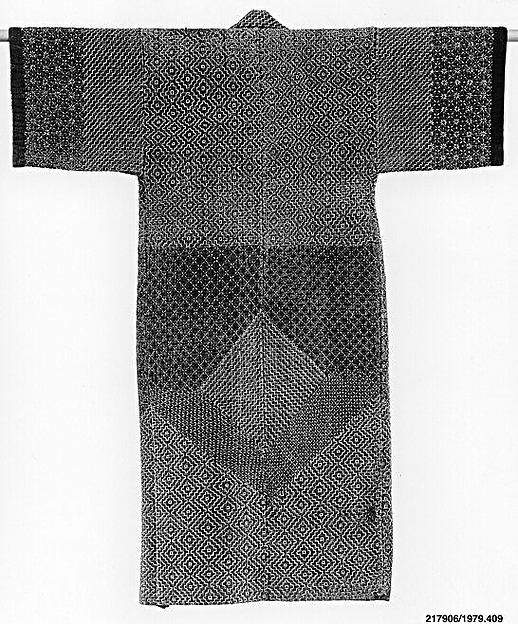
Sashiko Kimono, mid-19th century, Indigo-dyed plain-weave cotton, quilted and embroidered with white cotton thread. The Metropolitan Museum of Art, Purchase, Mrs. Jackson Burke Gift, 1979, accession 1979.409.
Look closer: Count the patterns. The Met records seven continuous designs on this robe, and finds the persimmon-flower motif at the shoulders and the hem.
Image: The Metropolitan Museum of Art, Open Access (CC0)
Indigo suited the poor household for other reasons. The boro entry says that ai, indigo, and its dyeing, aizome, were common and often the only dye available to peasants, that indigo was cheap to grow, and that its moth-repelling properties protected a garment. It also records a practical point about the vat: one bath could be used many times, and a weak bath, used repeatedly, gave better wear resistance and colourfastness than a strong bath used a few times. The dye itself is the subject of Aizome: The Indigo Dyer’s Craft.
The same entry places the decline of the tradition in the Meiji era and after. As living standards rose, most boro were discarded, because many working people saw them as a reminder of past poverty, and in the early twentieth century cheaper ready-made clothing made the craft largely unnecessary. What survives, it says, is mostly antique pieces and modern craft reproductions. The Met’s sledge-pulling vest, dated to the late nineteenth and early twentieth century, comes from exactly that last phase of use.
The work trouser, monpe, has a parallel history. Wikipedia describes it as loose agricultural trousers with a waist tie, most often worn by women in farming and mountain villages, and notes that its origin is unclear but is thought to descend from the court’s umanori hakama. Cotton was the commonest material in the Edo and Meiji periods, and with the industrialisation of textiles in the Meiji era wool and hemp allowed warmer, sturdier versions. In 1942, the entry says, monpe were promoted as part of the government’s standard dress for women, with wartime magazines showing how to cut them from old kimono, and afterwards the garment fell from mainstream use because of its association with wartime hardship.
Reading a mended coat
The first question to ask of a worn indigo garment is where the stitching falls. The Wikipedia entry on sashiko defines it as traditional stitching used to reinforce cloth decoratively or functionally, and glosses the name as ‘little stabs’. It dates the first appearance of sashiko to the Edo period, as running stitches used to strengthen homespun clothing, and says that in the Meiji era it became winter work in northern farming communities, when it was too cold to work outdoors. It names two main styles: moyōzashi, long lines of running stitches, and hitomezashi, single stitches aligned on a grid. White cotton thread on indigo cloth gave the look that we associate with the craft because both were cheap and abundant.

Sashiko Jacket, second half of the 19th century, Indigo-dyed plain-weave cotton, quilted and embroidered with white cotton thread. The Metropolitan Museum of Art, Seymour Fund, 1967, accession 67.172.1.
Look closer: Follow the stitch lines across the body. Compare their density with the kimono above, which carries seven separate patterns.
Image: The Metropolitan Museum of Art, Open Access (CC0)
The Met’s sledge-pulling vest shows the principle at work. Its record explains that farmers on the Shōnai plain of Yamagata prefecture, an area known for its rice, used sledges to haul fertiliser to the fields, and that this vest type was made for the job. The part of the vest that touched the sledge band was reinforced by farmers’ wives with fine sashiko in a geometric pattern called kaki no hana, persimmon flower, named for the concentric arrangement of sepals and petals. The jacket is also pieced from many different fabrics, which the museum reads as the thrift of the Shōnai farmwives, and small striped scraps at the shoulders and neckband contain silk stripes that may have come from more formal garments.
That description supplies a test that can be applied to any piece. Stitching that is dense where the body presses or rubs is working stitching. Stitching that is even across the whole garment may be decorative, as on the Met’s sashiko kimono, where seven continuous patterns are quilted over the indigo cotton. A patch of a different cloth set over a worn area, sewn through with the same white thread, is a repair.
A third category should be named so that it is not confused with the first two. Sakiori, according to the boro entry, is the technique of weaving with old kimono cut into strips about a centimetre wide, and one obi required roughly three old kimono. It is woven, not stitched, and its most common modern form is the expensive informal obi.
| Museum example | Material | What to read |
|---|---|---|
| Sledge-pulling vest, late 19th to early 20th century | Cotton and cotton-silk, with sashiko | Reinforced at the sledge band; many fabrics pieced; silk-striped scraps |
| Sashiko kimono, mid-19th century | Indigo plain-weave cotton, white cotton thread | Seven continuous patterns; persimmon flower at shoulders and hem |
| Sashiko jacket, second half of 19th century | Indigo plain-weave cotton, white cotton thread | Quilted and embroidered; compare the density with the kimono |
| Farmer’s jacket, 19th century | Linen and cotton with embroidery | A plainly catalogued working jacket; no further claim is made |
| Coverlet (yogi) with lobster and crest, mid-19th century | Plain-weave cotton, resist-dyed and painted | The same cloth used for bedding and brushed in tsutsugaki |
Mending as an art of its own
The aesthetic claim made for these garments is that of wabi-sabi, which the boro entry defines as finding beauty in natural wear and use. The claim deserves some caution. The museums are careful to describe thrift and necessity rather than intention, and the Met’s language about the Shōnai vest is exactly that: a record of what the wearers did to keep warm and keep working. The beauty comes after the fact, and a collector who treats every patch as design risks missing the more interesting truth, that the choices were made by tired people for practical reasons and are still, somehow, composed.

Farmer's Jacket, 19th century, Linen;cotton / Embroidery. The Metropolitan Museum of Art, Seymour Fund, 1980, accession 1980.493.2.
Look closer: Notice how little decoration the catalogue claims. The museum records the materials and the date and leaves the rest to the cloth.
Image: The Metropolitan Museum of Art, Open Access (CC0)
The modern attention to the tradition came late. The boro entry credits folklorists with preserving the surviving pieces and the wider recognition to exhibitions and publications, naming a travelling show, ‘Boro: The Fabric of Life’, of about fifty pieces made by Japanese peasants between 1850 and 1950 from leftover indigo cotton. The monpe entry records a parallel revival in films and games, and notes that the folklorist Kiyoko Segawa documented about three hundred versions of the trouser across Japan in the early 1930s. The point for a reader is that the field is documented in pieces by scholars, with gaps, and the careful collector holds claims about regions and dates loosely.
For the collector, the practical checks are few. Hold the cloth to the light to see the weave. Turn the garment inside out to follow the repairs. Look at the lining, where scraps of kasuri or printed cotton often survive. Check for mothing and for brittleness in the fibre. The grading of such textiles is set out in How to Read, Grade and Care for a Japanese Garment, the fibres themselves in Silk, Hemp, Cotton and Ramie: The Fibres of Japanese Dress, and the patterned cottons that sit beside indigo in Kasuri: Ikat Woven from Dyed Thread.
The working jacket also belongs to a larger family. The fire-brigade coat described in Happi, Hanten and the Fire Brigade Coat is the same indigo-and-stitch idea made for a city job, and Sashiko and Boro: The Mended Cloth follows the thread from the farm to the studio. For the wider story of how workwear became a fashion idea, the house’s Amekaji Almanac and Sukajan Museum show what happened when Japanese tailoring met American denim.
Hemp, a ban on cotton and the stitch that answered it
The most precise form of farm stitching has a place and a reason. Wikipedia describes kogin-zashi as a decorative reinforcing stitch, one technique of sashiko, which began in the part of present-day Aomori Prefecture held by the Tsugaru clan in the Edo period. Its materials were white cotton thread worked in diamond patterns on indigo-dyed cotton, linen or hemp. The reason it began, according to the same article, was a rule: peasants in Tsugaru were not allowed to wear cotton cloth, so they wore layers of linen, which frayed easily, and stitched cotton thread onto the linen for warmth, protection and strength. The article adds that this helped them to get round the restriction.
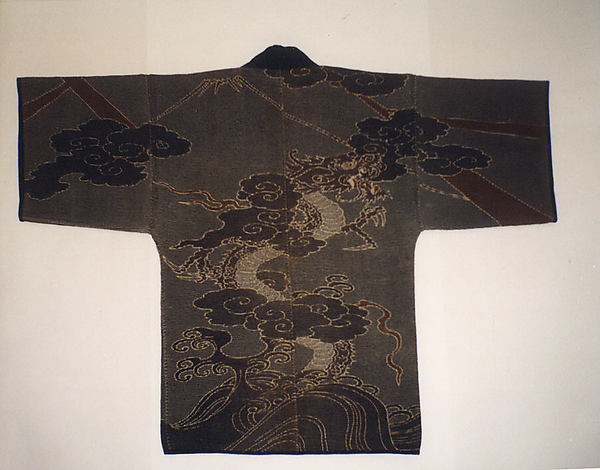
Jacket with Dragon and Mount Fuji, 19th century, Cotton. The Metropolitan Museum of Art, Gift of John B. Elliott through the Mercer Trust, 1999, accession 1999.247.2.
Look closer: Look at how cloth that began on the farm was dressed for the city. The Met says this jacket may have been worn by a firefighter in Edo, where the dragon’s link with water would have suited the job.
Image: The Metropolitan Museum of Art, Open Access (CC0)
The site of the Hirosaki Kogin Institute tells the same story from the other side. It says that Tsugaru farmers were ordered to wear hemp and that, to keep warm through the long, harsh winters, they stitched cotton thread into the hemp, and it names the result Tsugaru kogin-zashi. It records the method in a sentence that a reader can test on any good piece: the stitcher counts odd-numbered threads, one, three, five, seven, along the vertical weave. The pattern is therefore built on the cloth itself, not drawn on it. The site says that the craft was created by women in farming villages and developed mainly around Hirosaki.
Two older records are cited for it. The travel journal Yūranki of Sugae Masumi describes short embroidered garments worn by people in mountain villages around Kuroishi, which the site identifies as sashi-kogin, and the illustrated account Okumin Zui of Hirano Sadahiko recorded the practice with pictures. The site gives a date for the second work that does not agree with the era it names, so the careful reader should take the book as evidence of the practice and leave its year aside.

Kimono-Shaped Coverlet (Yogi) with Lobster and Crest, mid-19th century, Plain-weave cotton, resist-dyed and painted with dyes and pigments (tsutsugaki). The Metropolitan Museum of Art, Seymour Fund, 1966, accession 66.239.3.
Look closer: Look at how a kimono shape was used for bedding. The resist-drawn lobster is a tsutsugaki image, a technique described in the chapter on resist dyeing.
Image: The Metropolitan Museum of Art, Open Access (CC0)
The Meiji reforms changed the meaning of the stitch. Wikipedia says that the class system was abolished in the Meiji period, which let everyone in the former Tsugaru lands use cotton, and that white thread on indigo cloth became more common. Competition for designs followed, and the article estimates that more than three hundred patterns were created. It distinguishes three twentieth-century types by place: nishi-kogin, from west of Hirosaki, with horizontal stripes across the shoulders to strengthen clothing for carrying loads; higashi-kogin, from the east, without stripes and mostly in diamonds; and mishima-kogin, from the north, with smaller patterns that the article links to poor harvests after early harsh winters.
The revival is part of the record too. Wikipedia says that the Hirosaki Koginzashi Institute has promoted the craft since the 1960s, that it was designated a traditional craft of Aomori Prefecture in 1996, and that elementary school pupils in the prefecture learn to stitch it by hand. The institute’s own site names an earlier body, the Kimura Industrial Research Institute, which worked on research and revival, and says that the Hirosaki Kogin Institute took over the research in 1942. The two accounts are given by different sources and are not reconciled here. In 2010, according to the Amuse Museum’s Wikipedia entry, the museum showed a collection of 768 Tsugaru and Nanbu sashiko kimono from Aomori Prefecture, a number that gives a sense of how much of the tradition survives. The wider craft is followed in Sashiko and Boro: The Mended Cloth.
A coat of vine, paper and old cloth
Not every work coat was cotton. The Seattle Art Museum records a work coat of about 1900 woven of mountain wisteria fibre, fuji, with some paper wefts, the cloth called shifu, and sashiko stitching over the shoulder. It measures 99 by 126 centimetres. The museum’s page gives no description of how it was used, and the facts above are all that it states, but they are enough to show the range of the genre: a jacket from a vine, with paper as thread, reinforced where the load fell.

Obi, Woven cotton scraps. The Metropolitan Museum of Art, Funds from various donors, 1981, accession 1981.411.1.
Look closer: Look at the weft. The museum records only the materials, woven cotton scraps, and the dimensions, about 285 by 16 centimetres.
Image: The Metropolitan Museum of Art, Open Access (CC0)
The same museum holds a farmer’s jacket of the early twentieth century made of cotton cloth in the sakiori technique, from cotton scraps. Its record says that strips of decorated fabric were woven as the wefts, the horizontal threads, so that the colourful strips form the pattern of the surface, and that the jacket shows how simple reused materials could become functional objects. This is the second route by which old cloth lived on. Mending kept a garment together by adding to it. Sakiori took a garment apart, cut it into strips, and wove it into something new. Wikipedia’s boro entry says the strips are about a centimetre wide and that one obi requires roughly three old kimono. The Met’s sakiori obi, of the Taishō period and woven of cotton scraps, measures 284.5 by 15.9 centimetres.
The Victoria and Albert Museum’s coat shows the first route. Catalogued as a noragi dated 1850 to 1900, it is recycled indigo-dyed cotton, pieced together, patched, stitched and repaired, 115 centimetres high and 120 wide. The museum calls it a utilitarian work coat of the kind a peasant farmer in the late nineteenth century would probably have worn, and it names the style boro, meaning rags. Its most useful observation is a small one. The shredded end of the left sleeve suggests, says the museum, that the wearer was left-handed or did a repetitive task that caused friction there. A museum cannot say who the wearer was, and does not. It reads the cloth for the habit of a body.
A short article in Selvedge supplies the economic frame for these coats. It places noragi in the late nineteenth century, when city dwellers were growing more prosperous and adopting Western-style clothing, and says that although domestic cotton mills were producing abundant fabric, farmers’ wives were too poor to buy it. They went on spinning cotton into yarn and weaving it by hand. The article lists the usual garments, jackets, vests and the trousers momohiki and monpe, and says that sewing passed from mother to daughter as a basic skill of every farm wife. It adds a note on colour that any collector will recognise: indigo faded gradually to a lighter blue with use. The fading is evidence, since it records how long a coat was worn, and it is the reason a dark, unworn blue deserves a second look.
Tanaka, Asakusa and the fear of losing the stories
The prestige of the mended coat is recent, and the sources give a name to the man who did most to create it. The magazine Paper Sky, in an article on boro, describes Chūzaburō Tanaka, born in 1933 and died in 2013, as an ethnologist and archaeologist from Aomori who began collecting pieces out of fear that their stories and traditions would be lost. He built a private collection of nearly thirty thousand folk objects, many of them boro. The article says that most of the collection remains with his estate, which has never sold parts of it.

Fireman's jacket, 19th century, Quilted dye-patterned plain-weave cotton. The Metropolitan Museum of Art, Purchase, Gift of Timothy La Farge, by exchange, Bequest of Edward G. Kennedy, by exchange, 1983, accession 1983.100.
Look closer: Compare this quilted cotton with the farmer’s coats above. The Met says it resembles the coats of Edo firefighters but carries no insignia, so it cannot be identified as one.
Image: The Metropolitan Museum of Art, Open Access (CC0)
The figures differ between sources, and the difference is worth keeping in view. Wikipedia’s boro entry says that Tanaka personally collected more than twenty thousand pieces, of which 786 are designated Important Tangible Cultural Properties, and that fifteen hundred were exhibited at the Amuse Museum. The Amuse Museum entry says that his collection formed the basis of the museum and began with more than thirty thousand items, many in disrepair, with about fifteen hundred on display at a time. The magazine says nearly thirty thousand objects and nearly eight hundred designated, and is itself unsure whether the second figure applies to boro or to the whole collection. A reader should take from this that the collection was very large, that a substantial part carries official cultural designation, and that the exact counts depend on what is being counted.
The Amuse Museum opened on 1 November 2009 in Asakusa, east of Sensō-ji, and closed on 31 March 2019, according to Wikipedia. Its curatorial idea was mottainai, the sense of not being wasteful, which the entry links to the activism of the Nobel Peace Prize winner Wangari Maathai. Its chief curator was Kiyoshi Tatsumi. The Paper Sky article says the museum was founded by a fellow native of Aomori, Yokichi Ōsato, and that its collection now travels as an international exhibition, with Tatsumi as director. A review in artscape Japan records what a visitor found: a permanent exhibit called Boro, labels in Japanese and English, and, at the time of writing, the freedom to touch the objects and photograph them.

Noren with Design of Flowering Cherry Tree, 19th century, Indigo-dyed hemp. The Metropolitan Museum of Art, Seymour Fund, 1980, accession 1980.493.1.
Look closer: Look at the coarse hemp. The Met says the cherry tree is drawn in rice paste, which stays white when the cloth is dipped in indigo.
Image: The Metropolitan Museum of Art, Open Access (CC0)
The review gives details that make the abstract word concrete. It says that hemp was layered thickly because ordinary people could not wear silk and in many places cotton was also restricted, that some overcoats weigh up to fourteen kilograms and were used by whole families for sleeping, and that salmon-skin boots were waterproof while sealskin on the soles reduced slipping on ice. It records Tanaka advising the film director Akira Kurosawa, among others, on authentic household textiles. A special display of maekake aprons from the Nanbu district on the Pacific coast of Aomori combined hemp with wool embroidery, and each apron, the review says, bears the name of its maker, her family and village, and the year she married.
The influence on fashion is documented in the museum’s entry. Wikipedia says that boro motifs inspired designers including Louis Vuitton in its spring and summer 2013 Paris men’s collection, Joseph Altuzarra in spring and summer 2014 in New York, and Junya Watanabe of Comme des Garçons in spring and summer 2015. The magazine article adds Issey Miyake and Yohji Yamamoto as designers who have cited boro. What this record shows is the direction of the movement: from the farm, through the collector’s eye, to the runway. The house’s Amekaji Almanac takes up the other half of the story, in which Japanese makers reworked American workwear.
Fire, sea, shop and bed
The vocabulary of the field spread to other trades, and the Met’s collection shows how. Its jacket with a dragon among clouds and lightning above Mount Fuji, of cotton, is, in the museum’s words, possibly a firefighter’s coat from Edo, a city where fires were a serious danger because of its climate and its flammable buildings. The museum adds that some scholars believe firefighters’ jacket patterns were chosen for protection, and that the dragon’s association with water in East Asian tradition fits this idea. A second quilted cotton coat in the collection, dyed with autumn maple leaves, curtains and the drum used in court dance, resembles the coats of Edo firefighters but carries no insignia, so the museum declines to identify it as one. That caution is a model for the reader.

Fisherman’s Festival Robe (Maiwai) with Waves, Ship, and Fan, 19th century, Raw silk, hand-painted and paste-resist dyed. The Metropolitan Museum of Art, Gift of Alvin E. Friedman-Kien, 1977, accession 1977.447.
Look closer: Find the fan on its pole. The Met links the design to the archer Nasu no Yoichi, and records that the robe was once owned by the sculptor Louise Nevelson.
Image: The Metropolitan Museum of Art, Open Access (CC0)
Wikipedia’s entry on sashiko describes the working principle of such coats. Firefighters’ coats, hikeshi banten, were made thick and absorbent and were soaked in water before duty. It also cites a reversible firefighter’s coat in the Los Angeles County Museum of Art, of plain-weave cotton from the late Edo to early Meiji period, with ginkgo leaves and interlocking circles and kanji applied by tsutsugaki. The origin of that technique, drawing a line of rice paste through a tube, is described in Tsutsugaki and Katazome: Paste and Stencil, and the city uses of the coat in Happi, Hanten and the Fire Brigade Coat.
The sea is represented by a festival robe. The Met’s maiwai of the nineteenth century, in raw silk, hand-painted and paste-resist dyed, was probably made for a fisherman to wear when celebrating a good catch, and was later remade into a woman’s kimono, though it keeps its folk-art character. Its bold ship on waves draws on an episode from the Tale of the Heike, in which the archer Nasu no Yoichi, on horseback by the shore, shot a fan from a pole on an enemy ship. The robe was once owned by the sculptor Louise Nevelson, who occasionally wore it in public in the 1970s. The detail is a reminder that the mingei of the working world entered the collector’s world a century after it was made.

Piece of Cloth for Bedding with Pattern of Bamboo, 19th century, Plain-weave cotton with warp and weft kasuri (ikat ) patterning. The Metropolitan Museum of Art, Seymour Fund, 1966, accession 66.122.17.
Look closer: Compare the warp and weft patterning with the plainer cloth of the coats. The same hands that wove a farm jacket wove cloth for the bed.
Image: The Metropolitan Museum of Art, Open Access (CC0)
The shop and the bed complete the set. The Met’s noren, a shop curtain, of the nineteenth century, is indigo-dyed hemp with a flowering cherry tree drawn in paste, coarse plain-weave cloth carrying a bold image, hung in a doorway. The coverlet with a lobster, which stands in the gallery of this chapter, is a yogi, a warmly interlined cover shaped like a kimono. The museum says it is spread over the sleeper, with the collar band under the chin, and that yogi often carry auspicious patterns believed to protect the sleeper from demons or bad dreams. The same cotton, the same indigo and the same paste that dressed a farmer by day covered him by night.
These cousins matter to a collector because they widen the evidence. A garment is easier to place when it can be compared with a curtain or a coverlet made in the same dye, and the Met’s notes on tsutsugaki, kasuri and sashiko are cross-references that the sections of Kasuri: Ikat Woven from Dyed Thread and Aizome: The Indigo Dyer’s Craft follow in detail.
Seven designs on one robe
The designs on a stitched garment are a vocabulary, and the sources name a good part of it. Wikipedia’s sashiko entry lists common motifs as waves, mountains, bamboo, arrow feathers, shippō-tsunagi, pampas grass and interlocking geometric shapes, and names patterns such as tate-jima, yoko-jima, kōshi, hishi-moyō, kagome, uroko, shippō, amime and toridasuki. It says that many derive from Chinese designs and many were developed by Japanese embroiderers, and that the 1824 pattern book New Forms for Design by Katsushika Hokusai inspired many sashiko patterns. It notes that some fishermen’s coats carry symbolic motifs, and that red thread is used on some decorative pieces.
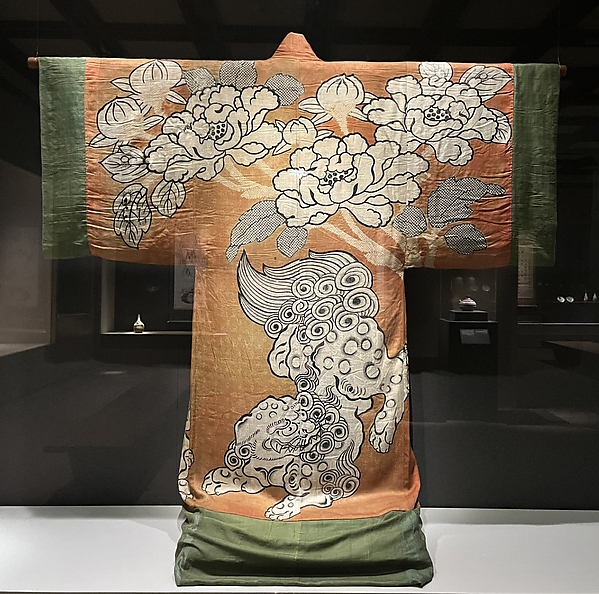
Kimono-Shaped Coverlet (Yogi) with Chinese Lions and Peonies, late 17th century, Figured satin-weave silk with paste-resist dyeing, tie-dyeing, and ink painting. The Metropolitan Museum of Art, Mary Livingston Griggs and Mary Griggs Burke Foundation Fund, 2018, accession 2018.635.
Look closer: A grander yogi. Compare its figured silk with the humble cotton coverlet with the lobster.
Image: The Metropolitan Museum of Art, Open Access (CC0)
The Met’s two sashiko robes give the vocabulary a face. The jacket of the second half of the nineteenth century, in indigo-dyed plain-weave cotton quilted and embroidered with white cotton thread, has mostly three variations on a pattern of interlocking circles, shippō-tsunagi, with a wave design in the bottom band. The kimono-form robe of the mid-nineteenth century has seven continuous patterns, and the museum notes that some geometric sashiko patterns are stylised versions of floral motifs, as in the persimmon flower at the shoulders and the hem. Reading those records together, a viewer can learn the main lesson: the grid hides a flower.
The Met also gives the practical principle behind the beauty. Its note on the jacket explains that sashiko is a quilting technique using running stitches to strengthen a textile and extend its life, or to join recycled cloth into a new garment, and that farmers used it to make warmer and more durable fabrics. The decorative stitching grew out of that purpose. To read a piece correctly, begin with strength and end with beauty. A good example will be densest where the body works. Seen the other way, a garment that is uniformly beautiful and unworn may be a later, decorative piece, and its dating should be treated with caution. The motifs themselves belong to the larger system described in A Motif Dictionary: Crane, Pine, Wave and Chrysanthemum.
Mountain hakama, a ministry and a video game
The trouser has a longer and stranger career than the jacket. Wikipedia’s entry gives the spellings monpe, moppe and mompei, says it is thought to descend from the court’s umanori hakama, and says that its origin is unclear. Rural variants were called yamabakama, mountain hakama, and nobakama, field hakama. Monpe has been linked to the north-eastern farming countryside, such as the Yonezawa area, though the article says historians have questioned this, and women across Japan, especially in the Tōhoku region, wore variations for centuries.

Piece of Cloth for Bedding, 19th century, Plain-weave cotton with weft kasuri (ikat ) patterning. The Metropolitan Museum of Art, Seymour Fund, 1966, accession 66.122.20.
Look closer: Look at the weft. Kasuri cotton of this kind is the patterned cloth the entry on monpe names beside indigo for rural trousers.
Image: The Metropolitan Museum of Art, Open Access (CC0)
The scholar who counted them was the ethnologist Kiyoko Segawa (1895 to 1984). According to the entry, she travelled to rural villages in the early 1930s to study traditional clothing and wrote sixty-one volumes recording about three hundred versions of monpe across Japan. A trouser that took three hundred forms, depending on valley and coast, cannot be reduced to one pattern, and this is why the chapter treats it as a family.
The city adopted it late. The entry records that in 1930 Matsukichi Kimura recommended monpe as ideal working dress for factory women, and that the historian Yi Jaeyoon argues that modern urban monpe did not develop until 1924. They spread quickly with the outbreak of the Second Sino-Japanese War and, in 1942, in the Pacific War, were encouraged as part of the government-regulated women’s standard dress, hyōjun-fuku, which paralleled the men’s kokumin-fuku of 1940. Girls’ magazines such as Shōjo Kurabu promoted them, and the Home Ministry sponsored a sewing workshop at a Tokyo school. The article says that monpe suited the campaign called ‘Luxury is the Enemy!’ because they could be made from old kimono and easily repaired, and records that in 1939 the Welfare Minister Keizō Saitō had called recycled national defence dress a disgrace. Women wore them in factories, during air raids and as everyday wear.

Piece, Indigo-dyed cotton. The Metropolitan Museum of Art, Gift of Amanda Stinchecum, 1982, accession 1982.385.4.
Look closer: A fragment kept for its cloth. The museum records only the material, indigo-dyed cotton.
Image: The Metropolitan Museum of Art, Open Access (CC0)
The colour changed with the century. The entry says that sumptuary laws barred farmers from silk and colours such as purple and crimson but allowed dark blue, so that rural workers became associated with blue, that brighter colours such as orange and purple became popular from the Taishō period, and that indigo remained the most common. Kasuri cotton gave patterned monpe, with Kurume kasuri named in the entry as coming from Fukuoka and Ryukyu kasuri from Okinawa. For those cloths see Kasuri: Ikat Woven from Dyed Thread.
After the war, the entry says, monpe fell from mainstream use because of the memory of deprivation, and today they are worn mainly on formal occasions. It records an afterlife in other countries and in other media. In the late 1930s monpe were distributed in colonial Korea, Taiwan and Thailand, mainly for air raids and fires, and in postwar Korea the garment was renamed ilbaji, work trousers, to remove traces of Japanese colonisation. It is now marketed in Korea as exercise and lounge wear. The entry also lists their appearance in the animated films Grave of the Fireflies (1988), Only Yesterday (1991) and In This Corner of the World (2016), and notes that the video game Animal Crossing: New Horizons (2020) sells ‘Traditional Monpe Pants’ for 1,040 Bells. A garment of the field has travelled a long way, and remains recognisable by its tied waist.
Four tales of the working coat
The left sleeve. The Victoria and Albert Museum’s coat is catalogued without a name or a village, and the museum’s curators did not invent either. Instead they looked at the cloth. They noticed the shredded end of the left sleeve, and concluded that the wearer was left-handed or repeated some task that wore the cloth there. It is a model of restraint, because it records a habit and declines to make a legend.

Piece, Cotton, bast fiber, silk. The Metropolitan Museum of Art, Gift of Amanda Stinchecum, 1982, accession 1982.385.1.
Look closer: Three fibres in one small piece. The museum records cotton, bast fibre and silk, and dates it to the Meiji or Taisho period.
Image: The Metropolitan Museum of Art, Open Access (CC0)
The persimmon flower. On the Shōnai plain in Yamagata, farmers hauled fertiliser to their fields on sledges, and a vest was made for the work. The part that met the sledge band was reinforced by farmers’ wives with fine stitches, in a pattern that looks geometric and is named for the sepals and petals of a persimmon blossom. The Met’s note says the vest is also a sign of their thrift, assembled from many fabrics, with small striped pieces that may have come from more formal garments. It is a story about women who stitched flowers into the place where the rope pulled.
The apron with a name. The special display of maekake in Asakusa showed Nanbu aprons of hemp with wool embroidery, and each, the artscape review reports, carries the name of its maker, her family and village, and the year she married. In a world of unsigned cloth these are signed. They are one of the few places in this chapter where a particular woman’s name is attached to a particular piece of work.
The collector’s fear. Chūzaburō Tanaka began to collect, according to the magazine article, because he feared the loss of the stories and traditions the cloth held. The fear was reasonable. Wikipedia says that after the Meiji period many working people saw the garments as a reminder of poverty and little effort went into preserving them, and that cheaper ready-made clothing made the craft largely unnecessary in the early twentieth century. The collection exists because someone chose to keep what everyone else was discarding.
Small surprises from the sources
Short facts, each given as the cited source gives it.
- Sashiko means ‘little stabs’, and the technique first appeared in the Edo period, according to Wikipedia.
- In Tsugaru, peasants could not wear cotton, so they stitched cotton thread into hemp and linen.
- A Tsugaru kogin stitcher counts odd-numbered threads along the weave: one, three, five, seven.
- More than three hundred kogin patterns were created, according to Wikipedia.
- In Aomori a local saying held that to slash cloth is to slash your own flesh.
- Some overcoats in the Tanaka collection weigh up to fourteen kilograms and were used by whole families for sleeping.
- Salmon-skin boots were waterproof, and sealskin soles reduced slipping on ice.
- A Seattle work coat of about 1900 is woven of wisteria fibre with paper wefts.
- One sakiori obi needs roughly three old kimono, according to Wikipedia.
- The V&A’s coat has a shredded left sleeve that may show a left-handed wearer.
- Ethnologist Kiyoko Segawa recorded about three hundred versions of monpe across Japan.
- In postwar Korea, monpe were renamed ilbaji, meaning work trousers.
Words of the field
The terms used in this chapter, in the sense the sources give them.
| Term | Meaning | Where it appears |
|---|---|---|
| Noragi | Farmer’s or peasant’s working clothing | Throughout |
| Boro | Mended or patched textiles; from boroboro, tattered | Mended coats |
| Sashiko | ‘Little stabs’; running stitch that strengthens and decorates | Persimmon flower; shippo-tsunagi |
| Kogin-zashi | Counted-thread stitching on hemp and cotton from Tsugaru | Aomori |
| Sakiori | Weaving with old cloth cut into strips | Obi; Seattle jacket |
| Monpe | Loose work trousers tied at the waist | Monpe section |
| Momohiki | Close-fitting work trousers | Selvedge list |
| Yogi | A kimono-shaped interlined coverlet | Lobster coverlet |
| Noren | A shop curtain hung in a doorway | Cherry-tree noren |
| Maiwai | A fisherman’s festival robe | Ship and fan robe |
| Shifu | Cloth woven with paper wefts | Wisteria coat |
| Maekake | An apron; Nanbu examples are hemp with wool embroidery | Amuse Museum |
| Mottainai | The sense of not being wasteful | Amuse Museum |
| Hyojun-fuku | Government standard dress for women, 1942 | Monpe section |
Where the working coats are kept
The Metropolitan Museum of Art holds the sledge-pulling vest, the two sashiko robes, the farmer’s jacket and the other pieces described here. Its records list each as not on view, so the museum’s own object pages are the way to see them. The Victoria and Albert Museum’s coat is held in its East Asia collection under accession number FE.27-2015, and its page notes that it can be viewed by appointment. The Seattle Art Museum holds the wisteria coat and the sakiori jacket, which it has shown in exhibitions between 1993 and 2021, according to its records.
The Amuse Museum in Asakusa, which housed the Tanaka collection, closed on 31 March 2019, and the Paper Sky article says the collection now travels as an exhibition. The Hirosaki Kogin Institute, whose site gives the history of Tsugaru kogin, is the place to follow the craft in Aomori. A visitor should check the current opening and display arrangements of each museum before making a journey.
Reading a working coat in the hand
Six marks are worth the time. First, wear. A coat that has been worn shows it where the body works, and the V&A’s reading of a shredded left sleeve shows what a trained eye can take from a single place. Second, reinforcement. The Met’s vest is stitched where the sledge band pressed, and stitching placed for a reason is more convincing than stitching spread evenly. Third, the cloth. Hemp, cotton, wisteria fibre and paper wefts are all recorded in museum examples, and a surprising material in a good state of wear is not a reason for doubt.
Fourth, the dye. Selvedge notes that indigo faded gradually to a lighter blue with use, and the boro entry on Wikipedia says that repeated dyeing in a weak bath gave better wear resistance and colourfastness than a few dips in a strong one. Fifth, the claim. The same entry says that what survives is mostly antique pieces and modern craft reproductions, and an owner’s story of a village, a family or a date is a claim, to be checked against a museum record. Sixth, the weight. The Asakusa review’s fourteen-kilogram overcoats are a reminder that a true family coat is heavy, and a light, pristine ‘boro’ deserves a second look. The care of fragile indigo cotton and bast fibre is set out in How to Read, Grade and Care for a Japanese Garment, and the fibres themselves in Silk, Hemp, Cotton and Ramie: The Fibres of Japanese Dress.
Indigo in the house
The shelf holds antique boro and sashiko pieces, a fire-brigade coat and a contemporary indigo patchwork. Each is described as what it is, with its age and condition set out plainly on its own page.


Kimono and textile heritage
Antique cloth of every kind is gathered in one collection, and the concierge desk can look for a particular fibre, dye or region on request.
Answered plainly
What is a noragi?
A farmer’s working jacket or field clothing, made of indigo cotton, hemp or linen, mended repeatedly. The word names a use, and the shapes vary by region.
Is noragi the same as boro?
No. Noragi is the garment; boro is the mended, patched cloth that many such garments became. A noragi can be boro, but need not be.
What does sashiko mean?
‘Little stabs’: a running stitch used to strengthen cloth and decorate it, traditionally white cotton thread on indigo cloth.
Why indigo?
It was cheap to grow, widely available, permitted to farmers under the dress rules, and its moth-repelling properties protected the garment. One dye bath could be used many times.
What is monpe?
Loose work trousers tied at the waist, worn above all by rural women. They were promoted as standard women’s dress in 1942 and declined after the war.
How can I tell age?
Look at the thread, the weave and the fading of the dye, and follow the repairs from the inside. Treat any exact date or village as a claim to be checked against a museum or a documented source.
Where did kogin-zashi begin?
In the part of Aomori Prefecture held by the Tsugaru clan in the Edo period. Peasants there were barred from wearing cotton, so they stitched cotton thread into linen and hemp for warmth and strength.
What is sakiori?
Cloth woven with old fabric cut into strips about a centimetre wide, used as the weft. It is woven rather than stitched; one obi needs about three old kimono.
Who was Chuzaburo Tanaka?
A folklorist and ethnologist from Aomori, 1933 to 2013, who collected tens of thousands of folk objects, many of them boro, and whose collection formed the basis of the Amuse Museum in Asakusa.
Is the Amuse Museum still open?
No. It opened on 1 November 2009 and closed on 31 March 2019. A magazine article says that the collection now travels as an international exhibition.
What did the V&A learn from its coat?
From the shredded end of the left sleeve it inferred that the wearer was left-handed or repeated a task that caused friction there. It does not name the wearer.
Were monpe worn in other countries?
Yes. Wikipedia records that in the late 1930s they were distributed in colonial Korea, Taiwan and Thailand, mainly for air raids and fires, and that in postwar Korea they were renamed ilbaji.
Why are the numbers for the Tanaka collection different?
Sources count different things. Wikipedia says more than 20,000 boro pieces and 786 designated properties; the Amuse Museum entry says more than 30,000 items; a magazine says nearly 30,000 objects and nearly 800 designated.
Which designers have drawn on boro?
Wikipedia’s Amuse Museum entry names Louis Vuitton, Joseph Altuzarra and Junya Watanabe; a magazine article adds Issey Miyake and Yohji Yamamoto.
Where next
Sources and image credits
- Sleeveless Work Jacket for Sledge Pulling, Metropolitan Museum of Art, 1978.66
- Sashiko Kimono, Metropolitan Museum of Art, 1979.409
- Farmer’s Jacket, Metropolitan Museum of Art, 1980.493.2
- Boro (textile), Wikipedia
- Sashiko, Wikipedia
- Monpe, Wikipedia
- Kogin-zashi, Wikipedia
- Tsugaru Kogin-zashi, Hirosaki Kogin Institute
- Amuse Museum, Wikipedia
- More Amazing than Amusing: Asakusa’s Amuse Museum, artscape Japan
- Boro, Paper Sky
- Coat (noragi), Victoria and Albert Museum, FE.27-2015
- Farmer’s jacket (noragi), Seattle Art Museum, 2001.576
- Work coat (noragi), Seattle Art Museum, 89.168
- Threadbare, Selvedge
- Sashiko Jacket, Metropolitan Museum of Art, 67.172.1
- Jacket with Dragon and Mount Fuji, Metropolitan Museum of Art, 1999.247.2
- Fireman’s jacket, Metropolitan Museum of Art, 1983.100
- Fisherman’s Festival Robe (Maiwai), Metropolitan Museum of Art, 1977.447
- Kimono-Shaped Coverlet (Yogi) with Lobster, Metropolitan Museum of Art, 66.239.3
- Noren with Design of Flowering Cherry Tree, Metropolitan Museum of Art, 1980.493.1
- Obi (sakiori), Metropolitan Museum of Art, 1981.411.1
- Object record: Piece of Cloth for Bedding with Pattern of Bamboo, The Metropolitan Museum of Art
- Object record: Kimono-Shaped Coverlet (Yogi) with Chinese Lions and Peonies, The Metropolitan Museum of Art
- Object record: Piece of Cloth for Bedding, The Metropolitan Museum of Art
- Object record: Piece, The Metropolitan Museum of Art
- Object record: Piece, The Metropolitan Museum of Art
Last reviewed 28 October 2026. Pictures, where shown, are public-domain or open-access and credited beneath each one.
Looking for a jacket, a length of indigo or a piece of mended cloth you have seen described here? The concierge desk replies within one to three business days.
Private concierge
Looking for something in particular?
Describe the piece or the project you have in mind. A senior advisor in Tokyo reads every case file personally and replies within two business days, with fees set out in writing before any work begins.