
Samurai Ceremonial Dress: Hitatare and Kamishimo
Costume · The castle and the shogun
Samurai Ceremonial Dress: Hitatare and Kamishimo
武家礼装
The samurai's formal dress began as the clothing of commoners and ended as a code of rank. Its sleeves, its crests and the length of its trousers told a visitor to a daimyo's castle exactly where a man stood.
Fact sheet
Samurai formal dress in one glance
- A commoner's start. The hitatare began as commoner garb in the Heian period and became the standard samurai outfit by the thirteenth century.
- Crests as livery. The daimon is a hitatare dyed with a large family crest in five places, and became full dress for samurai of the fifth rank and above.
- Top and bottom. In the Edo period the kataginu and hakama together were called kamishimo, meaning top and bottom.
- Length is rank. The long nagabakama made the kamishimo formal; the normal-length hakama made it a uniform.
- A castle code. Inside a daimyo's castle the naga-hitatare was reserved for the shogun, the Gosanke and the highest lords.
- Still seen. Kamishimo survive on the Noh stage, where the formal material is linen and the crest sits on back, breast and skirt.
Dress as a ladder of rank
A warrior class that stayed in office for centuries needed a way to dress its meetings. The samurai answered with clothes that were stiff, crested and stylised, and that told a stranger a man's place at a glance. The ensemble that most people now call samurai formal dress, a sleeveless jacket with winged shoulders over pleated trousers, is only the end of a long evolution, and it sits at the lower end of a ladder whose upper rungs were reserved for the shogun and the highest lords.
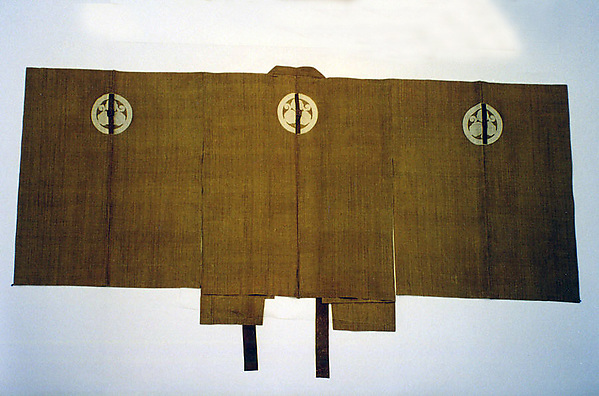
Jacket (suo) and trousers (nagabakama), 19th century, Resist-dyed hemp and ramie. The Metropolitan Museum of Art, Gift of John B. Elliott through the Mercer Trust, 1999, accession 1999.247.3a, b.
Look closer: Look at the trousers. The Met describes long nagabakama that extend well beyond the foot, and a jacket whose crest has leather cords and a leather knot at its centre.
Image: The Metropolitan Museum of Art, Open Access (CC0)
The Metropolitan Museum owns a suit that shows the logic plainly. It pairs a large-sleeved jacket, a suō, with long trousers, nagabakama, both decorated with a family crest. The museum notes that each sleeve uses two widths of cloth, that the trousers extend well beyond the foot, and that leather cords and a leather knot at the centre of each crest set the garment apart from other samurai clothes. The suō emerged in the Muromachi period and became the shogunate's formal dress in the Edo period when it was worn with the eboshi, the court cap.

Katsukawa Shunshō 勝川春章, The Second Sakata Hangoro as a Daimyo Attired in a Kamishimo, 1770, Woodblock print (nishiki-e); ink and color on paper. The Metropolitan Museum of Art, Purchase, Joseph Pulitzer Bequest, 1918, accession JP442.
Look closer: Look at the title. The Met names the role a daimyo attired in a kamishimo and dates the sheet to 1770.
Image: The Metropolitan Museum of Art, Open Access (CC0)
This chapter follows that dress from its beginnings, through the hitatare, the daimon and the suō, to the kataginu and hakama that were called kamishimo, and then up the ladder to the kariginu and the naga-hitatare of the great lords. It looks at the castle where the garments were worn, at the system of alternate attendance that brought daimyo to it, at the stage and the child's suit that preserve the forms, and at what a modern reader should ask of a piece in the hand. The older court dress from which the warriors borrowed is described in Court Dress: Jūnihitoe and Sokutai, and the stage costumes that still use the forms in Noh Costume: Karaori, Atsuita and Mizugoromo and Kabuki Costume: Hikinuki and the Onnagata Layers.
From commoner's garb to samurai standard
The samurai's formal wear starts below the court. Samurai-Archives, a reference site on warrior history, describes the hitatare as one standard style of samurai dress, in two pieces: a long-sleeved jacket and a hakama, a trouser-skirt. The jacket's upper body was open down the front and sides, the sleeves attached only halfway down the body, leaving the lower sleeves free, and it had an open neck, unlike the standing collar of the kariginu.

Noh costume (Hitatare), 19th century, Resist-dyed and painted plain-weave bast fiber, probably ramie. The Metropolitan Museum of Art, Purchase, Friends of Asian Art Gifts, 2002, accession 2002.385a, b.
Look closer: Look at the form. The Met records a Noh costume in the hitatare form, of the nineteenth century, the stage descendant of the samurai garment.
Image: The Metropolitan Museum of Art, Open Access (CC0)
The same page gives its history. The hitatare began as commoner garb in the Heian period, which ran from 794 to 1185. Courtiers sometimes wore it over their other clothes for warmth, so it entered the court's wardrobe, and at the end of the Heian period the Taira clan and others adopted it as their clans took up more aristocratic practices. By some point in the early Kamakura period, from 1185 to 1333, it had spread widely among courtiers and samurai, and its large sleeves looked more impressive than earlier samurai dress. By some point in the thirteenth century it had become the standard samurai outfit.
In the Muromachi period, from 1336 to 1573, it was samurai formalwear and was made in more lavish materials and patterns within the Kyoto court. The headwear changed with it: the tall tate eboshi was typically worn with it up to the Kamakura period, and from the Muromachi period on flatter, folded ori eboshi became more typical. A garment that begins as the clothing of ordinary people and ends as the badge of rank is one of the most useful patterns in the history of dress.

Katsukawa Shunshō 勝川春章, The First Nakamura Nakazo as a Samurai Dressed in Kamishimo, ca. 1775, Woodblock print (nishiki-e); ink and color on paper. The Metropolitan Museum of Art, Purchase, Joseph Pulitzer Bequest, 1918, accession JP430.
Look closer: Look at the date. The Met dates the sheet to about 1775.
Image: The Metropolitan Museum of Art, Open Access (CC0)
The Edo period added a reversal. In the 1710s, the page says, the shogunal advisor Arai Hakuseki aimed to make the shogun's court more aristocratic and replaced the hitatare with the nōshi on particular occasions. The nōshi had been worn by courtiers and emperors when the hitatare was still commoner garb, so it kept a stronger association with aristocracy and royalty. The warriors had spent centuries moving up in the world, and the shogun's adviser decided that the garment's origins still showed.
A reader looking for the earliest forms of the sleeves and the cap will find the court background in Court Dress: Jūnihitoe and Sokutai, where the kariginu and the sashinuki trousers are also described. The Noh stage keeps its own hitatare, described in Noh Costume: Karaori, Atsuita and Mizugoromo.
Five large marks on the suō and the daimon
From the hitatare came simpler versions. A page in the Costume pages of the Japanese-language costume site iz2.or.jp, whose publisher the pages read do not name, explains that simpler versions led to the daimon and the suō. The daimon is a hitatare dyed with a large family crest in five places, and the crests also appear in five places on the hakama. The daimon began in the Muromachi era, and in the Edo era it became the usual full dress for samurai ranked fifth or higher at the Imperial court.

Kyōgen Costume: Jacket (Suō) with Design of Lotuses, early 19th century, Resist-dyed and painted plain-weave bast fiber (asa). The Metropolitan Museum of Art, Purchase, Mrs. Roger G. Gerry Gift, 1997, accession 1997.209.1.
Look closer: Look at the jacket. The Met records a kyōgen suō with a design of lotuses, of the early nineteenth century.
Image: The Metropolitan Museum of Art, Open Access (CC0)
The Met's suit in the same form is a closer view of what such garments were. The museum records resist-dyed hemp and ramie, a jacket measuring about 97 by 177 centimetres and trousers about 160 by 75 centimetres, and a crest that is a form of the gotoku kashiwa, a tripod oak, with three Japanese oak leaves and a tripod. The family associated with the crest has not been identified. The museum says the suō emerged in the Muromachi period and became the shogunate's formal dress in the Edo period when worn with the eboshi headdress.
The crest is the garment's voice. A man in a daimon did not need to introduce himself, for the crest in five places on his body did it for him, and a hall of such men was a hall of visible houses. The general logic of the crest is set out in Mon: The Family Crests on Japanese Dress, and the family crests of the warrior houses in the house article on the samurai clans.

Katsukawa Shunshō 勝川春章, The Second Ichikawa Yaozo as a Samurai Dressed in a Gaudy Kamishimo, probably 1773, Woodblock print (nishiki-e); ink and color on paper. The Metropolitan Museum of Art, Purchase, Joseph Pulitzer Bequest, 1918, accession JP408.
Look closer: Look at the title. The Met calls the kamishimo gaudy and dates the sheet probably to 1773.
Image: The Metropolitan Museum of Art, Open Access (CC0)
The same page of the iz2.or.jp costume pages gives the portrait of Oda Nobunaga as its example of the older style. It says the figure is based on a portrait painted by Kanō Motohide the year after Nobunaga was assassinated at Honnō-ji in 1582, preserved at Chōkō-ji in Aichi Prefecture, and that the kataginu and hakama are bluish green with two white stripes and five dyed crests of the three-paulownia form. Compared with later kataginu, the page says, the pleats are more natural and the overlapping neckbands at the front of the chest are set deeper.
Kataginu and hakama: the kamishimo
The garment now best known is the kamishimo, literally top and bottom. The iz2.or.jp page explains that the kataginu is the suō without sleeves, worn with hakama and a kosode underneath, and that it was both everyday clothing and a form of full dress. In the Edo era, it adds, the kataginu and hakama together were called kamishimo, and served as a samurai's full dress. The Noh dictionary at the-noh.com agrees and adds the history: in the Muromachi era the kataginu was considered informal dress, based on suō with the broad sleeves removed.
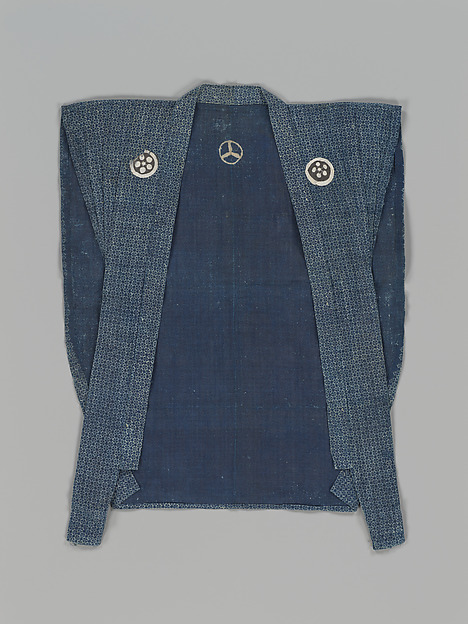
Child’s formal ensemble (kamishimo), early 19th century, Plain-weave bast fiber with stencil-dyeing. The Metropolitan Museum of Art, Gift of Minsun Hwang and Kevin Jahng, in the honor of Marin Cynthia Jahng, 2024, accession 2024.75a, b.
Look closer: Look at the back board. The Met says the pleated trousers have a supporting back board, and that the crest of this set was mostly replaced later.
Image: The Metropolitan Museum of Art, Open Access (CC0)
The same dictionary distinguishes two lengths. In the Edo era, han-kamishimo, the kataginu with the normal-length hakama, was the regular samurai uniform, and naga-kamishimo, with the trailing nagabakama, was the formal dress of higher-ranking samurai at the shogun's palace. The length of the trouser, in the words of the page, determines whether the outfit is informal or formal. A man's trousers were a rank in cloth.
The Met's child's ensemble shows the construction. The museum describes a two-piece formal outfit, the everyday formal wear of Edo-period samurai, worn over a kimono. The sleeveless jacket has extended shoulders and is often stiffened with paper. The pleated trousers have narrow ties and a supporting back board. Kamishimo are usually made of hemp or ramie and patterned with paper stencils, and the family crest, applied with a paste resist, appears on the jacket and the hakama's back board, though most of this set's crest was replaced later. It was made for a young boy, and the museum notes that Edo-period children's clothing rarely survives.

Ippitsusai Bunchō, Mimasuya Sukejuro as a Samurai Attired in Kamishimo, ca. 1770, Woodblock print; ink and color on paper. The Metropolitan Museum of Art, Rogers Fund, 1918, accession JP241.
Look closer: Look at the maker. The Met attributes the sheet to Ippitsusai Bunchō, about 1770.
Image: The Metropolitan Museum of Art, Open Access (CC0)
The Met also holds two overvests, called kataginu, of the Edo period, in unlined dark dye-patterned gauze or other sheer textile, and a kyōgen kataginu of the eighteenth century with a design of a Japanese lobster. The museum's records for these give materials and dates and no narrative label, so the house describes them as it finds them. The sheer fabrics matter: stiff, wing-shouldered jackets in gauze are summer formal wear, and the winged outline is the point of the garment.
Wikipedia on the hakama adds the lower half. It states that the most formal men's hakama is the sendaihira, made of stiff, glossy, striped silk, usually black and white or black and navy, worn with a black montsuki kimono bearing one, three or five family crests, white tabi, a white nagajuban and, in cooler weather, a montsuki haori. The kimono of the formal man is described in The Kimono Ladder: Furisode, Tomesode, Hōmongi and Komon, and the haori in Haori and Hakama: The Jacket and the Divided Skirt.
Pleats, boards and long trains
Wikipedia gives the anatomy of the hakama. It has four straps, two longer ones at the front and two shorter ones at the rear. At the back is a rigid, trapezoid-shaped board called the koshi-ita, and a spoon-shaped piece called the hakama-dome, or hera, is tucked into the obi or the straps at the back to keep the hakama in place. Martial-arts hakama typically have seven deep pleats, two at the back and five at the front, arranged asymmetrically, two to the right and three to the left. The article cites this as an example of asymmetry in Japanese aesthetics.

Trousers ("hakama") associated with Kyogen, late 19th century, Hemp. The Metropolitan Museum of Art, Purchase, Proceeds from Sale: Japanese Art, 1991, accession 1991.135.
Look closer: Look at the material. The Met records hemp for this late nineteenth-century hakama associated with kyōgen.
Image: The Metropolitan Museum of Art, Open Access (CC0)
The long form is the garment's showpiece. The article says samurai visiting the shogun or a high-ranking lord were sometimes required to wear very long hakama, the nagabakama, with trains one or two feet long that hindered walking, and that this may have helped prevent surprise attacks. Today, it says, they appear mainly in Noh, kyōgen and kabuki and in Shinto rituals. The Met's suit with long trousers shows the garment in cloth, and the Met's kyōgen hakama of the late nineteenth century, in hemp, shows the stage version.
Wikipedia names other historical styles too. The karusan-bakama, inspired by Portuguese trousers, belongs to the Sengoku period, with tapered hems and cuff-like bands. The yoroi hakama were armoured hakama with small plates or mail sewn in, worn by samurai. The court forms, ōguchi-hakama and uenobakama for the sokutai and sashinuki with a hem cord, are described in Court Dress: Jūnihitoe and Sokutai.

Katsukawa Shun'ei 勝川春英, Otani Hirohachi as a Samurai Dressed in a Gaudy Kamishimo, December 1790, Woodblock print; ink and color on paper. The Metropolitan Museum of Art, Purchase, Joseph Pulitzer Bequest, 1918, accession JP321.
Look closer: Look at the date. The Met dates the sheet to December 1790.
Image: The Metropolitan Museum of Art, Open Access (CC0)
For the history of the divided skirt beyond the warrior, the chapter Haori and Hakama: The Jacket and the Divided Skirt follows the hakama into school uniforms, the dojo and the shrine. The article reports that boys historically began wearing their first hakama at age five, as marked by Shichi-Go-San, and that hakama became standard for women's high schools in the Meiji and Taishō periods. The rite is the subject of Shichi-Go-San and the Clothes of Childhood Rites.
Naga-hitatare and the ceremonial day
At the top of the ladder were garments that most samurai never wore. The iz2.or.jp page on the daimyo in ceremonial dress describes the naga-hitatare as the ceremonial costume that samurai wore inside a daimyo's castle. It names who wore it: the shogun, the lords of the Gosanke, the three great Tokugawa families, and daimyo ranked above the fourth-place chamberlain to the Emperor. The occasions were ceremonial ones, including New Year and the coming-of-age ceremonies for boys.

Yōshū (Hashimoto) Chikanobu, Chiyoda Castle (Album of Men), 1897, Hexaptych of woodblock prints; ink and color on paper. The Metropolitan Museum of Art, Gift of Mrs. W. Walton Butterworth, 1979, accession JP3561.
Look closer: Look at the title. The Met titles the album Chiyoda Castle, Edo's castle, drawn in 1897, long after the ceremonies it recalls.
Image: The Metropolitan Museum of Art, Open Access (CC0)
The page gives details that read like a rule book. The hitatare was made from a silk-woven fabric called Seigo-ji, and the shogun's hitatare was purplish red with grey. The dainagon's hitatare was originally red, and a light yellow version was worn by shoguns in the Genna or Kanei eras, after which other samurai avoided it. Other pieces had no colour restriction, among them iridescent hitatare with purple chest strings and braided strings in a chrysanthemum-binding pattern. Purple kakeo strings were attached to the formal eboshi, worn only by high-ranking samurai permitted to use them. The wearer carried a small sword and a fan called a suehiro, finished with gold dust and a light red, and when carrying a long tachi he used the thread-wound form with a white undergarment.
A second page describes the kariginu as the full dress of the Tokugawa shogunate for daimyo and high-ranking samurai families of the bottom junior grade of the fourth court rank, and notes that the pictured costume is a naga-hitatare for a man ranked above the third court rank or as a fourth-ranked chamberlain to the Emperor, and a daimon for a fifth-ranked daimyo. The kariginu was of thin, light summer gauze, the colour and crest pattern were not restricted, and the sashinuki trousers were of light yellow raw silk, though purple had been used at one time. The footwear was formal rush-strap shoes, with straw sandals also used. The kariginu, described in Kesa, Kariginu and the Robes of Priests and Monks as the ancestor of the shrine priest's robe, therefore appears at the very top of the warrior's ladder.
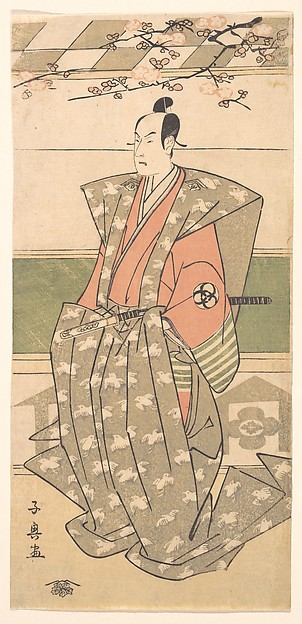
Eishōsai Chōki, The Actor Bandō Mitsugorō II in Ceremonial Robes with Kamishimo, 1751–1788, Woodblock print (nishiki-e); ink and color on paper. The Metropolitan Museum of Art, Henry L. Phillips Collection, Bequest of Henry L. Phillips, 1939, accession JP2906.
Look closer: Look at the title. The Met names ceremonial robes with kamishimo for the actor Bandō Mitsugorō II.
Image: The Metropolitan Museum of Art, Open Access (CC0)
The picture is of a society that ruled by protocol. Wikipedia on the Edo period records that the Buke shohatto code regulated private conduct, marriage, dress, weapons and troop numbers, though the page does not detail the specific dress rules. The code is the framework, and the garments are what the rules looked like when worn.
Daimyo on the road to Edo
The garments were worn because the lords came to Edo. Wikipedia on the Edo period records that after the Battle of Sekigahara in 1600, sankin-kōtai, alternate attendance, began as a voluntary way for lords to show loyalty, and that Shogun Iemitsu made it compulsory for all daimyo in 1635. About 260 lords spent alternate years in Edo, while their wives and heirs stayed in Edo permanently as hostages. The article on sankin-kōtai adds that the attendance cost the lords between seventy and eighty per cent of their yearly spending, that processions were almost daily occurrences in the shogunal capital, and that the law remained in force until 1862, except for an eight-year suspension under Tokugawa Yoshimune.

Hishikawa School, Daimyo Procession to Edo, ca. 1700, Handscroll; ink, color, and gold on silk. The Metropolitan Museum of Art, Gift of Lee E. Dirks, in celebration of the Museum's 150th Anniversary, 2019, accession 2019.447.1.
Look closer: Look at the length of the line. The Met titles the painting Daimyo Procession to Edo and attributes it to the Hishikawa school, about 1700.
Image: The Metropolitan Museum of Art, Open Access (CC0)
The Met has paintings of the processions: Daimyo Procession to Edo of about 1700 by the Hishikawa school, and Daimyo Procession from Yūshō-in of about 1800. The same museum holds the playful versions: Children Play-acting a Daimyo Procession by Torii Kiyomitsu of about 1763 and Boys Play-acting a Daimyo Procession by Utagawa Kuniyoshi. The existence of the games tells a reader how familiar the spectacle was.
The castle itself had its ceremony. Wikipedia on Edo Castle describes the Honmaru Palace, with the Ō-omote, the Great Outer Palace, holding reception rooms for public audiences. It also records the incident of 21 April 1701, when Asano Takumi-no-kami drew a short sword and attacked Kira Kōzuke-no-suke in the Matsu-no-ōrōka, the Great Pine Corridor, which led to the events of the forty-seven rōnin. The fact that an incident could be so catastrophic reflects how closely the dress and conduct of the castle were governed.

Daimyo Procession from Yūshō-in, ca. 1800, Six-panel folding screen; ink, color, and gold on gilded paper. The Metropolitan Museum of Art, Gift of Sue Cassidy Clark, in honor of Dr. Barbara Brennan Ford, 2004, accession 2004.506.
Look closer: Look at the date. The Met dates the painting to about 1800.
Image: The Metropolitan Museum of Art, Open Access (CC0)
Foreign visitors were drawn into the same rules. Wikipedia on the Edo period notes that the Dutch chief factor periodically travelled to Edo to pay homage to the shogun, and that Engelbert Kaempfer's account of his audience with Tsunayoshi describes being ordered to put on and remove hats and wigs as part of the ritual. In a world where dress was protocol, even a visitor's headgear belonged to the ceremony.
The hitatare in armour and the end of the form
The hitatare was also a war garment. The iz2.or.jp page on a daimyo in the armoured version describes the yoroi hitatare worn by Matsudaira Katamori, daimyo of the Aizu domain, with a sleeveless jinbaori over the armour, and refers to photographs of the late Edo shogunate, among them one of Nagai Naoyuki's expedition against Chōshū in 1864 and one of Prince Ninnaji Yoshiaki's battlefield inspection in 1868, in which the prince wore a brocade hitatare. The page states that in the fifth year of Meiji, the costume was abolished when the Western-style court dress became the standard.

Surcoat (Jinbaori), 17th century, Body: China, for the European market, late 16th–17th century; silk velvet, cut and voided Lining: China, late 16th–17th century; silk damask Lapels: Japan, probably 18th century; lampas, silk and gilt-paper strips. The Metropolitan Museum of Art, Friends of Asian Art, Purchase, Mr. and Mrs. Andrew Saul Gift, 1998, accession 1998.190.
Look closer: Look at the date. The Met dates this jinbaori to the seventeenth century.
Image: The Metropolitan Museum of Art, Open Access (CC0)
The surcoats that went over armour are the subject of Jinbaori: The Warlord’s Surcoat. The Met's jinbaori include a seventeenth-century example, an eighteenth-century battle surcoat, and a jinbaori made for a boy in the late eighteenth or early nineteenth century, a small garment whose existence is a reminder that the formal wardrobe began in childhood.
The end of the warrior class came in stages. Wikipedia on the samurai records that in 1869 daimyo and court nobles were reorganised as kazoku and most former warriors became shizoku, in 1871 the domains were abolished, in 1873 conscription was introduced, and in 1877 the Satsuma Rebellion, the last major armed revolt by former samurai, ended in defeat. The article also states that a 1629 law had required samurai on official duty to wear two swords, the daishō, which by the end of the Tokugawa era had become more a symbol of power than a working weapon.

Torii Kiyomitsu, Children Play-acting a Daimyo Procession, ca. 1763, Woodblock print; ink and color on paper. The Metropolitan Museum of Art, The Francis Lathrop Collection, Purchase, Frederick C. Hewitt Fund, 1911, accession JP695.
Look closer: Look at the title. The Met titles the sheet Children Play-acting a Daimyo Procession and dates it to about 1763.
Image: The Metropolitan Museum of Art, Open Access (CC0)
The form did not vanish with the class. The Met's Chikanobu album, Chiyoda Castle (Album of Men), of 1897, shows that the Meiji public remembered the castle's ceremonies three decades after the castle's government had ended. The garments passed into the theatre, the shrine and the museum, and the next sections follow them.
Actors in kamishimo
The theatre kept the forms and played with them. In the Noh, the dictionary at the-noh.com calls kamishimo a high-class formal costume worn by the kōken, the stage attendants, the jiutai, the chorus, and the hayashikata, the musicians, depending on the piece. It pairs a sleeveless robe with hakama of the same dyed fabric, usually patterned, and is worn with a montsuki. Family crests appear on the robe's back and breasts and on the waist of the skirt. Most are now silk, though the traditional formal material is linen, and most performers choose light blue, while older performers sometimes wear brown.

Katsukawa Shunshō 勝川春章, The Fifth Ichikawa Danjuro as a Samurai Attired in Ceremonial Kamishimo, probably 1774, Left-hand sheet of a triptych of woodblock prints (nishiki-e); ink and color on paper. The Metropolitan Museum of Art, Purchase, Joseph Pulitzer Bequest, 1918, accession JP427.
Look closer: Look at the title. The Met names the dress Ceremonial Kamishimo and dates the sheet probably to 1774.
Image: The Metropolitan Museum of Art, Open Access (CC0)
The Met's stage objects include a Noh costume in the hitatare form of the nineteenth century, and for kyōgen a suō with a design of lotuses and a kataginu with a Japanese lobster. The kyōgen comic stage plays the samurai and the daimyo for laughs, and its costumes borrow the forms of rank. The chapter Noh Costume: Karaori, Atsuita and Mizugoromo places these among the Noh and kyōgen costume families.
Kabuki actors were drawn in kamishimo by the Edo print-makers. The Met holds Katsukawa Shunshō's sheets of The Second Sakata Hangorō as a Daimyo Attired in a Kamishimo of 1770, The Fifth Ichikawa Danjūrō as a Samurai Attired in Ceremonial Kamishimo of probably 1774, The First Nakamura Nakazō as a Samurai Dressed in Kamishimo of about 1775, and The Second Ichikawa Yaozō as a Samurai Dressed in a Gaudy Kamishimo of probably 1773. Other makers appear too: Ippitsusai Bunchō's Mimasuya Sukejūrō as a Samurai Attired in Kamishimo of about 1770, Katsukawa Shun'ei's Ōtani Hirohachi as a Samurai Dressed in a Gaudy Kamishimo of December 1790, and Eishōsai Chōki's Bandō Mitsugorō II in Ceremonial Robes with Kamishimo.

Utagawa Kuniyoshi, Boys Play-acting a Daimyo Procession, 19th century, Pentaptych of woodblock prints; ink and color on paper. The Metropolitan Museum of Art, H. O. Havemeyer Collection, Bequest of Mrs. H. O. Havemeyer, 1929, accession JP1806a–e.
Look closer: Look at the title. The Met titles the print Boys Play-acting a Daimyo Procession.
Image: The Metropolitan Museum of Art, Open Access (CC0)
The print titles use the word gaudy for two of the sheets, which tells a reader that the theatre exaggerated the pattern. The real garment was a regulated one, with a crest and a restrained design; the stage version could be loud. The story of the stage costume is told in Kabuki Costume: Hikinuki and the Onnagata Layers, where the same warrior dress is among the roles of the aragoto hero.
Understated for men, ornate for women
The samurai wardrobe was not only the formal suit. Wikipedia on the Edo period notes that samurai used lavish clothing and material luxuries to signal their place at the top of the social order, and that military leaders wore the goshodoki, a palace-court-style kimono with landscape scenes and literary motifs, when in their residences. Samurai men wore more understated designs, with geometric patterns concentrated around the waist, while merchant-class women wore the tsuma moyō style, with rich decoration only from the waist down and family emblems on the neck and shoulders.

Kubo Shunman, Woman from Daimyo Household with Attendants, 1796, year of the dragon, Woodblock print (surimono); ink and color on paper. The Metropolitan Museum of Art, Purchase, Marjorie H. Holden Gift, 2012, accession 2012.248.18.
Look closer: Look at the group. The Met titles the sheet Woman from Daimyo Household with Attendants and dates it to 1796, the year of the dragon.
Image: The Metropolitan Museum of Art, Open Access (CC0)
The house's chapter on The Kimono Ladder: Furisode, Tomesode, Hōmongi and Komon follows the rise of that women's style. For the men, the page notes that samurai and wealthy merchants competed for high-value inrō and netsuke as male accessories, a story told in Netsuke, Inrō and Sagemono: The Hanging Objects, and that swords and armour were decorated with maki-e lacquer.
The Met's print of a woman from a daimyo household with attendants, by Kubo Shunman and dated 1796, the year of the dragon, shows the other half of the castle's population. The household of a lord included women in their own sets of rank and dress, and the Edo print-makers knew the type. Another sheet, by Katsukawa Shunkō, shows a daimyo talking to one of his retainers, and a third, also by Shunkō, shows the actor Nakamura Nakazō as a daimyo.

Surcoat (Jinbaori) for a Boy, late 18th–early 19th century, Wool, silk brocade, metallic yarn, wool. The Metropolitan Museum of Art, Purchase, Charles and Ellen Baber Gift, 2012, accession 2012.57.
Look closer: Look at the size. The Met records a jinbaori made for a boy.
Image: The Metropolitan Museum of Art, Open Access (CC0)
The point for a reader is that the formal suit was one register among several. A man who wore a daimon in the castle could wear a quiet kosode with waist patterning at home and carry a netsuke at his belt. The suit is the public face of a private wardrobe.
Four tales from the warrior's wardrobe
The corridor and the short sword. On 21 April 1701, Wikipedia records, Asano Takumi-no-kami drew a short sword and attacked Kira Kōzuke-no-suke in the Great Pine Corridor of Edo Castle. The event led to the forty-seven rōnin. In a castle where every guest was dressed by rank, the sword was a short one, as the dress code demanded.

Yōshū (Hashimoto) Chikanobu, Chiyoda Castle (Album of Men), 1897, Triptych of woodblock prints; ink and color on paper. The Metropolitan Museum of Art, Gift of Mrs. W. Walton Butterworth, 1979, accession JP3575.1, .2.
Look closer: Look at the date. The Met dates this Chiyoda Castle album to 1897, from the Meiji period.
Image: The Metropolitan Museum of Art, Open Access (CC0)
The adviser who reversed the garment. In the 1710s, Arai Hakuseki aimed to make the shogun's court more aristocratic, and replaced the hitatare with the nōshi on particular occasions. The warriors had adopted a commoner's garment and made it theirs; the adviser wanted something older.
The wigs of Nagasaki's chief. Engelbert Kaempfer's account of his audience with Shogun Tsunayoshi describes being ordered to put on and remove hats and wigs as part of the ritual. A European merchant's hat was a piece of the ceremony.
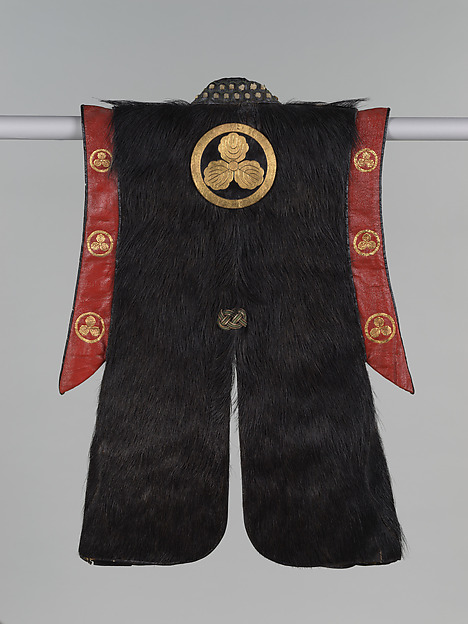
Battle surcoat (jinbaori), 18th century, Bear hide with red leather and impressed gold patterns; printed cotton lining. The Metropolitan Museum of Art, Gift of Rosemarie and Leighton R. Longhi, in honor of Monika Bincsik, 2023, accession 2023.286.1.
Look closer: Look at the date. The Met dates this battle surcoat to the eighteenth century.
Image: The Metropolitan Museum of Art, Open Access (CC0)
The small suit. The Met's child's kamishimo was made for a young boy in the early nineteenth century, and the museum notes that Edo-period children's clothing rarely survives. Most of its crest was replaced later, so the garment carries two generations of care.
Small surprises from the castle
Short facts from the sources, each given as the source gives it.
- Kamishimo means top and bottom.
- The daimon carries a large family crest in five places on the garment and on the hakama.
- Each sleeve of the Met's suō is made from two widths of cloth.
- The kataginu is a suō with the sleeves removed.
- A nagabakama's train could be one or two feet long.
- Martial-arts hakama have seven deep pleats: two at the back and five at the front.
- The most formal men's hakama is the sendaihira, of stiff, glossy striped silk.
- The shogun's hitatare was purplish red with grey.
- Sankin-kōtai became compulsory in 1635 and ended in 1862.
- Attendance cost a daimyo seventy to eighty per cent of his yearly spending.
- In the Noh the traditional formal material for kamishimo is linen.
- Boys historically began wearing their first hakama at age five.
Words from the warrior's wardrobe
The terms used in this chapter, with the garment or custom each names.
| Term | Meaning | Where it appears |
|---|---|---|
| Hitatare | The long-sleeved jacket and hakama that became standard samurai dress | Beginnings |
| Eboshi | The court cap worn with hitatare and suō | Beginnings |
| Daimon | A hitatare with a large crest in five places | Crests |
| Suō | A hitatare simplified; the shogunate's formal dress with the eboshi | Crests |
| Kataginu | The sleeveless jacket with winged shoulders | Top and bottom |
| Kamishimo | Kataginu and hakama together | Top and bottom |
| Han-kamishimo | Kamishimo with normal-length hakama | Top and bottom |
| Naga-kamishimo | Kamishimo with long hakama | Top and bottom |
| Hakama | Pleated divided or undivided skirt-trousers | Trousers |
| Nagabakama | Hakama with a trailing hem | Trousers |
| Koshi-ita | The rigid board at the back of the hakama | Trousers |
| Sendaihira | The most formal striped silk for men's hakama | Top and bottom |
| Naga-hitatare | Ceremonial dress of the shogun and highest daimyo in the castle | In the castle |
| Kariginu | Heian hunting robe, later the full dress for high ranks | In the castle |
| Gosanke | The three great Tokugawa houses | In the castle |
| Sankin-kōtai | Alternate attendance of daimyo in Edo | Alternate years |
| Honmaru | The main compound of Edo Castle | Alternate years |
| Jinbaori | Sleeveless surcoat over armour | War and peace |
| Kōken | Stage attendants in the Noh | On the boards |
| Goshodoki | Palace-court style kimono with landscapes | Pattern and cloth |
| Tsuma moyō | Decoration from the waist down | Pattern and cloth |
The suit in the present
The kamishimo is no longer a daily garment, but it is far from extinct. Wikipedia on the hakama says contemporary Japanese men wear hakama mainly on very formal occasions, at tea ceremonies, weddings and funerals, that martial artists in kendo, iaido, aikido, kyūdō and other disciplines wear them regularly, that sumo wrestlers often wear them at formal functions, and that Shinto priests wear them daily. The Noh stage keeps the full kamishimo, and kyōgen keeps its comic versions.

Overvest (kataginu), Unlined, dark dye-patterned gauze or other sheer textile. The Metropolitan Museum of Art, Purchase, Roy R. and Marie S. Neuberger Foundation Inc. and several members of The Chairman's Council Gifts, 2000 Benefit Fund, and funds from various donors, 2001, accession 2001.428.58.
Look closer: Look at the cloth. The Met records unlined, dark dye-patterned gauze or other sheer textile for this overvest.
Image: The Metropolitan Museum of Art, Open Access (CC0)
For the reader, the museum is the best place to study the form. The Met shows the suō, the kataginu and the child's suit in its Asian art holdings, and Japanese museums of costume and castle collections hold more. The house's own pages on the warrior world, The Warrior and Floating World Almanac, the article on samurai armour and the article on armour forms, describe what the same men wore in the field.

Katsukawa Shunkō, A Daimyo Talking to One of His Retainers, Woodblock print; ink and color on paper. The Metropolitan Museum of Art, Gift of Mrs. Morris Manges, in memory of her husband, Dr. Morris Manges, 1947, accession JP3063.
Look closer: Look at the pair. The Met titles the sheet A Daimyo Talking to One of His Retainers.
Image: The Metropolitan Museum of Art, Open Access (CC0)
The garments are an invitation to look at a society that expressed rank in cloth. The shapes still hold: the winged shoulders, the stiff pleats and the crest placed on the back and the breast appear on Noh performers, in period dramas and in formal photographs.
Reading a kamishimo in the hand
The first question is the cloth. The Met's records give hemp and ramie for the suō suit and stencil-dyed bast fibre for the child's kamishimo; the Noh dictionary calls linen the traditional formal material. A reader should ask for the fibre, and for the dye method, using the vocabulary in Silk, Hemp, Cotton and Ramie: The Fibres of Japanese Dress and Tsutsugaki and Katazome: Paste and Stencil.

Overvest (kataginu). The Metropolitan Museum of Art, Purchase, Roy R. and Marie S. Neuberger Foundation Inc. and several members of The Chairman's Council Gifts, 2000 Benefit Fund, and funds from various donors, 2001, accession 2001.428.59.
Look closer: Look at the pair. The Met holds two overvests of the same type, with consecutive accession numbers.
Image: The Metropolitan Museum of Art, Open Access (CC0)
The second is the crest. A crest on a kamishimo may have been applied, replaced or removed, and the Met's own child's set has a mostly replaced crest. The museum says the family of its suō's tripod-oak crest has not been identified, and the house takes the same care: it does not name a family from a crest without records, and it suggests asking whether the crest is original.
The third is completeness. A kamishimo is a pair: jacket and trousers of the same cloth, often with a back board in the hakama. Pieces that have lost their pair, or whose pair does not match, are partial. The condition scale and care advice in How to Read, Grade and Care for a Japanese Garment apply, and stiffened shoulders are best stored on a form, not folded.

Katsukawa Shunkō, The Actor Nakamura Nakazo as a Daimyo, ca. 1791, Woodblock print; ink and color on paper. The Metropolitan Museum of Art, The Francis Lathrop Collection, Purchase, Frederick C. Hewitt Fund, 1911, accession JP712.
Look closer: Look at the date. The Met dates the sheet to about 1791.
Image: The Metropolitan Museum of Art, Open Access (CC0)
The house's shelf of warrior pieces includes a samurai jinbaori and a remade happi with a warrior portrait, each described as what it is. None is described as a kamishimo, and the concierge desk can compare a piece with the museum records on request.
Neighbouring chapters
The samurai wardrobe connects to much of this almanac. The court forms are in Court Dress: Jūnihitoe and Sokutai, the stage costumes in Noh Costume: Karaori, Atsuita and Mizugoromo and Kabuki Costume: Hikinuki and the Onnagata Layers, the surcoat in Jinbaori: The Warlord’s Surcoat, the divided skirt in Haori and Hakama: The Jacket and the Divided Skirt, the crests in Mon: The Family Crests on Japanese Dress, and the child's rite in Shichi-Go-San and the Clothes of Childhood Rites. The vocabulary is gathered in Glossary of Japanese Dress and Textile Terms.

Kyōgen Overvest (kataginu) with Japanese Lobster, 18th century, Resist-dyed and painted on plain weave hemp. The Metropolitan Museum of Art, Purchase, Mrs. Jackson Burke Gift, 1981, accession 1981.155.
Look closer: Look at the design. The Met titles this kyōgen kataginu for its Japanese lobster.
Image: The Metropolitan Museum of Art, Open Access (CC0)
Among the house's other pages, The Warrior and Floating World Almanac describes the wider world, the samurai clans and battles the families whose crests appear on the garments, and the house's collection of samurai and bushido heritage the objects themselves.

Man's Trousers (Hakama), 19th century, Silk & paper silver. The Metropolitan Museum of Art, Gift of George M. Lefferts, 1909, accession 09.188.
Look closer: Look at the material. The Met records silk with paper silver for these men's trousers.
Image: The Metropolitan Museum of Art, Open Access (CC0)
Surcoat, banner and coat in the house
The shelf holds a samurai jinbaori, a remade happi with a warrior portrait and a haori coat titled for Sharaku. Each is described as what it is, with its age, maker and condition set out on its own page.


Samurai and bushido heritage
The house's collection of samurai and bushido heritage is the companion to this chapter, and the concierge desk can look for related pieces on request.
Answered plainly
What is a kamishimo?
A samurai's formal outfit of a sleeveless jacket with winged shoulders, the kataginu, and hakama of the same cloth; the word means top and bottom.
What is the difference between han-kamishimo and naga-kamishimo?
Han-kamishimo has normal-length hakama and was the regular samurai uniform; naga-kamishimo has the long trailing nagabakama and was formal dress at the shogun's palace.
What is a hitatare?
A two-piece garment of long-sleeved jacket and hakama, once commoner garb, that became standard samurai dress by the thirteenth century.
What is a daimon?
A hitatare dyed with a large family crest in five places; in the Edo period the usual full dress for samurai of the fifth rank or higher.
What is a suō?
A simplified hitatare; the Met says it became the shogunate's formal dress in the Edo period when worn with the eboshi.
What is a kataginu?
The suō without sleeves, with extended shoulders, often stiffened with paper.
What is a nagabakama?
A hakama with a trailing hem, forming a train one or two feet long, worn in the shogun's palace and today in Noh, kyōgen, kabuki and Shinto rituals.
Who wore the naga-hitatare?
The shogun, the lords of the Gosanke and daimyo ranked above the fourth-place chamberlain to the Emperor.
What was sankin-kōtai?
The system of alternate attendance in Edo, compulsory for daimyo from 1635 until 1862.
What fabric were kamishimo made of?
Usually hemp or ramie patterned with paper stencils; in the Noh the traditional formal material is linen.
Where did the crest go on a kamishimo?
On the back and breast of the jacket and on the waist of the hakama; on the Met's child's set, on the jacket and the hakama's back board.
What is the sendaihira?
The most formal men's hakama, of stiff, glossy striped silk, usually black and white or black and navy.
Is the kamishimo worn today?
Yes, on the Noh stage and in some ceremonies; hakama are worn at weddings, tea ceremonies and funerals.
Why did Arai Hakuseki replace the hitatare?
In the 1710s he aimed to make the shogun's court more aristocratic, and chose the nōshi for particular occasions.
Were children's kamishimo made?
Yes. The Met holds a boy's kamishimo of the early nineteenth century and notes that Edo children's clothing rarely survives.
When was the hitatare abolished as court dress?
In the fifth year of Meiji, according to the costume pages, when Western-style court dress became standard.
Where next
Sources and image credits
- Hakama, Wikipedia
- Edo period, Wikipedia
- Samurai, Wikipedia
- Sankin-kōtai, Wikipedia
- Edo Castle, Wikipedia
- Hitatare, Samurai-Archives
- Kamishimo, Noh Dictionary, the-noh.com
- Warrior general in kataginu and hakama, costume pages, iz2.or.jp (publisher not named on the pages read)
- Daimyo in ceremonial costume, naga-hitatare, costume pages, iz2.or.jp
- Daimyo in yoroi hitatare and jinbaori, costume pages, iz2.or.jp
- Warrior of high rank in kariginu and sashinuki, costume pages, iz2.or.jp
- Jacket (suo) and trousers (nagabakama), Metropolitan Museum of Art
- Child's formal ensemble (kamishimo), Metropolitan Museum of Art
- Chiyoda Castle (Album of Men), Metropolitan Museum of Art
- Overvest (kataginu), Metropolitan Museum of Art
- Noh costume (Hitatare), Metropolitan Museum of Art
- Object record: The Second Sakata Hangoro as a Daimyo Attired in a Kamishimo, The Metropolitan Museum of Art
- Object record: The First Nakamura Nakazo as a Samurai Dressed in Kamishimo, The Metropolitan Museum of Art
- Object record: Kyōgen Costume: Jacket (Suō) with Design of Lotuses, The Metropolitan Museum of Art
- Object record: The Second Ichikawa Yaozo as a Samurai Dressed in a Gaudy Kamishimo, The Metropolitan Museum of Art
- Object record: Mimasuya Sukejuro as a Samurai Attired in Kamishimo, The Metropolitan Museum of Art
- Object record: Trousers ("hakama") associated with Kyogen, The Metropolitan Museum of Art
- Object record: Otani Hirohachi as a Samurai Dressed in a Gaudy Kamishimo, The Metropolitan Museum of Art
- Object record: The Actor Bandō Mitsugorō II in Ceremonial Robes with Kamishimo, The Metropolitan Museum of Art
- Object record: Daimyo Procession to Edo, The Metropolitan Museum of Art
- Object record: Daimyo Procession from Yūshō-in, The Metropolitan Museum of Art
- Object record: Surcoat (Jinbaori), The Metropolitan Museum of Art
- Object record: Children Play-acting a Daimyo Procession, The Metropolitan Museum of Art
- Object record: The Fifth Ichikawa Danjuro as a Samurai Attired in Ceremonial Kamishimo, The Metropolitan Museum of Art
- Object record: Boys Play-acting a Daimyo Procession, The Metropolitan Museum of Art
- Object record: Woman from Daimyo Household with Attendants, The Metropolitan Museum of Art
- Object record: Surcoat (Jinbaori) for a Boy, The Metropolitan Museum of Art
- Object record: Chiyoda Castle (Album of Men), The Metropolitan Museum of Art
- Object record: Battle surcoat (jinbaori), The Metropolitan Museum of Art
- Object record: A Daimyo Talking to One of His Retainers, The Metropolitan Museum of Art
- Object record: Overvest (kataginu), The Metropolitan Museum of Art
- Object record: The Actor Nakamura Nakazo as a Daimyo, The Metropolitan Museum of Art
- Object record: Kyōgen Overvest (kataginu) with Japanese Lobster, The Metropolitan Museum of Art
- Object record: Man's Trousers (Hakama), The Metropolitan Museum of Art
Last reviewed 28 October 2026. Pictures, where shown, are public-domain or open-access and credited beneath each one.
Looking for a jinbaori, a warrior-related textile or a piece related to the world described here? The concierge desk replies within one to three business days.
Browse samurai and bushido heritage · Make a private request
Private concierge
Looking for something in particular?
Describe the piece or the project you have in mind. A senior advisor in Tokyo reads every case file personally and replies within two business days, with fees set out in writing before any work begins.