
Uchikake and Shiromuku: The Bridal Robes
Garments · The bride in two colours
Uchikake and Shiromuku: The Bridal Robes
打掛・白無垢
The uchikake is a robe worn open, without a sash, so that its padded hem trails behind the wearer. The shiromuku is its white relation, and between them they dress the Japanese bride.
Fact sheet
The bridal robes in one glance
- Shiromuku. The pure white wedding robe of the Shinto ceremony.
- Iro-uchikake. The coloured over-robe, embroidered with cranes, pines and waves, often worn after the ceremony.
- Wataboshi and tsunokakushi. The white hood and the cloth that covers the bride’s wig.
- Kaiken and sensu. The small sword and the folding fan tucked into the robe.
- Kakeshita. The kosode and obi worn beneath the over-robe.
A robe made to be held, not belted
Most Japanese dress is closed by a sash. The uchikake is the exception. It is an over-robe worn on top of a kosode and left hanging open, so that the long fabric falls to the floor and gathers behind the wearer. The Metropolitan Museum describes it as a robe worn without a sash over a kosode, chiefly on formal occasions, with a padded hem that helps the train settle into a graceful shape.
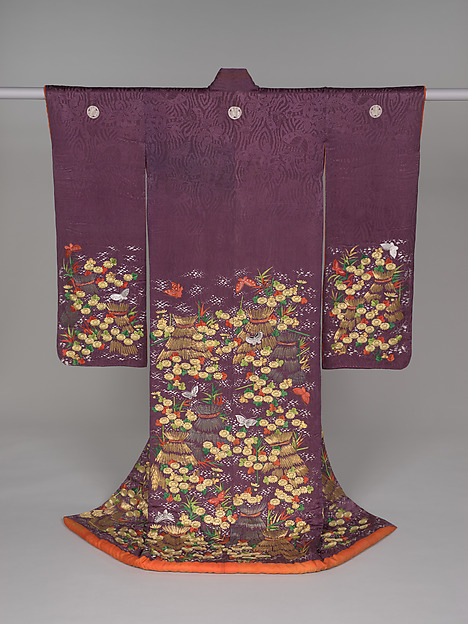
Over robe (uchikake) with chrysanthemums, butterflies, and sheaves of rice straw, first half 19th century, Figured satin-weave silk with paste-resist dyeing, silk embroidery, and couched gold thread. The Metropolitan Museum of Art, Purchase, Friends of Asian Art Gifts, 2023, accession 2023.323.
Look closer: Find where the pattern stops. The Met notes that the decoration is limited to the lower garment and the lower sleeves, so the upper body is left plain.
Image: The Metropolitan Museum of Art, Open Access (CC0)
That small fact explains the whole bearing of the garment. Because there is no sash, the wearer has to manage the robe with her hands. An article from Japan Up Close, written for the Japanese government’s web portal, notes that the wearer gathers the front folds, called tatezuma, whether standing, sitting or walking, and that holding the robe in this way is said to lend composure, grace and dignity. The uchikake is not only worn; it is performed.
The robe comes in three principal grounds, white, red and black, and is decorated with motifs drawn from nature. The white version, the shiromuku, is worn for the Shinto marriage ceremony and, as Wikipedia’s account of the Shinto wedding puts it, symbolises innocence and purity. The coloured version, the iro-uchikake, is the one that museums collect, because its surface carries the full range of embroidery, tie-dye and gold couching.
From samurai wives to the wedding hall
The Japanese Architecture and Art Net Users System, the JAANUS online dictionary hosted by Columbia University, defines the uchikake as an unbelted outer garment worn by women over a kosode on formal occasions. It places the beginning in the Kamakura period (1185 to 1333), among the elite women of the samurai class. In the early Muromachi period the robe was worn from early May to early September; from the late Muromachi period it became part of formal winter dress, made in heavy fabrics such as karaori, a brocaded weave, and nuihaku, a combination of embroidery and gilding.
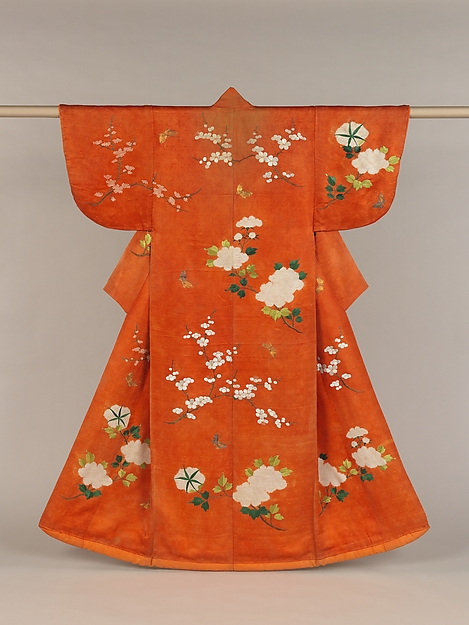
Outer Robe (Uchikake) with Peonies, Plum Blossoms, and Butterflies, late 18th–early 19th century, Silk damask embroidered with silk and metallic thread. The Metropolitan Museum of Art, Purchase, Friends of Asian Art Gifts, 2008, accession 2008.11.
Look closer: Count the flowers that are not peonies. A good robe pairs the great flower with smaller companions so that the eye has somewhere to rest.
Image: The Metropolitan Museum of Art, Open Access (CC0)
Two things followed in the Edo period. From the middle of the period the robe was made in white, black or red figured satin, rinzu, and embroidered over its whole surface in coloured thread; and in the eighteenth century padding was added to the hem. The Met’s curators agree on the satin and the padded hem, and add that the robe was worn by high-ranking samurai women for formal occasions, layered over kosode in spring and autumn.
Japan Up Close adds a useful witness. It cites the Kiyu Shoran of Kitamura Nobuyo, published in 1830, for the account that women of the samurai class draped a kosode over their clothes as an outer garment, which is how the garment came to be called uchikake, ‘thrown over’, and also kaidori. The same article records that the lining of a good robe was silk habutae, itself an extravagance, and that about three centimetres of it is turned to the front to make the turned-back hem, with cotton inserted to fill it out.
The step from court and castle to the wedding hall came late. The Wikipedia article on the Shinto wedding says that the first mention of a wedding in a Shinto manual dates from 1872, and that Crown Prince Yoshihito’s marriage to Kujō Sadako in 1900 was one of the first of its kind at the Imperial Palace. After 1945, when Shinto lost its status as a state religion, Shinto weddings became far more widespread. The same article describes the shiromuku as partly derived from samurai dress, and the uchikake as derived from the over-kimono that samurai women wore before the Meiji Restoration.
Reading the bridal wardrobe
A bride is dressed in layers, and the names are worth learning because they explain what you are looking at in a museum case or a collection. The Japan Government Online page on wedding kimono describes the shiromuku as a white kimono, a white obi and white accessories, and notes that white is considered a sacred and pure colour in Japan. The bride covers her head with the white hood, the wataboshi, or with the headdress called the tsunokakushi.

Over Robe (Uchikake) with Fans and Flowers, second half 18th–first half 19th century, Figured satin-weave silk with tie-dyeing, silk embroidery, and couched gold thread. The Metropolitan Museum of Art, Purchase, Seymour Fund, Mrs. Donald Oenslager Gift and Gifts in memory of Gertrude Carp, 1988, accession 1988.165.
Look closer: Find the Chinese fans among the bouquets. They are laid in between the flowers to break up the colour and add a second kind of luck.
Image: The Metropolitan Museum of Art, Open Access (CC0)
Wikipedia’s account of the Shinto wedding explains each. The tsunokakushi is a rectangular cloth, often of white silk, that covers the topknot of the bride’s wig, and tradition says that it veils the ‘horns’ of jealousy, ego and selfishness. The wataboshi is an all-white hood, the Japanese counterpart of a veil, which hides the bride’s face from everyone but the groom until the ceremony ends and is removed at the reception. The page notes that the bride may then change into a red kimono for good luck.
The accessories carry their own history. The Japan Government Online page says that the kaiken, a small sword, is believed to have been carried by samurai-class women around the seventeenth century and was used as a bridal accessory from the nineteenth. It is tucked into the robe with a small pouch that likely held a handkerchief, medicine and cosmetics. The bridal hairstyle, the bunkin takashimada, was popular among women in the late nineteenth century and is now the standard bridal style, usually worn today as a wig. Wikipedia lists a bridal wig, a set of matching kanzashi hair ornaments, usually in imitation tortoiseshell, and a folding fan tucked into the kimono.
Under the robe lies the garment that JAANUS calls the aigi, the kosode worn under an uchikake, and the kakeshita-obi, the sash worn beneath. These are rarely visible in a museum display, but they are the reason that an uchikake can be worn open: the wearer is fully dressed beneath it.
| Item | What it is | Reading it |
|---|---|---|
| Shiromuku | White over-robe, white obi and accessories | Worn for the Shinto ceremony; purity |
| Iro-uchikake | Coloured over-robe, padded hem | Embroidery, tie-dye and gold couching show the maker’s range |
| Wataboshi | White hood | Hides the face until the ceremony ends |
| Tsunokakushi | Cloth covering the wig’s topknot | Said to veil jealousy, ego and selfishness |
| Kaiken | Small sword in a pouch | Samurai-class women, about the seventeenth century |
| Aigi and kakeshita-obi | Kosode and sash worn beneath | Out of sight, but they make the open robe possible |
Cranes, butterflies and peonies
The motifs on bridal robes are chosen for what they promise. The Government Online page says that crane patterns symbolise longevity and vitality and that seigaiha, the blue ocean wave, stands for lasting peace and lasting happiness. The Met’s notes on a late eighteenth or early nineteenth century uchikake with mandarin oranges and folded-paper butterflies add detail: the paired butterflies, one male and one female, represent the newlywed couple, and because the word for butterfly, chō, sounds like the word for ‘long’, the motif also suggests a lasting and happy marriage. The evergreen mandarin orange, tachibana, is worked in tie-dye on a black satin damask ground.

Outer Robe (Uchikake) with Mandarin Oranges and Folded-Paper Butterflies, late 18th–early 19th century, Tie-dyed satin damask with silk embroidery and couched gold thread. The Metropolitan Museum of Art, Gift of Ilse Bischoff, 1976, accession 1976.108.
Look closer: Look for the pair. Two butterflies, one male and one female, stand for the couple, and they are repeated across the robe so that the promise is never out of sight.
Image: The Metropolitan Museum of Art, Open Access (CC0)
Another Met robe, from the same period, is embroidered with peonies, plum blossoms and butterflies. The Met calls the peony the ‘king of flowers’ and the first blossom of spring, and reads the butterflies as joy, longevity and marital happiness. A third, with fans and flowers, combines kanoko tie-dye, a white reserve called shiroage, hand painting, and embroidery in silk and metallic thread. The text there notes that robes for young women often have a bright red ground with bold floral motifs alternating with non-floral designs.
A good robe is also a seasonal calendar. The Met’s Tokugawa robe has irises that may refer to the Yatsuhashi scene of The Tales of Ise, which suggests late spring or early summer, and embroidered chrysanthemums and rice straw that suggest autumn, so the robe could suit both late spring and early autumn occasions. For the wider vocabulary of crane, pine and chrysanthemum, see A Motif Dictionary: Crane, Pine, Wave and Chrysanthemum.
Crests, sleeves and what a robe reveals
A robe can tell you who it was made for. The Met’s notes on the Tokugawa uchikake record that it was made for a high-ranking lady of the shogun’s family, that wild ginger crests on the shoulders, front and back mark Tokugawa ownership, and that its long furisode sleeves suggest it was made for a young, unmarried woman. The decoration is limited to the lower garment and the lower sleeves, and the museum calls the gold couching a reflection of the expensive tastes of high-ranking samurai women. The same page does not call the robe a bridal garment, and the distinction is worth keeping: the uchikake was a formal robe for many occasions before it was a wedding robe. The crest system is explained in Mon: The Family Crests on Japanese Dress.

Outer Robe (Uchikake) with Phoenixes and Paulownia, early 20th century, Resist-dyed and painted plain-weave silk embroidered with gold thread. The Metropolitan Museum of Art, Gift of Abby Aldrich Rockefeller, 1937, accession 37.92.10.
Look closer: Compare the ground with the older robes. This one is resist-dyed and painted, where the eighteenth century robes above are tie-dyed or woven.
Image: The Metropolitan Museum of Art, Open Access (CC0)
That distinction matters for collectors. An eighteenth or nineteenth century uchikake is not necessarily a bridal garment, and a twentieth century robe with phoenixes and paulownia, such as the one in the Met’s collection, was probably made with the wedding hall in mind. The Met also records that the robe is worn on stage, and the kabuki actor’s uchikake in its collection, with a design of a lioness, belongs to a different tradition that is taken up in Kabuki Costume: Hikinuki and the Onnagata Layers.
Condition and construction are the practical tests. Japan Up Close says that a well-made uchikake can last one or two hundred years, and that skilled artisans take many days to make one by hand. Check the hem first: padding should be even and the turned-back lining intact. Then check the surface, where gold couching and embroidery are most exposed to wear. How to Read, Grade and Care for a Japanese Garment sets out how to grade a garment, and Yūzen: The Painted Kimono and Embroidery and Gold Leaf on Japanese Cloth explain the techniques you will meet.
The parade of the merchant wives
The best-known story about luxury and the robe has nothing to do with brides. Japan Up Close, in its article on the uchikake, tells of a contest of the Genroku era, 1688 to 1704, under the fifth shogun, Tokugawa Tsunayoshi. Wives of merchants from Kyoto, Osaka and Edo paraded in Higashiyama, in Kyoto, each in the finest dress she could devise. The Osaka entrant, the wife of Nambaya Juemon, wore scarlet with scenes of Kyoto in gold and silver thread; the Edo entrant, the wife of Ishikawa Rokubei, wore a design of sacred bamboo with red coral berries.

Over-Robe (Uchikake), second half 19th century, Silk, metallic thread. The Metropolitan Museum of Art, Gift of Elizabeth Gordon, 1967, accession 67.177.2.
Look closer: Find the metallic thread. Couched gold and silver give a robe its weight as well as its glitter.
Image: The Metropolitan Museum of Art, Open Access (CC0)
The judges, the article says, preferred simplicity. The winner was the wife of Nakamura Kuranosuke, a silver-mint owner in Kyoto, who appeared in a black habutae-silk kimono over a white under-kimono with a gold-brocade obi. The article adds that the costume had been arranged by the painter Ogata Kōrin, whose patron Nakamura was. The tale is told as a lesson in restraint, and it is a useful corrective to the idea that the bridal robe is the Edo ideal. The prize went to a quiet black garment, and the painted splendour that fills museum cases was the taste of a different mood.
The tale also connects to the sumptuary laws summarised in The Kimono Ladder: Furisode, Tomesode, Hōmongi and Komon. Wikipedia says that the Edo authorities barred commoners from purple, red, gold embroidery and intricate shibori, and that the response was iki, a taste for hidden luxury. The black habutae of the Higashiyama winner is a perfect example: a plain surface, a white lining, a gold sash. The robe that is worn in the bridal procession, by contrast, is allowed to show everything.
Twenty minutes at the shrine
Wikipedia's article on the Shinto wedding says the ceremony typically lasts twenty to thirty minutes. It is small and for family only; the reception that follows is open to a larger group of friends. The altar holds offerings of salt, water, rice, sake, fruit and vegetables, with the wedding rings laid beside them. The priest, kannushi, stands to the right of the altar and a shrine maiden, miko, to the left.
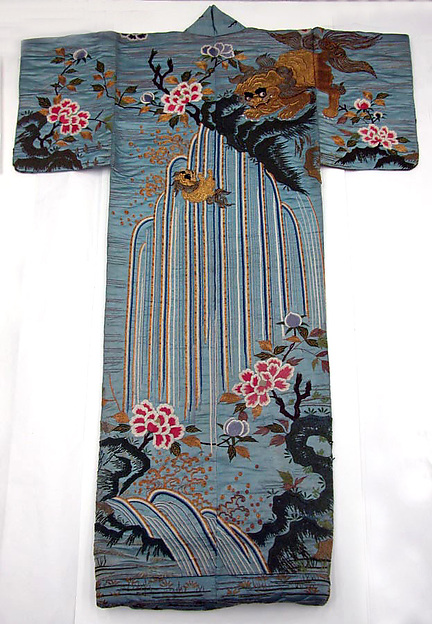
Kabuki Costume: Outer Robe (Uchikake) with Design of Lioness and Cubs, Second half of the 19th century, Silk, cotton, and metallic thread, glass, embroidered satin. The Metropolitan Museum of Art, Gift of Elizabeth Gordon, 1967, accession 67.177.1.
Look closer: A stage robe in the shape of a bridal one. Compare the scale of its pattern with the quieter wedding robes.
Image: The Metropolitan Museum of Art, Open Access (CC0)
The central rite is the san-san-ku-do, in which three cups of increasing size are each poured three times and sipped in three sips. The article gives the order of pouring as groom then bride, bride then groom, and groom then bride, and lists several proposed meanings, among them an origin in samurai weddings, shared joy and sorrow, the birth of children, and the union of heaven, earth and man. The groom reads the vows while the bride listens, and the families join in a toast. The priest offers a branch of Japanese evergreen, Cleyera japonica, to the altar, then to the couple, then to the fathers as representatives of the families, and the rings come last. The prayers, the article says, invoke Izanagi and Izanami for harmony, a respectful home and children.
Dress follows the ceremony's design. The groom wears a kimono, and the Japan Government Online page names the traditional outfit as the kuromontsuki, a black haori and hakama with five crests, the family crest appearing in five places to represent lineage and inherited standing. The bride wears a layered kimono with an outer garment, either the heavy, richly embroidered uchikake or the solid white shiromuku, worn over the kimono with the obi unfastened and often rented because of the cost.
The history of this ceremony is shorter than its look suggests. Wikipedia dates the first mention of a wedding in a Shinto manual to 1872 and says that weddings were reported in the 1880s only among families of Shinto priests. After the 1900 marriage of Prince Yoshihito and Kujō Sadako at the Imperial Palace, the next Shinto wedding was held in 1901 at the Hibiya Daijingu in Tokyo; later Ueno Shimotani and the Tokyo Izumo Grand Shrine hosted ceremonies, at first only for elites and in Tokyo, and the form spread to Osaka and Kyoto, with larger dowries becoming common. After 1945, the article says, Shinto weddings became far more widely available, and a commercial wedding industry grew from companies that rented large venues.
Satin, habutae and a hem that trails
Japan Up Close is the most exact of the sources on the fabric of the robe. It names three silks. Shuchin is satin-woven silk, the ground of the red robe in Sakae Tsuboi's novel Uchikake of 1955. Habutae is a traditional silk woven from unspun warps and wefts. Shioze-habutae is a thick, ribbed habutae, the stuff of that novel's hem. The article adds that a strip of habutae lining about three centimetres wide is turned to the front to make the turned-back hem, with cotton inserted to fill it, and that the use of habutae as lining was considered extravagant.
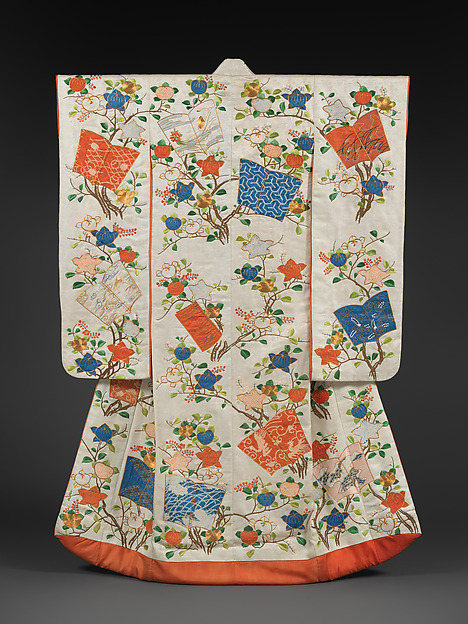
Woman's Overrobe (Uchikake) with Books and Mandarin Orange Branches, first half of the 19th century, Embroidery in silk and metallic thread; appliqué of resist-dyed (shibori) silk fabrics on silk satin damask. The Metropolitan Museum of Art, Gift of Mr. and Mrs. Earl Morse, 1972, accession 1972.18.
Look closer: Books and mandarin oranges are puns and wishes. Look for how the appliqué stands off the ground.
Image: The Metropolitan Museum of Art, Open Access (CC0)
JAANUS gives the structural story that complements this. From the middle of the Edo period the robe was made in white, black and red figured satin, rinzu, and embroidered over its whole surface in coloured thread, and padding was added to the hem in the eighteenth century. The kosode worn under an uchikake is called aigi, and the obi worn under it kakeshita-obi. Together these explain the weight of a surviving robe: figured satin, dense embroidery, couched metallic thread, a padded hem and a lining of silk.
The weight is part of the bearing. Because the robe has no sash, it hangs from the shoulders, and the wearer holds the front folds, the tatezuma, with her hands. The Met's notes on its robes describe the padded hem as helping the train fall into a graceful shape. The effect of the padding can be seen in the photographs of the Met's robes: the hem is rounded and firm, where an unpadded kosode hem would fall into a flat edge.
Japan Up Close claims for the uchikake a history of more than a thousand years and says that a single robe can last a hundred to two hundred years. The two sources do not quite agree on the age, since JAANUS places the origin of the robe in the Kamakura period, which began in 1185, and the claim of a thousand years may count its ancestors. Both agree that the robe is long-lived, and the surviving examples in museums bear them out.
Rental, new colours and knitted robes
The present practice has moved away from the single white robe. The Japan Government Online page notes two recent trends: wearing a colourful kimono beneath the white one, and choosing a vibrantly coloured, patterned uchikake as the outermost layer. Wikipedia's Shinto wedding article says that the bride may change into a red kimono for the reception, and that both shiromuku and uchikake are often rented because of their cost; its Shiromuku article adds that those who own one usually inherited it from close family.

Gion Nankai, Over Robe (Uchikake) with Bamboo, first half of the 18th century, Ink and gold powder on silk satin. The Metropolitan Museum of Art, The Harry G. C. Packard Collection of Asian Art, Gift of Harry G. C. Packard, and Purchase, Fletcher, Rogers, Harris Brisbane Dick, and Louis V. Bell Funds, Joseph Pulitzer Bequest, and The Annenberg Fund Inc. Gift, 1975, accession 1975.268.88.
Look closer: The bamboo is drawn in ink and gold powder, not embroidered. Notice how calm the surface is.
Image: The Metropolitan Museum of Art, Open Access (CC0)
The wider picture is one of decline in the ceremony and the market. Wikipedia reports that since the 1990s, Shinto ceremonies have dropped from about ninety per cent to fifty per cent of weddings, that most Japanese weddings now follow a Christian-style format whatever the faith of the couple, and that the marriage rate is declining. The Kimono article puts the postwar trousseau at up to ten million yen, displayed publicly in some cases on transparent trucks, and records the dyer Saitō Jōtarō's remark that people who know nothing about kimono often spend heavily on a wedding piece that is worn once.
New makers have responded in unexpected ways. Japan Up Close describes robes woven in Masuda, in Shimane Prefecture, by the Elance company, where Saitō Kanami, a third-generation designer at Saitō Toyoko's company, reimagined the uchikake in knitted form using the company's original thread. Skilled weavers take many days to knit one robe; the result is thick, heavy and drapes well over the shoulders, and the soft fabric can be folded and carried without creasing. The article says the designs can be worn as bridal robes or evening robes, and that a bridal uchikake can be altered into a dress for any occasion.
Four tales of the trailing robe
The winner who wore black. The Genroku contest told by Japan Up Close is the great anecdote of the robe. Of the merchant wives who paraded at Higashiyama, the one chosen for her simple beauty wore a plain black silk over white, and the painter who had arranged her costume was Ogata Kōrin. The story is a reminder that the most admired dress of the seventeenth century was not the most elaborate.
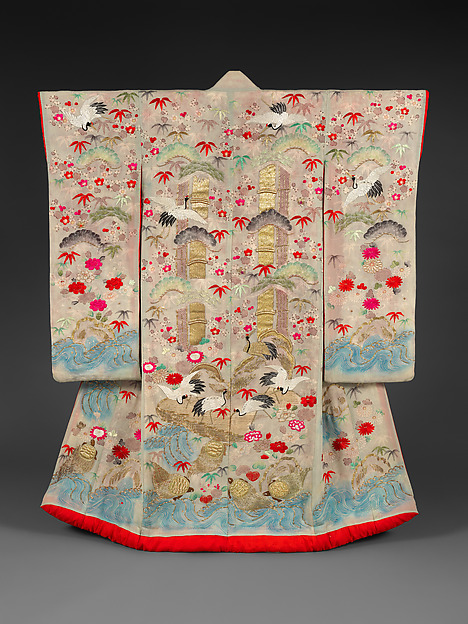
Outer Robe (Uchikake) with Mount Penglai, mid-19th century, Crepe silk with paste-resist dyeing, stencil-dyed dots, silk- and gold-thread embroidery. The Metropolitan Museum of Art, Purchase, Gift of I. N. Phelps Stokes, by exchange, 2017, accession 2017.403.
Look closer: Mount Penglai is the island of the immortals. Look for the cranes and pines that normally accompany it.
Image: The Metropolitan Museum of Art, Open Access (CC0)
A novel in a robe. Sakae Tsuboi's novel Uchikake, published in 1955, follows a red satin robe patterned with pine, bamboo and plum, its hem of thick ribbed habutae. Japan Up Close says that the robe in the novel belonged to a village headman, Fukumotoya Hachiroemon, and was passed down through at least five generations of women from the late Edo period. The novel turns the object into a family record, and the article uses it to explain what a robe of this kind means to those who inherit it.
The sword in the sleeve. The Japan Government Online page describes a small sword, the kaiken, tucked into the bridal robe together with a pouch. It is believed to have been carried by women of the samurai class around the seventeenth century, and it became a bridal accessory in the nineteenth. The pouch probably held a handkerchief, medicine and cosmetics. The object has outlived its use and kept its meaning, as a token of protection for the woman who carries it into a new house.
The horn-hider and the hood. Wikipedia gives two headdresses their stories. The tsunokakushi, the 'horn-hiding' cloth, is said to veil the horns of jealousy, ego and selfishness and to show the bride's resolve to be a gentle, obedient wife; the wataboshi, the 'cotton hood', was adapted from the katsuki hood worn by samurai wives from the Muromachi to the Momoyama periods, and is worn only outdoors. The reader should treat the first as a tradition of interpretation, which Wikipedia itself tells as such.
Small surprises from the sources
Short facts, each as the cited source gives it.
- Shiromuku means white and pure: the Wikipedia article glosses it as white and pure-innocence.
- The wataboshi hides the bride's face from everyone but the groom until the ceremony ends, and is taken off indoors, according to Wikipedia.
- The san-san-ku-do uses three cups, each poured three times and sipped three times, in increasing sizes.
- In the Genroku contest, the winning wife wore black silk over white with a gold sash; Ogata Kōrin arranged the costume.
- A bridal uchikake has a hem padded in the eighteenth century, which helps it trail, according to JAANUS and the Met.
- The kosode worn under an uchikake is called aigi; the sash beneath it is the kakeshita-obi.
- The bunkin takashimada hairstyle, popular in the late nineteenth century, is now the standard bridal style and usually worn as a wig.
- Since the 1990s, the share of Shinto ceremonies has fallen from about ninety to fifty per cent of weddings.
- The first Shinto wedding in the Hibiya Daijingu was held in 1901, a year after Prince Yoshihito's wedding at the Imperial Palace.
- Wikipedia says the uchikake is worn only by brides or onstage, not belted, and heavily decorated with auspicious motifs over the whole back.
- Japan Up Close says that the camellia in a poem by Bashō signifies 'unpretending excellence' in the language of flowers.
- A knitted bridal robe takes many days of hand-work, according to the article on the Masuda makers.
Words of the wedding wardrobe
A short list of the terms used in this chapter.
| Term | Meaning | Where it appears |
|---|---|---|
| Uchikake | An unbelted over-robe worn on top of a kosode | Bridal and stage dress |
| Shiromuku | The white bridal robe, ‘white and pure’ | Shinto wedding |
| Aigi | The kosode worn under an uchikake | JAANUS |
| Kakeshita-obi | The sash worn under an uchikake | JAANUS |
| Rinzu | Figured satin, used for Edo robes | Mid-Edo |
| Shuchin | A satin-woven silk | Red robes |
| Habutae | A traditional silk woven from unspun threads; also used for lining | Lining and hem |
| Tatezuma | The front folds, held by the wearer | Bearing |
| Tsunokakushi | A white cloth covering the bridal wig | Headwear |
| Wataboshi | A white hood, the counterpart of a veil | Headwear |
| Kaiken | A small sword carried in the robe | Accessories |
| Bunkin takashimada | The bridal hairstyle, usually a wig | Hair |
| San-san-ku-do | The three-cup sake rite | Ceremony |
| Kuromontsuki | Black haori and hakama with five crests, worn by the groom | Groom |
Where the bridal robe and rite can be met
A reader who wishes to see the rite will find it at a shrine. Wikipedia's article on the Shinto wedding names the Hibiya Daijingu in Tokyo, where a wedding was held in 1901, and the Tokyo Izumo Grand Shrine as early venues, and says that ceremonies are overseen by priests but are often held in hotels or purpose-built venues. Shinto shrines, according to the Shiromuku article, keep and rent the white robes for traditional weddings. The reader should ask the shrine directly about visits, since ceremonies are for the family.
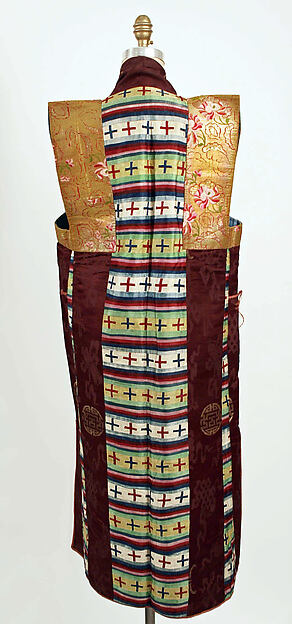
Wedding robe, late 19th century, Silk, metal. The Metropolitan Museum of Art, Gift of Mrs Faïe J. Joyce, 1970, accession 1970.164.1.
Look closer: A wedding robe in silk and metal. Note how much of the surface is given to metal thread.
Image: The Metropolitan Museum of Art, Open Access (CC0)
For the robes themselves, the Metropolitan Museum of Art holds a number of uchikake, from the late eighteenth century to the early twentieth, and the objects in this chapter are credited to it in their captions. The Met's own note describes the robes as belonging chiefly to the formal wardrobe of samurai women, and some pieces in its collection were made for the stage, among them a kabuki costume outer robe with a lioness design.
Reading a bridal robe in the hand
Four marks are worth looking for. The first is the hem: padding that is rounded and firm, with a lining turned to the front, belongs to a robe made to trail, and the sources place the padding in the eighteenth century. The second is the ground: figured satin, rinzu, or a damask under embroidery points to the Edo robes JAANUS describes, while heavy brocade belongs to the earlier winter robes. The third is the coverage: Wikipedia says an uchikake has its motifs over the whole back, where a robe made for another use may leave the upper body plain.
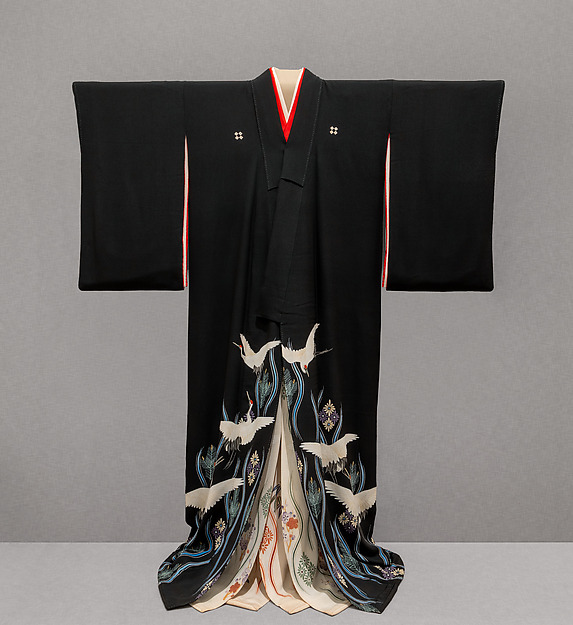
Wedding ensemble with cranes, pines, and rising-cloud patterns, early 20th century, Crepe silk with resist-dyed patterns and gold-and-silk thread embroidery. The Metropolitan Museum of Art, Gift of Atsuko Irie, in honor of Suga Irie, 1998, accession 1998.487.1a, b.
Look closer: Cranes, pines and clouds are the commonest wedding wishes: long life, constancy and good fortune.
Image: The Metropolitan Museum of Art, Open Access (CC0)
The fourth is the use. A robe with a lioness or a dramatic design may have been made for the stage, and the Met labels such pieces as kabuki costumes. A bridal robe is a different object from a stage robe even where the two share a shape. How to grade and care for any such garment is the subject of How to Read, Grade and Care for a Japanese Garment.
Neighbouring chapters
The bridal robe belongs to the same family as the garments in The Kimono Ladder: Furisode, Tomesode, Hōmongi and Komon and Obi and Its Companions: Scarf, Cord and Brooch, and its embroidery is the subject of Embroidery and Gold Leaf on Japanese Cloth. The colours and motifs of the surface are read in A Motif Dictionary: Crane, Pine, Wave and Chrysanthemum, the stage use of the robe in Kabuki Costume: Hikinuki and the Onnagata Layers, and the warrior-class origin of the robe in Samurai Ceremonial Dress: Hitatare and Kamishimo.
Bridal silk in the house
The shelf holds a bridal uchikake and garments remade from kimono and obi silk. Where a piece has been remade, the page says so plainly; the robe or the brocade is the subject.


Kimono and textile heritage
Uchikake, furisode and other formal garments are gathered in one collection, and the concierge desk can look for a particular robe or motif on request.
Answered plainly
What is the difference between an uchikake and a shiromuku?
The shiromuku is the white wedding robe worn for the Shinto ceremony, and is described as comparable to an uchikake. The uchikake is the broader term for the unbelted over-robe, which may be white, red or black.
Why is the hem of an uchikake padded?
The Metropolitan Museum says the padding helps the train fall into a pleasing shape. The JAANUS dictionary dates the addition of hem padding to the eighteenth century.
Why does the bride wear a hood or a cloth over her wig?
The wataboshi hides the bride’s face until the ceremony ends. The tsunokakushi covers the topknot of the wig and, according to tradition, veils jealousy, ego and selfishness.
Is an uchikake always a wedding garment?
No. The Metropolitan Museum describes the robe as formal wear for samurai women from the Kamakura period and notes that it is still worn at weddings. It is also worn on stage.
What does the butterfly mean on a bridal robe?
The Met reads paired butterflies as the newlywed couple. The word for butterfly sounds like the word for ‘long’, so the motif also suggests a lasting marriage.
Do brides buy their robes?
Few do. Renting is common, shrines keep robes to hire out, and some brides inherit one from a close relative.
Why is the uchikake not tied with a sash?
It is an over-robe worn on top of a kosode and obi and left hanging open, so the wearer holds the front folds herself.
What is the difference between a shiromuku and an uchikake?
The shiromuku is the white bridal robe, symbolising purity; the uchikake is the coloured or heavily embroidered over-robe, often worn as the outer layer for the reception.
What is a tsunokakushi?
A white cloth that covers the topknot of the bridal wig, said to veil jealousy and selfishness.
What is a wataboshi?
A white hood, the Japanese counterpart of a veil, which hides the bride's face until the end of the ceremony.
What is the san-san-ku-do?
The central rite of the Shinto wedding, in which three cups are each poured and sipped three times.
Who won the Genroku contest of the merchant wives?
Japan Up Close says the wife of Nakamura Kuranosuke won, in a black habutae-silk kimono over white, with a gold-brocade obi.
How common are Shinto weddings today?
Wikipedia says they have fallen from about ninety per cent of weddings in the 1990s to about fifty per cent.
Can a bridal uchikake be reworn?
Japan Up Close says a bridal uchikake can be altered into a dress for any occasion, and that a single robe can last a century or two.
Where next
Sources and image credits
- Shinto wedding, Wikipedia
- Shiromuku, Wikipedia
- Uchikake, JAANUS, Columbia University
- Refined Uchikake for the 21st Century, Japan Up Close
- Japan wedding kimono, Highlighting Japan, Government of Japan
- Kimono, Wikipedia (Edo sumptuary laws and the 1990s collapse)
- Object record: Over robe (uchikake) with chrysanthemums, butterflies, and sheaves of rice straw, The Metropolitan Museum of Art
- Object record: Outer Robe (Uchikake) with Peonies, Plum Blossoms, and Butterflies, The Metropolitan Museum of Art
- Object record: Over Robe (Uchikake) with Fans and Flowers, The Metropolitan Museum of Art
- Object record: Outer Robe (Uchikake) with Mandarin Oranges and Folded-Paper Butterflies, The Metropolitan Museum of Art
- Object record: Outer Robe (Uchikake) with Phoenixes and Paulownia, The Metropolitan Museum of Art
- Object record: Over-Robe (Uchikake), The Metropolitan Museum of Art
- Object record: Kabuki Costume: Outer Robe (Uchikake) with Design of Lioness and Cubs, The Metropolitan Museum of Art
- Object record: Woman's Overrobe (Uchikake) with Books and Mandarin Orange Branches, The Metropolitan Museum of Art
- Object record: Over Robe (Uchikake) with Bamboo, The Metropolitan Museum of Art
- Object record: Outer Robe (Uchikake) with Mount Penglai, The Metropolitan Museum of Art
- Object record: Wedding robe, The Metropolitan Museum of Art
- Object record: Wedding ensemble with cranes, pines, and rising-cloud patterns, The Metropolitan Museum of Art
Last reviewed 28 October 2026. Pictures, where shown, are public-domain or open-access and credited beneath each one.
Looking for a garment, textile or accessory you have seen described here? The concierge desk replies within one to three business days.
Private concierge
Looking for something in particular?
Describe the piece or the project you have in mind. A senior advisor in Tokyo reads every case file personally and replies within two business days, with fees set out in writing before any work begins.