
Yūzen: The Painted Kimono
Techniques · Brush and resist
Yūzen: The Painted Kimono
友禅
A pictorial cloth made in the manner of a cloisonné enamel: a ridge of rice paste holds each colour in its place, and the whole garment becomes a canvas.
Fact sheet
The process in one glance
- Sketch. The design is drawn freehand in ink made from dayflowers.
- Outline. Rice paste is piped from a cone along the lines.
- Colour. Dye is brushed into each enclosed area.
- Steam. Steaming sets the colours.
- Wash. The paste is washed out and the ground is revealed.
A fan painter’s idea
Wikipedia traces yūzen to the seventeenth century and names it after Miyazaki Yūzen, a fan painter of that century who perfected the technique. The entry records that a book of patterns, the yūzen-hiinagata, was published in 1688, showing similar patterns on the kosode that preceded the kimono, and that a fashion for elaborate pictorial yūzen designs lasted until 1692. It adds that the technique became popular partly as a way around sumptuary laws on dress fabrics.
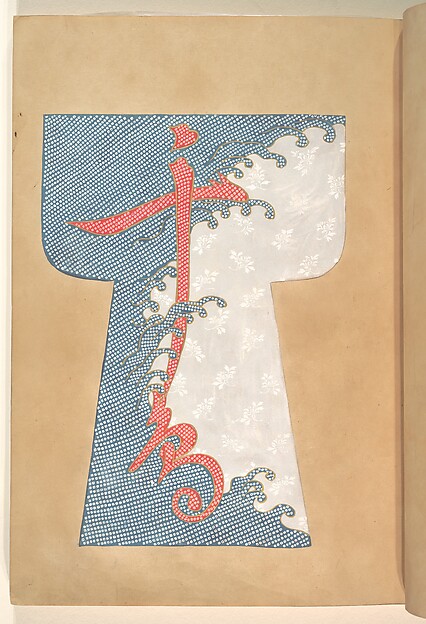
Book of Painted Kosode Patterns, second half 17th century, One of a set of two hand-painted albums; ink, color, gold, and silver on paper. The Metropolitan Museum of Art, Purchase, Friends of Asian Art Gifts, 2004, accession 2004.407.1.
Look closer: Look at the asymmetry. The Met says the patterns have a stylistic asymmetry popular in the second half of the seventeenth century, and that each volume has fifty designs for the backs of garments.
Image: The Metropolitan Museum of Art, Open Access (CC0)
The Met holds a book that belongs to the same world of pattern. The Book of Painted Kosode Patterns is one of a set of two hand-painted albums in ink, colour, gold and silver on paper, of the second half of the seventeenth century, 31.5 by 23 centimetres. The museum notes that the book is undated, but that the patterns have a stylistic asymmetry that was popular in the second half of the seventeenth century; each of the two volumes contains fifty designs illustrating the backs of the garments, and the patterns frequently incorporate seasonal motifs. A designer’s album of this kind is the ancestor of the pattern books the entry describes.
The point of the technique is that colour could be painted with a freedom that earlier dyeing did not allow. A tied or stencilled cloth is limited by the method; a yūzen cloth can carry a picture, with gradations of tone, within the lines of a drawing. That is why the Met’s catalogue uses the phrase ‘paste-resist and brush dyeing’ for a nineteenth-century kosode, and why the pictorial kimono remains, in the entry’s words, popular for formal kimono and obi such as the black tomesode described in The Kimono Ladder: Furisode, Tomesode, Hōmongi and Komon.
Ridges, colour and steam
Wikipedia sets out the classic process, itome-yūzen, also called hon-yūzen, in steps. A sketch is drawn freehand in a black ink made from dayflowers, which is heat-labile and disappears in later stages. A paste of rice powder, rice paste, rice bran and lime, called nori, is piped from a cone along the outline, forming ridges called itome. A bean-based liquid, gojiru, is applied as a mordant to help the dye penetrate. Dye is then painted on with a brush, irosashi, and gradients within an area are called bokashi-zome.

Kosode, Yuzen-dyed and painted, mostly on lower half of garment. The Metropolitan Museum of Art, Purchase, Roy R. and Marie S. Neuberger Foundation Inc. and several members of The Chairman's Council Gifts, 2000 Benefit Fund, and funds from various donors, 2001, accession 2001.428.50.
Look closer: Look at the hem. The Met records yūzen dyeing and painting, mostly on the lower half of the garment.
Image: The Metropolitan Museum of Art, Open Access (CC0)
The cloth is then steamed, mushi, at about 80 °C for roughly twenty to forty minutes, to set the colours; the entry says this may instead be done after the background is dyed. The background is dyed either by brush, hiki-zome, or by dipping in a vat, ji-zome, sometimes with shibori patterning. The paste is then washed out, in a process called yūzen-nagashi; in the past it was done in a clear stream, and is now done in a specialised sink. The cloth may be steamed again to adjust its dimensions, and embroidery may be added.
The entry stresses two points of character. The paste ridges separate the areas of dye, in a manner similar to cloisonné enamel. And yūzen is often compared with tsutsugaki, which typically uses a single paste application and an indigo dyebath, producing blue-and-white results; yūzen uses repeated applications of rice paste, with dye hand-painted into areas before the resist is removed. The comparison is useful to a reader: the chapter on Tsutsugaki and Katazome: Paste and Stencil describes the single drawn line, and yūzen the line that is used to hold colour.
The Met’s unlined kosode with a yūzen-dyed and painted design, mostly on the lower half of the garment, of the Edo period, 141 by 124.5 centimetres, shows the placing of the picture. The museum’s record gives no further text, but the medium line itself tells the reader where to look: the lower half of the garment carries the picture.
A tea party on a robe
Two Met robes show what the technique can say. The first is a kosode of the nineteenth century with a pattern of tea-ceremony utensils on a small pattern of auspicious objects, in paste-resist and brush dyeing on a background of stencil-resist-dyed plain-weave silk, 168.3 by 127 centimetres, in the Seymour Fund collection. The label describes colourful miniature renditions of items associated with the tea ceremony: tea bowls, caddies, whisks, water jars, charcoal and a hanging scroll, clustered at the hem. The dark ground carries a very small komon pattern of takarazukushi, an array of auspicious objects, and the museum notes that combining yūzen dyeing with a stencil-dyed komon ground often appears in robes of the early Meiji period.
The second is a piece from a kosode of the eighteenth century with maple leaves, a curtain and a large drum, in resist-dyed and painted (yūzen) silk crepe with details embroidered in silk and metallic thread. The museum says that the design can be tentatively identified as the autumn excursion to the Suzaku Palace in chapter seven of The Tale of Genji, even without any figures: the scene is set for Genji’s dance, performed within an enclosed curtained space under brilliant maple leaves with a drum accompaniment, and a stairway and post suggest palace architecture. It is a good example of a garment that quotes literature without drawing a person.
A reader looking at a yūzen cloth should ask three questions. Is there a fine, even outline between the colours, a sign of the paste ridge? Are the colours gradated within an area, the mark of the brush? And is there a second layer, such as embroidery or gold, added after the dyeing? The last of these is the subject of the chapter on Embroidery and Gold Leaf on Japanese Cloth, which treats the finishing of a dyed cloth in silk and metal thread.
| Stage | Term | What happens |
|---|---|---|
| Sketch | Shita-e | Drawn freehand in dayflower ink |
| Outline | Itome | A ridge of rice paste piped from a cone |
| Colour | Irosashi | Dye brushed into each area; gradients are bokashi-zome |
| Fixing | Mushi | Steamed at about 80 °C for roughly 20 to 40 minutes |
| Ground | Hiki-zome or ji-zome | Background dyed by brush or by dipping |
| Washing | Yūzen-nagashi | Paste washed out |
New dyes, stencils and velvet
The technique did not stand still. Wikipedia lists several developments. Utsushi-yūzen, of the 1870s, used newly introduced synthetic aniline dyes mixed with nori paste, with heavy use of stencils. Mosurin-yūzen, of 1879, applied utsushi-yūzen to wool, a new import to Japan at the time. Kata-yūzen is a silk adaptation credited to Hirose Jisuke of Kyoto. Shigoki, from 1881, dyed the background with paste applied through stencils with a spatula, each colour using its own stencil, the whole length of cloth being spread on a board.
The entry also describes birodo yūzen, in which velvet is dyed and painted and its pile is carefully cut in places to create light and shade; it first appeared in the nineteenth century and was described in 1905 by Basil Hall Chamberlain. In Okinawa, yūzen techniques are used to produce bingata, a stencil-dyed fabric native to the region, a subject touched on in the chapter on Tsutsugaki and Katazome: Paste and Stencil.
The twentieth century brought outside influence. The entry says that the Exposition Universelle in Paris in 1900 introduced Art Nouveau to Japanese artists, who then developed new yūzen designs inspired by it in the early twentieth century. It notes that, unlike tsujigahana, yūzen never fell out of fashion; that Moriguchi Kako continues to make yūzen kimono in Kyoto; and that the couturier Hanae Mori borrowed extensively from kimono patterns for her collections. The Met’s tea-ceremony robe is a useful dated anchor for these changes, since the museum places the combination of yūzen with a stencil-dyed komon ground in the early Meiji period, in the decades when the stencil and the new dyes were entering the workshops. A reader who meets a painted cloth with a very regular ground should therefore consider the later methods as well as the hand-drawn one. By the late 1980s, according to the entry, a new handwoven, hand-dyed kimono cost about twenty-five thousand US dollars for a formal garment, a reminder of how much labour is in a single length.
For the collector the chapter on How to Read, Grade and Care for a Japanese Garment explains how such garments are graded and kept, and the chapter on A Motif Dictionary: Crane, Pine, Wave and Chrysanthemum gives the meaning of the emblems that yūzen artists painted. Within the house, the shelf strip below shows remade and woven pieces, each described as what it is.
Yūzen at the Met
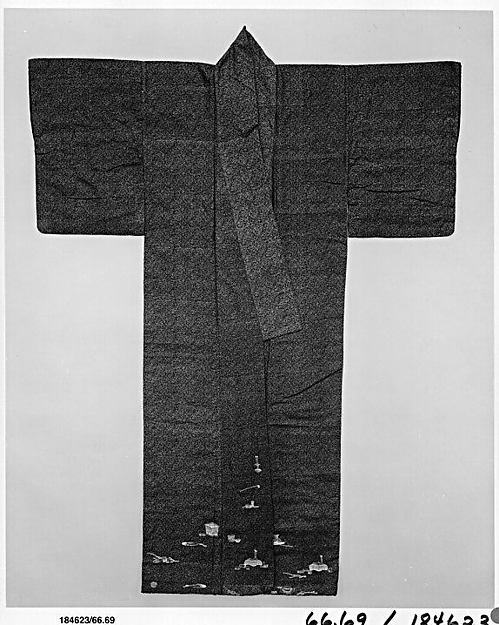
Kosode with Pattern of Tea-Ceremony Utensils on a Small Pattern (Komon) of Auspicious Objects, 19th century, Paste-resist and brush dyeing (yuzen) on a background of stencil-resist-dyed plain-weave silk. The Metropolitan Museum of Art, Seymour Fund, 1966, accession 66.69.
Look closer: Look at the hem. The Met describes tea bowls, caddies, whisks, water jars, charcoal and a hanging scroll clustered at the hem.
Image: The Metropolitan Museum of Art, Open Access (CC0)

Piece from a Robe (Kosode) with Maple Leaves, Curtain, and Large Drum, 18th century, Resist-dyed and painted (yūzen) silk crepe with details embroidered in silk and metallic thread. The Metropolitan Museum of Art, Purchase, Roy R. and Marie S. Neuberger Foundation Inc. and several members of The Chairman's Council Gifts, 2000 Benefit Fund, and funds from various donors, 2001, accession 2001.428.24.
Look closer: Look at the drum. The Met reads the scene as Genji’s dance at the Suzaku Palace excursion, with no figure drawn.
Image: The Metropolitan Museum of Art, Open Access (CC0)
Kosode, Yuzen-dyed and painted, mostly on lower half of garment. The Metropolitan Museum of Art, Purchase, Roy R. and Marie S. Neuberger Foundation Inc. and several members of The Chairman's Council Gifts, 2000 Benefit Fund, and funds from various donors, 2001, accession 2001.428.50.
Look closer: Look at where the picture sits. The Met records yūzen dyeing and painting mostly on the lower half of the garment.
Image: The Metropolitan Museum of Art, Open Access (CC0)
Book of Painted Kosode Patterns, second half 17th century, One of a set of two hand-painted albums; ink, color, gold, and silver on paper. The Metropolitan Museum of Art, Purchase, Friends of Asian Art Gifts, 2004, accession 2004.407.1.
Look closer: Look at the backs. The Met says each volume contains fifty designs illustrating the backs of garments.
Image: The Metropolitan Museum of Art, Open Access (CC0)
Painted and woven cloth in the house
The shelf holds a remade furisode, a remade jacket with crane and fan motifs, a brocade piece and an uchikake. Each is described as what it is, with its age and condition set out plainly on its own page.


Textile heritage
Antique cloth of every kind is gathered in one collection, and the concierge desk can look for a particular dye, subject or region on request.
Answered plainly
What is yūzen?
A pictorial dyeing technique in which a rice-paste outline holds brushed colour in place.
Who was Miyazaki Yūzen?
A seventeenth-century fan painter after whom the technique is named, according to Wikipedia.
What is the paste ridge called?
Itome, formed by piping rice paste from a cone.
How is the colour fixed?
By steaming at about 80 °C for roughly twenty to forty minutes.
How does yūzen differ from tsutsugaki?
Yūzen uses repeated paste applications with hand-painted colour; tsutsugaki typically uses one application and an indigo dyebath.
Is it still made?
Yes. Wikipedia names Moriguchi Kako as a maker of yūzen kimono in Kyoto.
Where next
Sources and image credits
- Yūzen, Wikipedia
- Kosode with Pattern of Tea-Ceremony Utensils on a Small Pattern (Komon) of Auspicious Objects, Metropolitan Museum of Art, 66.69
- Kosode, Metropolitan Museum of Art, 2001.428.50
- Piece from a Robe (Kosode) with Maple Leaves, Curtain, and Large Drum, Metropolitan Museum of Art, 2001.428.24
- Book of Painted Kosode Patterns, Metropolitan Museum of Art, 2004.407.1
Last reviewed 28 October 2026. Pictures, where shown, are public-domain or open-access and credited beneath each one.
Looking for a painted kimono, a length of old silk or a piece with a particular subject you have seen described here? The concierge desk replies within one to three business days.
Private concierge
Looking for something in particular?
Describe the piece or the project you have in mind. A senior advisor in Tokyo reads every case file personally and replies within two business days, with fees set out in writing before any work begins.