
A Motif Dictionary: Crane, Pine, Wave and Chrysanthemum
Reading · Meanings in cloth
A Motif Dictionary: Crane, Pine, Wave and Chrysanthemum
吉祥文様
A Japanese garment is read as well as worn. Each bird, plant and geometric repeat carries a wish, and the wishes can be found by looking in a few predictable places.
Fact sheet
Nine motifs in one glance
- Crane and pine. Both are associated with longevity.
- Seigaiha. Overlapping circles for the open sea; tranquillity and quiet strength.
- Chrysanthemum and water. A mythical Chinese river sweetened by dew from the petals.
- Plum and bamboo. New beginnings and perseverance.
- Kikkō. Tortoiseshell hexagons; long life.
- Asanoha. Hemp leaf; healthy growth, seen on children's clothes.
- Uroko. Scales; protection from evil.
- Ichimatsu. A two-colour check named after a kabuki actor.
- Yagasuri. Arrow feathers; what is fired does not return.
The auspicious pair
The first rule of reading a Japanese garment is to look for pairs. The Metropolitan Museum's wedding ensemble of the Taishō period, of the early twentieth century, is a black crepe silk outer robe and a white inner robe, resist-dyed and embroidered in gold and silk thread. The catalogue entry explains that the outer robe carries cranes and young pines, both associated with longevity, together with stylised chrysanthemums and a rising-cloud pattern that it calls an emblem of good fortune. The upper part of the robe is left plain apart from the formal depiction of the bride's family crest, and the white inner robe repeats the scheme with cranes, bamboo grass and stylised flowers framed by the same clouds.
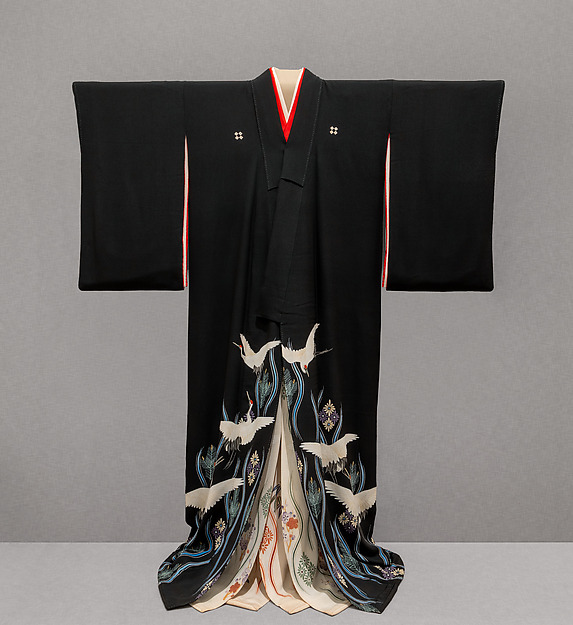
Wedding ensemble with cranes, pines, and rising-cloud patterns, early 20th century, Crepe silk with resist-dyed patterns and gold-and-silk thread embroidery. The Metropolitan Museum of Art, Gift of Atsuko Irie, in honor of Suga Irie, 1998, accession 1998.487.1a, b.
Look closer: Look at the upper back. The Met says it is left plain apart from the formal depiction of the bride's family crest.
Image: The Metropolitan Museum of Art, Open Access (CC0)
The pairing is old and it is not confined to weddings. The Met also holds a summer robe of about 1870 to 1880, in plain-weave silk with paste-resist dyeing, on which cranes and pines are painted by hand against sunrise colours while the rest of the robe sits in twilight. The entry notes that both motifs are associated with longevity, that the composition draws on ink painting, and that the layout follows the kosode style favoured by merchant-class women at the end of the Edo period. Because the left panel overlaps the right, it adds, much of the design would normally be hidden and would appear mainly as the wearer walked, which is a reminder that these pictures were made to be glimpsed in motion rather than studied flat.
Wikipedia's article on the Japanese crane gives the bird's own reputation. In Japan it is called tanchōzuru and is said to live for a thousand years. The article adds that the bird mates for life and flies far without tiring, which is why it has been taken for loyalty and strength, and that folk belief holds that cranes repay kindness shown through sacrifice, as in the tale of Tsuru no Ongaeshi. The red-crowned crane appears on the reverse of the Series D thousand-yen note and in the logo of Japan Airlines, which the article says was recommended after the designer saw it in a gallery of samurai crests.
Sea, mountain and mythical river
Water is the second great family of motifs. The Tokyo Weekender's guide to wagara explains that the word joins wa, Japanese-style, to gara, pattern, that many of the patterns date to the Heian period with roots reaching further back, and that they are mainly inspired by nature, in appearance or in meaning. Seigaiha, overlapping concentric circles forming an ocean wave, takes its name from a medieval court dance of the same name, whose dancers wore the pattern, and it symbolises tranquillity and quiet strength. The Fun-Japan guide adds that the design is said to have come from wave patterns in China and Western Asia along the Silk Road and to have taken its current form after the Heian period, and that it stands for eternal happiness, the prosperity of descendants and safe voyages.

Noh Robe (Karaori) with Chrysanthemums and Waves, first half of the 19th century, Twill-weave silk brocaded with silk and metallic thread. The Metropolitan Museum of Art, The Howard Mansfield Collection, Gift of Howard Mansfield, 1936, accession 36.120.691.
Look closer: Look at the red. The Met reads it as the colour of a young woman's role, and the water and flowers as a mythical Chinese river.
Image: The Metropolitan Museum of Art, Open Access (CC0)
A related design, nami-chidori, sets plovers among the waves. The Tokyo Weekender explains that plovers are short-billed wading birds that fly through strong winds and high waves while migrating, so the pattern symbolises perseverance and overcoming challenges, and is popular for expressing family safety and communities getting through rough times together. The Met's summer kimono with plovers, waves and Chinese bellflowers, in silk gauze with paste-resist dyeing, shows how such a motif is laid across a light summer cloth.
A different pairing gives a scholarly flavour. The Met's Noh robe of the first half of the nineteenth century, in twill-weave silk brocaded with silk and metallic thread, shows golden waves among large chrysanthemum plants of several varieties. The label explains that pairing water with chrysanthemums evokes a mythical Chinese river, a popular subject in Japanese art, and that dew falling from the petals was said to sweeten the water and grant eternal life to anyone who drank it. It reads the red ground as a sign that the robe was worn for the role of a young woman.
Mountains are given the same attention. The Met's battle surcoat of the early nineteenth century, in imported European wool called rasha with wool appliqué, carries a stylised volcano in white wool against a green ground with black waves at its base; the triple peak identifies it as Mount Fuji. The label records that a famous wool surcoat in the Osaka Castle Museum is said to have belonged to Toyotomi Hideyoshi, and that its bold colours and simplified decoration inspired Fuji to become a popular pattern on such coats. It calls the mountain a sacred home of Shinto, Buddhist and Taoist deities and, in folklore, an auspicious symbol. The chapter on Jinbaori: The Warlord’s Surcoat follows the surcoat itself.
Geometry with a purpose
The third family is geometric, and it is where a reader gains the most from a short list of names. Kikkō, the hexagons of a tortoise shell, stands for long life. The Fun-Japan guide records that it came from China, that it appears in the Shōsōin treasures and temple architecture of the Nara period, that it was used for aristocratic clothing and family crests in the Heian period, and that it had spread to the general public by the Edo period. The Tokyo Weekender links it to the legend of Urashima Tarō, who after saving a turtle spends more than a hundred years in an underwater kingdom. The Met's Noh robe with bamboo and young pines on bands of red and white shows the hexagon in use: its label reads young pine and bamboo as endurance and renewal, linked tortoiseshell as longevity and interlocking circles as prosperity, and notes that these symbols are also linked to the joyful New Year celebration.
Asanoha, the hemp leaf, is the next. The Tokyo Weekender says hemp was the main textile fibre before cotton was imported and is a hardy plant, so the pattern represents vitality and durability and often appears on children's clothes as a wish for health and strength. Fun-Japan adds that it is seen on Buddhist statues and architecture from the Nara and Heian periods and spread among common people from the Kamakura to the Edo period, when it was especially popular as a small komon pattern.
Uroko is a triangular pattern like the scales of snakes and fish, and the Tokyo Weekender says that since scales protect animals from predators it is believed to ward off evil, adding that ancient tombs used uroko talismans and that women in Kyoto have traditionally worn uroko-patterned under-kimono during their unlucky years. Ichimatsu, a check of two colours in alternating squares, is named after the eighteenth-century kabuki actor Sanogawa Ichimatsu, who often wore it; the Fun-Japan guide says it was previously called ishidatami, stone pavement, and that because the squares continue without interruption it suggests perpetuity and the prosperity of descendants. Yagasuri, arrow feathers, recalls the hamaya arrows sold at shrines at New Year as charms against evil; at weddings the saying that an arrow once fired does not return refers to promises that cannot be taken back, and Fun-Japan says that by the Taishō era it was the representative pattern of female students' hakama.
Two more complete the set. Kanoko, meaning fawn, names the spots on a fawn's back and is made by hand with tie-dyeing, each small knot tied before dyeing, which is why it signifies opulence; the process is explained in Shibori: The Art of the Bound Cloth. Shippo, the seven treasures, represents the splendour of the Pure Land, and karakusa, the arabesque, spreads vines in every direction for longevity and safe travels. Fun-Japan says it reached Japan from China, became a classic furoshiki pattern in the Edo period, and in the Shōwa era was found in nearly every household.
| Motif | Looks like | Meaning given in the sources |
|---|---|---|
| Seigaiha | Overlapping circles | Tranquillity and quiet strength; safe voyages |
| Kikkō | Tortoiseshell hexagons | Long life |
| Asanoha | Hemp leaf | Vitality and healthy growth; children's clothes |
| Uroko | Scales | Protection from evil |
| Ichimatsu | Two-colour check | Continuing prosperity; named after an actor |
| Yagasuri | Arrow feathers | Promises that cannot be taken back |
| Kanoko | Fawn spots in tie-dye | Opulence and wealth |
| Karakusa | Arabesque vines | Longevity and safe travels |
Plum, bamboo and the cold months
The most famous trio of the cold months is the pine, bamboo and plum, and the Met holds a robe in which two of them are drawn out at length. Its kosode of the later eighteenth century, in figured satin-weave silk with paste-resist dyeing and couched gold thread, carries peonies, snowflakes, scrolling vines and sayagata lozenges on an off-white ground. The catalogue explains that the peony and snowflake pairing recalls large snowflakes like white peony petals, that the pattern is associated with the beginning or end of winter, and that plum and bamboo cross diagonally in nearly geometric arrangements that suggest an early-spring garden. Plum signals new beginnings, since it is the first flower to bloom in the new year, and bamboo symbolises perseverance, resilience, hope and determination. The robe is an example of Kaga yūzen, made in Kanazawa, the technique described in Yūzen: The Painted Kimono.
The same trio is found on the cheapest cloth. The Met's child's kimono of the late nineteenth or early twentieth century, in ikat-patterned plain-weave bast fibre, carries pine, bamboo, plum blossoms and fans, and the kasuri technique behind it is explained in Kasuri: Ikat Woven from Dyed Thread. The cherry blossom, by contrast, is a flower of transience. Fun-Japan says it symbolises beauty, prosperity, transience and new beginnings, that flower viewing was central from the Nara to Heian periods, and that by the Edo period the blossom was widely used on small-pattern cloth, lacquer and netsuke.
A reader should therefore ask four questions of any garment. Which family do the motifs belong to: birds and plants, water and mountains, or geometry? Which pairing do they form? Which season is implied, since a flower worn in its own month signals something different from one worn out of season, a subject that is the work of Seasons and Occasions: What to Wear When? And what do the placement and the ground colour say about the wearer, as the red ground of the Noh robe does? The family crests that sit above these motifs are the work of Mon: The Family Crests on Japanese Dress.
The shelf strip below shows garments from the house that use these motifs, each described as what it is. The concierge desk can look for a particular motif, such as a crane or a wave, on request, and the chapter on Glossary of Japanese Dress and Textile Terms gathers the terms used here in one place. The chapter on Embroidery and Gold Leaf on Japanese Cloth explains how the gold and silk thread of the wedding ensemble was applied.
Motifs at the Met
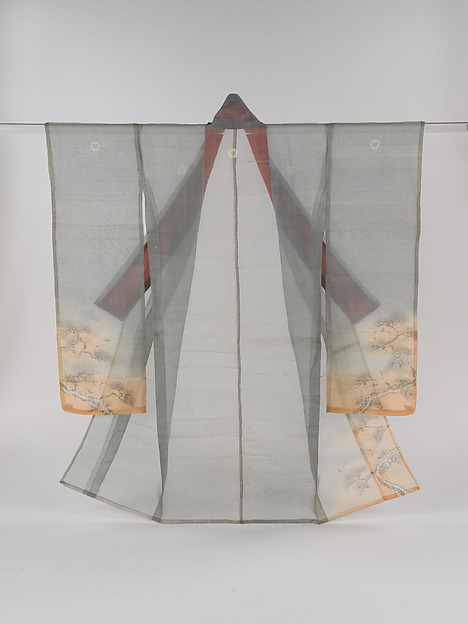
Summer robe (hito-e) with cranes and pines, ca. 1870–80s, Plain-weave silk with paste-resist dyeing. The Metropolitan Museum of Art, Purchase, Friends of Asian Art Gifts, 2023, accession 2023.325a, b.
Look closer: Look at the sky. The Met describes cranes and pines painted by hand against sunrise colours, with the rest of the robe in twilight.
Image: The Metropolitan Museum of Art, Open Access (CC0)
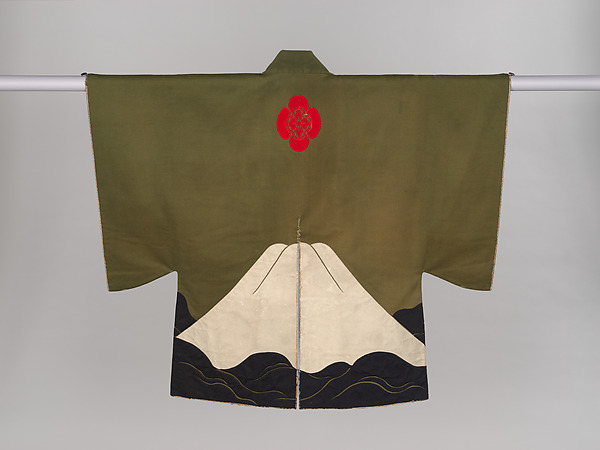
Battle surcoat (jinbaori) with Mount Fuji and waves, first half 19th century, Napped wool (rasha) with wool applique; brocaded silk lining. The Metropolitan Museum of Art, Gift of Rosemarie and Leighton R. Longhi, in honor of Monika Bincsik, 2023, accession 2023.286.2.
Look closer: Look at the peak. The Met says the triple peak identifies the white volcano as Mount Fuji, with black waves at its base.
Image: The Metropolitan Museum of Art, Open Access (CC0)

Noh Robe (Karaori) with Pattern of Bamboo and Young Pines on Bands of Red and White, first half 19th century, Twill-weave silk with resist-dyed warps, supplementary weft patterning in silk, and gold-leaf paper strips (karaori). The Metropolitan Museum of Art, Purchase, Gift of Mrs. Russell Sage, by exchange, 1979, accession 1979.408.
Look closer: Look at the bands. The Met reads young pine and bamboo as endurance and renewal, and the linked tortoiseshell as longevity.
Image: The Metropolitan Museum of Art, Open Access (CC0)
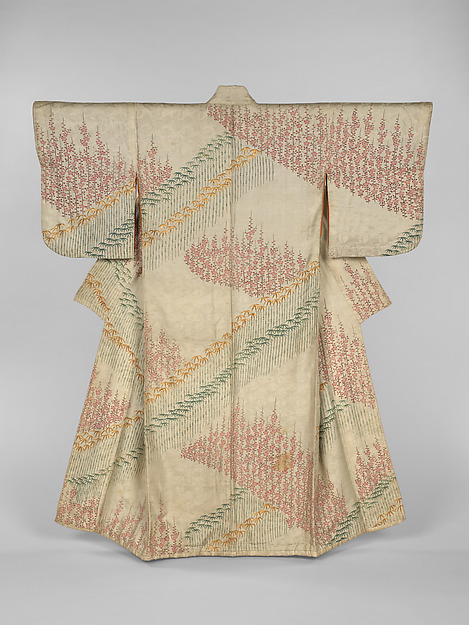
Robe (Kosode) with Bamboo and Plum, second half 18th century, Figured satin-weave silk (rinzu) with paste-resist dyeing (yūzen) and couched gold thread. The Metropolitan Museum of Art, Mary Livingston Griggs and Mary Griggs Burke Foundation Fund, 2025, accession 2025.326.
Look closer: Look at the diagonal. The Met says plum and bamboo cross in nearly geometric arrangements that suggest an early-spring garden.
Image: The Metropolitan Museum of Art, Open Access (CC0)
Motifs in the house
The shelf holds a remade blouson with cranes and fans, a hanten with waves and a crane lining, a surcoat and a festival coat. Each is described as what it is, with its age and condition set out on its own page.


Kimono and textile heritage
Antique cloth bearing every motif in this chapter is gathered in one collection, and the concierge desk can look for a particular motif on request.
Answered plainly
What do the crane and the pine mean together?
Both are associated with longevity, according to the Metropolitan Museum's entries for a wedding ensemble and a summer robe.
What is seigaiha?
A pattern of overlapping concentric circles forming an ocean wave, named after a medieval court dance and said to symbolise tranquillity and quiet strength.
Why are chrysanthemums paired with water?
The Met's label says the pairing evokes a mythical Chinese river, whose water was said to be sweetened by dew falling from the petals.
What does the hemp-leaf pattern stand for?
Vitality and durability; it often appears on children's clothes as a wish for health and strength.
Who was Ichimatsu?
An eighteenth-century kabuki actor, Sanogawa Ichimatsu, who often wore the two-colour check that now carries his name.
What does the plum signal?
New beginnings, since it is the first flower to bloom in the new year, according to the Met.
Where next
Sources and image credits
- Wagara: Japanese Patterns and What They Mean, Tokyo Weekender
- Traditional Japanese patterns, Fun-Japan
- Japanese crane, Wikipedia
- Wedding Ensemble with Cranes, Pines, and Rising-Cloud Patterns, Metropolitan Museum of Art, 1998.487.1a, b
- Summer Robe (Hito-e) with Cranes and Pines, Metropolitan Museum of Art, 2023.325a, b
- Noh Robe (Karaori) with Chrysanthemums and Waves, Metropolitan Museum of Art, 36.120.691
- Noh Robe (Karaori) with Pattern of Bamboo and Young Pines on Bands of Red and White, Metropolitan Museum of Art, 1979.408
- Battle Surcoat (Jinbaori) with Mount Fuji and Waves, Metropolitan Museum of Art, 2023.286.2
- Robe (Kosode) with Bamboo and Plum, Metropolitan Museum of Art, 2025.326
Last reviewed 28 October 2026. Pictures, where shown, are public-domain or open-access and credited beneath each one.
Looking for a garment bearing a particular crane, wave or flower you have seen described here? The concierge desk replies within one to three business days.
Private concierge
Looking for something in particular?
Describe the piece or the project you have in mind. A senior advisor in Tokyo reads every case file personally and replies within two business days, with fees set out in writing before any work begins.