
Mon: The Family Crests on Japanese Dress
Reading · Marks of lineage
Mon: The Family Crests on Japanese Dress
紋
A small circle on the back of a coat can tell a reader who wore it, whom it served and how formally it was meant. The mark is older than the kimono, and older than most of the words used to describe it.
Fact sheet
The crest in one glance
- Kamon. A mon that identifies a family; mon is the general word for an emblem.
- Jōmon and kaemon. The official mon of a family, and a secondary or unofficial one.
- Onnamon. A mon made for a woman after marriage by changing part of her family mon.
- Hinata and kage. Crests 'facing the sun' are the more formal; 'shadow' crests are less formal.
- Montsuki. A black formal haori bearing mon.
- Monzukushi. A field of many crests, as on a Noh nuihaku robe.
A mark carried by carriage
Wikipedia's account of the mon begins with the word. Mon is the general term for a Japanese emblem used to decorate and identify individuals, families or institutions. Kamon and mondokoro specifically identify families, while shinmon, shamon and jimon identify gods, shrines and temples. The article separates the jōmon, the mon officially used by a family, from the kaemon, a secondary or unofficial one, and records the onnamon, created for a woman after marriage by modifying part of her family mon. It notes that the use of the character 紋 for a stylised symbol is unique to Japan and Korea.
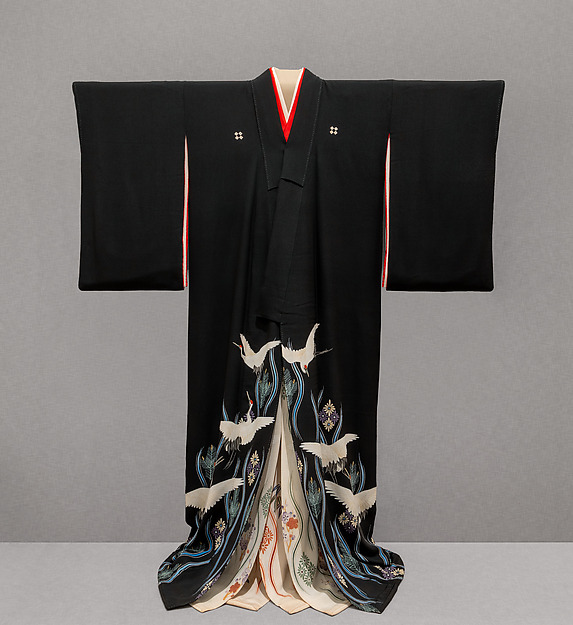
Wedding ensemble with cranes, pines, and rising-cloud patterns, early 20th century, Crepe silk with resist-dyed patterns and gold-and-silk thread embroidery. The Metropolitan Museum of Art, Gift of Atsuko Irie, in honor of Suga Irie, 1998, accession 1998.487.1a, b.
Look closer: Look at the upper back. The Met says it is left undecorated apart from formal depictions of the bride's family crest.
Image: The Metropolitan Museum of Art, Open Access (CC0)
The same article places the rise of the family crest in the middle of the Heian period, about 900 to 1000, when the nobility used it to identify families and pedigree. Nobles travelled in ox-drawn carriages, gissha, which displayed the mon as a status symbol, and when two carriages met on the road the one of lower status had to give way. The Heiji Monogatari Emaki shows carriages bearing crests during the Heiji rebellion of 1160, and the article adds that nobles also put their mon on their clothing. The mark therefore began as a sign of precedence, which is why so many of the rules that later governed it concern rank and formality.
A wedding ensemble in the Metropolitan Museum shows the mark where tradition places it. The black outer robe of the Taishō period is described in the catalogue as plain across the upper part apart from the formal depiction of the bride's family crest. The cranes, pines and rising clouds below are the subject of A Motif Dictionary: Crane, Pine, Wave and Chrysanthemum, but the crest above them is a different kind of mark: it is not a wish but a signature of lineage.
From battlefield to shop curtain
The samurai took the habit from the court. According to the Wikipedia article, the warrior class that emerged in the late Heian period and gained power in the Kamakura period, from 1185 to 1333, adopted mon, and by the twelfth century heraldic devices were used on battlefields, on flags, tents and equipment, although this was not universal because other army standards were equally common. The article states that mon predate heraldry in Japan by at least a hundred to a hundred and fifty years. The Met's battle surcoat with Mount Fuji and waves, of the first half of the nineteenth century, carries the idea on the back: its label says that a red wool appliqué family crest most likely represents the Horita clan. The surcoat is the subject of Jinbaori: The Warlord’s Surcoat.

Towel with the Family Crest of Ichikawa Danjūrō, early 20th century, Cotton with rust brown ground. The Metropolitan Museum of Art, Gift of Sidney Cardozo, 1962, accession 62.159.2.
Look closer: Look at the crop. The Met says the crest of three nested squares is boldly cropped in half, and that the towel was probably a memento for fans.
Image: The Metropolitan Museum of Art, Open Access (CC0)
In the Muromachi period, from 1336 to 1573, merchants painted emblems on shop signs, and these became mon. The Met's noren, or shop curtain, of the Meiji period, in resist-dyed plain weave probably of hemp, shows the result: its title names an oak-leaf crest, plovers and waves. The label explains that the plovers, chidori, are common on Japan's shores and most visible in winter, that in the early poetry anthology the Man'yōshū they carried melancholy associations, and that by the tenth-century Kokinshū their cry was heard as chiyō, one thousand years, which gave them auspicious meanings of longevity and good fortune. The curtain was drawn with the tube and rice paste described in Tsutsugaki and Katazome: Paste and Stencil, which leaves a white design on a blue ground.
The Edo period made the crest common. The Wikipedia article records that kabuki actors used mon, that the general public was allowed to choose and use their own, and that by the Genroku period, from 1680 to 1709, use among ordinary people was fully established. Guilds, temples, shrines, theatre troupes and criminal gangs also adopted them. Two crests were set apart: the imperial chrysanthemum and the Tokugawa shogunate's hollyhock were prohibited for general use.
A towel in the Met shows how far the mark travelled from the battlefield. The early-twentieth-century cotton towel with a rust-brown ground carries the family crest of the kabuki actor Ichikawa Danjūrō. The label says that the crest of three nested squares is boldly cropped in half, that two characters in a gourd-shaped seal at the lower left can also be read as mimasu, three nested squares, and that the towel was probably a Danjūrō memento for enthusiastic patrons and fans. The crest has become a form of celebrity; the same impulse appears in the chapter on Kabuki Costume: Hikinuki and the Onnagata Layers.
One, three or five
Formal Japanese attire generally shows the wearer's family kamon, and commoners without one used the mon of a patron or organisation. The Wikipedia article explains that a kimono may have one, three or five mon, and that formality increases with the number, from a single kage crest, a shadow crest, to five hinata crests, crests facing the sun. The most formal arrangement places the hinata mon on both sides of the chest, on the back of each sleeve and in the middle of the back. A black formal haori bearing mon is a montsuki; white-on-black hinata mon are the more formal style and black-on-white kage mon are less formal.
The method is as careful as the count. The article says that mon on kimono are typically applied by partly removing the base colour and then dyeing the design on, though painting and embroidery are also used. The mark is therefore worked into the cloth rather than printed over it. The garments that carry the marks are described in Haori and Hakama: The Jacket and the Divided Skirt and The Kimono Ladder: Furisode, Tomesode, Hōmongi and Komon.
The article gives an overview of the scale. A 2004 reference lists 241 general categories and 5,116 distinct individual mon, some of them lost or obscure, and by 2023 the total was projected to be between twenty and twenty-five thousand. A woman may keep her maiden mon and pass it to her daughters, and she is not required to adopt her husband's or father's. Modern mon are not regulated by law, except for the imperial chrysanthemum and the paulownia.
The Met's Noh robe with scattered crests, of the second half of the eighteenth to the nineteenth century, shows what happens when the crest is treated as pure design. In silk embroidery and gold leaf on silk satin, it has over twenty crests of different sizes. The label says that some have Buddhist meaning, such as the manji, a reverse swastika, and the circular wheels of Buddhist law, and others are auspicious or purely decorative. Crests set on gold-leaf backgrounds, called monzukushi, were typically embroidered on white, black, red or indigo satin Noh costumes, called nuihaku, mainly worn by male actors playing young female roles. The waist is left unembroidered, a style called koshi-ake, blank waist, because the robes were often worn folded down at the waist. The costume is discussed further in Noh Costume: Karaori, Atsuita and Mizugoromo.
| Term | Meaning | Note from the sources |
|---|---|---|
| Hinata mon | Crest facing the sun | The more formal |
| Kage mon | Shadow crest | Less formal |
| Jōmon | The family's official mon | A kaemon is secondary or unofficial |
| Onnamon | A woman's mon | Made after marriage by modifying part of her family mon |
| Montsuki | Black formal haori with mon | White-on-black hinata is the more formal |
| Monzukushi | A field of many crests | Embroidered on gold leaf for Noh nuihaku |
Sixteen petals and the rest
Two crests are reserved. The Wikipedia article says the imperial chrysanthemum specifies sixteen petals, and that lesser members of the imperial family use chrysanthemums with fewer petals. The paulownia with the five-seven-five arrangement of flowers is reserved for the prime minister, serves as the emblem of the cabinet and government, and appears on the obverse of the five-hundred-yen coin. The chrysanthemum and the paulownia also appear on cloth as decorative motifs, a subject treated in A Motif Dictionary: Crane, Pine, Wave and Chrysanthemum.
A reader looking at a garment should therefore ask four questions of its crest. Is it a single mark, or a field of them, as in a monzukushi? Is it dyed in, embroidered on, or painted? How many are there, and where are they placed? And does it belong to a family, an actor, a shop, a guild or a shrine? A towel, a curtain, a coat and a robe may each carry a mon, and the answer is rarely the same twice.
The Met's formal haori of the early twentieth century offers a contrast. Its curatorial description says that stylish men's clothing of the period emphasised the inside, so that a haori's lining often featured eye-catching designs, and on this example Mount Fuji's snowy peak dominates the composition. The description concerns the lining rather than any crest; the outside of a formal black haori is where the marks described above would sit.
The shelf strip below shows garments from the house that carry marks of lineage or occupation, each described as what it is. The chapter on Samurai Ceremonial Dress: Hitatare and Kamishimo follows the crest into ceremonial dress, the chapter on Uchikake and Shiromuku: The Bridal Robes into the wedding, and the chapter on Glossary of Japanese Dress and Textile Terms gathers the terms in one place. The concierge desk can look for a garment bearing a particular crest on request.
Crests at the Met
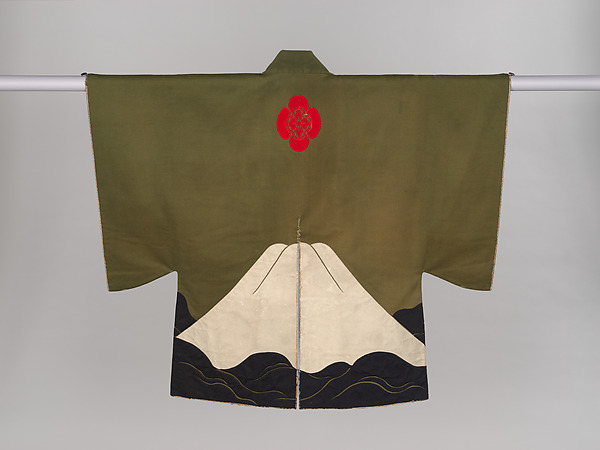
Battle surcoat (jinbaori) with Mount Fuji and waves, first half 19th century, Napped wool (rasha) with wool applique; brocaded silk lining. The Metropolitan Museum of Art, Gift of Rosemarie and Leighton R. Longhi, in honor of Monika Bincsik, 2023, accession 2023.286.2.
Look closer: Look at the red disc. The Met says the red wool appliqué crest on the back most likely represents the Horita clan.
Image: The Metropolitan Museum of Art, Open Access (CC0)

Noh Costume (Nuihaku) with Scattered Crests, second half of the 18th–19th century, Silk embroidery and gold leaf on silk satin. The Metropolitan Museum of Art, H. O. Havemeyer Collection, Bequest of Mrs. H. O. Havemeyer, 1929, accession 29.100.541.
Look closer: Look at the field. The Met counts over twenty crests of different sizes, some with Buddhist meaning, such as the manji.
Image: The Metropolitan Museum of Art, Open Access (CC0)

Noren with Design of Oak-Leaf Crest, Plovers, and Waves, Resist-dyed plain weave, probably hemp. The Metropolitan Museum of Art, Funds from various donors, 1988, accession 1988.206.
Look closer: Look at the birds. The Met explains that by the Kokinshu the plovers' cry was heard as one thousand years.
Image: The Metropolitan Museum of Art, Open Access (CC0)
Towel with the Family Crest of Ichikawa Danjūrō, early 20th century, Cotton with rust brown ground. The Metropolitan Museum of Art, Gift of Sidney Cardozo, 1962, accession 62.159.2.
Look closer: Look at the squares. The Met says three nested squares are boldly cropped in half.
Image: The Metropolitan Museum of Art, Open Access (CC0)
Marks and coats in the house
The shelf holds a surcoat, a festival coat, a bridal robe and a designer haori. Each is described as what it is, with its age and condition set out on its own page.


Kimono and textile heritage
Garments bearing crests, and cloth made for them, are gathered in one collection, and the concierge desk can look for a particular mark on request.
Answered plainly
What is a kamon?
A mon that identifies a family; mon is the general word for an emblem, according to Wikipedia.
When did family crests become common?
Among the nobility in the mid-Heian period, about 900 to 1000, and among ordinary people by the Genroku period, 1680 to 1709.
How many crests does a formal kimono carry?
One, three or five; formality increases with the number, and five facing-the-sun crests is the most formal.
How are crests applied to a kimono?
Typically by partly removing the base colour and dyeing the design on; painting and embroidery are also used.
Which crests are reserved?
The imperial chrysanthemum of sixteen petals and the paulownia of five-seven-five flowers are the only mon regulated by law.
Does a woman take her husband's crest?
She is not required to; she may keep her maiden mon and pass it to her daughters.
Where next
Sources and image credits
- Mon (emblem), Wikipedia
- Wedding Ensemble with Cranes, Pines, and Rising-Cloud Patterns, Metropolitan Museum of Art, 1998.487.1a, b
- Battle Surcoat (Jinbaori) with Mount Fuji and Waves, Metropolitan Museum of Art, 2023.286.2
- Noren with Design of Oak-Leaf Crest, Plovers, and Waves, Metropolitan Museum of Art, 1988.206
- Towel with the Family Crest of Ichikawa Danjūrō, Metropolitan Museum of Art, 62.159.2
- Noh Costume (Nuihaku) with Scattered Crests, Metropolitan Museum of Art, 29.100.541
- Man's Formal Jacket (Haori), Metropolitan Museum of Art, 1983.564
Last reviewed 28 October 2026. Pictures, where shown, are public-domain or open-access and credited beneath each one.
Looking for a garment bearing a particular crest, or a coat made for a particular house? The concierge desk replies within one to three business days.
Private concierge
Looking for something in particular?
Describe the piece or the project you have in mind. A senior advisor in Tokyo reads every case file personally and replies within two business days, with fees set out in writing before any work begins.