
Noh Costume: Karaori, Atsuita and Mizugoromo
Theatre · The stage wardrobe
Noh Costume: Karaori, Atsuita and Mizugoromo
能装束
On the Noh stage a robe is a character, a rank and a mood. Its silks were once the gifts of warlords, and its names are older than the stage that fixed them.
Fact sheet
The wardrobe in one glance
- Two sleeve groups. Ōsode, large sleeves open at the wrist, and kosode, small sleeves, according to the Metropolitan Museum.
- Karaori. The outer robe for women's roles, often considered the quintessential Noh costume.
- Atsuita. Mainly worn by male leads playing warlords, gods or demons.
- Nuihaku. Embroidery with gold or silver leaf, worn beneath, mainly for young women's roles.
- Mizugoromo. A deliberately distressed jacket for suffering ghosts and destitute characters.
- Red or not. Costumes with red are iroiri, for young women; those without are ironashi, for older women.
Silk that stands for a person
A Noh actor is dressed for a character, not for realism. The Nohcom guide to the art says that the costumes are stylised and symbolic: a poor fisherman or a salt-gatherer would never wear such finery, yet the splendour helps convey a character's feelings. Wikipedia puts the same point from the stage: the lead, the shite, wears the most lavish costume, made of shimmering silk brocade, and the costumes of the companions and the comic interlude actors become progressively less sumptuous.

Noh Costume (Karaori) with Cherry Blossoms and Fretwork, first half of the 18th century, Silk, brocaded twill. The Metropolitan Museum of Art, Rogers Fund, 1919, accession 19.88.2.
Look closer: Look at the bands of red and green. The Met says the blossoms in a range of colours give an intense chromatic effect, and that the red places the robe among the iroiri, for a young woman.
Image: The Metropolitan Museum of Art, Open Access (CC0)
The Metropolitan Museum's essay on the subject, by Joyce Denney of the Department of Asian Art, describes the effect in a sentence. In performance, the bare stage, the severe masks and the layered shimmering costumes give the actor an oversized, sculptural presence. All actors are men, most plays have few roles, and the costume changes with the identity of the lead: the essay notes that a lead often reveals late in the play that he is a ghost or spirit bound to a past person or event, and that a climactic dance follows.
The wardrobe is large and codified. Combinations of garments and ways of draping them are fixed for role types such as the warrior, the aristocratic lady, the monk and the demon, according to the essay, and within these constraints the actor generally chooses the final colours and patterns. The Nohcom page agrees that the lead decides what to wear and has considerable room for personal expression within the rules, and says that knowledgeable viewers can read a character's gender, age, social status, occupation and personality from the combination.

Noh Costume (Chōken) with Paulownia, 18th century, Silk gauze (ro) brocaded with silk and metallic thread. The Metropolitan Museum of Art, Gift of Mrs. Howard Mansfield, 1950, accession 50.110.2.
Look closer: Look at the ground. The Met describes paulownia flowers in gold, white, peach, orange and green on a purple gauze.
Image: The Metropolitan Museum of Art, Open Access (CC0)
This chapter takes the robes in turn: the history, the two great groups of garments, the woman's brocade, the warrior's weave, the gold-leaf under-robes, the rags, the colour code and the afterlife of a costume. The masks, the music and the stage are the subjects of Noh Theatre: Masks, Silence and the Hashigakari and Noh Masks and Costume: The Face and the Robe; the wider stage is described in The Performing Arts Almanac.
From borrowed clothes to a fixed code
The Met's essay dates Noh to the fourteenth century, evolving from several strands of the performing arts, and links its rise to the Muromachi period, when the shogun Ashikaga Yoshimitsu supported Kan'ami (1333 to 1384) and his son Zeami (about 1363 to about 1443), an actor and playwright who also wrote theoretical works. Zeami's idea of yūgen, often translated as quiet elegance or elusive beauty, is frequently applied to Noh. Wikipedia adds that Kan'ami first performed for the seventeen-year-old shogun, with Zeami, about twelve, as a child actor in the play.
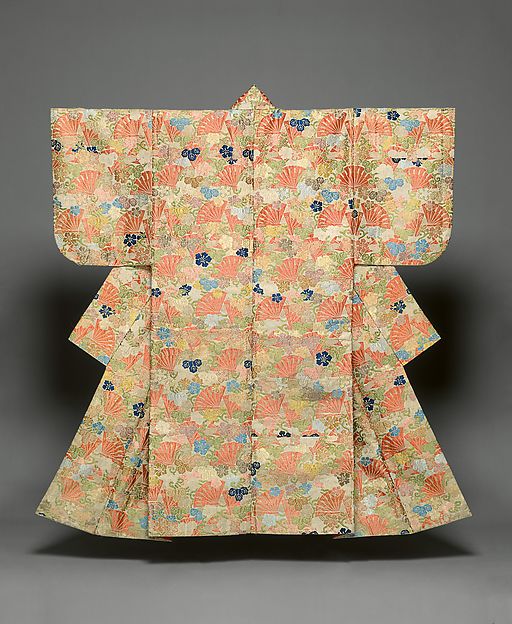
Noh Costume (Karaori) with Cypress Fans and Moonflower (Yūgao) Blossoms, 18th–early 19th century, Twill-weave silk with brocading in silk and supplementary-weft patterning in silk and metallic thread. The Metropolitan Museum of Art, Gift of Dorothy F. Rolph, in memory of her sister, Helen L. Beloussoff, 1961, accession 61.151.6.
Look closer: Look at the fans. The Met says the open cypress fan and moonflower refer to the Yugao chapter of The Tale of Genji and to the Noh play Yugao.
Image: The Metropolitan Museum of Art, Open Access (CC0)
The earliest costumes were borrowed. The Met's essay says early costumes resembled the everyday wear of the samurai class, and that some were military and court garments given to actors as gifts. Wikipedia says that under Zeami's vision costumes originally copied real clothing, such as courtiers' robes or commoners' street clothes, and that in the late sixteenth century they became stylised with symbolic conventions. The Nohcom guide says that in the time of Kan'ami and Zeami performers wore modest costumes, often their everyday clothes, and that as Noh gained the favour of the aristocracy and the military rulers finely crafted kimono became the norm.
In the fifteenth century, garment types made specially for the Noh stage appeared, including the mizugoromo jackets and the maiginu dance robes. In the Momoyama period, from 1573 to 1615, the samurai elite favoured bold pattern layouts and opulent textiles. Women often wore nuihaku, which combines embroidery with gold or silver leaf, and karaori, a woven textile with brocaded polychrome patterns, in some of which the silk patterning wefts are so long that the motifs look embroidered. These techniques were adopted for Noh costumes and gave their names to the kimono-shaped Noh robes. By the end of the Momoyama period, the essay says, the styles were codified in Noh and persisted there after they had largely left everyday dress.

Noh Costume (Mizugoromo), 19th century, Plain-weave bast fiber, ramie warp and hemp weft. The Metropolitan Museum of Art, Purchase, Friends of Asian Art Gifts, 2002, accession 2002.386.
Look closer: Look at the threadbare cloth. The Met says it is deliberately distressed yore cloth, worn by suffering ghosts or destitute characters.
Image: The Metropolitan Museum of Art, Open Access (CC0)
The Edo period, from 1615 to 1868, made Noh an official art. The Tokugawa shogunate sponsored it, daimyo were expected to learn chanting and dance, high-ranking samurai supported troupes, built stages and published libretti, and the study of Noh spread to wealthy merchants. In the late Edo period collecting and cataloguing produced costume inventories and a multivolume work, the Ken'eirō gasō, a compilation of graceful designs with hundreds of full-colour illustrations of costumes, masks and props, whose notes sometimes name the daimyo who commissioned a costume or the troupe or role it was made for.
The fall of the Tokugawa in 1868 ended state funding, and Wikipedia records that performers and stages declined sharply, partly regained through the art's appeal to foreign diplomats. The government designated Noh and its related arts an Important Intangible Cultural Property in 1957, the National Noh Theatre was founded in 1983, and UNESCO inscribed nōgaku on its Representative List of the Intangible Cultural Heritage of Humanity in 2008.
Large sleeves and small
The Met divides the Noh wardrobe into two groups by their sleeves. Ōsode, meaning large sleeves, are outer robes and jackets with broad sleeves open at the wrist, and include the kariginu, chōken, maiginu, happi and mizugoromo. Kosode, meaning small sleeves, are kimono-shaped garments with small wrist openings, and include the karaori, atsuita, surihaku and nuihaku. Trousers, headbands, sashes and other accessories complete the wardrobe.
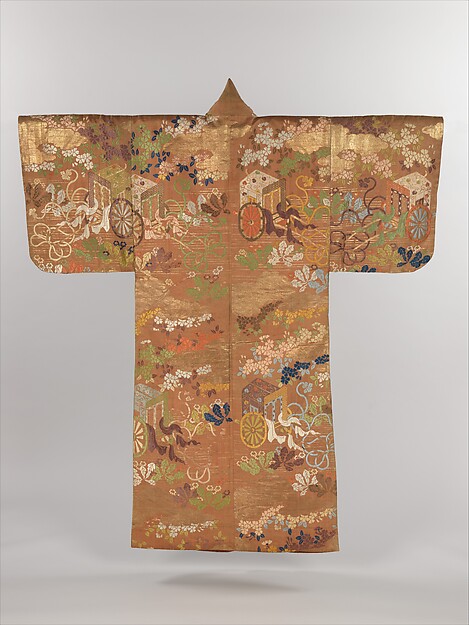
Noh Costume (Karaori) with Court Carriages, Cherry Blossoms, and Dandelions, late 18th–first half of the19th century, Twill-weave silk brocade with supplementary-weft patterning in metallic thread. The Metropolitan Museum of Art, The Howard Mansfield Collection, Gift of Howard Mansfield, 1936, accession 36.120.689.
Look closer: Look at the carriages. The Met says they refer to the Battle of the Carriages in The Tale of Genji, and to Zeami's play Lady Aoi.
Image: The Metropolitan Museum of Art, Open Access (CC0)
The Nohcom guide arranges the same material in seven categories. The first is hair, the wig, kazura. The second is head items, the cap eboshi and the headdress tengan. The third is outer garments worn over the kimono, among them the nōshi, the kariginu, the happi, the chōken and the maiginu. The fourth is the short-sleeved under-kimono, the surihaku, nuihaku and noshime. The fifth is the outer kimono, the women's karaori and the men's atsuita. The sixth is the pleated trousers, the hakama, including the large warrior ōkuchi, the half-cut hangiri and the long nagabakama. The seventh is the small tying items, the sashes.

Noh costume (Hitatare), 19th century, Resist-dyed and painted plain-weave bast fiber, probably ramie. The Metropolitan Museum of Art, Purchase, Friends of Asian Art Gifts, 2002, accession 2002.385a, b.
Look closer: Look at the painted resist. The Met records resist-dyed and painted plain-weave bast fibre, probably ramie.
Image: The Metropolitan Museum of Art, Open Access (CC0)
A careful reader will notice that the same dress that is called a kimono in the street is here a layer in a stack. The Nohcom page describes the layers as the under-kimono, the outer kimono, the garment worn over the kimono and the trousers, without a step-by-step procedure. Wikipedia adds that the musicians and chorus wear black montsuki kimono with five family crests, with hakama or kamishimo, and that the stage attendants, the kuroko, wear plain black; the costume proper belongs to the actors. The street forms of these garments are described in The Kimono Ladder: Furisode, Tomesode, Hōmongi and Komon and Haori and Hakama: The Jacket and the Divided Skirt.
| Garment | Group | Typical wearer, according to the Met |
|---|---|---|
| Karaori | Kosode | Women's roles; outer garment |
| Atsuita | Kosode | Male leads: warlords, gods or demons |
| Nuihaku | Kosode | Mainly young women's roles, worn beneath |
| Surihaku | Kosode | Under-robe with stencilled gold leaf |
| Kariginu | Ōsode | Elderly men of rank or divine nature |
| Chōken | Ōsode | Elegant women's dances and gentle male characters |
| Happi | Ōsode | Outer jacket for a warrior |
| Mizugoromo | Ōsode | Suffering ghosts and destitute characters |
Cherry blossoms on bands of red and green
The karaori is the robe most people picture. The Nohcom page calls it a women's kimono and one of the most beautiful theatrical costumes in the world, says that its flower patterns are made with gold, silver and coloured threads, and records that its name means Chinese-style fabric and that it is said to be modelled on Ming-period Chinese shokkō brocade. The Met adds that the karaori is usually the outer garment for women's roles and is often considered the quintessential Noh costume.
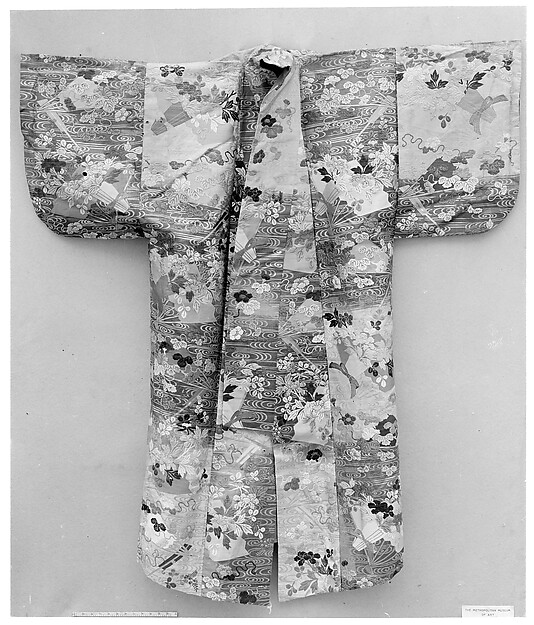
Noh Costume (Karaori) with Pattern of Fans Floating on Water, 18th century, Twill-weave silk brocaded with silk and metallic thread. The Metropolitan Museum of Art, Edward C. Moore Collection, Bequest of Edward C. Moore, 1891, accession 91.1.60.
Look closer: Look at the gold water. The Met says this Kanze water is named for the Kanze school, and flows over blocks of red, brown and light blue.
Image: The Metropolitan Museum of Art, Open Access (CC0)
The museum's karaori of the first half of the eighteenth century, with cherry blossoms and fretwork, shows the type at its best. Its label describes an intense chromatic effect created by cherry blossoms in a range of colours on bands of red and green; because the blossoms fall soon after full flowering, they poignantly evoke the transience of human life, a central theme of Noh. Because the robe includes red, it belongs to the iroiri category suited to a young woman. The museum dates it to the eighteenth century because it has no metallic threads, has allover patterning and has floating silk pattern wefts that are long and soft. It measures 166.4 by 163.8 centimetres and is brocaded twill silk.
Other karaori in the museum carry literature. One has a pattern of open cypress fans with moonflower blossoms; the label says this refers to the fourth chapter of The Tale of Genji, in which Genji notices moonflowers growing outside a modest house and the lady sends him a poem on a fan, and who is later killed by the jealous spirit of Lady Rokujō. The episode inspired the play Yūgao, attributed to Zeami. Another has large court ox carriages, cherry blossoms and dandelions partly veiled by gold clouds, which refers to the Battle of the Carriages in the chapter of The Tale of Genji in which Lady Rokujō's carriage is forced aside at the Kamo Festival, an episode that also appears in Zeami's play Lady Aoi.

Buddhist Vestment (Kesa) Made from a Noh Costume (Karaori) with Autumn Grasses and Butterflies, 18th–19th century, Twill-weave silk brocaded with silk and metallic thread. The Metropolitan Museum of Art, Purchase, Joseph Pulitzer Bequest, 1919, accession 19.93.10.
Look closer: Look at the patchwork. The Met's title records that this temple vestment was made from a Noh karaori, twill-weave silk brocaded with silk and metallic thread.
Image: The Metropolitan Museum of Art, Open Access (CC0)
A third, of the eighteenth century, is dedicated to a pattern the Noh world knows well: the gold water called Kanze mizu, after the Kanze school, which the label says flows over blocks of red, brown and light blue, with open, closed and half-open fans floating on it and covered with flowers. The fan pattern repeats along the length of the robe but does not seem repetitive, the label says, because of the skilful use of colour in the textile.
The Nohcom guide describes how such a robe is worn. A karaori is often worn in the kinagashi style, in which the upper part is folded to leave the neck open so that the under-kimono shows, and the hem is arranged in a triangular shape around the legs. A woman character who enters wearing a karaori is typically in this style. The technique that made such cloth is described in Nishijin: The Woven Brocades of Kyoto, where the same supplementary-weft brocade is discussed.
Boards, clouds and the stuff of gods
The atsuita takes its name from cloth. The Met's label explains that the word referred originally to high-quality Chinese fabrics imported as bolts wound on thick wood boards, atsu-ita; in the Muromachi period, warlords obtained these fabrics through private trade and gave them to Noh actors, and the costumes made from them also came to be called atsuita. In the Edo period, the label says, the robes were made from Japanese-produced twill-weave fabric and were mainly worn by male leads playing warlords, gods or demons.

Noh Robe (Atsuita) with Cloud-Shaped Gongs and “Chinese Flowers”, first half of the 19th century, Twill weave silk brocade. The Metropolitan Museum of Art, Gift of Mrs. Harold Bache, 1962, accession 62.158.2.
Look closer: Look at the gongs. The Met says robes for violent gods and demons feature dragons, clouds, zigzag hammer-wheels on lightning and flat cloud-shaped gongs.
Image: The Metropolitan Museum of Art, Open Access (CC0)
The motifs are strong. The museum's atsuita of the first half of the nineteenth century has cloud-shaped gongs and what the label calls Chinese flowers; the label says that robes for violent gods and demons feature powerful motifs such as dragons, clouds, zigzag patterns of hammer-wheels on lightning, and flat, cloud-shaped gongs. A second atsuita of the nineteenth century has scattered clouds over clusters of hexagons enclosing a stylised blossom: the hexagons form the conventional tortoise-shell pattern, which expresses long life, and the clouds are associated with supernatural power.
The outer jackets of male roles are a separate family. The kariginu, in the Met's label, is a broad-sleeved outer garment typically worn for an elderly man of high status or divine nature; it began as a loose informal jacket worn by aristocratic men in the Heian period, from 794 to 1185, and was adapted for Noh in the Edo period. The museum's kariginu with linked octagons and squares, with stylised flowers and dragons, is traditionally associated with the title role in Okina, a rite often performed to open a programme at New Year. The happi, the label says, is a costume unique to the Noh stage, often worn as an outer jacket for a warrior; when it is slipped off the right arm or both sleeves are hiked up, it gives the impression of armour. The street coat of the same name is described in Happi, Hanten and the Fire Brigade Coat.

Brow of a Noh Wig Band (Kazura-obi), late 18th century, Embroidered chrysanthemum scroll on gold (dohaku) silk satin ground, clematis scroll on gold leaf (surihaku) on silk satin. The Metropolitan Museum of Art, Purchase, Gift of Mr. and Mrs. Teiji Ito, by exchange, 1984, accession 1984.350.
Look closer: Look at the size. The Met records a strip 3.2 centimetres wide and 122.6 centimetres long, with a chrysanthemum scroll in embroidery.
Image: The Metropolitan Museum of Art, Open Access (CC0)
The weave deserves a closer look. Wikipedia notes that the Edo robes that nobles and samurai had given to actors in the Muromachi period were developed into costumes, and the museum's own account of its collection records that the Edward C. Moore bequest of 1891, which included the kariginu, was the beginning of the collection. A warrior's robe in a museum is therefore the descendant of a warlord's gift, and the conservation of such pieces draws on the methods in How to Read, Grade and Care for a Japanese Garment.
Gold leaf, silk thread and a blank waist
The nuihaku lies beneath. The Met's labels describe it as a Noh costume with fine embroidery on a metal-leaf ground, worn beneath the outer robes, mainly in plays that feature young female protagonists; the robes are typically made of satin in white, black, red or indigo and are mainly worn by male actors playing young women. The museum's nuihaku with scattered crests of the second half of the eighteenth to the nineteenth century has more than twenty crests of varying sizes on gold-leaf backgrounds, in a style called monzukushi; some have Buddhist meaning, such as the swastika-like manji and the circular wheels of the Buddhist law, and others are auspicious or purely decorative. The waist area is left unembroidered, a style called koshi-ake, because the robe is often worn folded down at the waist.

Noh Costume (Atsuita) with Clouds and Hexagons, 19th century, Silk twill damask with silk brocading wefts and supplementary weft patterning in metallic thread. The Metropolitan Museum of Art, Rogers Fund, 1919, accession 19.88.3.
Look closer: Look at the hexagons. The Met reads the interlocking tortoise-shell pattern as an expression of long life, and the clouds as a sign of supernatural power.
Image: The Metropolitan Museum of Art, Open Access (CC0)
The same fold appears in the greatest scene of the repertoire. The Met's essay says that in Dōjōji the female lead wears a particular nuihaku under an outer karaori, with a black or dark blue ground and colourful scattered roundels, and that late in the play, when she is revealed as a demonic serpent, the nuihaku is folded down at the waist in a style called koshimaki, the waist wrap; the inner robe then shows glittering gold triangles that represent the scales of the serpent. A robe designed to be folded down is also a robe whose waist, as the Met's label says, was left blank.
The designs can be learned. The museum's nuihaku with phoenixes and peonies, of the second half of the eighteenth century, is based, the label says, on a composition by the Kyoto painter Maruyama Ōkyo (1733 to 1795), who combined Western naturalism with East Asian painting traditions; the phoenix symbolises prosperity, fidelity and good deeds, and the peony is the king of flowers. A second, with scattered books and nandina branches, evokes the Heian period and works like The Tale of Genji and reflects the growth of publishing and literacy in the Edo period; its solid gold ground made it especially splendid, and it was likely worn by actors playing upper-class women. A third has butterflies, which the label traces from the Zhuangzi in China through the Tang dynasty into Japanese art, and notes that its embroidered butterflies date to the seventeenth century though they were later sewn onto a nineteenth-century robe.
The surihaku is the nuihaku's plainer relation. The Met's surihaku of the nineteenth century is made of gold leaf on plain-weave silk: paste is applied through stencils, gold leaf is pressed onto the wet paste, and the excess is brushed away when the paste has dried, giving a fluid, rhythmic design. The flowing water below the plants in that robe is the Kanze water already met in the karaori, and the label adds that the motif later became the signature of the kabuki actor Sawamura Sōjūrō III, who wears it in a woodblock print by Utagawa Toyokuni. The gold-leaf craft is described in Embroidery and Gold Leaf on Japanese Cloth, and the stencil craft in Tsutsugaki and Katazome: Paste and Stencil.
Threadbare jackets and gauze
Some of the most telling Noh costumes are the least splendid. The Met's mizugoromo of the nineteenth century, bought in 2002 and described there as the museum's first, is made of plain-weave bast fibre with a ramie warp and a hemp weft. The label says the name means water garment, that it is a three-quarter-length overgarment worn for many kinds of roles, and that this example is made of deliberately distressed plain-weave cloth called yore, which has a ragged, threadbare look, so that it is often worn by suffering ghosts or destitute characters. The fibres are described in Silk, Hemp, Cotton and Ramie: The Fibres of Japanese Dress.
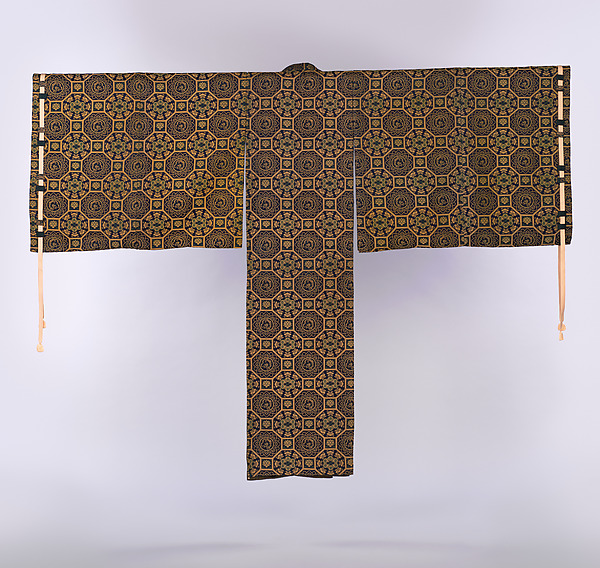
Noh Costume (Kariginu), first half 19th century, Twill-weave silk with supplementary weft patterning. The Metropolitan Museum of Art, Edward C. Moore Collection, Bequest of Edward C. Moore, 1891, accession 91.1.62.
Look closer: Look at the octagons and squares. The Met says this pattern is traditionally associated with the title role of Okina.
Image: The Metropolitan Museum of Art, Open Access (CC0)
The hitatare in the museum is the same type of cloth in a different mood: a jacket and trousers of resist-dyed and painted plain-weave bast fibre, probably ramie, of the nineteenth century, which the museum purchased in the same year. The costume called chōken is more elegant. The label says the name probably referred originally to a type of silk, literally long silk, and that chōken were garments worn in the Muromachi period by young boys of elite samurai families; high-ranking samurai gave Noh actors chōken hitatare, and the term gradually came to mean Noh robes. They are typically made of silk gauze patterned with gold supplementary wefts, and were often used in dances by male actors playing elegant female characters or as costumes for gentle male characters. The museum's example has paulownia flowers in gold, white, peach, orange and green on a purple gauze ground.
The smallest pieces show the craft best. The museum's brow of a wig band, kazura-obi, of the late eighteenth century, is a strip only 3.2 centimetres wide and 122.6 centimetres long, with an embroidered chrysanthemum scroll on a gold satin ground and a clematis scroll in gold leaf. It is a reminder that every part of the Noh wardrobe, down to the band that holds the wig, was made with the same care as the robe. The Nohcom guide places the wig in the first of its seven categories, and the sashes in the last.
With crimson, without, and the collars
The colour code of the female costumes is simple to state. The Nohcom page explains that a female costume is called iroiri, meaning red in, if it contains red, and ironashi, meaning no red, if it does not. Young women wear iroiri costumes, and middle-aged and older women wear ironashi; the red may appear in the outer kimono or in the sashes that fasten the wig or the kimono. The Met's karaori with cherry blossoms on red and green bands is a textbook iroiri robe.
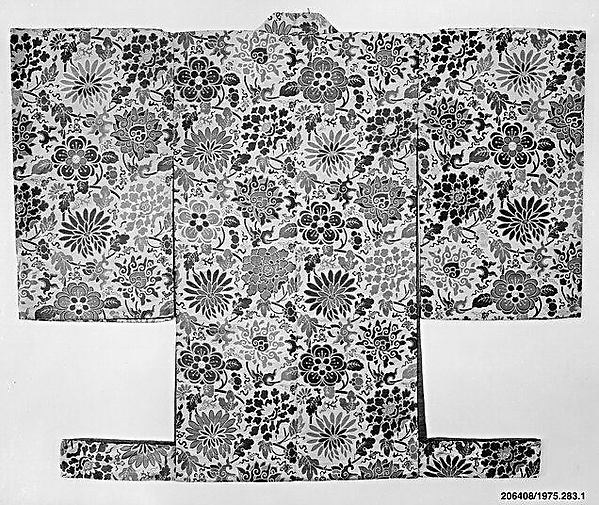
Noh Robe (Happi) with Pattern of Flowers and Auspicious Symbols, 19th century, Silk satin with supplementary weft patterning in silk and metallic thread. The Metropolitan Museum of Art, Gift of Arthur M. Crocker and William R. Crocker, 1975, accession 1975.283.1.
Look closer: Look at the sleeves. The Met says a happi slipped off the right arm, or with both sleeves hiked up, gives the impression of armour.
Image: The Metropolitan Museum of Art, Open Access (CC0)
The collars carry a code of their own. The Nohcom guide says that collars can be white, light blue, red, yellow or gold, dark blue or brown, and that how they are arranged around the neck indicates social status or inner feelings. White signifies purity, and two layers of white collars indicate the highest level of purity. The source does not give further rules, and the house does not extend them.
The Met's essay is cautious about general rules. It offers few colour conventions beyond the examples of the dark blue or black ground of the Dōjōji robe and the gold triangles for serpent scales, and says that colours and patterns are generally left to the actor within the codified constraints. The two sources are consistent: the framework is fixed, the choice within it is the actor's, and the audience who know the code read the choice.
Four tales told by robes
The serpent under the silk. In Dōjōji a woman enters in a karaori and an under-robe with colourful roundels on a dark ground. As the play turns, the under-robe is folded down at the waist and the glittering triangles of a serpent's scales appear. The Met's essay explains the device: the costume carries the revelation, and the robe that was beautiful becomes the demon's skin. It is among the clearest examples of a garment performing the plot.

Noh Costume (Nuihaku) with Scattered Crests, second half of the 18th–19th century, Silk embroidery and gold leaf on silk satin. The Metropolitan Museum of Art, H. O. Havemeyer Collection, Bequest of Mrs. H. O. Havemeyer, 1929, accession 29.100.541.
Look closer: Look at the waist. The Met says it is left unembroidered, the style called koshi-ake, because the robe is worn folded down.
Image: The Metropolitan Museum of Art, Open Access (CC0)
The fan on the vine. A Genji chapter and a play meet in a karaori. In The Tale of Genji, the lady of the evening faces sends the hero a fan inscribed with a poem when he notices moonflowers growing outside her modest house, and she is later killed by the jealous spirit of Lady Rokujō. The Met's label says the cypress fans and moonflower blossoms of its karaori refer to this chapter, and the play Yūgao that grew from it is attributed to Zeami. A viewer who knew the story saw the whole tragedy in a pattern.
The carriages at the festival. A second karaori in the museum shows courtly ox carriages, with heart-shaped wild ginger on them as at the Kamo Festival. The label identifies the subject as the Battle of the Carriages, in which Lady Rokujō's carriage is forced aside. She is the same jealous spirit as in the first story, and the museum notes that the episode is also referred to in Zeami's Lady Aoi. Patterns are a kind of citation, and the Noh robe is an anthology.
The silver designer's gift. The Met's account of its own collection begins with Edward C. Moore, silver designer for Tiffany and Company, who bequeathed four costumes in 1891. By 1932 more had entered through the Havemeyer bequest and the purchase of nine robes from Louis V. Ledoux, a collector of Japanese woodblock prints; a 1935 exhibition displayed the robes with loans from private collections in Japan and the United States. The mizugoromo bought in 2002 is the museum's most recent addition recorded in the essay. The Noh robe in a Western museum is itself a story of collecting.
Small surprises on the stage
Short facts from the sources, each given as the source gives it.
- The karaori's name means Chinese-style fabric, and the Nohcom guide says it is said to be modelled on Ming-period Chinese shokkō brocade.
- The word atsuita comes from thick wooden boards: the Chinese bolts it first described were wound on them.
- A nuihaku leaves the waist unembroidered so that it can be folded down without spoiling the design.
- The gold water pattern Kanze mizu later became the signature of a kabuki actor, Sawamura Sōjūrō III.
- The Met dates one karaori to the eighteenth century because it has no metallic threads, has allover patterning and has long, soft floating wefts.
- A mizugoromo is made deliberately threadbare, in a cloth called yore, for suffering ghosts and destitute characters.
- A chōken, now a Noh robe, was first a garment of young boys of elite samurai families in the Muromachi period.
- A wig band in the Met is 3.2 centimetres wide and 122.6 centimetres long, and is embroidered with a chrysanthemum scroll.
- There are about 240 plays in the current repertoire, and more than seventy Noh theatres in Japan, according to Wikipedia.
- Women were largely excluded from the guild system in the Edo period; the first joined the Nohgaku Performers' Association in 1948.
- The Ken'eirō gasō, a late Edo compilation of designs, has hundreds of full-colour illustrations of costumes, masks and props.
- Musicians and chorus wear black kimono with five family crests; the stage attendants wear plain black.
Words of the dressing room
The terms used in this chapter, with the garment or custom each names.
| Term | Meaning | Where it appears |
|---|---|---|
| Shōzoku | Costume | All Noh dress |
| Shite | The lead actor | Role |
| Karaori | Brocaded outer robe, mainly for women's roles | Women's brocade |
| Atsuita | Twill-brocade robe for male leads | Men's weave |
| Nuihaku | Embroidery and metal leaf on satin, worn beneath | Under-robes |
| Surihaku | Metal leaf pressed on stencilled paste | Under-robes |
| Kariginu | Broad-sleeved jacket of elderly men of rank or gods | Okina |
| Chōken | Gauze robe with gold supplementary wefts | Rags and plain |
| Happi | Noh warrior's outer jacket | Men's weave |
| Mizugoromo | Distressed three-quarter-length overgarment | Rags and plain |
| Hitatare | Jacket and trousers of bast fibre | Rags and plain |
| Kazura-obi | The wig band | Rags and plain |
| Iroiri | Costume with red, for young women | Colour |
| Ironashi | Costume without red, for older women | Colour |
| Kinagashi | Style with the upper part folded to show the under-kimono | Women's brocade |
| Koshimaki | Waist wrap; the robe folded down at the waist | Under-robes |
| Koshi-ake | A blank waist left unembroidered | Under-robes |
| Monzukushi | A pattern of many crests | Under-robes |
The wardrobe in the present
Noh is performed today in a living tradition. Wikipedia reports that there are five lead schools, Kanze, Hōshō, Komparu, Kongō and Kita, three schools of supporting actors and two of comic interlude actors, with about 240 plays in the current repertoire and more than seventy Noh theatres in Japan, and that in 2009 there were about 1,200 male and 200 female professional performers. Women, excluded largely from the guild system in the Edo period, joined the Nohgaku Performers' Association in 1948 and the Association for Japanese Noh Plays in 2004, and the National Noh Theatre began annual programmes for female performers in 2007.
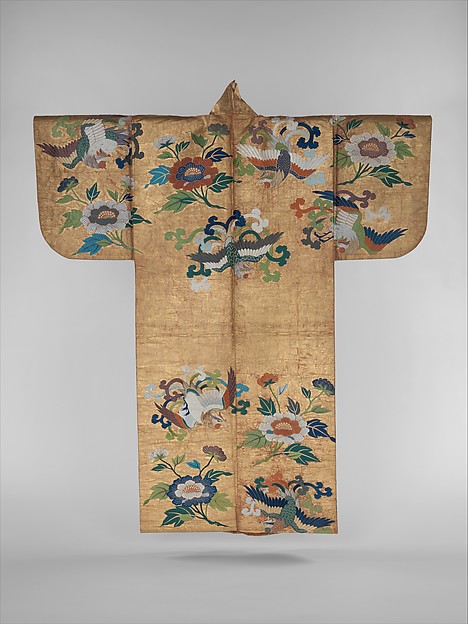
Noh Costume (Nuihaku) with Phoenixes and Peonies, second half 18th century, Plain-waive silk with gold leaf and silk-thread embroidery. The Metropolitan Museum of Art, Purchase, Joseph Pulitzer Bequest, 1932, accession 32.30.3.
Look closer: Look at the composition. The Met says the design is based on one by the Kyoto painter Maruyama Okyo.
Image: The Metropolitan Museum of Art, Open Access (CC0)
The robes are still made by hand. The Nohcom guide credits the costume maker Yamaguchi Yasujirō, whose interview it links, and states that the lead decides what to wear within the rules. The Met's essay notes that the museum's collection has grown by donation and purchase since 1891, with a robe once held by the textile collector Nomura Shōjirō among its highlights, and a first mizugoromo added in 2002.
For a reader today the best course is to see the robes in a theatre and in a museum, and to read the labels with the plays in mind. The house's own pages on the art, Noh Theatre: Masks, Silence and the Hashigakari and Kyōgen: The Comic Art Beside Noh, describe what the robes are made for.
Reading a robe in the hand
The Met's own dating gives a reader a method. An eighteenth-century karaori has no metallic threads, an allover pattern and long, soft floating wefts, while later robes use more metallic thread and more compact layouts, so that the first question is how the pattern is arranged and what yarn it uses. The second question is the type: a woman's karaori has small sleeves and a body-wide pattern, and an atsuita has stronger geometry and motifs of clouds, dragons and tortoise-shell hexagons. The third is the waist: a blank waist suggests a nuihaku made to be folded down.

Noh Costume (Nuihaku) with Books and Nandina Branches, second half of the 18th century, Silk embroidery and metallic leaf on silk satin. The Metropolitan Museum of Art, Gift of Mr. and Mrs. Paul T. Nomura, in memory of Mr. and Mrs. S. Morris Nomura, 1989, accession 1989.367.
Look closer: Look at the books. The Met says they evoke the Heian period and the growth of publishing in the Edo period.
Image: The Metropolitan Museum of Art, Open Access (CC0)
Costumes also had a second life. The Met holds a Buddhist vestment, a kesa, made from a Noh costume in the karaori technique, of the eighteenth to nineteenth century, an example of a theatre cloth recycled for the temple. That practice is the subject of Kesa, Kariginu and the Robes of Priests and Monks. The warrior families who gave such silks to actors are the subject of Samurai Ceremonial Dress: Hitatare and Kamishimo.
A reader considering a piece should ask for its fibre, weave, date range and condition, and treat any claim of a theatrical origin as one to be checked against museum comparanda such as those illustrated here. The concierge desk can compare a piece with the museum record on request. The house's collection of Noh masks and related pieces, Noh Masks, Japanese Nōmen, is the place to see what the house holds.
Neighbouring chapters
The Noh stage connects to several chapters of this almanac. The costume of the kabuki stage is the subject of Kabuki Costume: Hikinuki and the Onnagata Layers. The court robes that Noh remembers are described in Court Dress: Jūnihitoe and Sokutai, and the samurai clothes that gave Noh its patrons in Samurai Ceremonial Dress: Hitatare and Kamishimo. The monk's vestments recut from stage silk are in Kesa, Kariginu and the Robes of Priests and Monks, and the vocabulary of the whole wardrobe is gathered in Glossary of Japanese Dress and Textile Terms.

Noh Costume (Surihaku) with Water, Water Plants, and Leaves, 19th century, Gold leaf on plain-weave silk. The Metropolitan Museum of Art, Rogers Fund, 1958, accession 58.97.1.
Look closer: Look at the water. The Met names it Kanze mizu, and says the motif later became the signature of the kabuki actor Sawamura Sojuro III.
Image: The Metropolitan Museum of Art, Open Access (CC0)
On the wider performing arts, The Performing Arts Almanac gathers the pages on the stage, Kabuki: The Theatre of the Unusual and Gagaku and Bugaku: The Court Music and Dance among them. The craft vocabulary in this chapter is explained further in Nishijin: The Woven Brocades of Kyoto for brocade, Embroidery and Gold Leaf on Japanese Cloth for gold leaf and embroidery, and A Motif Dictionary: Crane, Pine, Wave and Chrysanthemum for the patterns.
Noh masks in the house
The shelf holds Noh masks: a three-mask ensemble, a Meiji one-horn immortal and a signed hannya. Each is described as what it is, with its age, maker and condition set out on its own page.


Noh masks, Japanese nōmen
The collection of Noh masks is the house's companion to the robes, and the concierge desk can look for related pieces on request.
Answered plainly
What are Noh costumes called?
Shōzoku, silk robes worn with wigs, hats and props such as the fan, according to Wikipedia.
What is a karaori?
The brocaded outer robe for women's roles, often considered the quintessential Noh costume, according to the Metropolitan Museum.
What is an atsuita?
A twill-brocade robe mainly worn by male leads playing warlords, gods or demons; the name comes from imported Chinese cloth wound on thick boards.
What is a nuihaku?
An under-robe with embroidery on a metal-leaf ground, worn mainly in plays with young female protagonists.
What is a surihaku?
A robe patterned with gold leaf pressed onto stencilled paste, with the excess brushed away when dry.
What is a mizugoromo?
A three-quarter-length overgarment of deliberately distressed cloth, worn by suffering ghosts or destitute characters.
What does iroiri mean?
Red in: a female costume with red, worn by young women. Ironashi, without red, is worn by middle-aged and older women.
Who wears Noh costumes?
Only men, in the traditional repertoire, though women have joined the professional associations since 1948.
Why is the waist of a nuihaku blank?
Because the robe is often worn folded down at the waist, in a style called koshi-ake.
What is koshimaki?
A waist wrap, in which the under-robe is folded down at the waist, as in the serpent scene of Dōjōji.
Who chooses the costume?
The lead actor generally chooses the final colours and patterns within codified constraints, according to the Met and Nohcom.
Where did Noh costumes come from?
Early costumes resembled samurai everyday wear, and some were military and court garments given to actors as gifts.
What is Kanze water?
A flowing-water pattern associated with the Kanze school, found on karaori and surihaku and later the signature of a kabuki actor.
Is Noh a UNESCO-listed art?
Yes. UNESCO inscribed nōgaku on the Representative List of the Intangible Cultural Heritage of Humanity in 2008.
Which Noh costumes are in the Metropolitan Museum?
Karaori, atsuita, nuihaku, surihaku, chōken, happi, kariginu, mizugoromo and hitatare, among others, with collecting that began in 1891.
Where can I see Noh masks?
The house's collection of Noh masks and the pages on the theatre describe them; the National Noh Theatre in Tokyo, founded in 1983, stages performances.
Where next
Sources and image credits
- Nō Costume, Metropolitan Museum of Art essay (Joyce Denney, 2008)
- Noh, Wikipedia
- Noh Costumes, Nohcom
- Noh Costume (Karaori) with Cherry Blossoms and Fretwork, Metropolitan Museum of Art
- Noh Costume (Karaori) with Cypress Fans and Moonflower Blossoms, Metropolitan Museum of Art
- Noh Costume (Karaori) with Court Carriages, Metropolitan Museum of Art
- Noh Costume (Karaori) with Fans Floating on Water, Metropolitan Museum of Art
- Noh Robe (Atsuita), Metropolitan Museum of Art
- Noh Costume (Mizugoromo), Metropolitan Museum of Art
- Noh Costume (Chōken) with Paulownia, Metropolitan Museum of Art
- Noh Costume (Nuihaku) with Scattered Crests, Metropolitan Museum of Art
- Noh Costume (Surihaku), Metropolitan Museum of Art
- Object record: Noh costume (Hitatare), The Metropolitan Museum of Art
- Object record: Buddhist Vestment (Kesa) Made from a Noh Costume (Karaori) with Autumn Grasses and Butterflies, The Metropolitan Museum of Art
- Object record: Brow of a Noh Wig Band (Kazura-obi), The Metropolitan Museum of Art
- Object record: Noh Costume (Atsuita) with Clouds and Hexagons, The Metropolitan Museum of Art
- Object record: Noh Costume (Kariginu), The Metropolitan Museum of Art
- Object record: Noh Robe (Happi) with Pattern of Flowers and Auspicious Symbols, The Metropolitan Museum of Art
- Object record: Noh Costume (Nuihaku) with Phoenixes and Peonies, The Metropolitan Museum of Art
- Object record: Noh Costume (Nuihaku) with Books and Nandina Branches, The Metropolitan Museum of Art
Last reviewed 28 October 2026. Pictures, where shown, are public-domain or open-access and credited beneath each one.
Looking for a Noh mask, a theatrical textile or a piece related to the stage? The concierge desk replies within one to three business days.
Private concierge
Looking for something in particular?
Describe the piece or the project you have in mind. A senior advisor in Tokyo reads every case file personally and replies within two business days, with fees set out in writing before any work begins.