
Happi, Hanten and the Fire Brigade Coat
Garments · Coats of the street
Happi, Hanten and the Fire Brigade Coat
法被・半纏
The happi and the hanten are the short coats of the shop, the workshop and the festival. Their cousin, the quilted hikeshi banten, was the firefighter’s armour, plain on the outside and a painted picture within.
Fact sheet
The street coats in one glance
- Happi. The livery or festival coat, bearing a crest or name.
- Hanten. The short working coat, traditionally lined and worn over a kimono.
- Shirushi banten. The inscribed coat of a house, shop or guild.
- Hikeshi banten. The reversible, quilted firefighter’s coat.
- Noh happi. A different thing: a stage robe that shares the name.
Short coats with a long memory
Wikipedia describes the happi as a traditional Japanese coat with tube-shaped sleeves, usually worn at festivals, and notes that its original purpose was to display the family crest, the mon, so that house servants could wear it as a uniform. The larger design on the back usually names the festival or the association taking part, and symbols or lettering run down the lapels. Colour is typically blue, with designs in red, black and white; modern coats may be cotton or polyester.

Festival coat with dragon, Cotton tabby, resist dyed and painted. The Metropolitan Museum of Art, Purchase, Seymour Fund and Citibank, N.A. Gift, 1986, accession 1986.337.
Look closer: Find the pine, plum blossom and bamboo that the Met groups as the three friends in winter, and compare their quiet scale with the dragon and the tiger.
Image: The Metropolitan Museum of Art, Open Access (CC0)
Japanese Wiki, which summarises Japanese reference articles in English, gives a fuller definition: a coat worn at festivals and also a craftsman’s livery coat, with the crest or the name of the shop on the back and the lapels. It is generally haori-style, waist or knee length, with a simple tubular sleeve or a wide sleeve, and has no lapel or breast cord. Vertical lettering from the collar to the chest can indicate membership, a name or an intention; the examples it gives include ‘Carpenter Tomekichi’, ‘Captain of Megumi’ and ‘Do come in’.
The hanten is its near twin. The Japanese Wiki account says a hanten is a short coat originally for craftsmen, worn over a kimono, and that the two garments lost their distinction by the end of the Edo period. It records that a happi was originally a single layer, hitoe, while a hanten was lined, awase. The Museum of Anthropology at the University of British Columbia describes a dark blue example as a shirushi banten, a type of hanten also called happi, with a wide blue band around the neck and down the front opening, white characters on the band, and the family crest on the upper back. It adds that hanten are casual wear, used as winter jackets, workers’ jackets, traditional shopkeepers’ garments or festival clothing.
From the servant’s crest to the festival crowd
The Japanese Wiki account says samurai first wore the happi with a large undyed family crest, and that craftsmen and fire brigades adopted it later. The folkwear.com history, from a pattern company, reads the garment as the result of a relaxation of social restrictions on marks of rank. It places the first appearance in the Edo period, when servants customarily wore their master’s crests, and describes a large, bold crest dyed on the centre back and the front neckband. It describes the happi as worn open and as a worker’s or artisan’s jacket.
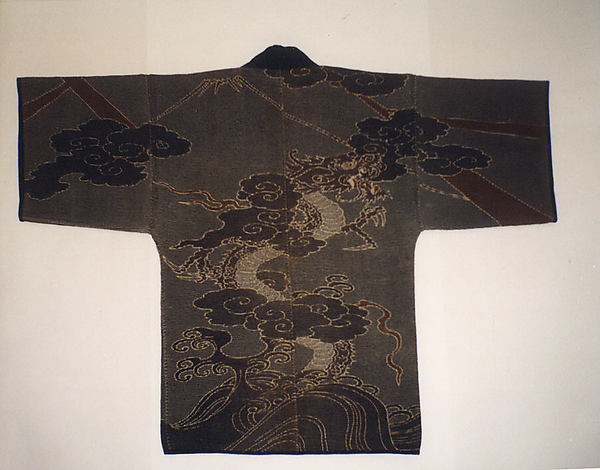
Jacket with Dragon and Mount Fuji, 19th century, Cotton. The Metropolitan Museum of Art, Gift of John B. Elliott through the Mercer Trust, 1999, accession 1999.247.2.
Look closer: Find Mount Fuji. The Met points out that it places the scene in Japan, while the dragon, which came from China, brings the water that a firefighter would want on his side.
Image: The Metropolitan Museum of Art, Open Access (CC0)
Japanese Wiki also gives a possible origin for the name. ‘Happi’ is said to derive from hanpi, a sleeveless garment worn under the hō in ancient court dress, sokutai; the characters used for a high priest’s chair cloth, 法被, are believed to be phonetic only. The sokutai is described in Court Dress: Jūnihitoe and Sokutai.
For the festival crowd, the coat is still a badge. It marks who belongs to which neighbourhood, guild or shrine, and the lettering on the collar tells a reader which. Today, according to Japanese Wiki, the happi is also worn at sporting events such as baseball and as a department store sale assistant’s costume. The Met’s festival coat with a dragon, from the Meiji period, may have been worn at a festival or regional theatre performance on the San’in coast, on the Sea of Japan side of Honshū, according to the museum’s notes.
The coat that went into the fire
Edo was a city of timber, and fire was its commonest disaster. The Public Domain Review, which draws on the Metropolitan Museum and other collections, quotes the saying that fires and quarrels were the flowers of Edo. Firefighting brigades were of two kinds: buke hikeshi, drawn from the samurai, and machi hikeshi, drawn from townspeople. Both fought fires the same way, by pulling down the buildings around the blaze to stop it spreading. The Met adds that commoner brigades increasingly bore the duty and the cost of fighting Edo’s fires, while samurai firefighters concentrated on protecting Edo Castle.
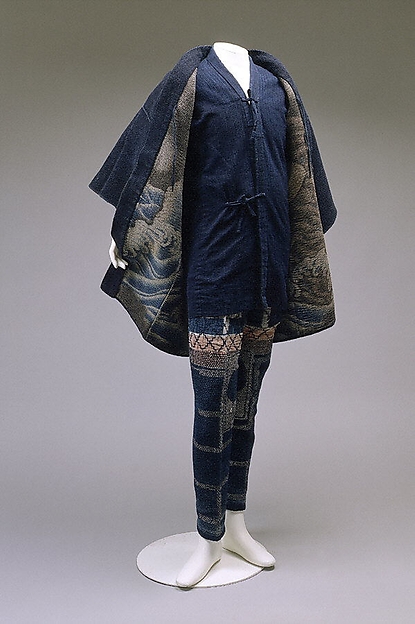
Fireman’s Jacket (Hikeshi-Banten) with Susanoo-no-mikoto Deity Scene, mid-19th century, Quilted cotton with tube-drawn paste-resist dyeing (tsutsugaki) with hand-painted details. The Metropolitan Museum of Art, Purchase, Irene Lewisohn and Alice L. Crowley Bequests, 1983, accession 1983.158a–c.
Look closer: Hold the two faces in mind. The Met describes a plain indigo exterior and a richly decorated interior, so whichever face is shown here, the other was meant to stay hidden.
Image: The Metropolitan Museum of Art, Open Access (CC0)
Wikipedia defines the hikeshi banten as a reversible hanten worn by firefighters in the Edo period. It was built of several layers of tightly stitched cotton, quilted with sashiko running stitches. One side bore only the brigade’s name; the other carried an elaborate design resist-dyed by the tsutsugaki method, often a warrior hero or a mythical creature linked to bravery or water, and often inspired by ukiyo-e prints. The Public Domain Review adds that the coats were thoroughly soaked in water before the firefighters went into the blaze, and that the plain side was worn outwards, probably to protect the dyed images.
The Met’s mid-nineteenth-century example shows how elaborate the inside could be. Its interior shows a scene from the Kojiki, of about 711, in which the god Susanoo rescues the youngest daughter of an elderly couple from a monstrous serpent. The museum notes that commoners wore reversible coats with a plain indigo exterior and a richly decorated interior, and that the full set would also have included trousers, an inner jacket, and matching gloves, socks and headgear. Another Met coat, with a dragon among clouds and lightning above Mount Fuji, may have been a firefighter’s; the museum says that some scholars think firefighters’ jacket designs were chosen for protection, and since East Asian tradition links dragons with water, the design fits that purpose.
Wikipedia’s account of the happi adds a detail of the street. In the Edo period firefighters were paid for firefighting, for promptness and for being present at the scene, and wearing a conspicuous coat and dancing on intact roofs with the standard, the matoi, was essential. The coat was therefore as much a signal as a shield. The Met’s print by Utagawa Yoshitora, Fireman, of about 1858, shows the same figure in the floating world, and the designs on the coats often borrowed from such prints.
The samurai brigades dressed differently. A Met jacket, plastron and sash set of the nineteenth century combines cotton and wool, and the museum notes that wool was expensive and rare in Japan before the Meiji period, that it appeared in the garments of high-ranking samurai firefighters, and that its self-extinguishing quality protects against stray sparks. The crest shows myōga, Japanese ginger, which the museum says was used by more than seventy Edo-period families, though it cannot name which family owned this set.
Sashiko, tsutsugaki and the Noh namesake
Two techniques make the fire coat what it is. Sashiko, the running stitch that holds several layers together, gave the coat its mass and its water-holding thickness; it is described at length in Sashiko and Boro: The Mended Cloth. Tsutsugaki, the drawing of paste lines through a tube before dyeing, made the picture; it is described in Tsutsugaki and Katazome: Paste and Stencil. Indigo, the dye of both the plain face and most of the pictures, is the subject of Aizome: The Indigo Dyer’s Craft.
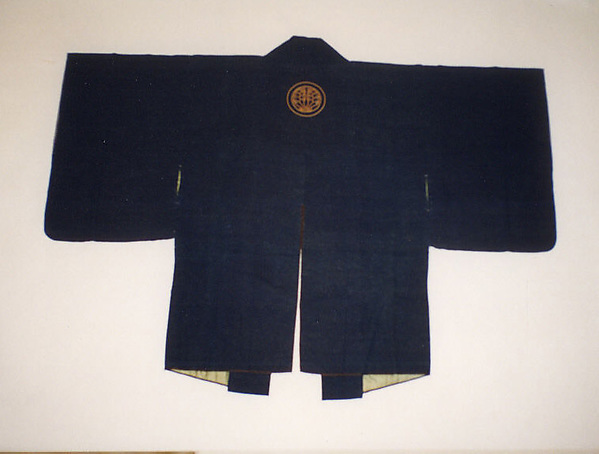
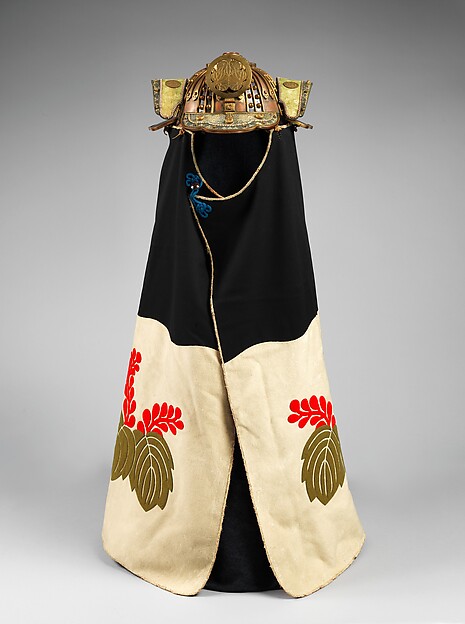
Fireman's jacket, plastron and sash, 19th century, Wool, cotton, silk, metallic thread, paper. The Metropolitan Museum of Art, Gift of John B. Elliott through the Mercer Trust, 1999, accession 1999.247.4a–c.
Look closer: Look for the crest. It shows Japanese ginger, myōga, used by more than seventy Edo families, so the crest alone does not name the owner.
Image: The Metropolitan Museum of Art, Open Access (CC0)
A confusion is worth clearing. The Met calls a nineteenth-century silk satin robe with a pattern of flowers and auspicious symbols a ‘Noh robe (happi)’. In the theatre the word is the name of a stage robe, quite unlike the festival coat; the Japanese Wiki entry gives the origin as the ancient court garment hanpi, but the museum’s notes do not link the two garments, and the reader should not assume that the stage robe and the festival coat are related. The Noh robe is discussed in Noh Costume: Karaori, Atsuita and Mizugoromo.
For the collector the useful distinctions are practical. A festival happi is usually a single layer of light cotton with a crest and lettering; a hanten is lined and warmer; a hikeshi banten is quilted, much heavier, and reversible. Check the lining and the stitching rather than the picture, because many modern festival coats borrow the imagery of the fire coat. How to Read, Grade and Care for a Japanese Garment sets out the wider grading of worn cotton, and Jinbaori: The Warlord’s Surcoat turns to the warrior’s coat, to which the firemen’s dress is distantly related.
Why Edo needed a coat for the flames
The fire brigade coat is the child of a catastrophe. Wikipedia's account of the Great Fire of Meireki says that it began on 2 March 1657 and burned for three days, driven by hurricane-force north-westerly winds through a city of wooden and paper buildings and narrow streets, after a drought the year before. The city's fire brigades, the article says, were too small and poorly equipped to stop it. The fire is said to have started when a priest cremated a furisode kimono that was believed to be cursed, because three teenage girls had owned it in turn and each had died before she could wear it. The article presents this as legend, and the reader should hold it as such.

Utagawa Yoshitora, Fireman, ca. 1858, Woodblock print; ink and color on paper. The Metropolitan Museum of Art, Gift of the Estate of Samuel Isham, 1914, accession JP212.25.
Look closer: Look for what the print does not tell you. The museum gives only the title, the artist and the date, so the coat has to be read from the picture itself.
Image: The Metropolitan Museum of Art, Open Access (CC0)
The figures are grim. The article estimates that the fire destroyed 60 to 70 per cent of Edo and that more than 100,000 people died, including from a severe blizzard that followed. On the second evening the wind shifted and drove the fire back through the city to Edo Castle, where the main keep and most of the outer buildings were lost. The shogunate gave 900 tons of rice and 160,000 ryō in relief, and the rebuilding took about two years: streets were widened, the castle area was cleared to make firebreaks, retainers' houses were moved farther away, and some temples and shrines were relocated to the riverbanks. The article compares the toll with that of the 1923 Great Kantō earthquake and the 1945 bombing of Tokyo.
Wikipedia's article on the hikeshi, the Edo fire brigades, takes the story forward. It says that the city brigades established after 1657 were the first permanent fire service in the world, with London's following after the Great Fire of 1666. In 1718 the volunteer brigades of commoners, the machi-bikeshi, were given official status, and each of the forty-seven brigades received a legally recognised number from the iroha sequence and its own emblem on its standard. They were divided into six ranks, and the members received only a small allowance, so that many took construction work or sought patrons. The article adds that Edo suffered 49 major fires between 1601 and 1867, against six in Osaka, and that two-thirds of the fires of Tokyo occurred from November to February.
The coat in this chapter belongs to that history. The Met's note on a fireman's jacket in its collection says that commoners' fire brigades increasingly bore the duties and costs of fighting Edo's frequent fires, while samurai firefighters mainly guarded Edo Castle. A garment that is both a uniform and a boast was made for a service that people trusted with the city, and the clothes were the one thing in the job that the firefighter could choose for himself.
The standard, the pike and the firebreak
A reader who imagines a modern fire engine will be surprised by the method. Wikipedia says that the main way of fighting an Edo fire was to tear down buildings in its path and so make a firebreak. The men known as tobi climbed burning roofs with pike poles, tobiguchi, and the article says the technique was used until the 1880s. Water pumps arrived in Japan in the middle of the eighteenth century but were not widely adopted. The coat was therefore a working garment for men who stood on roofs next to a fire, with a pole in their hands, while others soaked them with water.
Fireman's Helmet (Kajikabuto) for a Daimyo, 18th century, Gilt copper, leather, felt, silk, lacquer. The Metropolitan Museum of Art, Purchase, Kenneth and Vivian Lam Gift, 2005, accession 2005.429.
Look closer: Look at the scale. The museum gives the helmet as about a hundred centimetres high, a headpiece for display and rank, not for the roof.
Image: The Metropolitan Museum of Art, Open Access (CC0)
The article describes the soaking directly: citizens doused the cotton banten of the hikeshi with water before they began work. Public Domain Review, in its note on nineteenth-century firemen's coats, says the coats were thoroughly soaked before the firefighters went into the blaze and that the plain side was worn outwards, probably to protect the dyed images inside. A thick, quilted cotton garment, wet through, is a heavy thing to wear on a roof, and the picture on the inside was therefore a private possession, shown only afterwards.
The standard, the matoi, gave the brigade its public face. Wikipedia's article on the hikeshi describes it as a long pole carrying paper or fabric ribbons and the brigade's logo, raised beside a burning building to claim priority. The happi article adds a detail of employment: firefighters were paid for promptness and for being present at a fire, so wearing conspicuous coats and dancing on intact roofs near a fire with the standard was part of the job. The conspicuous coat was a form of invoice.
Rivalry and reward explain a good deal about the clothes. The Wikipedia article on the hikeshi records that a house owner whose fire spread to neighbours' houses could be arrested for thirty days, under a ruling of 1742, and that in 1747 the authorities called on the machi brigades to fight a fire at Edo Castle, which the article treats as official recognition of their rising status. It also records a less heroic moment: in the Kanda fire of 1881 the hikeshi demanded payment in advance before they would fight. A history that is full of pride is also full of business, and the coat is evidence of both.
A lord's firefighter in wool, cotton and a ginger crest
Not every fire coat was a commoner's quilted indigo. The Met's record of a nineteenth-century set of jacket, plastron and sash describes a costume that blends wool and cotton with silk, metallic thread and paper. It explains that wool was costly and rarely worn in Japan before the Meiji period (1868 to 1912), but that it appears in battle surcoats, the jinbaori, and in firefighting garments, including capelike hoods, worn by high-ranking samurai. The museum gives the practical reason: wool is self-extinguishing, and protects the wearer from stray sparks.
Fireman's jacket, plastron and sash, 19th century, Wool, cotton, silk, metallic thread, paper. The Metropolitan Museum of Art, Gift of John B. Elliott through the Mercer Trust, 1999, accession 1999.247.4a–c.
Look closer: Find the plastron and the sash. The jacket is only one of three pieces; the others turn a coat into a uniform.
Image: The Metropolitan Museum of Art, Open Access (CC0)
The crest shows whose men the firefighters were. The record says that the mon incorporates the myōga, Japanese ginger, a design used by more than seventy Edo-period families, and that the specific family that used this version has not been identified. The point of the note is its caution: a crest that was shared by seventy families cannot name one of them, and a fine coat with such a mark cannot be assigned to a house without further evidence. The reader who wishes to learn how crests are read will find the method in Mon: The Family Crests on Japanese Dress.
Compared with the commoner's coat, the set has a different silhouette. It includes a plastron, the front piece, about 58 centimetres high, and a sash about 187 centimetres long, according to the museum's dimensions, and the jacket itself is about 98 centimetres high and 127 centimetres wide. The elements add up to a uniform in which the wearer is covered, belted and marked, a different thing from the open festival happi of the same word family. The surviving examples remind a visitor that the fire service of Edo was run on two tiers: the retainers' brigades that guarded the castle and the townspeople's brigades that fought the city's fires.
The wool is a link with the next chapter. The surcoat worn over armour, which the Met's collection shows in rasha wool, is the subject of Jinbaori: The Warlord’s Surcoat, and the firefighter's cape belongs to the same family of foreign cloths that came to Japan through the Dutch and Portuguese and were prized for their colour and strength.
A serpent, a god and a maple grove on the lining
The most famous feature of the commoner's hikeshi banten is that it is reversible. The Met's record of a mid-nineteenth-century example says that commoners wore these reversible coats, that firefighters held high status in urban Japan, especially in Edo, where wooden architecture and crowded housing led to frequent fires, and that decoration was important to firefighters' garments. The full set included trousers and an inner jacket, and gloves, socks and headgear of the same material would also have been part of the ensemble.
Fireman’s Jacket (Hikeshi-Banten) with Susanoo-no-mikoto Deity Scene, mid-19th century, Quilted cotton with tube-drawn paste-resist dyeing (tsutsugaki) with hand-painted details. The Metropolitan Museum of Art, Purchase, Irene Lewisohn and Alice L. Crowley Bequests, 1983, accession 1983.158a–c.
Look closer: Look for the serpent. The scene is inside the coat, so a photograph of the open lining is the one view the wearer never had himself.
Image: The Metropolitan Museum of Art, Open Access (CC0)
The design is divided. The museum describes the exterior as plain indigo-dyed cotton, while the interior shows a climactic scene from the Kojiki of about 711: Susanoo-no-mikoto, the younger brother of the sun goddess Amaterasu, saves the eighth and last daughter of an elderly couple from a monstrous serpent. The jacket is thick and quilted, and is described as drawn with a tube in paste-resist, the technique called tsutsugaki (see Tsutsugaki and Katazome: Paste and Stencil), with hand-painted details. A god who kills a monster that devours the young is an obvious patron for a man who fights a monster of another kind.
Not every picture is so heroic. The museum's record of a fireman's jacket in quilted, dye-patterned cotton says that it shows an outdoor autumn scene with maple leaves, curtains and a taiko drum of the kind used in the court dance bugaku, and that it resembles the coats worn by Edo firemen but has no insignia, so that the museum says it cannot be identified as a fireman's jacket. It is a good example of how a museum label can be honest about what it does not know.
A third example, catalogued only as a jacket with a dragon and Mount Fuji, is explained in the record as showing a dragon among clouds and lightning, a creature that came from China and that East Asian tradition associates with water. The setting is distinctly Japanese because of Mount Fuji. The museum says that the jacket may have belonged to a firefighter in Edo and adds that some scholars suggest the patterns on firefighters' jackets were chosen to protect the wearer. The three coats show how the inside could carry myth, theatre or a charm against fire, and how little of it the outside was allowed to show.
The Noh robe that suggests armour
The word happi belongs to a second garment, and the reader is warned that the two are different. The Met's record of a nineteenth-century Noh robe in silk satin with supplementary-weft patterning in silk and metallic thread says that the happi is a costume unique to the Noh stage. It is often worn as an outer jacket for a warrior's role, and when one sleeve is slipped off the right arm, or both sleeves are pushed up, the robe suggests armour. Many lined happi, the museum notes, have bold designs inspired by Chinese art. It then states the distinction plainly: the happi worn by townsmen in the Edo period and later, a short coat, is a different garment.
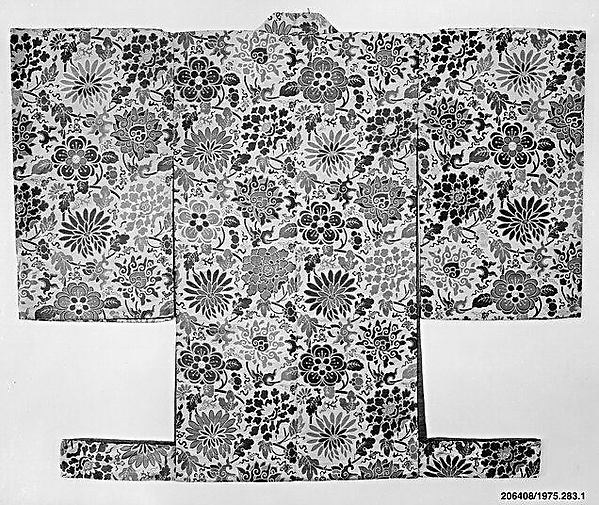
Noh Robe (Happi) with Pattern of Flowers and Auspicious Symbols, 19th century, Silk satin with supplementary weft patterning in silk and metallic thread. The Metropolitan Museum of Art, Gift of Arthur M. Crocker and William R. Crocker, 1975, accession 1975.283.1.
Look closer: Imagine one sleeve slipped off the right arm. That gesture is what turns this brocade into the suggestion of armour.
Image: The Metropolitan Museum of Art, Open Access (CC0)
The stage robe is large, about 110 centimetres by 204 centimetres, and woven rather than dyed, as the record's medium shows. It is the opposite of the festival coat in every way except the name. One is silk, brocaded, worn by a player on a polished stage and handled by dressers; the other is cotton, dyed, worn by a crowd on a street and handled by whoever is carrying the shrine. The stage garment is described in Noh Costume: Karaori, Atsuita and Mizugoromo.
The reader can use the pairing as a rule when meeting the word in a catalogue. A happi in silk with a woven pattern and a wide body is probably a stage costume; a short cotton coat with a crest or a lettered back is the townsman's. The Met's own note, quoted here, is a rare case of a museum telling its reader outright that the same term covers two things, and it is useful to remember that a Japanese word does not always have one English meaning.
The back of the coat and the street festival
The festival happi is the form that most visitors meet. Wikipedia describes it as a traditional Japanese coat with tube sleeves, usually worn only during festivals, with symbols or text on the lapels and a larger design on the back, often naming the festival or the participating group, and sometimes the kanji for festival, matsuri. In English it is usually called a happi coat. The traditional colour is blue, with red, black and white designs, and modern versions may be made of cotton or polyester.

Fireman's jacket, 19th century, Quilted dye-patterned plain-weave cotton. The Metropolitan Museum of Art, Purchase, Gift of Timothy La Farge, by exchange, Bequest of Edward G. Kennedy, by exchange, 1983, accession 1983.100.
Look closer: Count the layers in the quilting stitches. The Met says the coat resembles an Edo firefighter’s coat but has no insignia, so it cannot be confirmed as one.
Image: The Metropolitan Museum of Art, Open Access (CC0)
The same article records the origin in livery. Happi originally displayed a family's mon, and house servants wore them as uniforms; firefighters wore happi with their group's crest on the back. The article distinguishes these from the hikeshi sashiko banten, the heavily quilted cotton jacket designed to hold water. The two coats, one light and one heavy, show how a single word could cover a uniform of display and a garment of work.
The Wikipedia article on the hikeshi closes with the afterlife: the brigades were replaced in modern Japan by the Fire and Disaster Management Agency, and the matoi survive as decorations at festivals. The coat and the standard are therefore now ceremonial, and a crowd at a shrine festival is wearing the dress of a service that no longer exists in that form.
For what comes next, the cotton work coats of country and town are taken up in Noragi and the Clothes of Work, and the quilting and stitching that gave the fire coat its water-holding body in Sashiko and Boro: The Mended Cloth.
Four tales of the coat
The cursed kimono. Wikipedia's account of the Great Fire of Meireki begins with a legend: a furisode owned in succession by three teenage girls, each of whom died before she could wear it, was taken to a temple and cremated by a priest, and a gust of wind carried the flames to the wooden building. The article tells it as the tradition of the fire, not as established fact. It is an unusual tale in which a garment is the cause of the catastrophe that produced a garment, the firefighter's coat.
The coat soaked at the door. Public Domain Review and Wikipedia both describe the water. Before the hikeshi went to work, citizens doused their cotton coats, and the plain side was worn outwards to protect the images inside. The detail makes a quiet picture: a crowd with buckets at the edge of a fire, wetting men who are about to walk into it, and the dyed god or dragon on the lining kept dry for later.
The dragon among clouds. The Met's jacket with a dragon and Mount Fuji suggests that firefighters' patterns were chosen as a charm. The dragon is a water creature in East Asian tradition and the cloud and lightning around it are the weather in which it lives. A coat that carries a water beast above Mount Fuji is an argument against fire in the language of pictures.
Payment in advance. In the Kanda fire of 1881, according to Wikipedia, the hikeshi demanded payment before they would fight. The story is told with relish because it undercuts the romantic account of the brigades as selfless heroes. The truth that emerges from the sources is subtler: the men were skilled, proud, poorly paid and quick to claim their due, and their finest clothes were a sign of the trade as much as of the courage.
Small surprises from the sources
Short facts, each as the cited source gives it.
- The Great Fire of Meireki began on 2 March 1657 and burned for three days, destroying an estimated 60 to 70 per cent of Edo.
- Edo had 49 major fires between 1601 and 1867, against six in Osaka, according to Wikipedia.
- There were forty-seven machi-bikeshi brigades, each given a legally recognised number from the iroha sequence and its own emblem.
- The brigades were divided into six ranks, and the members received only a small allowance.
- A house owner whose fire spread to neighbours' houses could be arrested for thirty days under a ruling of 1742.
- Wool was costly and rarely worn in Japan before the Meiji period, but was used for firefighting garments because it self-extinguishes.
- The myoga crest on the Met's wool firefighter's set was used by more than seventy Edo families.
- The Met's reversible coat shows Susanoo killing the serpent from the Kojiki on its lining.
- Public Domain Review reports that the plain side of the coat was worn outwards, probably to protect the dyed images.
- The Noh happi suggests armour when one sleeve is slipped off the right arm.
- The traditional happi colour is blue with red, black and white designs.
- In the Kanda fire of 1881 the hikeshi demanded payment before fighting, according to Wikipedia.
Words of the fire coat
A short list of the terms used in this chapter.
| Term | Meaning | Where it appears |
|---|---|---|
| Hikeshi | The Edo fire brigades | History |
| Machi-bikeshi | Volunteer brigades of commoners, recognised in 1718 | History |
| Hikeshi banten | The reversible, quilted cotton coat of the brigade | The coat |
| Sashiko banten | A heavily quilted jacket designed to hold water | The coat |
| Happi | A short festival or livery coat; also a Noh stage robe | Throughout |
| Matoi | The brigade's standard, a pole with ribbons and a logo | The roof |
| Tobi | The men who climbed roofs with pike poles | The roof |
| Tobiguchi | The pike pole used to pull down buildings | The roof |
| Iroha | The sequence used to number the forty-seven brigades | History |
| Tsutsugaki | Tube-drawn paste-resist dyeing | The lining |
| Jinbaori | A battle surcoat, sometimes of wool | Wool |
| Mon | A family crest | Crests |
| Myoga | Japanese ginger, a crest motif | Wool set |
| Kojiki | The chronicle of about 711 that tells the serpent story | The lining |
Where the coats and helmets are held
The coats described in this chapter are in the Metropolitan Museum of Art, where the records state that the fireman's jacket and plastron set, the reversible Susanoo coat, the autumn-scene jacket and the Noh happi are not on view, while the daimyo's fire helmet is listed as on view in the Arms and Armor galleries. A visitor should check the museum's own object pages before travelling. Public Domain Review's gallery of nineteenth-century firemen's coats, which draws on the Met and other collections, is the quickest way to compare the dyed insides and plain outsides of several coats side by side.
Fireman's jacket, 19th century, Quilted dye-patterned plain-weave cotton. The Metropolitan Museum of Art, Purchase, Gift of Timothy La Farge, by exchange, Bequest of Edward G. Kennedy, by exchange, 1983, accession 1983.100.
Look closer: Look for the leaves and the drum. The museum says it resembles an Edo fireman's coat but carries no insignia, so it cannot be named as one.
Image: The Metropolitan Museum of Art, Open Access (CC0)
In Japan the living form of the tradition is the festival. Wikipedia's account of the hikeshi says that the matoi survive as festival decorations, and the happi is the coat of the crowd that carries a shrine through the streets. The reader who wishes to see one should go to a neighbourhood festival and look at the back of the coat for the name of the group.
Reading a fire coat in the hand
Five marks are worth the time. First, the weight: a true hikeshi banten is thick, quilted cotton, and a thin single-layer coat with a similar picture is more likely to be a festival happi. Second, the reversal: a good coat has a plain, indigo side and a pictorial side, and the pictorial side is often the better preserved because it was worn inward. Third, the stitching: sashiko quilting should be even and tight, and the repairs of a working life are a sign of use, not a fault.
Fourth, the crest or the lettering. A brigade's name or number, or an emblem on the back, is the best evidence of a coat's origin, and the Met's records are a reminder that a coat without insignia cannot safely be called a fireman's. A crest that was shared by seventy families, such as the ginger, cannot name one. Fifth, the cloth: wool in a firefighter's set points to a high-ranking retainer's brigade, cotton to the commoner's. How to Read, Grade and Care for a Japanese Garment sets out how to grade and store such pieces, and Tsutsugaki and Katazome: Paste and Stencil explains how the painted lining was drawn.
Happi and hanten in the house
The shelf holds a fire brigade hanten in indigo sashiko cotton, festival happi, including a remade banner coat, and a boro hanten. Each is described as what it is, and the page says so where a coat has been remade from other cloth.


Kimono and textile heritage
Hanten, happi and boro are gathered in the textile collection, and the concierge desk can look for a particular coat, crest or brigade on request.
Answered plainly
What is the difference between a happi and a hanten?
Japanese Wiki says a happi was originally a single layer and a hanten lined, and that the two lost their distinction by the end of the Edo period. A hanten is a short coat originally for craftsmen, worn over a kimono.
Why was the firefighter’s coat reversible?
One side bore the brigade’s name and the other a painted picture. The Public Domain Review says the plain side was worn out, probably to protect the dyed images.
Were the coats really soaked in water?
Yes. The Public Domain Review says they were thoroughly soaked before firefighters entered the blaze.
What is tsutsugaki?
A resist-dyeing method in which paste is drawn through a tube onto the cloth before dyeing. The Met and Wikipedia name it as the technique of the hikeshi banten pictures.
Why do some happi have lettering on the collar?
Japanese Wiki says the vertical lettering can indicate membership, a name or an intention, such as a carpenter’s name or a shop’s welcome.
Is a Noh happi the same garment?
No. The Met uses the word for a stage robe in silk satin. The festival coat is a different garment, though the word appears to be the same.
Why is a fire brigade coat reversible?
The Met describes the plain indigo side as the outside and the picture as the inside. Public Domain Review says the plain side was worn outwards, probably to protect the dyed images, and the coats were soaked before the work began.
What was the Great Fire of Meireki?
A fire that began on 2 March 1657 and burned for three days, destroying an estimated 60 to 70 per cent of Edo and killing more than 100,000 people, according to Wikipedia.
How many fire brigades did Edo have?
Forty-seven volunteer machi-bikeshi brigades, recognised from 1718, each numbered from the iroha sequence and given its own emblem.
How did Edo firefighters fight fires?
Mainly by pulling down buildings in the fire's path to make a firebreak. Tobi climbed roofs with pike poles, a method used until the 1880s.
Why was wool used in a fire coat?
The Met says wool is self-extinguishing and protects the wearer from stray sparks. It was costly and appears in the dress of high-ranking samurai.
What is a matoi?
The brigade's standard: a long pole with paper or fabric ribbons and the brigade's logo, raised beside a burning building to claim priority.
Is a Noh happi the same as a festival happi?
No. The Met says the Noh happi is a stage costume that suggests armour, and that the short coat worn by townsmen is a different garment.
What does the lining of a fireman's coat show?
Examples at the Met show Susanoo defeating a serpent, an autumn grove with a drum, and a dragon among clouds with Mount Fuji.
Did firefighters get paid?
A small allowance, and rewards for promptness. Wikipedia reports that in the Kanda fire of 1881 the hikeshi demanded payment before they would fight.
Where next
In the Lexicon: hanten, sashiko.
Sources and image credits
- Happi, Wikipedia
- Hikeshi banten, Wikipedia
- Happi coat (livery coat), Japanese Wiki
- Japanese Firemen’s Coats, 19th Century, The Public Domain Review
- The haori and hapi, history and details, Folkwear
- Jacket 698/20, Museum of Anthropology, University of British Columbia
- Great Fire of Meireki, Wikipedia
- Hikeshi, Wikipedia
- Fireman's jacket, plastron and sash, object record, The Metropolitan Museum of Art
- Fireman's jacket (hikeshi-banten) with Susanoo-no-mikoto, object record, The Metropolitan Museum of Art
- Jacket with dragon and Mount Fuji, object record, The Metropolitan Museum of Art
- Fireman's jacket, object record, The Metropolitan Museum of Art
- Noh robe (happi), object record, The Metropolitan Museum of Art
- Fireman's helmet (kajikabuto) for a daimyo, object record, The Metropolitan Museum of Art
- Fireman, Utagawa Yoshitora, The Metropolitan Museum of Art
- Object record: Festival coat with dragon, The Metropolitan Museum of Art
Last reviewed 28 October 2026. Pictures, where shown, are public-domain or open-access and credited beneath each one.
Looking for a garment, textile or accessory you have seen described here? The concierge desk replies within one to three business days.
Private concierge
Looking for something in particular?
Describe the piece or the project you have in mind. A senior advisor in Tokyo reads every case file personally and replies within two business days, with fees set out in writing before any work begins.