Japonista
Trío de pequeñas máscaras Noh Ko-Omote de la línea de Omiya Sadamori, conjunto Nieve-Luna-Flor con tomobako firmado
Trío de pequeñas máscaras Noh Ko-Omote de la línea de Omiya Sadamori, conjunto Nieve-Luna-Flor con tomobako firmado
No se pudo cargar la disponibilidad de recogida
All sales are final. Please read our refund policy before purchase.
Have a reasonable price in mind? Submit your best offer and our concierge will review it personally.
Snow, moon and flower, the old poetic triad, gives its name to this ensemble of three small ko-omote masks, each a different temperament of youthful femininity. One bears a carved signature linked to Omiya Sadamori, and all three rest in their inscribed Setsugetsuan tomobako with textile bags and documentation, a rare survival of a set kept whole.
The Piece
A refined trio of small-format Noh masks of Edo-period lineage, attributed to the workshop tradition of Omiya Sadamori and housed in an inscribed Setsugetsuan tomobako. The masks follow the ko-omote type, representing idealized young female characters, and each expresses a distinct emotional tone, youthful grace, serene beauty and gentle maturity, through differences in expression, cheek contour and eye shaping. Together they form a poetic ensemble in the Snow, Moon, Flower aesthetic tradition, a complete and historically anchored set.
The carving is consistent with Edo-influenced workshop practice: soft planes along the cheeks, delicately recessed eyes, subtly defined lips in red lacquer and carefully shaved interior chisel textures. The surfaces show age-appropriate patina, with the natural mellowing of lacquer and oxidation that develops over decades. The reverse sides reveal crisp, intentional tool marks.
A carved signature associated with Omiya Sadamori (大宮貞盛) appears inside one mask, aligning with the maker attribution in the accompanying document. The Omiya line is recorded as an early Edo-period school of mask-making, known for preserving classical forms and transmitting stylistic consistency through generations, and its carvers carried Edo aesthetics into later periods with gentle transitions in facial planes, emotional restraint and highly refined finishing.
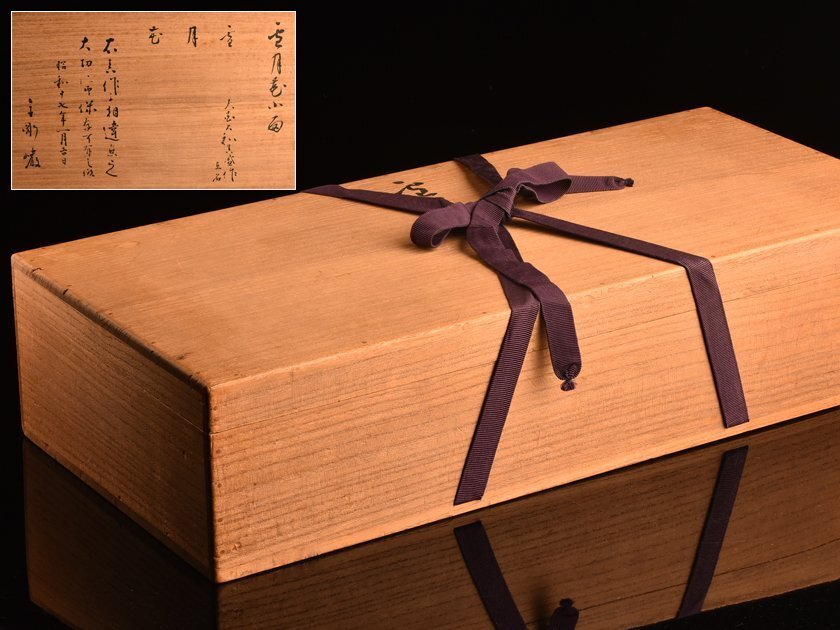
The tomobako is of particular importance. It carries multiple lines of brush inscription and signatures referencing Setsugetsuan (雪月庵), the masks' poetic designation, together with a note referencing 昭和十七年 (1942), likely the date of appraisal, curation or preservation by descendants or collectors. Its interior is partitioned into three compartments, each holding a patterned cloth bag. The use of such poetic identifiers reflects the long union of visual arts, literature and performance in Japanese aesthetics, and the set bridges Edo traditions, early 20th century preservation practice and the cohesive provenance a collector seeks; three-mask ensembles kept in their original divided box are rare.
Details
- Maker: Attributed to the workshop tradition of Omiya Sadamori (大宮貞盛)
- Line: Snow–Moon–Flower grouping; tomobako designation Setsugetsuan (雪月庵)
- Era: Edo lineage; box document references 昭和十七年 / 昭和17年 (1942) appraisal
- Material: Carved wood with pigment and lacquer layers
- Color: Natural wood tone with classical pale facial lacquer; red lacquer lips; dark hairlines
- Measurements: Mask A: 約21 × 13.5 cm, 高さ 約8 cm (approx. 21 × 13.5 cm, height approx. 8 cm) · Mask B: 約21 × 14 cm, 高さ 約7 cm (approx. 21 × 14 cm, height approx. 7 cm) · Mask C: 約20.5 × 13.5 cm, 高さ 約8 cm (approx. 20.5 × 13.5 cm, height approx. 8 cm)
- Included: Signed tomobako with internal divisions; three textile mask bags in varied patterns; full explanatory document (biography, appraisal notes, Edo lineage description)
- Cords: Brown braided cords attached through traditional side cord pass-throughs
- Markings: Carved signature visible on the reverse of one mask
Condition
- Very Good+ (VG+): excellent preservation for age, with mild discoloration only and uniform, stable aging across all three masks.
- Exterior: minimal abrasions; lacquer softening appropriate to age; gentle discoloration.
- Interior: clear chisel texture; carved signature visible; natural wood oxidation.
- Edges and corners: light rubbing only; stable.
- Structure: no visible cracks or structural instability; the wood appears dry-stable.
- Cords: braided cords intact and secure.
- Tomobako: mild rubbing and ribbon wear; inscriptions preserved.
- Well preserved considering a probable late Edo to early Shōwa preservation timeline.
Authenticity & Care
Examination covered carving and chisel marks, lacquer aging, the 大宮貞盛 signature, the tomobako brush inscriptions and the 1942 appraisal note, with structural inspection for cracks or non-period repairs; the masks are attributed to the Omiya Sadamori workshop tradition rather than documented as the master's own hand. Every piece is examined and documented in Japan before dispatch and is offered with the Japonista authenticity guarantee.
Delivery from Japan
Packed by hand in Japan and shipped insured and tracked by EMS or an equivalent express service. Import duties and taxes, where applicable, are payable on arrival. Returns follow our published policy.
Considered offers are welcome through Send an Offer, and each one is reviewed personally. Pieces over $1,000 may be reserved over several payments with Layaway Privilege™.
Continue browsing: Noh Masks
Related pieces: Meiji Ikaku Sen'nin hand-carved Noh mask · Nomura Ran hand-carved Hannya Noh mask
Consolidated Freight
Furniture, folk pieces and machines can be gathered, packed and shipped together from our Warehouse & Export Vault™, saving on international freight. Consolidate your pieces →
Collectors also search: ko-omote noh mask set · omiya sadamori noh mask · small noh masks tomobako · antique noh mask trio · edo lineage noh mask · japanese noh mask signed