
Kabuki: The Theatre of the Unusual
A stage that leans
Kabuki: The Theatre of the Unusual
歌舞伎
The name means to lean, to be out of the ordinary, and the art has never stopped living up to it. A shrine maiden's riverside dance became a four-hundred-year theatre of revolving stages, flying actors and faces painted as masks.
Fact sheet
At a glance
- A name that means odd. Kabuki comes from kabuku, to lean or be out of the ordinary.
- All-male since 1629. Women were banned; onnagata took female roles.
- Spectacle on purpose. Revolves, traps, wires and quick costume changes serve the sudden reveal.
- A performer's theatre. Actors improvise puns and references that depart from the script.
Why the name means strange
First lookIn the first decade of the seventeenth century, young men in Kyoto dressed in extravagant, swaggering clothes and walked the streets in a manner the authorities found alarming. They were called kabukimono, the leaning ones. When a former shrine maiden began to perform a new kind of dance-drama in the dry bed of the Kamo River around 1603, the audience used the same word for her, and it stuck.
Kabuki is a classical form of Japanese theatre that mixes dramatic performance with traditional dance. It is known for stylised performance, glamorous, heavily decorated costumes and, for some performers, the elaborate kumadori make-up covered in its own chapter. The three characters of the modern spelling mean sing, dance and skill, though scholars note they do not reflect the true etymology. UNESCO proclaimed kabuki a masterpiece in 2005 and inscribed it on the Representative List in 2008.
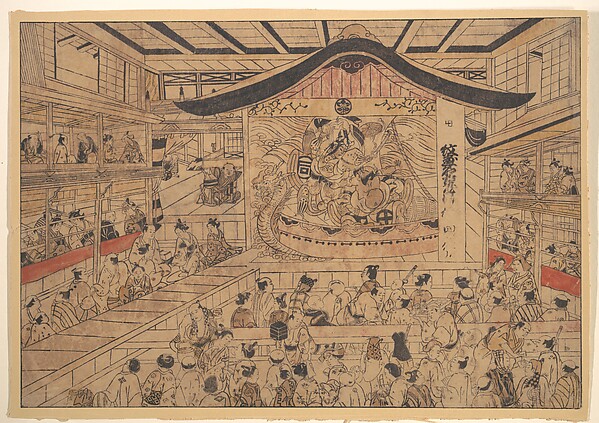
Okumura Masanobu, 1748 (Enkyō 5), first month. Woodblock print (nishiki-e); ink and color on paper. The Metropolitan Museum of Art, accession JP3059.
Look closer: Look for the long walkway that cuts through the audience: the hanamichi, along which actors enter and leave.
Okumura Masanobu, Perpsective View (uki-e) of a Kabuki Theatre, with a Performance of The Crest Patterns of the Soga Brothers and Nagoya Sanza (Mon-zukushi Nagoya Soga), 1748 (Enkyō 5), first month. The Metropolitan Museum of Art, Gift of Mrs. Morris Manges, in memory of her husband, Dr. Morris Manges, 1947, accession JP3059. Public domain (Met Open Access, CC0). Museum record
From the riverbed to the men's stage
Izumo no Okuni, who is believed to have served as a miko at Izumo Grand Shrine, took her troupe of young women to the Shijo dry riverbed of the Kamo River and to Kitano Shrine. The earliest performances were dance and song with no significant plot, and the women played both men and women in comic playlets about ordinary life. Rival troupes formed quickly. Because many performers were also involved in prostitution, and because fights broke out among the young samurai in the audience, the shogunate banned women from the stage in 1629.
Boys followed, then adult men, and by the mid-seventeenth century the all-male theatre was established, with onnagata playing women. When the government outlawed the more ribald early forms, it allowed the new men's kabuki only if it modelled itself on the restrained comic art of kyogen, a connection described in the chapter on Kyogen.
A selection of turning points.
Diagram by Japonista.
Kabuki flourished in the Genroku period. Its plays took the structure in which they are performed today, and the playwright Chikamatsu Monzaemon, who also wrote for the puppet theatre described in Bunraku, wrote some of the most influential. The mid-eighteenth century brought a lull, with puppet theatre briefly the favourite of the lower classes, before kabuki recovered at the end of the century.
A stage built for surprise
The connoisseur's eyeThe kabuki stage projects into the audience. The hanamichi, the flower path, is a walkway running through the auditorium along which dramatic entrances and exits are made; important scenes are also played on it. Technical invention followed in the eighteenth century: the revolving stage, the traps that raise and lower actors or sets, and later wires that let an actor fly over the stage. The driving idea, in the standard account, is the sudden, dramatic revelation or transformation.

Tak1701d, 28 March 2013. Wikimedia Commons.
Look closer: The facade echoes castle and temple architecture, a style kept in each rebuilding since 1924.
Tak1701d, Kabuki-za Theatre 2013 0328. Wikimedia Commons, Public domain. Source file
Sources differ on the revolve. One account places its development in the Kyoho era (1716 to 1735), at first as a wheeled platform pushed by hand; another credits the playwright Namiki Shozo with the idea in 1758, inspired by the spinning of a top. Both agree that it began in kabuki and that it was manual before it was electric.
| Device | Japanese | What it does |
|---|---|---|
| Flower path | Hanamichi 花道 | Walkway through the audience for entrances and exits |
| Revolve | Mawari-butai 廻り舞台 | Turns to change a scene while the audience watches |
| Traps | Seri 迫り, suppon すっぽん | Raise or lower actors and sets |
| Flying | Chunori 宙乗り | Wires carry an actor over the stage |
| Costume reveal | Hikinuki 引き抜き, bukkaeri ぶっ返り | An outer layer is pulled away to show the true self |
| Black-clad assistants | Kuroko 黒子 | Invisible stagehands who assist actors and move props |
Stagehands in black (kuroko) are by convention invisible. They add and remove props mid-scene and help with quick costume changes. In hikinuki and bukkaeri a stagehand pulls a layer of costume away before the audience to reveal a character's true nature. The curtain, in vertical stripes of black, red and green (or white), is drawn aside by hand.
Three kinds of play and one great family
The deep endPlays fall into three groups. Jidaimono, history plays, are set within major events such as the Genpei War of the 1180s. Strict Edo censorship forbade the representation of contemporary events, so many writers used historical settings as metaphors. Sewamono, domestic plays, concern townspeople and peasants and often turn on family drama and romance; the love-suicide plays adapted from Chikamatsu belong here. Shosagoto, dance pieces, are driven by movement, in which long sleeves and rhythmic stamping communicate emotion.

Katsukawa Shunshō 勝川春章, 11th month 1776. Woodblock print (nishiki-e); ink and color on paper. The Metropolitan Museum of Art, accession JP368.
Look closer: Count the squares on the sleeve crests: the three nested squares are the Ichikawa family crest.
Katsukawa Shunshō 勝川春章, Kabuki Actor Ichikawa Danjūrō V in a Shibaraku (Stop Right There!) Role as Hannya no Gorō, 11th month 1776. The Metropolitan Museum of Art, Purchase, Joseph Pulitzer Bequest, 1918, accession JP368. Public domain (Met Open Access, CC0). Museum record
The greatest family is the Ichikawa. Ichikawa Danjuro is a stage name taken by a series of actors, bestowed in a grand naming ceremony called shumei, and usually assumed at the peak of a career; before it, an actor often bore the name Ichikawa Ebizo. The first Danjuro (1675 to 1704) originated aragoto, the bold, exaggerated style, and is credited with the mie pose. The seventh established the Kabuki Juhachiban, the Eighteen Favourites that showcase the family's specialities. The family crest is three nested squares.
The great actors were the subject of the woodblock print, discussed in Ukiyo-e. Katsukawa Shunsho records Danjuro V in a Shibaraku role in 1776; Tosusai Sharaku, active in 1794 and 1795, exaggerates the faces of his sitters. Sharaku's actors reappear on silk in the reversible Sharaku sukajan on our shelf, and the wider story of such jackets is told in the Sukajan Museum.
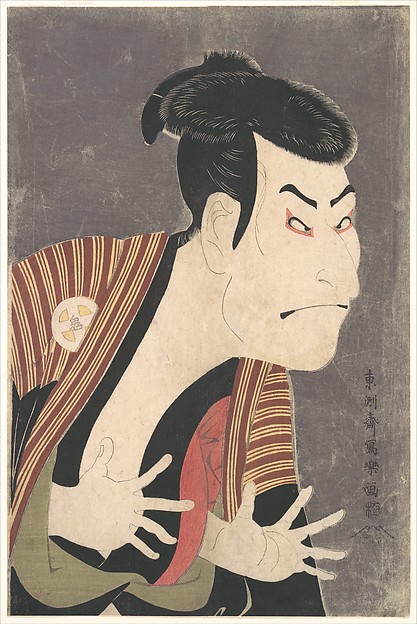
Tōshūsai Sharaku, 1794. Woodblock print; ink, color, and white mica on paper. The Metropolitan Museum of Art, accession JP2822.
Look closer: Sharaku exaggerates the hands and the jaw: the portrait catches a moment of pose, not a face at rest.
Tōshūsai Sharaku, Kabuki Actor Ōtani Oniji III as Yakko Edobei, 1794. The Metropolitan Museum of Art, Henry L. Phillips Collection, Bequest of Henry L. Phillips, 1939, accession JP2822. Public domain (Met Open Access, CC0). Museum record
Wigs, padding and the weight of cloth
Kabuki costumes began as new designs for the general public, since sumptuary laws forbade imitating the dress of samurai and nobles and the use of luxurious fabrics. They are now made from written records and in collaboration with families who have worked in the theatre for generations. Kimono are vibrant and layered; both men and women wear hakama in some plays; padding gives the correct body shape. Each actor has a wig for each role, made on a thin base of hand-beaten copper with human hair hand-sewn onto a silk base. Dedicated chapters on stage costume are being prepared in the Traditional Clothing almanac and will be linked here when they open.

Utagawa Hiroshige, ca. 1838. Woodblock print; ink and color on paper. The Metropolitan Museum of Art, accession JP597.
Look closer: Hiroshige records the street outside: a theatre district was a fashion show before the curtain rose.
Utagawa Hiroshige, View of the Kabuki Theaters at Sakai-cho on Opening Day of the New Season (Sakai-cho Shibai no Zu), from the series, "Toto Meisho", ca. 1838. The Metropolitan Museum of Art, Purchase, Joseph Pulitzer Bequest, 1918, accession JP597. Public domain (Met Open Access, CC0). Museum record
Kabuki, worn and carried
Two pieces from the house shelf with a kabuki subject, photographed by us. Stock changes; a private request can follow a particular actor or crest.


Answered plainly
What does kabuki mean?
It is believed to derive from kabuku, to lean or be out of the ordinary. The characters in the modern spelling mean sing, dance and skill, but scholars say they do not reflect the true etymology.
Why are all the actors men?
Women were banned from the stage in 1629, partly to preserve order among young samurai in the audience. Male onnagata took the female roles.
How long is a performance?
A programme usually has two to three plays, and the total including intermissions is about four hours. One play can last from half an hour to nearly two hours.
Can I see just one act?
At the Kabuki-za there are single-act seats on the fourth floor, about 70 reserved seats and 20 standing places sold on the day, though numbers vary.
What is a mie?
A dramatic pose held at the climax of a scene, credited to the first Ichikawa Danjuro.
Where next
Sources and image credits
- Kabuki, Wikipedia
- Izumo no Okuni, Wikipedia
- Ichikawa Danjuro, Wikipedia
- Kabuki-za, Wikipedia
- Hanamichi, Wikipedia
- GLT, Guide to discovering Kabuki and enjoying its performance
- Kyoto Travel, Kabuki theater
- Metropolitan Museum of Art Open Access (images)
Image credits, in order of appearance:
- Okumura Masanobu, Perpsective View (uki-e) of a Kabuki Theatre, with a Performance of The Crest Patterns of the Soga Brothers and Nagoya Sanza (Mon-zukushi Nagoya Soga), 1748 (Enkyō 5), first month. The Metropolitan Museum of Art, Gift of Mrs. Morris Manges, in memory of her husband, Dr. Morris Manges, 1947, accession JP3059. Public domain (Met Open Access, CC0). Museum record
- Tak1701d, Kabuki-za Theatre 2013 0328. Wikimedia Commons, Public domain. Source file
- Katsukawa Shunshō 勝川春章, Kabuki Actor Ichikawa Danjūrō V in a Shibaraku (Stop Right There!) Role as Hannya no Gorō, 11th month 1776. The Metropolitan Museum of Art, Purchase, Joseph Pulitzer Bequest, 1918, accession JP368. Public domain (Met Open Access, CC0). Museum record
- Tōshūsai Sharaku, Kabuki Actor Ōtani Oniji III as Yakko Edobei, 1794. The Metropolitan Museum of Art, Henry L. Phillips Collection, Bequest of Henry L. Phillips, 1939, accession JP2822. Public domain (Met Open Access, CC0). Museum record
- Utagawa Hiroshige, View of the Kabuki Theaters at Sakai-cho on Opening Day of the New Season (Sakai-cho Shibai no Zu), from the series, "Toto Meisho", ca. 1838. The Metropolitan Museum of Art, Purchase, Joseph Pulitzer Bequest, 1918, accession JP597. Public domain (Met Open Access, CC0). Museum record
Last reviewed 28 October 2026. Pictures are public-domain or openly licensed and credited beneath each one; diagrams are drawn by Japonista.
The woodblock prints, silks and trunks of the kabuki world are scarce. If you are looking for a particular actor or crest, we will search.
Private concierge
Looking for something in particular?
Describe the piece or the project you have in mind. A senior advisor in Tokyo reads every case file personally and replies within two business days, with fees set out in writing before any work begins.