
Gagaku and Bugaku: The Court Music and Dance
Imperial sound
Gagaku and Bugaku: The Court Music and Dance
雅楽 舞楽
The oldest of Japan's traditional performing arts is also one of the slowest, a music of long, drifting phrases played by eight instruments for the emperors of Japan. Its dance, bugaku, is performed on a square platform, in masks.
Fact sheet
At a glance
- Oldest of all. UNESCO calls gagaku the oldest of the Japanese traditional performing arts.
- A world in one ensemble. Music from China, Vietnam, India, Korea and Manchuria fused with Japanese songs.
- The source of jo-ha-kyu. The idea of a gradually quickening tempo began here and spread to Noh.
- Slow and regal. Bugaku movements are slow, precise and regal, and patterns repeat.
Music older than the samurai
First lookGagaku means elegant music. It is characterised, in UNESCO's words, by long, slow songs and dance-like movements, and it is the oldest of the Japanese traditional performing arts. It is performed at banquets and ceremonies in the Imperial Palace and in theatres throughout the country, and today it is performed by the Board of Ceremonies at the Tokyo Imperial Palace. Its near-current form was established in the Heian period, around the tenth century, and the tradition is transmitted from master to apprentice in the Music Department of the Imperial Household Agency.
It encompasses three arts. The first is Kuniburi no Utamai, ancient Japanese songs and dances, with part accompaniment by harp and flute and simple choreography. The second is instrumental music, especially for winds, and a ceremonial dance that developed on the Asian continent and was adapted by Japanese artists. The third is Utamono, dance to vocal music whose texts include folk songs and Chinese poems. UNESCO inscribed gagaku on the Representative List in 2009.
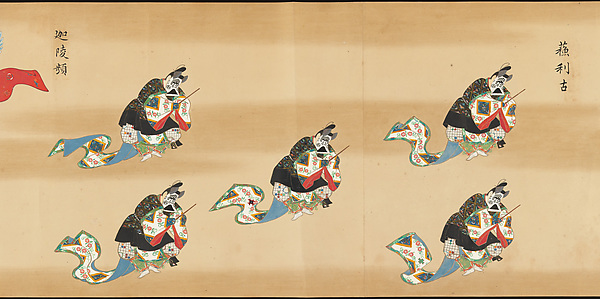
Japan, 17th century. Handscroll from set of two; ink, color, and gold on paper. The Metropolitan Museum of Art, accession 57.52.1.
Look closer: A dance called Soriko, as recorded on a seventeenth-century handscroll.
Japan, Bugaku Imperial Court Dance, 17th century. The Metropolitan Museum of Art, Seymour Fund, 1957, accession 57.52.1. Public domain (Met Open Access, CC0). Museum record
How Asia arrived in the palace
The term gagaku originated in Japan in the year 701, when the Gagaku-ryo, a government bureau overseeing music education and performance at the Imperial Court, was established. The word comes from the Chinese yayue, originally Confucian ritual music, though by the time it reached Japan its meaning had changed to popular and foreign music. The prototype was introduced with Buddhism from China. In 589 Japanese delegations were sent to the Sui court to learn Chinese culture, including court music, and by the seventh century the thirteen-stringed zither and a short-necked lute had arrived. The importation peaked during the Tang dynasty.
The present composition was established by the Meiji period.
Diagram by Japonista.
Korean music was recorded as early as 453, from the kingdom of Goguryeo, and in 736 music from India and Vietnam was introduced. In the Heian period these foreign styles fused with native Shinto music and the songs born in Japan. The foreign repertoire was sorted into the music of the left (togaku), from China, Vietnam and India, and of the right (komagaku), from Korea and Manchuria. A diagram is below.
Its fortunes tracked the court's. Popularity peaked between the ninth and tenth centuries; it declined with the Kamakura military government and was played by hereditary guilds based in Osaka, Nara and Kyoto. After the Onin War of 1467 to 1477, ensembles ceased to perform in Kyoto for about a hundred years. The Tokugawa shogunate revived and reorganised the court ensembles, the direct ancestors of today's, and after the Meiji Restoration musicians of the three guilds moved to the capital, their descendants forming most of the current Music Department.
Winds, drums and strings
The connoisseur's eyeBy the Meiji Restoration the ensemble that exists now had been fixed: three wind instruments, the hichiriki (an oboe), the ryuteki (a transverse flute) and the sho, a bamboo mouth organ that provides harmony; three percussion instruments, the kakko (a small drum), the shoko (a small gong) and either a taiko or a large drum; and two strings, the biwa and the so. Each piece is based on a main melody that every instrument embellishes.
| Instrument | Japanese | Type | Role |
|---|---|---|---|
| Sho | 笙 | Mouth organ of bamboo pipes | Sustained harmony |
| Hichiriki | 篳篥 | Double-reed oboe | The principal melody |
| Ryuteki | 龍笛 | Transverse flute, 'dragon flute' | Used in togaku, the left repertoire |
| Kakko | 鞨鼓 | Small hourglass drum | Struck with two wooden sticks |
| Shoko | 鉦鼓 | Small gong | Struck with two horn beaters |
| Gaku biwa | 楽琵琶 | Four-stringed lute | Plucked accompaniment (kangen) |
| Gakuso | 楽箏 | Thirteen-string zither | Plucked accompaniment (kangen) |
Gagaku is performed in three ways: as kangen, concert music for winds, strings and percussion; as bugaku, dance music, for which the strings are omitted; and as kayo, singing and chanting of poetry to instrumental accompaniment. Some instruments, such as the panpipes (haisho), the five-stringed biwa and the harp (kugo), left the ensemble in the Heian period and were reconstructed in the Showa era from old documents and the remains of instruments in the Shosoin.

Japanese, 19th century. Bamboo wood, metal. The Metropolitan Museum of Art, accession 89.4.2957.
Look closer: A bundle of bamboo pipes set in a wind chest: the sho provides the ensemble's harmony.
Japanese, Shō, 19th century. The Metropolitan Museum of Art, The Crosby Brown Collection of Musical Instruments, 1889, accession 89.4.2957. Public domain (Met Open Access, CC0). Museum record

Japanese, 19th century. Wood, bamboo. The Metropolitan Museum of Art, accession 89.4.104.
Look closer: A reed pipe, the oboe of the ensemble.
Japanese, Hichiriki (篳篥), 19th century. The Metropolitan Museum of Art, The Crosby Brown Collection of Musical Instruments, 1889, accession 89.4.104. Public domain (Met Open Access, CC0). Museum record
Bugaku: a square of boards and a mask
The deep endBugaku is dance performed to gagaku for more than twelve hundred years, mostly in the imperial court and known only to the nobility until it was opened to the public after the Second World War. It toured abroad in 1959. The movements are slow, precise and regal, and the music and dance pattern is repeated several times. It is danced on a square platform, usually about six yards on a side, in costumes that usually include masks.
Some dances depict legendary battles, others encounters with divine personages or mythical beasts such as the phoenix; one famous piece shows two dragons at play. The dancers are told, by an ancient instruction manual, to move like a tree swaying in a cool breeze. Its origins in myth are the dance of the goddess Ame-no-uzume at the cave of Amaterasu, and the dance-drama traditions that came with Buddhism in the seventh century. In 1955 the Japanese government recognised gagaku and bugaku as important national treasures.
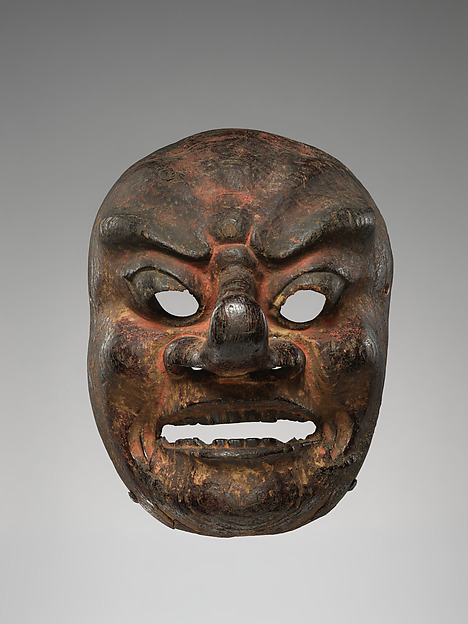
Japan, 12th century. Wood with remains of red and black pigments. The Metropolitan Museum of Art, accession 1975.268.162.
Look closer: Wood with remains of red and black pigment, twelfth century: the face has been worn by time as well as by dancers.
Japan, Bugaku Mask (Sanju), 12th century. The Metropolitan Museum of Art, The Harry G. C. Packard Collection of Asian Art, Gift of Harry G. C. Packard, and Purchase, Fletcher, Rogers, Harris Brisbane Dick, and Louis V. Bell Funds, Joseph Pulitzer Bequest, and The Annenberg Fund Inc. Gift, 1975, accession 1975.268.162. Public domain (Met Open Access, CC0). Museum record
Bugaku masks are larger and more fantastical than Noh masks, and the earliest ritual Noh masks are linked to them. The Met holds a wooden mask of the Sanju type made in the twelfth century, and a hinoki mask from the sixteenth, both of which should be set beside the masks in Noh masks and costume.

Japan, 1535–1538. Hinoki wood. The Metropolitan Museum of Art, accession 25.215.101.
Look closer: Compare this mask with a Noh mask: a bugaku mask is larger and more fantastical.
Japan, Bugaku Mask, 1535–1538. The Metropolitan Museum of Art, Fletcher Fund, 1925, accession 25.215.101. Public domain (Met Open Access, CC0). Museum record
Listening now, and the neighbours
Since the 1960s composers have written new pieces for gagaku instruments, a subgenre called reigaku; Toru Takemitsu is among those who wrote for them, and ensembles such as Reigakusha perform contemporary works. The celestial musicians and dancers, gakuten and bugakuten, have their own Musical Celestials module in the Buddhism and Zen almanac, and the goddess Benzaiten, long associated with music, is met there too.
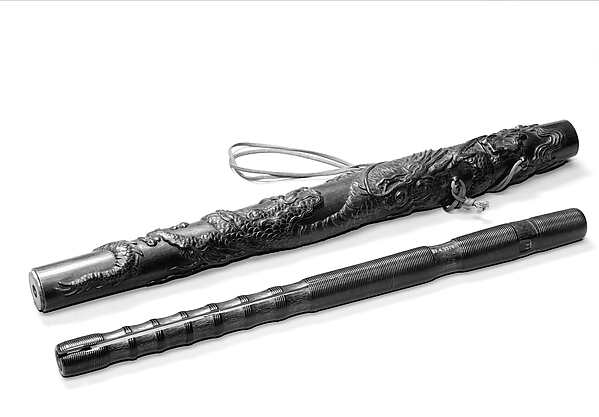
Japanese, 19th century. Bamboo, various woods. The Metropolitan Museum of Art, accession 07.222.1.
Look closer: A transverse flute of bamboo; its name means dragon flute.
Japanese, Ryuteki (龍笛 "dragon flute"), 19th century. The Metropolitan Museum of Art, The Crosby Brown Collection of Musical Instruments, 1889, accession 07.222.1. Public domain (Met Open Access, CC0). Museum record
The idea of jo-ha-kyu, beginning, breaking and rushing, began in gagaku to describe a gradually quickening tempo and migrated to Noh, tea ceremony, poetry and flower arrangement. For that reason the Noh chapter and the Tea almanac both lead back here.
Answered plainly
What is gagaku?
Japan's court music, whose name means elegant music. UNESCO calls it the oldest of the Japanese traditional performing arts, and it is kept by the Imperial Household Agency Music Department.
What is the difference between gagaku and bugaku?
Gagaku is the music. Bugaku is the dance that gagaku accompanies, usually without strings.
Which instruments are used?
Three winds (hichiriki, ryuteki, sho), three percussion (kakko, shoko and a taiko or large drum) and two strings (the biwa and the so).
What do left and right mean?
Togaku, the music of the left, came from China, Vietnam and India. Komagaku, the music of the right, came from Korea and Manchuria.
Can the public see bugaku?
Yes. After the Second World War the dance was opened to the public and toured abroad in 1959. Check the Imperial Household and theatre calendars for performances.
Where next
Sources and image credits
Image credits, in order of appearance:
- Japan, Bugaku Imperial Court Dance, 17th century. The Metropolitan Museum of Art, Seymour Fund, 1957, accession 57.52.1. Public domain (Met Open Access, CC0). Museum record
- Japanese, Shō, 19th century. The Metropolitan Museum of Art, The Crosby Brown Collection of Musical Instruments, 1889, accession 89.4.2957. Public domain (Met Open Access, CC0). Museum record
- Japanese, Hichiriki (篳篥), 19th century. The Metropolitan Museum of Art, The Crosby Brown Collection of Musical Instruments, 1889, accession 89.4.104. Public domain (Met Open Access, CC0). Museum record
- Japan, Bugaku Mask (Sanju), 12th century. The Metropolitan Museum of Art, The Harry G. C. Packard Collection of Asian Art, Gift of Harry G. C. Packard, and Purchase, Fletcher, Rogers, Harris Brisbane Dick, and Louis V. Bell Funds, Joseph Pulitzer Bequest, and The Annenberg Fund Inc. Gift, 1975, accession 1975.268.162. Public domain (Met Open Access, CC0). Museum record
- Japan, Bugaku Mask, 1535–1538. The Metropolitan Museum of Art, Fletcher Fund, 1925, accession 25.215.101. Public domain (Met Open Access, CC0). Museum record
- Japanese, Ryuteki (龍笛 "dragon flute"), 19th century. The Metropolitan Museum of Art, The Crosby Brown Collection of Musical Instruments, 1889, accession 07.222.1. Public domain (Met Open Access, CC0). Museum record
Last reviewed 28 October 2026. Pictures are public-domain or openly licensed and credited beneath each one; diagrams are drawn by Japonista.
Court instruments and bugaku masks are among the rarest objects of the stage. If you are looking for one, tell us and we will search.
Private concierge
Looking for something in particular?
Describe the piece or the project you have in mind. A senior advisor in Tokyo reads every case file personally and replies within two business days, with fees set out in writing before any work begins.