
Hiten and Tennyo: Celestial Beings
Flying Heavenly Beings
Hiten and Tennyo
飛天・天女
The apsaras who fly over the Buddha's paradise with flowers, incense and music, and the feather-robed celestial maidens who came down to earth in a Noh play.
Identity card
Know the figure at a glance
- Flowers. In Buddhist art the hiten fly over the Buddha's pure land and honour him by scattering flowers (JAANUS).
- Music. They play musical instruments, a type JAANUS calls gakuten; Wikipedia lists the biwa and the flute.
- Incense. They also burn incense in honour of the Buddha (JAANUS).
- Feather robe. The feathered robe called tenne or hagoromo lets a tennin fly; in some legends one who loses it cannot return to heaven (Wikipedia).
- Scarves. Wikipedia describes jewellery and feathered scarves, and lotus blossoms in the hand.
- Clouds. The Byōdō-in bodhisattvas sit or float on clouds, each doing something different (Mark Schumacher, tourism database).
Heavenly figures who fly
The Japan Architecture and Art Net Users System (JAANUS) defines hiten as heavenly beings, rendered in English as flying apsaras, who are invisible to the human eye and believed to fly with superhuman power and speed. It notes that they appear in Middle Eastern, Indian, Chinese and Japanese art. In Buddhist art they fly over the Buddha's pure land and honour him by scattering flowers, playing musical instruments, a variety called gakuten, or burning incense.
Wikipedia's article on the tennin places the hiten in a larger family, with Tenshi, Tennotsukai and the female Tennyo. It traces the whole group to the Hindu apsara, a female spirit of clouds and waters who later became a nymph or fairy, and says the figure reached Japan through Chinese Buddhism, itself shaped by Indian Buddhism and Chinese Daoism. Art usually shows them as unnaturally beautiful women, bare-breasted or in coloured robes, with jewellery and feathered scarves, often carrying lotus blossoms or playing the biwa or flute. Wings, the article says, appear only rarely.
The Wikipedia article on the apsara supplies the Sanskrit background. The stem is apsaras, which Monier-Williams, it says, traces to ap, water, and a root meaning to go, so that the word suggests beings who move in or between the waters of the clouds. The earliest descriptions present them as water-nymph-like beings. The Rigveda names one, Urvashi, and her dialogue with the mortal Pururavas in hymn 10.95 is the best-known early text. Later Hindu texts make apsaras attendants of Indra and dancers in his court beside the Gandharvas, and the Mahābhārata lists principal apsaras, among them Ghritachi, Menaka, Rambha, Tilottama, Urvashi and Swayamprabha, adding that thousands more exist.
The Tennin article adds the Japanese reading of the same family. It says that in Buddhism these beings are called devatās and are said to live in the Buddhist heaven as companions of Buddhas and bodhisattvas, and that they are also linked to trees, river bends and stones. Their power was believed to be held in amulets such as clothing or jewellery. In art they wear feathered, flowing scarves called tenne, 'wrapping raiment', or hagoromo, 'feathered raiment', which loosely wrap the body, and the usual five colours are traditional for their robes. The article does not say how a hiten differs from a tennin in a strict sense and lists hiten as a related term. This chapter follows JAANUS in using hiten for the flying figures of Buddhist art and tennyo for the heavenly maidens of story.
Urvashi, Menaka and the dancers of Indra
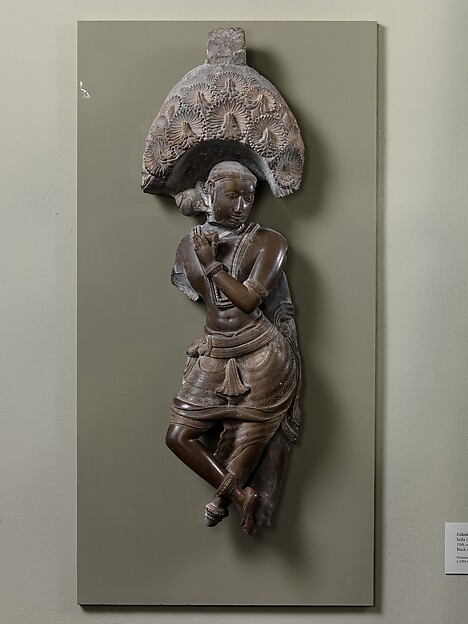
India (Karnataka, possibly Dharwar), 11th century. Slate; 103.5 cm. Metropolitan Museum of Art, 2008.537.
Look closer: Note the raised hand at the lips and the legs crossed in mid-air: the male counterpart of the apsara, a gandharva, flying with his music.
The Metropolitan Museum of Art, Gift of Florence and Herbert Irving, in honor of Philippe de Montebello, 2008. Open Access.
Before the Japanese maiden there was the Indian dancer. The apsaras of the Vedas are beings of the waters and clouds, and the Wikipedia article on the subject says the Rigveda mentions an apsara as the wife of a gandharva and hints that there is more than one. The only apsara named in the Rigveda, it says, is Urvashi, whose dialogue with her mortal lover Pururavas fills hymn 10.95. The Kauṣītaki Upaniṣad links apsaras with ointments, garlands, vestments and powdered aromatics.
The epics and Purāṇas give them a court. The Rāmāyaṇa and the Purāṇas tie their origin to the churning of the ocean, and later Hindu texts make them dancers in the court of Indra beside the gandharvas, the celestial musicians. A recurring plot, the article says, sends an apsara to break a sage's austerities: in the Ādi Parva of the Mahābhārata, sections 71 and 72, Indra sends Menaka to distract the sage Viśvāmitra, and their union produces Śakuntalā. Tilottama helps defeat the asura brothers Sunda and Upasunda, and Urvashi tries to seduce Arjuna. The Nāṭya Śāstra, the foundational text on drama, names a separate set, among them Manjukesi, Sukesi and Sumukhi.
The article makes two points that matter for the Japanese hall. First, it says that Indian texts gave most apsaras no individual physical features, so that artworks rarely individualise them; the hiten of Byōdō-in are anonymous in the same way. Second, it says apsaras are described as beautiful, youthful and able to change shape, and are often portrayed dancing. The Japanese heavenly maiden who loses her robe and cannot fly is a long way from this shape-changing dancer, and yet the dance remains the centre of her story.
The first winged figures at the stupa
Wikipedia says that in Gandhāran art apsaras first appear as winged beings who place garlands at a stupa, which was an early symbolic way of showing the Buddha. Later, it says, they crown the Buddha in a motif that resembles the Greek goddess Nike, and the article suggests that Nike's imagery shaped apsara iconography. It adds that this lineage developed into the Chinese feitian. The statement is a modest one, since the article gives no dates or sites for the Gandhāran examples, and this page does not add any. It is still a useful frame: the flying figure that drops flowers on the Buddha in Japan descends from a figure that once crowned him in the Greco-Buddhist world.
The same article notes that in Chinese Buddhist art the flying figures are called feitian and that they appear in the caves already named and on pagoda tiles. Wikipedia's separate page for the word feitian is only a disambiguation page, giving the term as the Chinese word for apsara, 'a flying deva of Hindu and Buddhist mythology'. Nothing in the sources read for this chapter explains how feitian was transmitted to Japan in detail, and the Japanese Tourism Agency's database, JAANUS and Wikipedia's Tennin article all assume the route through China without dating it.
From Central Asia to the Tang
The flying figure is far older than its Japanese form. The Metropolitan Museum has a stucco celestial figure from Xinjiang of the sixth or seventh century and a seventh-century Chinese earthenware relief of a Flying Celestial Apsara, called feitian in Chinese. Cleveland holds a Chinese dry-lacquer Dancing Apsaras of the late Tang or Five Dynasties period, in the tenth century. These are not Japanese works, but they show the road: a flying figure with streaming scarves, drawn first in the oasis cities and Chinese temples and later at Byōdō-in.
The Metropolitan Museum has a limestone fragment of the early sixth century, titled Flying celestial (apsara) fragment, 22.9 centimetres high and 37.5 centimetres long. Its record gives no description. The photograph shows a worn figure with a halo, drawn out sideways by a great sweep of scarf, which is the form the feitian kept for a thousand years. Wikipedia's article on the apsara names the places where such figures fly in Chinese caves: Mogao, Yulin, Tianlongshan, Yungang and Longmen, and on the tiles of the Xiuding-si pagoda. It says they play the flute, the pipa and the sheng and are often shown with long, billowing skirts.
Central Asia lay between India and China, and the Cleveland Museum of Art owns a rare embroidery from there, titled Celestial Musician, of the fourteenth century, 66.5 by 45 centimetres. The Museum says Central Asian embroideries of the period are exceedingly rare and that this goddess, standing on a lotus and playing a bowed lute, may be the personification of the sense of hearing, since in Buddhism the five senses were represented as female deities, each of a different colour, and here the colour is blue. It reads the style of the hair, the crown, the ruffled hem, the scrolling scarves and the rainbow halo with rays as Central Asian, and says the figure was originally part of a large hanging. It is a reminder that a celestial musician is not always an apsara in the Indian sense; the same flying scarf can carry several meanings.
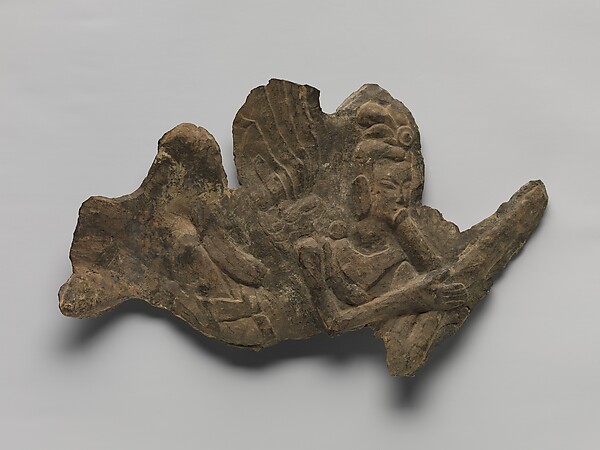
China, early 6th century. Limestone; 22.9 cm. Metropolitan Museum of Art, 46.53.
Look closer: Note the sweep of the scarf behind the figure and the halo at the head: a flying celestial of the early sixth century, long before Byodo-in.
The Metropolitan Museum of Art, Rogers Fund, 1946. Open Access.
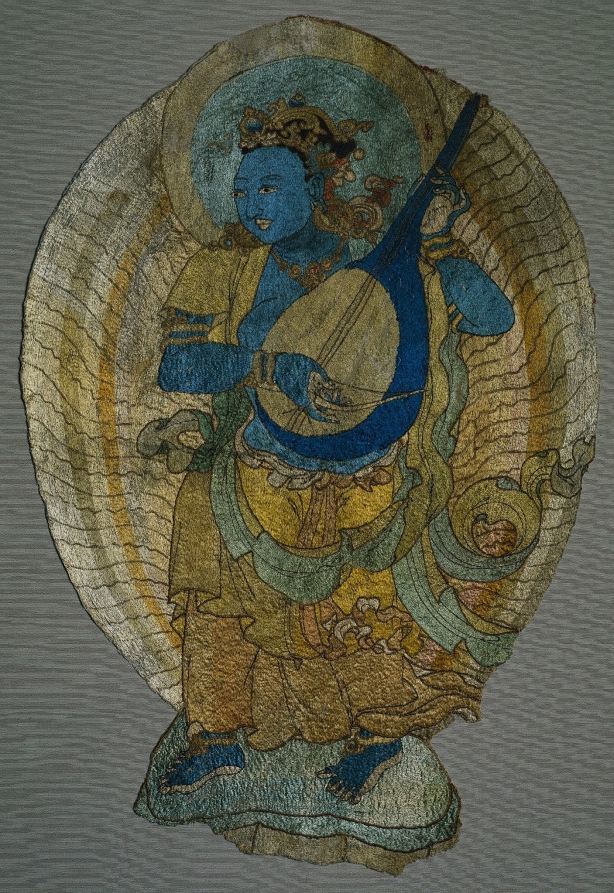
Central Asia, 1300s. Silk and gold thread over two layers of cotton, embroidery; 66.5 x 45 cm. Cleveland Museum of Art, 1987.145.
Look closer: Note the blue skin, the bowed lute and the rainbow halo with rays: a Central Asian celestial musician that the Cleveland Museum reads as the sense of hearing.
Cleveland Museum of Art, John L. Severance Fund. Open Access (CC0).
Dancers on Angkor and Java
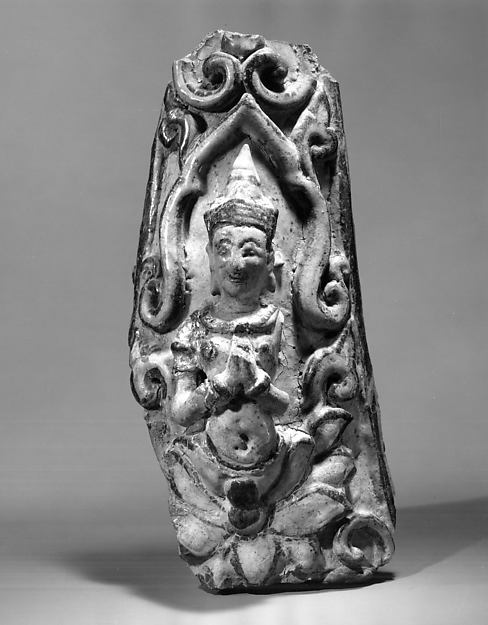
Thailand (Sukhothai), 14th–15th century. Glazed ceramic with traces of gilt; 23.5 cm. Metropolitan Museum of Art, 1979.503.
Look closer: Note the joined hands, the crown and the curling scrolls round the niche: a tile apsara from Sukhothai, made for a building.
The Metropolitan Museum of Art, Gift of Mark W. Phillips, 1979. Open Access.
In South-East Asia the apsara became the most visible woman in stone. Wikipedia says they are a major motif in the Angkorian bas-reliefs of Cambodia, dated to the eighth to thirteenth centuries, and that Khmer convention distinguishes apsaras, shown dancing or poised to dance, from devatās, who stand facing forward like guardians. Angkor Wat, built from 1113 to 1150, has more than 1,796 devatās in its inventory, which outnumber the apsaras, and the Bayon, built in the late twelfth to early thirteenth century, has about 6,250 dancing apsaras, often on lotus flowers. The Hall of Dancers at Ta Prohm has ninety-six pillars and lintels carved with rows of dancers. The mid-twentieth-century Apsara Dance of the Royal Ballet of Cambodia, created under Queen Sisowath Kossamak, drew its costumes and poses from these reliefs.
The Cleveland Museum of Art owns a frieze from the Bayon, late twelfth century, 25.4 by 87.6 centimetres. The Museum says the celestial dancers have their legs drawn up to show that they are flying in space. It places the Bayon as the main state temple of the Khmer empire under Jayavarman VII, who reigned from 1181 to 1218, and says the temple was conceived like a pantheon, with the central icon changed according to whether the temple was dedicated to the Buddha or to Shiva, which it calls a common occurrence in Cambodian religious practice. A bust from the Cham culture of Vietnam, in the same museum, shows the same figure in another kingdom: an Apsara Bracket of the tenth century, 55.9 by 53.3 centimetres, which the Museum describes as a resident of heaven, ornamented as a goddess with a tiered crown, heavy earrings and a broad necklace, who reverently offers possibly a lotus bud.
Wikipedia adds the Javanese record. The Kakawin Arjunawiwaha, written by Mpu Kanwa in 1030 under King Airlangga, tells how Indra sends apsaras to tempt Arjuna, and the Javanese and Balinese call them bidadari or hapsari. Borobudur, Mendut, Prambanan, Plaosan and Penataran all carry apsara carvings, and after the spread of Islam the word bidadari was linked to the houri of the Quran. The Tra Kieu style of Cham art, of the tenth and eleventh centuries, features apsaras too.
The Metropolitan Museum has two smaller pieces from the Thai world. A bronze finial of the twelfth century from Haripunjaya, 12.5 centimetres high, is titled Finial in the Form of an Apsara; the record gives no description, and in the photograph a crowned figure flies horizontally from a curved stem, with a lotus bud at each end. A glazed architectural tile from Sukhothai of the fourteenth to fifteenth century, 23.5 centimetres high, is titled Architectural Tile with Apsara; it too has no description, and the photograph shows a seated crowned figure with joined hands in a pointed niche of curling scrolls, on a lotus base. Neither is Japanese. They show that when the Japanese hall carved fifty-two clouds of heavenly beings, it joined a far wider habit of putting such beings on the architecture of paradise.

Cambodia, Angkor, the Bayon, reign of Jayavarman VII, late 1100s. Sandstone; 25.4 x 87.6 cm. Cleveland Museum of Art, 1938.433.
Look closer: Note the legs drawn up beneath each dancer: the Cleveland Museum says this is how Khmer sculptors show flight.
Cleveland Museum of Art, Purchase from the J. H. Wade Fund. Open Access (CC0).
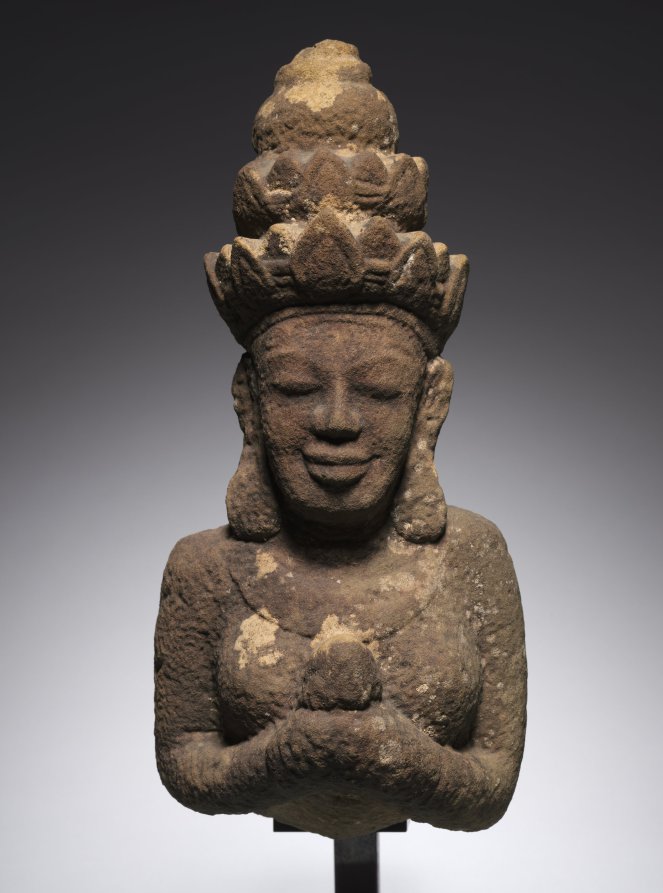
Vietnam (Champa), 900s. Sandstone; 55.9 x 53.3 cm. Cleveland Museum of Art, 1990.34.
Look closer: Note the tiered crown, the heavy earrings and the hands offering a small bud: a Cham apsara emerging from the end of a temple balustrade.
Cleveland Museum of Art, Gift of Robert H. Ellsworth, Ltd. Open Access (CC0).
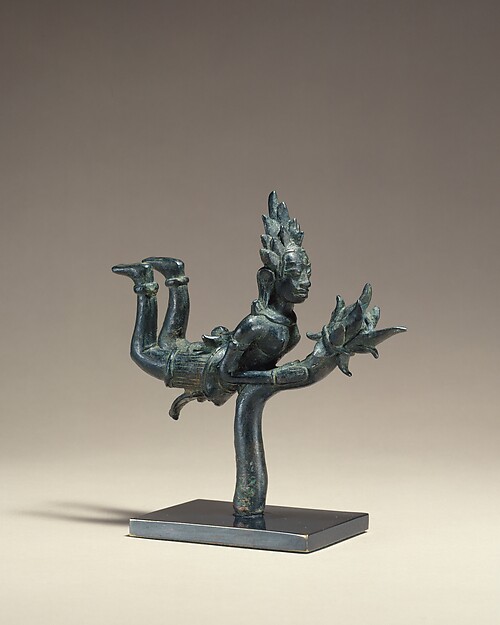
Thailand (Haripunjaya), ca. 12th century. Bronze; 12.5 cm. Metropolitan Museum of Art, 1987.218.23.
Look closer: Note the horizontal body and the lotus buds at each end of the stem: a flying apsara made as a finial in the Thai kingdoms.
The Metropolitan Museum of Art, Samuel Eilenberg Collection, Ex Coll.: Columbia University, Purchase, Mr. and Mrs. Uzi Zucker Gift and Rogers Fund, 1987. Open Access.
A halo carved with dancers
JAANUS describes the hiten kōhai, the flying-apsaras nimbus, as a halo surrounding the whole image, with a pointed peak that makes it a kind of boat-shaped halo. It is decorated with hiten who sing and dance in praise of the Buddha. The form came to Japan from the Northern Wei dynasty in China and was used on statues from the Asuka period. The Shaka Nyorai of 623 in the Kondō of Hōryūji is an early example, though its flying figures are now lost.
The celebrated surviving example is the Amida Nyorai of 1053 at Byōdō-in's Hōōdō in Kyoto, where the halo is carved in openwork. The Tourism Agency's database gives the hall's date as 1053 as well, and says the Amida is 2.77 metres tall, carved from Japanese cypress, covered in gold leaf and made by the sculptor Jōchō and his workshop in the joined-wood technique.
Fifty-two on the walls of the Phoenix Hall
The Hōōdō is built to stand for the Pure Land, and on its walls and beams around the Amida the database counts fifty-two bodhisattva statues, which it calls Worshipping Bodhisattvas on Clouds. They are carved from cypress, and the page says they are nearly a thousand years old. Twenty-eight of the fifty-two play instruments, flutes and cymbals among them, while others dance, press their hands in prayer, sit on lotus pedestals or appear under heavenly canopies. The bronze haloes were added later.
Mark Schumacher's Buddhist statuary site adds detail. It says twenty-six figures are on the north wall and twenty-six on the south, that Jōchō, who died in 1057, and his disciples are believed to have made them, and that they are thought to date from his last years. Early twelfth-century literature called them apsaras in flight. The same page says one figure was found outside the hall after the others were listed as National Treasures in 1904, that some bear ink characters with names from esoteric Buddhism, and that the original arrangement is unknown. It also lists earlier music-playing bosatsu at Kōfukuji and Tōdaiji.
The two sources disagree about where the figures now stand. The English text of the database says twenty-six originals and twenty-six replicas are in the hall, with the other twenty-six originals in the temple museum; the Japanese text seems to say the originals are in the museum with copies in the hall. Treat the exact count in the hall as something to confirm on a visit.
The English-language Wikipedia article on Byōdō-in gives the surrounding history and some figures that differ from the database. It says the site was built in 998 as a rural villa of Minamoto no Shigenobu, that Fujiwara no Michinaga bought it from Shigenobu's widow, and that his son Fujiwara no Yorimichi converted it into a temple in 1052. The Phoenix Hall, the Amida-dō, was completed in 1053 and is the only original building to survive the fire of 1336. It is named for its shape and for the pair of phoenix statues on its roof. The article also says that twenty-six praying Bodhisattvas on clouds are displayed in the Hōshōkan Museum, which opened in 2001, along with the temple bell, a National Treasure.
The Hall and the Amida were designated National Treasures in 1951, according to Wikipedia, and the temple was inscribed by UNESCO in December 1994 as part of the Historic Monuments of Ancient Kyoto. The Hall is shown on the ten-yen coin. Wikipedia gives the height of the Amida as about 2.4 to 3 metres depending on the measurement used, where the Tourism Agency's database says 2.77 metres. It adds that Jōchō used the yosegi, joined-wood technique, carving separate pieces hollowed from the inside and fitting them together. Schumacher says the fifty-two figures were listed as National Treasures in 1904, which is a different date from the 1951 designation of the Hall, and the two statements are about different objects.
Amida descends among the clouds
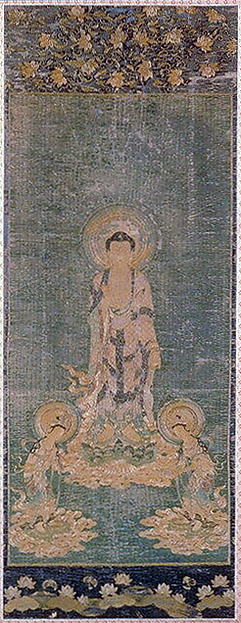
Japan, 13th century. Framed panel; embroidered silk and possibly human hair; 100.3 x 38.7 cm. Metropolitan Museum of Art, 12.37.166.
Look closer: Note the standing Buddha with a halo and the two kneeling attendants on lotus seats below: the welcome of the dying, worked in silk thread.
The Metropolitan Museum of Art, Rogers Fund, 1912. Open Access.
The cloud-borne bodhisattvas of the Phoenix Hall belong to a larger picture, the welcoming descent, raigō, in which Amida comes with attendants to receive the dying believer. The Tourism Agency's database calls the Byōdō-in doors and walls the earliest surviving raigō paintings in Japan, and the Wikipedia article on the temple calls the paintings on the doors an early example of Yamato-e, designated, like the other wall and door paintings of the central hall, National Treasures. The hiten who dance on the halo and the bodhisattvas who play on the cloud are the musicians of that arrival.
The Metropolitan Museum owns a Japanese raigō of the thirteenth century, titled Welcoming Descent of Amida, the Buddha of Limitless Light, with Bodhisattvas Kannon and Seishi. It is a framed panel of embroidered silk and possibly human hair, with an image 100.3 by 38.7 centimetres. The record gives no description. In the photograph a haloed standing Amida stands in the middle of a green ground, two kneeling bodhisattvas on lotus seats are below him, and a band of floral patterns closes the top. The embroidery is small, but it shows the pose that the great Hall puts into carved wood: the Buddha who arrives, his two attendants, and the clouds beneath them.
Hōryūji, Hōkaiji and the walls of paradise
JAANUS names two further sites for the hiten in wall painting: the Kondō of Hōryūji in Nara, a building it says was rebuilt in 693, and Hōkaiji in Kyoto, with paintings of the thirteenth or fourteenth century. The Byōdō-in doors and walls themselves carry the nine forms of Amida welcoming the dead, from the Amida Meditation Sutra, together with four-season landscapes, which the database calls the earliest surviving raigō paintings in Japan.
A feather robe and a fisherman
In Japan the tennyo is as much a figure of folk story as of scripture. Wikipedia explains that the feathered robe, called tenne or hagoromo, lets her fly, and that in some legends a tennin who loses it cannot return to heaven. In the Noh play Hagoromo a tennyo comes to earth and takes the robe off; a fisherman hides it to force her to marry him; years later she finds it and returns to heaven. The article places the story at Miho no Matsubara in Shizuoka and notes its likeness to Western swan-maiden legends.
The Metropolitan Museum holds a mid-nineteenth-century iron sword guard titled Pine Grove at Miho, shown in the gallery below. It shows Mount Fuji, a pine grove and a stream in inlaid metals and does not itself show the tennyo, so it is offered as the place of the story rather than an illustration of it.
A robe on a pine at Miho
The tennyo of Japanese story is a related figure, not the same one. Wikipedia's article on swan maidens notes that the Ōmi fudoki tells of a heavenly woman who loses her feather garment to a man and is forced to marry him, and that the Tango fudoki tells of a heavenly woman whose garment is hidden, so that she has no choice but to become the adoptive daughter of a childless couple. The Hagoromo play article says the earliest recorded version of the legend is the eighth-century Tango fudoki, and names a parallel tale in the fourteenth volume of the Sōushénjì, which it calls fifth-century. The swan-maiden article dates the Chinese record of the type to 'c. 300 or later', with its own question mark, and says Gan Bao, who died in 336, put it in his Sōushénjì, a work it calls fourth-century; the two articles do not agree on the century. It quotes the scholar Alan Miller calling it one of the most popular of all Japanese folktales.
The Noh play is a refined version. According to Wikipedia, the fisherman Hakuryō and his companions find the hagoromo hanging on a bough. The tennin demands its return because she cannot go back to heaven without it. He agrees to return it if she dances, and she accepts. The chorus explains the dance as symbolising the changing of the moon, and at the end she vanishes gradually, like a mountain slowly hidden in mist. The author is unknown, and the earliest references to the play date to 1524, which, the article says, suggests that it was written well after Zeami's time. It is a katsura-mono, a play of the third category, performed by all the schools, set in spring at night in the pine grove of Miho on Suruga Bay. The article says it combines two legends, one about the origin of the Suruga dance and one about an angel descending onto Udo Beach. It also records that W. B. Yeats's play At the Hawk's Well drew extensively on the legend.
Miho no Matsubara is a real place. Wikipedia says it lies on the Miho Peninsula in Shimizu Ward, Shizuoka, with a seashore of about seven kilometres lined with pines, and that a pine about 650 years old, the Hagoromo no Matsu, is said to be where the angel in the feather robe descended. The pine grove was added to the World Heritage List in 2013 as part of the Fujisan Cultural Site and had been designated a National Place of Scenic Beauty in 1922. On the second Saturday and Sunday of October Shizuoka holds a Hagoromo Festival with a Noh performance by firelight and dances in honour of Hélène Giuglaris, who lived from 1916 to 1951; the article does not say who she was, so neither does this page. The Metropolitan Museum's sword guard of the mid-nineteenth century, shown in the gallery, places Mount Fuji, a pine grove and a stream in inlaid metals and is offered as the setting, not as an illustration of the tennyo.
Hiten, tennyo or bodhisattva?
A figure with streaming scarves, flying over a Buddha or around a halo, scattering flowers or playing an instrument, is a hiten (JAANUS). A woman in a feather robe in a story, a Noh play or a netsuke, who has come down from heaven, is a tennyo (Wikipedia). The fifty-two figures of the Phoenix Hall are called Bodhisattvas on Clouds by the Tourism Agency's database, although Schumacher says that early twelfth-century literature called them apsaras in flight. Which name to use depends on the hall, not on the carving.
Wings are a poor test, since Wikipedia says wings appear only rarely, and the Cleveland Museum's Central Asian musician carries her scarves in a rainbow halo, not on wings. A better test is whether the figure is flying, making music or carrying flowers, and whether it is anonymous. The apsara of Indian texts is rarely individualised, and the hiten of Japanese halos are the same. A named figure, such as Benzaiten with her biwa, belongs to a different chapter.
Ten small facts
- Urvashi is the only apsara named in the Rigveda (Wikipedia, Apsara).
- The Bayon has about 6,250 dancing apsaras, and Angkor Wat has more than 1,796 devatās in its inventory (Wikipedia, Apsara).
- The Hall of Dancers at Ta Prohm has ninety-six pillars and lintels with dancers (Wikipedia, Apsara).
- The Phoenix Hall was completed in 1053 and is the only original building to survive the fire of 1336 (Wikipedia, Byōdō-in).
- Byōdō-in was inscribed by UNESCO in December 1994 (Wikipedia, Byōdō-in).
- The Hōshōkan Museum opened in 2001 and shows twenty-six of the Bodhisattvas on Clouds (Wikipedia, Byōdō-in).
- The Hagoromo no Matsu at Miho is said to be about 650 years old (Wikipedia, Miho no Matsubara).
- Miho no Matsubara was designated a National Place of Scenic Beauty in 1922 and added to the World Heritage List in 2013 (Wikipedia).
- The earliest references to the Noh play Hagoromo date to 1524 (Wikipedia, Hagoromo).
- The Kakawin Arjunawiwaha, written in 1030, has Indra send apsaras to tempt Arjuna (Wikipedia, Apsara).
Across Asia
The same weightless figure bears a different name in each country.
| Where | Form and name | What the record shows |
|---|---|---|
| India | Apsara | A female spirit of clouds and waters (Wikipedia). |
| China | Feitian 飛天 | Flying celestials in Central Asian stucco and Chinese relief and lacquer (Met, Cleveland). |
| Japan, Buddhist | Hiten 飛天 | Flying apsaras who scatter flowers, play music and burn incense (JAANUS). |
| Japan, popular | Tennyo 天女 | The celestial maiden of the Noh play Hagoromo (Wikipedia). |
| Japan, hall | Bodhisattvas on Clouds | Fifty-two statues at Byōdō-in (tourism database). |
| Cambodia | Apsara; devatā | Dancing apsaras and standing guardians in the Angkor reliefs (Wikipedia, Cleveland). |
| Java | Bidadari; hapsari | Apsaras in the Kakawin Arjunawiwaha of 1030 and on Borobudur and Prambanan (Wikipedia). |
| Central Asia | Celestial musician | A rare embroidered goddess that Cleveland reads as the sense of hearing. |
The air of paradise
The hiten and tennyo belong with the Heavenly Beings as the lightest members of the company: not rulers or guardians but attendants, who fill the sky around the Buddha with flowers and sound.
| Companion | Why they meet |
|---|---|
| Karyōbinga | The singing bird of the same paradise. |
| Benzaiten and Kishijōten | Two goddesses of the Heavenly Beings, each with a chapter of her own here. |
| Amida | The Buddha at the centre of the paradise they fly around (JAANUS). |
Where to see them
| Place | What to look for |
|---|---|
| Byōdō-in, Uji | The Hōōdō of 1053: Amida with an openwork flying-apsaras nimbus and the Bodhisattvas on Clouds (tourism database, JAANUS). |
| Hōryūji, Nara | Wall paintings in the Kondō (JAANUS). |
| Hōkaiji, Kyoto | Wall paintings of the thirteenth or fourteenth century (JAANUS). |
| Metropolitan Museum of Art, New York | A netsuke of a tennin, a sword guard of Miho, and Chinese and Central Asian flying celestials, in open access. |
| Cleveland Museum of Art | Chinese Dancing Apsaras in dry lacquer, in open access. |
| Hōshōkan Museum, Byōdō-in, Uji | Twenty-six of the Bodhisattvas on Clouds, and the temple bell (Wikipedia). |
| Miho no Matsubara, Shizuoka | The pine grove of the Hagoromo legend and the Hagoromo no Matsu (Wikipedia). |
| Angkor, Cambodia | Dancing apsaras at the Bayon and standing devatās at Angkor Wat (Wikipedia). |
Five flying figures

Japan, 19th century. Wood; H. 3.8 cm, W. 5.6 cm. Metropolitan Museum of Art, 10.211.2091.
Look closer: Note the calm face and the scarves that spiral round the body like a current of air.
The Metropolitan Museum of Art, Gift of Mrs. Russell Sage, 1910. Open Access.

Japan, mid-19th century. Iron, gold, silver-copper alloy (shibuichi), lead; H. 8.6 cm, W. 7.8 cm. Metropolitan Museum of Art, 91.1.766.
Look closer: Note the pierced snow-capped peak above the inlaid clouds and the single stream curving through the pines.
The Metropolitan Museum of Art, Edward C. Moore Collection, Bequest of Edward C. Moore, 1891. Open Access.
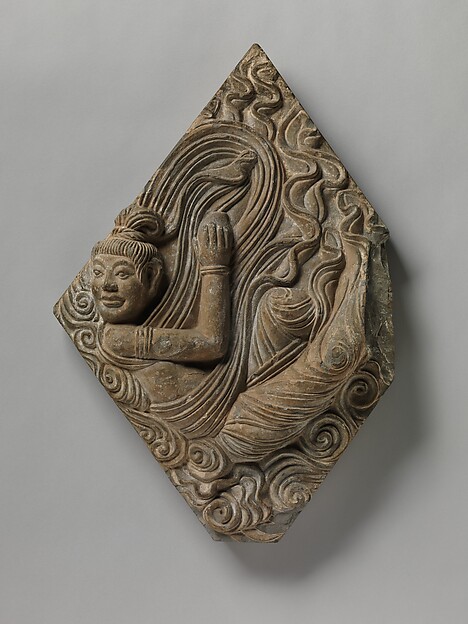
China, 7th century. Earthenware with traces of pigment; H. 67.9 cm, W. 42.5 cm. Metropolitan Museum of Art, 65.178.2.
Look closer: Note the long scarves swept back along the body and the clouds curling in the corners.
The Metropolitan Museum of Art, Purchase, Mrs. Vincent Astor Gift, 1965. Open Access.
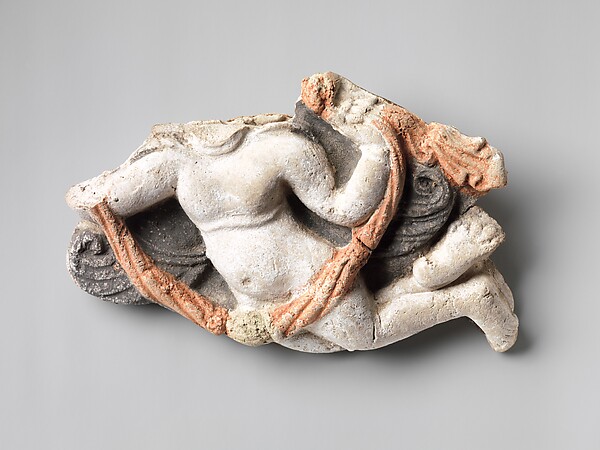
China (Xinjiang Autonomous Region), 6th-7th century. Stucco with color; 15.9 x 10.2 cm. Metropolitan Museum of Art, 30.32.14.
Look closer: Note the coral scarf that crosses the torso and the grey carved shape behind the figure.
The Metropolitan Museum of Art, Rogers Fund, 1930. Open Access.

China, late Tang dynasty (618-907) to Five Dynasties (907-960), 900s. Dry lacquer; overall H. 36.3 cm. Cleveland Museum of Art, 1953.356.
Look closer: Note the raised arm holding a blossom and the weight shifted onto one bent leg, as in a dance step.
Cleveland Museum of Art, John L. Severance Fund. CC0 (Cleveland Open Access).
At the desk
A netsuke, print or carving of a tennin appears below when we hold one. If none shows, the concierge desk can search for it.
A short glossary
- Hiten (飛天)
- 'Flying heaven': the flying apsaras of Buddhist art.
- Tennyo (天女)
- A heavenly maiden; the female form of tennin.
- Tennin (天人)
- A heavenly being, roughly an angel, in Japanese Buddhism.
- Apsara
- A Sanskrit water and cloud spirit, later a celestial dancer.
- Feitian (飛天)
- The Chinese name for the flying apsara.
- Gandharva
- A celestial musician of Indian tradition, male counterpart of the apsara.
- Devatā
- A divine being; at Angkor, a standing guardian figure distinct from the dancing apsara.
- Hagoromo (羽衣)
- The feathered robe that lets a tennyo fly.
- Tenne (纏衣)
- The wrapping scarf of a heavenly being.
- Raigō (来迎)
- The welcoming descent of Amida to receive the dying.
- Hōōdō (鳳凰堂)
- The Phoenix Hall of Byōdō-in.
- Yosegi (寄木)
- The joined-wood technique used by Jōchō.
- Katsura-mono (鬘物)
- A Noh play of the third category, about a woman.
- Gakuten (楽天)
- Heavenly beings who play musical instruments.
- Kōhai (光背)
- The halo or aureole behind an image.
Answered plainly
What is a hiten?
A flying apsara, a heavenly being who flies over the Buddha's paradise with flowers, music and incense (JAANUS).
What is a tennyo?
A celestial maiden; in the Noh play Hagoromo she loses her feather robe to a fisherman (Wikipedia).
Where do they come from?
From the Indian apsara, by way of Chinese Buddhism (Wikipedia).
Where is the best-known set?
The fifty-two Bodhisattvas on Clouds in the Hōōdō at Byōdō-in, Uji, from 1053 (tourism database).
Who made them?
Jōchō, who died in 1057, and his disciples are believed to have made them (Mark Schumacher).
Do they have wings?
Rarely; the feathered robe lets them fly (Wikipedia).
What is the difference between a hiten and a tennyo?
Hiten are the flying apsaras of Buddhist art; tennyo are heavenly maidens of story, such as the feather-robe maiden of the Noh play Hagoromo (JAANUS, Wikipedia).
Where do apsaras come from?
From Indian tradition, where the Rigveda names Urvashi and the epics make apsaras dancers in the court of Indra (Wikipedia).
How many figures are on the Phoenix Hall walls?
The Tourism Agency's database counts fifty-two Bodhisattvas on Clouds; Wikipedia says twenty-six are in the Hōshōkan Museum (Japan Tourism Agency, Wikipedia).
Where is the Hagoromo legend set?
At Miho no Matsubara in Shizuoka, where the Hagoromo no Matsu is said to be where the angel descended (Wikipedia).
When was the Phoenix Hall completed?
In 1053, according to Wikipedia and the Tourism Agency's database (Wikipedia, Japan Tourism Agency).
Where next
Sources and image credits
- JAANUS, Hiten 飛天 (Columbia University)
- JAANUS, Hiten kōhai 飛天光背 (Columbia University)
- Wikipedia, Tennin
- Japan Tourism Agency multilingual database, Art of Byodoin
- Japan Tourism Agency multilingual database, Bodhisattvas on Clouds (Japanese text)
- Mark Schumacher, Unchū Kuyō Bosatsu, Bosatsu on Clouds (Apsaras)
- Metropolitan Museum of Art, Netsuke of Tennin (Apsara) (10.211.2091)
- Metropolitan Museum of Art, Sword Guard (Tsuba) Depicting the Pine Grove at Miho (91.1.766)
- Metropolitan Museum of Art, Flying Celestial Apsara (Feitian) (65.178.2)
- Metropolitan Museum of Art, Flying Celestial Figure (30.32.14)
- Cleveland Museum of Art, Dancing Apsaras, 1953.356
- Wikipedia, Apsara
- Wikipedia, Hagoromo (play)
- Wikipedia, Byōdō-in
- Wikipedia, Miho no Matsubara
- Wikipedia, Swan maiden
- Metropolitan Museum of Art, Flying celestial (apsara) fragment (46.53)
- Cleveland Museum of Art, Celestial Musician (1987.145)
- Metropolitan Museum of Art, Celestial Musician (Gandharva) (2008.537)
- Cleveland Museum of Art, Frieze with Apsaras (1938.433)
- Cleveland Museum of Art, Apsara Bracket (1990.34)
- Metropolitan Museum of Art, Finial in the Form of an Apsara (1987.218.23)
- Metropolitan Museum of Art, Architectural Tile with Apsara (1979.503)
- Metropolitan Museum of Art, Welcoming Descent of Amida, the Buddha of Limitless Light, with Bodhisattvas Kannon and Seishi (12.37.166)
Last reviewed 28 October 2026. Pictures are public-domain or openly licensed, each credited beneath it. Diagrams on this page are drawn by Japonista.
Looking for a tennin netsuke, print or carving? Tell the concierge desk what you have in mind and we will search Japan for it.
Private concierge
Looking for something in particular?
Describe the piece or the project you have in mind. A senior advisor in Tokyo reads every case file personally and replies within two business days, with fees set out in writing before any work begins.