
Karyōbinga
The Bird of the Pure Land
Karyōbinga
迦陵頻伽
A bird with the head of a bodhisattva and a voice that preaches, named in the sutra of Amida's paradise and carried from temple ornaments into court dance and a Hokusai New Year card.
Identity card
Know the figure at a glance
- Bodhisattva head. JAANUS describes the head as that of a bodhisattva; Wikipedia calls it a human head.
- Winged body. The body is that of a bird, with wings (JAANUS).
- Phoenix tail. The tail resembles that of the hōō, the Japanese phoenix (JAANUS); Wikipedia says long and flowing.
- Instrument. It typically holds a musical instrument (JAANUS); Hokusai gives it a flute.
- Pure Land. Its home is the paradise of Amida, where its voice proclaims the Dharma (JAANUS, Epstein).
A bird with a bodhisattva's head
The Japan Architecture and Art Net Users System (JAANUS) gives the creature a modest origin: it was originally a sparrow-like bird living in the snowy mountains of the Himalayas, famed for a melodious voice. Later sutras moved it into gokuraku, the paradise of Amida Buddha, and art gave it its familiar shape: the head of a bodhisattva, the winged body of a bird and a tail like that of the hōō, the Japanese phoenix. It typically holds a musical instrument.
Wikipedia lists the name in many tongues: Sanskrit kalaviṅka, Pali karavika, Chinese Jiālíngpínqié, Japanese Karyōbinga, with Burmese, Thai, Khmer and Malay forms. In Japanese it is also called myōonchō and kōonchō, the exquisitely sounding and goodly sounding bird. The article adds that East Asian art often confuses it with the kinnara, which the scholar Edward H. Schafer, in 1963, called a distinct and unrelated creature. That confusion is worth knowing, because the kinnara is one of the eight classes of the Hachibushū.
Birds that preach the Dharma
The clearest textual source is the Amitabha Sutra, the short Sukhāvatīvyūha. In Ronald Epstein's English translation, based on Kumārajīva's Chinese version, the Buddha tells Śāriputra that in the Pure Land there are always rare and wonderful birds of many colours: white cranes, peacocks, parrots and egrets, kalavinkas and two-headed birds. Six times through day and night, the flocks sing harmonious and elegant sounds.
What they sing is the teaching. According to the same translation, their clear and joyful voices proclaim the five roots, the five powers, the seven factors of enlightenment and the eightfold path, and those who hear them become mindful of the Buddha. The Buddha adds a warning against a natural misreading: the birds are not born as the result of bad karma. Amida made them by transformation, wishing the sound of the Dharma to be widely heard. This is why the kalaviṅka became a figure of heaven rather than of the hunt: it is a sermon with wings.
On the temple's hanging garlands
The keman is a ritual ornament hung from the beam of the inner sanctuary in front of the enshrined Buddha. Wikipedia derives the word from the Sanskrit kusumamālā, a garland of flowers, and says the usual material is gilt bronze, cut in the shape of a round fan. Karyōbinga are among its common motifs, alongside scrolling foliage, the imaginary hōsōge flower, the lotus and the peony.
The best-known example is in the Golden Hall of Chūson-ji in Iwate. The Konjikidō was completed in 1124 and was the first structure in Japan to receive National Treasure status, according to Wikipedia, and its keman is itself a National Treasure. A pair of karyōbinga is carved there in openwork. One of them appeared on a 120-yen stamp issued on 1 November 1962. The Tokyo National Museum holds a twentieth-century copy, in forged, gilded and chased copper, of a twelfth-century original with karyōbinga. Wikipedia notes that a Tokugawa-period keman shows the creatures standing more upright and more human.
The Metropolitan Museum holds a thirteenth-century keman in gilt bronze and silver, shown in the gallery below. Its two birds face each other among openwork scrolls; the museum calls it a decorative pendant disk and does not call the birds karyōbinga, so the pairing here is the reader's to make.
Four children in wings
The kalaviṅka also became a dance. The Japanese Wiki Corpus article on Karyōbin says it is one of the eight old gagaku pieces called Rinyū hachigaku, in the Vietnamese tradition, that it probably came by way of China, and that it is now played in the ichikotsu mode, close to D major. Its title comes from the sacred bird, described there as having a human face and a bird's body with a beautiful voice.
It is danced by four children, or at shrines often by shrine maidens, and was used as entertainment but mainly played as bugaku at Buddhist events. The costume is detailed: plain white silk hakama, a long-tailed red gauze robe with a scattered small-bird pattern, copper or iron cymbals called dōbyōshi, leg guards, silk shoes, wings on the back, and a gilt crown with arabesques and two sprays of cherry blossom. In earlier times, the article says, children in these costumes rowed a boat at feasts. The Tokyo National Museum holds a nineteenth-century robe of this kind in embroidered red silk gauze with a long-tailed bird pattern.
The dance is half of a pair. Karyōbin forms a tsugaimai, a paired dance, with Kochō, the butterfly dance, which the article links to The Tale of Genji. The Metropolitan Museum's Kochō screen of the late sixteenth or early seventeenth century, shown below, has boats, musicians and winged dancers across a field of gold.
Ceilings, mandalas and a New Year card
JAANUS records the creature on low-relief pendant discs, on keman, printed on priests' robes and painted on ceiling and wall panels, and in the paradise paintings called jōdo hensō. The Cleveland Taima Mandala, a copy of the early fourteenth century after an eighth-century woven original, is such a painting: Cleveland says it shows Amida's Pure Land at the centre, the story of Queen Vaidehi on the left, the scenes she is given to visualise on the right, and the nine levels of birth below.
Wikipedia names further places: a painting by Hasegawa Tōhaku at Daitoku-ji's Kinmōkaku, ceilings at the Sanmon gates of Tōfuku-ji and Myōshin-ji, and a ceiling painting in the Mizusawa Kannon hall in Gunma.
The most vivid portrait is by Hokusai. The Metropolitan Museum's print Mystical Bird (Karyōbinga) is a surimono, a New Year's card, made between 1820 and 1833 in the period when he signed himself Iitsu. The museum's text says the creature has a bird's body and a human head and that one can never tire of listening to its heavenly music. The poems were inscribed by Nikyō and Kokusui, and the signature reads Hokusai aratame Iitsu, Hokusai changed to Iitsu.
Dunhuang, Xia and the royal barge
Wikipedia traces the figure across Asia. In China, murals show it with a human head and a bird's body, and Dunhuang murals show figures dancing and playing music. In the Yulin Cave 25 of the mid-Tang period a Bird of Life plays a panpipe and a pipa. Western Xia art, which belongs to 1038 to 1227, often features it, including glazed and grey pottery architectural ornaments, and a grey pottery sculpture from the Yuan capital Dadu survives without its head.
In Burma the karaweik is a common motif on traditional royal barges, and the Karaweik on Yangon's Kandawgyi Lake is an iconic reproduction of the royal barge. In Burmese art, the article says, it is shown as a bird and not with a human head.
Across Asia
The names change with each language; the singing bird of paradise stays.
| Where | Form and name | What the record shows |
|---|---|---|
| India | Kalaviṅka | A sparrow-like Himalayan bird known for its voice (JAANUS); a bird of the Pure Land in the Amitabha Sutra (Epstein). |
| China | Jiālíngpínqié 迦陵頻伽 | Murals at Dunhuang and Yulin Cave 25; Western Xia pottery ornaments (Wikipedia). |
| Japan | Karyōbinga 迦陵頻伽 | Keman, paradise paintings, ceilings and robes (JAANUS). |
| Japan, dance | Karyōbin 迦陵頻 | A gagaku dance for four children, paired with Kochō (Japanese Wiki Corpus). |
| Burma | Karaweik | A bird motif on royal barges, without the human head (Wikipedia). |
A voice among the heavens
The karyōbinga is not a deity and has no rank of its own. It sits with the Heavenly Beings as one of the creatures that fill the Pure Land and make its air sing.
| Companion | Why they meet |
|---|---|
| Hiten and Tennyo | The flying heavenly beings and celestial maidens who share the Pure Land and its music. |
| Kinnara | Often confused with the karyōbinga in East Asian art, though Schafer called it distinct (Wikipedia). |
| Amida | The Buddha of the paradise where the bird sings (JAANUS). |
Where to see it
| Place | What to look for |
|---|---|
| Chūson-ji, Iwate | The keman of the Golden Hall, completed in 1124, with a pair of karyōbinga in openwork (Wikipedia). |
| Tokyo National Museum | A copy of a twelfth-century karyōbinga keman and a nineteenth-century karyōbin dance robe (Cultural Japan). |
| Daitoku-ji, Kyoto | A painting by Hasegawa Tōhaku at the Kinmōkaku (Wikipedia). |
| Metropolitan Museum of Art, New York | Hokusai's Mystical Bird, a thirteenth-century keman and a Kochō screen, in open access. |
| Cleveland Museum of Art | A Taima Mandala of the early fourteenth century, in open access. |
Five views in two museums

Katsushika Hokusai, Japan, 1820-33. Woodblock print (surimono); ink and color on paper; 21.7 x 17.9 cm. Metropolitan Museum of Art, JP1868.
Look closer: Note the flute at her lips, the patterned feathers of the wings and the poems in the upper corner.
The Metropolitan Museum of Art, H. O. Havemeyer Collection, Bequest of Mrs. H. O. Havemeyer, 1929. Open Access.
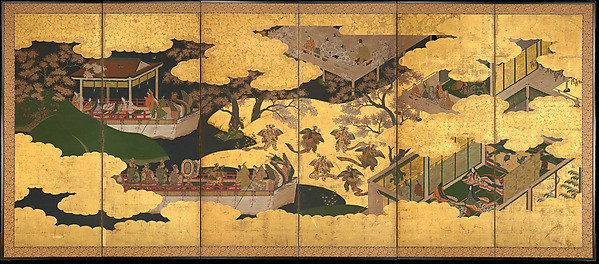
Tosa Mitsuyoshi, Japan, late 16th-early 17th century. Six-panel folding screen; ink, color, gold and gold leaf on paper; 165.1 x 367.7 cm. Metropolitan Museum of Art, 2015.300.32.
Look closer: Note the small winged dancers at the centre of the screen and the boat of musicians at the left edge.
The Metropolitan Museum of Art, Mary Griggs Burke Collection, Gift of the Mary and Jackson Burke Foundation, 2015. Open Access.

Japan, 13th century. Gilt bronze and silver; H. 27.9 cm, W. 38.7 cm. Metropolitan Museum of Art, 68.76.
Look closer: Note the two birds facing each other among the openwork flower scrolls, and the knotted cord at the centre.
The Metropolitan Museum of Art, Gift of John M. Crawford Jr., 1968. Open Access.

Japan, ca. 1665. Gilded bronze; H. 33 cm, W. 25.4 cm. Metropolitan Museum of Art, 25.215.60.
Look closer: Note the strings of tiny flowers and bells that hang below the pierced disk.
The Metropolitan Museum of Art, Fletcher Fund, 1925. Open Access.
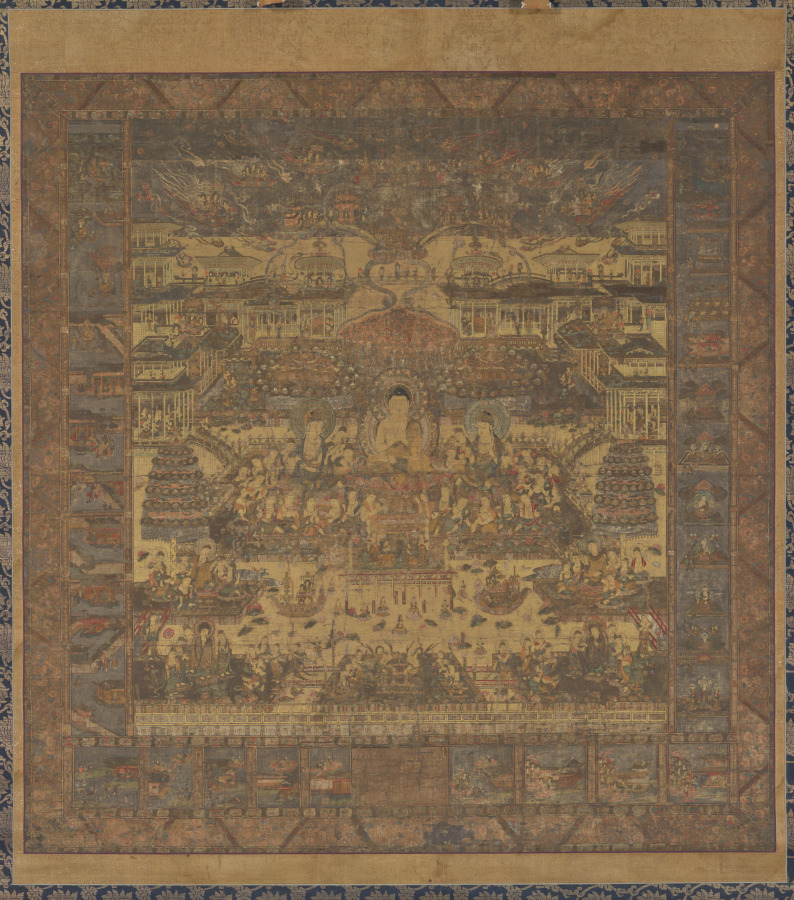
Japan, Kamakura period (1185-1333), early 1300s. Hanging scroll; ink, color and gold on silk; painting 135.6 x 140.3 cm. Cleveland Museum of Art, 1990.82.
Look closer: Note Amida at the centre, the lake with its boats and the narrow bands of story scenes along the left, right and bottom.
Cleveland Museum of Art, Severance and Greta Millikin Purchase Fund. CC0 (Cleveland Open Access).
At the desk
Pieces showing a karyōbinga, whether a keman, a print or a netsuke, appear below when we hold one. If none shows, the concierge desk can search for it.
Answered plainly
What is a karyōbinga?
A bird with a bodhisattva's head and a phoenix-like tail that lives in Amida's paradise (JAANUS).
Where does it appear in scripture?
Among the birds of the Pure Land in the Amitabha Sutra, in Epstein's translation of Kumārajīva's version.
What does it do?
Its voice proclaims the Dharma, and those who hear it become mindful of the Buddha (Epstein).
Where is the famous keman?
In the Golden Hall of Chūson-ji, completed in 1124 (Wikipedia).
Is there a dance?
Yes, Karyōbin, a gagaku dance for four children, paired with Kochō (Japanese Wiki Corpus).
Is it the same as a kinnara?
No, though East Asian art often confuses them (Wikipedia, citing Schafer).
Where next
Sources and image credits
- JAANUS, Karyōbinga 迦陵頻伽 (Columbia University)
- Wikipedia, Kalaviṅka
- Wikipedia, Keman
- Wikipedia, Chūson-ji
- The Amitabha Sutra, translated by Ronald Epstein
- Japanese Wiki Corpus, Karyobin
- Cultural Japan, Flower Garland with Kalaviṅka (Copy), Tokyo National Museum
- Cultural Japan, Karyōbin robe, Tokyo National Museum
- Metropolitan Museum of Art, Mystical Bird (Karyōbinga), JP1868
- Metropolitan Museum of Art, Butterflies (Kochō), 2015.300.32
- Metropolitan Museum of Art, Keman (Decorative Pendant Disk), 68.76
- Metropolitan Museum of Art, Keman, 25.215.60
- Cleveland Museum of Art, Taima Mandala, 1990.82
Last reviewed 28 October 2026. Pictures are public-domain or open-access, each credited beneath it. Diagrams on this page are drawn by Japonista.
Looking for a karyōbinga keman, print or netsuke? Tell the concierge desk what you have in mind and we will search Japan for it.
Private concierge
Looking for something in particular?
Describe the piece or the project you have in mind. A senior advisor in Tokyo reads every case file personally and replies within two business days, with fees set out in writing before any work begins.