
Taiko: The Drums of Japan
Sound you can feel
Taiko: The Drums of Japan
太鼓
A drum can be a signal, a prayer, an accompaniment or a concert hall in itself. Taiko is all four, and its history stretches from clay figures of the sixth century to the ensemble of Sado Island.
Fact sheet
At a glance
- Drum of many uses. Communication, war, theatre, ritual and concert.
- Three constructions. Nailed-head drums, rope-tensioned shime-daiko and hourglass tsuzumi.
- A modern art. Ensemble playing as concert music dates from 1951.
- A body art. Kata, the posture and movement, matters as much as sound.
From clay to concert hall
First lookIn Japanese, taiko can mean any drum. Outside Japan it names the family of Japanese drums called wadaiko and, more particularly, the style of ensemble drumming called kumi-daiko. The drum has a mythological origin: when the goddess Amaterasu hid in a cave, Ame-no-Uzume emptied a barrel of sake and danced upon it, and historians regard her performance as the mythical creation of taiko music.
The archaeology is older and plainer. Haniwa clay figures from Sawa District, Gunma Prefecture, dated to the sixth century in the late Kofun period, show a man with a barrel-shaped drum hung from his shoulder, struck with a stick at hip height, the oldest evidence of drumming in Japan. Historical accounts as early as 588 note young Japanese men travelling to Korea to study a drum that originated in south China, and court music from the continent brought drums of its own. Their functions across the centuries include communication, war, theatrical accompaniment, religious ceremony and concert performance.

Kodenji Hayashi, ca. 1873. Wood, metal, cloisonné, hide, silk, padding. The Metropolitan Museum of Art, accession 89.4.1236a–d.
Look closer: A great drum with cloisonne mounts, made by Kodenji Hayashi about 1873: ornament as well as sound.
Kodenji Hayashi, O-daiko, ca. 1873. The Metropolitan Museum of Art, The Crosby Brown Collection of Musical Instruments, 1889, accession 89.4.1236a–d. Public domain (Met Open Access, CC0). Museum record
Drums in war, on stage and at the shrine
The connoisseur's eyeIn feudal Japan taiko motivated troops, called out orders and set a marching pace, and during the Warring States period particular drum calls signalled advance and retreat. Chronicles record patterns such as nine sets of five beats to summon an ally. In theatre, the drums supply rhythm, atmosphere and sometimes decoration. In kabuki a large o-daiko is played offstage to set the mood; in Noh the hayashi uses the ko-tsuzumi, o-tsuzumi and sometimes a stick drum, the taiko, whose Komparu school has 65 basic patterns and 25 special ones. The tsuzumi cords have a code of colour: orange and red for amateurs, light blue for experts and lilac for masters.
After the construction-based classification: nailed-head, rope-tensioned, hourglass and racket drums.
Diagram by Japonista.
Taiko are used in the ensemble of gagaku, where the kakko is the lead instrument and the dadaiko, the largest drum, stands on a tall pedestal with a rim painted with flames. They are central to local festivals and religious ritual, including the Bon festival, where drums on a tower adorned with red and white cloth set the rhythm for circling dancers.

Nambuya Keikichi, Tokyo, Asakuja, Kamejima-cho, 19th century. Wood, hide, metal. The Metropolitan Museum of Art, accession 89.4.92.
Look closer: A nineteenth-century drum by the Tokyo maker Nambuya Keikichi.
Nambuya Keikichi, Tokyo, Asakuja, Kamejima-cho, Taiko, 19th century. The Metropolitan Museum of Art, The Crosby Brown Collection of Musical Instruments, 1889, accession 89.4.92. Public domain (Met Open Access, CC0). Museum record
| Drum | Japanese | Where you meet it |
|---|---|---|
| O-daiko | 大太鼓 | Festivals, concerts and kabuki offstage; some are too large to move |
| Chu-daiko | 中太鼓 | A medium nagado-daiko in ensembles |
| Shime-daiko | 締め太鼓 | Small, tunable, rope-tensioned: ensembles and theatre |
| Nagauta shime-daiko | 長唄締め太鼓 | Kabuki and Noh; thin heads with a deerskin patch |
| Kakko and dadaiko | 鞨鼓, 鼉太鼓 | Gagaku, the court ensemble |
| Uchiwa-daiko | 団扇太鼓 | A handheld racket drum, one skin, no sound box |
Zelkova, cowhide and patience
The deep endMaking a drum is slow. The body of a byo-uchi-daiko was traditionally carved from the trunk of a Japanese zelkova (keyaki), dried for years with techniques to prevent splitting, then roughed out by a master carpenter with a chisel; the texture of the carved wood softens the tone. The preferred skin is cowhide, usually from Holstein cows aged about three or four years, with bull hide preferred for larger drums. The hair is removed by soaking the hide in a river or stream for about a month, winter being best. Preparing both body and skin can take several years.
Two makers are named in the standard reference: Miyamoto Unosuke Shoten in Tokyo, which has been making taiko since 1861 and made drums exclusively for the Emperor, and the Asano Taiko Corporation, which has produced drums for more than four hundred years from its origins in Matto, Ishikawa, first for Noh theatre. A byo-uchi-daiko cannot be tuned; a shime-daiko can, by tightening its ropes.
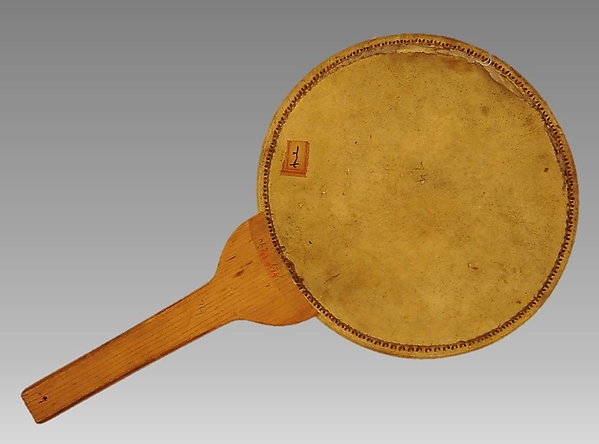
Japanese, 19th century. Wood, metal. The Metropolitan Museum of Art, accession 89.4.74.
Look closer: The uchiwa-daiko has a single skin and no sound box: one hand holds the handle while the other plays.
Japanese, Uchiwa Daiko, 19th century. The Metropolitan Museum of Art, The Crosby Brown Collection of Musical Instruments, 1889, accession 89.4.74. Public domain (Met Open Access, CC0). Museum record
Oguchi, Ondekoza and Kodo
Ensemble taiko, kumi-daiko, was developed in 1951 by Daihachi Oguchi, a jazz-trained musician in Nagano, whose ensemble Osuwa Daiko devised pieces for non-religious performance. Oedo Sukeroku Daiko, formed in Tokyo in 1959, is called the first group to tour professionally, and taiko became more visible internationally at the 1964 Summer Olympics in Tokyo. Den Tagayasu gathered young men to devote their lives to drumming and took them to Sado Island, where he and his family had settled in 1968, founding Ondekoza; the training included long-distance running.

Marho, 11 September 2016, 13:42:05. Wikimedia Commons.
Look closer: Taiko at a local festival, where the drum still serves its oldest purposes.
Marho, Taiko Festival Takanosu. Wikimedia Commons, CC BY-SA 4.0. Source file

Kodo, which made its debut at the Berliner Festspiele in 1981, grew from that lineage. In 1988 it moved to 13.2 hectares on the Ogi Peninsula and established Kodo Village, where sixty members live and work. It collaborates widely: the kabuki onnagata Bando Tamasaburo directed a first project with it in 2003 and collaborated on stage in 2006 in Amaterasu. In 2023 Kodo received the Commissioner for Cultural Affairs Award. Estimates of the number of taiko groups in Japan range from about 800 to as many as 5,000.
Answered plainly
What does taiko mean?
In Japanese it means any kind of drum. Outside Japan it names the Japanese drums called wadaiko and, particularly, ensemble drumming.
How old is taiko drumming?
Haniwa figures show drummers in the sixth century, the oldest evidence in Japan. Ensemble playing as concert music dates from 1951.
What are the drums made of?
Bodies of zelkova or other woods, sometimes even wine barrels; skins mostly of cowhide. Shime-daiko are rope- or bolt-tensioned over metal rings.
What is Kodo?
A drumming ensemble based at Kodo Village on Sado Island. It made its debut in Berlin in 1981 and tours internationally.
Is taiko in kabuki and Noh?
Yes. Noh uses ko-tsuzumi, o-tsuzumi and sometimes a stick drum; kabuki uses a large o-daiko offstage as well as nagauta shime-daiko.
Where next
Sources and image credits
- Taiko, Wikipedia
- Ondekoza, Wikipedia
- Kodo, History
- Kodo, Kodo Village and Sado Island
- Kodo, Frequently asked questions
- Noh, Wikipedia
- Gagaku, Wikipedia
- Metropolitan Museum of Art Open Access (images)
Image credits, in order of appearance:
- Kodenji Hayashi, O-daiko, ca. 1873. The Metropolitan Museum of Art, The Crosby Brown Collection of Musical Instruments, 1889, accession 89.4.1236a–d. Public domain (Met Open Access, CC0). Museum record
- Nambuya Keikichi, Tokyo, Asakuja, Kamejima-cho, Taiko, 19th century. The Metropolitan Museum of Art, The Crosby Brown Collection of Musical Instruments, 1889, accession 89.4.92. Public domain (Met Open Access, CC0). Museum record
- Japanese, Uchiwa Daiko, 19th century. The Metropolitan Museum of Art, The Crosby Brown Collection of Musical Instruments, 1889, accession 89.4.74. Public domain (Met Open Access, CC0). Museum record
- Marho, Taiko Festival Takanosu. Wikimedia Commons, CC BY-SA 4.0. Source file
Last reviewed 28 October 2026. Pictures are public-domain or openly licensed and credited beneath each one; diagrams are drawn by Japonista.
Drums, bachi and festival textiles are heavy and rare. If one has caught your attention, tell us what you have in mind.
Private concierge
Looking for something in particular?
Describe the piece or the project you have in mind. A senior advisor in Tokyo reads every case file personally and replies within two business days, with fees set out in writing before any work begins.