
Seasons and Occasions: What to Wear When
Reading · The kimono year
Seasons and Occasions: What to Wear When
衣替え
The kimono keeps a calendar of its own. A garment is lined, single or sheer according to the month, and its pictures are worn a little ahead of the flowers they show.
Fact sheet
The year in one glance
- Awase. Lined; October to May, the standard type.
- Hitoe. Unlined; June and September, a transition between seasons.
- Usumono. Sheer cloth for July and August; sha and ro.
- Yukata. Plain-weave cotton, a single layer for festivals and fireworks.
- Natural fibres. Linen, hemp, banana fibre and ramie; exclusively casual.
- Motifs. Worn before and during the season in which the subject appears.
Lined, single and sheer
The Okamoto Kimono column sets out the traditional schedule in three lines. Lined garments, awase, are worn from the first of October to the end of May; single-layer garments, hitoe, in June and again in September; and the thin garments, usumono, from the first of July to the end of August. The Motoji article agrees on the substance and describes awase as the most standard type, worn for about six months. Habutae, a thin white silk, lines the cloth, and a contrasting fabric called hakkake at the cuffs and hem shows slightly when the kimono is worn. The lining keeps the wearer warm and, as the Okamoto column notes, can be glimpsed when walking.

Unlined Summer Kimono (Hito-e) with Crickets, Grasshoppers, Cricket Cages, and Pampas Grass, early 20th century, Gauze-weave silk with paste-resist dyeing, hand-painted details, and gold thread. The Metropolitan Museum of Art, Gift of Abby Aldrich Rockefeller, 1937, accession 37.92.13.
Look closer: Look at the cages. The Met says the motif suggests early autumn evenings but is often used on summer kimono.
Image: The Metropolitan Museum of Art, Open Access (CC0)
Hitoe, according to Motoji, use the same materials as awase without the lining, and so are lighter; a half lining called ishiki-ate at the back from the waist down protects the back seam and reduces sheerness. They are worn in June and September as a transition between seasons. The Okamoto column adds that a hitoe is not see-through, so it suits days that are neither hot nor cold, and may be worn earlier or later if hot or cold weather persists. For the pairing of accessories it gives a rule: in June, a hitoe goes with a summer obi and accessories; in September, with the winter versions.
The thin garments are a separate world. Motoji describes natsumono or usumono as sheer and gauzy for breathability, which matters when summer temperatures exceed thirty-five degrees for long periods in high humidity. Sha is the more casual of the two weaves, and ro is more often used for formal summer kimono. Okamoto explains that both are translucent because of coarser thread density and better air permeability, that sha is woven with a karami weave, and that ro combines plain weave and karami weave. The Met's unlined summer kimono of the second half of the eighteenth century, in gauze-weave silk, and its other summer robes are the museum's best illustration; the fibre side of the story is told in Silk, Hemp, Cotton and Ramie: The Fibres of Japanese Dress.
Dates that bend
The calendar is a custom rather than a law, and the sources are open about it. The Openers magazine column states the traditional rule that people switch from lined to unlined kimono on the first of June and keep the unlined type until the end of September. It adds that warming has made strict adherence impractical: temperatures near thirty degrees in mid-May are not uncommon, and wearing summer clothes earlier is no longer frowned upon. The Okamoto column says in its own words that the rules are not absolute and have shifted over time, and Motoji notes that many people now start wearing hitoe as early as March and that summer kimono are also sometimes worn earlier.

Unlined Summer Kimono (Hito-e) with Carp, Water Lilies, and Morning Glories, ca. 1876, Resist-dyed, painted, and embroidered silk gauze with plain-weave patterning. The Metropolitan Museum of Art, Gift of Naoki Nomura, 2006, accession 2006.73.2.
Look closer: Look at the lower half. The Met describes a pond with carp and water lilies, and morning glories at the shoulders.
Image: The Metropolitan Museum of Art, Open Access (CC0)
Regions differ too. Motoji says the guidelines are recognised within the kimono canon but vary locally, since the north has longer winters and cooler summers while the south has extended heat; even in Tokyo the timing varies with the weather, though formal events such as weddings and ceremonies are generally expected to follow the canon. The practical problem is described by Openers: during the rainy season, humid but slightly chilly days occur, and once the summer wardrobe is out, bringing the lined kimono back is not feasible, so layering is the only solution. In July and August kimono are for midsummer, although summer fabrics are fine in June if it is hot, and cotton is the quintessential summer fabric, suited to festivals from spring to autumn.
Accessories lead. According to Motoji, the obi, outerwear and accessories typically change before the kimono itself; its examples for June are a man in a hitoe with a sha haori, and a woman in a hitoe with a ro obi. The Okamoto column describes the summer obi as worn from June to September with light summer kimono or hitoe, and rarely with awase, made from transparent woven fabrics such as sha, ro and ra, with hemp often used, while the winter obi is not transparent and is worn in the other three seasons. Summer versions of the obiage and obijime, the summer juban collar, the sandals and the tabi socks exist too. The pieces are described in Obi and Its Companions: Scarf, Cord and Brooch and Geta, Zōri and Tabi: The Footwear of the Kimono.
The yukata sits outside the calendar of weights. Motoji describes it as plain-weave cotton, worn as a single layer without a nagajuban, more casual, and common at summer festivals and fireworks. Okamoto records that it was originally called yukatabira, worn by Heian-period aristocrats after steam baths, adopted by commoners in the Edo period for use after public baths, still worn at hot-spring inns, and now regarded as a summer garment. The full story is told in Yukata: The Summer Cotton Robe.
Winter in a summer cloth
The motifs follow their own rule, and Motoji states it plainly. Seasonal flowers, fruits, plants and leaves are generally worn before and during the season in which they bloom, appear or can be seen, while abstract motifs are less tied to a specific season and can be worn year-round. The cleverest exception is the winter motif on a summer sheer: snow-covered plants and snowflakes appear on summer kimono to create a sense of coolness, as in a ro summer hōmongi with yūzen-dyed snow-covered banana leaves, suited to a dressy midsummer occasion. Common summer motifs, the article adds, include snow-covered plants, wind chimes, fans and swirling water.
The Met's summer robes show the rule in cloth. The early-twentieth-century unlined kimono with crickets, grasshoppers, cricket cages and pampas grass is gauze-weave silk with paste-resist dyeing, hand-painted details and gold thread, 165.1 by 127 centimetres. The label explains that insects prized for their chirping were kept in small cages, that this robe shows cages holding crickets, grasshoppers and suzumushi among pampas grass, that the motif suggests early autumn evenings but is often used on summer kimono, and that it was already popular in the early Edo period and appears in the pattern book On-hiinagata of 1667. Here is the principle at its simplest: the garment is worn in summer, and the picture is of the evening that comes after it.
A second Met robe, of about 1876, shows an early summer scene. In resist-dyed, painted and embroidered silk gauze with plain-weave patterning, it has a pond with carp and water lilies on the lower part and morning glories blooming at the shoulders, with goldfish subtly woven into the fabric. The label records an occasion as well as a season: the donor's grandmother, one of a family of four generations of female textile artists, wore it around 1876 at the age of thirteen for a jūsan-mairi temple visit to Hōrinji at Arashiyama, Kyoto, to receive blessings on entering adolescence. The kimono carries three family crests, one at the centre back and one on each sleeve, a count explained in Mon: The Family Crests on Japanese Dress.
A third robe, of the early twentieth century, adds rank to the season. The Met's summer kimono in silk gauze with paste-resist dyeing shows court carriages, pinks, bellflowers, pines, flying plovers and flowing water. The label explains that the court-carriage motif was long associated with the aristocracy, so only high-ranking women wore kimono with it, and that it alludes to the Tale of Genji. The picture can therefore be read three ways at once: for its flowers and water, for its season, and for the standing of the person entitled to wear it. The motifs themselves are collected in A Motif Dictionary: Crane, Pine, Wave and Chrysanthemum.
For occasions beyond the calendar, the rule from Motoji applies: formal events are generally expected to follow the canon. The garments for those events are described in The Kimono Ladder: Furisode, Tomesode, Hōmongi and Komon and Uchikake and Shiromuku: The Bridal Robes, and the clothes of childhood rites in Shichi-Go-San and the Clothes of Childhood Rites.
| Type | Months in the sources | Character |
|---|---|---|
| Awase | October to May | Lined; the standard type |
| Hitoe | June and September | Unlined; a transition between seasons |
| Usumono | July and August | Sheer; sha is casual, ro is also used for formal wear |
| Yukata | Summer | Single-layer cotton; festivals and fireworks |
| Natural fibres | Casual | Linen, hemp, banana fibre and ramie |
The reader's four checks
A reader looking at a garment can ask four questions. What weight is it: lined, single or sheer? What fibre is it: silk, cotton, or one of the natural fibres Motoji calls exclusively casual, though sometimes very expensive because of the labour involved? What month does the picture belong to, bearing in mind that the flower is worn ahead of its bloom? And what does the pairing of obi, collar and sandals say about the day? Each answer narrows the date and the occasion.
The Met's unlined summer kimono of the second half of the eighteenth century, discussed in Silk, Hemp, Cotton and Ramie: The Fibres of Japanese Dress, shows how a whole year can be folded into a single summer garment: spring flowers and wisteria at the hem, winter pine at the neckline and sleeves. A second Met kimono, of the early twentieth century, is a light brown figured crepe with woven diagonal fret patterns, hand-painted with lilies, bellflowers and pinks on the lower front panels in pastel white, light green, yellow and blue; the petal interiors are nearly translucent, so the fret shows through. Neither garment is loud. The calendar of the kimono is a calendar of restraint.
The shelf strip below shows pieces from the house, each described as what it is. The concierge desk can look for a garment suited to a particular month on request, and the care of each weight is the subject of How to Read, Grade and Care for a Japanese Garment. The chapter on Glossary of Japanese Dress and Textile Terms gathers the terms used here.
Summer robes at the Met
Unlined Summer Kimono (Hito-e) with Crickets, Grasshoppers, Cricket Cages, and Pampas Grass, early 20th century, Gauze-weave silk with paste-resist dyeing, hand-painted details, and gold thread. The Metropolitan Museum of Art, Gift of Abby Aldrich Rockefeller, 1937, accession 37.92.13.
Look closer: Look at the shimmer. The Met says variations in the ground colour and scattered gold thread give a shimmering quality.
Image: The Metropolitan Museum of Art, Open Access (CC0)
Unlined Summer Kimono (Hito-e) with Carp, Water Lilies, and Morning Glories, ca. 1876, Resist-dyed, painted, and embroidered silk gauze with plain-weave patterning. The Metropolitan Museum of Art, Gift of Naoki Nomura, 2006, accession 2006.73.2.
Look closer: Look at the crests. The Met records three family crests, one at the centre back and one on each sleeve.
Image: The Metropolitan Museum of Art, Open Access (CC0)
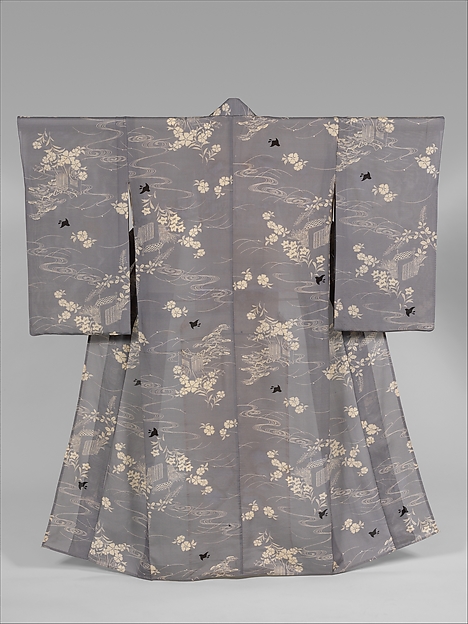
Summer Kimono with Design of Plovers, Waves, Chinese Bellflowers, Pinks, Pines, Carriages, and Fences, first quarter of the 20th century, Silk gauze; paste-resist dyeing. The Metropolitan Museum of Art, Gift of Sue Cassidy Clark, in memory of Terry Satsuki Milhaupt, 2013, accession 2013.510.1.
Look closer: Look at the carriages. The Met says the court carriage motif was long associated with the aristocracy and alludes to the Tale of Genji.
Image: The Metropolitan Museum of Art, Open Access (CC0)

Kimono with Design of Lilies, Chinese Bellflowers, and Pinks, second quarter of the 20th century, Figured crepe silk with woven diagonal fret pattern; hand-painted with gold accents, embroidered crest. The Metropolitan Museum of Art, Gift of Sue Cassidy Clark, in memory of Terry Satsuki Milhaupt, 2013, accession 2013.510.2.
Look closer: Look through the petals. The Met says the interiors are nearly translucent, so the woven fret pattern shows through.
Image: The Metropolitan Museum of Art, Open Access (CC0)
Through the year in the house
The shelf holds a basket bag made for kimono and yukata, an indigo patchwork piece, and two remade garments. Each is described as what it is, with its age and condition set out on its own page.
 Handmade kago basket bag with ukiyo-e design, for kimono and yukataView the piece
 Aizome indigo patchwork bomber with vintage kimono liningView the piece
 Furisode silk remake shirt, gosho-guruma and shibori bandsView the piece
 Kimono and obi remake bomber, gold brocade peony and chrysanthemumView the piece
Kimono and textile heritage
Kimono of every weight are gathered in one collection, and the concierge desk can look for a garment suited to a particular month on request.
Answered plainly
When are lined kimono worn?
Traditionally from October to May; awase are the standard type, according to the Okamoto and Motoji articles.
When are unlined kimono worn?
In June and September, as a transition between seasons.
What are sha and ro?
Translucent summer weaves for July and August; sha is more casual and ro is also used for formal summer kimono.
Why is snow shown on summer kimono?
Winter motifs such as snow-covered plants create a sense of coolness on a sheer summer cloth.
Do the dates ever change?
Yes. The sources say the rules are not absolute, vary by region and have shifted with warmer weather.
When are seasonal flowers worn?
Before and during the season in which they bloom; abstract motifs can be worn all year.
Where next
Sources and image credits
- Kimono seasonality, Motoji
- Kimono column, Okamoto Kimono
- The Season of Changing Clothes for Summer, and Kimono Q&A, Openers
- Unlined Summer Kimono (Hito-e) with Crickets, Grasshoppers, Cricket Cages, and Pampas Grass, Metropolitan Museum of Art, 37.92.13
- Unlined Summer Kimono (Hito-e) with Carp, Water Lilies, and Morning Glories, Metropolitan Museum of Art, 2006.73.2
- Summer Kimono with Design of Plovers, Waves, Chinese Bellflowers, Pinks, Pines, Carriages, and Fences, Metropolitan Museum of Art, 2013.510.1
- Kimono with Design of Lilies, Chinese Bellflowers, and Pinks, Metropolitan Museum of Art, 2013.510.2
Last reviewed 28 October 2026. Pictures, where shown, are public-domain or open-access and credited beneath each one.
Looking for a kimono of a particular weight, or a piece suited to a particular month? The concierge desk replies within one to three business days.
Private concierge
Looking for something in particular?
Describe the piece or the project you have in mind. A senior advisor in Tokyo reads every case file personally and replies within two business days, with fees set out in writing before any work begins.