
Obi and Its Companions: Scarf, Cord and Brooch
Accessories · The sash
Obi and Its Companions: Scarf, Cord and Brooch
帯
The obi began as a thin cord and became the largest single object in a woman’s dress. It is woven, folded, stiffened, tied and then adorned, and each stage has its own vocabulary.
Fact sheet
The sash in one glance
- Width. From about 8 cm in the Heian period to about 30 cm by 1800.
- Fukuro. Functionally the most formal obi worn today.
- Nagoya. The most-used obi now, developed in the late 1920s.
- Knot. The drum knot, said to date from 1823, is the usual one.
- Companions. Scarf, cord and brooch complete the front of the sash.
From a cord to a wall of silk
Wikipedia defines the obi as a sash worn with traditional Japanese clothing and with the uniforms of the Japanese martial arts, and says that obi are categorised by design, formality, material and use. Its history begins in the Heian period, when the obi was a simple thin sash, cord-like or ribbon-like, about 8 centimetres wide, and men’s and women’s were similar. Before the Edo period, the entry says, the kosode was fastened with a narrow sash at the hips.

Obi with Dragon and Phoenix, 19th century, Silk satin with supplementary weft patterning in silk and metallic threads. The Metropolitan Museum of Art, Gift of Phillip H. Rubin, 2006, accession 2006.572.5.
Look closer: Look for the peonies and chrysanthemums that fill the ground. The Met says the dragon is drawn in its usual Chinese setting of stylised mountain, wave and flaming-jewel motifs.
Image: The Metropolitan Museum of Art, Open Access (CC0)
The change came with the sleeve. In the early Edo period longer, wider sleeves led to wider obi, and by the 1680s women’s obi had doubled from their original width. In the 1730s a woman’s obi was about 25 centimetres wide, while a man’s, at its widest, was about 16. At the turn of the nineteenth century the women’s sash reached about 30 centimetres and needed separate ties to hold it. The entry adds that the sash was mostly tied at the back by the end of the seventeenth century, though the custom was not firmly established until the early twentieth.
Two Met objects mark the extremes of the weaver’s ambition. One is an obi of the nineteenth century in silk satin with supplementary weft patterning in silk and metallic threads, 416.6 centimetres long, showing a dragon and a phoenix against a ground of peonies and chrysanthemums, which the museum describes as mythical creatures of Chinese origin. The other is an obi of the early twentieth century, in the Meiji tradition, with waves in gold and silver metallic thread and white and greenish-blue silk, woven as a double cloth, a structure the museum calls very popular for obi in the Meiji period.
Types by width, length and weave
The Wikipedia entry sorts women’s obi by width and formality, and its table of types is worth keeping beside any catalogue description. The maru obi, about 30 to 35 centimetres wide and 360 to 450 long, is the most formal and now largely obsolete, worn only by brides and maiko. The fukuro obi, about 30 centimetres wide and of the same length range, is the most formal type worn today and has largely replaced the maru. The nagoya obi, about 30 centimetres wide and 315 to 345 long, is the most used obi today. The entry says it was developed by a seamstress in Nagoya in the late 1920s and popularised by Tokyo geisha.

Obi with Stylized Waves, early 20th century, Silk and metallic thread. The Metropolitan Museum of Art, Gift of Sue Cassidy Clark, in honor of Dr. Barbara Brennan Ford, 2005, accession 2005.171.
Look closer: Follow the waves across the width. The Met records gold and silver metallic thread with white and greenish-blue silk, woven in the double-cloth structure.
Image: The Metropolitan Museum of Art, Open Access (CC0)
Beneath those are the lighter types. The hanhaba obi is about 15 centimetres wide and 300 to 400 long, informal and easy to tie, and often worn with Yukata: The Summer Cotton Robe. The tenga obi is a more formal version at about 20 centimetres. The hitoe obi is a single-layer type stiff enough to need no lining, such as the Hakata weave. The kyōbukuro obi was invented in Nishijin, Kyoto, in the 1970s. The pre-tied tsuke obi, with ribbons holding the pieces in place, suits wearers who are unfamiliar with tying. The odori obi is made for dance performances and often carries large metallic designs, and the manaita obi, thickly padded and tied in front, was historically worn by oiran and is now worn by actors.
The men’s obi is narrower. The kaku obi is about 10 centimetres wide and 400 long and suits most occasions; the heko obi is a soft informal sash; and the sanjaku obi, named for its length of three old Japanese feet, about 37.9 centimetres, was popular in the Edo period. The entry notes that the men’s obi is worn below the stomach and tied in simple knots at the back, and requires none of the accessories that a woman’s needs.
Fabric follows the same hierarchy. The entry says that heavy brocade is worn for formal occasions and that silk is considered essential for a formal obi, with lighter silk for informal ones, and cotton, hemp and polyester also used. Nishijin-ori from Kyoto and Hakata-ori from Fukuoka are the prized specialist weaves, and some Nishijin obi cost up to a million yen. The weaving tradition is the subject of Nishijin: The Woven Brocades of Kyoto.
| Obi | Width and length | Use |
|---|---|---|
| Maru obi | 30–35 cm by 360–450 cm | Most formal; now brides and maiko |
| Fukuro obi | About 30 cm by 360–450 cm | Most formal worn today |
| Nagoya obi | About 30 cm by 315–345 cm | Most used today; late 1920s |
| Hanhaba obi | About 15 cm by 300–400 cm | Informal; often with yukata |
| Kaku obi (men) | About 10 cm by 400 cm | Main men’s obi for most occasions |
| Sakiori obi | Woven from strips of old cloth | Informal; valued for rural craft |
The drum knot and its helpers
Most women’s obi are too wide and stiff to hold the kimono closed, as the entry points out, and so ties called koshihimo are worn underneath. The sash itself is shaped by a set of small supports. The obi-ita is a stiffener inserted at the front for a flat appearance, and the obimakura is a small pillow that shapes the knot. On the outside, three accessories finish the front: the obi-age, a scarf-like cloth worn above the obi, often dyed with kanoko shibori, of which younger women show more; the obijime, a decorative cord of kumihimo about 150 centimetres long, usually woven silk with a tassel at each end; and the obidome, a small brooch fastened to the obijime. The entry notes that a maiko’s obidome is much larger.

Obi, Woven cotton scraps. The Metropolitan Museum of Art, Funds from various donors, 1981, accession 1981.411.1.
Look closer: Look at the surface. The Met gives the medium as woven cotton scraps, 284.5 by 15.9 centimetres, and its Japanese title names it a sakiori obi.
Image: The Metropolitan Museum of Art, Open Access (CC0)
The Met’s collection includes a piece described as a ‘Sash for Use Under Obi’, a nineteenth-century silk plain-weave crepe, a useful reminder that the visible sash is the last of several layers. It also holds a Taishō-period obi of woven cotton scraps, 284.5 centimetres long and about 16 wide, whose Japanese title names it as a sakiori obi. The entry on obi says that sakiori obi are woven from strips of old cloth and valued for rural craftsmanship, and the technique, which is also described in Noragi and the Clothes of Work, ties the sash to the clothes of work.
The knot is the other half of the obi’s story. The entry says that the taiko musubi, the drum knot, is the most common women’s knot today, suitable for most ages and occasions, and that it was created in Tokyo in 1823 by some geisha to celebrate the opening of the Taikobashi bridge. It needs an obimakura to hold its shape. A two-layer version, nijūdaiko musubi, is tied with a formal fukuro obi folded in two. The darari musubi is worn only by maiko, dancers and kabuki actors, with long tails that need an obi of up to six metres. The costume of the quarter is the subject of Geisha, Maiko and Oiran: The Costume of the Quarter.
Several practical points follow for a reader assessing an obi. Width and length identify the type, and the tables above give the ranges. How to Read, Grade and Care for a Japanese Garment sets out the grades, and Kasuri: Ikat Woven from Dyed Thread describes the patterned cloth that sometimes lines or accompanies a sash.
A cost larger than the kimono
A curious feature of obi is the way their price relates to the garment they accompany. The Wikipedia entry observes that second-hand obi are inexpensive but that new ones typically cost more than a kimono, and that some Nishijin-ori obi cost up to a million yen.
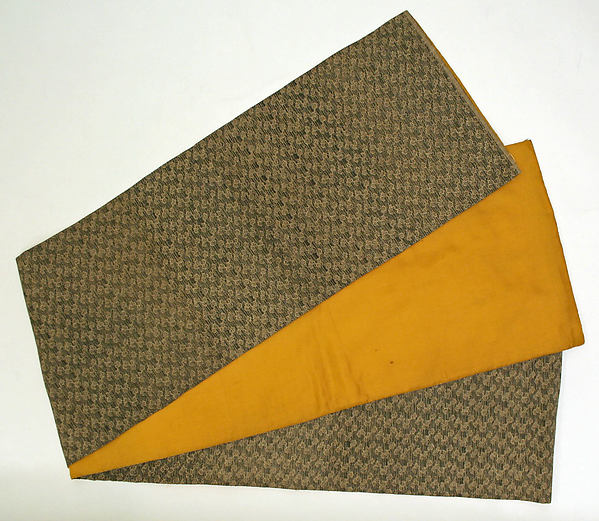
Obi, late 19th century, silk. The Metropolitan Museum of Art, Gift of Miss Irene Lewisohn and Mrs. Alice Lewisohn Crowley, 1946, accession C.I.46.9.190.
Look closer: Compare the proportions with the other two. This is a late-nineteenth-century silk obi, catalogued without further description by the Met.
Image: The Metropolitan Museum of Art, Open Access (CC0)
Two makers are named by the same entry. Tatsumura Textile, founded in the nineteenth century by Heizo Tatsumura I, is described as a centre of obi manufacture in Nishijin, and Kazuko Hattori, who founded the Kimono Institute in the twentieth century, is credited with teaching the tying of obi. The entry says fancy knots have declined, largely because fewer women wear kimono regularly. For a collector the lesson is twofold: named houses matter in the weaving, and the knowledge of how to tie and wear a sash is itself a craft that has to be taught.
The obi is also a place where kimono are reused. The house’s article on remade kimono describes how obi and kimono silks become jackets and blouses, and the shelf strip below shows pieces made from kimono and obi brocade. A reader who wants to follow that line should also see Embroidery and Gold Leaf on Japanese Cloth and Nishijin: The Woven Brocades of Kyoto for the weaving and gold-thread techniques that give a fine obi its surface.
The vocabulary of the sash is large, but a few rules cover most cases. A wide, heavy, brocaded obi is formal. A narrow, soft one is informal. A woven or patterned cotton sash belongs to the summer or to work. A pre-tied sash is for convenience and a padded front-tied sash is for the stage or the quarter. Beyond that, the guide to obi types in the house’s journal gives a longer practical account.
Eight centimetres, then thirty
The sash did not begin as a showpiece. Wikipedia gives its first form as a thin sash of about 8 centimetres, worn alike by men and women in the Heian period, and says that before the Edo period the kosode was fastened by a narrow hip sash. The change came with the sleeve. Longer, wider sleeves in the early Edo period led to wider obi, and by the 1680s a woman’s obi had doubled its original width. By the 1730s it had reached about 25 centimetres, while the men’s obi peaked at about 16 centimetres. Around 1800 a woman’s obi had grown to about 30 centimetres, a width that required separate ties and cords to keep it in place. The sash had become heavy enough to need its own scaffolding.

Obi with Pattern of Checks and Floral Roundels, 19th century, Silk, metallic thread; twill with supplementary weft patterning and brocading. The Metropolitan Museum of Art, Gift of Jean Mailey, 1981, accession 1981.229.2.
Look closer: Look at the checks and the roundels together. The Met records twill with supplementary weft patterning and brocading, with metallic thread, and a size of 410 by 32.2 centimetres.
Image: The Metropolitan Museum of Art, Open Access (CC0)
Its position moved as well. The same entry says that obi were originally tied in front, then to the side, then to the back, and that by the end of the seventeenth century they were mostly tied at the back, although the custom was not firmly set until the early twentieth century. A smaller fashion of the late eighteenth century, the shigoki obi, held up the excess length of the hem. That habit evolved into the ohashori, the fold at the hip that a modern wearer makes by hand.
A government cultural magazine, Niponica, supplies the picture of how the sash became a fashion. It says that before the Edo period the obi was just a belt holding the kimono, and that it gradually became broader and longer until it served as an accessory. It points to a seventeenth-century painting by Hishikawa Moronobu, Mikaeri Bijin-zu, known in English as the Beauty Looking Back, as an early record of an Edo woman with the sash in view. Variations in weave, colour and pattern, it adds, drove new ways of tying, and the fashion for tied sashes arrived in the eighteenth century, when Edo’s population reached one million.

Woman's Obi, 19th century, Silk;gold / Compound. The Metropolitan Museum of Art, Gift of Courtland Palmer, 1950, accession 50.79.3.
Look closer: Follow the long gold lines. The Met gives the medium as silk and gold in a compound weave and the size as 439.4 by 33 centimetres.
Image: The Metropolitan Museum of Art, Open Access (CC0)
The magazine names one of the people who set that fashion. The kichiya-musubi, in which the ends of the obi droop to left and right, was introduced by Uemura Kichiya, a popular onnagata, an actor who played women’s roles in kabuki, and Edo’s young women are said to have been enamoured with it. The theatre is again the source of the fashion, as it was for the yukata. The stage that shaped the dress of the city is described in Kabuki Costume: Hikinuki and the Onnagata Layers.
Two sashes in museum collections show what the widening produced. The Metropolitan Museum of Art records a kakeshita obi of the late eighteenth century, in satin-weave silk with silk embroidery and couched gold thread, 26 by 374.7 centimetres, lent by the John C. Weber Collection. The museum explains that it was a formal sash for a merchant-class bride, to be worn with a long-sleeved furisode beneath an uchikake. The underside has cranes and clouds, both auspicious, and the front shows items from the shell-matching game, kai-awase, which the museum calls closely associated with weddings. The game was a courtly pastime of the late Heian period, and its most elaborate form used 360 shells, roughly the number of days in a year. The record says the obi is not on view and has been returned to the lender.
Drum, sparrow and the samurai’s fold
The knot is where a woman’s obi becomes a sculpture. Wikipedia says the taiko musubi, the drum knot, is the most common women’s knot today and was created in 1823 by geisha to mark the opening of the Taikobashi bridge in Tokyo. It is made with a small pillow, the obimakura, and its upper part is covered by a scarf, the obiage. A two-layer variant, the nijūdaiko musubi, is tied with the fukuro obi. The same entry lists the long-tailed darari musubi, worn by maiko, dancers and kabuki actors, which requires up to 6 metres of obi, and a half-length version, the handara musubi.

Obi, Cotton. The Metropolitan Museum of Art, Funds from various donors, 1981, accession 1981.411.2.
Look closer: Look at the plain cotton. The Met gives only the medium, cotton, and the credit, funds from various donors, 1981, but the cloth shows how a sash can be woven without silk.
Image: The Metropolitan Museum of Art, Open Access (CC0)
Niponica gives the knot a more detailed family tree. It says that over 100 ways to tie the sash exist now and that most derive from knots of the Edo period. Observers could read social position, occupation and marital status from the knot. The tateya-no-ji musubi angled the obi toward the right shoulder inside a castle and toward the left shoulder outside it. The fukura-suzume, the puffed sparrow, evolved from it and is still common for young women’s kimono; Wikipedia adds that it traditionally signalled availability for marriage. The bunko-musubi is tightly tied and resistant to unravelling, and its modest, dignified look was meant to signal the vitality of a samurai family’s woman.
Class shaped the choice. The tsunodashi-musubi, a puffy, gentle knot, is associated with townsfolk. The otaiko-musubi is described by the magazine as a simplified tsunodashi secured with a cord, which spread widely among the general population, a statement that agrees with the account of the drum knot above without matching its details. The kata-basami was a samurai knot, easy to tie and very secure. With a sword inserted at the waist, the magazine says, it tightens the abdomen and improves posture.
Men and informal dress have their own knots. Wikipedia names the kai-no-kuchi musubi as subdued and common for men and sometimes older women, the koma musubi as a square knot used for the haori cord, the obijime, the sanjaku obi and martial arts sashes, and the chōchō musubi, the butterfly knot, as the knot for the half-width hanhaba obi. It also notes that knots were once believed to ward off malicious spirits.
The magazine quotes a practitioner, Sasajima Sumi, who researches obi culture and has taught and demonstrated kimono-wearing in Japan and abroad for about 50 years. She describes tying an obi as akin to embracing one’s spirit and straightening oneself. A second figure in the photographs, unnamed, studies the material of the obi and the body of the wearer before tying it quickly into an ideal form. The point is that the knot is not a fixed pattern but a response to cloth and wearer, and that it is learned with the hands.
The same entry on the sash lists the companions of the knot. The obiage is a scarf-like cloth above the obi, often kanoko-shibori dyed, that covers the obimakura. The obidome is a decorative clip fastened to the obijime at the front, often of precious metal and gemstone. The obi-ita are long stiffeners inserted at the front for a flat look. The koshihimo are ties worn under the obi so that the stiffer modern sash is not the closure. The dyeing of the scarf is described in Shibori: The Art of the Bound Cloth.
The stiff silk that held the sword
A sash that must hold a knot needs a cloth that does not slip, and the cloth most associated with that task comes from Fukuoka. The Wikipedia entry on Hakata-ori says the fabric has been produced in Fukuoka Prefecture for more than 770 years and traces its origin to 1235, when a merchant named Mitsuda Yazaemon travelled to Song China with the monk Shōichi Kokushi to study trades and crafts, including textile techniques. He returned in 1241 and began a textile business using the technique that later became hakata-ori. About 250 years later, the page says, his descendant Mitsuda Hikosaburō studied in Ming China and combined Ming and Song methods, producing a taffeta-like cloth with a raised stripe called fusenmon and ryūjo.

Four Pieces for Obi (?), 19th century. The Metropolitan Museum of Art, Rogers Fund, 1910, accession 10.167a–d.
Look closer: Notice the question mark in the title. The Met lists four pieces of different lengths and does not say how they were used.
Image: The Metropolitan Museum of Art, Open Access (CC0)
In the Edo period, according to the same page, the feudal lord Kuroda Nagamasa chose hakata-ori as a tribute to the Tokugawa shogunate, which the page links to the term kenjō-gara; it gives no year. The entry also records a theatrical moment. In 1815 a kabuki actor wore a hakata-ori obi on stage, and its popularity rose. Women’s hakata-ori obi were developed in the Meiji period, and multicoloured mon-ori designs developed after the Jacquard loom reached Japan in 1886.
The cloth is distinctive. It pairs a thin warp with a thicker weft in a tight weave, which produces a stiff, ribbed texture, and the pattern comes from the warp. The best-known pattern, kenjō hakata-ori, has long unbroken stripes at the edges and centre and patterned stripes between them. The wider stripe, dokkō, is based on a Buddhist vajra, and the thinner, hanazara, on a plate used in Buddhist rituals. Only five colours are used, each with a symbolic meaning: purple for elegance and virtue, red for happiness and prosperity, yellow for sincerity and trust, blue for honour and peace, and navy for wisdom and solidity.
Production follows four stages: design (ishō), dyeing the yarns (ito-kui), preparing the loom (hatajikake), and weaving. Most production is now mechanised, the page notes, though specialists still check patterns and threads. Silk is typical, and cheaper casual versions may use cotton or synthetic yarn. The cloth is used mainly for obi for men and women, especially the men’s kaku obi, because the stiff weave holds knots well, and also for handbags, neckties, card holders and scarves.
The name has been protected. The entry records that the hakata-ori trademark is registered to the Hakataori Industrial Association, registered on 9 March 2017, and covers silk textiles and cloth made in Fukuoka city and 21 other cities using the Hakata technique. The Wikipedia obi entry classes the hakata-ori sash among the hitoe obi, stiff enough to need no lining, in widths of 15 to 20 or about 30 centimetres and a length of about 400. The Wikipedia entry on the yukata names the stiff one-layer Hakata weave as the example of the sash worn with it, and that garment is described in Yukata: The Summer Cotton Robe.
A ruined city, a European loom and a million yen
The sashes of the highest rank are woven in Kyoto. The Wikipedia entry on Nishijin-ori stresses that the name refers to the place of origin, the Nishijin district of Kamigyō ward, and not to a particular technique or pattern. Weaving in Kyoto, it says, goes back over 1,200 years, and the Ōnin War of 1467 to 1477 cut demand and destroyed much of the city. When residents returned in the 1480s they settled in the western area, which took the name Nishijin, ‘western position’. Weavers supplied the imperial court and samurai lords and developed gold brocades and damask silks that had originated in Ming China.

Obi with Textile Fragments, second half of the 19th century, Brocaded silk. The Metropolitan Museum of Art, Gift of Mr. and Mrs. Frank M. Michaelian, 1977, accession 1977.136.
Look closer: Find the patchwork of woven pieces. The Met gives the Japanese title as 裂模様袋帯, a fukuro obi, with a size of 311 by 32 centimetres, in brocaded silk of the Meiji period.
Image: The Metropolitan Museum of Art, Open Access (CC0)
The entry records two shocks. In 1837 production halted because crop failures cut the supply of material. In 1869 the capital moved to Tokyo, which was seen as a likely end of the trade. The response came in 1872, when weavers who had travelled to Europe brought back new methods, including the Jacquard loom and the flying shuttle, and by 1898 the trade had developed around the new technology. The same account says Nishijin-ori is commonly used for high-quality obi and kimono, often worn at ceremonies such as weddings. The wider story is told in Nishijin: The Woven Brocades of Kyoto.
One maker is named by both Wikipedia entries. Tatsumura Textile, the entries say, was founded in the nineteenth century by Heizo Tatsumura I and is known for luxurious obi, some costing up to 1 million yen. The firm’s own website gives 1894 as the year of its establishment, describes its work as the research and restoration of textiles and the production of original obi, and refers to a Fourth Tatsumura and a fifth-generation Heizo Tatsumura. The site names no techniques, and this chapter does not supply any. The Wikipedia obi entry adds that the kyōbukuro obi, about 30 by 350 centimetres and between nagoya and fukuro in formality, was invented in Nishijin in the 1970s.

Obi with Thistle, second half of the 19th century, Brocaded silk with metallic thread. The Metropolitan Museum of Art, Gift of Jean Mailey, 1981, accession 1981.229.1.
Look closer: Look for the thistle. The Met gives the Japanese title as 弁柄地薊模様帯 and the size as 410.2 by 31.8 centimetres.
Image: The Metropolitan Museum of Art, Open Access (CC0)
The Met’s nineteenth-century sashes belong to the same world of woven pattern. One, with a thistle, is brocaded silk with metallic thread, 410.2 by 31.8 centimetres, of the second half of the nineteenth century. Another, with a pattern of checks and floral roundels, is twill with supplementary weft patterning and brocading, 410 by 32.2 centimetres. A third, the Woman’s Obi given by Courtland Palmer in 1950, is silk and gold in a compound weave, 439.4 by 33 centimetres. The museum’s early-twentieth-century obi with stylised waves is woven in the double-cloth weave which, according to the catalogue, was very popular for obi in the Meiji period, and it measures 414 by 29.5 centimetres. These are the sashes that the hierarchy described earlier ranks highest.
Gathered threads for the front of the sash
The cord that closes the front of the obi belongs to a very old craft. Wikipedia says kumihimo, ‘gathered threads’, reached Japan around the year 700 from China by way of the Korean peninsula, first decorating Buddhist scrolls and votive items, and that it flourished in the Heian period, when it decorated large armour, sometimes using about 300 metres for a single piece. It tied swords and harnesses. Patterns for armour multiplied over the following centuries, and in the Muromachi period braids decorated tea-ceremony ware. In the Edo period demand for sword fittings grew and the high frame, the takadai, and the naikidai were invented, and braiding spread to townspeople for haori, inro and netsuke cords. After the Sword Abolishment Edict of the Meiji era, the entry says, kumihimo survived mainly as obijime.

Sash for Use Under Obi, 19th century, Silk / Plain weave crepe. The Metropolitan Museum of Art, Gift of Arthur M. Crocker and William R. Crocker, 1975, accession 1975.283.2.
Look closer: Think of the layers. The Met catalogues this crepe as a sash for use under the obi, 281.94 by 41.91 centimetres.
Image: The Metropolitan Museum of Art, Open Access (CC0)
The Tokyo Metropolitan Government’s craft page, which treats Tokyo kumihimo as a designated craft certified on 4 February 1982, gives a fuller account. It says that braiding came to Japan through China and Korea, that Buddhist priests used it to secure sutra scrolls and priestly robes, that aristocrats used it with formal dress and the warrior class on helmets and armour, and that a flat-braided cord was developed to wrap sword hilts. Samurai practised the craft as part of their occupation. From the seventeenth century, the page says, braiding was used for everyday items, including obijime and netsuke. Tokyo cords use controlled colours reflecting samurai and townsmen, while Kyoto cords favour splendour; seasonal colours and thread tension that is ‘neither too tight nor too loose’ are named as key traits.
The page gives the raw materials as raw silk thread, silk thread, and gold or silver thread, and the main production areas as Taitō, Suginami and Kita wards. The threads are dyed by plain dyeing, gradation dyeing and spaced dyeing, and braided on looms of several kinds: the yotsudai (four-bobbin), kakudai (square), marudai (round), ayatakedai (bamboo), shigeuchidai, takadai (high), naikidai and kagouchi. The page itself is inconsistent here, naming seven looms in one place and eight in another, and the eight named in its technique section are given above.
The Japan Times visited a workshop in 2000. It reports that obijime are one type of kumihimo, made from silk with a weighted-bobbin technique, with strand counts from three to over a hundred and each strand containing several hundred fine threads. About 90 percent of what Tokyo kumihimo artisans make, according to Yasuhisa Fukushima, who owns a Tokyo shop and directs the Association for Tokyo Kumihimo, are obijime. Handmade kumihimo was declining because of competition from machine-made cord. Hiroyuki Kondo, then 67, was one of the few remaining handmade artisans; he works on a high frame and says that when he makes a mistake his hands stop moving automatically. His signature patterns are gourds, hyōtan, and tortoise shells, kikkō.
The accounts disagree on one point, and the disagreement is worth recording. The Tokyo craft page says braiding was used for obijime from the seventeenth century, and Wikipedia says the geisha’s drum knot of the Edo period increased the decorative value of the sash and led to decorative kumihimo being used as obijime. The Japan Times article, by contrast, says that kumihimo was rarely used as an obijime in the Edo period and that geisha began using it for kimono only after the Meiji era. The sources do not reconcile these statements, and neither does this chapter. What all of them agree on is that the Meiji ban on swords left the obijime as the main outlet of the craft, and that the cord now holds the front of the sash in place and finishes the outfit.
What the museum records tell us
The Met’s catalogue records give dimensions for its sashes, and the figures are worth setting beside the modern type table. They are the only measurements this chapter can offer for real nineteenth-century objects, and they show where the old sashes sit within the later categories. The Woman’s Obi of the nineteenth century is 439.4 by 33 centimetres. The checks-and-roundels sash is 410 by 32.2, the thistle sash 410.2 by 31.8, and the Meiji waves sash 414 by 29.5. All of these fall within the length range of about 360 to 450 centimetres that Wikipedia gives for the fukuro obi, and their widths are close to the 30 centimetres that the entry gives as the standard.
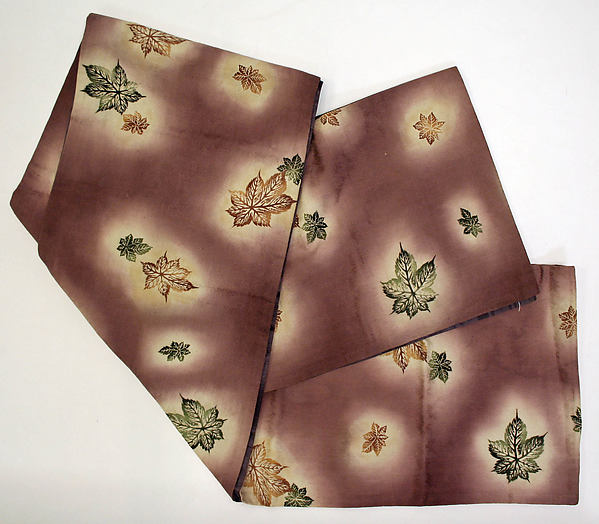
Obi, late 19th century, silk. The Metropolitan Museum of Art, Gift of Miss Irene Lewisohn and Mrs. Alice Lewisohn Crowley, 1946, accession C.I.46.9.189.
Look closer: Compare it with the other late-nineteenth-century silk obi in the same gift. The Met adds no description.
Image: The Metropolitan Museum of Art, Open Access (CC0)
The exceptions are instructive. The obi with textile fragments, whose Japanese title names it a fukuro obi, is only 311.15 centimetres long, shorter than the modern range, and shorter than even the nagoya obi’s 315 to 345 centimetres. The Taishō sakiori sash of woven cotton scraps is 284.5 by 15.9 centimetres, which places it with the half-width informal sashes. The silk under-sash, catalogued as a Sash for Use Under Obi, is 281.94 by 41.91 centimetres, much shorter and wider than any outer sash, and is a plain-weave crepe. The set of four pieces catalogued with a question mark as pieces for obi runs from 166.4 to 546.1 centimetres, in widths of about 42 centimetres, and the museum does not say how they were used. The kazura-obi, a Noh wig band of the late eighteenth century, is a different thing entirely, 3.2 by 122.6 centimetres, embroidered with a chrysanthemum scroll on gold silk satin; it is a headband, not a sash, and its name shows how the word obi extended to any band.
The Victoria and Albert Museum records a sash of yellow cut silk velvet, 400 by 25.5 centimetres, with silk and gold embroidery on both sides, dated 1800 to 1850. The museum says it shows peonies, paulownia and wisteria, each group with a lozenge and an ox-cart wheel motif, and that it is a kakeshita obi of the kind worn by a samurai-class woman beneath an uchikake. The width is close to the 25 centimetres that Wikipedia gives for the 1730s, although the museum dates the object a century later, and the comparison is offered only as a reminder that the types overlap in time.
These records also show what the museum does not say. Most of the Met pages for the sashes carry no catalogue essay, and the objects are listed as not on view. The chapter therefore describes them by what is recorded and does not guess at the wearer, the weaver or the occasion.
| Object | Size | Remark |
|---|---|---|
| Woman’s Obi, 19th century | 439.4 by 33 cm | Silk and gold, compound weave |
| Obi, checks and floral roundels | 410 by 32.2 cm | Twill, supplementary weft, brocading |
| Obi with thistle | 410.2 by 31.8 cm | Brocaded silk, metallic thread |
| Obi with stylised waves | 414 by 29.5 cm | Double cloth, Meiji period |
| Obi with textile fragments | 311.15 by 31.75 cm | Japanese title names a fukuro obi |
| Sakiori obi, woven cotton scraps | 284.5 by 15.9 cm | Taishō period |
| Sash for use under obi | 281.94 by 41.91 cm | Silk plain-weave crepe |
| V&A velvet kakeshita obi | 400 by 25.5 cm | Embroidered on both sides |
Four tales of the sash
The actor who set the droop. According to Niponica, the kichiya-musubi, with its ends hanging to left and right, was introduced by the onnagata Uemura Kichiya, and the young women of Edo were enamoured with it. A fashion for a knot was thus begun on the kabuki stage, by a man playing a woman, and copied in the street.
The sword at the waist. The samurai knot, the kata-basami, was easy to tie and very secure, the magazine says, and with a sword inserted at the waist it tightens the abdomen and improves posture. A sash is a practical object before it is a decorative one, and this fold is the plainest reminder of that fact.
The voyage of Mitsuda Yazaemon. In 1235, the Hakata-ori entry says, a Fukuoka merchant sailed to Song China with a monk to study trades and crafts, and came back six years later, in 1241, to start a textile business. The stiff ribbed silk of the sash is credited to that return. The monk is named in the entry as Shōichi Kokushi, and the page makes no further claim about how the technique was taught.
The hands that stop. The Japan Times reports that the Tokyo cord-maker Hiroyuki Kondo has memorised his sequences so well that he does not need to look while braiding, and that when he errs his hands stop on their own. He compares his sense of which thread comes next to a cook seasoning by feel. It is a small portrait of what a handmade obijime contains.
Small surprises from the sources
Short facts, each given as the cited source gives it.
- A Heian sash was about 8 centimetres wide; by about 1800 a woman’s sash was about 30.
- A woman’s obi had doubled in width by the 1680s, according to Wikipedia.
- Obi were tied at the front, then the side, then the back; the custom of tying at the back was not firmly set until the early twentieth century.
- The drum knot is credited to geisha in 1823, to celebrate the opening of the Taikobashi bridge.
- More than 100 ways of tying the sash exist, most from the Edo period.
- The darari knot of the maiko needs up to 6 metres of obi.
- The five colours of kenjō hakata-ori are purple, red, yellow, blue and navy.
- The hakata-ori trademark was registered on 9 March 2017.
- Jacquard looms reached Japan, for hakata-ori, in 1886; Nishijin weavers brought the loom back from Europe in 1872.
- About 90 percent of what Tokyo kumihimo artisans make is obijime, according to the Japan Times in 2000.
- Tokyo kumihimo was certified as a craft on 4 February 1982.
- A single suit of Heian armour might use about 300 metres of braid.
- The most elaborate shell-matching game used 360 shells, close to the number of days in a year.
Words of the sash
The terms used in this chapter, in the sense the sources give them.
| Term | Meaning | Where it appears |
|---|---|---|
| Obi | The sash worn with kimono and martial arts dress | Throughout |
| Kakeshita obi | A formal sash worn under an uchikake | Edo growth |
| Kai-awase | The shell-matching game, associated with weddings | Edo growth |
| Taiko musubi | The drum knot, said to date from 1823 | Tying |
| Fukura-suzume | The puffed sparrow knot, for young women | Tying |
| Bunko-musubi | A tight, dignified knot linked to samurai families | Tying |
| Kata-basami | A secure samurai knot | Tying |
| Obimakura | A small pillow that shapes the knot | Tying |
| Obiage | The scarf above the obi | Tying |
| Obijime | The braided cord tied round the obi | Braids |
| Obidome | A clip fastened to the obijime | Tying |
| Hakata-ori | Stiff ribbed silk from Fukuoka | Fukuoka |
| Dokko | The wide stripe, from the Buddhist vajra | Fukuoka |
| Nishijin-ori | Silk woven in the Nishijin district of Kyoto | Looms |
| Kumihimo | Gathered threads; braided cord | Braids |
| Takadai | The high frame for flat braids | Braids |
| Kazura-obi | A Noh wig band | Tape measure |
Where to see the sash and the cord
The Metropolitan Museum of Art holds the nineteenth-century sashes, the sakiori sash and the Noh wig band described here, and its pages list them as not on view at the time of writing, so a visitor should ask the museum before travelling. The Victoria and Albert Museum holds the velvet sash under accession number FE.23-1973, and the Weber Collection’s kakeshita obi is recorded by the Met as returned to the lender. The Tokyo craft page gives the contact of the Edo Kumihimo Manufacturing Guild in Taitō ward, and the main areas of production for Tokyo cords are Taitō, Suginami and Kita. Hakata-ori is made in Fukuoka city and the cities named in its trademark, and Nishijin-ori in the Nishijin district of Kyoto. Arrangements change, and a visitor should check any workshop or museum in advance.

Brow of a Noh Wig Band (Kazura-obi), late 18th century, Embroidered chrysanthemum scroll on gold (dohaku) silk satin ground, clematis scroll on gold leaf (surihaku) on silk satin. The Metropolitan Museum of Art, Purchase, Gift of Mr. and Mrs. Teiji Ito, by exchange, 1984, accession 1984.350.
Look closer: Notice how narrow it is, 3.2 by 122.6 centimetres. The Met catalogues it as a Noh wig band, and the medium names a chrysanthemum scroll on gold silk satin with a clematis scroll in gold leaf.
Image: The Metropolitan Museum of Art, Open Access (CC0)
Reading a sash in the hand
Five checks are worth the time. First, measure. Width and length identify the type, and the museum records show that old sashes can fall outside the modern ranges, so a nineteenth-century obi that is shorter than a modern nagoya is not necessarily wrong. Second, feel the cloth. Hakata-ori is stiff and ribbed because of its thin warp and thick weft, and a limp cloth sold under that name deserves a question. Third, turn the sash over. The V&A velvet is embroidered on both sides, and the Met’s kakeshita obi has a different pattern underneath from the one on top, so the reverse tells you the function.
Fourth, look at the weave. A double cloth, which the Met says was very popular in the Meiji period, has a different structure from a brocaded twill, and the supplementary weft that makes the pattern should be regular. Fifth, judge the price against the type. Wikipedia notes that second-hand obi are inexpensive and that new ones cost more than a kimono, which means that a good second-hand sash is often the better purchase. For cords, the Japan Times points out that handmade kumihimo has a warmth machine-made versions lack and fits snugly when tied, and that the market is contracting. The grading approach is set out in How to Read, Grade and Care for a Japanese Garment, and the way the sash finishes a kimono in The Kimono Ladder: Furisode, Tomesode, Hōmongi and Komon.
Kimono and obi silk, remade
The shelf holds contemporary jackets and shirts made from vintage kimono and obi silk, including brocade and Nishijin weaving. Each is described as what it is, with its age and condition set out plainly on its own page.


Kimono and textile heritage
Antique silk, brocade and sash cloth are gathered in one collection, and the concierge desk can look for a particular weave or house on request.
Answered plainly
What is an obi?
A sash worn with traditional Japanese clothing and with martial arts uniforms. Women’s obi are broad and woven; men’s are narrow.
Which obi is the most formal?
The maru obi, now worn only by brides and maiko. The fukuro obi is the most formal type worn today.
What is a nagoya obi?
The most-used obi today, about 30 cm wide and 315 to 345 cm long. It was developed by a Nagoya seamstress in the late 1920s.
When was the drum knot created?
In Tokyo in 1823, by some geisha celebrating the opening of the Taikobashi bridge, according to Wikipedia.
What is an obijime?
A decorative kumihimo cord, about 150 cm long, tied around the obi, usually of woven silk with a tassel at each end.
Why can a new obi cost more than a kimono?
Wikipedia notes that new obi typically cost more than a kimono, and that some Nishijin-ori obi cost up to one million yen.
How wide was the obi in the Heian period?
About 8 centimetres, worn by men and women alike, according to Wikipedia.
When did the obi reach its modern width?
By about 1800 a woman’s obi was about 30 centimetres wide, which required separate ties and cords.
Who introduced the kichiya-musubi?
Niponica credits Uemura Kichiya, a popular onnagata, the actor who played women’s roles in kabuki.
What is hakata-ori?
A stiff, ribbed silk from Fukuoka, made with a thin warp and a thicker weft. It is used mainly for obi, especially men’s kaku obi.
What are the colours of kenjo hakata-ori?
Purple, red, yellow, blue and navy, each with a symbolic meaning, according to Wikipedia.
What is kumihimo?
A braided cord, from words meaning gathered threads. It came to Japan around 700 from China and survives mainly as obijime.
Which Tokyo wards make kumihimo?
Taito, Suginami and Kita, according to the Tokyo Metropolitan Government’s craft page, which records a certification date of 4 February 1982.
Did Nishijin weavers use the Jacquard loom?
Yes. Weavers who had travelled to Europe brought back the Jacquard loom and the flying shuttle in 1872, according to Wikipedia.
Is the Met’s obi collection on view?
The pages for the sashes described here list them as not on view at the time of writing.
Where next
Sources and image credits
- Obi (sash), Wikipedia
- Obi with Dragon and Phoenix, Metropolitan Museum of Art, 2006.572.5
- Obi with Stylized Waves, Metropolitan Museum of Art, 2005.171
- Obi (sakiori), Metropolitan Museum of Art, 1981.411.1
- Hakata-ori, Wikipedia
- Nishijin-ori, Wikipedia
- Kumihimo, Wikipedia
- Tokyo Kumihimo, Traditional Crafts of Tokyo
- Twisted tradition that's knotty but nice, The Japan Times
- The obi, Niponica, Web Japan
- About Tatsumura Art Textile
- Obi (Kakeshita-obi) with Shell-Matching Game Boxes, Metropolitan Museum of Art
- Obi, FE.23-1973, Victoria and Albert Museum
- Woman's Obi, Metropolitan Museum of Art, 50.79.3
- Obi with Pattern of Checks and Floral Roundels, Metropolitan Museum of Art, 1981.229.2
- Obi with Thistle, Metropolitan Museum of Art, 1981.229.1
- Obi with Textile Fragments, Metropolitan Museum of Art, 1977.136
- Brow of a Noh Wig Band (Kazura-obi), Metropolitan Museum of Art, 1984.350
- Four Pieces for Obi (?), Metropolitan Museum of Art, 10.167a-d
- Sash for Use Under Obi, Metropolitan Museum of Art, 1975.283.2
- Object record: Obi, The Metropolitan Museum of Art
- Object record: Obi, The Metropolitan Museum of Art
- Object record: Obi, The Metropolitan Museum of Art
Last reviewed 28 October 2026. Pictures, where shown, are public-domain or open-access and credited beneath each one.
Looking for an obi, a cord or a length of brocade you have seen described here? The concierge desk replies within one to three business days.
Private concierge
Looking for something in particular?
Describe the piece or the project you have in mind. A senior advisor in Tokyo reads every case file personally and replies within two business days, with fees set out in writing before any work begins.