
Kanzashi, Combs and the Dressed Head
Accessories · Hair ornament
Kanzashi, Combs and the Dressed Head
簪
The kanzashi is the pin, the comb and the folded-silk flower that dress a Japanese hairstyle. Its history follows the history of the hairstyle itself, and its peak came when the styles of the Edo period grew large.
Fact sheet
The ornament in one glance
- Tsumami. Tiny squares of silk folded with tweezers into petals.
- Kushi. The comb, worn at the front of the bun.
- Kogai. A two-piece stick that resembles a sheathed sword.
- Bira-bira. A two-pronged pin with metal strips that tremble.
- Calendar. A maiko’s flowers change with the month of the year.
A pin that became a garden
Wikipedia defines kanzashi as hair ornaments used in traditional Japanese hairstyles, including hairpins, barrettes, fabric flowers and fabric hair ties, and notes that in English-speaking countries the word usually refers to the fabric-flower ornaments called tsumami kanzashi, or to the folding technique used to make them. The word covers a very large range of objects, and the first task of a reader is to separate the kinds.

Lacquer Hairpin with Geese, second half of the 19th century, Lacquered wood with gold, silver hiramaki-e on gold ground. The Metropolitan Museum of Art, Bequest of Hope Skillman Schary, 1981, accession 1982.244.7a, b.
Look closer: Look at the geese on the gold ground. The Met records gold and silver in the hiramaki-e technique, and a length of just 13 centimetres.
Image: The Metropolitan Museum of Art, Open Access (CC0)
The entry names six. Tsumami kanzashi are flowers, plants and animals made by folding small squares of dyed or printed silk with tweezers and gluing them to a base with rice glue, a piece using from 5 to 75 squares or more. Hana kanzashi are clusters of tsumami flowers, sometimes with metal strips or petal streamers, and maiko often wear larger-than-average versions, usually in pairs. Bira-bira kanzashi are two-pronged pins with a rounded plate and metal strips that move independently, some with bells or silk flower chains. Kushi are comb-shaped ornaments, usually worn at the front of the bun and often sold as sets with kogai, the two-piece stick-shaped ornaments that resemble sheathed swords. Kanoko-dome are short, heavily decorated pins with a large rounded end, worn at the back of bun-style hairstyles.
The Metropolitan Museum holds a small lacquered example from the nineteenth century. It is a hairpin of lacquered wood decorated in hiramaki-e, in which gold and silver powders are sprinkled onto wet lacquer to form the design, with a goose motif on a gold ground, dated to the second half of the nineteenth century and measuring 13 centimetres in length. The Met’s Japanese title for it, 雁蒔絵笄, ends in the character conventionally read kōgai, one of the types above. A second Met pin in the same lacquer, decorated with flowers, shows how easily the motif vocabulary of the kimono passes onto the head.
From a single rod to the great coiffures
The Wikipedia entry sets out a history by period, and the early claims should be read as traditions rather than established facts. It says that kanzashi were first used in the Jōmon period, when a single thin rod or stick was believed to ward off evil spirits, but it marks the claim as needing a citation. In the Nara period, it says, Chinese hairpins and combs were brought to Japan through trade and envoys. In the Heian period hairstyles shifted from being worn up to being worn long and tied back low, and ‘kanzashi’ became a general term for any hair ornament, including combs and hairpins.
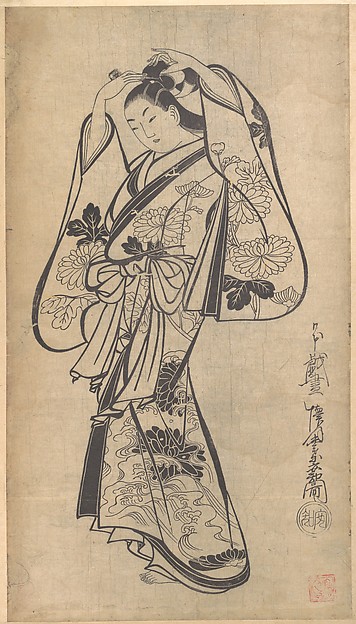
Kaigetsudō Anchi, Courtesan Placing a Hairpin in Her Hair, ca. 1714, Monochrome woodblock print (sumizuri-e); ink on paper. The Metropolitan Museum of Art, Harris Brisbane Dick Fund and Rogers Fund, 1949, accession JP3106.
Look closer: Look at the gesture in the title. The Met records an inscription calling the sheet an amusing picture in the Japanese style drawn by Anchi, and notes Anchi’s seal.
Image: The Metropolitan Museum of Art, Open Access (CC0)
The decisive change came later. In the Azuchi-Momoyama period, the entry says, hairstyles changed from hanging-down styles to styles worn up, which made more use of ornaments. In the Edo period kanzashi came into wider use as hairstyles grew larger and more complex, and craftsmanship peaked in the latter part of the period, with many of its designs persisting to the present. A reader should connect this development with the history of the kimono and the obi, which grew in scale over the same decades; the wider obi are described in Obi and Its Companions: Scarf, Cord and Brooch.
Prints record the result. The Met's collection includes a monochrome print by Kaigetsudō Anchi of about 1714, titled Courtesan Placing a Hairpin in Her Hair, with an inscription calling it an amusing picture in the Japanese style drawn by Anchi. The same museum holds a privately published print by Ryūryūkyo Shinsai of about 1805 to 1810 titled Roll of Cloth for an Obi and Tortoise-shell Hair Ornaments, subtitled ‘Presents for One’s Beloved’, from an album of surimono, the privately printed prints that poets commissioned as New Year greetings. The museum calls the pigments, printing and paper in the album the finest of their kind. Such prints show the hair ornament as a gift, a luxury and a subject worth a picture in its own right.
Materials, months and maiko
The Wikipedia entry lists the materials: lacquered wood, gold- and silver-plated metal, tortoiseshell, silk, and, more recently, plastic. Early bakelite plastic kanzashi, it adds, are highly valued as collectables. Tama kanzashi are often made of jade or coral, or of shibori-dyed fabric, and the stamens of hana kanzashi are often made with mizuhiki, a twine of washi paper. A collector should keep this inventory in mind, because it shows that the field is not only of fine lacquer and tortoiseshell, and that humble and modern materials have their own markets.

Lacquer Hairpin with Flowers, second half of the 19th century, Lacquered wood with gold, silver hiramaki-e, gold, silver foil application and mother-of-pearl inlay on black ground. The Metropolitan Museum of Art, Bequest of Hope Skillman Schary, 1981, accession 1982.244.8a, b.
Look closer: Compare the flowers with the geese on the first pin. The pair shows how the same lacquer technique carries different motifs.
Image: The Metropolitan Museum of Art, Open Access (CC0)
For the seasoned eye the most revealing feature is the calendar. According to the entry, a maiko’s flowers change with the month. In January the motif is pine, bamboo and plum, with sparrows, spinning tops and battledore paddles; in February deep pink or red plum blossoms; in March rapeseed, butterflies, peach, narcissus, camellia and peony; in April cherry blossoms with butterflies; in May wisteria and flag irises; in June willow leaves with carnations; in July fan displays linked to the Gion Festival; in August morning glory or susuki grass; in September Japanese bellflower, often with bush clover; in October chrysanthemum; in November autumn maple leaves, with ginkgo; and in December rice-cake flowers, with bamboo leaves for senior maiko and lucky charms for junior ones. The entry adds that at the New Year the ornament is of unhusked rice ears, worn on the right by maiko and on the left by geisha, with eyeless white doves.
The calendar is a useful dating aid for anyone reading a picture or a photograph, because it gives the month. It also explains the obsession with seasonal motifs that runs through Japanese dress, a subject treated in Seasons and Occasions: What to Wear When and, in its wider form, in A Motif Dictionary: Crane, Pine, Wave and Chrysanthemum. The costume of the quarter, in which these ornaments are worn, is the subject of Geisha, Maiko and Oiran: The Costume of the Quarter.
Two practical points complete the picture. The first is that hairstyles are now rare. The entry says traditional Japanese hairstyles are rarely worn outside geisha, maiko, sumo wrestlers, brides and re-enactors, although everyday kanzashi, including modern hairclip styles, remain popular. Brides, the entry says, typically wear pre-styled wigs with traditional hairstyles. The second is the craft's fragility: professional craftspeople typically complete a five-to-ten-year apprenticeship, and the entry reports that the number of traditionally trained craftspeople in Japan fell from an estimated fifteen to five between 2002 and 2010.
| Type | Form | Where it sits |
|---|---|---|
| Tsumami kanzashi | Folded silk squares, 5 to 75 or more per piece | Flowers, plants and animals on a base |
| Hana kanzashi | Tsumami flower clusters, sometimes with streamers | Maiko wear larger versions, usually in pairs |
| Bira-bira kanzashi | Two-pronged pin with moving metal strips | Bells or silk flower chains on some |
| Kushi | Comb-shaped | Front of the bun; often a set with the kogai |
| Kogai | Two-piece stick resembling a sheathed sword | One end removable, placed in the hairstyle |
| Kanoko-dome | Short pin with a large rounded end | Back of bun-style hairstyles |
Lacquer, tortoiseshell and the gift
The Met’s hairpin is a lacquer object before it is an ornament. Its technique, hiramaki-e, is one of the family of maki-e methods that decorate inrō and boxes, and the lacquer worker who made a pin was the same kind of maker who made a gold box. That link is useful for a collector, because the same standards of gold ground, even sprinkling and edge finish that apply to an inrō apply to a lacquered kōgai or hairpin. The hanging objects of the sash are described in Netsuke, Inrō and Sagemono: The Hanging Objects.

Ryūryūkyo Shinsai, Roll of Cloth for an Obi and Tortoise-shell Hair Ornaments (“Presents for One’s Beloved”), from the Butterfly Series, from Spring Rain Surimono Album (Harusame surimono-jō, vol. 3), ca. 1805–10, Privately published woodblock prints (surimono) mounted in an album; ink and color on paper. The Metropolitan Museum of Art, H. O. Havemeyer Collection, Bequest of Mrs. H. O. Havemeyer, 1929, accession JP2296.
Look closer: Find the gift. The sheet comes from an album that the Met describes as the epitome of late Edo woodblock printing, and the title names the objects it shows.
Image: The Metropolitan Museum of Art, Open Access (CC0)
The gift is the other half of the object. The Shinsai print is entitled ‘presents for one’s beloved’, and shows a roll of obi cloth with tortoiseshell ornaments, which suggests that a hair ornament belonged to the economy of courtship and gift-giving in the early nineteenth century. The museum’s account of the surimono, privately commissioned by poets and often alluding to literary classics, adds that a poem and an object could travel together.
Tortoiseshell deserves a caution. It appears in the Wikipedia list of materials and in the Met print’s title, but a reader should be aware that trade in it can be regulated under international controls, so that an owner should take advice before moving such a piece across a border. The concierge desk can advise in particular cases.
The wider family of hair and head adornment connects to the costume chapters: Geisha, Maiko and Oiran: The Costume of the Quarter covers the hair ornaments of the quarter and Shichi-Go-San and the Clothes of Childhood Rites the children’s festival dress. Within the house’s own shelves, the Kimono and Textile Heritage collection shows the silks that these ornaments were chosen to accompany.
Squares, tweezers and rice-starch paste
The best-known kanzashi are made without a loom, a kiln or a lathe. The Tokyo Metropolitan Government’s craft page on Edo tsumami-kanzashi records that the craft was certified on 24 December 1982, with its main production in Taitō, Sumida and Arakawa wards. It names the materials as finely woven, glossy habutae silk for the petals and boxwood, pear, magnolia or a similar wood for the base of the pin. The tools are a fabric slicer, a wooden measure and a chopping board for cutting the silk into squares, fine-tipped tweezers for pinching and folding, a pasteboard coated with rice starch on which the pieces are placed, and a very fine silk twine for mounting.

Torii Kiyomitsu, The Actor Onoya Matsusuke, in Female Robe of O-Kane, Adjusts the Comb in His Hair, 1735–1785, Woodblock print; ink and color on paper. The Metropolitan Museum of Art, Henry L. Phillips Collection, Bequest of Henry L. Phillips, 1939, accession JP2763.
Look closer: Find the hand at the hair. The Met names the actor, the woman’s robe and the gesture, and records a size of 30.8 by 14 centimetres.
Image: The Metropolitan Museum of Art, Open Access (CC0)
The page lists the folds. Maru-tsumami, the round pinch, gives a soft look, and kaku-tsumami, the square pinch, a strong one. Suji-tsumami is a pinch for family-crest patterns, uragaeshi-tsumami a reverse pinch, and fuki, the placement, is the stage at which pinched pieces are shaped into petals, flowers and cranes. Production follows four steps: cutting dyed silk into small squares, pinching and folding the squares with tweezers, arranging the pieces on the starch board, and mounting the finished ornaments on hairpins. The motifs it names are chrysanthemums, plum flowers, butterflies, Chinese phoenixes and cranes.
A workshop article published by a Tokyo cultural society in 2023 describes the same process from the bench. It says the cloth is cut into squares on a board with a long slender knife, the tachibōchō, and that tweezers are the essential tool, some pieces measuring only one square centimetre. The pieces are fixed to the board with rice-starch paste, which, the article notes, attracts insects and small rodents and must dry for a few days. The term for laying the pinched pieces is the same verb used for laying roof tiles. A second description, from a Japan Times feature of 2000, follows a third-generation maker, Tsuyoshi Ishida, who works with his father Kenji at a dining table in Shinjuku ward. He spreads starch adhesive on a small wooden board, picks up a one-square-centimetre piece of silk with tweezers, folds it diagonally three times, creases it sharply and sets the small triangle on the starch. That is square pinching; round pinching, the feature says, gives a softer effect.
A Japanese craft site that sells tsumami work adds that the word tsumami zaiku means ‘pinching craft’, that the thin silk may be habutae or crepe, that a single piece can use several hundred petals, and that round pinching suits plum, cherry and chrysanthemum while the pointed fold, which it calls ken-tsumami, suits spiky chrysanthemums and pine needles. It also says the craft grew out of the small silk offcuts left over from kimono sewing, in the spirit of mottainai, the dislike of waste. The Wikipedia entry on kanzashi gives a figure for the labour: a piece may use from 5 to 75 squares or more.
How Kyoto’s palace ladies shaped Edo’s counters
The origin story the sources tell is of a fashion that moved downhill. The Tokyo craft page says that in the early Edo period a flower-petal technique came to Edo from Kyoto, which is said to have started the Edo tradition. The workshop article gives more detail: court ladies at the Kyoto Imperial Palace made origami-based flower decorations from kimono lining and offcuts, and Edo imitated the practice. Noblewomen adopted them first as a fashion, the article says, and ukiyo-e depictions later spread them to townswomen. Provincial feudal lords, who had to live in Edo in alternate years, often took them home as souvenirs.

Torii Kiyomasu II, Sanjō Kantarō as a Woman Arranging Her Hair Before a Lacquer Mirror, before 1763, Woodblock print; ink and color on paper. The Metropolitan Museum of Art, Harris Brisbane Dick Fund and Rogers Fund, 1949, accession JP3081.
Look closer: Find the mirror. The Met’s title records an actor in a woman’s role arranging her hair before a lacquer mirror, which is where the ornaments of this chapter were set in place.
Image: The Metropolitan Museum of Art, Open Access (CC0)
The craft page names a surviving souvenir. In the middle of the Edo period, it says, kusudama, ball-shaped flower ornaments, combs and hair decorations were made in the city and sold as Edo souvenirs, and the Byakkotai Memorial Museum in Aizuwakamatsu, Fukushima Prefecture, holds a tsumami kusudama hairpin believed to have been taken to the Aizu domain from Edo. The museum is named for the Byakkotai, the Aizu domain’s young warriors of the Boshin War of 1868 to 1869, a reminder of how much of the nineteenth century a single pin can span.
A literary source supplies the fashion. According to the craft page, the Morisada Mankō, the nineteenth-century encyclopaedia of Edo customs, describes women in the Bunsei era, 1818 to 1830, decorating their hair with crepe scraps shaped into chrysanthemums and cranes. The craft site gives a similar picture: in the Bunsei era women decorated the Shimada hairstyle with folded crepe in white, blue, red and purple, affordable ornaments that were popular Edo souvenirs. The craft page adds that late Edo to early Meiji woodblock prints of women show these hairpins, so a reader who looks at a print of the period is looking at the trade in action.
The numbers the sources give suggest how large that trade was. The Japan Times reports that according to statistics of 1877 Tokyo alone had 1,000 kanzashi makers. It adds that in 2000 about 15 craftsmen carried the tradition across Japan. The workshop article of 2023 says that most professional artisans are elderly and that fewer than ten remain in Tokyo, and the Wikipedia entry gives a fall in the number of traditionally trained craftspeople from fifteen in 2002 to five in 2010. These figures come from different sources, count different things, and cannot be reduced to a single series, but they agree on direction.
The occasions named by the craft page are New Year, Shichigosan at ages three, five and seven, the temple visit at thirteen known as jūsan-mairi, the coming-of-age ceremony and weddings. The children’s festival is described in Shichi-Go-San and the Clothes of Childhood Rites, and the maiko’s monthly calendar in Geisha, Maiko and Oiran: The Costume of the Quarter.
The comb that dresses the hair
A kanzashi is only one part of a hairdresser’s kit, and the oldest part is the comb. Tokyo’s Yonoya shop, whose history is told on the Tokyo government’s news site, says it was founded in 1717 in what is now Bunkyō ward, moved to Denbōin-dōri in Asakusa by the early 1900s, and is run by its fourth generation, Saitō Yutaka, who is both owner and artisan. It uses Satsuma boxwood from Kagoshima Prefecture, which it describes as hard yet flexible, so that it bends before it breaks. Each comb takes years of preparation: the wood is dried and smoked repeatedly, shaped, honed and polished by hand, and the finished comb is soaked in camellia oil, which gives it an amber glow as it ages.

Portable Stationery and Cosmetic Box (Tabi kushi-bako) with Moon and Autumn Grasses, 18th century, Lacquered wood with gold and silver togidashimaki-e, hiramaki-e, e-nashiji, and pewter inlay. The Metropolitan Museum of Art, Gift of Florence and Herbert Irving, 2015, accession 2015.500.2.42a–c.
Look closer: Look at the moon over the autumn field. The Met’s romanised title names a kushi-bako, and records gold and silver togidashi-maki-e and hiramaki-e with pewter inlay, 14.6 by 14.9 by 23.5 centimetres.
Image: The Metropolitan Museum of Art, Open Access (CC0)
The article records a change in who bought combs. Before the Meiji era, it says, hair care was done by specialists, tokoyama for men and kamiyui for women, and combs were wholesale goods for professional hairdressers until Western hairstyles led households to style their own hair. Its customers were mostly grandmothers in the past, and now more women in their twenties and thirties, and men, find the shop through social media.
A cultural-heritage story on Kyoto boxwood combs, supplied by the Jūsan-ya comb shop, gives the craft’s vocabulary. Edo-period comb shops often used the number thirteen, jūsan, in their names, since ku (nine) and shi (four) are the syllables of kushi, comb. Kyoto still has a shop called Jūsan-ya and another called Nijūsan-ya, the latter punning on ‘Chinese comb shop’. The story says combs appear at Jōmon sites, from about 10,500 BCE to the third century BCE, and that boxwood, tsuge, combs are thought to have been used from around the Nara period. It adds that decorative hair combs appeared in the Edo period and that boxwood combs do not generate static and darken to a more attractive amber with use.

Kitagawa Utamaro, A Woman Dressing a Girl for a the Kabuki Dance “Musume Dojōji,” with “Brother Picture” (E-kyōdai) of a Monkey Trainer, ca. 1795–96, Woodblock print in the e-kyodai format; ink and color on paper. The Metropolitan Museum of Art, Gift of Estate of Samuel Isham, 1914, accession JP985.
Look closer: Look at the hair as well as the robe. The Met’s essay reads the scene as a mother dressing her daughter to play Kiyohime, with a monkey-trainer picture above it.
Image: The Metropolitan Museum of Art, Open Access (CC0)
The wood is chosen and cured with care. According to the same story, the ideal tree is about 35 years old and is harvested in August or September, when it is hot but humidity is low. The wood is sun-dried, its core removed, and wedge-shaped pieces are bound into a circle to correct warping, then smoked for about ten days, which strengthens it and removes insects. It is cured for at least five years, often several decades. The teeth are cut with a saw matched to their width, filed from the right, then the left, then square-on, and the surface is smoothed with horsetail boards and a triangular rod fitted with ribbed horsetail pieces. A final polish uses muku leaves and a buffing brush made from the roots of broomsedge.
The combs for traditional hairstyles come in many forms. The story names the horizontal tokigushi, about 16 centimetres long, for untangling; the fine-toothed sukigushi; the bingushi for the temple hair; the fork-shaped bindashi; the naginata with angled ends; the chunky semicircular hamaguri for finishing a top-knot; the sujidate, which Nishijin weavers use in narrow-toothed form to beat weft threads; the genroku, named for an Edo era; and the hakekoki for men’s chonmage. Combs for the hairstyles themselves are either tategushi, vertical, or yokogushi, horizontal, and today the buyers of the specialist vertical combs are mainly professionals, such as the hairdressers of maiko, geisha and sumo wrestlers.
Bone rods from the last of the potters
The Wikipedia entry traces the kanzashi to the Jōmon period and marks the claim that a single rod warded off evil spirits as needing a citation. The Metropolitan Museum can add objects. It holds hairpins of bone from the final Jōmon period, about 1000 to 300 BCE, one of them 7 centimetres long and 0.3 wide and another 14.3 centimetres long and 1 wide. The museum’s note places them in the Jōmon period, which it describes as Japan’s earliest, lasting from about 14,000 to 300 BCE. Hairpins like these, it says, are relatively common and may have had a spiritual as well as a decorative purpose.

Hairpin, Bone. The Metropolitan Museum of Art, The Harry G. C. Packard Collection of Asian Art, Gift of Harry G. C. Packard, and Purchase, Fletcher, Rogers, Harris Brisbane Dick, and Louis V. Bell Funds, Joseph Pulitzer Bequest, and The Annenberg Fund Inc. Gift, 1975, accession 1975.268.314.
Look closer: Notice how small it is, 7 centimetres by 0.3. The Met calls hairpins of this kind relatively common and suggests a spiritual as well as a decorative purpose.
Image: The Metropolitan Museum of Art, Open Access (CC0)
That cautious wording is a useful model. The pins show that the habit of holding the hair with a rod is very old in Japan. They do not show what the rod meant, and the later belief that a thin pointed rod wards off evil, which the Tokyo craft page repeats as the origin of the custom of passing something through the hair, is a tradition and not a finding. The two kinds of evidence, objects and stories, are worth keeping apart.
A silver and silver-gilt hair ornament in the same museum, of the late nineteenth century and 27.9 centimetres long, belongs to a later tradition of metalwork. The museum records only the material, the length and the Rogers Fund credit of 1930, and says it is not on view. The contrast with the 7-centimetre bone pin is large, and it is consistent with the Wikipedia account that Edo hairstyles grew larger and more complex, as the sash described in Obi and Its Companions: Scarf, Cord and Brooch grew wider over the same period.

Hairpin, Bone. The Metropolitan Museum of Art, The Harry G. C. Packard Collection of Asian Art, Gift of Harry G. C. Packard, and Purchase, Fletcher, Rogers, Harris Brisbane Dick, and Louis V. Bell Funds, Joseph Pulitzer Bequest, and The Annenberg Fund Inc. Gift, 1975, accession 1975.268.363.
Look closer: Compare the length with the first pin. This one is 14.3 centimetres long and 1 centimetre wide, in the same period and material.
Image: The Metropolitan Museum of Art, Open Access (CC0)
The lacquer pins of the nineteenth century are the middle of the story. The Met’s hairpin with flowers is of lacquered wood with gold and silver hiramaki-e, gold and silver foil application and mother-of-pearl inlay on a black ground, 15.9 centimetres long, and its Japanese title ends in the character for kōgai. Set beside the goose pin, which is 13 centimetres long, it shows the same technique on two grounds, gold and black.
A husband, a wife and a nail artist’s tweezers
The 2023 workshop article names the people who carry the craft today. Sugino Shoten, commonly called Kanzashi Sugino, is a shop in Mukōjima, Sumida ward. Its third-generation president, Mamoru Sugino, runs it as a wholesaler and holds workshops to teach the craft. His wife Satoko Sugino is an artist who trained in the tsumami technique in 2012 and 2013 under a master artisan, drawing on her earlier work as a nail artist, and who won the grand prix at the Takumi Tokyo exhibition of 2021. The couple’s Arenca series, which sells unassembled parts so that customers can make their own, won a special prize in the 2022 Omotenashi Selection. Mamoru Sugino also runs work-experience programmes for local elementary school children and seminars for educators.

Utagawa Kunisada, Woman with a Folding Fan and Hand Mirror, from the series Sensuous Young Women of Contemporary Times, 1838, Woodblock print (nishiki-e). The Metropolitan Museum of Art, Bequest of William S. Lieberman, 2005, accession 2007.49.267.
Look closer: Look at the hair in the mirror’s company. The Met notes that the print includes a fashionable shibori-dyed fabric, the kind of cloth also used for the beads of tama kanzashi.
Image: The Metropolitan Museum of Art, Open Access (CC0)
The article does not hide the difficulty. Japan’s low birthrate and a shortage of artisans threaten the craft, it says. The Tokyo craft page, in its modern note, says that Tokyo is the main manufacturing area, that a non-Japanese student of the techniques has become popular in Los Angeles, and that overseas wholesalers place many orders. The craft site that sells tsumami work names a second maker, Ayano Fujii, whose brand makes earrings, brooches and hoops with the same folds, a reminder that the technique has moved from the head to the ear and the lapel.
The Wikipedia entry adds the system of training: professional training takes five to ten years. A long apprenticeship for a craft whose raw material is a square of silk a centimetre across is itself a clue to how much of the work is in the hands. The braid-makers described in Obi and Its Companions: Scarf, Cord and Brooch and the comb-makers below teach the same lesson: these are crafts of repetition.
Four tales of the hair
The palace offcuts. According to the 2023 workshop article, the court ladies of the Kyoto Imperial Palace made flowers from kimono lining and offcuts, and Edo imitated them. A craft that now sells to collectors began as a way of using what would otherwise be thrown away.
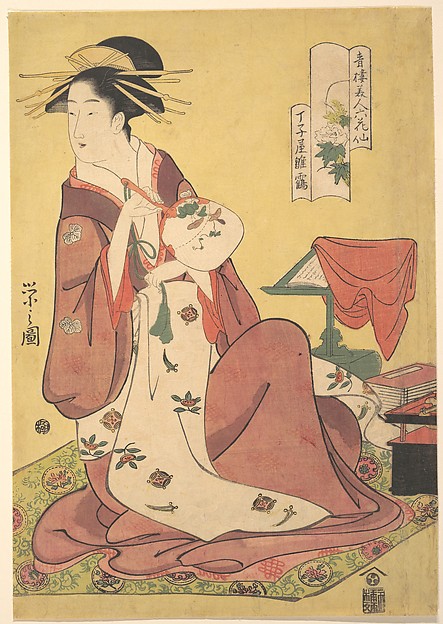
Chōbunsai Eishi, The Courtesan Hinazuru of the Chōjiya Brothel (Chōjiya Hinazuru), from the series Beauties of the Pleasure Quarters as Six Floral Immortals (Seirō bijin rokkasen), ca. 1795, Woodblock print; ink and color on paper. The Metropolitan Museum of Art, Henry L. Phillips Collection, Bequest of Henry L. Phillips, 1939, accession JP2816.
Look closer: Look at the head of the figure. The Met records that the series likens its women to flowers and that this sheet is marked with a peony.
Image: The Metropolitan Museum of Art, Open Access (CC0)
The souvenir from Aizu. The Tokyo craft page says a tsumami kusudama hairpin believed to have been brought from Edo is kept at the Byakkotai Memorial Museum in Aizuwakamatsu. The pin has outlasted the domain that took it home.
The thirteen shop. Comb makers of the Edo period put the number thirteen in their shop names, the story says, because nine and four, ku and shi, are the first syllables of the word for comb, and a Kyoto shop still bears the name. A pun became a trade mark.
The nail artist. Satoko Sugino brought the skills of fine nail art to the tweezers of tsumami in 2012 and 2013, and won a grand prix in 2021. The craft survives through people who come to it from somewhere else.
Small surprises from the sources
Short facts, each given as the cited source gives it.
- Edo tsumami-kanzashi was certified on 24 December 1982.
- A tsumami piece can use from 5 to 75 squares of silk, or more.
- Some squares are only one square centimetre.
- The rice-starch paste attracts insects and small rodents and takes a few days to dry.
- The verb for laying pinched pieces is the one used for laying roof tiles.
- In 1877, according to the Japan Times, Tokyo had 1,000 kanzashi makers.
- The Bunsei era women of Edo wore crepe chrysanthemums and cranes in their hair.
- A Jōmon bone hairpin in the Met is about 7 centimetres long.
- Yonoya, a Tokyo comb shop, was founded in 1717.
- Boxwood combs are soaked in camellia oil and turn amber with age.
- Combs are smoked for about ten days and cured for at least five years.
- The ideal boxwood tree for a comb is about 35 years old.
- Edo comb shops liked the number thirteen because nine and four spell the first syllables of kushi.
Words of the hair
The terms used in this chapter, in the sense the sources give them.
| Term | Meaning | Where it appears |
|---|---|---|
| Kanzashi | A hair ornament, in the widest sense | Throughout |
| Tsumami zaiku | Pinching craft; folded silk squares | Folded silk |
| Maru-tsumami | The round pinch, soft in effect | Folded silk |
| Kaku-tsumami | The square pinch, strong in effect | Folded silk |
| Uragaeshi | The reverse pinch | Folded silk |
| Habutae | A fine glossy silk used for petals | Folded silk |
| Kusudama | A ball-shaped flower ornament | Court to city |
| Morisada Manko | A nineteenth-century encyclopaedia of Edo customs | Court to city |
| Tsuge | Boxwood, the traditional comb wood | Boxwood |
| Tategushi | A vertical comb for traditional styles | Boxwood |
| Yokogushi | A horizontal comb | Boxwood |
| Kamiyui | A hairdresser for women before the Meiji era | Boxwood |
| Hiramaki-e | Lacquer sprinkled with gold or silver on wet lacquer | Earliest pins |
| Kogai | A two-piece stick resembling a sheathed sword | Earliest pins |
| Mottainai | Dislike of waste | Folded silk |
Where to see the pin and the comb
The Metropolitan Museum of Art holds the bone hairpins, the lacquer pins, the silver ornament, the cosmetic box and the prints described here, and the pages that were consulted list them as not on view, so a visitor should ask the museum before travelling. The Byakkotai Memorial Museum in Aizuwakamatsu holds the tsumami kusudama hairpin named by the Tokyo craft page. Sugino Shoten stands in Mukōjima in Sumida ward and runs workshops, and the Tokyo Kamikazarihin Manufacturing Association is named on the craft page as the contact for the craft. The Yonoya comb shop is in Asakusa, and the Jūsan-ya comb shop in Kyoto supplied the cultural-heritage story. Opening arrangements change, and a visitor should check with any workshop or museum in advance.
Reading a hair ornament in the hand
Five checks are worth the time. First, the material. The Tokyo craft page names habutae silk and a base of boxwood, pear or magnolia, and the Wikipedia entry lists lacquered wood, plated metal, tortoiseshell, silk and plastic, with early bakelite pieces collectable in their own right, so identify which tradition a piece belongs to before judging it. Second, look at the folds. Round pinches should be even and the points of the square pinches crisp, and a piece with hundreds of petals should still have a regular rhythm. Third, check the paste. Rice-starch paste is the traditional adhesive, and old pieces that have lost petals, or show insect damage, tell their own story.

Hair Ornament, late 19th century, Silver and silver gilt. The Metropolitan Museum of Art, Rogers Fund, 1930, accession 30.42.4.
Look closer: Follow the length of it, 27.9 centimetres. The Met records silver and silver gilt and a Rogers Fund credit of 1930, and gives no further description.
Image: The Metropolitan Museum of Art, Open Access (CC0)
Fourth, if the piece is lacquered, treat it as lacquer. The Met’s pins are described in terms of gold and silver sprinkling, foil application and mother-of-pearl inlay, and the same standards of ground, edge and wear apply as to any maki-e object. Fifth, for tortoiseshell, take advice before moving a piece across a border, as the trade can be regulated; the concierge desk can advise. For combs, the Japan-based sources point out that boxwood darkens to amber with age and oil, which is a sign of use and not of fault. The grading approach is set out in How to Read, Grade and Care for a Japanese Garment, and the hanging objects that complete the sash are described in Netsuke, Inrō and Sagemono: The Hanging Objects.
Dress and adornment in the house
The shelf holds a bridal robe, a furisode silk remake, a doll in a kimono and a gold maki-e inrō. Each is described as what it is, with its age and condition set out plainly on its own page.


Kimono and textile heritage
Antique silk and the accessories that were worn with it are gathered in one collection, and the concierge desk can look for a particular pin, comb or maker on request.
Answered plainly
What does kanzashi mean?
A hair ornament used in traditional Japanese hairstyles: pins, combs, barrettes and fabric flowers. In English the word usually means the folded-silk flower.
What is tsumami kanzashi?
A flower, plant or animal made by folding small squares of dyed or printed silk with tweezers and gluing them to a base with rice glue.
When did the craft peak?
In the later part of the Edo period, when hairstyles grew larger and more complex, according to Wikipedia.
Why do maiko wear different flowers?
The ornament changes with the month: plum in February, cherry blossom in April, wisteria in May, chrysanthemum in October and so on.
What is a kogai?
A two-piece stick-shaped ornament that resembles a sheathed sword. One end is removable for placement in the hairstyle.
Who still wears traditional hairstyles?
Geisha, maiko, sumo wrestlers, brides and re-enactors. Everyday kanzashi, including modern hairclip styles, remain common.
When was Edo tsumami-kanzashi designated a traditional craft?
The Tokyo Metropolitan Government’s craft page records its certification on 24 December 1982.
What is the difference between round and square pinching?
Round pinching, maru-tsumami, gives a soft look and suits plum and cherry petals; square pinching, kaku-tsumami, gives a strong look.
What adhesive is used for tsumami kanzashi?
Rice-starch paste, which attracts insects and rodents and takes a few days to dry.
How did tsumami kanzashi spread?
They began as folded flowers made from kimono offcuts by court ladies in Kyoto, were imitated in Edo, and spread to townswomen through ukiyo-e, according to a 2023 workshop article.
How old are the oldest Japanese hairpins in the Met?
Bone hairpins of the final Jomon period, about 1000 to 300 BCE, which the museum calls relatively common.
What wood are traditional combs made from?
Boxwood, tsuge, often Satsuma boxwood from Kagoshima Prefecture, cured for years.
Why did Edo comb shops use the number thirteen?
Because ku (nine) and shi (four) are the first syllables of kushi, comb, according to a heritage story supplied by a Kyoto comb shop.
How many tsumami kanzashi makers were there in Tokyo in 1877?
The Japan Times, citing statistics of 1877, reported 1,000 makers in Tokyo alone.
Where next
Sources and image credits
- Kanzashi, Wikipedia
- Lacquer Hairpin with Geese, Metropolitan Museum of Art, 1982.244.7
- Courtesan Placing a Hairpin in Her Hair, Metropolitan Museum of Art, JP3106
- Roll of Cloth for an Obi and Tortoise-shell Hair Ornaments, Metropolitan Museum of Art, JP2296
- Edo Tsumami-Kanzashi, Traditional Crafts of Tokyo
- Carrying on the Exquisite Beauty of Edo Tsumami-Kanzashi, IHCSA Cafe
- A tradition that's all pinned down, The Japan Times
- Tsumami Kanzashi, Japan Documented
- Tradition in Every Tooth: Yonoya's Handcrafted Boxwood Combs, Tokyo Updates
- Kyoto Boxwood Combs, Google Arts and Culture
- Hairpin, Metropolitan Museum of Art, 1975.268.314
- Hairpin, Metropolitan Museum of Art, 1975.268.363
- Hair Ornament, Metropolitan Museum of Art, 30.42.4
- Lacquer Hairpin with Flowers, Metropolitan Museum of Art, 1982.244.8a, b
- The Actor Onoya Matsusuke, Adjusts the Comb in His Hair, Torii Kiyomitsu, Metropolitan Museum of Art, JP2763
- Portable Stationery and Cosmetic Box, Metropolitan Museum of Art, 2015.500.2.42a-c
- Object record: Sanjō Kantarō as a Woman Arranging Her Hair Before a Lacquer Mirror, The Metropolitan Museum of Art
- Object record: A Woman Dressing a Girl for a the Kabuki Dance “Musume Dojōji,” with “Brother Picture” (E-kyōdai) of a Monkey Trainer, The Metropolitan Museum of Art
- Object record: Woman with a Folding Fan and Hand Mirror, from the series Sensuous Young Women of Contemporary Times, The Metropolitan Museum of Art
- Object record: The Courtesan Hinazuru of the Chōjiya Brothel (Chōjiya Hinazuru), from the series Beauties of the Pleasure Quarters as Six Floral Immortals (Seirō bijin rokkasen), The Metropolitan Museum of Art
Last reviewed 28 October 2026. Pictures, where shown, are public-domain or open-access and credited beneath each one.
Looking for a pin, a comb or a hair ornament you have seen described here? The concierge desk replies within one to three business days.
Private concierge
Looking for something in particular?
Describe the piece or the project you have in mind. A senior advisor in Tokyo reads every case file personally and replies within two business days, with fees set out in writing before any work begins.