Japonista
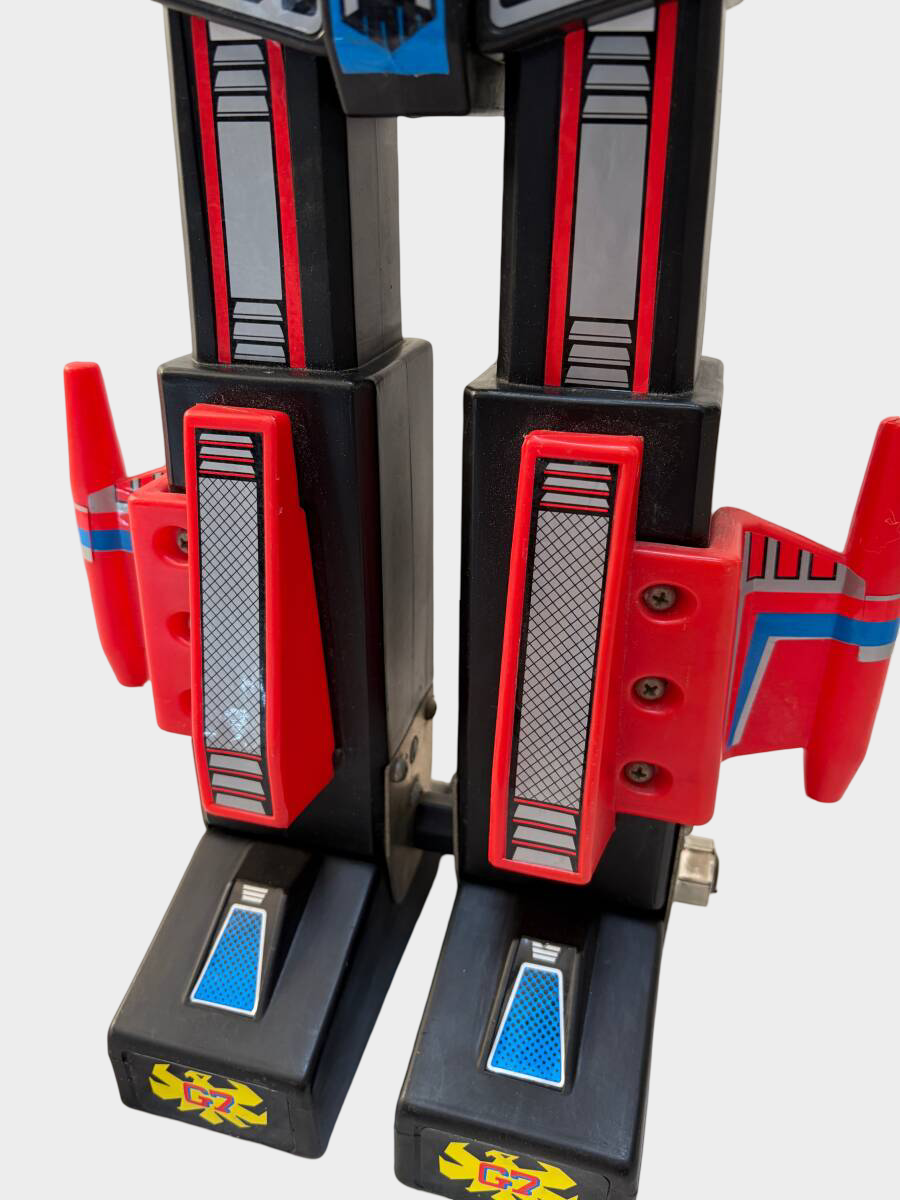
Figura decorativa en formato Jumbo Machinder de robot Invincible Robot Trider G7 de Clover, de unos 60 cm, principios de los años 1980
Figura decorativa en formato Jumbo Machinder de robot Invincible Robot Trider G7 de Clover, de unos 60 cm, principios de los años 1980
No se pudo cargar la disponibilidad de recogida
All sales are final. Please read our refund policy before purchase.
Have a reasonable price in mind? Submit your best offer and our concierge will review it personally.
At roughly 60 centimeters, this Clover Trider G7 belongs to the jumbo size tier that turned Japanese robot toys into room-presence artifacts. Broad shoulders, an emphatic crest and banner-like wings make the Sunrise hero of 1980–1981 read like a heraldic emblem rendered in engineering, unmistakably early-1980s mecha built for scale.
The Piece
A large-format robot of the Jumbo Machinder class is more than an upsized plaything: it sits where toy history overlaps with pop-design furniture, built for visual impact first and tactility second. Trider G7 comes from Sunrise's 1980–1981 robot television run, a period when robots were becoming brands rather than mere characters, and the figure distills that era's priorities into one silhouette: strong front-facing geometry, high-contrast color blocking and a graphic clarity that stays legible across a room.
Trider G7 is a working-class hero robot dressed in ceremonial shapes. The wings read like a crest or standard, turning the robot into a moving insignia, and the chest emblem acts as an authority mark, almost a uniform plate, a recurring motif of late-1970s to early-1980s mecha in which the machine is a symbol of the story's moral alignment as much as a weapon. Black anchors the torso like armor while bright primary accents map function zones for the eye; at jumbo scale this logic becomes architectural, a three-dimensional standing poster.
Figures in this size tier prioritize durability and presence, with rigid body shells and resilient components meant to survive decades of handling and display. The telling details are the edges and planes: crisp geometry that catches light cleanly and large uninterrupted color fields that show patina honestly. For a large figure, condition is judged less by mint perfection than by whether the silhouette reads cleanly at distance, with a straight stance, intact crest and wings and no catastrophic fractures, and this example is a display-forward survivor.
The jumbo robot era is a time capsule of Japanese industrial optimism, made when character robots were cultural infrastructure: Saturday television, department-store toy floors and the birth of modern collector memory. Big toys lived hard lives, moved, stored, bumped and outgrown, their boxes lost and wings stressed, so a large robot that remains visually complete becomes a surviving artifact of domestic design culture. Trider G7's timing places it at a hinge between earlier super-robot iconography and the wider evolution of 1980s robot narratives, and its wings and crest make it instantly legible even to non-specialists, an ideal single flagship for a series or a bold anchor for vintage box art, mid-century shelving, a studio desk or a modern interior.
Details
- Maker: Clover
- Model: Invincible Robot Trider G7, Jumbo Machinder-format display figure
- Series: Trider G7 (Sunrise, 1980–1981)
- Era: 1980s (toy production continued into the early 1980s)
- Origin: Japan
- Material: Rigid body shells with resilient components
- Color: Black torso with bright primary accents
- Measurements: Height ~60 cm · Width ~26 cm (wingspan) · Depth ~15 cm (torso to back)
Condition
- Vintage wear consistent with age, with no major breakage; stance straight and crest and wings intact.
- Expect scuffs, rubs and small paint and edge wear typical for the format; micro scuffs, surface rubs and small gloss shifts are present.
The Jumbo Format
Jumbo Machinder refers to a large-scale Japanese robot toy format, typically produced in soft vinyl at approximately 60 cm in height and developed during the 1970s super-robot era as monumental display pieces with missile-launching features. Many of the most iconic examples were made by Popy, founded in 1971 and later integrated into Bandai in the early 1980s, which through its Chogokin and Jumbo Machinder lines formalized the scale, weight and material language of Japanese robot toys: die-cast heft, oversized proportions and bold mechanical silhouettes that made toys feel monumental rather than disposable. Collectors still use the term as shorthand for the 60 cm size tier that other makers, Clover among them, carried forward.
Authenticity & Care
Every piece is examined and documented in Japan before dispatch and is offered with the Japonista authenticity guarantee.
Delivery from Japan
Packed by hand in Japan and shipped insured and tracked by EMS or an equivalent express service. Import duties and taxes, where applicable, are payable on arrival. Returns follow our published policy.
Considered offers are welcome through Send an Offer, and each one is reviewed personally. Pieces over $1,000 may be reserved over several payments with Layaway Privilege™.
Continue browsing: Vintage Toys
Related pieces: Nomura Tetsujin 28-go flying tin robot with remote · Prewar Nomura tin armored military vehicle · Popy Daikengo Jumbo Machinder robot with box
Toy Box Requests
Hunting a particular robot, kaiju, figure or model? The Hunting Salon™ searches Japan’s collector shops and private collections, and the Deputy Vault™ secures a piece you have already found. Begin a Hunting Salon™ request →
Collectors also search: trider g7 jumbo machinder · clover trider g7 robot · jumbo machinder vintage · 60cm vintage robot toy · invincible robot trider g7 toy · sunrise robot toy 1980s · large japanese robot figure