Popy
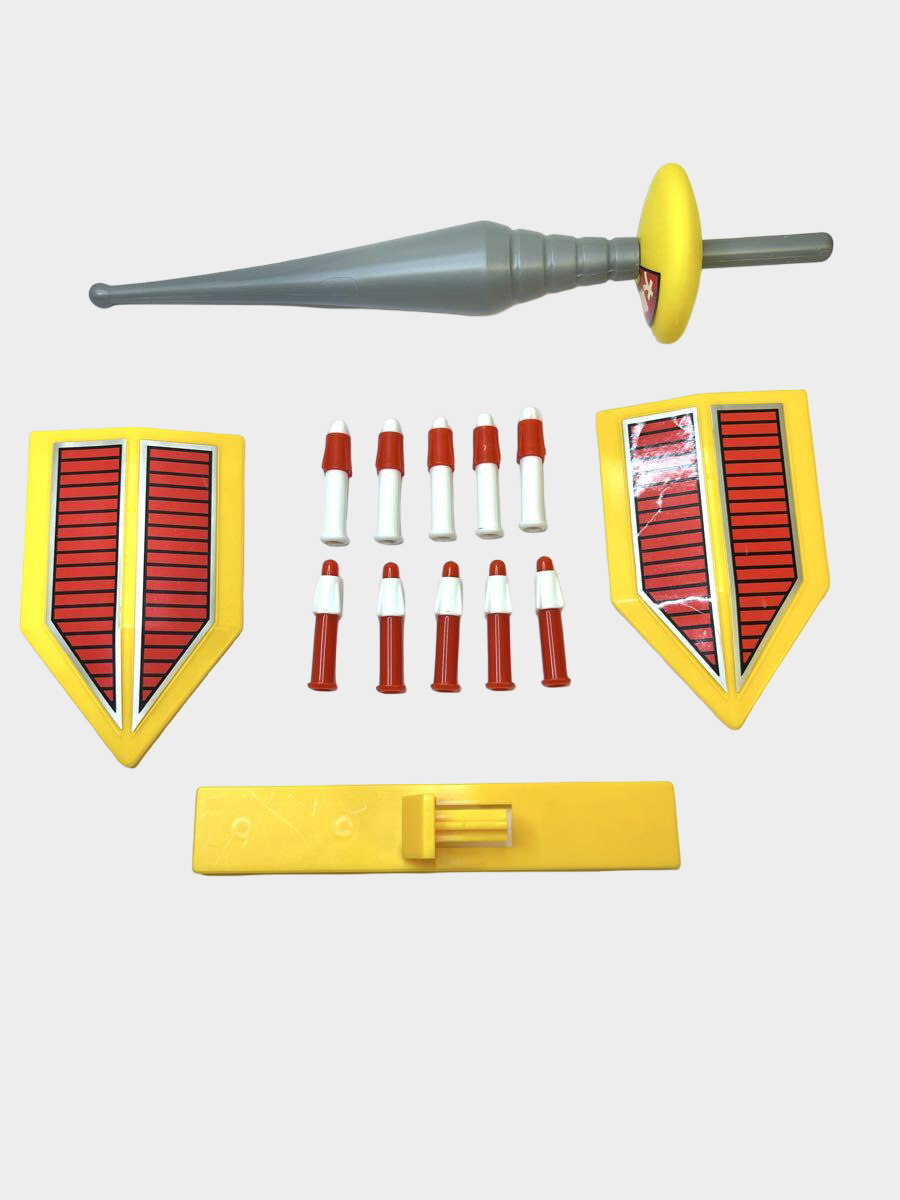
Figura de robot gigante Daikengo Popy Jumbo Machinder con caja, era Showa de los años 1970, falta la pieza de la cola
Figura de robot gigante Daikengo Popy Jumbo Machinder con caja, era Showa de los años 1970, falta la pieza de la cola
No se pudo cargar la disponibilidad de recogida
All sales are final. Please read our refund policy before purchase.
Have a reasonable price in mind? Submit your best offer and our concierge will review it personally.
Daikengo in the Jumbo Machinder format is Showa robot ambition at its most maximal: an oversized guardian built to own a room. This example survives with its box, the element decades most often destroy, and carries one honestly declared absence, a small accessory that attaches at the tail end.
The Piece
This is a Jumbo Machinder-class character robot, the oversized, room-commanding format that sits somewhere between toy, statue and pop-cultural artifact. In the 1970s, Japan’s robot boom was more than a television trend; it was a design language that rewired how children imagined heroism, with machines given faces, armor given symbolism and weapons that read like mythology rebuilt in industrial steel. Jumbo figures were the flagship scale of that moment, meant to dominate a space, turning a child’s bedroom into a control room and a small apartment into a hangar.
Daikengo’s silhouette carries the era’s most specific visual grammar: primary colors that stand out under indoor light, sharp emblem geometry and a knight-meets-robot posture that makes the figure feel like a guardian idol more than a mere character. Showa robot design is never random decoration but a codified mythology. Bold red, blue and yellow color-blocking served as an instant readability system for television and print, and on a jumbo body those colors become almost architectural, like signage on a futuristic fortress. Helmet crests, chest emblems and shield-like panels borrow from medieval silhouettes because the narrative role is the same: a protector in a world where ordinary bodies cannot win.
Accessories in this lineage function like sacred regalia, objects that symbolize power rather than simply serving play, which is why collectors instinctively read them as part of a figure’s complete myth. Here the missing tail-mounted part is acknowledged plainly, and what survives speaks for itself: the commanding core figure, its boxed context and its rarity. For jumbo robots, visual presence and body integrity often matter more than one small attachment, especially when the figure reads powerfully at a distance and photographs as a centerpiece.
These giants were neither cheap nor niche. They were aspirational objects in a high-velocity decade when Japan’s manufacturing confidence was rising and television was shaping childhood at national scale, yet survival rates are severe. Size is the enemy of storage, so large toys were moved, bumped and discarded first; boxes were treated as disposable, since keeping packaging required a collector mindset most families did not have; and small parts vanished long before the main body did. For these giants the packaging is usually the first casualty of the decades, so a surviving box lifts the object from large vintage figure to archival display material, the kind of piece collectors use to anchor an entire shelf section.
When a boxed jumbo robot remains presentable it becomes evidence of what Showa-era toy ambition looked like at full scale: bright, fearless and engineered to feel larger than life. The piece speaks to the collector building a period-accurate wall of hero robots, where jumbo scale is the crown; to the interior collector who wants one object that reads instantly as Japanese pop-cultural design history; and to the archival-minded enthusiast who values box and figure as a matched unit, the packaging being part of the cultural document. It is best understood as rare, boxed and display-grade, for collectors who place visual impact and era authenticity above microscopic completeness.
Details
- Maker: Popy
- Model: Jumbo Machinder Daikengo
- Category: Showa-era character robot, jumbo display-grade figure
- Era: 1970s (period-accurate styling)
- Material: Painted molded plastic body with internal hardware; accessories appear to be mixed molded plastic components
- Size: Jumbo Machinder class, large and display-dominant (the class typically runs in the ~55–65 cm range)
- Included: Box, figure and the accessories shown in the photographs only
- Missing: One accessory part that attaches at the tail end
- Shipping preparation: Double-boxed with rigid corner protection and void-fill so the figure cannot strike the box walls in transit
Condition
- Very rare boxed example, offered as a used vintage display-grade piece; one accessory part that attaches at the tail end is missing.
- Condition is documented through the photographs, which should be reviewed closely.
- Typical age markers for jumbo figures of this era include micro-scuffs and surface rub on raised paint edges and corners, joint looseness at shoulders and hips depending on storage stress, and box wear such as creases, soft corners and abrasion from stacking and humidity cycles.
Popy Jumbo Heritage
Jumbo Machinder refers to a large-scale Japanese robot toy format, typically produced in soft vinyl at approximately 60 cm in height. Developed during the 1970s super-robot era, these figures were designed as monumental display pieces with missile-launching features and bold mechanical presence, and many of the most iconic examples were produced by Popy, the Bandai subsidiary that defined the standards of Japanese robot toys.
Founded in 1971 and later integrated into Bandai, Popy occupies a foundational position in the history of Japanese character toys. During the explosive growth of anime and tokusatsu in the 1970s it established the manufacturing and design standards by which robots and heroes were translated from screen to physical form, formalizing scale, weight and material language through lines such as Chogokin and Jumbo Machinder: die-cast heft, oversized proportions and bold mechanical silhouettes that made toys feel monumental rather than disposable, at once playthings and display icons within the home.
Even after the brand was absorbed into Bandai in the early 1980s, the term “Popy era” continues to signal a peak period of experimentation, quality and cultural impact. For collectors, Popy represents origin rather than revival: items bearing the name are recognized not merely as licensed merchandise but as historical benchmarks in the evolution of modern toy culture.
Authenticity & Care
Presented as a vintage Popy Jumbo Machinder Daikengo with its box; the accessory materials are read from the photographs and close-ups are the reference for confirmation. Every piece is examined and documented in Japan before dispatch and is offered with the Japonista authenticity guarantee.
Delivery from Japan
Packed by hand in Japan and shipped insured and tracked by EMS or an equivalent express service. Import duties and taxes, where applicable, are payable on arrival. Returns follow our published policy.
Considered offers are welcome through Send an Offer, and each one is reviewed personally. Pieces over $1,000 may be reserved over several payments with Layaway Privilege™.
Continue browsing: Vintage Toys
Related pieces: Popy Jumbo Machinder Grendizer with box · Popy Daimos jumbo giant robot figure · Popy Jumbo Machinder Getter 2 with box
Toy Box Requests
Hunting a particular robot, kaiju, figure or model? The Hunting Salon™ searches Japan’s collector shops and private collections, and the Deputy Vault™ secures a piece you have already found. Begin a Hunting Salon™ request →
Collectors also search: popy daikengo jumbo machinder · daikengo jumbo machinder with box · jumbo machinder daikengo · vintage popy giant robot · boxed jumbo machinder · showa robot toy 1970s · 60 cm vintage robot figure