
Twelve Divine Generals
Guardians in Clay and Wood
Twelve Divine Generals
十二神将
Twelve armoured guardians who stand round the Medicine Buddha: their names and animals, the three rival lists, and the oldest surviving set, modelled in clay at Shin-Yakushi-ji in Nara.
Identity card
Know them at a glance
- Flaming hair. Fiery locks mark the fierce guardian; the Met drawing of 1164 and the Cleveland carving both show them.
- The animal crest. In later lists a zodiac animal rises from the hair. The oldest set, at Shin-Yakushi-ji, has none.
- The weapon. Swords, vajras, mallets, axes and bows, each general with his own (Onmark).
- The armour. Lacquered and gilt in the Kamakura carvings, with eyes of rock crystal set in from within.
- The stance. No two are posed alike; the twelve stand round the Buddha as a company.
Names, animals and three rival lists
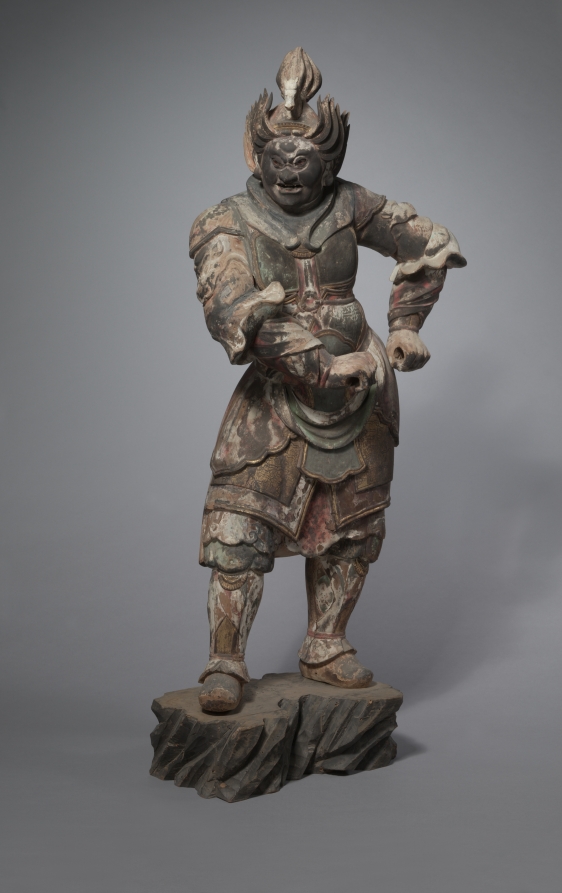
Japan, Kamakura period, 1200s. Wood with lacquer, colour, gold and crystal eyes.
Look closer: Look at the crest rising above the forehead, which the museum reads as a horse, the animal of the Year of the Horse and its hour of the day. Then look at the armour, where traces of red, green and gold survive.
Cleveland Museum of Art, John L. Severance Fund (1988.53). CC0, Open Access.
The twelve generals are not interchangeable. Each has a name, a colour, a weapon, a zodiac animal and, in Japan’s medieval thought, a Buddha or bodhisattva whom he is said to represent. The table below gives the common Japanese list, using Mark Schumacher’s Onmark Productions, which follows the 1783 iconographic compendium Butsuzō-zu-i, for the names, colours and weapons, and Wikipedia’s account for the Buddhas behind them. Where the two sources say different things, both are shown.
The animals are the most contested part. Onmark gives three lists: a main list which matches the order of the table, an alternative in which Bikara is the rat, Shotora the ox, Shindara the tiger, Makora the rabbit, Anchira the monkey and Basara the dog, and a third list from the generals at Kakuon-ji in Kamakura. Wikipedia’s table sets the Japanese zodiac beside the Chinese one and shows the two systems, offset by the order of the animals, giving different answers for the same general. Onmark adds that the pairing with animals seems to have come late: the main text puts it in the late Heian or early Kamakura period, whereas the Art Net Users System says that animal headdresses appear from the Kamakura period on. At Shin-Yakushi-ji, the oldest set, the generals wear no animals at all.
The generals also carry time. Onmark says Saichō’s Yakushi Nyorai Kōshiki links them to the twelve hours of the day, and the Cleveland Museum’s general with a horse on his head is explained in the museum’s note as corresponding to the Year of the Horse and to the hour associated with the horse. The same logic gives them months and compass points, which is why a hall of twelve generals can serve as a calendar. Wikipedia adds that the Japanese name Kubira is also that of the Shintō deity Konpira, whom the pilgrimage temple at Kotohira honours, and Onmark tells the tale of how that came to be, in the stories section of the parent page.
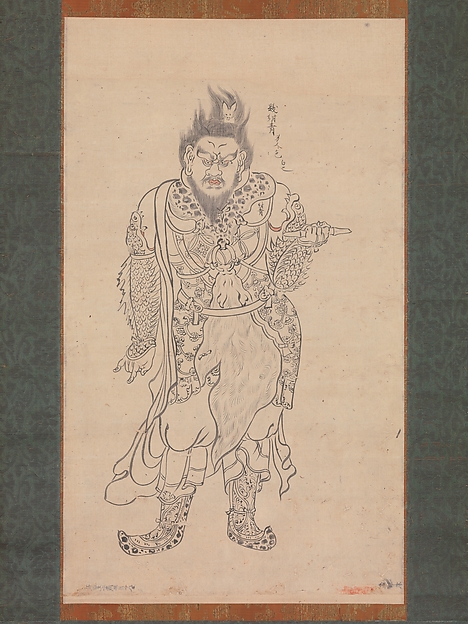
Japan, 1164. Hanging scroll; ink on paper; image 56 × 32 cm.
Look closer: This is the earliest dated general in these pages, drawn in 1164. Look at the flaming hair, the thick brows and the fierce stare, then compare the pose with the carved figures nearby, made a century or more later.
The Metropolitan Museum of Art, The Harry G. C. Packard Collection of Asian Art, Gift of Harry G. C. Packard, and Purchase, Fletcher, Rogers, Harris Brisbane Dick, and Louis V. Bell Funds, Joseph Pulitzer Bequest, and The Annenberg Fund Inc. Gift, 1975 (1975.268.14a, b). Public domain, Open Access.
| General | Zodiac animal (main list) | Colour and attribute (Onmark) | Buddha behind him (Wikipedia) |
|---|---|---|---|
| Kubira (宮毘羅), leader of the twelve | Rat | Yellow; vajra | Śākyamuni |
| Basara (伐折羅) | Ox | White; sword | Vajrapāṇi |
| Mekira (迷企羅) | Tiger | Yellow; vajra | Amitābha |
| Anchira (安底羅) | Rabbit | Green; mallet or fly-whisk | Avalokiteśvara |
| Anira (頞儞羅) | Dragon | Red; trident or arrow | Mārīcī |
| Sanchira (珊底羅) | Snake | Grey; sword or conch | Ākāśagarbha |
| Indara (因陀羅) | Horse | Red; staff or halberd | Kṣitigarbha |
| Haira (波夷羅) | Sheep | Red; mallet, bow or arrow | Mañjuśrī |
| Makora (摩虎羅) | Monkey | White; axe | Yamāntaka |
| Shindara (真達羅) | Rooster | Yellow; rope, whisk or staff | Samantabhadra |
| Shotora (招杜羅) | Dog | Blue; mallet or sword | Mahāsthāmaprāpta |
| Bikara (毘羯羅) | Boar | Red; three-pointed vajra | Maitreya |
Clay soldiers and a tree
Shin-Yakushi-ji is not a branch of Yakushi-ji. Wikipedia says the two temples have no connection, and that the first word of its name, shin, which usually means “new”, is here said to mean “miraculous”. It was founded in March 747 as Kōyaku-ji by Empress Kōmyō, praying for the recovery of her husband, Emperor Shōmu, from an eye ailment. It was built as a great seven-structure garan covering about 200,000 square metres, with more than a hundred monks and a nine-bay main hall enshrining the Seven Buddhas of Healing.
Lightning started a fire thirty-three years after the foundation, in 780, and it burned many of the halls. The great hall was lost in the middle Heian period. What survives is the Hondō, the main hall, which Wikipedia says is thought to have been the refectory. It dates from the eighth century and is a National Treasure; it has an irimoya roof, whitewashed walls and, curiously, a stained-glass window in the east wall. In the Kamakura period the priests Jōkei and Myōe restored the temple, and the belfry of 1279, the East and South gates and the Jizō Hall date from that revival.
Inside, on a circular dais nine metres across, sits the Yakushi. It is 191.5 centimetres tall, carved from a single hinoki tree, and its date is argued over: some suggest 793. In 1975 eight scrolls of the Lotus Sutra were found inside the figure, and the scrolls are a National Treasure in their own right (Wikipedia, “Shin-Yakushi-ji”).
The generals are the reason many people come. Eleven of the twelve are original clay, made between 729 and 749 and the oldest set to survive in Japan; the twelfth, Haira, was damaged in an earthquake at the end of the Edo period and replaced with a wooden figure in 1931. The wooden replacement is not a National Treasure; the eleven clay figures are. Wikipedia adds that the set was scanned in three dimensions in 2001 and 2002, and that the figure of Bazara (Basara) has appeared on a 500-yen stamp. A bell of the Nara period kept at the temple, said to come from Gangō-ji, is linked to a demon legend from the Nihon Ryōiki.

Photograph. Clay, 729 to 749, with one wooden replacement of 1931.
Look closer: Look at the twelve clay generals as a company: each has its own pose and expression. Eleven are the original clay of the eighth century; one, Haira, is a wooden replacement of 1931.
Ogawa Seiyou (1894-1960), a famous photographer in Japan, “The twelve generals at Shin-Yakushi-ji, Nara”, Wikimedia Commons, Public domain. Source: commons.wikimedia.org (file page listed in the sources below).
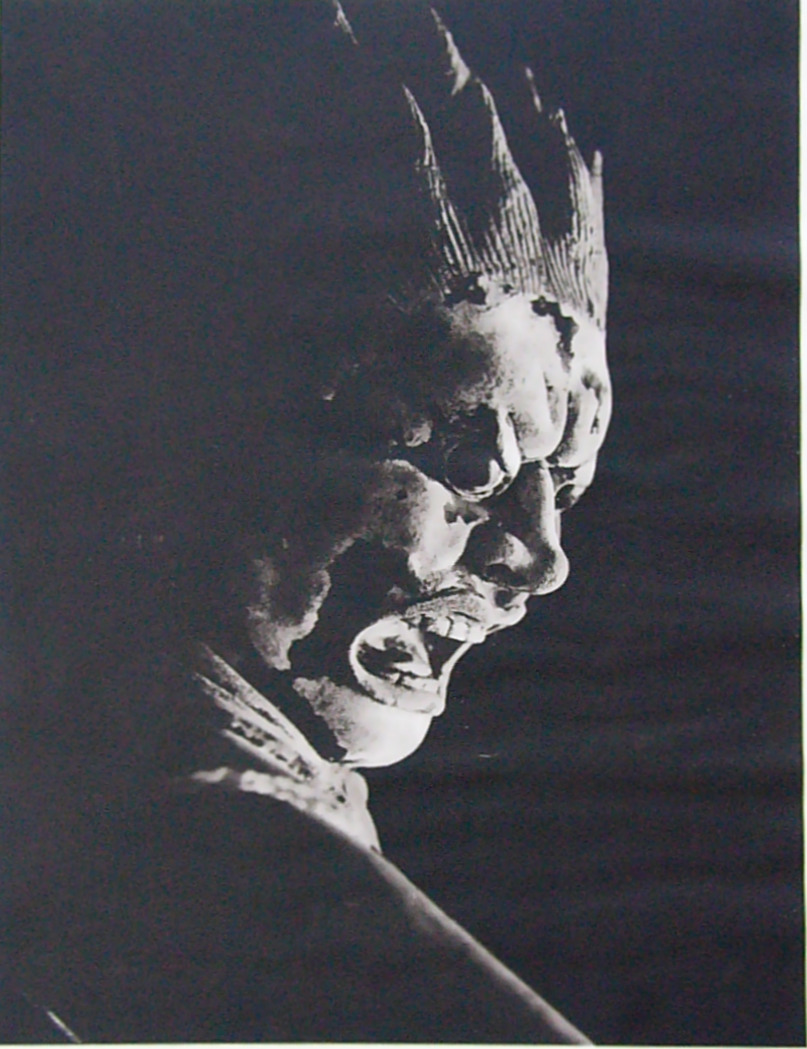
Photograph.
Look closer: This is Basara, the general who appears on the 500-yen stamp. Look at the face and the armour, and at the way the figure has been modelled in clay rather than carved.
Ogawa Seiyou (1894-1960), a famous photographer in Japan, “Basara, one of the twelve generals at Shin-Yakushi-ji”, Wikimedia Commons, Public domain. Source: commons.wikimedia.org (file page listed in the sources below).
Small facts worth the detour
- Eleven of the twelve clay generals at Shin-Yakushi-ji are National Treasures; the twelfth is a wooden replacement of 1931 (Wikipedia, “Shin-Yakushi-ji”).
- The generals were 3D-scanned in 2001 and 2002, and Basara has appeared on a 500-yen stamp (Wikipedia, “Shin-Yakushi-ji”).
- The general Kubira shares his name with Konpira, the deity of Kotohira (Onmark; Wikipedia).
- The Cleveland horse general and the Met drawing of Anchira are separated by about a century and a half, and the Cleveland figure has an animal crest (Cleveland Museum of Art; Met).
Guardians beyond Japan
The sources read for this page speak only of the Japanese generals. The Met and Cleveland objects shown here are Japanese; no claim is made about parallel sets abroad.
| Where | Form and name | What the record shows |
|---|---|---|
| Japan | Jūni shinshō | The form described on this page. |
The healer of the east
Among the Nyorai Yakushi is the Buddha who answers illness. The Thirteen Buddhas place him at the forty-ninth day after a death, the last of the seven-day rites that open the sequence, the same occasion that follows Jizō at thirty-five days and Miroku at forty-two. His attendants Nikkō and Gakkō stand on either side of him, and his twelve generals protect those who pray to him.
| Memorial occasion | Figure | Role |
|---|---|---|
| 35th day | Jizō Bosatsu | Fifth of the thirteen |
| 42nd day | Miroku Bosatsu | Sixth of the thirteen |
| 49th day | Yakushi Nyorai | The Healing Buddha, seventh of the thirteen |
| 100th day | Kannon Bosatsu | Eighth of the thirteen |
| 1st anniversary | Seishi Bosatsu | Ninth of the thirteen |
Where to see him
| Place | What to look for |
|---|---|
| Yakushi-ji, Nara | The bronze triad of 697 in the main hall rebuilt in 1976, and the East Pagoda of 730, the only original eighth-century building. |
| Shin-Yakushi-ji, Nara | The unpainted hinoki Yakushi and the twelve clay generals of the eighth century, eleven of them original. |
| Jingo-ji, Kyoto | The bare-wood Yakushi of the early Heian period, a National Treasure, in the Kondō. |
| Hōryū-ji, Ikaruga | The Yakushi of 607 in the Golden Hall, with the vow of Emperor Yōmei on the halo. |
| Metropolitan Museum of Art, New York | A Yakushi triad scroll, six wooden generals and a drawing of Anchira, all in the public domain. |
| Enryaku-ji, Mount Hiei | The Konpon-chūdō, the main hall of the Tendai school, rebuilt in 1642 under Tokugawa Iemitsu and dedicated to Yakushi. |
| Cleveland Museum of Art | The Kamakura scroll of Yakushi and the twelve generals, a seated Nikkō of about 800, a crystal-eyed general with a horse and a Silla gilt plaque, all in Open Access. |
| Rijksmuseum, Amsterdam | A hanging scroll of Yakushi, in the public domain. |
Generals in four media

Japan, early 14th century. Wood with lacquer, color, gold, and inlaid crystal eyes; each 49 cm high.
Look closer: Six of the twelve in one picture: compare the stances and the faces, and the flames rising from the hair.
The Metropolitan Museum of Art, Mary Griggs Burke Collection, Gift of the Mary and Jackson Burke Foundation, 2015 (2015.300.254a–l). Public domain, Open Access.
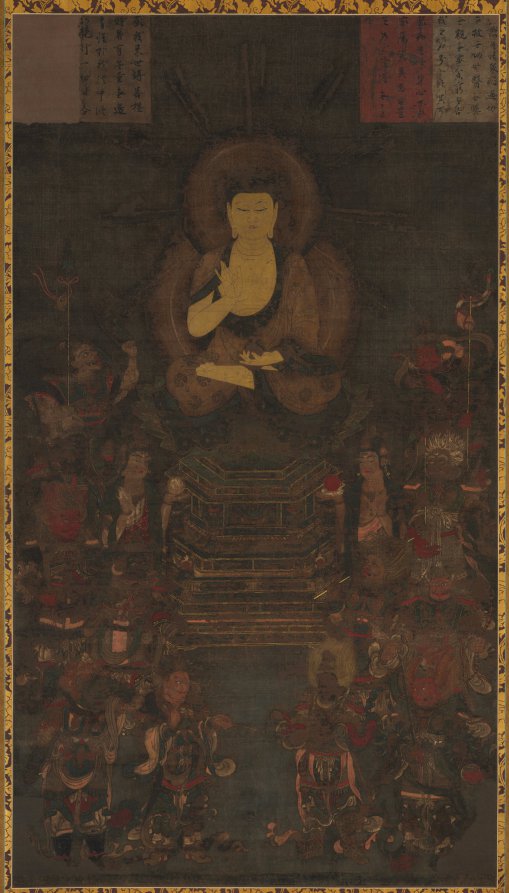
Japan, Kamakura period, 1200s. Hanging scroll; ink, colour, gold and silver on silk.
Look closer: Find the generals in the lower half of the scroll, ranged round the enthroned Buddha as they stand round him in a temple hall.
Cleveland Museum of Art, Edward L. Whittemore Fund (1938.422). CC0, Open Access.
In the house
The house keeps pieces that carry the Healing Buddha. The strip below reads the live shelves, so it shows what is available now.
A short dictionary of the generals
- Jūni shinshō (十二神将)
- The Twelve Divine Generals who protect the Buddha and his devotees.
- Butsuzō-zu-i (仏像図彙)
- The 1783 compendium of Buddhist images on which common lists of the generals draw.
- Haira (波夷羅)
- The general replaced in wood in 1931 at Shin-Yakushi-ji.
- Kokuhō (国宝)
- National Treasure, the highest designation for cultural property in Japan.
Answered plainly
What do the Twelve Divine Generals do?
They vow to protect the Medicine Buddha and those who follow him. In Japan they stand round Yakushi in a hall, or are painted below him on a scroll.
Who leads the twelve generals?
Kubira, whose name is also that of the deity Konpira, is the leader in the common Japanese list given by Onmark Productions.
Which are the oldest generals in Japan?
The clay set at Shin-Yakushi-ji in Nara, made between 729 and 749. Eleven are original and National Treasures; the twelfth, Haira, is a wooden replacement of 1931.
Do the generals match the zodiac?
In later lists each general is paired with an animal, but the lists differ. Onmark gives a main list, an alternative and a third from Kakuon-ji, and at Shin-Yakushi-ji the generals wear no animals at all.
Is there one general for each of the twelve vows?
Onmark says its sources relate the generals to the vows but that none maps each general to a particular vow, so the pairing should not be repeated as fact.
Why are some generals shown with flames in the hair?
Fiery hair marks the fierce guardian type. The museum objects shown on this page, the Met drawing of 1164 and the Cleveland carving, both show it.
Where next
Sources and image credits
- The Metropolitan Museum of Art, object 45622
- Wikipedia, Shin-Yakushi-ji
- Wikipedia, Twelve Heavenly Generals
- Onmark Productions, Twelve Heavenly Generals (names, animals, lists)
- Onmark Productions, Ashuku Nyorai (Kakuon-ji statue)
- Cleveland Museum of Art, A Heavenly General (One of the Jūnishinshō) (1988.53)
Last reviewed 28 October 2026. Pictures are public-domain or openly licensed, each credited beneath it. Diagrams on this page are drawn by Japonista.
Looking for a Yakushi, a triad scroll, or a small altar piece for a home shrine? Tell us what you have in mind and we will look.
Private concierge
Looking for something in particular?
Describe the piece or the project you have in mind. A senior advisor in Tokyo reads every case file personally and replies within two business days, with fees set out in writing before any work begins.