Japonista
Senju Kannon Reversible Sukajan, Thousand-Armed Bodhisattva on Blue Satin, Black and Gold Brocade Reverse
Senju Kannon Reversible Sukajan, Thousand-Armed Bodhisattva on Blue Satin, Black and Gold Brocade Reverse
This piece has found its collector.
The Hunting Salon™ can search Japan's private collections for another like it. Ask us to find one or browse similar pieces.
Couldn't load pickup availability
Have a reasonable price in mind? Submit your best offer and our concierge will review it personally.
A visually extraordinary reversible sukajan centered on Senju Kannon, the Thousand-Armed manifestation of Kannon Bosatsu, embroidered in silver-gray across a mottled blue satin back. Reversed, black and antique-gold jacquard opens onto a woven garden of pavilions and bridges: monumental Buddhist iconography on one side, a midnight textile garden on the other.
The Piece
The principal face presents a serene figure seated on an immense lotus throne, surrounded by radiating arms, sacred implements, crowned heads, circular emblems and finely articulated devotional ornament, in a restrained palette of cobalt blue, antique silver and charcoal that recalls an old temple engraving translated into thread. Where most sukajan announce themselves with tigers, dragons or military eagles, this one rewards close inspection: pale embroidery traces the deity through layers of silver, gray, muted lavender and shadow, the image almost engraved into the fabric while the mottled ground lends an aged, atmospheric quality. It is a contemplative sukajan rather than an aggressive one, though its presence remains formidable.
The blue satin shifts between cobalt, indigo, turquoise and smoky gray depending on the light, its irregular, washed or naturally aged surface giving depth to the composition. Aged ivory sleeves frame the blue center, narrow blue piping and inset stripes follow the raglan seams, and blue-and-cream striped ribbing completes the face. On the back, the deity sits in meditative balance on an expansive lotus pedestal, two central hands meeting in prayer at the chest while further arms radiate outward holding symbolic implements. Visible details include a calm, symmetrical face with half-closed eyes, an elaborate crown with smaller crowned or divine faces above the principal head, staffs and ritual implements, circular emblems, lotus blossoms, a wheel-like Buddhist symbol, globular objects in outstretched hands, ornamental jewelry, flowing robes, layered lotus petals and fine linear halos with architectural framing.
The embroidery deliberately avoids the bright treatment used for dragons and warriors, resembling instead a monochrome Buddhist print, a silver temple relief, a weathered devotional hanging, a line drawing in satin stitch or a figure emerging from blue stone. Thick satin-stitched contours define the lotus and major arms, finer linear stitching articulates jewelry, crown, hands and implements, and the face remains largely blue so the deity seems part of the jacket. The thread palette of pale silver, dove gray, charcoal, muted lavender, faded blue and occasional darker accents gives a moonlit effect, light alternately revealing and concealing the figure as the jacket moves. The crown rises in tiers to a larger divine face with smaller heads, and the implements appear to include lotus flowers, staffs, a wheel or circular emblem, a dark orb, a ritual vessel, possibly a mirror or jewel, bladed or trident-like forms, small seated Buddhist figures and esoteric emblems, the still center set against active outer arms. The lower third is an enormous lotus, its petals opening in symmetrical layers with heavy charcoal borders, pale silver interior stitching and small diamond details, a ceremonial pedestal whose pointed petals echo the crown and implements.
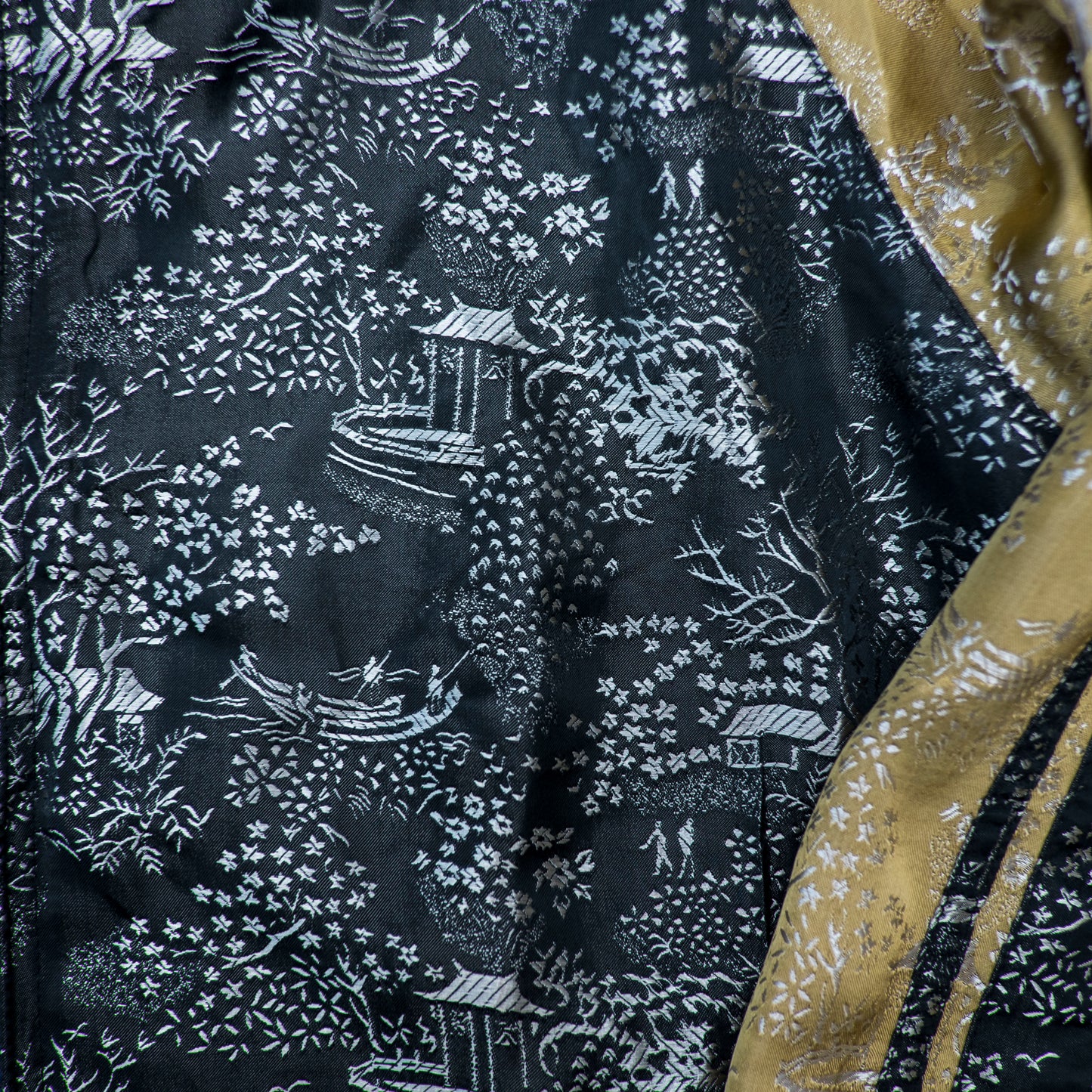
The front carries two devotional emblems rather than logo-sized chest decoration: on one side a raised hand inside a circular flame-like halo, its wrist rising from a lotus base, with fingers, palm lines and flame points carefully rendered; on the other a crowned Kannon face within a petal-shaped mandala, like a devotional seal. The reverse is a fully developed brocade bomber with its own pockets and ribbing: a black or deep charcoal body woven with a silver-gray repeating landscape, antique-gold raglan sleeves patterned with the same miniature scenery, and black-and-tan striped ribbing. Pavilions, trees, flowering branches, bridges, small structures, waterways, boats, fences, hills or rocks and garden pathways are woven into the cloth rather than embroidered, so the face reads as textured black and gold from afar and as a complete landscape up close, a garden at night with the gold sleeves as illuminated borders. More formal and textile-focused, it can be worn with no hint of the composition concealed inside.
Sukajan emerged from the postwar souvenir-jacket tradition, and modern Japanese labels have since carried the form into mythology, Buddhism, folklore, tattoo imagery and fine-art references; this example belongs to that later evolution, using the sukajan as a moving textile shrine. It does not appear to be a 1940s or 1950s occupation-era jacket: the dense computer-guided embroidery, coordinated reverse, modern zipper, extensive brocade and elaborate composition point to later Japanese fashion production, cautiously dated to the late 1990s to 2010s. The assessment rests on visible construction and design rather than a maker archive.
Details
- Maker: Unattributed
- Era: Late 1990s to 2010s (cautious assessment from construction)
- Origin: Japanese-market or Japanese-inspired production
- Material: Satin-finish outer fabric; jacquard or brocade-style reverse; multicolor embroidery thread; rib-knit trim; metal zipper with reversible slider
- Color: Blue face: mottled cobalt, lapis and ocean blue body, aged ivory or pale champagne sleeves, silver-gray, charcoal, lavender and blue embroidery. Reverse: black jacquard-style satin with silver landscape, antique-gold brocade-style sleeves
- Construction: Fully reversible raglan-sleeve bomber; angled welt pockets on both faces; striped rib-knit collar, cuffs and waistband; contrasting sleeve panels; decorative sleeve piping
Condition
- Pre-owned vintage condition with visible age and substantial signs of previous wear and storage, especially on the pale sleeves and rib-knit areas; the main Kannon composition remains remarkably complete and visually powerful.
- General satin wrinkling and creasing; mottled color variation throughout the blue body; uneven fading or a washed appearance.
- Noticeable discoloration and grayish marks on the ivory sleeves, areas of yellowing or age toning, surface soiling concentrated around the sleeves and cuffs, and darkened areas near the lower sleeves.
- Wear and discoloration to the striped ribbing, with minor fuzzing or pilling on the knit trim.
- Natural rippling around dense embroidery, possible isolated thread pulls and minor loose or projecting embroidery fibers.
- Creasing throughout the brocade reverse and general evidence of handling and prolonged storage.
- The central face, arms, implements, crown, chest emblems and lotus base are all clearly readable, and the brocade landscape continues across body and sleeves.
- No large structural tear is immediately apparent, but the jacket is not represented as unused or pristine; satin changes under light, so some dark and pale areas may look stronger or weaker by angle. Further close-ups are available on request.
Kannon Iconography
The composition is likely intended to represent Senju Kannon, the Thousand-Armed Kannon, in an elaborate crowned form associated with perceiving suffering in every direction and responding through innumerable compassionate actions. In established Japanese Buddhist imagery the many arms symbolize compassion reaching outward through countless methods; Japanese museum and temple scholarship explains that the "thousand" is understood as immeasurable, the hands and their implements representing the many ways Kannon answers those in distress.
The tiered crown and smaller faces recall the many-faced iconography of Kannon manifestations able to observe the world from every direction. Because the design is stylized rather than copied from a documented temple statue, it is best read as a fashion interpretation of Senju Kannon and eleven-faced Kannon imagery: perception expands upward while compassionate action radiates outward. The lotus, widely associated with awakening and spiritual purity, gives the figure its stable base.
Display and Storage
The Kannon face is substantial enough to display as embroidered textile art, in a Japanese fashion archive, meditation room, Buddhist art collection, tattoo studio, boutique, creative studio, music room or eclectic interior. Use a wide padded hanger, avoid prolonged direct sunlight, moisture and compression beneath heavier garments, and keep the pale sleeves away from dark-dyed fabrics that may transfer color.
Styling Notes
- Blue face: black denim, wide charcoal trousers, raw indigo jeans, cream work pants, black leather boots, minimal white sneakers, silver jewelry, plain black T-shirts, avant-garde or monochrome layering, vintage amekaji wardrobes
- Brocade face: black tailored trousers, dark denim, neutral knitwear, cream shirts, gold-toned accessories, loafers, minimal sneakers, contemporary Japanese silhouettes, evening streetwear
Authenticity & Care
Unattributed; the jacket is presented on its imagery, construction and visible craftsmanship without a brand attribution, and the dating is a cautious assessment from construction and design. Every piece is examined and documented in Japan before dispatch and is offered with the Japonista authenticity guarantee.
Delivery from Japan
Packed by hand in Japan and shipped insured and tracked by EMS or an equivalent express service. Import duties and taxes, where applicable, are payable on arrival. Returns follow our published policy.
Considered offers are welcome through Send an Offer, and each one is reviewed personally. Pieces over $1,000 may be reserved over several payments with Layaway Privilege™.
Continue browsing: Sukajan Souvenir Jackets · Amekaji & Wagara Fashion
Related pieces: Mihara Yasuhiro Japan map reversible sukajan · WACKO MARIA × 56 Tattoo Studio skull sukajan · Japonisme Kyoto Botan Doro peony lantern sukajan
Yokosuka Archive
A particular size, motif or decade in mind? Postwar souvenir jackets and heritage amekaji surface in Japan one at a time. Name the maker, the embroidery and the chest measurement, and the Hunting Salon™ watches for it on your behalf. Request a jacket search →
Collectors also search: senju kannon jacket · thousand armed kannon sukajan · buddhist sukajan · kannon embroidered bomber · blue reversible sukajan · brocade souvenir jacket · bodhisattva embroidery jacket