Rare Vintage, Antiques and Art Collector / Curator / Personal Shopper From Japan
WACKO MARIA x 56 Tattoo Studio “Gebor” Horned Skull Reversible Sukajan Jacket — Blue & Champagne Satin — Size L
WACKO MARIA x 56 Tattoo Studio “Gebor” Horned Skull Reversible Sukajan Jacket — Blue & Champagne Satin — Size L
Couldn't load pickup availability
Have a reasonable price in mind? Submit your best offer and our concierge will review it personally.
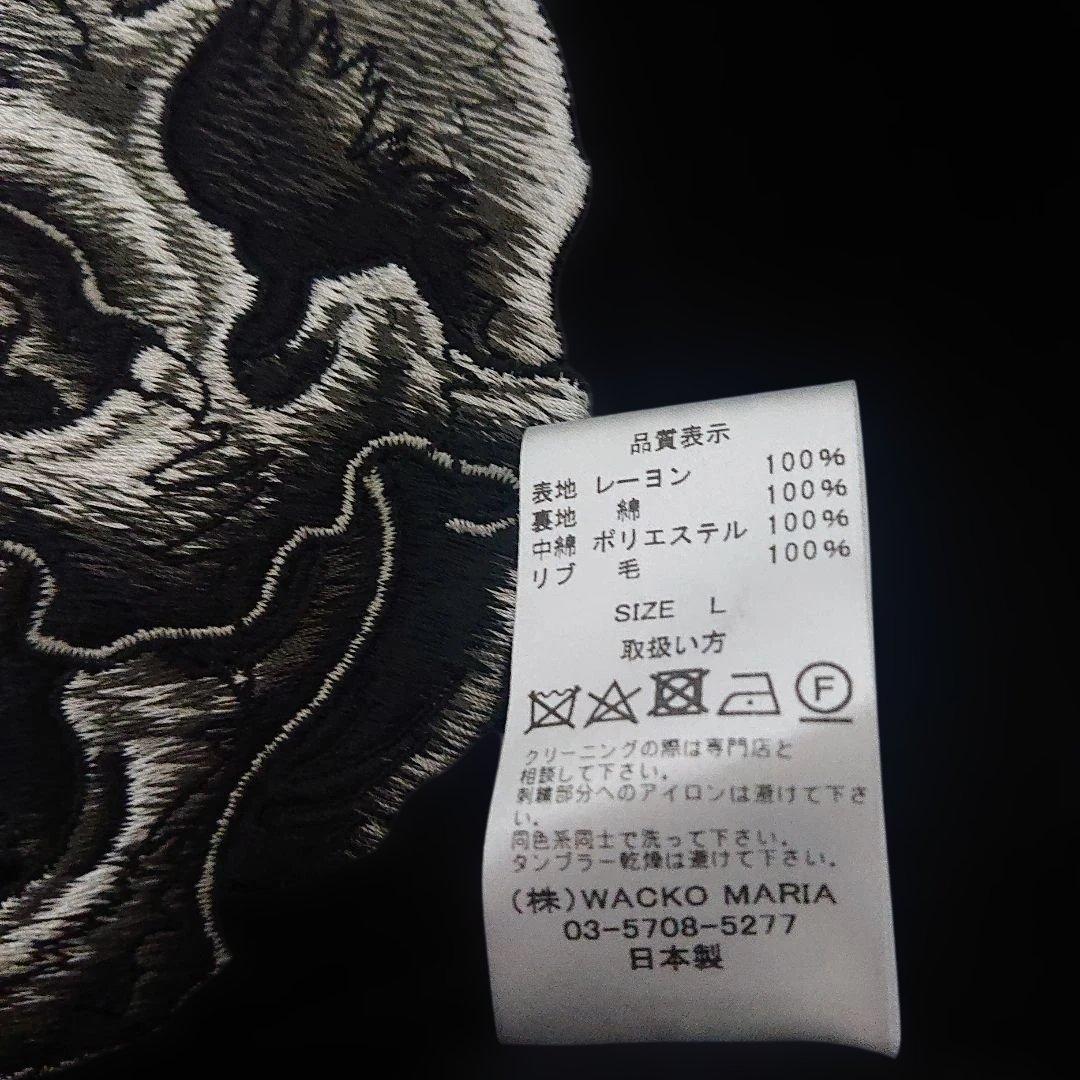
There are jackets that simply cover the body, and then there are jackets that operate as portable archives—objects that carry a visual lineage, a scene, a city, and a set of private codes. This WACKO MARIA collaboration with Tokyo’s 56 TATTOO STUDIO belongs in the second category. It uses the classic souvenir-jacket grammar—raglan sleeves, rib-knit collar and cuffs, lustrous satin sheen, oversized back embroidery—and then re-authors that grammar through contemporary Shibuya tattoo culture.
The composition is anchored by an imposing horned skull, embroidered at heroic scale across the back. In traditional sukajan iconography, dragons, tigers, eagles, and maps act as emblems of power, myth, and travel. Here, the skull becomes a modern crest—less about “danger” and more about permanence. Tattoo culture is a practice of committing to an image, and this jacket translates that commitment into cloth: the back panel reads like a backpiece, an embroidered declaration that mirrors the language of skin.
Below the skull sits the script “Gebor,” stitched in red like a signature on a canvas. Whether read as a name, a password, or a studio code, it functions the way the best collaborative garments function: not as a loud logo, but as an insider marker that rewards the person who knows where to look. It is the kind of detail collectors fixate on because it is specific, difficult to counterfeit convincingly, and inseparable from the collaboration’s identity.
Color does quiet luxury work. The deep blue body feels nocturnal and formal, while the champagne sleeves keep the silhouette tied to mid-century souvenir-jacket contrast. That tension—refined palette versus transgressive subject matter—is core WACKO MARIA. The brand’s identity lives in collision: “good” tailoring with “guilty” imagery, elegance with blunt iconography. The result is a jacket that can read as elevated streetwear or as a tailored statement layer, depending on how you style it.
The reversible construction is not a gimmick; it is a curatorial mechanism. Reversible garments allow the wearer to choose which face of the archive to exhibit. One side can be the proclamation (the skull as banner), while the reverse—often velvet or a quieter textile—becomes the “vault side,” worn when you want the aura without the broadcast. This duality mirrors real collector behavior: some days you want the museum wall label; other days you want the piece to whisper.
What makes this collaboration especially compelling is the way it frames tattoo practice as a legitimate design discipline. 56 TATTOO STUDIO is known as a Shibuya-based tattoo studio, and the partnership sits inside a broader WACKO MARIA pattern of working with tattoo artists and studios—treating tattoo iconography as high visual culture rather than novelty. In this jacket, the studio’s identity is embedded into the garment’s most traditional sukajan feature: the back embroidery, where craft and iconography meet at full scale.
From an archive-fashion perspective, the piece also sits at an intersection of Japanese and American references. Sukajan itself emerged from postwar Japan, combining American varsity silhouettes with Japanese embroidery technique and iconography. This jacket continues that hybrid line: the silhouette reads varsity-adjacent, the craft reads Japanese, and the subject matter reads global underground—tattoo, rockabilly, punk, and nightlife. That layered provenance is why sukajan remains collectible: it is not one story; it is multiple histories braided into one garment.
Practically, the measurements make it a wearable collector’s size. A wide chest and comfortable yuki (raglan sleeve measurement) let the jacket drape over hoodies or knitwear, while the ribbing keeps the shape crisp. That wearability matters for resale: collectors do not only buy to store; they buy to live inside the archive. When a jacket can be both “display” and “daily,” it becomes more liquid internationally.
In short, this is not a generic skull jacket. It is a collaboration-coded sukajan that uses traditional Japanese souvenir-jacket construction to carry a contemporary Shibuya tattoo-studio signature. The value is not only in the embroidery; it is in the specificity—of partner, motif, script, palette, and reversible structure. That specificity is what turns clothing into a catalog-worthy object.
• Brand / Label: WACKO MARIA (Guilty Parties)
• Collaboration: 56 TATTOO STUDIO
• Type: Reversible Sukajan / Souvenir Jacket
• Size: L
• Colorway: Blue body / Champagne sleeves
• Construction highlights:
- Raglan sleeve sukajan silhouette
- Rib knit collar/cuffs/hem for structure
- Oversized embroidery panel work (collector-grade visual impact)
- Reversible build (two “faces” in one jacket)
• Fit note (international buyers):
- Wide chest (66 cm) = comfortable layering, relaxed drape, strong resale liquidity for “L” wearers
WHY THIS COLLAB COMMANDS PREMIUM
• WACKO MARIA’s collectible lane:
- Resale demand is strongest for outerwear with narrative density: sukajan, Vietnam jackets, artist/tattoo collaborations.
• 56 TATTOO STUDIO as collaborator:
- Studio collaborations read as “scene-authenticated” pieces—less mass-fashion, more subculture artifact.
- They circulate less frequently than general releases, and the best sizes (L/XL) become internationally chased.
• Value drivers present in this piece:
- Reversible build (higher material/production complexity)
- Large-scale embroidery (not a minimal logo item)
- Partner specificity (collab-coded, not generic)
- Wearable collector sizing (L with generous measurements)


There are 2 type of jackets with different measuring guides as can be seen above. Please be guided accordingly to distinguish which is which.
Authenticity & Archive Standards
Each piece is evaluated under the Japonista Authentication Framework™, with close attention to:
-
Fabric, material, and construction analysis
-
Stitching, embroidery, print, and hardware verification
-
Brand, era, and stylistic consistency
-
Condition grading and wear-pattern assessment
-
Handling, storage, and long-term preservation considerations
All items are 100% authentic, backed by the Japonista Lifetime Authenticity Warranty™.
A Note on Stewardship & Archive Curation
At Japonista, we approach Amekaji fashion archives not merely as clothing, but as cultural garments shaped by craft, subculture, and time. Every piece is carefully examined, researched, and curated with respect for its origin, design language, and place within the evolution of Japanese street and heritage fashion.
Our role extends beyond offering rare pieces — we act as responsible stewards of archive-grade fashion, connecting garments with collectors who value authenticity, depth, and intention.
Before Proceeding
We kindly encourage customers to review our shop policies and house guidelines, available via the website footer. These outline shipping, handling, and condition considerations specific to vintage, archive, and collectible fashion pieces.
A Closing Note
Thank you for exploring Japonista’s Amekaji fashion archives and rare street-heritage pieces. We are honored to share garments that carry history, craftsmanship, and character — and to help place them where they will continue to be worn, preserved, and appreciated.
If you have questions or wish to explore related pieces, please feel free to contact Japonista Concierge™ at any time.