Miyabi Musubi
Miyabi Musubi Reversible Sukajan, Dokuro Skull & Dragon to Kingyo Goldfish and Sakura, Red Satin, Size L
Miyabi Musubi Reversible Sukajan, Dokuro Skull & Dragon to Kingyo Goldfish and Sakura, Red Satin, Size L
Couldn't load pickup availability
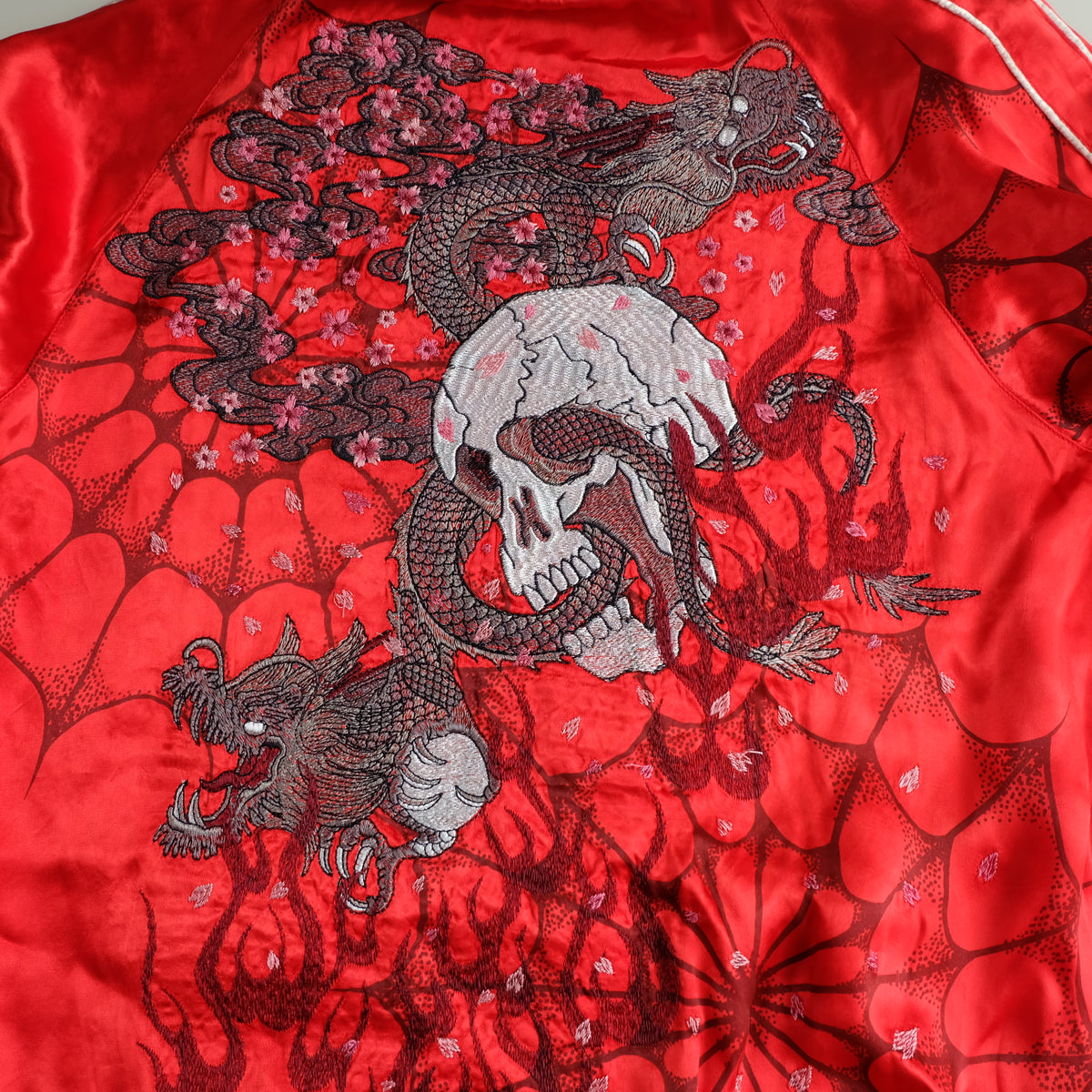
Two worlds in blood-red satin. One face of this Miyabi Musubi sukajan erupts with a pale dokuro skull pierced by a coiling dragon among dark clouds and cherry blossoms; the other turns lyrical, with ornamental kingyo drifting beneath sakura branches. Beautiful and confrontational at once, it is maximalist Japanese streetwear at full volume.
The Piece
One face is crimson satin with a skeletal dokuro, serpentine dragons, dark clouds, flowering cherry branches and shadowy floral forms; the other shifts into a lyrical composition of embroidered kingyo goldfish, drifting sakura petals, flowering branches and rippling water. Part Japanese garden, part underground rock poster, part tattoo flash sheet, it is wearable textile theater. Silver-gray embroidery glows against the scarlet ground, burgundy shadows deepen the imagery, and pale sleeves on the kingyo face create a dramatic change when the jacket is turned. A specialist reference matching this exact design identifies it as a Miyabi Musubi reversible goldfish-and-sakura jacket with a dragon-and-skull reverse, confirming the intended pairing.
The skull dominates the upper torso, its cracked crown, hollow nasal cavity and exposed teeth worked in cool silver, white and muted gray with burgundy outlines that keep it from dissolving into the red. A scaled serpent or dragon passes directly through it, emerging at the eye, curving around the cheek and continuing through the open jaw, so that skull and dragon become a single hybrid emblem. A second dragon descends from dark embroidered clouds on the opposite side of the torso, built from dense directional stitching that defines individual scales, horns and whiskers, curving limbs, clawed feet, a serpentine body, open jaws and a layered mane; it is rendered mainly in deep plum, charcoal, gray and dark red so it stays within the crimson atmosphere. Rolling cloud forms with scattered sakura spread across the upper body, a fierce bird-like creature with spread wings and extended claws appears below the larger dragon like a shadow or guardian, and large dark floral forms run across the sleeves and lower body as an all-over printed or woven graphic field that reads, at a distance, like spiderwebs, chrysanthemum petals or abstract tattoo geometry.
The dokuro here speaks less of death than of impermanence, fearlessness and confrontation. Beside cherry blossoms it joins the familiar Japanese tension between beauty and transience: the blossom reaches full brilliance and falls, the skull remains, and the dragon moves between them with energy and supernatural power. Beauty and decay, power and mortality, movement and stillness, spring blossoms and exposed bone, traditional ornament and punk rebellion are held in one image, with the force of tattoo culture but no direct imitation of any single tattoo composition. The red monochrome, anatomical imagery and crowded surface belong naturally in punk, metal, rockabilly, visual-kei, tattoo, biker and alternative wardrobes, yet the raglan silhouette, reversible structure, satin finish, cloud forms, dragon anatomy and sakura keep the jacket firmly within Japanese sukajan and wagara design.
Turned inside out, the skull disappears into a red-and-ivory composition. The fish have rounded bodies, large eyes and broad flowing fins closer to ornamental kingyo than streamlined carp, worked in red, wine, silver and white with individual scales and long directional fin stitches; they appear across front and back in different sizes and orientations, some turning upward, others moving horizontally, smaller ones drifting between branches. Fine embroidered sakura branches cross the red body with blossoms in pale pink, dusty rose, burgundy, crimson and soft ivory, petals floating between the fish and onto the pale ivory sleeves, where crimson piping and red-striped ribbing reconnect them to the palette. Dark red lines beneath the embroidery read as flowing water around the fish, as the grain of an old lacquered panel near the branches and as almost psychedelic marbling across the lower body. Kingyo, with their exaggerated tails and cultivated forms, evoke ornamental beauty and summer atmosphere and act as a counterweight to the dragon: one side roars, the other glides. Sakura on both faces form the bridge between the two worlds.
Miyabi Musubi is an original Japanese fashion label associated with Ryugi Assaku and the METHOD retail group; its official description presents wearable Japanese-pattern clothing that balances traditional imagery with everyday styling rather than confining wagara to ceremonial or costume-like use. This jacket represents the louder, more theatrical edge of that philosophy, treating front panels, sleeves, shoulders and back as connected surfaces. It appears to be an earlier or discontinued design rather than a current seasonal release; no production year is visible, and the saturated palette, all-over embroidery, reversible construction and maximalist wagara styling are consistent with late Y2K and post-Y2K Japanese streetwear. It is an older Japanese designer streetwear piece, not an original postwar souvenir jacket.
Details
- Maker: Miyabi Musubi
- Era: Earlier or discontinued design, late Y2K to post-Y2K style; no production year visible
- Material: Glossy satin-finish textile; multicolor machine embroidery with printed detailing; rib knit; metal zipper; decorative piping
- Color: Scarlet red, crimson, burgundy, silver-gray, pink and ivory
- Size: L (manufacturer's tag); unisex
- Measurements: Length approx. 72 cm · Flat body width approx. 55 cm · Sleeve from upper shoulder approx. 66.5 cm · Sleeve along underarm seam approx. 53.5 cm (laid flat)
- Model Reference: Photographed on a model approx. 164 cm tall and 52 kg
- Construction: Fully reversible; reversible front zipper; raglan sleeves; striped rib-knit collar, cuffs and waistband (red with pale stripes); angled welt pockets on both faces
- Dokuro Face: Dragon-pierced skull, second dragon, dark clouds, sakura, bird-like creature, oversized floral linework
- Kingyo Face: Kingyo goldfish, sakura branches, marbled water currents; ivory sleeves
Condition
- Pre-owned and offered in its present vintage condition; no claim of mint, unworn or factory-perfect condition is made.
- General surface creasing, folding lines, light signs of wear, minor thread irregularity, natural puckering around embroidered sections and subtle tonal variation across the glossy satin.
- The embroidery keeps strong definition and vivid color; skull, dragon, goldfish and sakura motifs remain highly legible. Rib-knit trim, zipper and pockets appear present.
- Heavy embroidery naturally gathers and puckers the surrounding satin, part of the dimensional character of the garment.
- Minor storage signs, faint marks, small pulls, loose fibers or embroidery wear may not show equally under every light; glossy red and ivory satin reveal marks differently by angle, so the photographs form part of the condition record.
Fit and Styling
Compare the 72 cm length and 55 cm flat width with a jacket you own; small variations may occur with positioning, fabric movement and the volume of the reversible construction, and vintage Japanese sizing does not always match Western sizing. On the 164 cm, 52 kg model the jacket shows a comfortably relaxed silhouette with room through the body and sleeves; a slimmer wearer will find a deliberately oversized profile, a broader wearer a closer fit.
The dokuro face pairs with black denim, leather trousers, distressed jeans, military cargos, engineer boots, creepers, combat boots, silver jewelry and monochrome layers, suiting punk, rock, metal, visual-kei, gothic, biker and tattoo styling. The kingyo face, slightly easier to style thanks to its ivory sleeves, works with dark indigo denim, cream trousers, wide-leg black pants, vintage sneakers, plain knitwear, minimal T-shirts and Japanese workwear. Over a plain black or white base the embroidery functions almost like a moving mural.
Authenticity & Care
A specialist reference matching this exact design identifies it as a Miyabi Musubi reversible goldfish-and-sakura jacket with a dragon-and-skull reverse; no production year is visible, so none is assigned. Every piece is examined and documented in Japan before dispatch and is offered with the Japonista authenticity guarantee.
Delivery from Japan
Packed by hand in Japan and shipped insured and tracked by EMS or an equivalent express service. Import duties and taxes, where applicable, are payable on arrival. Returns follow our published policy.
Considered offers are welcome through Send an Offer, and each one is reviewed personally.
Continue browsing: Sukajan Souvenir Jackets · Amekaji & Wagara Fashion
Related pieces: Miyabi Musubi rising koi and sakura sukajan · Miyabi Musubi reversible kingyo and dragon sukajan · Miyabi Musubi Sanada samurai reversible sukajan
Yokosuka Archive
A particular size, motif or decade in mind? Postwar souvenir jackets and heritage amekaji surface in Japan one at a time. Name the maker, the embroidery and the chest measurement, and the Hunting Salon™ watches for it on your behalf. Request a jacket search →
Collectors also search: miyabi musubi skull sukajan · dokuro dragon jacket · red reversible sukajan · kingyo goldfish sukajan · skull dragon souvenir jacket · punk japanese bomber jacket · sakura skull embroidered jacket