
The Thirteen Buddhas (Jūsanbutsu)
Memorial Cycle
The Thirteen Buddhas
十三仏
Thirteen Buddhas, bodhisattvas and one wisdom king, each assigned a rite for the dead from the first week to the thirty-third year: a Japanese invention grown from the Ten Kings of Hell.
Identity card
Know the figure at a glance
- 7th day. Fudō begins the sequence of memorial rites (JAANUS, Wikipedia).
- 49th day. Yakushi closes the seven weeks; the seventh seven-day rite falls on the 49th day (Wikipedia).
- 100th day. Kannon presides over the hundredth day (JAANUS, Wikipedia).
- 1st year. Seishi governs the first anniversary (Wikipedia).
- 12th year. Dainichi presides over the twelfth-year rite in Wikipedia's count, the thirteenth in JAANUS's.
- 32nd year. Kokūzō ends the sequence at the thirty-second year in Wikipedia's count, the thirty-third in JAANUS's.
Thirteen figures, one for each rite
The Japan Architecture and Art Net Users System (JAANUS) calls the jūsanbutsu a set of thirteen Buddhist deities, including myōō, wisdom kings, and bosatsu, bodhisattvas, who are invoked at the thirteen memorial services traditionally held for the dead. The Metropolitan Museum's note on its Mandala of the Thirteen Buddhas counts five buddhas, seven bodhisattvas and one wisdom king, worshipped in the Shingon school, each the focus of one memorial rite in the days, weeks and years after a death. Wikipedia adds that the figures are used chiefly in Shingon and Tendai and that lay followers recite a mantra to each; in Shingon, disciples usually devote themselves to one figure, as their teacher assigns, and Yakushi's is the only mantra that fundamentally differs between the two schools.
JAANUS calls it a purely Japanese convention, already evolved by the fourteenth century and popular in the next. Mark Schumacher's Buddhist statuary site makes the same point from the other side: the group does not appear in the Taishō Buddhist Canon, and it is not the same as the Thirteen Buddha texts that the canon does contain.
Five buddhas, seven bodhisattvas, one king
The Metropolitan Museum's count of five buddhas, seven bodhisattvas and one wisdom king can be checked against the roll that Wikipedia gives. The buddhas, nyorai, are Shaka, Yakushi, Amida, Ashuku and Dainichi; the bodhisattvas, bosatsu, are Monju, Fugen, Jizō, Miroku, Kannon, Seishi and Kokūzō; and the one wisdom king, myōō, is Fudō. That makes thirteen, and the sums agree. Wikipedia says the same in its own words: the deities are, in fact, not only buddhas but also include bodhisattvas, which is why its illustration of a set is captioned with the looser word deities.
Eight of the thirteen also appear in a second role, as guardians of the twelve earthly branches of the zodiac. The table gives the guardian for each branch where Wikipedia names one. It also gives the memorial rite in Wikipedia's count; the next section sets that count beside JAANUS's.
| No. | Figure | Class | Rite (Wikipedia's count) | Zodiac guardian of (Wikipedia) |
|---|---|---|---|---|
| 1 | Fudō | Wisdom king | 7th day | Rooster |
| 2 | Shaka | Buddha | 14th day | None given |
| 3 | Monju | Bodhisattva | 21st day | Rabbit |
| 4 | Fugen | Bodhisattva | 28th day | Dragon and snake |
| 5 | Jizō | Bodhisattva | 35th day | None given |
| 6 | Miroku | Bodhisattva | 42nd day | None given |
| 7 | Yakushi | Buddha | 49th day | None given |
| 8 | Kannon | Bodhisattva | 100th day | Rat |
| 9 | Seishi | Bodhisattva | 1st anniversary | Horse |
| 10 | Amida | Buddha | 2nd anniversary | Dog and pig |
| 11 | Ashuku | Buddha | 6th anniversary | None given |
| 12 | Dainichi | Buddha | 12th anniversary | Goat and monkey |
| 13 | Kokūzō | Bodhisattva | 32nd anniversary | Ox and tiger |
The second anniversary, or the third?
The order of the thirteen is the one thing the sources we read agree on. Wikipedia gives it from Fudō to Kokūzō; JAANUS opens with Fudō and closes with Kokūzō; the Tale of Genji site visits the Kyoto temples in the same order, Fudō first and Kokūzō last; and the Japanese Wikipedia, whose own table of the thirteen came through empty in the copy we read, states that the thirteen rites run from the first seven days to the thirty-third memorial. Where the sources give the early rites, they agree on those too: the seventh, fourteenth, twenty-first, twenty-eighth, thirty-fifth, forty-second and forty-ninth days, then the hundredth day.
The disagreement begins after the hundredth day, and it is a disagreement about numbers, not about figures. Wikipedia names the later rites the first, second, sixth, twelfth and thirty-second anniversaries. JAANUS counts the same last four as the third, seventh, thirteenth and thirty-third. Schumacher's account of the Chinese precedent agrees with JAANUS's numbers: it describes Chinese rites on the hundredth day and in the first and third years, and says that Japan added the seventh, thirteenth and thirty-third years. JAANUS's table of the ten kings, set out on the page for Enma and the Ten Kings, likewise gives Amida's king the third anniversary.
The Japanese Wikipedia supplies a rule that may explain the gap. It says that counting starts with the day of death as the first day, so that the first seven-day rite falls on the seventh day, six days after the death, and that the same counting applies to the other intervals except the first anniversary. On that rule a rite called the third falls two years after the death, and the seventh, thirteenth and thirty-third fall six, twelve and thirty-two years after it. That is exactly Wikipedia's second, sixth, twelfth and thirty-second. Neither source states the equivalence in these words, so we offer it as our reading; the table sets the two counts side by side.
| Source | Rites after the hundredth day | What it adds |
|---|---|---|
| Wikipedia (English) | 1st, 2nd, 6th, 12th and 32nd anniversaries | Full roll with Sanskrit names and a mantra for each |
| JAANUS | Last four rites as the 3rd, 7th, 13th and 33rd | Calls the set a purely Japanese convention |
| Mark Schumacher | Chinese rites at 100 days, 1 year, 3 years; Japan added the 7th, 13th and 33rd years | Traces each rite to its earlier source |
| Wikipedia (Japanese) | From the first seven days to the 33rd memorial; day of death counted as day one | Notes that the Kansai practice favours the evening before |
| Tale of Genji site | No dates; thirteen temples in order | Confirms the order from Fudō to Kokūzō |
| Enma page, from JAANUS | Seishi at the first anniversary, Amida at the third | Matches JAANUS's count of the ten kings |
From ten kings to thirteen
JAANUS says the set is thought to have developed from the belief in the ten kings of the underworld, jūō, who were seen as manifestations of ten Buddhas, jūbutsu; three more were then added. The first ten Buddhas in the list match the honji that JAANUS assigns to the ten kings, Fudō to Amida, and the Enma chapter of this almanac sets the ten kings out in full. Schumacher dates the earliest text that pairs the kings with Buddhist deities to the late twelfth century, the Scripture on Jizō and the Ten Kings, which he considers an apocryphal Japanese text, and quotes the scholar Takeda Kazuaki's sequence: ten kings with ten Buddhas, then ten kings with eleven, then eleven Buddhas alone as the kings disappear, and finally thirteen.
The date is uncertain. Schumacher writes that in the twelfth and thirteenth centuries the group had ten, eleven or twelve members, and that the standard thirteen appeared around the mid-fourteenth century; art of the group appears in the late twelfth century, but texts naming all thirteen do not appear until the Muromachi era. The Kagakushū dictionary of 1444 and an early-fifteenth-century Kōbō Daishi text list the thirteen with their memorial dates. The three late additions, the rites of the seventh, thirteenth and thirty-third years in the Japanese count, he says, appear only in Japan. He reports no conclusive textual evidence for the creation of the group, while arguing that the Shingon school is the likeliest origin, and lists several theories for the number thirteen: seven weeks plus six realms of rebirth; the ten directions plus the three ages of Buddhas; and the thirteen great courts of the Womb World Mandala.
Ten judges, their Buddhas, three more
The set grew from a trial. In the Chinese scheme, ten kings judge the dead in turn; each trial falls at a fixed point, from the first seven days to the third year. The chapter on Enma and the Ten Kings sets the ten out in full. JAANUS gives each king a honji, an original nature, and the first ten of the thirteen are exactly those natures. The table pairs them.
The three further figures are Ashuku, Dainichi and Kokūzō. JAANUS's roll of kings, as that page sets it out, has ten; the Japanese Wiki Corpus, according to the same page, links three additional kings to the thirteen Buddhas. The Japanese Wikipedia says the later hearings, those of the seventh, thirteenth and thirty-third memorials, belong to judges whose honji are these Buddhas. What the three share is that they appear only in Japan, as Schumacher notes.
| King (JAANUS) | His trial | Honji | Thirteen Buddhas rite |
|---|---|---|---|
| 1 Shinkōō 泰広王 | First seven-day period | Fudō | 7th day |
| 2 Shokōō 初江王 | Second seven-day period | Shaka | 14th day |
| 3 Sōteiō 宋帝王 | Third seven-day period | Monju | 21st day |
| 4 Gokan'ō 五官王 | Fourth seven-day period | Fugen | 28th day |
| 5 Enmaō 閻魔王 | Fifth seven-day period | Jizō | 35th day |
| 6 Henseiō 変成王 | Sixth seven-day period | Miroku | 42nd day |
| 7 Taizan'ō 泰山王 | Seventh seven-day period | Yakushi | 49th day |
| 8 Byōdōō 平等王 | 100th day | Kannon | 100th day |
| 9 Toshiō 都市王 | First anniversary | Seishi | 1st anniversary |
| 10 Godōtenrin'ō 五道転輪王 | Third anniversary | Amida | 2nd anniversary (3rd in JAANUS) |
| Added later | Seventh memorial | Ashuku | 6th (7th in JAANUS) |
| Added later | Thirteenth memorial | Dainichi | 12th (13th in JAANUS) |
| Added later | Thirty-third memorial | Kokūzō | 32nd (33rd in JAANUS) |
From a forty-nine-day wait to thirteen rites
Schumacher's account of the evidence runs across more than a thousand years of memorial practice, and the timeline gives its dates in order. The earlier entries establish only that memorial rites existed; the later ones are the first to name figures. Schumacher reports no conclusive textual evidence for the moment the thirteen were chosen.
- 4th centuryThe Yogācārabhūmi-śāstra discusses the forty-nine-day period after death, the seven weeks that the first seven rites mark (Schumacher).
- 687The Nihon Shoki records memorial services in Japan (Schumacher).
- 735 and 757The Shoku Nihongi mentions memorials in both years (Schumacher).
- 9th or early 10th centuryThe Chinese Scripture on the Ten Kings is compiled; the Chinese Book of Rites is the source Schumacher gives for the hundredth-day, first-year and third-year rites.
- 11th centuryThe Shōryōshū refers to the memorial rites (Schumacher).
- 1112 to 1187The diary of Taira no Nobunori, the Hyōhanki, links the forty-nine days with particular deities (Schumacher).
- Late 12th centuryThe Scripture on Jizō and the Ten Kings, thought to be Japanese, pairs the kings with Buddhist figures for the first time (Schumacher).
- 1379A stone group of ten deities with Shaka at the centre is dated in Chiba (Schumacher).
- Mid-14th centuryThe standard thirteen appears, with the seventh, thirteenth and thirty-third years added (Schumacher). Wikipedia's illustration of a set is dated to the Nambokuchō to Muromachi period, about 1336 to 1568.
- 1444The dictionary Kagakushū lists the thirteen with their memorial dates (Schumacher).
- Early 15th centuryA Kōbō Daishi text, the Gyakushu Nikki no koto, lists the thirteen with their dates (Schumacher).
- 15th century and afterThe Muromachi offering tablets multiply across the country; the set is popularised (Schumacher, Ueshima).
- 16th or 17th centuryThe Museum's Mandala of the Thirteen Buddhas is painted (Metropolitan Museum).
- Early EdoAn undated treatise, the Jūsanbutsu Honji-Suijaku Kenbetsu Shaku, distinguishes each figure's original nature and its manifestation (Schumacher).
Six guesses at one number
Why thirteen? Schumacher gathers six explanations and treats the whole question as largely speculative. The table keeps them in his order and credits each to the scholar or the text he names.
| No. | Theory | Reasoning | Credited to |
|---|---|---|---|
| 1 | Karmic rebirth | Seven weeks of judgement, forty-nine days, plus the six realms of rebirth | Schumacher's list |
| 2 | Folklore | The thirteen memorial mounds, jūsanzuka; thirteen-storied pagodas also peaked in the Kamakura period | Yanagita Kunio (1875 to 1962) |
| 3 | Directions and ages | The ten directions plus the three ages of the Buddhas | Schumacher's list |
| 4 | Thirteen great courts | The jūsandai-in of the Womb World Mandala | Schumacher's list |
| 5 | Central court | The chūdai hachiyō-in, the central eight-petalled court of the same mandala | Schumacher's list |
| 6 | Astrotheology | Thirteen moon cycles in a year with its intercalary month | Steven Hutchins |
A mandala and a woodblock icon
JAANUS lists three forms: statue sets, stone tablets called itabi, which either show the Buddhas or carry their seed-syllables, and hanging scrolls, still used at memorial services today. The Metropolitan Museum owns two. Its Mandala of the Thirteen Buddhas, of the sixteenth or seventeenth century, is a hanging scroll in ink, colour and gold on silk, 94 centimetres high. The thirteen sit on lotus seats, one at the head and then rows of three, beneath a small red figure with outstretched arms at the very top of the scroll; a dark figure within flames sits at the lower right.
The Ōtsu-e of Thirteen Buddhist Deities, of the seventeenth century, is cheaper and more ingenious. The museum explains that earlier versions were a series of separate paintings, one for each deity, and that this work combines them into a single icon which could be used repeatedly by less affluent families. The halos and mandorlas were printed from one woodblock, and a few blocks were used for the faces; the head block used for Jizō also appears on Fudō, which softens his usually fierce expression.
Stamped Buddhas by the hundred
The Ōtsu-e shows how a printed icon could stand in for thirteen paintings. Two other Museum scrolls show the same economy at a smaller scale, though neither is a set of the thirteen. The Museum catalogues Stamped Images of Fudō Myōō, of the fourteenth or fifteenth century, as a hanging scroll of woodblock-printed images in ink on paper: a sheet of tiny identical figures, row after row, each pressed from one block. The Museum's Kana Letter on Stamped Images of Amida Buddha, of the early thirteenth century, records a brush-written letter on the front of the paper and stamped images on its reverse; in the photograph, lines of cursive show among the rows of tiny figures.
These are not memorial sets and the Museum's records do not say what they were for. They are here because they are what the technique looks like when it is not hidden by colour: a stamp, repeated. The Ōtsu-e of the thirteen, which prints its halos from one block and varies only the faces, belongs to the same family, with its economy turned to the needs of a less affluent household.
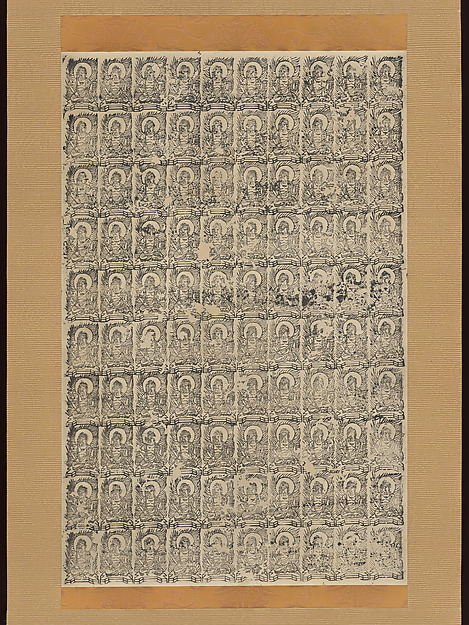
Japan, 14th–15th century. Hanging scroll; woodblock printed images; ink on paper. Metropolitan Museum of Art, 2020.396.5.
Look closer: Note the grid of identical small figures: each one is a stamp, pressed again and again across the sheet.
The Metropolitan Museum of Art, Mary and Cheney Cowles Collection, Gift of Mary and Cheney Cowles, 2020. Open Access.
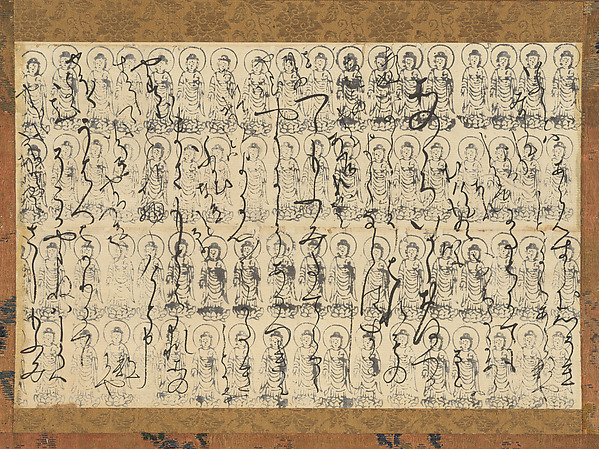
Japan, early 13th century. Hanging scroll; brush written letter, ink on paper (front); stamped images, ink on paper (reverse). Metropolitan Museum of Art, 2020.396.3.
Look closer: Note the lines of cursive writing and the rows of tiny stamped figures: the Museum's record lists the brush-written letter on the front of the paper and the stamped images on its reverse.
The Metropolitan Museum of Art, Mary and Cheney Cowles Collection, Gift of Mary and Cheney Cowles, 2020. Open Access.
From Fudō to Yakushi
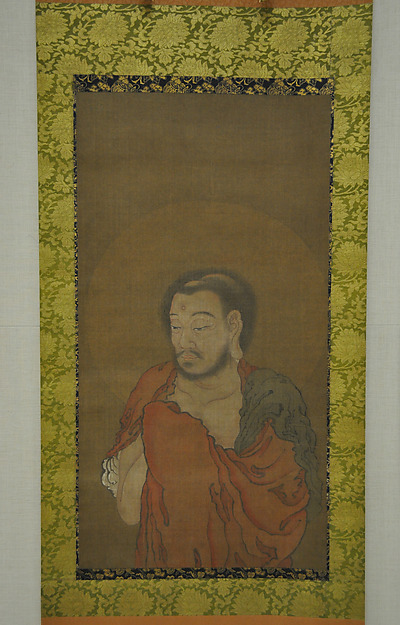
Japan, 15th century. Hanging scroll; ink and color on silk; Image 107.3 x 56.8 cm. Metropolitan Museum of Art, 18.124.11.
Look closer: Note the lowered eyes and heavy beard, and the red robe pulled across the body: the Museum titles the scroll Shaka descending from the mountains.
The Metropolitan Museum of Art, Rogers Fund, 1918. Open Access.
The first seven figures keep the seven weeks. Fudō, the wisdom king, opens the sequence on the seventh day; Shaka, the historical Buddha, follows on the fourteenth; Monju, the bodhisattva of wisdom, on the twenty-first; Fugen on the twenty-eighth; Jizō on the thirty-fifth; Miroku on the forty-second; and Yakushi on the forty-ninth, which closes the seven weeks. Each has a chapter of its own in this almanac; this page is concerned with the rite and not with the figure.
Wikipedia, in giving the mantra of each, says that Yakushi's is the only one that fundamentally differs between Shingon and Tendai; the table in the section on mantras shows the difference. Schumacher notes several pairings among the thirteen, among them Jizō with Miroku, and Fudō with Dainichi, whom he links by a shared holy day, and says that Yakushi and Ashuku may belong together. He also pairs Jizō with Kokūzō as earth and space.
Four Museum objects stand for the seven weeks, and the Museum's records give titles, dates and materials but no description, so what follows is what the photographs show. The fifteenth-century scroll titled Shaka, The Historical Buddha, Descending from the Mountains shows a bearded figure with lowered eyes in a red robe. The fourteenth-century scroll titled Monju Bosatsu with Eight Sacred Sanskrit Syllables sets a dark central figure inside a pale circle ringed by Sanskrit characters, with lines of inscription across the upper edge. Kaikei's Jizō, of about 1202, is a standing figure in lacquered cypress with gold, cut gold and inlaid crystal; he holds a tall staff and stands on a lotus base. The Yakushi triad scroll, of the seventeenth or eighteenth century, seats the Buddha on a red pedestal with an attendant at each side.

Japan, mid- to late 14th century. Hanging scroll; ink and color on silk; 103.8 x 63.8 cm. Metropolitan Museum of Art, 12.134.15.
Look closer: Note the ring of Sanskrit syllables around the dark central figure and the columns of inscription at the top.
The Metropolitan Museum of Art, Rogers Fund, 1912. Open Access.
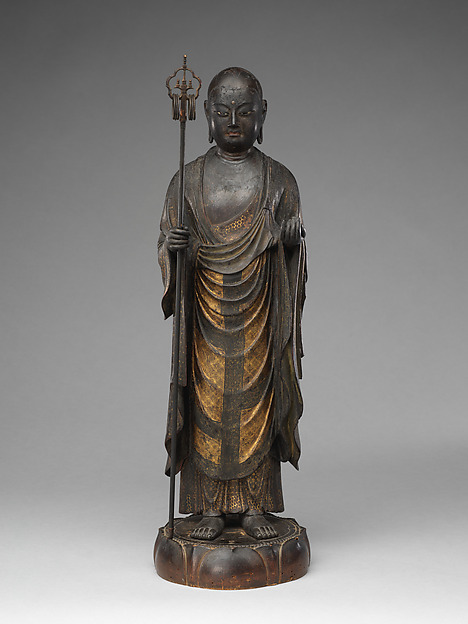
Kaikei, Japan, ca. 1202. Lacquered Japanese cypress, color, gold, cut gold, and inlaid crystal; H. 55.9 cm; W. 17.1 cm; D. 17.1 cm; Diam. 17.1 cm. Metropolitan Museum of Art, 2015.300.250a, b.
Look closer: Note the shaven head, the tall staff with its ringed top and the gold lines along the hem of the robe.
The Metropolitan Museum of Art, Mary Griggs Burke Collection, Gift of the Mary and Jackson Burke Foundation, 2015. Open Access.
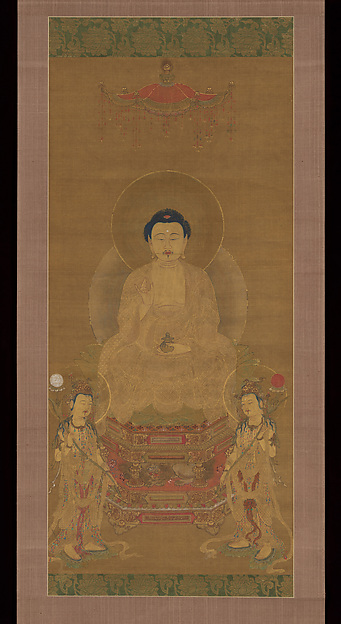
Unidentified artist, Japan, 17th or 18th century. Hanging scroll; ink, color, metallic paint, and kirikane (cut gold) on silk. Metropolitan Museum of Art, 2021.396.3.
Look closer: Note the seated central Buddha on his red pedestal with an attendant standing at either side: the three together make the triad of the title.
The Metropolitan Museum of Art, Gift of Sue Cassidy Clark, in honor of Barbara Brennan Ford, 2021. Open Access.
Kannon, Seishi and Amida
After the seven weeks the cycle leaves the calendar of days. Kannon takes the hundredth day, which JAANUS and Wikipedia both give; Seishi the first anniversary; and Amida the next, called the second anniversary by Wikipedia and the third by JAANUS. The Museum titles a further scroll with all three names, Amida with the bodhisattvas Kannon and Seishi, so the three are often met together; the images below show them one by one.
A twelfth-century wooden Shō Kannon in the Museum, 45 centimetres high, stands on a lotus base with the warm colour of aged wood. A fifteenth- or sixteenth-century scroll of the Welcoming Descent of Amida Buddha shows the standing Buddha on curling white clouds, leaning towards the viewer. The thirteenth-century Amida Triad in the Form of Sacred Sanskrit Syllables replaces the three figures with three characters in circles, embroidered in silk and gold-wrapped thread with, the Museum records, human hair. A scroll of about 1300 titled Descent and Return of Amida to Western Paradise with a Believer's Soul fills its length with tiny figures. None of these is a memorial set; they are the images that the rites of these three figures call to mind.

Japan, 12th century. Wood with traces of gold and color; H. 45.1 cm; W. 15.2 cm; D. 14.6 cm. Metropolitan Museum of Art, 2002.447.2.
Look closer: Note the high topknot, the upright slender pose on the lotus base and the warm colour of the aged wood, which the Museum records as keeping traces of gold and colour.
The Metropolitan Museum of Art, Dr. and Mrs. Roger G. Gerry Collection, Bequest of Dr. and Mrs. Roger G. Gerry, 2000. Open Access.
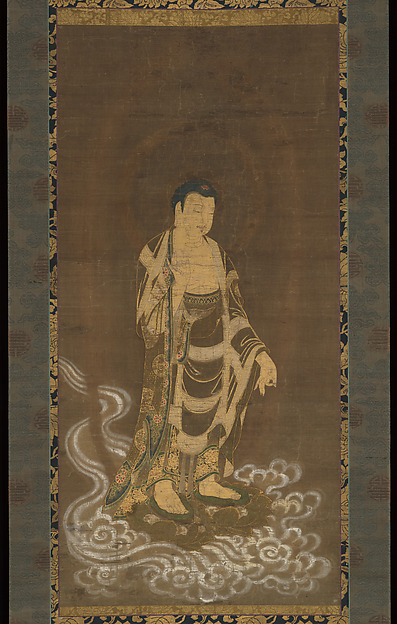
Japan, 15th–16th century. Hanging scroll; ink, color, and gold on silk; 111.1 x 63.8 cm. Metropolitan Museum of Art, 30.72.1.
Look closer: Note the white curling clouds beneath his feet and the slight forward lean of the standing figure, coming towards the viewer.
The Metropolitan Museum of Art, H. O. Havemeyer Collection, Gift of Mrs. J. Watson Webb, 1930. Open Access.
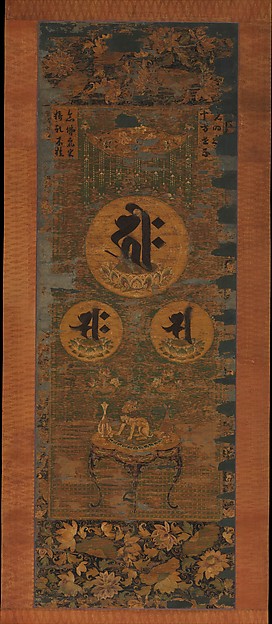
Japan, 13th century. Hanging scroll; silk embroidery, gold-wrapped thread, and human hair; Image 114 x 38.7 cm. Metropolitan Museum of Art, 1975.268.22.
Look closer: Note how three syllables in circles take the place of the three figures of a normal Amida triad.
The Metropolitan Museum of Art, The Harry G. C. Packard Collection of Asian Art, Gift of Harry G. C. Packard, and Purchase, Fletcher, Rogers, Harris Brisbane Dick, and Louis V. Bell Funds, Joseph Pulitzer Bequest, and The Annenberg Fund Inc. Gift, 1975. Open Access.

Japan, ca. 1300. Hanging scroll; ink and color on silk. Metropolitan Museum of Art, 1975.268.21.
Look closer: Note how many tiny figures fill the long scroll, with a small gathering in the clouds at the upper left.
The Metropolitan Museum of Art, The Harry G. C. Packard Collection of Asian Art, Gift of Harry G. C. Packard, and Purchase, Fletcher, Rogers, Harris Brisbane Dick, and Louis V. Bell Funds, Joseph Pulitzer Bequest, and The Annenberg Fund Inc. Gift, 1975. Open Access.
Ashuku, Dainichi and Kokūzō
The last three rites are the ones the sources most often single out. JAANUS and Schumacher agree that the rites of the later years, the seventh, thirteenth and thirty-third in the JAANUS count, appear only in Japan. The figures assigned to them are Ashuku, Dainichi and Kokūzō, the buddha of the east, the cosmic Buddha and the bodhisattva of space.
Schumacher pairs Dainichi with Fudō through a shared holy day. The zodiac column of the roll above gives Dainichi the goat and the monkey and Kokūzō the ox and the tiger. Wikipedia also says that eight of the thirteen are assigned in this way, which leaves five without a sign: Shaka, Jizō, Miroku, Yakushi and Ashuku.
Why Shingon and Tendai keep them
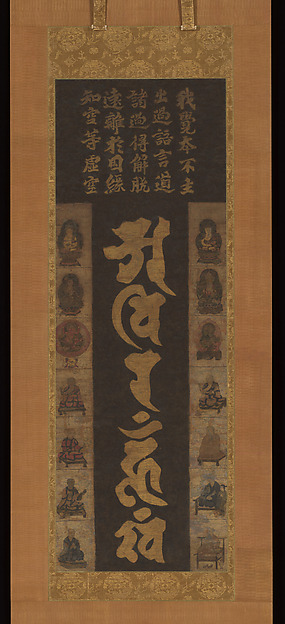
Japan, 13th–14th century. Hanging scroll; ink, colors, and gold on silk. Metropolitan Museum of Art, 2024.410.
Look closer: Note the large Sanskrit script down the centre and the small figures stacked in columns at either side.
The Metropolitan Museum of Art, Purchase, Sue Cassidy Clark Gift, in memory of Koichi Yanagi, 2024. Open Access.
Wikipedia says that chanting the mantras of the thirteen is a basic practice among Shingon and Tendai lay followers, and that the figures are important in funeral and protective ritual as well. Schumacher argues that the group began in the Shingon school and says that no text proves it. The Museum agrees in its record of the mandala that the thirteen are worshipped in Shingon.
The Museum's 2024 acquisition of a Mandala in Sanskrit with Buddhas, Bodhisattvas and Eight Patriarchs of the Shingon Sect, of the thirteenth or fourteenth century, shows what a Shingon hanging scroll of that world looked like: large gold Sanskrit script on a black ground, with small seated figures in columns at either side. It is not a mandala of the thirteen.
One mantra for each figure
Wikipedia gives the mantra recited to each figure in the standard Japanese ritual formula, in the Shingon and Tendai transliterations of the Sanskrit. It warns that its section may need cleanup, because the Japanese text is not clearly interpreted there, so the table below is given as Wikipedia gives it and not as a recitation guide. Four of the thirteen, Kannon, Amida, Ashuku and Dainichi, are written identically in the two lists. Eight differ only in transliteration, and Yakushi's is the one that Wikipedia says fundamentally differs between the schools.
| Figure | Shingon | Tendai |
|---|---|---|
| Fudō | nōmaku sanmanda bazara dan senda makaroshada sowataya un tarata kanman | namaku samanda bazaranan senda makaroshana sowataya un tarata kanman |
| Shaka | nōmaku sanmanda bodanan baku | namaku samanda bodanan ba |
| Monju | on arahashanō | on a ra ha sha na |
| Fugen | on sanmaya satoban | on samaya sataban |
| Jizō | on kakaka bisanmaei sowaka | on kakakabi samaei sowaka |
| Miroku | on maitareiya sowaka | on maitariya sowaka |
| Yakushi | on korokoro sendari matōgi sowaka | on baiseizeibaiseizei baiseijasanborgyatei sowaka |
| Kannon | on arorikya sowaka | on arorikya sowaka |
| Seishi | on san zan saku sowaka | on sanzen zensaku sowaka |
| Amida | on amirita teisei kara un | on amirita teisei kara un |
| Ashuku | on akishubiya un | on akishubiya un |
| Dainichi | on abiraunken basara datoban | on abiraunken basara datoban |
| Kokūzō | nōbō akyashakyarabaya on arikya mari bori sowaka | namo akyashagerubaya onarikya maribori sowaka |
Temples, tablets and the zodiac
Schumacher cites a stone group of ten deities in Chiba dated 1379, with Shaka at the centre, as an early work, and notes that Ueshima Motoyuki records many offering tablets to the thirteen across Japan in the Muromachi era. Wikipedia lists regional circuits of the Thirteen Buddhist Sites, including Kamakura, Kyoto, Osaka, Chichibu and Awaji Island. The Tale of Genji site gives the Kyoto order: Chishaku-in for Fudō, Seiryō-ji for Shaka, Reiun-in for Monju, Daikōmyō-ji for Fugen, Daizen-ji for Jizō, Sennyūji for Miroku, Inaba Yakushi for Yakushi, Senbon Shakadō for Kannon, Ninna-ji for Seishi, Hōkongō-in for Amida, Hōkan-ji for Ashuku, Tōji for Dainichi and Hōrin-ji for Kokūzō. Pilgrims go in numerical order, it says, exchanging a blank page in the pilgrim's book for a stamped one at each.
Eight of the thirteen also serve a second role. Wikipedia says they are assigned as guardians of the twelve earthly branches of the zodiac: Kannon for the rat, Kokūzō for the ox and tiger, Monju for the rabbit, Fugen for the dragon and snake, Seishi for the horse, Dainichi for the goat and monkey, Fudō for the rooster and Amida for the dog and pig.
Schumacher cites Ueshima Motoyuki for the offering tablets, kuyōhi, built across Japan in the Muromachi period, and Watanabe Shōgo, who in 1989 estimated more than four hundred medieval monuments dedicated to the thirteen. His other examples include a stone group of the late twelfth century at Usuki in Ōita, paintings at Kiyamaji in Okayama, and scrolls at Nōman-in and Chōgaku-ji in Nara. The Japanese Wikipedia, for its part, names the Kōen Thirteen Buddhas of the Usuki stone Buddhas among its references.
Thirteen temples in one binder
The Tale of Genji site describes the Kyoto round in practical terms. By tradition the pilgrim goes from the first temple to the thirteenth. A pilgrim's book, a ring binder called a nōkyōchō, is sold plain at Chishaku-in and with a picture of the thirteen at Tōji. At each temple's pilgrim office a blank page is exchanged for a page already inscribed and stamped, at 300 yen, and only the date is written in while the pilgrim waits. At the hall of the figure the pilgrim puts money in the box, strikes the gong three times with the rope and prays, and may light three incense sticks or candles for the Buddha, the teaching and the community. Not every temple displays its image. Many temples charge an entrance fee of 300 to 600 yen. All but one of the thirteen are in the Kyoto metropolitan area; the site does not say which is the exception.
The circuit is one of fifteen that Wikipedia names: Anan, Awaji Island, Chichibu, Dewa, Hokkaido, Iyo, Izumo, Kamakura, Kobe, Kyoto, Musashi, Osaka, Tama, Yamagata and Yamato. Prices and arrangements change, so the temples' own notices should be followed.
| Stop | Temple (Tale of Genji site) | Figure |
|---|---|---|
| 1 | Chishaku-in | Fudō |
| 2 | Seiryō-ji | Shaka |
| 3 | Reiun-in | Monju |
| 4 | Daikōmyō-ji | Fugen |
| 5 | Daizen-ji (Rokujizō) | Jizō |
| 6 | Sennyūji (Mitera) | Miroku |
| 7 | Inaba Yakushi (Byōdō-ji) | Yakushi |
| 8 | Senbon Shakadō (Daihōon-ji) | Kannon |
| 9 | Ninna-ji | Seishi |
| 10 | Hōkongō-in | Amida |
| 11 | Hōkan-ji (Yasaka no Tō) | Ashuku |
| 12 | Tōji (Kyō-ōgokokuji) | Dainichi |
| 13 | Hōrin-ji | Kokūzō |
Rites for the living
Schumacher notes that the thirteen rites were also performed in advance for the living, in a practice called gyakushu kuyō. According to Ueshima Motoyuki, a person who performs the rite before death receives its full benefit, while a rite after death benefits the deceased only a seventh. He describes the thirteen as a miniature mandala, used to pray for rebirth outside the lower realms, and adds that the painted pieces in the end often showed only the Buddhas, without the imagery of judgement. A Japanese Wiki Corpus article on the ten kings records that today the memorial services are simplified and, after the funeral and the first seven days, generally none are held until the forty-ninth day; Jōdo Shinshū believers do not hold them at all.
The Japanese Wikipedia adds two observations about practice. The days are counted with the day of death as the first, and in the Kansai region many temples concentrate on the evening before each anniversary, the taiya.
Things worth knowing
- Five of the thirteen are buddhas, seven are bodhisattvas and one is a wisdom king (Metropolitan Museum).
- Wikipedia names fifteen regional circuits of the thirteen, from Hokkaido to Iyo (Wikipedia).
- A Kyoto pilgrim's stamped page costs 300 yen on the Tale of Genji site's account, and only the date is written in by hand (Tale of Genji site).
- Watanabe Shōgo estimated in 1989 that more than four hundred medieval monuments to the thirteen survive (Schumacher).
- Eight of the thirteen guard a sign of the zodiac, and Dainichi and Amida each guard two (Wikipedia).
- A rite performed before death brings its full benefit to the performer, where one performed afterwards benefits the dead only a seventh (Ueshima Motoyuki, in Schumacher).
- Counting the day of death as the first day makes the first rite fall on the seventh day, six days after the death (Japanese Wikipedia).
- Only Yakushi's mantra fundamentally differs between the Shingon and Tendai lists (Wikipedia).
Across Asia
The Thirteen Buddhas are Japan's own extension of an older Chinese scheme.
| Where | Form and name | What the record shows |
|---|---|---|
| China | Ten Kings | The Scripture on the Ten Kings, compiled in the 9th or early 10th century, describes the trials of the dead (Schumacher). |
| Japan, 12th century | Jizō and the Ten Kings | The earliest text pairing kings with Buddhas, thought to be Japanese (Schumacher). |
| Japan, 14th century | Jūsanbutsu 十三仏 | Thirteen figures, one for each rite; the 7th, 13th and 33rd-year rites appear only in Japan (JAANUS, Schumacher). |
A single circle of rites
The Thirteen Buddhas cross the almanac's ranks: Buddhas, bodhisattvas and a wisdom king stand side by side, each presiding over one memorial rite. They belong to no single rank, which is why the table below sets them in order of time rather than of status.
| No. | Figure | Memorial rite |
|---|---|---|
| 1 | Fudō | 7th day |
| 2 | Shaka | 14th day |
| 3 | Monju | 21st day |
| 4 | Fugen | 28th day |
| 5 | Jizō | 35th day |
| 6 | Miroku | 42nd day |
| 7 | Yakushi | 49th day |
| 8 | Kannon | 100th day |
| 9 | Seishi | 1st anniversary |
| 10 | Amida | 2nd anniversary (3rd in JAANUS) |
| 11 | Ashuku | 6th anniversary (7th in JAANUS) |
| 12 | Dainichi | 12th anniversary (13th in JAANUS) |
| 13 | Kokūzō | 32nd anniversary (33rd in JAANUS) |
Where to see them
| Place | What to look for |
|---|---|
| Kyoto circuit | Thirteen temples from Chishaku-in to Hōrin-ji, visited in order (Tale of Genji site). |
| Regional circuits | Kamakura, Osaka, Chichibu and Awaji Island among others (Wikipedia). |
| Metropolitan Museum of Art, New York | A Mandala of the Thirteen Buddhas and an Ōtsu-e of Thirteen Buddhist Deities, in open access. |
| Memorial services | Hanging scrolls of the thirteen are still used at services for the dead (JAANUS). |
| Chishaku-in to Hōrin-ji, Kyoto | The thirteen temples in order, with a stamped page at each for 300 yen on the Tale of Genji site's account. |
| Usuki, Ōita | The Japanese Wikipedia names the Kōen Thirteen Buddhas of the Usuki stone Buddhas among its references. |
Four faces of the cycle
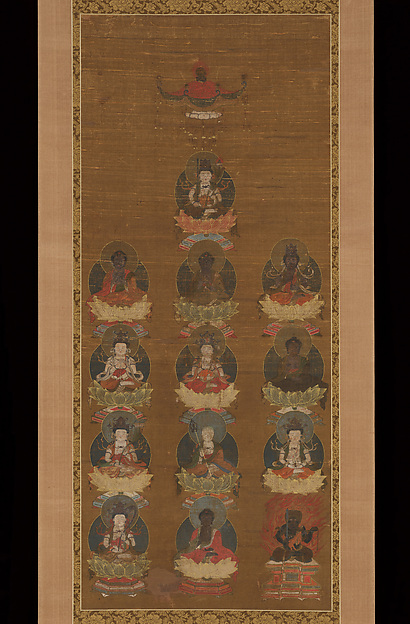
Japan, 16th or 17th century. Hanging scroll; ink, color and gold on silk; image H. 94 cm, W. 39.7 cm. Metropolitan Museum of Art, 2021.396.1.
Look closer: Note the small figure with outstretched arms floating above the column and the red flames around the figure at the lower right.
The Metropolitan Museum of Art, Gift of Sue Cassidy Clark, in honor of Barbara Brennan Ford, 2021. Open Access.

Japan, 17th century. Hanging scroll; ink, color and woodblock print on paper; image H. 33.7 cm, W. 17.5 cm. Metropolitan Museum of Art, 1975.268.143.
Look closer: Note how the same printed halo is repeated for every figure, with only the faces and the flame at the lower right to tell them apart.
The Metropolitan Museum of Art, The Harry G. C. Packard Collection of Asian Art, Gift of Harry G. C. Packard, and Purchase, Fletcher, Rogers, Harris Brisbane Dick, and Louis V. Bell Funds, Joseph Pulitzer Bequest, and The Annenberg Fund Inc. Gift, 1975. Open Access.
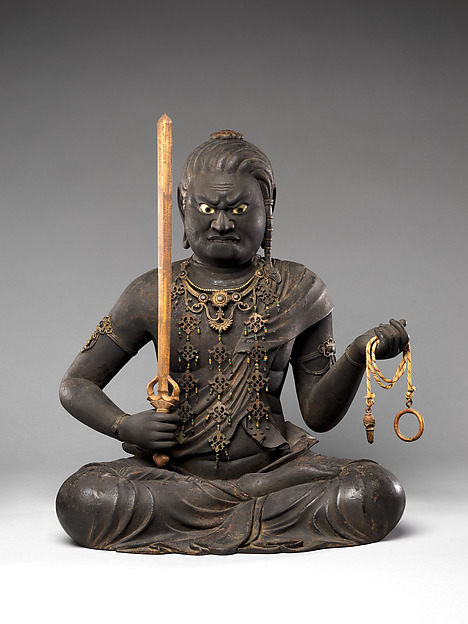
Kaikei, Japan, early 13th century. Japanese cypress with lacquer, color, gold, cut gold leaf (kirikane) and inlaid crystal eyes; H. 53.3 cm, W. 42.5 cm, D. 38.1 cm. Metropolitan Museum of Art, 2015.300.252a, b.
Look closer: Note the sword in his right hand and the rope in his left, and the gold pattern worked into the jewelled collar.
The Metropolitan Museum of Art, Mary Griggs Burke Collection, Gift of the Mary and Jackson Burke Foundation, 2015. Open Access.
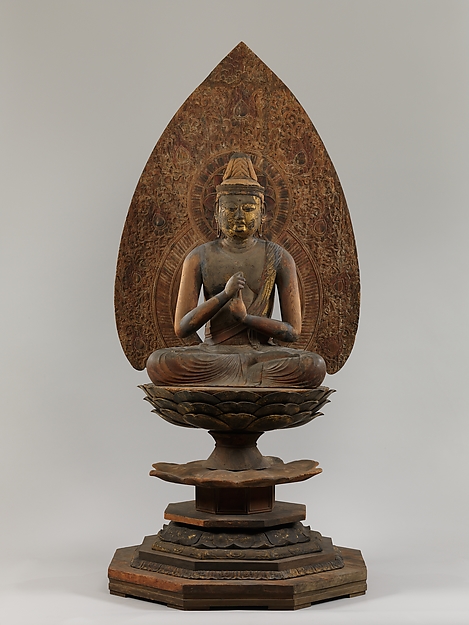
Japan, 12th century. Wood with lacquer and gold leaf; figure H. 92.4 cm; with base and halo H. 218.4 cm. Metropolitan Museum of Art, 26.118a, b.
Look closer: Note the leaf-shaped halo carved all over with fine scrolls and the hands joined before the chest.
The Metropolitan Museum of Art, Rogers Fund, 1926. Open Access.
At the desk
A Thirteen Buddhas scroll, set or tablet appears below when we hold one. If none shows, the concierge desk can search for it.
Words on the memorial shelf
The words most often met on a scroll, a tablet or a pilgrim's page.
- Jūsanbutsu 十三仏
- The Thirteen Buddhas: jū ten, san three, butsu Buddha (JAANUS, Wikipedia).
- Jūō 十王
- The ten kings of the underworld from whom the set grew (JAANUS).
- Honji 本地
- The original nature of a manifested figure, as the kings are matched to their Buddhas (JAANUS).
- Kuyō 供養
- A memorial service or offering for the dead; the kuyōhi are the offering tablets raised to the thirteen (Schumacher).
- Gyakushu kuyō 逆修供養
- The rites performed in advance, for the living (Schumacher).
- Itabi 板碑
- A stone tablet that shows the Buddhas or carries their seed-syllables (JAANUS).
- Kakejiku 掛軸
- A hanging scroll, the usual form of a painted set at a memorial service (JAANUS, Wikipedia).
- Ōtsu-e 大津絵
- The folk painting of Ōtsu, here a single printed icon of the thirteen (Metropolitan Museum).
- Nōkyōchō 納経帳
- A pilgrim's book of stamped pages (Tale of Genji site).
- Taiya 逮夜
- The evening before a memorial day, which Kansai temples often observe (Japanese Wikipedia).
Answered plainly
What are the Thirteen Buddhas?
A set of Buddhist figures, each invoked at one of thirteen memorial services for the dead (JAANUS).
Who is first?
Fudō, on the seventh day after death (JAANUS, Wikipedia).
Who is last?
Kokūzō, at the 32nd or 33rd anniversary depending on the count (Wikipedia, JAANUS).
Are they from India or China?
No; the set is a purely Japanese convention that developed by the fourteenth century (JAANUS).
How did the set begin?
It is thought to come from the ten kings of the underworld seen as ten Buddhas, with three added (JAANUS).
Can the rites be held in advance?
Yes, as gyakushu kuyō, according to Ueshima Motoyuki (Mark Schumacher).
Which of the thirteen are buddhas and which are bodhisattvas?
Five are buddhas, seven are bodhisattvas and Fudō is a wisdom king (Metropolitan Museum, Wikipedia).
Why do sources give different anniversaries?
Wikipedia counts the later rites as the 2nd, 6th, 12th and 32nd, and JAANUS as the 3rd, 7th, 13th and 33rd; the Japanese Wikipedia's rule of counting the day of death as day one may account for the difference (Wikipedia, JAANUS).
Which temple comes first on the Kyoto round?
Chishaku-in, for Fudō, and the last is Hōrin-ji, for Kokūzō (Tale of Genji site).
How many regional circuits are there?
Wikipedia names fifteen, among them Kamakura, Kyoto, Osaka, Chichibu and Awaji Island (Wikipedia).
Must the circuit be walked in order?
By tradition, from the first temple to the thirteenth (Tale of Genji site).
Why thirteen?
Schumacher gathers six theories and no conclusive text, among them seven weeks plus six realms and the thirteen courts of the Womb World Mandala (Schumacher).
Do the thirteen have mantras?
Yes, one each, in Shingon and Tendai forms; Yakushi's differs most between the two (Wikipedia).
Which Kannon guards the rat?
English Wikipedia says Kannon; the Japanese Wikipedia says strictly Senju Kannon (Wikipedia).
Where next
Sources and image credits
- JAANUS, Jūsanbutsu 十三仏 (Columbia University)
- Wikipedia, Thirteen Buddhas
- Mark Schumacher, Thirteen Buddhist Deities of Japan
- Tale of Genji site, The Kyoto Jusan Butsu Pilgrimage
- Japanese Wiki Corpus, Juo (10 Kings; 10 judges of the hell)
- Metropolitan Museum of Art, Mandala of the Thirteen Buddhas (2021.396.1)
- Metropolitan Museum of Art, Otsu-e of Thirteen Buddhist Deities (1975.268.143)
- Metropolitan Museum of Art, Fudo Myoo (2015.300.252a, b)
- Metropolitan Museum of Art, Dainichi, the Cosmic Buddha (26.118a, b)
- Wikipedia (Japanese), 十三仏
- Metropolitan Museum of Art, Shaka Descending from the Mountains (18.124.11)
- Metropolitan Museum of Art, Stamped Images of Fudō Myōō (Achala Vidyaraja) (2020.396.5)
- Metropolitan Museum of Art, Kana Letter on Stamped Images of Amida Buddha (2020.396.3)
- Metropolitan Museum of Art, Monju Bosatsu with Eight Sacred Sanskrit Syllables (12.134.15)
- Metropolitan Museum of Art, Jizō, Bodhisattva of the Earth Store (Kshitigarbha) (2015.300.250a, b)
- Metropolitan Museum of Art, Triad of the Medicine Master Buddha Yakushi (Bhaisajya Buddha) (2021.396.3)
- Metropolitan Museum of Art, Shō Kannon, the Bodhisattva of Compassion (2002.447.2)
- Metropolitan Museum of Art, Welcoming Descent of Amida Buddha (30.72.1)
- Metropolitan Museum of Art, Amida Triad in the Form of Sacred Sanskrit Syllables (1975.268.22)
- Metropolitan Museum of Art, Descent and Return of Amida to Western Paradise with a Believer's Soul (Gōshō mandara) (1975.268.21)
- Metropolitan Museum of Art, Mandala in Sanskrit with Buddhas, Bodhisattvas, and Eight Patriarchs of the Shingon Sect (2024.410)
Last reviewed 28 October 2026. Pictures are public-domain or openly licensed, each credited beneath it. Diagrams on this page are drawn by Japonista.
Looking for a Thirteen Buddhas scroll or set? Tell the concierge desk what you have in mind and we will search Japan for it.
Private concierge
Looking for something in particular?
Describe the piece or the project you have in mind. A senior advisor in Tokyo reads every case file personally and replies within two business days, with fees set out in writing before any work begins.